Carbon Market Network


If you have come across the term CSRD and wondered what it actually means for your business, you are not alone. Thousands of companies across the world are asking the same question right now.
CSRD stands for the Corporate Sustainability Reporting Directive. It is one of the most significant sustainability regulations to come out of the European Union, and it is reshaping how companies measure, manage, and report their environmental, social, and governance performance.
This guide answers the question “what is CSRD” in plain, simple language. No jargon, no confusing legal text, just a clear explanation of what CSRD is, who it applies to, why it matters, and what you need to do about it.
Whether you run a large multinational, manage sustainability for a mid-sized company, or simply want to understand how corporate reporting is changing, this article covers everything you need to know.
What Is CSRD?
CSRD is a European Union law that requires certain companies to disclose detailed information about how their business affects the environment and society, and how sustainability issues affect their business in return.
In simple terms, CSRD makes sustainability reporting a legal requirement, similar to financial reporting. Companies covered by CSRD must publish a sustainability report alongside their annual financial statements.
This report is not a marketing brochure. It follows a strict set of rules called the European Sustainability Reporting Standards, or ESRS, which define exactly what information companies must disclose and how.
CSRD replaced an older, weaker rule called the Non-Financial Reporting Directive, or NFRD. The older rule covered far fewer companies and allowed a lot of flexibility in what got reported. CSRD closes those gaps.
Carbon Market Insider Newsletter
Weekly insights on carbon markets, climate policy, carbon credits, and sustainability.
Why the Name Matters
Breaking down the name helps make sense of the regulation:
- Corporate – it applies to companies, not individuals or governments.
- Sustainability – the focus is on environmental, social, and governance (ESG) topics.
- Reporting – companies must formally disclose this information in a structured report.
- Directive – it is EU legislation that member states must turn into national law.
Why Was CSRD Created?
Investors, regulators, and the public increasingly want to know how companies impact climate change, human rights, and society, not just how much profit they make.
Before CSRD, sustainability reports varied wildly in quality. Some companies shared detailed data. Others published vague statements with little substance. This made it nearly impossible to compare companies fairly.
CSRD was designed to fix three core problems:
- Inconsistent data – Investors could not compare sustainability performance across companies because there was no common standard.
- Greenwashing risk – Without strict rules, some companies exaggerated their environmental credentials.
- Limited scope – Only a small number of large public companies were required to report anything at all under the older rules.
By introducing standardized, audited, and legally binding disclosure requirements, CSRD aims to give investors, regulators, customers, and the public reliable sustainability data they can actually trust and compare.
Who Needs to Comply with CSRD?
This is usually the first question business owners ask, and the honest answer is that CSRD scope has changed significantly since the rule was first introduced. A major simplification reform, often referred to as the Omnibus package, narrowed the number of companies required to report.
Under the current, simplified thresholds, a company generally falls within CSRD scope if it meets certain size criteria.
EU Companies
| Criteria | Threshold |
|---|---|
| Employees | More than 1,000 |
| Net turnover | Above €450 million |
| Listing status | Applies to both listed and unlisted large companies meeting the thresholds |
Both conditions generally need to be met together for a company to fall inside the mandatory scope under the revised rules.
Non-EU (Third-Country) Companies
Companies headquartered outside the EU are not automatically exempt. If a non-EU company has significant operations inside the EU, it can still fall within scope.
| Criteria | Threshold |
|---|---|
| EU-generated turnover of the parent company | Above €450 million |
| Turnover of the EU subsidiary or branch | Above €200 million |
This means a US, UK, Indian, Japanese, or any other non-EU company with a large enough EU footprint may still need to comply, even if it never expected to be covered by European law.
Smaller Companies and the Value Chain Effect
Small and medium-sized companies below these thresholds are generally not required to report under CSRD directly. However, many still feel the impact indirectly.
Large companies that must comply with CSRD often ask their suppliers, including smaller businesses, for sustainability data to complete their own reports. This is sometimes called the trickle-down effect.
To reduce this burden, regulators introduced a voluntary reporting standard for smaller companies, along with a cap that limits how much data large companies can request from smaller value chain partners. This helps prevent large corporations from unofficially forcing full CSRD-level reporting onto suppliers who are legally exempt.
Quick Self-Check Table
| Question | If Yes |
|---|---|
| Does your company have more than 1,000 employees and turnover above €450 million? | Likely in scope |
| Are you a non-EU company with an EU subsidiary generating over €200 million? | Likely in scope |
| Are you a small or medium business supplying a large in-scope company? | Not directly in scope, but may face data requests |
| Are you a small business with no EU exposure? | Not in scope |
If you are unsure where your company stands, it is worth getting a professional assessment, since group structures, holding companies, and turnover calculations can complicate the picture.
CSRD vs Other Sustainability Frameworks
Many people confuse CSRD with other sustainability terms. Here is a simple comparison to clear up the confusion.
| Framework | What It Is | Mandatory? | Region |
|---|---|---|---|
| CSRD | EU law requiring detailed sustainability reporting | Yes, for in-scope companies | European Union, plus qualifying non-EU companies |
| ESRS | The detailed standards that define what CSRD reports must contain | Yes, alongside CSRD | Applies wherever CSRD applies |
| NFRD | The older, weaker EU reporting rule that CSRD replaced | No longer active | Formerly EU |
| GRI | Global Reporting Initiative, a voluntary global reporting framework | Voluntary | Global |
| ISSB | International Sustainability Standards Board, focused mainly on financial materiality | Varies by jurisdiction | Global |
| SEC Climate Rule | US disclosure requirements on climate-related risks | Depends on ongoing US regulatory developments | United States |
A simple way to remember it: ESRS is the rulebook, CSRD is the law that makes following the rulebook mandatory.
Key Concepts Every Beginner Should Understand
Double Materiality
This is the single most important concept in CSRD, and it is genuinely useful even outside compliance.
Double materiality means a company must report on sustainability issues from two directions:
- Impact materiality – how the company’s operations affect the environment and people (for example, its carbon emissions or labor practices).
- Financial materiality – how sustainability issues affect the company’s financial performance (for example, how climate change could disrupt its supply chain).
If either angle is material, the company must report on it. This dual lens is what sets CSRD apart from many voluntary frameworks that only look at one side.
The ESRS Standards
ESRS stands for European Sustainability Reporting Standards. These standards break sustainability reporting into clear categories, generally grouped as:
- Environmental – climate change, pollution, water and marine resources, biodiversity, resource use and circular economy.
- Social – workforce conditions, workers in the value chain, affected communities, consumers and end users.
- Governance – business conduct, anti-corruption practices, political engagement, and supplier relationships.
Following a major simplification review, the number of mandatory data points within ESRS was significantly reduced, and sector-specific standards were removed altogether. Reporting is now meant to focus more tightly on what is genuinely material to each company, rather than requiring exhaustive disclosure across every possible metric.
Assurance Requirements
Sustainability reports under CSRD are not simply self-published. They require external assurance, similar to a financial audit.
Initially, companies must obtain limited assurance, which is a lighter-touch review compared to full financial audit assurance. This gives some confidence that reported data is accurate without demanding the same rigor as full audits from day one.
Digital Tagging
Reports must be prepared in a digital format that allows sustainability data to be tagged and machine-readable. This makes it easier for investors, regulators, and analytics platforms to extract and compare data across companies automatically.
What Does a CSRD Report Actually Include?
A CSRD-compliant sustainability report typically covers the following areas.
Environmental disclosures
- Greenhouse gas emissions across relevant scopes
- Energy consumption and mix
- Water usage and pollution
- Waste management and circular economy practices
- Biodiversity and ecosystem impact
Social disclosures
- Employee working conditions, pay, and diversity
- Health and safety practices
- Human rights due diligence in the workforce and supply chain
- Community impact
- Consumer protection and product safety
Governance disclosures
- Business ethics and anti-corruption measures
- Board diversity and oversight of sustainability issues
- Executive pay linked to sustainability targets
- Political lobbying activities
- Supplier relationships and payment practices
Strategy and risk disclosures
- How sustainability risks affect business strategy and financial planning
- Climate transition plans, where material
- Targets, timelines, and progress tracking
CSRD Reporting Timeline and Waves
CSRD was originally designed to be phased in through several waves, based on company size and type. Following the simplification reforms, this timeline has shifted considerably, and many companies that were originally expected to report have been removed from scope entirely.
| Wave | Original Scope | Current Status |
|---|---|---|
| Wave 1 | Large public interest companies already reporting under the old NFRD rules | Some companies in this group have fallen out of scope under the new thresholds and may qualify for a transition exemption |
| Wave 2 | Other large companies meeting size criteria | Companies that still meet the revised, higher thresholds continue toward mandatory reporting under the simplified rules |
| Wave 3 | Listed small and medium-sized companies | This wave has been removed entirely and no longer faces mandatory CSRD reporting |
| Non-EU companies | Non-EU groups with significant EU turnover | Still in scope if they meet the revised turnover thresholds |
Because national governments must convert this EU directive into their own domestic laws, exact deadlines can vary slightly between member states. Companies should always confirm requirements with local regulatory guidance or a qualified advisor rather than relying on a single fixed date.
Recent Simplification: The Omnibus Reform
It is worth understanding why CSRD looks different today compared to when it was first introduced.
After feedback from businesses about the administrative burden of full compliance, EU regulators launched a simplification initiative, widely referred to as the Omnibus package. This reform substantially reshaped CSRD without abandoning its core purpose.
Key changes introduced through this reform include:
- Raising the company size thresholds, which removed a large share of previously in-scope companies from mandatory reporting.
- Removing listed small and medium-sized companies from scope entirely.
- Cutting the number of mandatory ESRS data points by more than half, based on materiality.
- Removing sector-specific reporting standards that were originally planned.
- Introducing a value-chain cap, limiting how much data large companies can demand from smaller suppliers.
- Expanding exemptions for financial holding companies and certain subsidiary structures.
- Strengthening companies’ rights to withhold certain sensitive information under specific conditions.
What has not changed:
- Double materiality remains a core requirement.
- Assurance requirements still apply to in-scope companies.
- The underlying goal of standardized, comparable sustainability data remains intact.
The takeaway here is important. Simplification reduced the number of companies required to report and lightened the reporting load, but it did not remove CSRD or weaken its fundamental purpose. Companies still within scope face real, binding obligations.
Step-by-Step: How to Prepare for CSRD
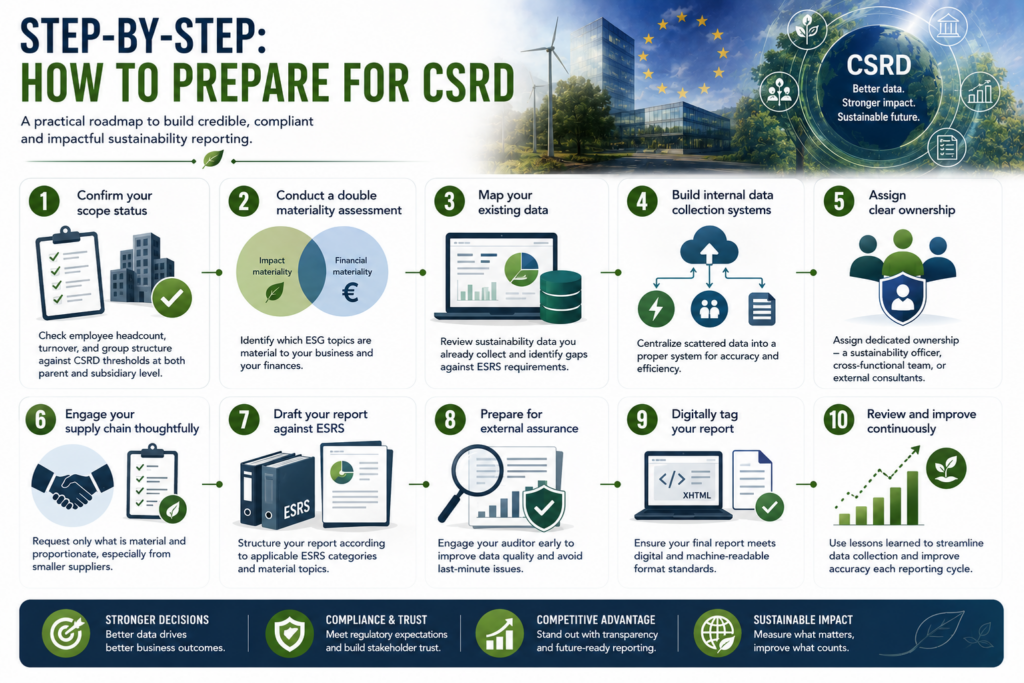
If your company falls within CSRD scope, or expects to soon, here is a practical roadmap to follow.
Step 1: Confirm your scope status
Check your employee headcount, turnover, and group structure against the current thresholds. Do this at both the parent and subsidiary level, since group calculations can be complex.
Step 2: Conduct a double materiality assessment
Identify which environmental, social, and governance topics are genuinely material to your business, both in terms of your impact on the world and the world’s impact on your finances.
Step 3: Map your existing data
Review what sustainability data you already collect, such as energy bills, HR records, or supplier contracts. Identify the gaps between what you have and what ESRS requires.
Step 4: Build internal data collection systems
Sustainability data often lives in scattered spreadsheets across departments. Centralizing this into a proper data management system makes future reporting far more efficient.
Step 5: Assign clear ownership
Sustainability reporting cannot succeed as a side project. Assign dedicated ownership, whether that is a sustainability officer, a cross-functional team, or external consultants.
Step 6: Engage your supply chain thoughtfully
If you need data from suppliers, request only what is genuinely material and proportionate, especially from smaller partners who may not be in scope themselves.
Step 7: Draft your report against ESRS
Structure your report according to the applicable ESRS categories, focusing on the topics your materiality assessment flagged as significant.
Step 8: Prepare for external assurance
Work with an auditor early, rather than waiting until the report is finished. Early involvement helps catch data quality issues before they become bigger problems.
Step 9: Digitally tag your report
Ensure your final report meets the required digital and machine-readable format standards.
Step 10: Review and improve continuously
Treat your first report as a baseline. Use lessons learned to streamline data collection and improve accuracy in future reporting cycles.
Real-World Examples of CSRD in Practice
A European manufacturing group with operations across several countries had to consolidate emissions data from dozens of facilities that previously tracked sustainability information inconsistently. Preparing for CSRD pushed the company to build a single centralized emissions database, which ultimately helped it identify energy efficiency savings worth pursuing regardless of the regulation.
A non-EU technology company with a large European subsidiary discovered through a scope assessment that its EU turnover placed it within CSRD requirements, despite being headquartered outside Europe. This came as a surprise to leadership, highlighting why non-EU companies should never assume the rule does not apply to them without checking the numbers.
A mid-sized supplier to a large EU retailer initially faced extensive sustainability data requests from its retail customer. After the value-chain cap was introduced, the volume of data the retailer could request was reduced, easing pressure on the smaller supplier while still allowing the retailer to meet its own reporting obligations.
These examples show that CSRD affects far more companies than the headline thresholds suggest, either directly or through supply chain relationships.
Common Challenges Companies Face with CSRD
- Data fragmentation – sustainability data is often scattered across finance, HR, operations, and procurement systems.
- Defining materiality – deciding which topics are truly material requires judgment, stakeholder input, and evidence, not guesswork.
- Supply chain data gaps – smaller suppliers may lack the systems to provide reliable sustainability data.
- Keeping pace with regulatory change – thresholds, standards, and deadlines have shifted multiple times, requiring ongoing monitoring.
- Assurance readiness – many companies underestimate how much evidence and documentation auditors expect.
- Resource constraints – smaller in-scope companies may lack a dedicated sustainability team, unlike large multinationals.
Benefits of CSRD Compliance Beyond the Legal Requirement
Compliance is not only about avoiding penalties. Companies that approach CSRD strategically often gain real business advantages.
- Stronger investor confidence – standardized, audited data builds trust with investors and lenders who increasingly factor ESG performance into decisions.
- Better risk management – identifying sustainability risks early helps companies prepare for supply chain disruptions, regulatory shifts, and reputational threats.
- Operational efficiency – tracking energy, waste, and resource use often uncovers cost-saving opportunities.
- Competitive differentiation – transparent, credible sustainability performance can influence customer and partner decisions.
- Improved data infrastructure – the systems built for CSRD reporting often improve broader business intelligence and decision-making.
How CSRD Affects Different Industries
CSRD applies the same core framework to every in-scope company, but the practical impact looks different depending on the sector. Understanding these differences helps companies focus their preparation where it matters most.
Manufacturing and industrial companies typically face heavy reporting demands around energy use, emissions, waste, and resource efficiency, since production processes are often resource intensive. Supply chain mapping is usually the biggest challenge here, since raw materials often pass through many hands before reaching a factory floor.
Financial institutions, including banks, asset managers, and insurers, face a unique layer of complexity. They must report not only on their own operations but also on the sustainability profile of the companies and portfolios they finance or invest in. This is sometimes called financed emissions reporting, and it can be far more complex than reporting on direct operations alone.
Retail and consumer goods companies often struggle most with value chain data, since products may involve dozens of suppliers across multiple countries. The value-chain cap introduced through recent simplification reforms has been particularly helpful for this sector, reducing pressure on smaller suppliers.
Technology companies frequently focus on data center energy consumption, electronic waste, and workforce related disclosures, alongside governance topics like data ethics and responsible innovation practices.
Energy and utilities companies face some of the most detailed climate related disclosure expectations, given their direct role in the energy transition, along with scrutiny of transition plans and emissions reduction targets.
While the underlying ESRS framework stays consistent, materiality assessments naturally surface different priority topics depending on how a company operates and where its greatest impacts and risks actually lie.
Tools and Technology for CSRD Compliance
Manually collecting sustainability data through spreadsheets quickly becomes unmanageable for companies with complex operations. Many organizations now rely on dedicated tools to manage the process efficiently.
Common categories of tools used for CSRD readiness include:
- ESG data management platforms that centralize data collection across departments and facilities.
- Carbon accounting software that calculates greenhouse gas emissions across relevant scopes using activity data.
- Supply chain data collection tools that streamline requests to suppliers and track responses.
- Materiality assessment platforms that support stakeholder surveys and impact scoring.
- Reporting and digital tagging software that formats final disclosures to meet required technical standards.
- Audit and assurance workflow tools that organize evidence and documentation for external reviewers.
Choosing the right combination of tools depends heavily on company size, existing systems, and how much data is already digitized versus scattered across manual records. Smaller in-scope companies often start with simpler spreadsheet based systems before graduating to dedicated software as their reporting matures.
CSRD Compared Across Global Regions
CSRD is an EU regulation, but it does not exist in isolation. Understanding how it fits alongside other regions’ approaches helps multinational companies plan a coherent global sustainability strategy rather than juggling conflicting requirements.
| Region | Approach |
|---|---|
| European Union | Mandatory, detailed disclosure through CSRD and ESRS, with double materiality and external assurance |
| United States | Disclosure requirements vary by state and remain subject to ongoing regulatory and legal developments at the federal level |
| United Kingdom | Separate sustainability disclosure requirements are developing, influenced by international standards |
| Global baseline | The International Sustainability Standards Board provides a voluntary global baseline many countries reference or adapt |
Companies operating across multiple regions often find it efficient to build a reporting system flexible enough to satisfy the strictest applicable framework, typically CSRD, while mapping outputs to other regional requirements as needed. This avoids duplicating effort across separate reporting systems for each jurisdiction.
CSRD and the Carbon Market Connection
CSRD is closely linked to the wider carbon market ecosystem. Companies reporting greenhouse gas emissions under CSRD often need accurate, verifiable emissions data, the same type of data that underpins carbon credit projects, carbon accounting tools, and voluntary carbon market transactions.
As companies build stronger emissions tracking systems to meet CSRD requirements, many also gain the data foundation needed to participate more confidently in carbon markets, whether through purchasing credits to support climate goals or through improved internal carbon management. Understanding CSRD is therefore useful not just for compliance teams, but for anyone working across sustainability, climate finance, or carbon markets more broadly.
Actionable Takeaways
- Confirm whether your company, including subsidiaries and EU operations, meets the current CSRD thresholds.
- Do not assume non-EU headquartered companies are automatically exempt.
- Start with a double materiality assessment before attempting to build a full report.
- Centralize sustainability data collection early rather than scrambling before deadlines.
- Only request proportionate data from smaller suppliers who may not be directly in scope.
- Treat simplification as reduced burden, not reduced importance. Compliance obligations remain real for in-scope companies.
- Build sustainability data systems that serve broader business goals, not just regulatory checkboxes.
Frequently Asked Questions
What is CSRD in simple terms?
CSRD is an EU law requiring certain large companies to publicly disclose detailed, audited information about their environmental, social, and governance performance, alongside their financial statements.
Who has to comply with CSRD?
Generally, companies with more than 1,000 employees and net turnover above €450 million, along with qualifying non-EU companies with significant EU operations, must comply. Thresholds and exemptions can vary, so companies should confirm their specific status.
Is CSRD only for European companies?
No. Non-EU companies with sufficiently large EU subsidiaries or branches can also fall within CSRD scope, based on turnover thresholds.
What is the difference between CSRD and ESRS?
CSRD is the law that requires reporting. ESRS is the detailed set of standards that defines exactly what information must be included in that report.
Does CSRD require an external audit?
Yes. Reports require external assurance from an approved auditor, starting with a limited assurance standard for in-scope companies.
What is double materiality?
Double materiality means reporting on both how a company impacts the environment and society, and how sustainability issues financially impact the company itself.
Has CSRD been simplified recently?
Yes. A major reform, commonly called the Omnibus package, raised scope thresholds, removed certain company categories from mandatory reporting, and reduced the number of required disclosure data points, while keeping core requirements like double materiality in place.
What happens if a company does not comply with CSRD?
Non-compliance can lead to penalties determined by individual EU member states, along with reputational damage and reduced investor confidence, since CSRD reports are meant to be publicly available and comparable.
Do small businesses need to worry about CSRD?
Most small businesses are not directly required to report under CSRD. However, those supplying large in-scope companies may still receive sustainability data requests, though a value-chain cap now limits how much can be requested.
Is CSRD the same as ESG reporting in general?
Not exactly. ESG reporting is a broad, often voluntary practice. CSRD is a specific, legally mandatory reporting framework with defined standards, audit requirements, and enforcement mechanisms.
Conclusion
So, what is CSRD, in the end? It is the European Union’s answer to a simple but important problem: sustainability claims need to be accurate, comparable, and verifiable, just like financial statements.
CSRD has evolved since its introduction, with recent simplification reforms narrowing its scope and easing some of its administrative demands. But its core mission remains unchanged. Companies within scope must measure what matters, report it honestly, and back it up with credible evidence.
For businesses navigating this landscape, the smartest approach is not to wait for the next regulatory update, but to build strong sustainability data foundations now. Those foundations pay off well beyond compliance, supporting better decision-making, stronger investor relationships, and a genuine understanding of how a company’s operations connect to the wider world.
Understanding CSRD today puts you ahead of the curve, whether you are directly in scope, part of a supply chain affected by it, or simply working to understand where global sustainability regulation is headed next.
For more updates, guides, and resources on carbon markets, explore Carbon Market Network.