Carbon Market Network


Every day, companies around the world buy and sell something you cannot hold in your hand.
It has no physical weight. You cannot see it. But it represents one tonne of carbon dioxide that was either removed from the atmosphere or never released into it in the first place.
That “something” is a carbon credit.
And it is worth real money. Billions of dollars change hands every year in carbon markets. Projects across the globe earn these credits. Companies buy them to meet their climate goals.
But here is the question most people never think to ask: who actually issues carbon credits? And how exactly does that process work?
If you have ever wondered about this, you are in the right place.
This article breaks down everything you need to know about who issues carbon credits, the exact process behind issuance, the key players involved, and how the system works in both compliance and voluntary markets. We also cover India’s growing carbon market in detail.
Let us start from the beginning.
What Is a Carbon Credit, Really?
Before we get into who issues carbon credits, it helps to understand what a carbon credit actually is.
A carbon credit is a certificate that represents the reduction, removal, or avoidance of one metric tonne of carbon dioxide (CO₂) or its equivalent greenhouse gas (CO₂e) from the atmosphere.
Think of it as a receipt. A receipt that proves a specific amount of climate benefit has been delivered.
Projects that reduce greenhouse gas emissions earn these credits. Those credits can then be sold to companies that want to offset their own emissions.
One carbon credit = one tonne of CO₂ avoided, reduced, or removed.
That is the simple math behind a complex market.
Carbon Market Insider Newsletter
Weekly insights on carbon markets, climate policy, carbon credits, and sustainability.
The Core Idea: Not Just Anyone Can Issue a Carbon Credit
Here is something important to understand upfront.
Carbon credits are not printed by a single central authority, the way a government prints currency. There is no global “carbon credit bank.”
Instead, the right to issue carbon credits flows through a structured process involving multiple parties:
- Standard-setting bodies that define the rules
- Project developers who do the actual emission-reduction work
- Third-party auditors who independently verify that the work was done
- Registries that officially record and issue the credits
Only when all these parties play their role correctly does a carbon credit get officially issued.
This system exists for one reason: trust. Carbon credits only have value if the world can trust that the underlying climate benefit is real, measurable, and permanent.
Now, let us look at each of these players in detail.
The Two Types of Carbon Markets (and Why It Matters for Issuance)
Carbon credits are issued differently depending on which market they belong to.
There are two main types of carbon markets:
1. Compliance Carbon Markets
These are mandatory markets created by governments or international agreements.
Companies and industries are legally required to participate. They must keep their emissions within a set limit. If they exceed that limit, they must buy credits (called allowances) to cover the excess.
The government or a designated regulatory body issues the credits in these markets.
Examples of compliance carbon markets:
- The European Union Emissions Trading System (EU ETS)
- California’s Cap-and-Trade Program
- China’s National Emissions Trading Scheme (ETS)
- India’s Carbon Credit Trading Scheme (CCTS)
- South Korea ETS
- UK ETS
2. Voluntary Carbon Markets (VCM)
These are optional markets where companies, governments, and individuals buy carbon credits voluntarily.
No law forces them to. They do it to meet their own climate pledges, ESG goals, or net-zero commitments.
In voluntary markets, independent standard-setting organizations and registries issue the credits after verification.
Examples of voluntary carbon market standards:
- Verra (Verified Carbon Standard / VCS)
- Gold Standard
- American Carbon Registry (ACR)
- Climate Action Reserve (CAR)
- Plan Vivo
- Puro.earth
Understanding this difference is crucial. In compliance markets, governments issue credits. In voluntary markets, independent bodies issue them. The process is different, but the principle of verification is the same.
Who Issues Carbon Credits? The Complete List of Issuers
1. Governments and Regulatory Authorities (Compliance Markets)
In compliance markets, governments are the primary issuers of carbon credits.
They set a “cap,” which is the maximum total amount of greenhouse gases that covered industries can emit. They then distribute or auction a limited number of allowances (each equal to one tonne of CO₂) to covered companies.
How does this work in practice?
Take the EU Emissions Trading System (EU ETS) as an example. It is the world’s largest compliance carbon market, launched in 2005.
The European Commission sets the total emissions cap for covered sectors. That cap declines every year, in line with climate targets. The EU ETS is set to reduce covered sectors’ emissions by 62% compared to 2005 levels by 2030.
Each allowance is called an EU Allowance (EUA). Companies receive or auction these allowances, which they can trade among themselves.
The Union Registry (managed by the European Commission) records all the allowances, creation, transactions, and retirements. It replaced individual national registries. Government competent authorities of EU Member States, plus Iceland, Liechtenstein, and Norway, oversee compliance.
Similar structures exist in California (cap-and-trade program run by the California Air Resources Board), China (Ministry of Ecology and Environment), and elsewhere.
In India, the Carbon Credit Trading Scheme (CCTS) was notified in June 2023 under the Energy Conservation (Amendment) Act, 2022. The Bureau of Energy Efficiency (BEE), under the Ministry of Power, acts as the market administrator and issues Carbon Credit Certificates (CCCs). The Grid Controller of India (GCI) serves as the central registry. The National Steering Committee for Indian Carbon Market (NSCICM), co-chaired by the Ministry of Power and the Ministry of Environment, Forest and Climate Change (MoEFCC), directly oversees the compliance carbon market.
As of October 2025, India notified greenhouse gas emission intensity targets for four sectors: aluminium, cement, chlor-alkali, and pulp and paper, covering 282 industrial entities. The compliance market is set to begin full-scale trading by 2026.
2. International Bodies (Kyoto Protocol / UNFCCC / Paris Agreement)
Before domestic compliance markets took over, international bodies played a major role in issuing carbon credits.
The most important mechanism was the Clean Development Mechanism (CDM), established under the Kyoto Protocol by the United Nations Framework Convention on Climate Change (UNFCCC).
Under the CDM, projects in developing countries could earn Certified Emission Reductions (CERs) by reducing greenhouse gas emissions. These CERs were issued by the CDM Executive Board, which sits under the UNFCCC.
India was one of the most active participants in the CDM, registering the second-largest number of CDM projects globally.
The CDM’s successor under the Paris Agreement is the Article 6.4 mechanism, which is often called the “new CDM.” It is supervised by the Article 6.4 Supervisory Body (SBM), which adopted key standards for methodologies and GHG removals at COP29 in Baku in late 2024. This mechanism will issue internationally recognized credits that countries can use toward their climate commitments (NDCs).
3. Independent Standard-Setting Bodies (Voluntary Markets)
In the voluntary carbon market, a handful of organizations have become the de facto issuers of carbon credits. They do not issue credits directly from thin air. Instead, they develop the rules, verify the projects, and then officially issue the credits through their registries.
Here are the major ones:
Verra (Verified Carbon Standard / VCS)
Verra is the largest carbon crediting program in the world. It issues credits called Verified Carbon Units (VCUs).
Projects ranging from forestry and agriculture to renewable energy and waste management can earn VCUs. Once a project is validated and verified under Verra’s rules, Verra issues the credits into the project developer’s registry account.
Verra does not buy, sell, or trade carbon credits. It acts as a standard-setter and registry operator. It maintains an impartial position in the marketplace.
The credits are widely used by Fortune 500 companies. Many voluntary carbon projects globally operate under the VCS methodology.
Gold Standard
Gold Standard was launched in 2003 by WWF and other international NGOs. It focuses specifically on projects that deliver both climate benefits and sustainable development co-benefits (like improving health, access to clean energy, or supporting biodiversity).
Gold Standard issues credits called Gold Standard Verified Emission Reductions (GS-VERs).
It is particularly popular among buyers who want ESG-focused or community-driven credits, such as clean cookstove projects and clean water programs.
American Carbon Registry (ACR)
ACR is one of the oldest carbon registries in the United States, operating since 1996.
It holds a distinctive position as the only U.S.-based registry approved for California’s cap-and-trade program. In 2024, ACR credits accounted for roughly 35% of all offset credits retired within California’s compliance market.
ACR accredits project types including afforestation, improved forest management, landfill gas destruction, methane recovery, carbon capture, and renewable energy.
Climate Action Reserve (CAR)
CAR got its start in 2001 as the California Climate Action Registry. It has since grown into a leading voluntary and compliance market registry.
It operates in California’s cap-and-trade program and in CORSIA (Carbon Offsetting and Reduction Scheme for International Aviation). In 2024, three of its protocols were approved for the Core Carbon Principles (CCP) label by the Integrity Council for the Voluntary Carbon Market (ICVCM).
Plan Vivo
Plan Vivo was founded in 1994 and holds the distinction of helping create the first-ever carbon credits for the voluntary carbon market (from tree-planting projects in Mexico). It focuses on community-based land-use and agroforestry projects.
In April 2024, Plan Vivo became one of the first registries to have its credits approved as CCP-eligible by the ICVCM.
Puro.earth
Puro.earth is a newer registry focused specifically on carbon removal (rather than emissions avoidance). It issues credits for high-tech removal methods like biochar, enhanced weathering, and engineered carbon removal. The first issuances from biochar activities have been issued under Puro.earth’s standards.
4. The Integrity Council for the Voluntary Carbon Market (ICVCM)
The ICVCM is a relatively new and important body. It does not issue credits directly, but it approves registries and methodologies as meeting its Core Carbon Principles (CCP).
Credits that meet the CCP standard receive a quality label, making them more credible and in demand among buyers. This body plays a growing role in elevating the integrity of voluntary carbon market credits globally.
How Are Carbon Credits Issued? The Step-by-Step Process
Now that you know who issues carbon credits, let us go through exactly how the issuance process works.
This process applies primarily to the voluntary carbon market, where the steps are most detailed and transparent. Compliance market issuance by governments is somewhat simpler (governments set the cap and distribute allowances).
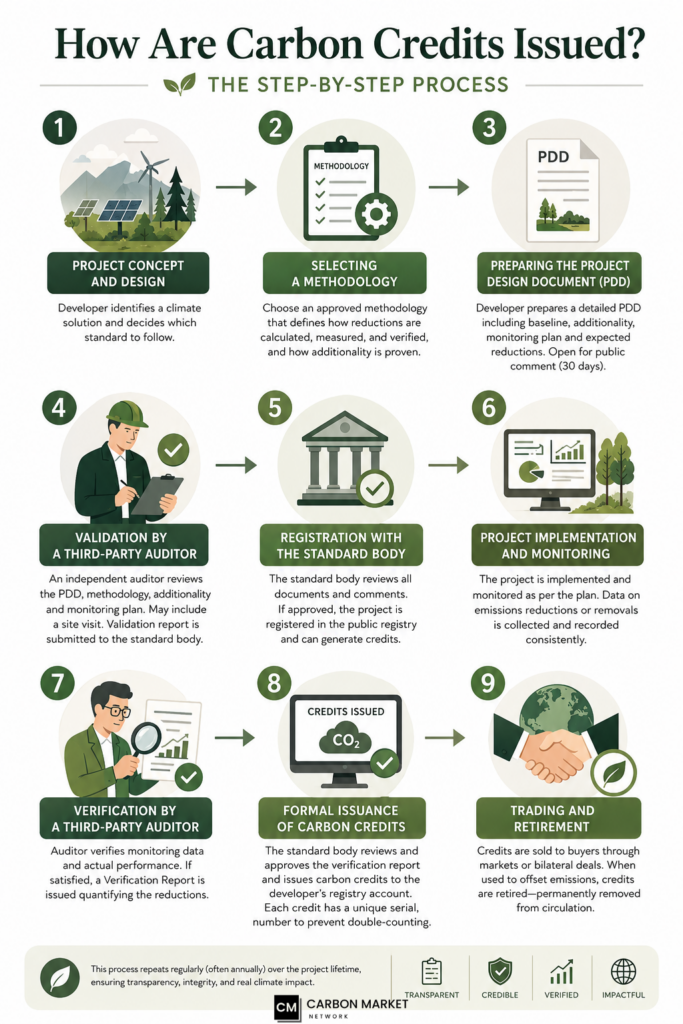
Step 1: Project Concept and Design
Everything starts with a project developer.
A project developer is an individual, company, NGO, or government entity that creates and runs a project that reduces or removes carbon emissions.
Common project types include:
- Forestry projects: Planting trees, protecting forests from deforestation (REDD+), improved forest management
- Renewable energy: Solar, wind, hydropower projects
- Agriculture: Methane capture from livestock or manure, soil carbon sequestration
- Waste management: Landfill gas capture, composting
- Industrial energy efficiency: Upgrading equipment to use less energy
- Carbon removal: Biochar, enhanced weathering, direct air capture
- Clean cooking: Replacing wood-burning stoves with cleaner alternatives
The developer first identifies the project idea and determines which standard it will follow (e.g., Verra VCS, Gold Standard, ACR).
Step 2: Selecting a Methodology
This is a critical step that many people overlook.
The project developer must select an approved methodology from the chosen standard. A methodology is essentially a rulebook that defines:
- How the baseline emissions are calculated (i.e., how much would have been emitted without the project)
- How emission reductions or removals are measured and quantified
- What monitoring activities must be done
- How additionality is demonstrated (i.e., proof that the project would NOT have happened without carbon finance)
If there is no existing methodology that fits the project, the developer may need to create a new one and get it approved by the standard body. This is a lengthy and expensive process.
In India’s CCTS, the BEE approved 8 crediting methodologies in March 2025, covering renewable energy, green hydrogen, industrial energy efficiency, landfill methane recovery, mangrove afforestation, renewable energy with storage, offshore wind, and compressed biogas.
Step 3: Preparing the Project Design Document (PDD)
The developer writes a detailed Project Design Document (PDD).
Think of this as the project’s complete blueprint. It covers:
- A full description of the project activities
- The chosen methodology and how it applies
- Baseline scenario (what emissions would look like without the project)
- Additionality arguments
- Monitoring plan
- Expected emissions reductions per year
- Project boundaries and timeline
- Risk factors and safeguards
This document is submitted to the standard body and also made available for public comment. All Verra projects, for example, undergo a mandatory 30-day public comment period during which anyone can raise concerns. The project developer must address those comments.
Step 4: Validation by a Third-Party Auditor
Once the PDD is ready, it goes through validation.
Validation is an independent check by an accredited third-party organization, often called a Validation/Verification Body (VVB). These are specialized auditing firms approved by the standard body.
The validator reviews:
- Whether the project design document is accurate and complete
- Whether the chosen methodology is appropriate
- Whether the additionality claim holds up
- Whether the monitoring plan is rigorous
- Whether the project can realistically deliver the claimed reductions
The validator may also conduct a site visit to assess the project on the ground.
After the review, the validator writes a Validation Report and submits it along with the PDD to the standard body (e.g., Verra).
Most crediting programs develop specific requirements that auditors must fulfill to reduce conflicts of interest.
Step 5: Registration with the Standard Body
The standard body reviews the validation report, the PDD, and all public comments.
If everything checks out, the project is officially registered.
The registration is publicly recorded in the standard’s registry. This is a major milestone. It means the project is now recognized as credible and eligible to generate carbon credits.
The PDD document is generally made publicly available on the program’s registry tracking system after registration.
Step 6: Project Implementation and Monitoring
With registration complete, the project gets underway (or continues if it started before registration).
During implementation, the project developer puts the monitoring plan into action. They collect data on:
- Actual emissions reductions or carbon sequestration achieved
- Forest growth, energy generated, methane captured, or whatever metric applies
- Any changes to the project area or activities
Monitoring should follow the plan outlined during the design phase, and regular reports are submitted to the verification body.
Accurate, consistent monitoring is crucial. Poor monitoring = poor data = credits not being issued or being disputed later.
Step 7: Verification by a Third-Party Auditor
After a monitoring period (often one year), the developer submits their monitoring data to an accredited third-party verifier for verification.
Note that validation (Step 4) and verification (Step 7) are related but different:
- Validation checks the project design (before it starts)
- Verification checks the actual performance (after it operates)
The verifier conducts a detailed audit. They review the monitoring data, assess whether the actual reductions match what was reported, and check for any irregularities.
Once the project developer resolves any issues flagged by the verifier, the verifier writes a Verification Report, which quantifies the actual avoided or removed emissions.
Some standards (like Gold Standard) require a full re-verification by an independent organization every five years to confirm the project remains on track.
Step 8: Formal Issuance of Carbon Credits
This is the moment the credits come into existence.
The verifier submits the verification report to the standard body (e.g., Verra). The standard body reviews it. If approved, the standard body officially issues the carbon credits into the project developer’s registry account.
For Verra, once verification has been completed and approved, a project proponent can request the issuance of Verified Carbon Units (VCUs). The exact timeline for this process varies from project to project.
Each issued credit is given a unique serial number. This number tracks:
- Which project it came from
- When it was issued
- Its status (available, sold, or retired)
This prevents double-counting, which is one of the biggest integrity risks in carbon markets.
The carbon credit now officially exists and can be bought and sold.
Step 9: Trading and Retirement
Once credits are in the project developer’s registry account, they can be sold to buyers through:
- Bilateral deals (direct negotiations between developer and buyer)
- Carbon marketplaces and brokers (platforms that connect buyers and sellers)
- Exchange platforms (for more standardized trading)
When a company buys a credit and uses it to “offset” their emissions, the credit is retired. Retirement means it is permanently taken out of circulation and can never be used again. This ensures that one tonne of CO₂ benefit is only counted once.
The audit and issuance process happens regularly (often annually) over the lifetime of the project, as long as the project continues to generate reductions.
The Key Roles in Carbon Credit Issuance: A Summary Table
| Role | Who Plays It | What They Do |
|---|---|---|
| Project Developer | Companies, NGOs, governments, individuals | Design and operate the emission-reduction project |
| Standard Body | Verra, Gold Standard, ACR, CAR, BEE (India) | Set the rules, approve methodologies, issue credits |
| Validation/Verification Body (VVB) | Accredited auditing firms (e.g., Bureau Veritas, SGS, DNV) | Independently validate project design and verify performance |
| Registry | Verra Registry, Gold Standard Registry, Grid-India | Record credits, track ownership, manage retirement |
| Buyer | Companies, governments, individuals | Purchase and retire credits to offset emissions |
| Government Authority | EU Commission, CARB (California), BEE (India) | Issue allowances in compliance markets, regulate the system |
| ICVCM | Independent oversight body | Approve standards and methodologies for quality labels |
Major Carbon Credit Registries and What They Do
Registries are the databases where carbon credits live. They track every credit from the moment it is issued to the moment it is retired.
A good way to think about registries is like a land registry for property. The land registry tracks who owns what land. A carbon registry tracks who owns what carbon credits.
Verra Registry
The Verra Registry hosts all VCS (Verified Carbon Standard) projects and credits. It is the most widely used voluntary carbon market registry in the world. It is publicly accessible, meaning anyone can look up a project and see how many credits have been issued and retired.
Gold Standard Registry
Gold Standard projects are tracked here, along with their GS-VER credits. After SustainCERT ended its certification services under Gold Standard in December 2024, Gold Standard introduced a new assurance model for the certification of its projects.
American Carbon Registry (ACR) Registry
ACR maintains its own registry for projects operating under its standard.
Climate Action Reserve (CAR) Registry
CAR’s registry lists all projects, their verification history, and credit issuances. CAR maintains quality through accredited verification bodies approved to verify the purported impact levels for providers.
Grid Controller of India (GCI) Registry
In India’s CCTS, the Grid Controller of India serves as the central registry. It records all Carbon Credit Certificates (CCCs), tracking issuances, transactions, and retirements under the Indian Carbon Market.
IHS Markit (Now S&P Global) Registry
This is an independent registry used by some programs. All Gold Standard projects were historically retired on this registry.
Compliance Market Issuance: How Governments Issue Carbon Credits
In compliance markets, the issuance process is different from the voluntary market.
Here is how it typically works:
Step 1: Government Sets the Cap
The government or regulatory authority decides the maximum total emissions allowed across all covered sectors. This is the “cap.” In the EU ETS, the cap is set to decline each year to reach a 62% reduction below 2005 levels by 2030.
Step 2: Allowances Are Created
Based on the cap, a fixed number of allowances are created. Each allowance = 1 tonne of CO₂ (or equivalent).
Step 3: Distribution (Free Allocation or Auction)
The government distributes allowances to covered companies via:
- Free allocation: Companies receive a certain number of allowances for free, often based on historical emissions or sector benchmarks.
- Auction: Companies bid for allowances. This is increasingly the preferred method as markets mature.
In the EU ETS, the majority of allowances are now auctioned rather than given for free. EU ETS auction revenue primarily flows to national budgets, and Member States must use it to support investments in clean energy and low-carbon technologies.
Step 4: Companies Comply or Trade
At the end of the compliance period, companies must surrender enough allowances to cover their verified emissions.
- Companies that emit less than their allowances can sell their surplus.
- Companies that emit more must buy additional allowances from those with surplus.
This is the “trade” part of cap-and-trade.
Step 5: Registry Records Everything
All of this is recorded in the official registry. In the EU, the Union Registry (which replaced national registries) records the creation of allowances, all transactions, and surrendering for compliance. It also tracks the European Union Transaction Log (EUTL), which logs every transfer.
The Paris Agreement and Article 6: A New Era of International Carbon Credit Issuance
The Paris Agreement introduced a new framework for international carbon markets through Article 6.
This is still a developing area, but it is shaping the future of carbon credit issuance.
Article 6.2: Government-to-Government Trading
Under Article 6.2, countries can trade “Internationally Transferred Mitigation Outcomes” (ITMOs) directly with each other. These are emissions reductions that one country achieves and transfers to another country to count toward its climate pledges (NDCs).
The two countries involved (host country and buyer country) issue Corresponding Adjustments (CAs) to prevent double-counting.
Japan’s Joint Crediting Mechanism (JCM) is a real-world example of this. India joined as the 31st JCM partner country in September 2024, opening doors for bilateral carbon trading with Japan.
Article 6.4: The New International Carbon Market
Article 6.4 creates a centralized international crediting mechanism supervised by the United Nations. It is often called the “new CDM.”
The Article 6.4 Supervisory Body (SBM) adopted key standards for methodologies and GHG removals at COP29 in Baku in late 2024. Credits from this mechanism will be called A6.4ERs (Article 6.4 Emission Reductions).
Unlike the old CDM where project developers received credits directly from an international body, under the new system project developers need to interact with national governments. This gives governments a more active role in deciding which projects receive authorization.
COP29 in Baku (November 2024) made significant progress in finalizing the rules for Article 6.4, bringing the new international carbon market closer to operational status.
What Makes a Carbon Credit Valid? The Five Key Principles
Not all carbon credits are created equal. For a carbon credit to be trustworthy, it must satisfy five core principles. These are sometimes called the “gold standard” of carbon credit quality.
1. Real
The emission reductions must have actually happened. They cannot be based on assumptions or projections alone.
2. Additional
The emission reductions must be “additional” to what would have happened anyway without the project. If a forest was already protected by law and was never going to be cut down, protecting it does not generate additional carbon benefits.
This is one of the most debated and important criteria in the carbon market.
3. Measurable
The reductions must be quantifiable using an approved methodology. You need numbers, not just claims.
4. Permanent
For removal projects especially (like forests), the carbon must stay out of the atmosphere long enough to have a meaningful climate impact. A forest planted today should not be burned down next year.
Standards use mechanisms like buffer pools (a portion of credits set aside as insurance) to manage permanence risk.
5. Verified
An independent third party must confirm that the reductions have actually occurred. Self-reporting alone is not accepted.
What Is the Difference Between Carbon Credits and Carbon Offsets?
These two terms are often used interchangeably, and understandably so.
Here is a simple way to think about it:
A carbon offset is the broader concept: it refers to any compensation for emissions made elsewhere. It is the climate action itself.
A carbon credit is the tradeable unit that represents that action. Once a carbon offset is verified and certified, it becomes a carbon credit.
In other words: a carbon credit is a formally issued, tradeable representation of a carbon offset.
A carbon offset becomes a carbon credit only after it has been fully validated and certified through the process described above.
Who Can Develop a Carbon Credit Project?
This is one of the most common questions from people exploring the space.
Almost anyone can, in theory.
In practice, the most common project developers are:
- Landowners and farmers: Especially for forestry, agriculture, and soil carbon projects
- Industrial companies: For energy efficiency or fuel switching projects
- Renewable energy companies: For solar, wind, or biogas projects
- NGOs and foundations: For community-based forest conservation or clean cooking projects
- Government agencies: For large-scale land use or infrastructure projects
- Startups and technology companies: Especially for high-tech removal projects like biochar, enhanced weathering, or direct air capture
In India’s CCTS, non-obligated entities (including start-ups, renewable energy firms, and technology innovators) can register as project developers under the voluntary offset mechanism, which opened registrations in June 2025.
How Long Does It Take to Issue Carbon Credits?
This is a very practical question, and the honest answer is: it takes time, and often a lot of it.
The timeline varies widely depending on:
- The project type and complexity
- The chosen standard and registry
- How quickly auditors are available
- How smoothly the validation and verification go
A rough timeline for the voluntary carbon market:
| Stage | Approximate Time |
|---|---|
| Project design and PDD preparation | 3 to 12 months |
| Third-party validation | 3 to 9 months |
| Registration with standard body | 1 to 6 months |
| First monitoring period | 1 year (typically) |
| First verification | 2 to 6 months |
| Credit issuance | 1 to 2 months after verification |
| Total from concept to first issuance | Typically 2 to 4 years |
This is one reason why established, ongoing projects are often more attractive to buyers. They already have a track record of verified issuances.
The Cost of Issuing Carbon Credits
Another practical consideration for project developers is cost.
Developing a carbon credit project and getting credits issued is not free. Costs include:
- Project development costs: Preparing the PDD, selecting methodology, legal work
- Validation fees: Paying the third-party auditor for validation
- Registration fees: Registry fees charged by the standard body
- Verification fees: Annual costs for ongoing monitoring and verification
- Ongoing monitoring costs: Staff, equipment, data collection systems
These costs vary significantly by standard and project type, but they can range from tens of thousands to hundreds of thousands of dollars for a single project cycle.
This is one reason why carbon credit projects are often financially viable only if the project generates enough credits to cover these costs and still turn a profit.
Carbon Credit Issuance in India: A Deep Dive
India is one of the most important emerging carbon markets in the world.
It has historically been a major supplier of voluntary carbon credits to the global market, particularly through the CDM. India registered the second-largest number of CDM projects globally, reflecting deep experience in carbon project development.
Now, India is building its own formal domestic carbon market.
The Carbon Credit Trading Scheme (CCTS)
The CCTS was first notified in June 2023 under the Energy Conservation (Amendment) Act, 2022. It draws authority from Section 14(w) of the Act, which allows the central government to “specify the carbon credit trading scheme.”
The CCTS has two main components:
1. Compliance Mechanism (Obligated Entities)
Large industrial entities in energy-intensive sectors are required to meet greenhouse gas emission intensity targets. If they reduce emissions below the target, they earn CCCs. If they exceed the target, they must buy CCCs from others.
In October 2025, the MoEFCC notified final GHG emission intensity targets for aluminium, cement, chlor-alkali, and pulp and paper sectors, covering 282 entities.
2. Voluntary Offset Mechanism (Non-Obligated Entities)
Non-obligated entities (companies and individuals outside the covered sectors) can register eligible projects and earn CCCs through the voluntary offset mechanism. In March 2025, the BEE released detailed procedures for this offset mechanism and approved 8 methodologies covering areas including green hydrogen, landfill methane, mangrove afforestation, and compressed biogas.
Key Institutions in India’s Carbon Market
- Bureau of Energy Efficiency (BEE): Acts as the market administrator. It accredits verification agencies, maintains digital infrastructure, develops methodologies and MRV protocols, and issues CCCs.
- Ministry of Power (MoP): Oversees the regulatory framework of the CCTS.
- Ministry of Environment, Forest and Climate Change (MoEFCC): Notifies emission intensity targets and ensures alignment with India’s net-zero 2070 goal.
- Grid Controller of India (GCI): Serves as the central registry, recording all CCC transactions.
- National Steering Committee for Indian Carbon Market (NSCICM): Oversees the functioning of the Indian Carbon Market.
- Accredited Carbon Verification Agencies: Independent verifiers accredited by BEE to verify emissions reports.
Trading of CCCs is expected to take place through India’s power exchanges under supervision. The first official trades of compliance-based CCCs are expected by October 2026.
How the ICVCM Is Raising the Bar for Carbon Credit Quality
The Integrity Council for the Voluntary Carbon Market (ICVCM) is a newer but increasingly influential body.
It developed the Core Carbon Principles (CCP), a set of global benchmark standards for high-quality carbon credits. Credits and methodologies that meet these standards receive a CCP-approved label.
In 2024, the ICVCM approved selected registries and methodologies as CCP-eligible. Plan Vivo received CCP-eligible status in April 2024. Climate Action Reserve had three of its protocols approved in June 2024.
This “quality mark” is becoming increasingly important for buyers who want to ensure they are purchasing credible credits, especially in light of growing scrutiny of the voluntary carbon market.
Common Challenges in the Carbon Credit Issuance Process
The issuance process is not without problems. Here are the key challenges:
Additionality Disputes
Proving that a project is truly additional is difficult. Critics have argued that some projects, especially older renewable energy projects in developing countries, would have been built anyway without carbon finance.
Permanence Risk
For forest and land-use projects, there is always a risk that the carbon stored could be released later due to wildfires, disease, or political changes.
Double Counting
With multiple carbon markets operating at the national and international levels, there is a risk that the same emission reduction is counted in more than one place. Article 6 of the Paris Agreement is specifically designed to address this through Corresponding Adjustments.
Verification Capacity
There are a limited number of accredited verification bodies globally. This creates bottlenecks, especially for smaller or newer project types.
Cost Barriers for Small Projects
Small-scale projects (e.g., a single farmer’s soil carbon project) often cannot justify the cost of the full issuance process. Aggregation models and simplified methodologies are being developed to address this, but it remains a challenge.
Integrity Concerns in REDD+
Forest-based REDD+ projects have faced significant integrity concerns in recent years. Some investigations found that certain projects overestimated their carbon benefits. This has led to a shift in market preference, with buyers increasingly avoiding avoidance-based credits in favor of removal-based credits.
What Happens After Carbon Credits Are Issued?
Once carbon credits are issued into a project developer’s registry account, several things can happen:
They can be sold.
The developer sells the credits to a buyer. This can happen through a bilateral agreement, a broker, or a marketplace.
They can be held.
Some developers hold credits, expecting prices to rise.
They can be “retired” by the buyer.
When a company buys credits to offset its own emissions, the credits are retired. Retirement permanently removes them from circulation. This is the final step in a credit’s lifecycle. Once retired, the credit represents a permanent climate contribution.
Importantly: Verra, as a mission-driven nonprofit standard-setter, maintains an impartial position and does not buy, sell, or trade carbon credits. Negotiations and purchase agreements are established entirely outside the registry.
Carbon Credit Issuance for Different Project Types
Different project types follow different pathways to issuance. Here is a quick overview:
Forestry and Land Use (REDD+, ARR)
- Projects protect existing forests or plant new ones
- Baseline = what would have happened without the project (usually deforestation)
- Complex monitoring using satellite imagery, field plots, and carbon models
- Subject to additionality and permanence scrutiny
Renewable Energy
- Projects replace fossil fuel-based power with clean energy
- Baseline = the emissions factor of the electricity grid being displaced
- Methodology is relatively standardized
- Market preference has been shifting away from renewable energy credits as they become cheaper and mainstream
Methane Capture (Landfill, Agriculture)
- Projects capture methane (a potent greenhouse gas) from landfills, livestock, or agricultural waste
- High credit value because methane has 28x the warming potential of CO₂ over 100 years
- Strong demand and relatively straightforward verification
Carbon Removal (Biochar, Enhanced Weathering, DAC)
- Newest and fastest-growing category
- Biochar (converting organic waste into stable carbon-rich material) is one of the most commercially active removal methods in 2024
- Enhanced weathering, direct air capture, and ocean-based methods are still emerging
- Puro.earth specializes in these high-tech removal credits
Clean Cooking
- Projects distribute improved cookstoves that use less fuel
- Reduce both CO₂ and health-damaging black carbon emissions
- Major social co-benefits (especially for women and children in developing countries)
- Popular under Gold Standard for ESG-focused buyers
Actionable Takeaways for Different Readers
If You Are a Beginner:
- Carbon credits are issued after a rigorous process of project design, independent validation, monitoring, and verification.
- Two separate types of organizations issue credits: governments (in compliance markets) and independent standard bodies (in voluntary markets).
- Always check whether a credit you are looking at has been verified by an accredited body and is listed on a recognized registry.
If You Are a Business Considering Carbon Credits:
- Buying credits does not replace the need to reduce your own emissions. Credits should be a complement, not a substitute.
- Look for credits that meet the CCP standard from the ICVCM for highest quality assurance.
- Verify that the credit has been retired in your name on the registry. Any reputable seller will provide a retirement certificate.
If You Want to Develop Carbon Credit Projects:
- Start by understanding which standard and methodology fits your project type.
- Budget significant time (2 to 4 years) and money for the validation and verification process.
- In India, explore the BEE’s voluntary offset mechanism under CCTS, which opened registrations in 2025.
- Work with experienced project developers or consultants if this is your first project.
If You Are Interested in the Indian Carbon Market:
- The BEE and MoEFCC are the key institutions to follow.
- As of early 2026, the voluntary offset mechanism is being actively operationalized.
- The compliance mechanism targets 9 industrial sectors, with the first CCC trades expected by October 2026.
- India’s participation in Japan’s JCM as the 31st partner country (September 2024) also creates new opportunities for international carbon credit generation.
The Future of Carbon Credit Issuance
The carbon credit market is evolving rapidly. Here are the key trends shaping future issuance:
Article 6 Implementation
With COP29 finalizing key rules for Article 6.4, the new international carbon market is moving toward operational status. This will create a new layer of government-authorized, internationally recognized credits that will coexist with existing voluntary market credits.
Quality Over Quantity
The market is moving clearly toward higher-quality, high-integrity credits. The ICVCM’s CCP label, along with increasing scrutiny from media, scientists, and NGOs, is pushing registries and project developers to raise their standards.
Shift Toward Carbon Removal
Buyers are increasingly interested in carbon removal projects (biochar, direct air capture, enhanced weathering) rather than avoidance projects. This trend is expected to accelerate as removal technologies become more scalable and cost-effective.
Digital Innovation and Blockchain
Companies are exploring how digital technologies can make carbon credit issuance more transparent, faster, and cheaper. Blockchain-based registries could reduce the risk of double-counting and make credit tracking more efficient. JPMorgan’s 2025 research on carbon markets specifically highlighted digital assets and blockchain-based solutions as a potential way to deliver scale, resiliency, and transparency to the carbon market.
Growing Government Participation
More governments are building domestic carbon markets. Japan plans to make its GX-ETS mandatory in 2026. India’s CCTS is entering its compliance phase. The EU’s CBAM (Carbon Border Adjustment Mechanism) is being phased in starting in 2026. More issuers and more markets mean more demand for high-quality carbon credits.
Corporate Accountability Pressures
The EU’s Green Claims Directive and the Science Based Targets Initiative (SBTi) are shaping how companies can use carbon credits in their net-zero claims. This is pushing the market toward greater transparency in issuance, use, and accounting.
Frequently Asked Questions (FAQ)
Who issues carbon credits in India?
In India’s compliance carbon market (CCTS), the Bureau of Energy Efficiency (BEE) issues Carbon Credit Certificates (CCCs). Each CCC represents one tonne of CO₂ equivalent reduced or removed. The Grid Controller of India manages the central registry. For projects in the voluntary offset mechanism, non-obligated entities can register with BEE and earn CCCs after verification by an accredited carbon verification agency.
Can individuals issue carbon credits?
Individuals can develop carbon credit projects (for example, a farmer participating in a soil carbon program or a landowner enrolling forests in a conservation project). However, credits are formally issued by the standard body or registry, not by the individual. The individual earns credits into their registry account after the project is verified.
Who issues carbon credits in the compliance market?
Governments and regulatory authorities issue carbon credits (called allowances) in compliance markets. In the EU, the European Commission issues EU Allowances through the Union Registry. In India, the BEE issues Carbon Credit Certificates. In California, the California Air Resources Board oversees the cap-and-trade program.
How do I verify a carbon credit is real?
You can look up any credit on the public registry of the standard body. For Verra VCS credits, visit the Verra Registry (registry.verra.org). You can search by project ID, credit serial number, or project name and check whether the credit has been issued and whether it has been retired. This is one of the great features of carbon registries: they are publicly accessible and transparent.
What is a VVB in carbon credits?
VVB stands for Validation/Verification Body. It is an independent accredited auditing organization that validates carbon credit projects (before they start) and verifies their performance (after they operate). Examples include Bureau Veritas, SGS, DNV, and TÜV SÜD. VVBs play a central role in ensuring the integrity of carbon credits before they are issued.
How long does carbon credit issuance take?
The process typically takes 2 to 4 years from project concept to the first issuance of credits. The most time-consuming steps are preparing the Project Design Document, undergoing third-party validation, and completing the first verification period. After the first issuance, subsequent annual issuances are typically faster.
What is the difference between a carbon credit and a carbon allowance?
A carbon credit is generated by a project that reduces or removes emissions (used in voluntary markets or as offsets in compliance markets). A carbon allowance is a compliance unit issued by a government under a cap-and-trade system (like an EU Allowance under the EU ETS). Allowances give a company the “right” to emit one tonne of CO₂. EU Allowances (EUAs) and voluntary carbon credits are separate instruments. Voluntary carbon credits cannot be used to meet EU ETS obligations.
What is additionality in carbon credits?
Additionality means that the emission reductions achieved by a project would not have occurred without the financial incentive provided by carbon credit revenues. In other words, the project is “additional” to what would have happened under business-as-usual conditions. Demonstrating additionality is one of the most important and closely scrutinized parts of the carbon credit issuance process.
Can a carbon credit be used more than once?
No. Once a carbon credit is retired, it is permanently removed from circulation. It can only be used once to offset one tonne of emissions. The registry records the retirement and ensures the credit cannot be sold or used again. This prevents double-counting.
Which is the largest carbon credit registry in the world?
Verra, which operates the Verified Carbon Standard (VCS), is the largest carbon credit registry in the world by volume of issued credits. It certifies diverse project types including forestry, agriculture, and renewable energy, and is widely used by Fortune 500 companies and project developers globally.
Conclusion
Carbon credits do not appear out of nowhere. They are the result of a rigorous, multi-step process involving project developers, independent auditors, standard-setting bodies, and registries working together to ensure that every credit represents a genuine climate benefit.
Who issues carbon credits? The answer depends on the market:
- In compliance markets, governments and regulatory authorities issue carbon allowances under legal cap-and-trade frameworks. In India, the BEE issues Carbon Credit Certificates. In Europe, the European Commission oversees EU Allowances.
- In voluntary markets, independent standard bodies like Verra, Gold Standard, ACR, and CAR issue credits after a thorough validation and verification process.
- At the international level, the Article 6.4 mechanism under the Paris Agreement is building a new UN-supervised carbon credit system, with rules finalized at COP29 in 2024.
Understanding who issues carbon credits and how is not just academic knowledge. It is essential for anyone who wants to buy high-quality credits, develop projects, invest in carbon markets, or simply understand one of the most important tools in the global effort to address climate change.
The market is growing. The rules are tightening. And the integrity of every issued credit matters more than ever.
Whether you are a student, a business owner, a project developer, or a climate professional, the knowledge in this article gives you the foundation to engage with carbon markets confidently and intelligently.
This article covers information as of early 2026 and is updated to reflect key developments including COP29 outcomes, India’s CCTS progress, and ICVCM approvals. Carbon markets evolve rapidly; always verify current standards and regulations with official sources such as Verra, the BEE, or the ICVCM.