Carbon Market Network

If you have ever heard someone talk about carbon credits, carbon offsets, or voluntary carbon markets, there is a very good chance the name “Verra” came up.
But what exactly is Verra? Why do thousands of climate projects around the world register with it? And why does it matter so much to companies, governments, and people trying to fight climate change?
This article answers all of that. Whether you are completely new to carbon markets or already know a bit about how they work, this guide will give you a clear, complete picture of what Verra is, what it does, and why it is so important in 2026.
What Is Verra?
Verra is a nonprofit organization that sets the rules and standards for voluntary carbon markets.
Think of Verra as the “quality control” body for carbon credits. Before a company can sell a carbon credit to the world, Verra checks whether that credit is real, measurable, and actually reduces greenhouse gas (GHG) emissions.
Verra is headquartered in Washington, D.C., and operates globally.
Its full legal name is Verra, but it is most known for running the Verified Carbon Standard (VCS) Program, which is the world’s largest voluntary greenhouse gas crediting program.
In simple terms: if a company plants trees in Brazil, installs clean cookstoves in Kenya, or captures methane from a landfill in India, Verra is the organization that verifies whether those climate actions actually offset the emissions they claim to offset.
Only after Verra approves that verification does the project receive carbon credits it can sell on the voluntary carbon market.
Carbon Market Insider Newsletter
Weekly insights on carbon markets, climate policy, carbon credits, and sustainability.
A Brief History of Verra
Verra did not appear overnight. Its story goes back to the early 2000s, when the voluntary carbon market was still finding its feet.
2005: Climate Wedge, a carbon markets investment advisory firm, and its partners developed what would become the Voluntary Carbon Standard. The goal was simple: create a credible, independent standard that any carbon project around the world could use.
2006: The first version of the Voluntary Carbon Standard was published. It gave project developers a clear framework for how to measure, report, and verify (MRV) their emission reductions.
2007–2008: The standard gained traction. More projects started registering under it because it gave buyers of carbon credits a trustworthy quality benchmark.
2009: Verra (then still operating under the Voluntary Carbon Standard brand) became a registered nonprofit organization.
2017: The organization rebranded to “Verra” to reflect its expanding mission beyond just carbon standards. The name also acknowledged that the organization now ran multiple programs beyond the VCS.
2019 onward: Verra continued expanding its programs, including the Climate, Community and Biodiversity (CCB) Standards and the Sustainable Development Verified Impact Standard (SD VISta).
2023: Verra faced significant scrutiny after investigative reports questioned the quality of some REDD+ (forest protection) credits. Verra responded by reforming its methodologies and increasing oversight.
2024–2025: Verra released version 4.7 of the VCS Program with important updates for CORSIA compliance.
December 2025: Verra released VCS Version 5.0, the most comprehensive overhaul of the standard in over a decade.
August 2025: Verra announced a landmark partnership with S&P Global Commodity Insights to build a next-generation carbon registry.
Today, Verra is led by CEO Mandy Rambharos and remains the world’s most widely used voluntary carbon standard body.
Why Was Verra Created?
Before Verra existed, the voluntary carbon market had a serious problem: there was no universal quality standard.
Any organization could claim to have “offset” emissions, but there was no agreed-upon way to check if that claim was true.
This created confusion, mistrust, and what is called “greenwashing,” where companies made environmental claims that were not backed by real evidence.
Verra was created to solve exactly this problem.
By providing a rigorous, transparent, and science-based framework, Verra allowed:
- Project developers to prove that their emission reduction activities were real
- Carbon credit buyers to trust that the credits they purchased actually represented genuine climate action
- Governments and regulators to recognize voluntary action as credible
In short, Verra brought credibility to a market that desperately needed it.
What Does Verra Actually Do?
Verra plays several important roles in the global carbon market. Here is a breakdown of what it actually does on a day-to-day basis:
Sets Rules and Standards
Verra publishes detailed rules for how carbon projects must measure, report, and verify their emission reductions. These rules cover everything from how you calculate how many tonnes of CO2 a forest absorbs to how long a project must stay active to prevent emissions from returning (called “permanence”).
Approves Methodologies
Before a project can register, it must follow an approved methodology. A methodology is essentially a scientific blueprint that tells a project developer how to calculate emission reductions for a specific type of project.
For example, there is a methodology for cookstove projects, another for solar energy projects, and another for reforestation projects. Verra approves, updates, and publishes these methodologies.
Registers Projects
Once a project follows the right methodology and passes independent verification, Verra formally registers it. This registration is what allows the project to issue carbon credits.
Issues Carbon Credits
Verra’s registered projects issue carbon credits called Verified Carbon Units (VCUs). Each VCU represents one metric tonne of CO2 equivalent reduced or removed from the atmosphere.
Maintains the Verra Registry
Verra operates a public registry where anyone can see which projects are registered, how many credits have been issued, and how many credits have been “retired” (used to offset emissions by a buyer).
Accredits Verifiers
Verra does not verify projects itself. Instead, it accredits third-party Validation and Verification Bodies (VVBs) who conduct independent audits of projects.
Verra’s Key Programs and Standards
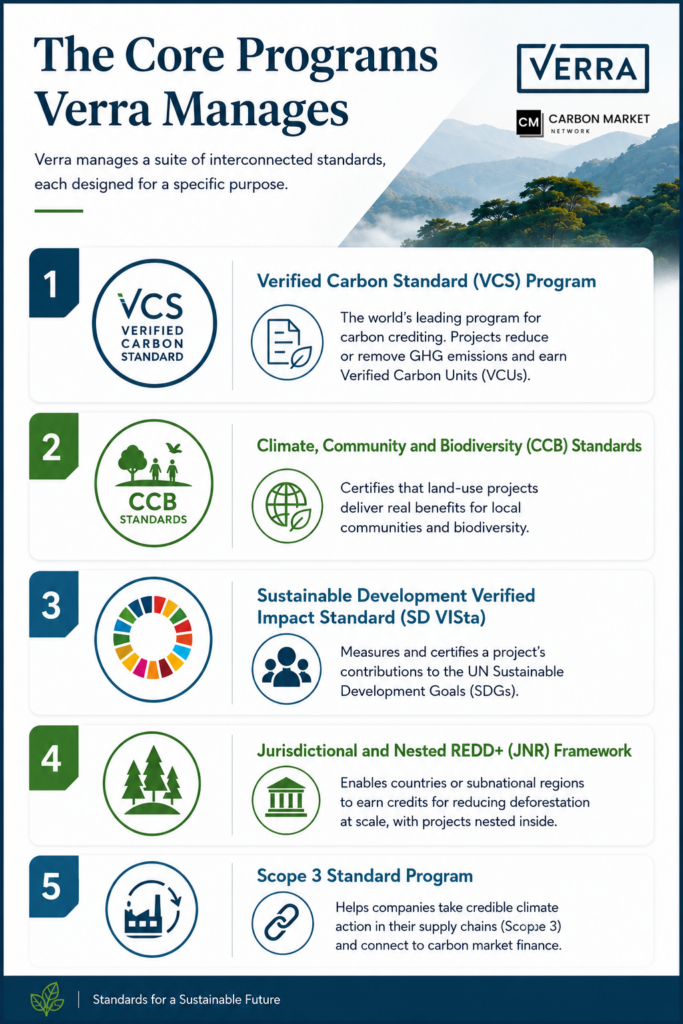
Verra is not a one-trick pony. It runs several programs, each serving a different purpose. Here is an overview of the main ones:
1. Verified Carbon Standard (VCS) Program
This is Verra’s flagship program. It is the world’s leading voluntary greenhouse gas crediting program. We cover this in detail in the next section.
2. Climate, Community and Biodiversity (CCB) Standards
The CCB Standards assess whether a carbon project also delivers co-benefits for local communities and ecosystems. A project can earn a CCB label on top of its VCS certification. This tells buyers that the project does more than just reduce emissions; it also helps local people and protects biodiversity.
3. Sustainable Development Verified Impact Standard (SD VISta)
SD VISta evaluates projects based on their contributions to the United Nations Sustainable Development Goals (SDGs). It is designed for organizations that want to demonstrate and sell verified sustainability impacts beyond carbon.
4. Plastic Waste Reduction Program
This program certifies projects that reduce plastic pollution. It is especially relevant for projects in coastal and ocean environments where plastic waste is a major environmental problem.
5. Jurisdictional and Nested REDD+ (JNR) Framework
This is a special framework within the VCS Program. It is designed for government-led strategies that harmonize emission reductions across national REDD+ programs, subnational programs, and individual project activities.
6. Scope 3 Standard Program
Launched more recently, this program certifies Scope 3 interventions to catalyze science-based climate action within supply chains.
7. California Offset Project Registry (OPR)
Verra also operates the California Offset Project Registry, which supports projects seeking to participate in California’s compliance carbon market.
What Is the VCS Program?
The Verified Carbon Standard (VCS) Program is Verra’s most important and well-known program.
It is the world’s most widely used voluntary greenhouse gas crediting program.
Here is what makes the VCS Program stand out:
- It provides a globally recognized, science-based framework for certifying carbon offset projects
- It covers a huge range of project types, from forests and agriculture to clean energy and waste management
- It requires all projects to meet strict quality criteria before issuing carbon credits
- It is used by project developers, companies, governments, and financial institutions across more than 80 countries
The VCS Program sets out specific requirements for:
- Additionality: The emission reductions must happen because of the project. They would not have happened without it.
- Permanence: The emission reductions must last long enough to make a real difference.
- No double counting: Each carbon credit can only be used once to offset emissions.
- Independent verification: A third-party body must confirm the emission reductions before credits are issued.
- Measurability: Emissions must be calculated using approved, scientifically rigorous methodologies.
As of 2024, more than 2,300 projects were registered under the VCS Program across sectors including forests, energy, transport, and waste. These projects have collectively issued over 1.3 billion carbon credits, with more than 776 million credits retired to offset emissions.
What Are Verified Carbon Units (VCUs)?
A Verified Carbon Unit (VCU) is the carbon credit issued by Verra’s VCS Program.
Each VCU represents a reduction or removal of one metric tonne of carbon dioxide equivalent (CO2e) from the atmosphere.
Think of a VCU like a certificate. It proves that one tonne of greenhouse gas was either prevented from entering the atmosphere or removed from it.
Here is what makes a VCU trustworthy:
- Additional: The emission reduction would not have happened without the project
- Durable: The emission reduction is long-lasting
- Independently Verified: A third party confirms it
- Traceable: It can be tracked in the registry
- Not double counted: It is only used to offset emissions once
- Robustly Quantified: It is calculated using approved, peer-reviewed science
With VCS Version 5.0 (released December 2025), Verra added even more quality attributes to VCUs, including Participatory-based (ensuring communities are involved), Safeguarded from Harm (ensuring the project does not harm people or ecosystems), and Aligned (with international frameworks like the Paris Agreement).
Companies buy VCUs to offset their Scope 1, Scope 2, or Scope 3 emissions as part of their corporate sustainability strategies.
Airlines buy VCUs to comply with the CORSIA aviation offset scheme.
Individuals can also retire VCUs to offset their personal carbon footprints.
How Does a Project Get Registered with Verra?
If you are a project developer who wants to register a carbon project with Verra, here is the step-by-step process you need to follow:
Step 1: Identify the Right Methodology
First, you need to find an approved VCS methodology that fits your project type. If your project is a forest conservation project, you would use a REDD+ methodology. If it is a clean energy project, you would use an energy methodology.
Step 2: Write a Project Description (PD)
You must prepare a detailed Project Description that explains what your project does, where it is located, how it reduces emissions, and how it meets VCS requirements. This document must follow the template provided by Verra.
Step 3: Hire a Validation/Verification Body (VVB)
You must hire an accredited third-party VVB to independently review your project. The VVB checks whether your project design meets all VCS requirements.
Step 4: Validation
The VVB reviews your Project Description and confirms that your project is designed correctly. This is called validation. After successful validation, your project can be listed on the Verra Registry.
Step 5: Project Implementation
You then implement the project. You monitor your emission reductions regularly using the approved methodology and keep detailed records.
Step 6: Verification
After a monitoring period, you hire a VVB again (it can be the same one or a different accredited body) to independently verify that the emission reductions your project claims to have achieved are real, measurable, and accurate. This is called verification.
Step 7: Registration and Credit Issuance
Once verification is complete and Verra reviews and approves the verification report, the project is formally registered, and Verra issues VCUs to your account in the Verra Registry.
Step 8: Selling Credits
You can now sell or transfer your VCUs to buyers on the voluntary carbon market.
What Project Types Does Verra Support?
One of Verra’s strengths is the breadth of project types it supports. VCS projects are organized into 16 sectoral scopes. Here are the most important categories:
Agriculture, Forestry, and Other Land Use (AFOLU)
This is the largest category by volume. It includes:
- REDD+ projects: Reducing emissions from deforestation and forest degradation
- Afforestation and Reforestation (ARR): Planting trees on land that was previously not forested
- Improved Forest Management (IFM): Managing existing forests to increase carbon storage
- Agricultural Land Management (ALM): Improving farming practices to sequester more carbon in soils
- Wetlands restoration: Restoring peatlands, mangroves, and other carbon-rich ecosystems
Nature-based solutions (NBS) accounted for more than 52% of all VCUs issued, making forests the most important category in Verra’s portfolio.
Renewable Energy
This includes solar, wind, hydro, and biomass projects that replace fossil fuel electricity generation.
Energy Efficiency
Projects that reduce energy consumption, including industrial energy efficiency improvements and efficient cookstove distribution.
Waste Handling and Disposal
This includes landfill gas capture projects (capturing methane from landfills before it escapes into the atmosphere), composting projects, and biochar projects.
Transport
Projects that reduce emissions from transportation, including electric vehicle infrastructure and cleaner fuel alternatives.
Chemical Industry and Manufacturing
Projects that reduce emissions from industrial processes.
Carbon Capture and Storage (CCS)
Projects that physically capture CO2 from the atmosphere or from industrial sources and store it underground.
What Is the Verra Registry?
The Verra Registry is Verra’s central database that records every project, every credit issued, and every credit retired under its programs.
Think of it as the accounting ledger of the voluntary carbon market.
The registry does several critical things:
- Tracks all registered projects with a unique project ID
- Records all VCU issuances, showing exactly how many credits each project has generated
- Records all VCU retirements, showing when a credit has been permanently used to offset emissions
- Prevents double counting by ensuring each VCU is unique and can only be retired once
- Provides transparency by making project documents publicly available for download
Anyone can search the Verra Registry at registry.verra.org for free. You can look up any project, see its status, and verify whether a carbon credit that was sold to you is legitimate.
As of August 2025, Verra announced a major partnership with S&P Global Commodity Insights to build a next-generation registry with improved digital infrastructure, API integration, and faster verification and issuance timelines. The first phase of this new registry was expected to launch within six months of the announcement, with full integration planned for 2026.
Verra and REDD+: Protecting the World’s Forests
REDD+ stands for Reducing Emissions from Deforestation and Forest Degradation, plus the sustainable management of forests and the conservation and enhancement of forest carbon stocks.
It is one of the most important tools in the global fight against climate change, and Verra plays a central role in how REDD+ works in the voluntary carbon market.
Here is the basic idea:
Forests absorb CO2 from the atmosphere. When forests are cut down, all that stored carbon is released. So protecting existing forests from deforestation is one of the most effective ways to prevent emissions.
Under Verra’s VCS Program, landowners and governments in forested regions (like the Amazon, Congo Basin, and Southeast Asia) can:
- Demonstrate how much deforestation would have occurred without their project
- Calculate how much carbon was saved by preventing that deforestation
- Issue VCUs equal to that carbon saving
- Sell those VCUs on the voluntary carbon market
Verra’s Jurisdictional and Nested REDD+ (JNR) Framework is the world’s first framework for REDD+ projects at a national or subnational (state/province) level. It allows entire governments, not just individual landowners, to participate in REDD+ carbon markets.
It is worth noting that REDD+ projects faced significant scrutiny in 2023 when investigative reporting raised questions about whether some projects were overclaiming emission reductions. Verra responded by launching a comprehensive reform of its REDD+ methodology, releasing a new, more rigorous methodology known as VM0048 in 2023, which introduced stricter rules for calculating deforestation baselines.
In December 2024, the Integrity Council for the Voluntary Carbon Market (ICVCM) approved Verra’s ARR methodology VM0047 under its Core Carbon Principles (CCPs) framework, marking a significant step forward for high-integrity nature-based solutions.
In April 2026, Verra approved the issuance of the world’s first carbon credits under its new ARR methodology VM0047, with the Brazil Cerrado 1 project (Project ID 5511) receiving authorization to issue 230,120 VCUs.
Verra and CORSIA: Aviation’s Carbon Offset Program
CORSIA stands for the Carbon Offsetting and Reduction Scheme for International Aviation.
It is a global scheme managed by the International Civil Aviation Organization (ICAO) that requires airlines to offset the growth in their CO2 emissions above 2019 levels.
Verra’s VCS Program is one of the few voluntary carbon standards that has been approved for use under CORSIA. This means that airlines can buy VCUs from eligible VCS projects to meet their CORSIA compliance obligations.
In November 2025, Verra announced that the VCS Program had received full approval from ICAO for the second phase of CORSIA (2027–2029). This decision expanded the range of eligible project types, including cookstove projects and certain carbon capture projects.
Under ICAO’s criteria, only VCUs from projects that began crediting on or after January 1, 2016, and that represent emission reductions between January 1, 2021, and December 31, 2029, qualify for use in CORSIA Phase 2.
This approval is a big deal for Verra’s market position. It means that airlines around the world can use Verra-certified credits to demonstrate regulatory compliance, not just as voluntary corporate sustainability gestures.
VCS Version 5.0: Verra’s Biggest Overhaul Yet
In December 2025, Verra launched VCS Version 5.0, the most comprehensive update to the Verified Carbon Standard in over a decade.
Released on December 16, 2025, VCS 5.0 rewrote seven core program documents from the ground up. This was not just an incremental update. It was a structural reimagining of how the world’s largest voluntary carbon standard operates.
What Changed in VCS 5.0?
New VCS Program Principles: VCS 5.0 introduced five new program principles that all projects must adhere to:
- Accuracy
- Conservativeness
- Relevance and Completeness
- Consistency
- Transparency
New VCU Quality Attributes: VCS 5.0 introduced nine VCU attributes that define what makes a carbon credit high-quality:
- Additional
- Durable
- Independently Verified
- Traceable and Not Double-Counted
- Robustly Quantified
- Participatory-Based
- Safeguarded from Harm
- Aligned (with international frameworks)
- And more
Improved Community Rights and Benefit-Sharing: VCS 5.0 introduced stronger requirements for community consultation, benefit-sharing, and the free, prior, and informed consent (FPIC) of indigenous and local communities. This was a direct response to criticism that some carbon projects had not adequately involved or compensated the communities living near them.
Financial Transparency: Projects must now provide greater disclosure of financial flows, including how revenue from carbon credit sales is distributed.
Digitalization and Efficiency: VCS 5.0 made major changes to how programs are accessed and how activities are digitalized, reducing administrative burdens for project developers and verification bodies.
Permanence Innovation: VCS 5.0 introduced an insurance mechanism to deal with non-permanence risks, particularly relevant for nature-based projects that could be affected by fire, disease, or climate change.
Updated Crediting Periods: VCS 5.0 changed crediting period rules. Many project types now have standardized, shorter crediting periods (typically 5 years), with the maximum crediting period varying by project type.
CORSIA and Paris Agreement Alignment: VCS 5.0 strengthened the alignment between VCS credits and international compliance frameworks, making it easier for VCUs to be used under CORSIA and potentially under Article 6 of the Paris Agreement.
The rollout of VCS 5.0 was staggered throughout 2026 to give the market time to adjust. Old v4 methodologies could still be used for new projects until December 2026.
Verra and S&P Global: The New Next-Generation Registry
In August 2025, Verra and S&P Global Commodity Insights announced a landmark partnership to build a next-generation carbon registry.
This was described as a defining moment for carbon markets.
S&P Global is the world’s leading commodities and benchmark information provider. Combining Verra’s deep climate expertise with S&P Global’s market infrastructure capabilities created a powerful partnership for transforming the carbon registry.
What Will the New Registry Do?
The new registry, powered by S&P Global Commodity Insights, was designed to deliver:
- Two-way data exchange with Verra’s Project Hub, so project developers can move through the full project lifecycle with less duplication
- Expanded digitization and system connectivity, reducing administrative burden and accelerating verification and credit issuance timelines
- Digital transactions through APIs, enabling streamlined high-volume trading
- Alignment with international frameworks, including Article 6 of the Paris Agreement and CORSIA
- Training for project developers, especially in emerging markets like Africa, to help them engage more effectively with global carbon markets
The first phase of the new registry was expected to launch within six months of the August 2025 announcement. Full integration was planned for 2026.
Leanne Todd, head of energy transition and sustainability at S&P Global Commodity Insights, called the launch “a defining moment” for carbon markets, saying the alliance would deliver “tangible benefits of improved transparency, credibility, and credit tracking efficiency.”
Verra vs. Gold Standard: What Is the Difference?
Verra is not the only carbon crediting standard in the world. The most well-known alternative is the Gold Standard, a nonprofit based in Switzerland founded with support from WWF.
Here is a clear side-by-side comparison:
| Feature | Verra (VCS) | Gold Standard |
|---|---|---|
| Founded | 2005 | 2003 |
| Headquarters | Washington, D.C., USA | Geneva, Switzerland |
| Focus | Broad (all project types) | Strong focus on co-benefits and SDGs |
| Market Share | Largest in the world | Smaller, but highly respected |
| Credits Issued | Over 1.3 billion VCUs | Much smaller volume |
| CORSIA Eligible | Yes | Yes |
| Popular Project Types | REDD+, ARR, Energy, Waste | Energy, Cookstoves, Community Projects |
| Co-Benefit Focus | Available via CCB label | Built into the core standard |
In general:
- Verra (VCS) is preferred for scale and flexibility, particularly for large-scale forestry, REDD+, and diverse project types
- Gold Standard is often preferred by buyers who prioritize social co-benefits and SDG contributions
Many projects choose to stack both certifications. For example, a project might get VCS certification for carbon credits and a CCB label (Verra’s own co-benefit standard) or Gold Standard certification to demonstrate additional development benefits.
Criticisms of Verra and How It Has Responded
No organization of Verra’s size and influence is without controversy. Understanding the criticisms of Verra is important for anyone working in carbon markets.
The 2023 REDD+ Controversy
In early 2023, a major investigative report claimed that up to 94% of Verra’s REDD+ rainforest offset credits were “phantom credits” that did not represent real emission reductions. The investigation claimed that many REDD+ projects used inflated deforestation baselines, meaning they were claiming credit for preventing deforestation that would not have happened anyway.
Verra strongly disputed the specific figures in the report, but acknowledged that improvements were needed in how deforestation baselines were calculated.
Verra’s Response
Verra responded to the 2023 controversy in several concrete ways:
- New REDD+ Methodology (VM0048): Verra released a completely new, more rigorous REDD+ methodology that required projects to use landscape-level deforestation data to set baselines, rather than project-level estimates. This made it much harder for projects to overstate how much deforestation they were preventing.
- Strengthened VCS 5.0 Rules: VCS 5.0 (released December 2025) introduced stronger requirements for community consultation, financial transparency, and benefit-sharing.
- Sanctions for Bad Actors: In 2024 and 2025, Verra took enforcement action against projects that had over-issued VCUs, including suspending registry accounts and demanding compensation.
- Integrity Council Alignment: Verra has actively worked to align its methodologies with the ICVCM’s Core Carbon Principles, which represent the highest global bar for carbon credit quality.
It is worth noting that while the 2023 controversy was serious and led to important reforms, independent experts have pointed out that Verra’s response has been substantive. The new VM0048 REDD+ methodology and VCS 5.0 represent real improvements in the integrity of the standard.
Why Does Verra Matter to Businesses and Investors?
Verra matters enormously to a wide range of stakeholders. Here is why each group cares about it:
For Corporations with Net-Zero Targets
Thousands of companies worldwide have made public commitments to reach net-zero emissions by 2050 or earlier. Carbon credits are one of the tools these companies use to offset the emissions they cannot yet eliminate.
By purchasing CCP-approved VCUs (those that meet the ICVCM’s Core Carbon Principles), companies can demonstrate that their offsetting activities meet the highest global integrity standards.
For Carbon Project Developers
If you want to monetize a climate project, registering with Verra is often the most practical path. VCS registration gives your project global credibility and access to a large pool of corporate buyers.
For Financial Institutions and Investors
Carbon credits have become an asset class. Investment banks, commodity traders, and specialized carbon funds buy and sell VCUs. Verra’s registry provides the transparent, public data infrastructure that makes this financial market possible.
For Airlines
As mentioned above, airlines use VCUs to comply with CORSIA obligations. VCS Program eligibility under CORSIA Phase 2 (2027–2029) makes this directly relevant to every major airline in the world.
For Governments
Verra’s JNR Framework allows national governments to participate in REDD+ carbon markets. Countries with large forest reserves can generate significant revenue from VCS credits while also meeting their Nationally Determined Contributions (NDCs) under the Paris Agreement.
Verra’s Role in India and Emerging Markets
India has a rapidly growing interest in voluntary carbon markets, and Verra plays a central role in shaping how Indian projects access global buyers.
Indian Projects on the Verra Registry
Hundreds of climate projects across India are registered under the VCS Program. These include:
- Solar and wind energy projects that replace coal-based electricity
- Cookstove projects that reduce indoor air pollution and deforestation
- Agricultural soil carbon projects that improve farming practices while sequestering carbon
- Biogas projects that capture methane from agricultural waste
India’s Carbon Credit Trading Scheme (CCTS) and Verra
India launched its own Carbon Credit Trading Scheme (CCTS) under the Energy Conservation (Amendment) Act, 2022. While the CCTS operates as a domestic compliance market separate from voluntary markets, the two systems are expected to interact as India’s market matures.
Indian project developers who have experience operating under Verra’s VCS Program are well-positioned to participate in the CCTS as well, given the overlapping MRV (Measurement, Reporting, and Verification) principles.
Emerging Market Opportunity
Verra has expressed a strong commitment to supporting project developers in emerging markets. As part of its partnership with S&P Global, Verra specifically mentioned plans to provide training for project developers in Africa, and similar efforts are underway in South and Southeast Asia.
For Indian entrepreneurs and businesses, this creates a real opportunity. By understanding Verra’s standards and developing high-quality carbon projects, Indian developers can access global carbon markets and attract international investment.
How to Use Verra’s Registry to Verify Carbon Credits
One of the best things about Verra is that its registry is publicly accessible. Anyone can verify whether a carbon credit is legitimate by following these steps:
Step 1: Go to the Registry
Visit registry.verra.org (the registry is in the process of transitioning to a new platform as part of Verra’s partnership with S&P Global).
Step 2: Search for the Project
You can search by:
- Project ID number
- Project name
- Country
- Project type
- Methodology used
Step 3: Review Project Details
Click on a project to see:
- The full project description document
- The validation report
- Verification reports
- How many VCUs have been issued
- How many VCUs have been retired
Step 4: Check the Serial Number
Each VCU has a unique serial number. If you purchased a carbon credit, you can enter this serial number in the registry to confirm that the credit was legitimately issued and has not already been retired.
This public transparency is one of Verra’s most important features. It allows buyers, journalists, researchers, and civil society to hold the carbon market accountable.
The Future of Verra
Looking ahead to 2026 and beyond, Verra is positioned at the center of several major trends shaping global carbon markets.
VCS 5.0 Rollout
The full rollout of VCS 5.0 continues throughout 2026. Verra is rolling out new digital project templates, updated methodologies, and standardized methods for different project types incrementally. By the end of 2026, the new standard will be fully in effect for all projects.
New Registry Launch
The new S&P Global-powered registry is expected to be fully integrated by 2026. This will bring significant efficiency gains, faster credit issuance, and better digital infrastructure for the entire voluntary carbon market.
Article 6 Alignment
Article 6 of the Paris Agreement allows countries to use internationally transferred mitigation outcomes (ITMOs) to meet their climate targets. Verra is working to ensure that VCS credits can be used in Article 6 transactions, which could unlock a massive new source of demand.
ICVCM Alignment
The ICVCM’s Core Carbon Principles have become the gold standard for carbon credit quality in institutional and high-integrity buyer markets. Verra is continuing to work toward broader CCP approval for its methodologies, which will make VCS credits more attractive to sophisticated buyers.
Soil Carbon and Blue Carbon
Emerging project types like soil carbon sequestration and blue carbon (mangroves, seagrasses, and tidal marshes) are becoming more important. In early 2026, Verra issued a record 3 million soil carbon credits to a Mexican grassland project, signaling the growing importance of these new categories.
Carbon Removal Focus
As the science of carbon removal matures, Verra is expected to expand its support for Carbon Dioxide Removal (CDR) projects, including direct air capture, enhanced weathering, and biochar.
Conclusion
So, what is Verra? In the simplest terms, Verra is the organization that makes voluntary carbon markets trustworthy.
It sets the rules. It approves the methodologies. It certifies the projects. It issues the credits. And it maintains the public registry that keeps the whole system accountable.
Without Verra, the voluntary carbon market would be a far less credible place. Companies would not be able to trust the carbon credits they buy. Project developers would not have a recognized framework to work within. And billions of dollars in climate finance would struggle to find its way to real, measurable climate action.
Verra is not perfect. The 2023 REDD+ controversy showed that even the world’s most trusted carbon standard body can face serious credibility challenges. But Verra’s response, including the VM0048 methodology reform and the comprehensive VCS 5.0 overhaul in December 2025, shows an organization that is genuinely committed to improving.
With VCS 5.0 now in effect, a next-generation registry on the way, CORSIA Phase 2 approval secured, and new methodologies like VM0047 issuing their first credits, Verra enters 2026 as a stronger, more transparent, and more rigorous organization than ever before.
For anyone working in carbon markets, studying climate change, developing sustainability strategies, or simply trying to understand how the world is trying to fund climate action, understanding Verra is essential.
Frequently Asked Questions (FAQs)
Q1: What does Verra stand for?
Verra does not stand for an acronym. It is simply the name of the nonprofit organization. Before 2017, the organization was most commonly known by the name of its flagship program, the Verified Carbon Standard (VCS). The rebranding to Verra reflected its expanded mission across multiple programs and standards.
Q2: Is Verra a government organization?
No. Verra is a private, nonprofit organization registered as a 501(c)(3) in the United States. It is not part of any government, though many governments and intergovernmental bodies recognize and accept Verra-certified credits.
Q3: Who funds Verra?
Verra generates revenue primarily from fees charged to carbon projects that register under its programs. Project developers pay fees for project registration, credit issuance, and other services. Verra also receives some philanthropic funding.
Q4: What is the difference between a VCU and a carbon credit?
A VCU (Verified Carbon Unit) is a specific type of carbon credit issued by Verra’s VCS Program. “Carbon credit” is the general term; a VCU is the specific product issued under the VCS standard. Other standards issue credits with different names (e.g., Gold Standard issues Gold Standard Verified Emission Reductions or GS VERs).
Q5: Are Verra carbon credits the same as EU ETS carbon credits?
No. Verra operates in the voluntary carbon market. The EU ETS (Emissions Trading System) is a compliance market operated by the European Union. They are different systems, though there is growing discussion about how voluntary and compliance markets might interact in the future.
Q6: How do I register a project with Verra?
To register a project, you need to select an approved VCS methodology, prepare a Project Description document, hire an accredited VVB for validation, implement the project, complete verification, and then submit the verification report to Verra. The full process is documented on Verra’s website at verra.org.
Q7: What is VCS 5.0?
VCS 5.0 is the fifth version of Verra’s Verified Carbon Standard, released in December 2025. It is the most comprehensive overhaul of the standard in over a decade, introducing new quality principles, improved community safeguards, financial transparency requirements, and updated crediting period rules.
Q8: Can Indian companies use Verra to earn carbon credits? Yes. Indian companies, landowners, and project developers can register projects with Verra under the VCS Program. Many Indian projects in sectors such as solar energy, cookstoves, biogas, and afforestation are already registered on the Verra Registry.
Q9: What is the Verra Registry?
The Verra Registry is the public database that records all VCS projects, VCU issuances, and VCU retirements. It is publicly accessible and allows anyone to verify the legitimacy of a carbon credit. Verra is in the process of migrating to a new, more advanced registry built in partnership with S&P Global Commodity Insights.
Q10: How many carbon credits has Verra issued?
As of 2024, VCS projects have collectively issued over 1.3 billion Verified Carbon Units (VCUs), with more than 776 million VCUs retired to offset emissions, making Verra by far the largest voluntary carbon crediting program in the world.
Q11: Is Verra the same as ICVCM?
No. Verra and the ICVCM (Integrity Council for the Voluntary Carbon Market) are different organizations. Verra operates a carbon crediting program. The ICVCM is an independent governance body that sets quality benchmarks (called Core Carbon Principles, or CCPs) for voluntary carbon markets. Verra works to get its methodologies approved under the ICVCM’s CCP framework.
Q12: What is REDD+ and how does it relate to Verra?
REDD+ stands for Reducing Emissions from Deforestation and Forest Degradation. Verra’s VCS Program is the dominant standard for REDD+ carbon projects in the voluntary carbon market. Project developers who protect forests from deforestation can earn VCUs by demonstrating that their project prevents emissions that would otherwise occur.
This article reflects information available as of May 2026. Carbon market standards and regulations evolve rapidly. Always refer to Verra’s official website at verra.org for the most current information.