Carbon Market Network


The world is running out of time to cut carbon emissions alone. Scientists and policymakers increasingly agree that we also need to pull carbon out of the atmosphere. That is exactly what biomass carbon removal companies do.
These companies take plant-based material, which has already absorbed carbon from the air through photosynthesis, and store that carbon in a way that keeps it out of the atmosphere for hundreds or even thousands of years. The result is real, measurable carbon dioxide removal (CDR).
This article walks you through the top biomass carbon removal companies operating today, the technologies they use, how they are scaling up, and why major corporations are betting billions on them.
What Is Biomass Carbon Removal?
Biomass carbon removal refers to a family of approaches that use organic material, such as wood residues, agricultural waste, or crop stalks, to permanently store carbon dioxide.
Plants pull CO2 from the air as they grow. When those plants die or decompose naturally, that carbon returns to the atmosphere. Biomass carbon removal companies interrupt that cycle.
They take the biomass and convert it or store it in a way that locks the carbon away for the long term. This approach sits at the heart of what the industry calls BiCRS (Biomass Carbon Removal and Storage).
The Main Types of Biomass Carbon Removal
There are several distinct approaches that companies in this space use:
| Approach | What It Does | How Long Carbon Stays Stored |
|---|---|---|
| Biochar (BCR) | Converts biomass into charcoal through pyrolysis and adds it to soil | 100 to 1,000+ years |
| Bio-oil Sequestration | Converts biomass into liquid bio-oil and injects it underground | Thousands of years |
| Biomass Burial / Carbon Casting | Dries and compresses biomass into blocks and buries them underground | 1,000+ years |
| Biomass Geological Storage | Injects organic waste slurry deep into geologic formations | Thousands of years |
| BECCS | Burns biomass for energy and captures the CO2 before it escapes | Thousands of years |
Each approach has different costs, permanence levels, and verification challenges. Together, they make up the core toolkit of the biomass carbon removal sector.
Carbon Market Insider Newsletter
Weekly insights on carbon markets, climate policy, carbon credits, and sustainability.
Why Biomass Carbon Removal Is Growing Fast
The voluntary carbon market for biomass-based removal has grown dramatically. According to CDR.fyi, which tracks carbon credit purchases, 16 of the top 20 durable CDR credit sellers are biochar producers.
Major corporations including Microsoft, Google, JPMorgan, BCG, Swiss Re, and Nasdaq have all purchased biomass carbon removal credits. These are not small pilot purchases. Microsoft signed the world’s largest biochar deal in history, a 10-year, 1.24 million tonne agreement with Exomad Green.
BiCRS projects dominate actual delivery volume across the CDR market. Biochar Carbon Removal (BCR), Biomass Direct Storage, and Biomass Geological Sequestration collectively account for around 97% of all verified durable CDR deliveries to date.
Here is why the sector is growing so fast:
- Lower cost than alternatives like direct air capture (DAC)
- Faster scaling because it uses existing waste streams
- Verified deliveries at scale, building market trust
- Co-benefits like improved soil health, reduced air pollution, and waste management
Top Biomass Carbon Removal Companies in the World
1. Exomad Green (Bolivia)
Approach: Biochar Carbon Removal (BCR)
Exomad Green is, by a wide margin, the world’s largest biomass carbon removal company measured by actual tonnes delivered. The company operates out of Bolivia and converts waste biomass from sawmills, which would otherwise be burned in open pits, into high-quality biochar.
That biochar is then donated to indigenous farming communities, where it is applied to degraded soils. This improves agricultural productivity, reduces air pollution from open burning, and stores carbon for hundreds of years.
Scale and impact:
- Exomad Green has produced over 320,000 tonnes of durable carbon removal and has expanded production by more than 200% year-over-year.
- The company currently operates two facilities in Bolivia, with a third under construction in Guarayos.
- It plans to reach 1 million tonnes of CO2 removed annually across five facilities by the end of this decade.
- Exomad Green accounts for roughly 24.5% of all durable carbon removals globally.
Key buyer deals:
- Microsoft: 10-year deal to remove 1.24 million tonnes of CO2, the largest biochar purchase in history.
- Supercritical: 3-year agreement for up to 500,000 tonnes.
Certification: Puro.earth biochar methodology, with credits issued as CORCs (Carbon Removal Certificates).
2. Charm Industrial (USA)
Approach: Bio-oil Sequestration
Charm Industrial converts agricultural biomass, including corn stalks, husks, and wildfire-risk wood, into a stable bio-oil through fast pyrolysis. It then injects that bio-oil deep underground into EPA-regulated wells, where it sinks and solidifies for permanent storage.
This clever approach takes advantage of retired and abandoned oil wells, which are plentiful across the United States, especially in agricultural states.
Scale and impact:
- As of the latest available data, Charm has sequestered close to 12,000 tonnes of CO2.
- The company raised $100 million in Series B funding and received a $54 million advanced market commitment from Frontier Climate.
- Charm was the first BiCRS company to deliver credits from a fully closed system verified by Isometric, a leading carbon registry.
- It also holds the distinction of being the first company to receive Isometric’s highest verification rating.
Key buyer deals:
- Purchases from Frontier Climate, JPMorgan, and other major institutions.
Certification: Isometric registry.
3. Graphyte (USA)
Approach: Subsurface Biomass Storage (Carbon Casting)
Graphyte, backed by Bill Gates’ Breakthrough Energy Ventures, takes a refreshingly simple approach. The company collects biomass residues from sawmills and agriculture, such as sawdust and rice hulls, dries them extensively, compresses them into dense blocks, seals those blocks in polymer barriers, and buries them in monitored underground pits.
This process, which Graphyte calls “Carbon Casting,” does not require chemical transformation. That keeps costs low and allows the company to scale quickly across diverse feedstock types.
Scale and impact:
- Graphyte is on track to remove nearly 50,000 tonnes of CO2 through its Arkansas facility (Project Loblolly) and a second project in Arizona.
- The company raised $30 million in funding to expand operations.
- Three biomass-based companies, Vaulted Deep, Graphyte, and Charm Industrial, have collectively delivered 94% of all durable CDR credits issued by Isometric.
Key buyer deals:
- JPMorgan: 10-year deal to purchase 60,000 metric tonnes of carbon removal credits from Graphyte.
- American Airlines: One of the first corporate partners.
Certification: Isometric registry.
4. Vaulted Deep (USA)
Approach: Biomass Geological Sequestration
Vaulted Deep tackles a different problem from most BiCRS companies. It focuses on organic waste that is too wet or contaminated to use for energy, including manure, agricultural byproducts, paper mill sludge, and biosolids.
Rather than treating this as a liability, Vaulted converts it into an asset. The company uses slurry sequestration technology to inject this organic waste deep underground into stable geologic formations, including repurposed salt caverns in Kansas that offer natural impermeability and high structural integrity.
This dual value proposition, permanent carbon storage plus waste management, gives Vaulted a unique commercial edge.
Scale and impact:
- Vaulted Deep has delivered over 53,000 tonnes of verified carbon removal.
- It raised $32.3 million in Series A funding, led by Lowercarbon Capital.
- Its CDR.fyi leaderboard ranking reflects over 5 million tonnes in contracted sales.
Key buyer deals:
- Frontier Climate, Rubicon Carbon, JPMorgan.
Certification: Isometric registry.
5. Varaha (India)
Approach: Biochar Carbon Removal (BCR)
Varaha is India’s first industrial biochar producer and one of Asia’s most compelling biomass carbon removal stories. The company’s flagship facility in Gujarat converts an invasive shrub, Prosopis juliflora, that has overtaken native grasslands into biochar.
This approach does double duty: it removes an invasive species harming local ecosystems and converts that material into permanent carbon storage.
Scale and impact:
- Varaha has delivered over 164,000 tonnes of verified carbon removal.
- It is India’s first Puro.earth-certified biochar facility.
- Sylvera and BeZero, two leading carbon credit rating agencies, have given Varaha an “A” integrity rating.
- The company uses a digital MRV (Measurement, Reporting, and Verification) system with remote sensing and a mobile app capturing geo-tagged proof of biochar application.
Key buyer deals:
- Google: 100,000 tonnes of removal contracted through 2030, the world’s largest biochar purchase by a tech company at the time it was signed.
- Swiss Re: 70,000 tonnes contracted via Carbonfuture.
Certification: Puro.earth.
6. Aperam BioEnergia (Brazil)
Approach: Biochar Carbon Removal (BCR)
Aperam BioEnergia is a Brazilian operating unit of Aperam, a global stainless steel company. It produces charcoal from FSC-certified eucalyptus plantations and native forests in the Minas Gerais region. The residue from these sites is converted into biochar and applied to agricultural soil, where it absorbs atmospheric CO2 while also improving water retention and nutrient absorption.
Scale and impact:
- Aperam BioEnergia has delivered over 109,000 tonnes of verified carbon removal.
- It has the capacity to produce approximately 40,000 tonnes of carbon removal per year.
- Its credits are certified under the Puro Standard and issued as CORCs.
- Buyers include the Nasdaq exchange, a notable signal of growing institutional interest.
Certification: Puro Standard.
7. Carboneers (Global)
Approach: Biochar Carbon Removal (BCR)
Carboneers is a Netherlands-based company that develops and manages biochar carbon removal projects across the Global South. It ranks among the top five CDR suppliers globally by delivered volume, with over 206,000 tonnes delivered to date.
Carboneers focuses on projects that generate strong co-benefits for local communities, including soil improvement, reduced deforestation pressure, and improved livelihoods for smallholder farmers. The company’s credits have attracted buyers including BCG, as part of a large multi-supplier durable CDR purchase.
Certification: Puro.earth and other recognized standards.
8. Wakefield Biochar (USA)
Approach: Biochar Carbon Removal (BCR)
Wakefield Biochar is a family-owned company based in Valdosta, Georgia. Founded by twin brothers inspired by their late father, a chemical engineer and avid gardener, Wakefield has grown into one of the most recognized biochar producers in North America.
The company produces biochar at multiple sites in partnership with pulp mills and sawmills, turning residual wood waste into carbon-storing biochar.
Scale and impact:
- Over 62,000 tonnes delivered to date.
- Tide Platform relies exclusively on Wakefield Biochar credits, alongside Exomad Green, to meet its goal of removing 100% of its Scope 1, 2, and 3 emissions annually through durable removals.
Certification: Puro.earth.
9. Corigin Solutions (USA)
Approach: Biochar + Bio-oil Sequestration
Corigin Solutions is an emerging US-based BiCRS company that uses an impressively efficient process. It collects agricultural waste, including almond shells, and processes them through pyrolysis to produce biochar, liquid fertilizer (Coriphol), and bio-oil for underground storage.
Each tonne of input biomass yields approximately 80% product across these three streams, making Corigin’s process highly resource-efficient. Farmers benefit from both the biochar soil amendment and the liquid fertilizer, while the bio-oil is stored underground to lock in the carbon permanently.
Scale and impact:
- The company has produced over 60 tonnes of biochar for farmers and 18,000 liters of bio-oil for carbon storage.
- Still in early commercial stages but backed by strong scientific underpinning and a resource-efficient model.
10. Stockholm Exergi (Sweden)
Approach: Bioenergy with Carbon Capture and Storage (BECCS)
Stockholm Exergi represents the BECCS model at its most ambitious. The company, which provides heat and electricity to over 800,000 Stockholm residents, is building the world’s first large-scale BECCS facility at its existing Värtaverket biomass-fired combined heat and power plant.
The plant already burns forestry residues, including wood chips, branches, and tops, to generate energy. By adding carbon capture technology, Stockholm Exergi will capture the biogenic CO2 from those combustion gases before it enters the atmosphere.
That captured CO2 will be compressed, liquefied, and shipped to the Northern Lights geological storage site in the North Sea for permanent storage.
Scale and impact:
- The facility is designed to capture up to 800,000 tonnes of CO2 per year, more than the emissions from all of Stockholm’s road traffic in a year.
- The project received a €260 million loan from the European Investment Bank (EIB) and additional support from the EU Innovation Fund.
- Total project financing exceeds €1.1 billion.
- The facility is scheduled to begin full operations in 2028.
- Stockholm Exergi has been operating a test BECCS facility since 2019.
Certification: EU-recognized negative emissions certificates.
11. NULIFE GreenTech (Canada)
Approach: Hydrothermal Liquefaction + Bio-oil Injection
NULIFE GreenTech uses a process called hydrothermal liquefaction (HTL) to convert wet and dry waste biomass into bio-oil. The feedstocks include material from food processors, grain handlers, pulp and paper mills, and municipal biosolids facilities.
This approach is particularly well-suited to wet biomass that would be energy-intensive to dry before using other conversion methods. The resulting bio-oil is injected deep underground for permanent carbon removal.
Frontier Climate has committed both a prepurchase and an offtake agreement to NULIFE, reflecting confidence in the technology’s potential to scale.
12. CO280 (USA)
Approach: Industrial BECCS from Pulp and Paper
CO280 partners with existing pulp and paper facilities to capture biogenic CO2 produced during containerboard manufacturing. By integrating with industrial processes already in operation, CO280 dramatically reduces the capital costs that typically make carbon capture expensive.
The company signed a deal priced under $200 per tonne, one of the lowest-ever price points for any engineered carbon removal solution at the time. This demonstrates that industrial BECCS, when integrated cleverly into existing infrastructure, can compete on cost.
Side-by-Side Comparison of Top Biomass Carbon Removal Companies
| Company | Country | Approach | Tonnes Delivered | Key Buyers |
|---|---|---|---|---|
| Exomad Green | Bolivia | Biochar | 320,000+ | Microsoft, Supercritical |
| Carboneers | Netherlands (projects globally) | Biochar | 206,000+ | BCG, others |
| Varaha | India | Biochar | 164,000+ | Google, Swiss Re |
| Aperam BioEnergia | Brazil | Biochar | 109,000+ | Nasdaq |
| Wakefield Biochar | USA | Biochar | 62,000+ | Tide Platform |
| Pacific Biochar | USA | Biochar | 54,000+ | Multiple |
| Vaulted Deep | USA | Biomass Geological Storage | 53,000+ | JPMorgan, Frontier |
| Graphyte | USA | Carbon Casting / Burial | 50,000+ | JPMorgan, American Airlines |
| Charm Industrial | USA | Bio-oil Injection | 12,000+ | Frontier, JPMorgan |
| Stockholm Exergi | Sweden | BECCS | Under construction | TBD (2028 launch) |
Source: CDR.fyi leaderboard and company disclosures (data reflects publicly available figures as of the time of writing)
How Do These Companies Verify Their Carbon Removal?
Verification is the backbone of any carbon removal claim. Buyers pay a premium for verified, permanent removal. Here are the leading registries used by biomass carbon removal companies:
Puro.earth
Puro.earth is the leading registry for biochar and other engineered carbon removal. It issues CORCs (Carbon Removal Certificates) and requires rigorous documentation of feedstock sourcing, production methods, and permanence. Exomad Green, Varaha, Aperam BioEnergia, and Wakefield Biochar all use Puro.earth.
Isometric
Isometric has established itself as the preferred registry for bio-oil and biomass burial approaches. It places a strong emphasis on transparency and has developed proprietary protocols for BiCRS verification. Charm Industrial, Graphyte, and Vaulted Deep all use Isometric.
BeZero and Sylvera
These are independent carbon credit rating agencies (not registries). They assess the quality and integrity of credits on the market and provide buyers with an objective second opinion. Varaha holds an “A” rating from both.
What Makes a Good Biomass Carbon Removal Company?
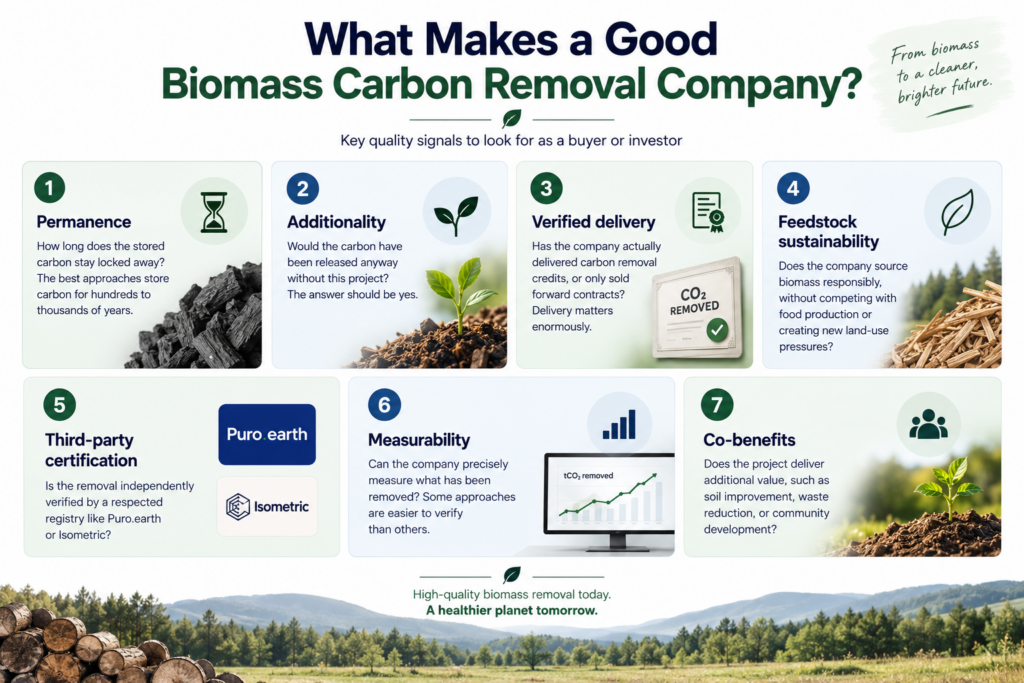
If you are a corporate buyer or climate-focused investor looking at this space, here are the key quality signals to look for:
- Permanence: How long does the stored carbon stay locked away? The best approaches store carbon for hundreds to thousands of years.
- Additionality: Would the carbon have been released anyway without this project? The answer should be yes.
- Verified delivery: Has the company actually delivered carbon removal credits, or only sold forward contracts? Delivery matters enormously.
- Feedstock sustainability: Does the company source biomass responsibly, without competing with food production or creating new land-use pressures?
- Third-party certification: Is the removal independently verified by a respected registry like Puro.earth or Isometric?
- Measurability: Can the company precisely measure what has been removed? Some approaches are easier to verify than others.
- Co-benefits: Does the project deliver additional value, such as soil improvement, waste reduction, or community development?
The Buyers Driving Biomass Carbon Removal Demand
Corporate buyers are the engine of this market. Here is a look at who is buying and why:
| Buyer | Purchase | Supplier |
|---|---|---|
| Microsoft | 1.24 million tonnes over 10 years | Exomad Green |
| 100,000 tonnes through 2030 | Varaha | |
| JPMorgan | 60,000 tonnes over 10 years | Graphyte |
| Swiss Re | 70,000 tonnes | Carboneers / Carbonfuture |
| BCG | 50,250 tonnes | Exomad Green, Euthenia Energy |
| Nasdaq | Multiple years of credits | Aperam BioEnergia |
| American Airlines | Multiple purchases | Graphyte |
| Tide Platform | 100% of Scope 1, 2, 3 emissions | Exomad Green, Wakefield Biochar |
These companies are buying carbon removal credits for several reasons. Many face science-based net-zero targets with 2030 or 2050 deadlines. Biomass-based removal offers a combination of durability, third-party verification, and lower cost compared to direct air capture, making it highly attractive to corporate procurement teams.
Challenges Facing Biomass Carbon Removal Companies
This sector is growing fast, but it faces real challenges that every informed buyer and observer should understand.
Sustainable Biomass Sourcing
This is the most significant challenge. BiCRS companies need biomass, but the wrong kind of sourcing can create new land-use problems, drive deforestation, or compete with food production. The leading companies address this by using genuine waste streams, including sawmill residues, agricultural byproducts, and invasive species, that would have been burned or decomposed anyway.
Measurement and Monitoring
Verifying how much carbon is actually stored, and for how long, is complex. Biochar applied to soil is easier to track than biomass buried underground. The industry is developing better protocols, and registries like Isometric and Puro.earth are raising the bar.
Scaling Production
Converting from pilot projects to large-scale operations requires significant capital investment. Many of the companies in this space are still in early growth stages and face the classic challenge of scaling cleantech businesses.
Market Demand
While corporate demand is growing, the overall market for durable carbon removal remains small relative to what the climate requires. Policy support, from carbon pricing to government procurement programs, will be critical to unlocking the next phase of growth. Europe is ahead of the curve here, with the EU working toward a carbon removal certification framework and an EU-wide registry expected to be operational by 2028.
The Road Ahead for Biomass Carbon Removal
The durable CDR market has grown dramatically over the past few years, and biomass-based approaches are leading the way on actual delivered volume.
Biochar alone has seen 1.6 million tonnes contracted in a single six-month period, driven largely by the Microsoft-Exomad Green deal. But smaller deals from companies like Google, JPMorgan, Swiss Re, and BCG signal that a much broader base of buyers is entering the market.
The pipeline looks strong. Stockholm Exergi is on track to become one of the world’s most impactful BECCS projects when it launches in 2028. Graphyte is expanding to Arizona. Exomad Green is building its third facility and targeting five sites with one million tonnes per year of capacity by 2027. Vaulted Deep is scaling its geological storage approach across multiple US states.
Meanwhile, countries including Japan, Canada, and several EU member states are investing in policy frameworks to recognize and reward negative emissions. This policy momentum will further accelerate demand.
Frequently Asked Questions (FAQ)
What is a biomass carbon removal company?
A biomass carbon removal company takes plant-based organic material and stores the carbon it contains in a way that keeps it out of the atmosphere for the long term. Methods include converting biomass into biochar, bio-oil, or compressed blocks, and storing those materials in soil or underground geological formations.
What is BiCRS?
BiCRS stands for Biomass Carbon Removal and Storage. It is the collective name for the family of technologies that use organic plant material to remove and permanently store CO2. It includes approaches like biochar production, bio-oil sequestration, biomass burial, and BECCS.
What is the difference between biochar and BECCS?
Biochar converts biomass into a charcoal-like material through pyrolysis and applies it to soil, where it stores carbon for hundreds of years while improving soil health. BECCS (Bioenergy with Carbon Capture and Storage) burns biomass to generate energy and captures the CO2 emitted during combustion, then stores it underground. Both achieve carbon removal, but through very different processes and at different cost levels.
Which biomass carbon removal company has delivered the most credits?
As of the latest publicly available data, Exomad Green leads all carbon removal suppliers globally by delivered volume, contributing approximately 24.5% of all verified durable carbon removals to date.
Are biomass carbon removal credits permanent?
It depends on the method. Biochar carbon removal is considered durable for 100 to over 1,000 years. Bio-oil and biomass geological storage approaches are expected to store carbon for thousands of years. All credible approaches require third-party verification to confirm permanence claims.
What companies are buying biomass carbon removal credits?
Major buyers include Microsoft, Google, JPMorgan Chase, BCG, Swiss Re, Nasdaq, American Airlines, and Tide Platform, among many others. Most are purchasing credits to meet science-based net-zero commitments.
How do I buy biomass carbon removal credits?
Buyers typically purchase credits directly from suppliers or through marketplaces and intermediaries such as Supercritical, Patch, or Frontier Climate’s advance market commitment program. Credits from certified suppliers on Puro.earth or Isometric are generally considered the most reliable.
What is the difference between biomass carbon removal and tree planting?
Tree planting is a nature-based solution that stores carbon in living trees, but that carbon is released if the trees die, burn, or are cut down. Biomass carbon removal approaches, such as biochar or bio-oil injection, lock carbon away permanently even if the biomass source is disturbed. This makes them more durable and verifiable.
Final Thoughts
Biomass carbon removal companies are not a niche experiment anymore. They are delivering verified carbon removal at meaningful scale, attracting billions in corporate purchase commitments, and building the infrastructure for a permanent carbon removal industry.
From Exomad Green’s biochar facilities in Bolivia to Graphyte’s carbon-casting pits in Arkansas, from Varaha’s invasive species conversion in Gujarat to Stockholm Exergi’s city-scale BECCS plant in Sweden, the diversity of approaches is striking. What they share is a common goal: take carbon that would have returned to the atmosphere and lock it away permanently.
For companies with net-zero targets, these biomass carbon removal companies represent some of the most credible, most scalable, and most cost-effective tools available today. Understanding who the leaders are, how they work, and what to look for in a high-quality credit is the first step toward making better climate decisions.
The carbon removal industry is moving fast. The companies profiled here are leading it.
This article was published on carbonmarketnetwork.com, your resource for carbon market education and insights.