Carbon Market Network


Money talks. And right now, billions of dollars are speaking loudly in favor of the planet.
Climate change is no longer just an environmental conversation. It has become one of the biggest investment opportunities in human history. Governments, corporations, and private funds are now racing to back the technologies, companies, and ideas that will power a cleaner world.
But who exactly is putting up the capital? Who are the top climate investors shaping this transition, and what are they betting on?
This guide breaks it all down. Whether you are a curious beginner, a sustainability professional, or someone thinking about impact investing, you are in the right place.
Why Climate Investing Has Exploded
Before we get to the names, it helps to understand why climate investing has grown so dramatically in recent years.
Global investment in clean energy hit a record $2.3 trillion, according to BloombergNEF’s Energy Transition Investment Trends report. Climate tech startups alone attracted $40.5 billion in venture and growth funding globally, an 8% increase over the prior year.
Even more telling: the first half of the current year saw $41.3 billion flow into climate tech companies, according to Net Zero Insights, despite deal counts hitting their lowest level in years. This means investors are writing bigger checks to fewer, better companies.
The market is maturing. And the people leading that charge are the top climate investors we will explore below.
What Makes Someone a “Climate Investor”?
A climate investor is any individual, fund, or institution that actively allocates capital to companies, projects, or technologies aimed at reducing greenhouse gas emissions, removing carbon from the atmosphere, or helping the world adapt to climate change.
This can include:
- Venture capital funds backing early-stage clean tech startups
- Private equity firms acquiring and scaling mature climate businesses
- Infrastructure funds building out renewable energy projects
- Philanthropic entities using grants and mission-aligned capital
- Corporate venture arms investing in solutions aligned with their own decarbonization goals
The best climate investors do not just write checks. They bring networks, technical expertise, policy access, and operational support that help their portfolio companies survive and grow.
The Top Climate Investors You Need to Know
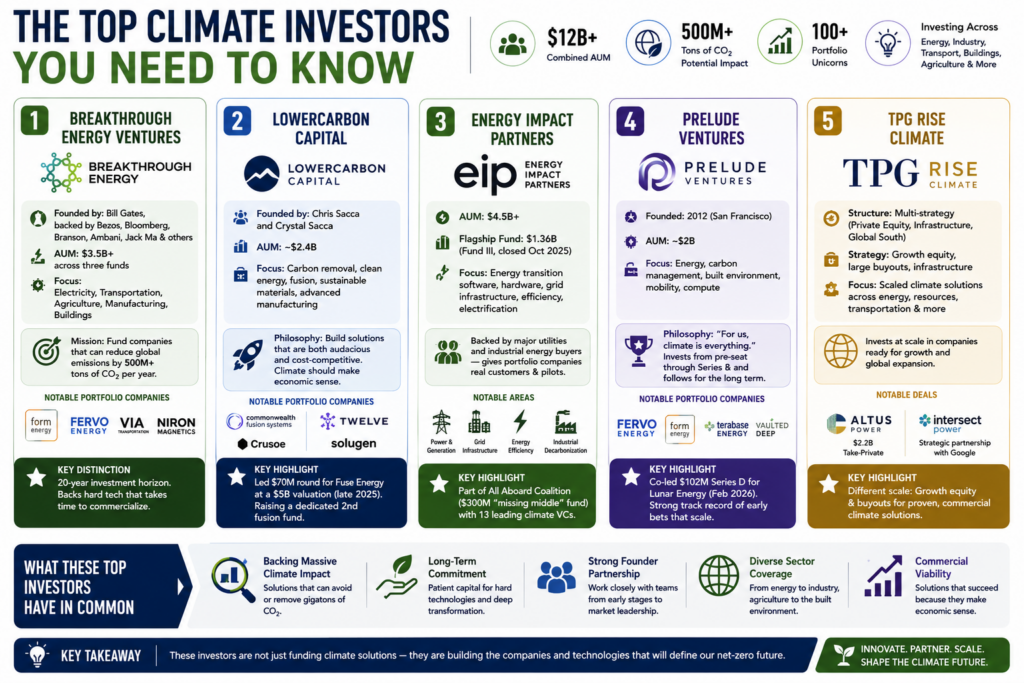
1. Breakthrough Energy Ventures (BEV)
Founded by: Bill Gates, with backing from Jeff Bezos, Michael Bloomberg, Richard Branson, Mukesh Ambani, Jack Ma, and others
AUM: $3.5 billion+ across three funds
Focus: Electricity, transportation, agriculture, manufacturing, buildings
Breakthrough Energy Ventures is widely considered the flagship institution in climate investing. It was founded with a singular mission: fund companies with the potential to reduce global greenhouse gas emissions by at least 500 million tons per year.
BEV operates differently from most venture funds. It has a 20-year investment horizon, which means it can back hard technologies that take time to develop commercially. Its due diligence is rigorous and often involves independent technical experts who assess whether a company’s core science actually works at commercial scale.
Portfolio companies include Form Energy, Fervo Energy (geothermal), Via Transportation, and Niron Magnetics, among more than 100 others.
BEV also launched a Sustainable Aviation Fuel fund in partnership with oneworld member airlines, targeting one of the hardest-to-abate sectors in transportation.
What they look for: Companies that can mitigate at least 500 million tons of CO2 per year by 2050, with a credible path from lab to commercial scale.
Key distinction: BEV’s Catalyst project-finance arm paused new investments in early 2026, but the venture arm continues to operate fully and remains one of the most active climate funds in the world.
2. Lowercarbon Capital
Founded by: Chris Sacca and Crystal Sacca
AUM: ~$2.4 billion
Focus: Carbon removal, clean energy, fusion, sustainable materials, advanced manufacturing
Lowercarbon Capital has a philosophy as bold as its name. Founded by Chris Sacca, best known for early investments in Uber, Twitter, and Instagram, Lowercarbon puts money behind companies that slash and suck carbon from the atmosphere.
The fund has invested in over 207 companies and covers an unusually wide range of climate solutions: from practical energy efficiency software to genuinely audacious bets like nuclear fusion and zero-carbon cement.
Notable portfolio companies include Commonwealth Fusion Systems, Charm Industrial, Twelve (which converts CO2 into useful chemicals), Watershed, Crusoe (sustainable compute infrastructure), and Solugen.
In late 2025, Lowercarbon led a $70 million raise for Fuse Energy at a $5 billion valuation, and it announced it is raising a dedicated second fusion fund, signaling its belief in fusion as a viable climate solution.
What they look for: Founders building solutions that are both audacious and cost-competitive. Sacca’s philosophy is that climate solutions should work for pure economic reasons, even for those who don’t care about the environment.
3. Energy Impact Partners (EIP)
AUM: $4.5 billion+
Flagship Fund: $1.36 billion (Fund III, closed October 2025, 40% larger than Fund II)
Focus: Energy transition software, hardware, grid infrastructure, efficiency, electrification
Energy Impact Partners stands out because of who backs it. EIP’s limited partners include major utilities and large industrial energy buyers. This gives portfolio companies something most climate VCs simply cannot offer: direct access to real customers, pilot opportunities, and procurement processes within the utility industry.
EIP invests across power generation, grid infrastructure, energy efficiency, electrification, and industrial decarbonization. Its Fund III is one of the largest climate-focused venture funds ever raised.
EIP also participated in the All Aboard Coalition, a $300 million “missing middle” fund launched in September 2025 by thirteen leading climate VC firms, including Breakthrough Energy Ventures, Khosla Ventures, DCVC, and Congruent Ventures.
What they look for: Climate tech companies with B2B energy applications, especially those who can benefit from utility introductions, grid pilots, or scaling into regulated energy markets.
4. Prelude Ventures
Founded: 2012 (San Francisco)
AUM: ~$2 billion
Focus: Energy, carbon management, built environment, mobility, compute
Prelude Ventures has a philosophy that is simple and sweeping: “For us, climate is everything.”
Backed primarily by the philanthropic entities of Nat and Laura Simons through a single-LP structure, Prelude enjoys unusual flexibility in its investment decisions. It invests from pre-seed through Series B and follows companies for the long term.
Prelude’s portfolio includes some of the most talked-about names in climate tech: Fervo Energy (which filed for IPO after a $462 million Series E), Form Energy (iron-air long-duration batteries), Terabase Energy (solar manufacturing automation), and Vaulted Deep (deep geologic carbon storage).
In February 2026, Prelude co-led a $102 million Series D round for Lunar Energy, a home battery and virtual power plant software company.
Prelude is also a founding member of the Breakthrough Energy Coalition and a founding member of the All Aboard Coalition.
What they look for: Technically credible founders with long-term vision. Prelude is particularly known for leading rounds at very early stages and following companies through their full development arc.
5. TPG Rise Climate
Structure: Multi-strategy platform (private equity, transition infrastructure, Global South)
Strategy: Growth equity, large buyouts, infrastructure
Notable deals: Altus Power ($2.2B take-private), Intersect Power (strategic partnership with Google)
TPG Rise Climate operates at a completely different scale from most venture funds. This is growth equity and private equity capital designed for companies that have already proven their technology and now need hundreds of millions to build capacity.
TPG Rise Climate took solar company Altus Power private for $2.2 billion. It acquired a stake in Kinetic, an electric bus platform. It also launched a Global South Initiative Fund targeting $1 billion, with investments spanning India, Southeast Asia, the Middle East, and Africa.
Former U.S. Treasury Secretary Hank Paulson serves as Executive Chairman of TPG Rise Climate, underscoring the fund’s policy reach and institutional credibility.
The fund’s LPs include institutional investors, Delta Airlines, JetBlue Technology Ventures, and 3M, reflecting a broad coalition of corporate partners who see climate transition as both a risk and an opportunity.
What they look for: Companies at growth or commercial scale that need large capital infusions, operational support, or strategic partnerships to expand rapidly.
6. Congruent Ventures
Founded by: Josh Posamentier and Abe Yokell
AUM: $1 billion+
Fund III: $275 million (closed December 2023, actively deploying)
Focus: Mobility, energy, food and agriculture, advanced materials, clean production
Congruent Ventures is one of the most active pure-play early-stage climate funds in the world. Its model is built around being the first institutional investor in a company and then actively helping founders reach their next milestone.
With Fund III at $275 million and a total AUM crossing $1 billion, Congruent has made over 122 investments to date. Portfolio companies include Fervo Energy, AMP Robotics, Avalanche Energy, and Camus Energy.
Congruent also raised a continuity vehicle that allows it to follow on into growth stages, meaning its relationship with portfolio companies does not end at Series A.
The fund published its 2026 Outlook in January 2026, highlighting climate resilience, adaptation, and energy infrastructure as its priority themes.
What they look for: Fast-moving teams with validation data and a credible path to positive gross margin. Congruent writes checks from $500K to $10 million, making it accessible for genuinely early-stage founders.
7. Clean Energy Ventures (CEV)
Fund II: $305 million (closed 2024)
Focus: Climate tech hardware, deep tech, carbon removal, energy
Clean Energy Ventures is a specialist climate fund known for its exceptionally rigorous impact methodology. When you pitch to CEV, they run an independent assessment of your company’s abatement potential. They want to see your life cycle analysis data, your cost curves, and your manufacturing plan before they write a check.
CEV is a founding member of the All Aboard Coalition and has been actively deploying throughout 2025. Recent portfolio activity includes participation in carbon removal and energy hardware companies that other funds consider too early or too technically complex.
What they look for: Companies with genuine and quantifiable carbon abatement potential. CEV wants founders who arrive with their technical documentation ready, not hand-waving about future impact.
8. Fifth Wall Climate
Parent: Fifth Wall (real estate-focused VC)
Focus: Real estate, construction, built environment decarbonization
The built environment accounts for roughly 40% of global carbon emissions. Fifth Wall’s climate strategy zeroes in on this overlooked but enormous opportunity: making buildings and construction more energy efficient and less carbon intensive.
Fifth Wall is backed by real estate companies themselves, which gives its portfolio companies direct access to customers who own and manage the very buildings that need to be upgraded.
Fifth Wall Climate backs companies working on everything from smart building technology and energy management to low-carbon construction materials and electrification of heating systems.
What they look for: Climate solutions specifically relevant to real estate operators, developers, and the construction supply chain. Having a clear path to the commercial real estate market is a significant advantage.
9. Elemental Excelerator (Now Elemental Impact)
Focus: Early-stage climate tech pilots
Structure: Non-profit backed investor and accelerator
Elemental Excelerator stands apart from the purely financial funds on this list. It provides not just capital but hands-on support to help companies prove their technology in the real world.
Elemental focuses on founders who are often overlooked by traditional VC: those working in hard-to-pilot sectors like utilities, agriculture, and coastal resilience. The organization helps companies navigate regulatory environments, set up pilot programs with real customers, and demonstrate technology performance before approaching larger investors.
What they look for: Early-stage climate companies that need a strategic partner to run a real-world proof of concept, particularly in sectors with high regulatory complexity.
10. Khosla Ventures
Founded by: Vinod Khosla
Focus: Clean energy, fusion, carbon capture, advanced materials, food tech
Vinod Khosla is one of the most well-known and outspoken figures in climate tech investing. His firm, Khosla Ventures, has backed bold climate bets for over a decade, often at stages when the science was still speculative.
Khosla Ventures was a co-founder of the All Aboard Coalition in 2025 and has made early bets in fusion companies, next-generation nuclear, and sustainable food systems. The firm is known for backing technologies that most investors consider too risky, operating on the belief that transformative climate solutions require transformative science.
Key Climate Investment Sectors
Understanding where top climate investors focus their capital helps you see the full picture.
| Sector | What It Covers | Why Investors Are Excited |
|---|---|---|
| Clean Energy | Solar, wind, geothermal, nuclear, fusion | Record funding, improving unit economics |
| Energy Storage | Batteries, iron-air, thermal storage | Critical to grid reliability |
| Carbon Removal | Direct air capture, ocean-based removal, biochar | Policy support, corporate demand |
| Industrial Decarbonization | Green steel, green cement, green chemicals | Hard-to-abate sectors with massive markets |
| Sustainable Transportation | EVs, sustainable aviation fuel, electric shipping | Global electrification wave |
| Built Environment | Smart buildings, heat pumps, low-carbon materials | Largest source of global emissions |
| Food and Agriculture | Alternative proteins, methane reduction, precision fermentation | Land use and methane are major emission sources |
| Climate Data and Software | Carbon accounting, MRV, grid software | Enabling layer for everything else |
The All Aboard Coalition: A New Collaboration Model
One of the most significant recent developments in climate investing is the rise of investor coalitions.
In September 2025, thirteen of the world’s top climate VC firms came together to launch the All Aboard Coalition, a $300 million fund designed to address the “missing middle” problem in climate finance.
Founding members include Breakthrough Energy Ventures, Lowercarbon Capital, Khosla Ventures, DCVC, Clean Energy Ventures, Congruent Ventures, Energy Impact Partners, and Prelude Ventures, among others.
The “missing middle” refers to climate companies that have graduated from early-stage venture funding but are not yet large enough to attract growth equity or infrastructure capital. This gap has caused many promising companies to stall or fail, even when their technology worked.
The All Aboard Coalition is a direct response to that structural problem. It signals a new era of collaboration among climate investors, rather than competition.
How Top Climate Investors Evaluate Deals
If you are a founder or a curious observer, understanding how top climate investors think about deals is valuable.
Most leading climate funds look for a combination of these factors:
1. Gigaton-scale potential Does this company’s technology, if deployed at scale, have the potential to reduce emissions by hundreds of millions or billions of tons per year? BEV’s explicit requirement is 500 million tons. Most other serious climate funds think in similar terms, even if they don’t state it as formally.
2. Defensible technology Is the core science or engineering real? Can it be independently verified? Climate tech funds are increasingly skeptical of vaporware and demand rigorous technical documentation.
3. A credible path to commercial scale Having great technology is not enough. Investors want to see a realistic plan for manufacturing, distribution, customer acquisition, and scale. Many climate tech companies fail not because the science doesn’t work, but because they cannot get to cost-competitive production.
4. Team quality This is universal across venture investing but especially critical in climate tech, where founders often need to navigate regulatory complexity, long development timelines, and capital-intensive buildouts simultaneously.
5. Policy awareness Climate businesses operate in regulated environments. Top investors want founders who understand the regulatory landscape and can either exploit policy tailwinds or survive headwinds.
6. Capital efficiency Unlike software, climate tech is often hardware-intensive and capital-heavy. Investors want to see a realistic CapEx plan and a path to positive unit economics.
What the Numbers Tell Us About Climate Investing
The data paints a picture of a sector that is maturing rapidly.
$40.5 billion was invested in climate tech startups globally, with an 8% increase over the prior year.
Deals fell 18% while total funding rose, meaning larger checks went to fewer, more proven companies.
Energy sector investment rose 31% driven by large grid infrastructure and nuclear deals.
US funding rose 27% driven by mega-deals in data centers, nuclear, and electric vehicles.
Europe saw $10.1 billion, its lowest level in recent years, while India held steady.
Bankruptcies in climate tech fell nearly 50%, signaling improving market health overall.
The carbon removal sector saw investor participation fall 47%, reflecting increased selectivity and higher scrutiny around project quality.
This shift matters. The early days of climate investing rewarded bold promises. Today’s climate investors reward proven performance, real revenue, and credible scale-up plans.
Institutional Investors Entering Climate Finance
Beyond pure-play climate funds, large institutional investors are allocating significant capital to climate-related strategies.
CalSTRS, the California State Teachers Retirement System, committed capital to Just Climate’s Natural Climate Solutions strategy.
Temasek, Singapore’s sovereign wealth fund, co-invests with Breakthrough Energy Ventures across multiple portfolio companies.
AIIB (Asian Infrastructure Investment Bank) committed $50 million to TPG Rise Climate’s Global South Initiative Fund.
Major pension funds and sovereign wealth funds are integrating climate into their core investment strategies, not as a sidecar but as a central allocation.
This institutional participation is critical because it brings the long-term patient capital that climate technologies require.
Carbon Markets and Climate Investors
Climate investors and carbon markets are deeply intertwined.
Many of the technologies backed by top climate investors, from direct air capture to soil carbon sequestration to biochar, generate or consume carbon credits. The carbon market provides a revenue stream that makes these technologies economically viable.
Companies like Watershed (backed by Lowercarbon Capital) build the software that helps corporations measure, report, and reduce their emissions, with carbon market transactions at the heart of their business model.
Running Tide, Pachama, Noya, and Twelve are all Lowercarbon portfolio companies with direct connections to carbon removal and the voluntary carbon market.
Prelude Ventures backed Vaulted Deep, which focuses on deep geologic carbon storage, and Ebb Carbon, which focuses on ocean-based CO2 removal. Both generate carbon credits.
Just Climate, another leading fund, launched a $175 million Natural Climate Solutions strategy specifically targeting permanent, high-quality carbon credit generation.
For anyone following the carbon market, tracking what top climate investors are funding is a direct window into the future of carbon credit supply.
Emerging Trends in Climate Investing
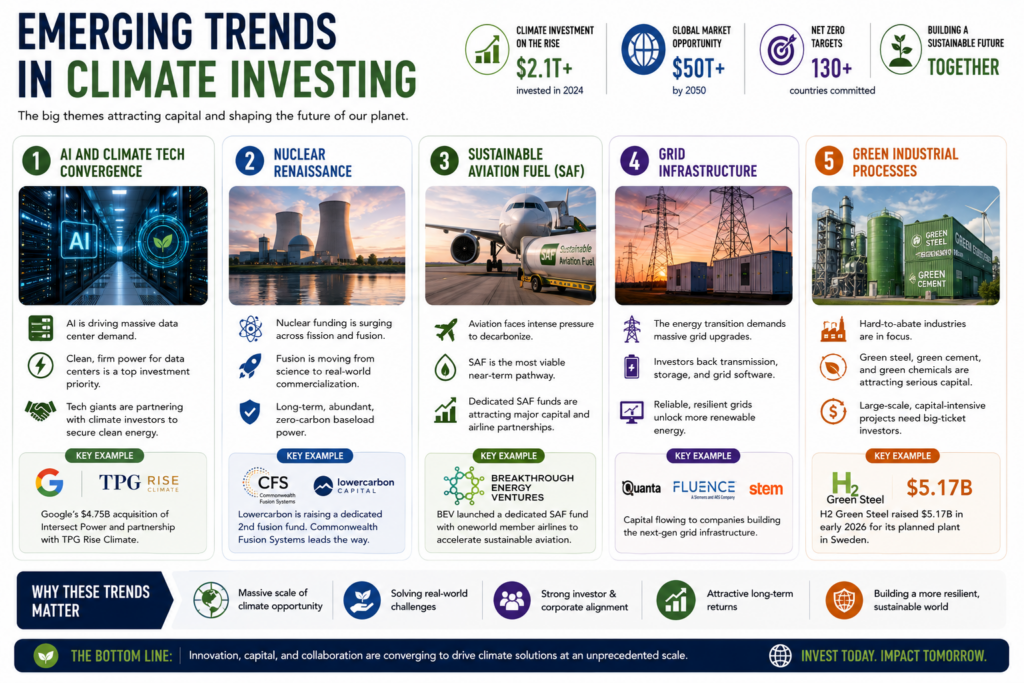
AI and Climate Tech Convergence
The explosion in data center demand driven by AI is reshaping climate investment priorities. Clean firm power for data centers has become one of the hottest investment themes. Google’s $4.75 billion acquisition of Intersect Power in late 2025 and its partnership with TPG Rise Climate are direct examples of how AI infrastructure demand is accelerating climate investment.
Nuclear Renaissance
Nuclear tops the rankings for venture capital growth, with funding up dramatically driven by both fission and fusion bets. Lowercarbon is raising a dedicated second fusion fund. Commonwealth Fusion Systems (backed by Lowercarbon) is the most-funded private fusion company in the world.
Sustainable Aviation Fuel (SAF)
BEV launched a dedicated SAF fund with oneworld airlines. This sector is receiving intense investor attention as airlines face mounting pressure to decarbonize, and SAF is currently the most viable near-term pathway.
Grid Infrastructure
The energy transition requires massive grid upgrades. Investors are backing companies that build the transmission, storage, and software infrastructure to make a renewable grid reliable.
Green Industrial Processes
Green steel, green cement, and green chemicals are attracting serious capital. H2 Green Steel raised $5.17 billion in early 2026 for a planned plant in Sweden. These are enormous, capital-intensive bets that only the largest climate funds and infrastructure investors can underwrite.
How to Connect With Top Climate Investors
If you are a founder or someone working in climate tech, here is practical guidance for engaging with these funds.
Do your homework first. Each fund has a specific thesis. Do not pitch a grid software company to Fifth Wall Climate. Do not pitch a real estate decarbonization company to BEV. Match your pitch to the fund’s actual focus areas.
Quantify your climate impact. Every serious climate investor wants to know the carbon abatement potential of your company. Have an independent life cycle analysis ready. Know your tons of CO2 avoided per unit of product or service delivered.
Show commercial realism. Investors have seen many technically sound companies that could not achieve cost-competitive production. Show your cost curve, your path to gross margin, and your manufacturing or delivery plan.
Be transparent about risks. Top climate investors have seen every type of risk. They respect founders who identify and address risks honestly far more than those who minimize them.
Seek warm introductions. Most leading climate funds prefer warm introductions from founders they know, co-investors, or advisors in their network. Building those relationships before you are fundraising is the most effective strategy.
Consider accelerators and coalitions. Organizations like Elemental Impact and the All Aboard Coalition can be stepping stones that help early-stage founders get in front of the top climate investors.
Climate Investors vs. Traditional Investors: Key Differences
| Dimension | Traditional VC | Top Climate Investors |
|---|---|---|
| Investment horizon | 7 to 10 years | Often 10 to 20 years |
| Due diligence focus | Market size, team, traction | Technical viability, climate impact, scale pathway |
| Success metrics | Financial returns | Returns plus measurable carbon abatement |
| Sector expertise | Generalist | Deep climate, energy, or industrial expertise |
| Ecosystem access | Broad tech networks | Policy makers, utilities, industrial partners |
| Capital type | Equity primarily | Equity, debt, project finance, grants |
The Role of Policy in Climate Investing
Policy shapes the economics of climate investment more than in almost any other sector.
The U.S. Inflation Reduction Act drove a wave of clean energy investment by making projects economically viable through tax credits. Even as some of those credits face political uncertainty, the underlying investment thesis for many clean energy technologies remains strong because costs have fallen so far.
In Europe, the Green Deal and related policies continue to drive industrial decarbonization investment.
In Asia, China has become the second-largest destination for climate tech investment, driven by massive domestic clean energy manufacturing.
Top climate investors spend significant time monitoring and influencing policy environments. BEV’s coalition of business leaders gives it direct access to policy makers globally. TPG Rise Climate’s relationship with Hank Paulson brings former U.S. Treasury Secretary-level policy insight to its deal-making.
Policy risk is real, but so is policy opportunity. The best climate investors know how to navigate both.
FAQ: Top Climate Investors
Who is the largest climate investor in the world?
Breakthrough Energy Ventures, founded by Bill Gates and backed by global business leaders, is widely considered the largest and most influential dedicated climate investment vehicle, with over $3.5 billion in committed capital across three funds. Energy Impact Partners, with $4.5 billion in AUM, is also one of the largest by assets under management.
What is the difference between climate investing and ESG investing?
ESG investing typically refers to integrating environmental, social, and governance criteria into the evaluation of existing companies across all sectors. Climate investing is a more specific and active strategy: directly funding companies and technologies designed to reduce or remove greenhouse gas emissions.
How much money is flowing into climate tech?
Global climate tech investment reached approximately $40.5 billion in venture and growth funding recently, with clean energy investment broadly reaching $2.3 trillion globally according to BloombergNEF.
Can individual investors participate in climate investing?
Yes, though access to the top climate VC funds is typically limited to institutional investors and high-net-worth individuals. Retail investors can participate through climate-focused ETFs, green bonds, publicly listed clean energy companies, and community investing platforms.
Are climate investors making money?
Many climate investments are still in early stages, and returns vary widely. However, exits and IPOs are increasing. Fervo Energy filed for IPO after a $462 million Series E. The exit landscape in 2026 has been more active than any six-month period since 2021, signaling that the sector is maturing and generating real financial returns alongside climate impact.
What sectors do top climate investors focus on most?
Energy generation and storage, grid infrastructure, industrial decarbonization (green steel, cement, chemicals), carbon removal, sustainable transportation, and built environment decarbonization attract the largest share of climate capital today.
What is the All Aboard Coalition?
The All Aboard Coalition is a $300 million collaborative fund launched by thirteen leading climate VC firms, including BEV, Lowercarbon, Congruent, EIP, and Prelude Ventures. It targets the “missing middle” gap in climate finance: companies that have grown beyond early venture funding but have not yet reached the scale needed to attract large growth equity or infrastructure capital.
How do climate investors measure impact?
Most serious climate investors measure impact in terms of tons of CO2 equivalent avoided or removed per year. BEV requires a minimum threshold of 500 million tons. Many funds conduct independent life cycle analyses of portfolio companies and publish annual impact reports tracking portfolio-level abatement.
Conclusion: The Top Climate Investors Are Building Tomorrow Today
The top climate investors profiled in this article are not just writing checks. They are building the infrastructure of a decarbonized economy, one company at a time.
From Breakthrough Energy Ventures backing the science of the future to Lowercarbon Capital supporting everything from fusion to cow methane, from Energy Impact Partners connecting startups to utility customers to Congruent Ventures writing the first institutional check into a founder’s bold idea, these funds represent the full spectrum of what climate investing looks like.
The money flowing into climate tech is more than a financial signal. It is a signal that the world’s most sophisticated investors believe that solving climate change is not just necessary but profitable.
For anyone involved in carbon markets, clean energy, sustainability, or climate policy, tracking the top climate investors is one of the most valuable things you can do. Their portfolio companies are the companies that will shape the next decade of the energy transition.
The planet needs capital. The capital is showing up. Now comes the hard work of turning investment into impact.
Explore more insights on carbon markets and climate finance at carbonmarketnetwork.com