Carbon Market Network


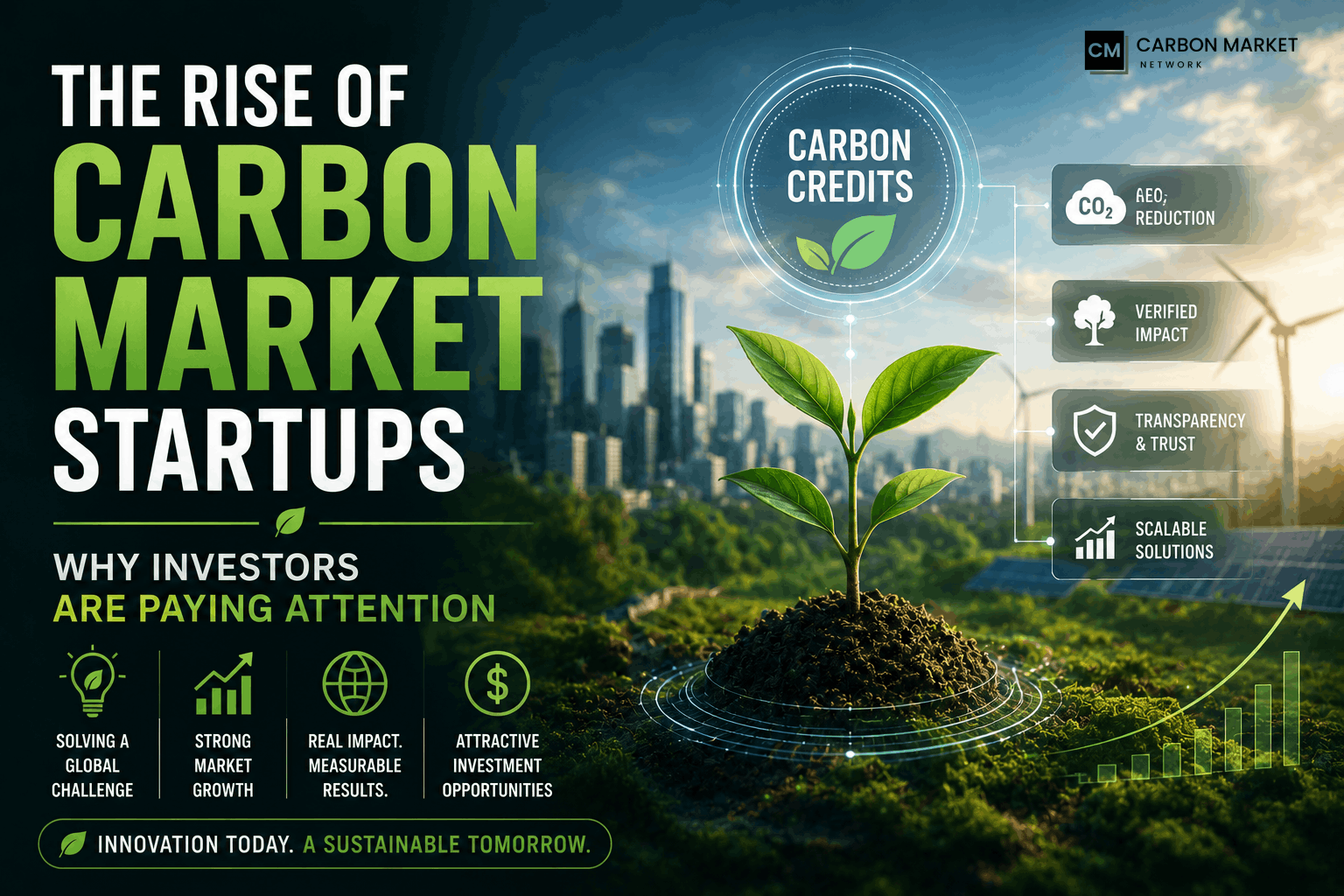
Imagine a market that did not exist 20 years ago, now on track to be worth hundreds of billions of dollars by the end of this decade.
That is exactly what is happening with carbon markets, and investors around the world are racing to get in early.
Carbon market startups are building the tools, platforms, and infrastructure that power one of the fastest-growing sectors in climate finance. From AI-powered credit verification to blockchain-based trading platforms, these companies are reshaping how the world prices and trades carbon.
In this article, we break down what carbon market startups actually do, why they are pulling serious investor attention in 2026, who the leading players are, and what opportunities and risks lie ahead.
What Is a Carbon Market, and Why Does It Matter?
Before diving into startups, it helps to understand what carbon markets are and why they have become such a big deal.
A carbon market is a system where companies, governments, and other entities can buy and sell carbon credits to offset their greenhouse gas emissions.
One carbon credit typically represents one metric ton of carbon dioxide (CO2) either reduced, avoided, or removed from the atmosphere.
There are two main types of carbon markets:
1. Compliance Carbon Markets These are regulated by governments or international bodies. Companies operating in industries like aviation, energy, or heavy manufacturing are legally required to hold enough carbon credits to cover their emissions. The European Union Emissions Trading System (EU ETS) is the world’s largest compliance market.
2. Voluntary Carbon Markets (VCMs) These are not legally required. Companies, organizations, or even individuals buy carbon credits voluntarily to meet their own climate commitments, net-zero targets, or ESG (Environmental, Social, and Governance) goals.
Both markets are growing fast, and carbon market startups are active in both.
The total carbon credit market was valued at approximately USD 114.3 billion in 2025 and is expected to grow to USD 127.3 billion in 2026, with projections reaching as high as USD 482 billion by 2035 according to Global Market Insights.
That is not a niche market. That is a major financial ecosystem in the making.
Carbon Market Insider Newsletter
Weekly insights on carbon markets, climate policy, carbon credits, and sustainability.
Why Carbon Market Startups Are Exploding Right Now
A perfect storm of regulatory change, corporate climate commitments, and technological innovation has created ideal conditions for carbon market startups to thrive.
Here is what is driving the surge.
Net-Zero Pledges Are Creating Massive Demand
Thousands of the world’s largest corporations have committed to reaching net-zero emissions by 2050 or earlier.
Microsoft, Apple, Amazon, and hundreds of other major brands have pledged to neutralize or eliminate their carbon footprints. Many of them cannot do it through operational changes alone, at least not in the short term.
Carbon credits fill the gap. And as demand for high-quality credits grows, so does the need for startups that can create, verify, trade, and manage them.
Article 6 of the Paris Agreement Changed the Game
One of the most significant developments for carbon market startups was the finalization of the rulebook for Article 6 of the Paris Agreement at COP29 in Baku in late 2024.
Article 6 defines how countries can cooperate on carbon markets internationally. It covers bilateral trading between countries (Article 6.2) and a UN-supervised crediting mechanism (Article 6.4) that opens the market to both countries and corporations.
As of March 2025, 97 bilateral agreements between 59 countries had been adopted, with 155 pilot projects recorded under Article 6.2 alone.
This regulatory clarity gave investors and startups the confidence to invest and build at scale. Before this, market uncertainty held many back.
The EU CBAM Is Creating Compliance Urgency
The European Union’s Carbon Border Adjustment Mechanism (CBAM) reached its full scope application in 2026. This mechanism charges importers for the carbon emissions embedded in goods they bring into the EU.
This has pushed thousands of companies, including those outside Europe, to take carbon accounting and offsetting more seriously. Startups offering carbon management software, emissions tracking tools, and compliance solutions are directly benefiting.
Record Capital Is Flowing In
In 2024, the voluntary carbon market attracted an estimated USD 16.3 billion in new funding, according to Qubit Capital. Companies retired more credits in the first half of 2025 than in any previous period.
Offtake deals announced in 2025 totaled USD 12.3 billion, up from USD 3.95 billion in 2024. That is more than a 3x increase in just one year.
Investors can clearly see the trajectory.
The Different Types of Carbon Market Startups
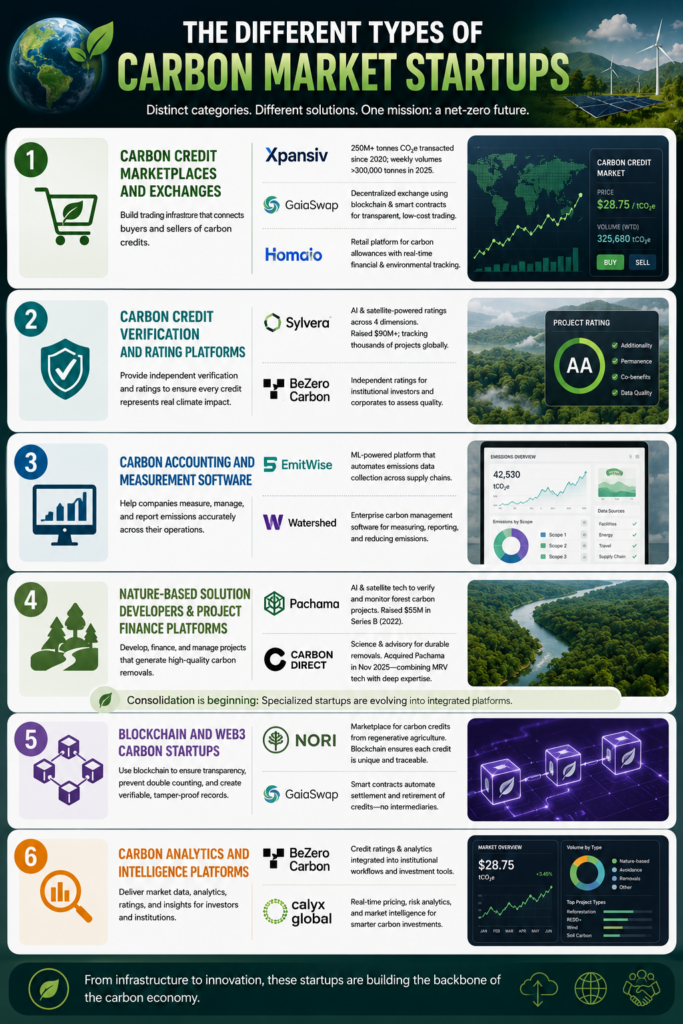
Not all carbon market startups do the same thing. The sector has several distinct categories, and each one is attracting different types of investors.
1. Carbon Credit Marketplaces and Exchanges
These startups build the trading infrastructure that lets buyers and sellers transact in carbon credits.
Xpansiv is one of the best-known examples. Its platform has handled more than 250 million metric tons of CO2-equivalent transactions since 2020, with weekly trading volumes frequently exceeding 300,000 tons in 2025. Xpansiv has also expanded to include removal-only credits and CORSIA-compliant aviation credits, and launched a partnership with the Korea Exchange (KRX) to build a carbon credit trading market in Asia.
GaiaSwap, a Singaporean startup, offers a decentralized exchange for carbon credits. It uses blockchain-based smart contracts and automated liquidity pools to enable direct pricing without intermediaries. This approach cuts costs and improves price transparency.
Homaio, a French startup, offers a retail investment platform for carbon allowances. It lets individual investors monitor both financial and environmental performance in real time, pairing market returns with measurable climate impact.
These platforms solve a critical problem: carbon markets have historically been fragmented, opaque, and hard to access. Marketplaces are fixing that.
2. Carbon Credit Verification and Rating Platforms
Trust is the foundation of any market. In carbon markets, trust means verifying that a carbon credit actually represents a real ton of CO2 reduced or removed.
This is where verification and rating startups come in.
Sylvera, based in London, has become the de facto ratings agency for carbon credits. The company uses AI, machine learning, and satellite data to rate carbon credit projects across four dimensions: additionality, permanence, co-benefits, and data quality. It has been described as the “Moody’s of carbon markets,” providing buyers with independent quality scores that cut through the noise.
Sylvera has raised over USD 90 million from investors including Index Ventures and Balderton Capital. By 2025, it was tracking and rating thousands of carbon offset projects globally.
BeZero Carbon takes a similar approach, offering independent ratings that help institutional investors and corporates evaluate credit quality before purchase. BeZero’s ratings have increasingly been built into procurement and investment workflows at major financial institutions.
Both Sylvera and BeZero have become essential infrastructure in a market where quality varies enormously from one project to the next.
3. Carbon Accounting and Measurement Software
Before a company can offset its emissions, it needs to measure them accurately.
EmitWise helps large businesses monitor and reduce their carbon footprints using machine learning and a software platform. It automates data collection across complex supply chains, a task that was previously manual, slow, and error-prone.
Watershed is another well-known name in this space, offering enterprise carbon management software that helps companies measure, report, and reduce emissions. It has attracted clients from major tech and consumer brands.
These startups essentially act as the “accounting layer” of the carbon market. Without accurate measurement, no offset claim has any credibility.
4. Nature-Based Solution Developers and Project Finance Platforms
Some carbon market startups go straight to the source, developing the projects that generate carbon credits in the first place.
Pachama built an AI-powered platform using satellite imagery and LiDAR technology to verify and monitor forest carbon projects. It raised USD 55 million in a 2022 Series B round backed by Amazon’s Climate Pledge fund, Breakthrough Energy Ventures, and Lowercarbon Capital.
However, in November 2025, Carbon Direct acquired Pachama in one of the first significant consolidation moves in the carbon market sector. This signals a maturing market where specialization is giving way to integrated platforms.
Carbon Direct itself focuses on the science and advisory side, helping companies navigate the procurement of durable carbon removals. Post-acquisition, it now combines Pachama’s MRV technology with its own research capabilities.
5. Blockchain and Web3 Carbon Startups
Blockchain technology offers a solution to one of carbon markets’ biggest problems: double counting.
If the same carbon credit is claimed by two different buyers, the entire system breaks down. Blockchain creates a tamper-proof record of every credit’s creation, transfer, and retirement.
Nori is a blockchain-based marketplace where farmers can sell carbon credits generated by regenerative agricultural practices like soil carbon sequestration. The blockchain ensures each credit is unique and traceable.
GaiaSwap, mentioned earlier, also uses smart contracts to automate credit settlement, removing the need for manual clearing and custodian services.
6. Carbon Analytics and Intelligence Platforms
As institutional investors allocate more capital to carbon markets, they need the kind of sophisticated data tools they rely on in equity or bond markets.
Startups in this space provide real-time pricing, portfolio analytics, risk modeling, and market intelligence.
BeZero Carbon and Calyx Global both offer credit ratings and analytics that integrate with investment platforms. These tools help fund managers make evidence-based allocation decisions in a market that has historically lacked transparency.
Why Investors Are Paying Close Attention to Carbon Market Startups
Investors are not putting money into carbon market startups out of altruism. They see a genuine financial opportunity backed by powerful structural tailwinds.
Here is the investment case in plain terms.
A Market at the Ground Floor
The voluntary carbon credit market was valued at approximately USD 2.77 billion in 2025 and is projected to grow to USD 3.75 billion in 2026, with some forecasts pushing the market to USD 45 billion by 2034 at a CAGR of over 36%.
For investors who got in early on SaaS, fintech, or biotech, these growth rates look very familiar.
Policy Tailwinds Are Irreversible
The regulatory direction is clear. Governments worldwide are tightening emissions targets, expanding carbon pricing systems, and mandating sustainability disclosures.
The EU’s CSRD (Corporate Sustainability Reporting Directive) requires large companies to disclose detailed emissions data. The ICVCM’s Core Carbon Principles (CCPs) are bringing new integrity standards to voluntary markets. Article 6 of the Paris Agreement has created an international trading framework that will only expand over time.
Investors in carbon market startups are essentially betting on a regulatory trend that is unlikely to reverse.
First-Mover Advantage in Infrastructure
Just as early investors in payment processing or cloud storage captured outsized returns by building foundational infrastructure, carbon market startups are building the pipes and rails of a new financial ecosystem.
Companies that become the standard for credit ratings, trading infrastructure, or emissions accounting will be very difficult to displace once entrenched.
ESG Capital Continues to Grow
Despite some volatility in ESG fund flows, institutional investors continue to allocate capital to climate-aligned assets. Pension funds, sovereign wealth funds, and large asset managers now include carbon market exposure as part of their broader climate strategy.
Temasek, Singapore’s sovereign wealth fund, has emerged as one of the most active investors across batteries, carbon capture, and climate tech more broadly. Climate Impact X (CIX), Singapore’s carbon exchange, was backed by DBS Bank, Singapore Exchange, Standard Chartered, and Temasek itself.
This institutional backing signals that carbon markets are graduating from niche experiment to mainstream financial asset class.
The Quality Premium Opportunity
In 2025, a major market shift accelerated: buyers began paying significant premiums for high-quality, verified carbon credits rather than chasing cheap but unreliable offsets.
Offtake deals signed in 2025 were being priced at a weighted average of USD 180 per credit, representing a substantial premium over generic market prices.
Startups that can deliver high-integrity credits, backed by rigorous science and third-party verification, are positioned to capture this quality premium. Investors who back these startups early are betting on a value-driven market rather than a commodity race to the bottom.
Key Trends Shaping Carbon Market Startups in 2026
The sector is evolving fast. Here are the most important trends that founders and investors are tracking right now.
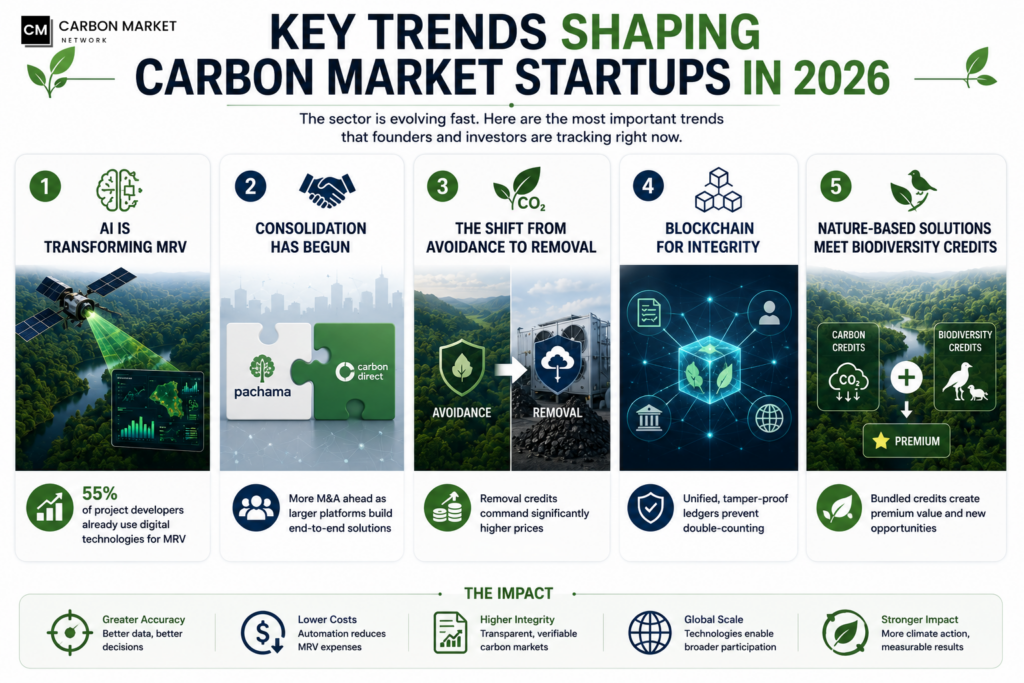
AI Is Transforming MRV
Monitoring, Reporting, and Verification (MRV) has long been the bottleneck of carbon markets. Traditional MRV relies on slow, expensive on-the-ground assessments.
AI and satellite technology are changing that completely. Companies like Sylvera use remote sensing and machine learning to assess project performance continuously, not just at annual intervals. This reduces fraud, improves accuracy, and cuts the cost of verification dramatically.
Around 55% of project developers have already integrated digital technologies for carbon credit tracking and verification, according to Business Research Insights. That adoption rate is only going up.
Consolidation Has Begun
The acquisition of Pachama by Carbon Direct in November 2025 was a signal that the carbon market startup ecosystem is entering a consolidation phase.
Early-stage investors who backed the right founders are now seeing exits. Larger platforms are absorbing specialized tools to build end-to-end offerings. This mirrors the playbook seen in fintech, insurtech, and healthtech.
Expect more M&A activity through 2026 and 2027 as the market matures and larger players seek to build comprehensive carbon solutions.
The Shift from Avoidance to Removal
Not all carbon credits are equal, and the market increasingly reflects that.
Credits based on “carbon avoidance” (preventing emissions from happening, like protecting a forest from being cut down) are giving way to premium demand for “carbon removal” (actively pulling CO2 out of the atmosphere through direct air capture, enhanced weathering, or biochar).
Carbon removal credits are more expensive to generate but command significantly higher prices. Startups working on carbon removal technology and project development are attracting some of the largest funding rounds in the sector.
Blockchain for Integrity
The double-counting problem has plagued carbon markets for years. If the same credit is claimed multiple times, or if a country counts an emission reduction that a corporation has already counted, the system fails.
Blockchain-based registries and smart contracts are solving this at scale. The UNFCCC’s International Registry for ITMOs (Internationally Transferred Mitigation Outcomes) under Article 6 is designed to be interoperable with other registries, creating a unified ledger for international carbon trading.
Startups building on this infrastructure are positioned at the intersection of Web3 and climate finance, a combination that continues to attract venture capital.
Nature-Based Solutions Meet Biodiversity Credits
Carbon market startups are increasingly bundling carbon credits with biodiversity credits and other ecosystem service payments.
A reforestation project in the Amazon, for example, might generate carbon credits for CO2 sequestration and biodiversity credits for protecting endangered species habitat. Buyers who want to demonstrate comprehensive environmental stewardship are willing to pay premiums for these bundled credits.
This convergence is creating new product and business model opportunities for founders in the nature-tech space.
Real-World Examples of Carbon Market Startup Success
Looking at specific cases helps illustrate the breadth and depth of what carbon market startups are building.
Xpansiv: Building the Carbon Market’s Stock Exchange
Xpansiv operates the CBL marketplace, which functions like a stock exchange for carbon credits. It handles spot trading of voluntary carbon credits across multiple project types and has become the global benchmark for voluntary carbon market pricing.
Its partnership with KRX in 2025 to build a carbon credit trading market in Asia shows how carbon market infrastructure is going global. Xpansiv also expanded its listings to include CORSIA-compliant aviation credits as airlines faced increasing pressure to offset their emissions.
Sylvera: Becoming the Moody’s of Carbon
Sylvera has raised over USD 90 million and built a platform that tracks thousands of carbon offset projects. Its ratings are embedded in procurement workflows at major corporations and investment platforms at institutional investors.
In early 2026, Mirova, the asset management arm of Natixis, announced partnerships with both Sylvera and BeZero Carbon to strengthen the integrity of its voluntary carbon market investments. This kind of institutional adoption validates the business model and signals how deeply these rating tools are being embedded in mainstream finance.
Homaio: Democratizing Carbon Market Investment
Homaio’s retail investment platform for carbon allowances opened up a market that was previously accessible only to institutional investors and large energy companies.
By allowing individual investors to buy EU carbon allowances (EUAs), Homaio created a new asset class for retail portfolios. Its platform provides detailed analysis on price drivers, monthly dynamics, and macroeconomic trends, making carbon a mainstream investment product.
Carbon Direct + Pachama: The First Big Merger
The November 2025 acquisition of Pachama by Carbon Direct shows what platform consolidation looks like in this sector.
Carbon Direct gained Pachama’s proprietary satellite MRV technology and forest carbon expertise. Pachama’s backers, including Breakthrough Energy Ventures and Amazon’s Climate Pledge fund, saw a liquidity event. And the combined entity emerged as the leading science-led advisor on carbon removal, with both advisory and technology capabilities.
Challenges Carbon Market Startups Must Overcome
It would be misleading to present this sector as all opportunity with no difficulty. Carbon market startups face real and serious challenges.
Integrity and Greenwashing Concerns
The voluntary carbon market has faced intense scrutiny over greenwashing claims. Several high-profile investigations have found that some forest carbon projects issued far more credits than the actual emissions reductions they achieved.
One analysis found that a cookstove project in Myanmar, the first approved transition project under the new PACM system, planned to issue 26 times more credits than scientifically justified.
These integrity failures damage buyer confidence and invite regulatory backlash. Startups building credibility and transparency tools are partly responding to this crisis of trust.
The good news is that new standards like the ICVCM’s Core Carbon Principles and platforms like Sylvera and BeZero are systematically addressing this problem. But founders and investors must understand that integrity is not a solved problem yet.
Market Fragmentation and Liquidity
Carbon markets remain fragmented across geographies, registries, and credit types.
A credit verified under Verra’s Verified Carbon Standard (VCS) may not be comparable to one verified under the Gold Standard or the American Carbon Registry. Buyers struggle to compare prices, and sellers struggle to find the right buyers.
Liquidity is improving, but it is still thin in many segments of the market. Startups building marketplace and exchange infrastructure are directly addressing this challenge.
Regulatory Uncertainty
While Article 6 has clarified the international framework, many details remain unresolved at the national level.
Methodology approvals for Article 6.4 credits are still being finalized, and first issuances are expected in 2025 and 2026. Buyers and investors still face uncertainty about which credits will qualify under future compliance frameworks.
Startups must build businesses that are resilient to regulatory shifts while staying close to the policy developments that will shape market rules.
Early-Stage Deal Contraction
While large late-stage deals in carbon and climate tech continue to grow, early-stage deal activity has contracted through 2025 and into 2026.
Investors are writing bigger checks to fewer companies with proven technologies and real revenues. For early-stage carbon market startups, this means the bar for fundraising has risen. Founders need to show early traction, clear revenue models, and a defensible path to scale.
How Investors Evaluate Carbon Market Startups
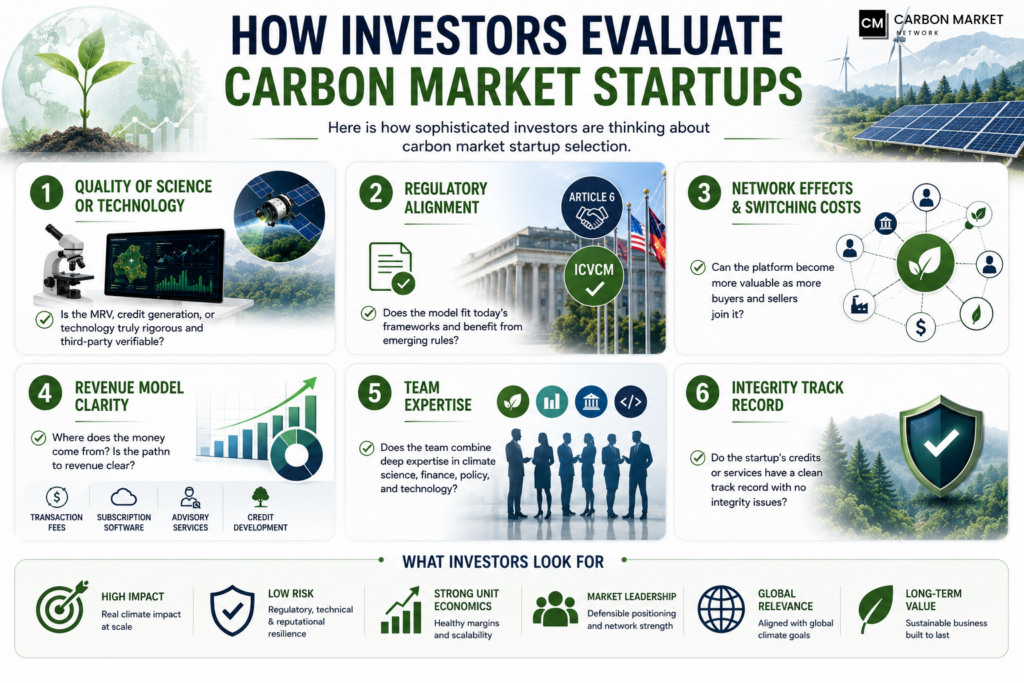
If you are an investor looking at this sector, or a founder raising capital, here is how sophisticated investors are thinking about carbon market startup selection.
Quality of the underlying science or technology. Investors ask whether the startup’s approach to MRV, credit generation, or trading infrastructure is genuinely rigorous. Does it hold up under third-party scrutiny?
Regulatory alignment. Does the business model work within existing frameworks, and is it positioned to benefit from the rules being built under Article 6 and ICVCM?
Network effects and switching costs. The best carbon market platforms become more valuable as more buyers and sellers use them. Investors look for platforms with the potential to create strong network effects.
Revenue model clarity. Carbon market startups need a credible answer to “where does the money come from?” Whether through transaction fees, subscription software, advisory services, or credit development economics, the path to revenue must be clear.
Team expertise. Carbon markets sit at the intersection of climate science, financial markets, policy, and technology. The strongest founding teams typically combine expertise across several of these domains.
Integrity track record. Given the greenwashing scandals that have hit the sector, investors scrutinize whether a startup’s credits or services have faced any integrity challenges.
The Future of Carbon Market Startups: What Comes Next
The carbon market startup ecosystem is still in its early chapters. Here is what the next few years are likely to bring.
Scaling Compliance Carbon Markets
As more countries and regions expand mandatory carbon pricing, compliance markets will grow dramatically. The EU ETS is already the world’s largest carbon market by value. China’s national ETS is the world’s largest by volume. More markets are coming in Latin America, Southeast Asia, and Africa.
Carbon market startups that build compliance-ready infrastructure, credit registries, and trading platforms will have a growing global opportunity.
Article 6.4 Going Live
The UN-supervised carbon crediting mechanism under Article 6.4 is expected to begin issuing its first credits in 2025 and 2026. When fully operational, this mechanism will open international carbon markets to corporations directly, not just governments.
This is a significant unlock for voluntary market startups. Companies that have already built relationships with project developers, buyers, and registries will be well-positioned to capture the first wave of Article 6.4 activity.
AI-Powered Carbon Management at Scale
AI is not just improving MRV. It is reshaping every part of the carbon market value chain: from identifying the best locations for nature-based project development, to predicting credit prices, to automating corporate emissions reporting.
As AI capabilities improve, carbon market startups that embed AI deeply into their offerings will achieve significant cost and quality advantages over competitors.
The Rise of Carbon as an Asset Class
Institutional investors are beginning to treat high-quality carbon credits as a genuine asset class, comparable to commodities or infrastructure investments.
Bloomberg reported record-breaking credit retirements and unprecedented capital inflows in 2025, with more than USD 10 billion committed to new carbon credit generation, three times the 2024 level.
As carbon becomes a more liquid, transparent, and regulated asset, fund managers, ETF providers, and retail investment platforms will build carbon-specific products. This creates further demand for the infrastructure and rating tools that carbon market startups are building.
Actionable Takeaways for Founders, Investors, and Climate Professionals
Whether you are building, investing in, or working alongside carbon market startups, here are the most important things to take away from this overview.
- Focus on quality over volume. The market is moving decisively toward high-integrity credits. Build or invest in solutions that prioritize transparency and verification.
- Watch the Article 6.4 timeline closely. The first issuances of UN-authorized carbon credits will be a major market event. Positioning around this now gives you a first-mover advantage.
- Understand the technology stack. The best carbon market startups combine domain expertise (climate science, policy, markets) with strong technology (AI, remote sensing, blockchain). Neither alone is sufficient.
- Track regulatory developments in your target markets. CBAM, CSRD, ICVCM CCPs, and Article 6 bilateral agreements are all shaping where and how carbon markets operate. Regulatory fluency is a genuine competitive advantage.
- Expect consolidation. The Pachama-Carbon Direct deal is unlikely to be the last. Whether you are a founder thinking about exit strategy or an investor thinking about portfolio construction, the wave of M&A in this sector has just begun.
- Build for institutional buyers. The biggest growth in carbon credit demand is coming from corporations with sophisticated procurement teams and from institutional investors. Solutions that meet institutional requirements for data, documentation, and auditability will win.
Conclusion: Why Carbon Market Startups Deserve Your Attention
The rise of carbon market startups is not a trend driven by optimism alone. It is backed by regulatory mandates, institutional capital, technological innovation, and a growing recognition that carbon pricing is one of the most powerful tools available for addressing climate change.
The global carbon credit market sits at over USD 114 billion in 2025 and is on a trajectory that could take it past USD 480 billion within a decade. Carbon market startups are building the infrastructure, tools, and platforms that will make this market function at scale.
From Sylvera’s AI-powered credit ratings to Xpansiv’s global trading exchange, from GaiaSwap’s decentralized blockchain platform to Carbon Direct’s science-led advisory, these companies are proving that profitable business models and genuine climate impact can coexist.
For investors, the window to back foundational infrastructure in this space is still open but narrowing.
For founders, the combination of policy tailwinds, unmet market needs, and growing corporate demand creates a rare opportunity to build category-defining companies.
And for climate professionals and informed observers, carbon market startups represent one of the most dynamic and consequential sectors in the global economy today.
Explore more insights on carbon markets, startups, and climate finance at Carbon Market Network.
Frequently Asked Questions About Carbon Market Startups
What is a carbon market startup?
A carbon market startup is a company that builds products, platforms, or services that operate within or support the trading, verification, measurement, or development of carbon credits. This includes carbon trading platforms, rating agencies, carbon accounting software, project developers, and blockchain-based credit registries.
Why are investors interested in carbon market startups?
Investors see carbon market startups as early-stage opportunities in a sector with powerful regulatory tailwinds, growing corporate demand for carbon credits, and the potential to build foundational financial infrastructure. The voluntary carbon credit market alone is projected to grow at over 20% CAGR through 2030.
What is the difference between voluntary and compliance carbon markets?
Compliance markets are legally required. Companies must hold carbon credits to cover their regulated emissions, as in the EU ETS. Voluntary markets are optional, where companies buy credits to meet self-imposed climate or net-zero commitments.
How do carbon market startups make money?
Revenue models vary. Trading platforms charge transaction or listing fees. Rating and analytics platforms charge subscription fees to corporate buyers and institutional investors. Carbon project developers earn revenue by selling the credits their projects generate. Advisory firms charge consulting fees. Software platforms charge SaaS subscriptions for emissions accounting and reporting tools.
What is MRV in carbon markets?
MRV stands for Monitoring, Reporting, and Verification. It is the process of measuring how much carbon a project actually reduces or removes, reporting that data accurately, and having an independent third party verify the claims. Startups using AI and satellite technology are making MRV faster, cheaper, and more reliable.
Are carbon market startups risky investments?
Like any emerging market sector, carbon market startups carry risks including regulatory uncertainty, credit integrity challenges, market fragmentation, and liquidity constraints. However, investors with a long-term view who back startups with strong science, regulatory alignment, and proven team expertise can find significant opportunities.
What role does Article 6 of the Paris Agreement play?
Article 6 provides the international framework for countries to cooperate on carbon markets. Its finalization at COP29 in 2024 cleared the path for international carbon credit trading at scale. Article 6.4 in particular creates a UN-supervised crediting mechanism expected to begin issuing credits in 2025 and 2026, which will open the market significantly to corporate participation.
Which carbon market startup sectors attract the most investment?
In 2025 and 2026, the highest investor interest has been in carbon credit marketplaces and exchanges, AI-powered MRV and verification platforms, carbon removal technology, and carbon accounting software. Companies with strong institutional adoption and regulatory alignment are attracting the largest rounds.
What is the Integrity Council for the Voluntary Carbon Market (ICVCM)?
The ICVCM is an independent governance body that sets quality standards for voluntary carbon markets through its Core Carbon Principles (CCPs). Its approval process is designed to identify which carbon credit programs meet a rigorous integrity threshold, helping buyers and investors distinguish high-quality credits from low-quality ones.
How can I learn more about carbon market startups and climate finance?
You can explore in-depth resources, market updates, and analysis at Carbon Market Network, a dedicated platform for professionals and investors tracking the evolution of carbon markets worldwide.