Carbon Market Network


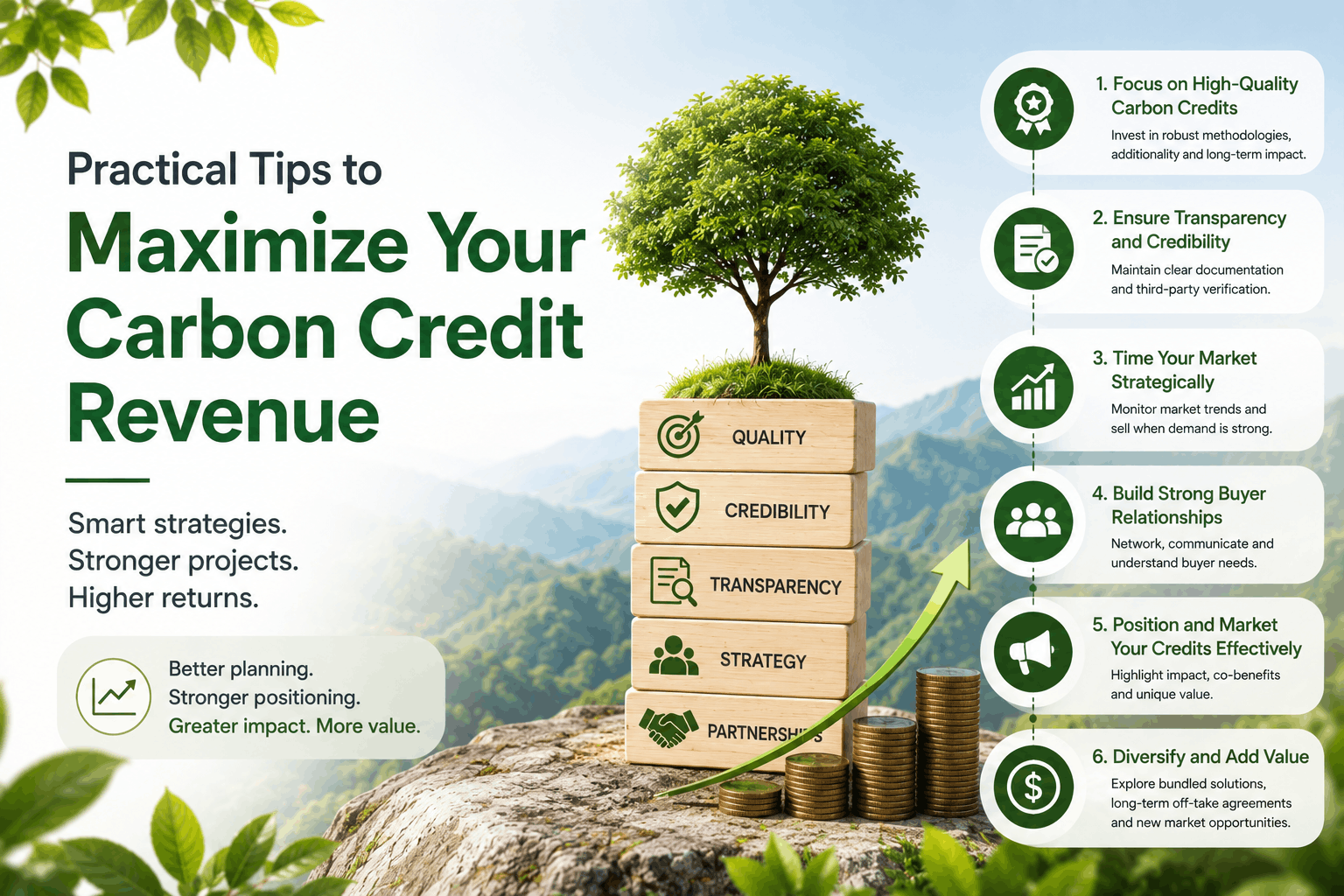
You worked hard to develop a carbon project. You went through the baseline studies, the validation process, and the verification audits. And now you want to make sure you are getting the best possible price for your credits.
The good news is that the carbon market has matured significantly. High-quality credits now command premiums that were unimaginable a few years ago. The gap between a top-tier credit and a low-quality one can be more than 300% in some project categories.
The not-so-good news is that doing things halfway will cost you. A lot.
This guide gives you practical, actionable tips to maximize your carbon credit revenue — whether you are a project developer, landowner, farmer, or investor entering the voluntary carbon market (VCM) for the first time.
Why Carbon Credit Revenue Varies So Much
Before we get into the tips, it helps to understand why two projects of the same type can earn wildly different prices.
The voluntary carbon market is no longer one market. It has split into two distinct tiers.
Tier 1 includes high-integrity credits with verified co-benefits, robust methodology, and strong third-party ratings. These credits command premium prices.
Tier 2 includes lower-quality avoidance credits, older vintage credits, and projects with weak verification. These sell at steep discounts.
The price gap between the two tiers keeps widening. High-rated credits (A to AAA) have averaged more than four times the price of low-rated ones (CCC to B). BBB+ rated afforestation, reforestation, and revegetation (ARR) projects now command median prices above $35, while lower-rated equivalents trade below $20.
This bifurcation is the single most important thing to understand about the modern carbon market. Your revenue depends almost entirely on which tier your credits fall into.
Carbon Market Insider Newsletter
Weekly insights on carbon markets, climate policy, carbon credits, and sustainability.
Tip 1: Prioritize Project Quality Above Everything Else
This is not just advice. It is the foundation of your entire revenue strategy.
The market has moved decisively from volume to quality. Buyers no longer chase cheap credits. They actively screen for high-integrity projects and are willing to pay a significant premium for them.
What makes a carbon project “high quality”?
| Quality Factor | What It Means | Revenue Impact |
|---|---|---|
| Additionality | The project would not have happened without carbon finance | Critical — without this, buyers walk away |
| Permanence | Emission reductions are long-lasting and protected | High — especially for nature-based solutions |
| Verification | Independent, rigorous third-party auditing | High — unverified claims kill your price |
| Measurability | Clear, quantifiable emission reductions | Medium-High — data-backed projects earn more |
| Transparency | Full data disclosure to buyers | High — opacity raises buyer risk perception |
| Co-benefits | Biodiversity, community, and SDG outcomes | Growing — now priced into premium credits |
When you invest in quality from the start, you do not just earn more per credit. You also attract better buyers, build longer-term relationships, and face less risk of project invalidation or credit cancellation.
Start With the Right Methodology
Your methodology determines how your credits are calculated and verified.
Choose a methodology that is approved by your standard and, if possible, recognized by the ICVCM (Integrity Council for the Voluntary Carbon Market). Methodologies that carry the CCP-eligible designation are increasingly preferred by corporate buyers and auditors.
If your methodology is outdated or has been flagged for overcounting, your credits will sell at a discount. Some older methodologies have been rejected entirely by large corporate buyers.
Before you finalize your project design, confirm that:
- Your methodology is currently approved by Verra, Gold Standard, or your chosen standard
- The methodology has not been suspended or revised in a way that could affect your credit count
- Your baseline emissions calculation uses conservative, defensible assumptions
Tip 2: Get Rated by an Independent Carbon Rating Agency
One of the most impactful things you can do to maximize your carbon credit revenue is to have your project rated by a recognized third-party rating agency.
The market now works much like the bond market. Just as investors look at Moody’s or S&P ratings before buying bonds, corporate buyers look at carbon credit ratings before purchasing offsets.
The two most widely used rating agencies in the voluntary carbon market are:
- Sylvera — uses satellite imagery, machine learning, and scientific models to rate projects on a scale from AAA to D
- BeZero Carbon — rates projects on a similar scale, widely used by procurement teams
Research from Patch shows that around 79% of corporate buyers now require BeZero BBB or higher, and 83% require Sylvera Tier 2 or higher before completing a purchase.
If your project does not have an independent rating, many large buyers will simply not consider it. They cannot justify the reputational or regulatory risk.
What a good rating does for your revenue:
- Unlocks access to premium-paying corporate buyers
- Reduces the buyer’s perceived risk, allowing you to command a higher price
- Gives you a competitive edge in broker and marketplace listings
- Makes your project more attractive for long-term offtake agreements (more on that below)
Getting rated costs money, but it consistently pays for itself many times over in the premium pricing it unlocks.
Tip 3: Pursue the CCP Label From the ICVCM
If getting an independent rating is step one in signaling quality, getting the CCP label from the Integrity Council for the Voluntary Carbon Market (ICVCM) is step two.
The CCP (Core Carbon Principles) label is the gold standard for carbon credit integrity. It is awarded to credits that meet the ICVCM’s rigorous assessment framework, which covers ten core principles including additionality, permanence, no double counting, and sustainable development contributions.
Why the CCP label matters for your revenue:
Governments and regulators are aligning with CCPs. They are being integrated into national emissions trading systems, carbon taxes, and Article 6 frameworks under the Paris Agreement. Credits without the label are increasingly seen as higher-risk assets by auditors, investors, and legal teams.
The EU’s Empowering Consumers Directive, entering force in late 2026, bans generic “climate neutral” claims based on unverified offsetting. This regulation alone is pushing large European corporates to demand CCP-eligible or CCP-labeled credits.
If your project operates under Verra (VCS) or Gold Standard, check whether your specific methodology category has received CCP assessment. If it has, work with your standard to ensure your project can issue CCP-labeled credits.
Projects with CCP-labeled credits are positioned to earn significantly more from buyers who need audit-ready, regulatory-proof offsets.
Tip 4: Stack Co-Benefits to Unlock Premium Pricing
Co-benefits are the additional social and environmental outcomes your project generates beyond carbon.
They include things like:
- Biodiversity conservation and habitat restoration
- Employment and income generation for local communities
- Clean water access
- Gender equity support
- Alignment with the UN Sustainable Development Goals (SDGs)
For years, co-benefits were treated as a “nice to have.” That has fundamentally changed.
Data from Calyx Global and ClearBlue Markets shows that high-integrity Tier 1 carbon credits — which typically include stronger co-benefits — now sell at an average 65% price premium compared to Tier 3 credits.
ARR projects with a high co-benefit score have seen their average prices jump from $19 to over $30 within a short period. Projects supporting biodiversity in endangered ecosystems and community health programs in low-income countries earn the strongest premiums.
How to Maximize Co-Benefit Value
Step 1: Identify the co-benefits your project naturally generates. A reforestation project in a biodiversity hotspot, for example, generates significant habitat value.
Step 2: Get those co-benefits independently verified. Self-reported co-benefits carry little weight. Verified co-benefits through schemes like the Climate, Community and Biodiversity (CCB) standard or the SD Vista (Sustainable Development Verified Impact Standard) carry real pricing power.
Step 3: Explore credit stacking or bundling. Stacking means issuing separate carbon and biodiversity credits from the same project area, allowing you to sell each to a different buyer. Bundling means embedding biodiversity value into a single, premium-priced carbon credit.
Stacking is currently about three times as popular as bundling in the market, giving you more flexibility in how you monetize your project’s full environmental value.
Tip 5: Time Your Credit Sales Strategically
Not all timing is equal in the carbon market. When you sell your credits can meaningfully affect the price you receive.
Understand Vintage Preferences
A “vintage” refers to the year in which your emission reductions were achieved or verified.
Newer vintages generally attract higher prices in the spot market. Corporate buyers often have reporting requirements that favor recent vintages. Some compliance schemes, like CORSIA for aviation, enforce vintage eligibility rules that restrict how old credits can be.
Key vintage insights for sellers:
| Vintage Strategy | Situation | Outcome |
|---|---|---|
| Hold newer credits | Market prices are rising and supply is tight | Higher spot price later |
| Sell older credits soon | Buyer’s reporting window may exclude them later | Avoid future liquidity risk |
| Mix vintages in a portfolio | Buyers want diversified supply | Negotiate package deals |
| Verify promptly | Delays can age your credits before sale | Maximize market relevance |
One practical note: verification backlogs are real. Projects sometimes issue credits for older vintages due to verification timelines. A 2023 emission reduction that is not verified until 2025 can still carry its 2023 vintage. In that case, the credit’s underlying environmental value is real, but you may need to price it at a small discount versus a freshly verified 2025 credit.
The best advice is to begin the verification process as early as possible to minimize the gap between when reductions occur and when credits are issued.
Watch Market Cycles
The carbon market has clear seasonal patterns. Corporate buyers often make large purchases before their fiscal year ends or ahead of sustainability reporting deadlines. If your credits are ready to sell, timing them to coincide with this demand can meaningfully improve the price you receive.
Work with a broker or marketplace to understand the demand calendar in your target buyer segment.
Tip 6: Lock In Long-Term Revenue With Offtake Agreements
One of the most powerful strategies for maximizing your carbon credit revenue is moving away from spot market sales and into long-term offtake agreements.
An offtake agreement is a long-term contract between your project and a buyer. The buyer commits to purchasing a set volume of credits over a defined period, typically five to fifteen years, at an agreed price.
In a single recent period, companies signed roughly $12.25 billion in carbon offtake agreements, according to Sylvera. This is more than twelve times the value of credits retired on the spot market in the same period. The signal is unmistakable: serious corporate buyers have stopped treating carbon credits as a year-end purchase and started contracting supply years in advance.
Why Offtake Agreements Benefit Project Developers
Financial security: Contracted revenue allows you to secure early-stage financing. Banks and investors are far more willing to fund a project with bankable offtake agreements than one that relies entirely on spot market sales.
Price certainty: You lock in a price before market volatility can work against you.
Relationship building: Long-term buyers become partners, not just customers. This creates opportunities for upselling co-benefit credits and expanding your project.
Scale: With guaranteed revenue, you can confidently invest in expanding your project, improving monitoring systems, and generating more credits over time.
Types of Carbon Purchase Contracts
| Contract Type | Duration | Price Structure | Best For |
|---|---|---|---|
| Spot purchase | Immediate | Current market price | Small volumes, immediate needs |
| Forward contract | 1 to 5 years | Fixed or floating price | Near-term revenue certainty |
| Offtake agreement | 5 to 15 years | Fixed, escalating, or indexed | Large projects needing capital |
| Take-or-pay contract | 5 to 15 years | Buyer pays regardless of delivery | Maximum revenue certainty for developers |
Take-or-pay contracts offer the strongest revenue guarantee and are common where developers need contracted cash flow to secure project financing. If you can negotiate a take-or-pay structure, it dramatically reduces the financial risk of your project.
Forward prices in the market for durable removal credits can be significantly higher than spot prices. Offtake agreements signed for high-quality removal credits have implied average prices well above $100 per credit, reflecting the scarcity and long-term value of durable carbon removal.
Tip 7: Choose the Right Standard and Registry
Not all carbon standards are equal in the eyes of buyers, and your choice of standard directly affects how much you can charge for your credits.
The most widely recognized standards in the voluntary carbon market are:
- Verra (Verified Carbon Standard / VCS): The largest by volume, covering a wide range of project types
- Gold Standard: Highly respected, particularly for projects with strong SDG co-benefits; often commands a price premium
- American Carbon Registry (ACR): Strong in North American markets
- Climate Action Reserve (CAR): Widely accepted in compliance and voluntary markets
- Puro.earth: Specialist standard for engineered carbon removal; sets the benchmark for biochar, concrete mineralization, and similar technologies
Gold Standard credits often command a premium because of their rigorous verification of SDG impacts. Puro.earth sets the pricing benchmark for high-durability engineered removals, where prices can reach hundreds of dollars per credit.
Verra remains the largest by volume but requires careful project-level due diligence. A Verra credit from a highly rated project trades very differently from a Verra credit from a poorly rated one.
Before choosing your standard:
- Research which standards your target buyers prefer
- Check whether your project type is eligible under multiple standards
- Understand the cost and timeline of each standard’s verification process
- Confirm whether the standard’s methodologies are CCP-eligible
If your project type qualifies under a premium standard like Gold Standard or Puro.earth, the investment in that certification is almost always worth it for the pricing power it creates.
Tip 8: Build Buyer Relationships Directly
Many project developers sell their credits through brokers or carbon marketplaces. This is a valid strategy, but it comes with a cost — the intermediary margin.
More importantly, direct buyer relationships allow you to:
- Negotiate better prices based on your project’s specific attributes
- Understand exactly what buyers value, so you can emphasize the right features
- Build repeat business and long-term contracts
- Receive feedback that helps you improve your project’s market positioning
How to Find Direct Carbon Credit Buyers
Corporate sustainability teams: Large companies with net-zero commitments are actively looking for high-quality credits. Reach out to their sustainability or procurement teams directly.
Industry events: Carbon market conferences, UNFCCC meetings, and sustainability forums bring buyers and sellers together. These events are where offtake deals often begin as conversations.
Carbon market platforms: Platforms like Xpansiv, CBL, and South Pole’s marketplace list projects and connect them with buyers. Even if you use a platform, building relationships beyond the transaction is valuable.
Respond to RFPs (Requests for Proposals): Many large corporate buyers issue formal RFPs for carbon credits. Responding with detailed project documentation, independent ratings, and co-benefit data gives you a strong competitive position.
When you talk to buyers, focus on what they need. Some prioritize biodiversity. Others prioritize supply chain alignment. Some need specific SDG outcomes for their ESG reporting. Tailor your pitch to the buyer’s stated goals.
Tip 9: Invest in Monitoring, Reporting, and Verification (MRV)
Your MRV system is not just a compliance requirement. It is a revenue tool.
Projects with rigorous, technology-backed MRV systems demonstrate transparency and accountability. This reduces buyer risk perception and directly supports premium pricing.
The market is moving toward more data-driven MRV. Satellite imagery, machine learning, IoT sensors, and remote sensing tools are now being used to monitor project performance in near-real time. Projects that use these technologies generate higher-quality data, which supports:
- More accurate credit issuance
- Faster verification timelines
- Higher confidence in credit permanence
- Better ratings from independent rating agencies
What strong MRV includes:
- Baseline emissions data collected with clear methodology
- Ongoing monitoring of actual emissions reductions or removals
- Third-party verification on a regular schedule (typically annual or every two years)
- Public disclosure of monitoring reports in your standard’s registry
- Satellite or sensor data to supplement on-the-ground measurements
If your current MRV system relies entirely on manual, on-the-ground data collection, explore whether integrating remote sensing could improve both your verification speed and the quality of your data.
Faster verification means credits reach the market sooner. Better data means fewer credit issuance disputes. Both outcomes directly protect your revenue.
Tip 10: Diversify Your Project Portfolio
If you develop or invest in multiple carbon projects, diversification is a core revenue protection strategy.
Different project types perform differently in different market conditions. A diversified portfolio helps you smooth out price volatility, reduce concentration risk, and serve a broader range of buyers.
| Project Type | Key Revenue Characteristics |
|---|---|
| REDD+ (Avoided Deforestation) | High volume, but quality scrutiny is intense; rated projects command strong prices |
| ARR (Afforestation / Reforestation / Revegetation) | Strong co-benefit potential; recent price growth for high-rated projects |
| Improved Forest Management (IFM) | Stable demand from North American buyers; good for long-term offtake |
| Soil Carbon / Regenerative Agriculture | Growing interest; near-term measurement challenges being solved with tech |
| Biochar | Engineered removal; permanence of centuries; high per-credit price ($100+) |
| Direct Air Capture (DAC) | Ultra-premium removal; high cost but extremely high per-credit prices |
| Methane Capture | Compliance and voluntary demand; stable revenue with strong additionality |
| Mangrove / Blue Carbon | Emerging premium category; strong biodiversity and SDG co-benefits |
Nature-based solutions currently dominate voluntary carbon market demand, accounting for around 46% of buyer interest. However, technology-based removals like biochar, enhanced weathering, and direct air capture command the highest per-credit prices because of their permanence and scalability.
If you are building a carbon project portfolio, a combination of nature-based solutions (for volume and co-benefits) and technology-based removals (for premium pricing) gives you the strongest overall revenue position.
Tip 11: Understand and Leverage Article 6 of the Paris Agreement
Article 6 of the Paris Agreement creates a framework for countries to trade carbon credits with each other to meet their national climate commitments (called Nationally Determined Contributions or NDCs).
This is relevant to your revenue in two ways.
First, projects that generate credits eligible for use under Article 6 frameworks (particularly Article 6.4, the UN-supervised carbon mechanism) may command higher prices from sovereign buyers and from companies operating in Article 6-linked compliance markets.
Second, understanding corresponding adjustments is critical. When a host country applies a corresponding adjustment to a carbon credit, it removes that tonne from the country’s own national accounting. This makes the credit more valuable for international buyers who need credits that fully count toward global climate targets.
Credits with corresponding adjustments are increasingly preferred by buyers who need to make credible, auditable climate claims. This is especially relevant for airlines under CORSIA, large multinationals subject to CSRD reporting, and companies operating in jurisdictions with strict green claims regulations.
Work with your standard and your host country government to understand whether corresponding adjustments are available for your project’s credits. This can be a meaningful revenue unlock, particularly for projects in countries that have established Article 6 bilateral agreements.
Tip 12: Use Brokers and Marketplaces Strategically (But Know Their Limits)
Brokers and carbon marketplaces serve a real purpose. They provide market access, price discovery, and transaction support. But they are tools, not strategies.
When brokers add clear value:
- You are new to the market and lack direct buyer relationships
- You have a large volume of credits that need to be placed quickly
- You want price discovery across multiple buyers simultaneously
- You need help structuring a complex offtake agreement
When to go direct instead:
- You have an established relationship with a buyer who understands your project
- You are negotiating a long-term offtake deal where personal trust matters
- Broker margins would materially erode your price per credit
Common marketplace platforms worth knowing:
- Xpansiv / CBL — the largest spot trading platform for voluntary carbon credits
- South Pole’s marketplace — broad project coverage with buyer matching
- Anew — specialist in North American voluntary and compliance credits
- Carbon Direct — buyer-side advisory, but valuable for understanding buyer requirements
Even when using a broker, maintain direct communication with buyers where possible. The strongest carbon credit revenue strategies combine professional brokerage with genuine buyer relationships.
Tip 13: Document and Communicate Your Project’s Story
Buyers do not just purchase carbon credits. They purchase confidence that the climate impact is real, the community benefits are genuine, and the project will last.
Your project’s story is a revenue asset.
High-quality project documentation and storytelling can justify premium pricing, particularly when selling to:
- Consumer-facing brands that publicize their sustainability claims
- Companies under public ESG scrutiny
- Impact investors who want to demonstrate tangible environmental outcomes
What strong project documentation includes:
- Project Design Document (PDD): Detailed, transparent, and publicly available in your registry
- Verification reports: Published and current, with a clear verification schedule
- Co-benefit evidence: Third-party verified data on biodiversity, community outcomes, and SDG contributions
- Monitoring reports: Showing real performance against projections
- Independent ratings: BeZero, Sylvera, or Calyx Global ratings with supporting data
- Case studies and impact reports: Photos, community interviews, satellite before-and-after imagery
A well-documented project tells buyers exactly what they are purchasing. It reduces due diligence time, builds confidence, and makes it much easier to justify a premium price in a negotiation.
Common Mistakes That Reduce Carbon Credit Revenue
Avoiding these mistakes is just as important as implementing the tips above.
| Mistake | Why It Costs You | What to Do Instead |
|---|---|---|
| Choosing a cheap methodology | Low credit quality, buyer rejection | Invest in a rigorous, CCP-eligible methodology |
| Skipping independent ratings | Large buyers will not purchase | Budget for BeZero or Sylvera rating |
| Selling only on the spot market | Miss out on long-term premium pricing | Pursue offtake agreements |
| Overcounting credits | Registry cancellations destroy value | Use conservative baseline assumptions |
| Ignoring co-benefits | Miss out on growing premium tier | Verify and market your SDG contributions |
| Selling old vintages last | Buyers may exclude them | Monitor vintage restrictions by buyer |
| No direct buyer relationships | Always dependent on broker margins | Build a buyer pipeline in parallel |
| Poor MRV documentation | Slow verification, disputed credits | Invest in strong monitoring from day one |
What Buyers Actually Pay: A Realistic Price Reference
Understanding the price landscape helps you set revenue expectations and know when a buyer’s offer is below market.
| Credit Type | Approximate Price Range |
|---|---|
| Low-rated avoidance credits (legacy) | $3 to $7 per tonne |
| Average voluntary market credit (all types) | $6 to $15 per tonne |
| High-rated nature-based credits (A/AA rated) | $15 to $35+ per tonne |
| ARR credits with high co-benefit scores | $25 to $40+ per tonne |
| Gold Standard credits with SDG co-benefits | $15 to $50 per tonne |
| Biochar credits (Puro, Verra certified) | $100 to $300+ per tonne |
| Direct Air Capture (DAC) credits | $300 to $1,000+ per tonne |
| Forward offtake prices for removal credits | $80 to $160+ per tonne |
These are approximate ranges. Actual prices depend on project quality, rating, vintage, volume, and buyer type. The key takeaway: the market rewards quality with a premium that can be 4x to 10x higher than the lowest-quality tier.
Frequently Asked Questions (FAQs)
Q: What is the most important factor in maximizing carbon credit revenue?
Project quality is the single most important factor. A high-integrity project with verified co-benefits, an independent rating, and a CCP-eligible methodology will consistently earn far more per credit than a lower-quality project, regardless of project type.
Q: Do co-benefits really affect the price of carbon credits?
Yes, significantly. Research shows that Tier 1 credits with strong co-benefits sell at an average 65% premium over Tier 3 credits. Projects with biodiversity, community health, and gender equity co-benefits consistently attract higher prices from corporate buyers.
Q: Is it better to sell carbon credits on the spot market or through offtake agreements?
For long-term revenue maximization, offtake agreements are almost always better for project developers. They provide price certainty, enable project financing, and build buyer relationships. The spot market is useful for placing smaller volumes quickly, but it exposes you to price volatility.
Q: How does the ICVCM CCP label affect my carbon credit price?
The CCP label significantly improves buyer confidence and access. As regulators push companies to prove the integrity of their offsets, credits with CCP-eligible or CCP-labeled status are becoming the preferred choice for large corporate buyers. This preference supports premium pricing.
Q: What are the best carbon credit standards for premium pricing?
Gold Standard is known for commanding premiums due to its rigorous SDG verification. Puro.earth sets the pricing benchmark for engineered removals like biochar. Verra (VCS) is the largest by volume and can also support premium pricing when combined with an independent rating and CCP-eligible methodology.
Q: How does vintage affect carbon credit revenue?
Newer vintages generally fetch higher prices on the spot market. Some compliance programs restrict buyers to credits issued within the past five years. As a project developer, aim to verify and issue credits as promptly as possible after emission reductions occur.
Q: Can a small carbon project compete with large developers in terms of pricing?
Yes. Price is driven by quality, not size. A well-designed, independently rated small project can command higher per-credit prices than a large but poorly rated one. Focus on quality, co-benefits, and direct buyer relationships, and size becomes less of a disadvantage.
Q: What is credit stacking and how does it increase revenue?
Credit stacking means issuing separate credits for different ecosystem services from the same project land. For example, a reforestation project can issue carbon credits and biodiversity credits separately, selling each to different buyers. This allows you to monetize the full value of your project’s environmental impact.
Final Thoughts: Revenue Follows Integrity
The carbon market’s most important lesson of recent years is this: integrity and revenue are not in tension. They move together.
The projects earning the highest prices per credit are not the ones that cut corners on methodology or skipped the verification process. They are the ones that invested in quality from the start, pursued independent ratings, documented their co-benefits, and built real relationships with serious buyers.
If you focus on building a carbon project that genuinely delivers what it promises, you will find that the premium pricing follows naturally.
The tips in this guide are not theoretical. They reflect what the market is actually rewarding right now. Use them to position your project at the top of the quality tier — and maximize your carbon credit revenue in the process.
Looking to learn more about carbon markets and carbon credit strategies? Explore the full library of resources at Carbon Market Network.