Carbon Market Network


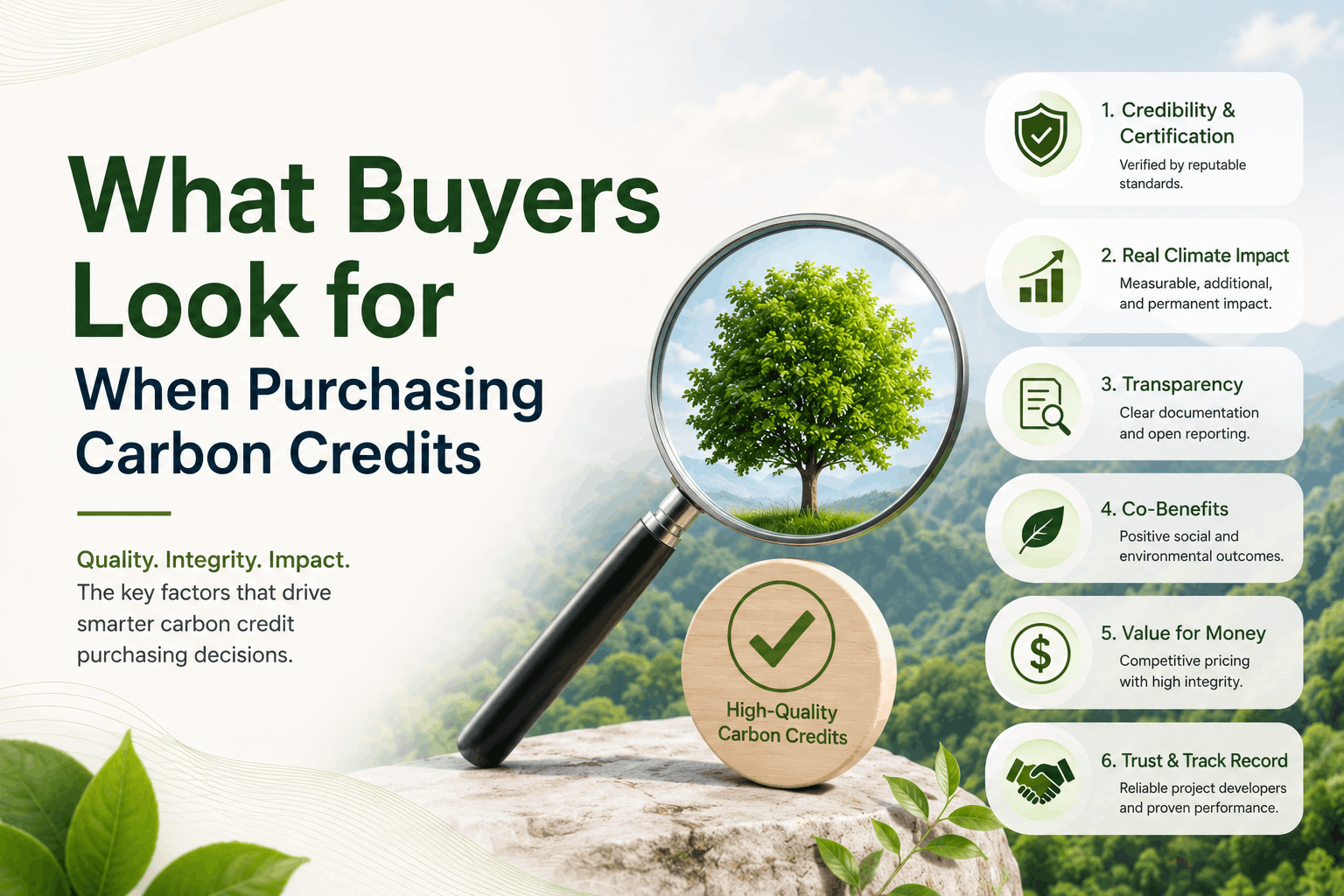
Carbon credit buyers today are not just checking a compliance box.
They are making strategic decisions that directly affect their company’s reputation, sustainability claims, and long-term climate goals. The wrong purchase can lead to greenwashing accusations, wasted budgets, and credits that regulators or investors simply will not accept.
So what separates a smart carbon credit purchase from a risky one?
This guide breaks down exactly what buyers look for when purchasing carbon credits — from the most basic quality checks to the advanced criteria that sophisticated corporate buyers now demand.
Whether you are new to carbon markets or looking to sharpen your procurement strategy, this article gives you a clear, practical, and up-to-date picture of how modern buyers think and what they prioritize.
Why Carbon Credit Quality Has Become the Central Issue
For years, the voluntary carbon market had a serious problem: buyers purchased carbon credits based mostly on price and marketing claims, with very little independent verification of whether those credits actually represented real climate impact.
That era is over.
Media investigations, academic studies, and NGO reports exposed a wave of low-quality credits — particularly in forestry — where the actual climate benefit was a fraction of what was claimed. This triggered a sharp drop in market confidence and forced buyers to become far more rigorous.
Today, the market has split clearly in two directions. Low-quality credits struggle to find buyers at any price. High-quality credits, on the other hand, command significant premiums and are often sold out before they are even issued.
The lesson is simple: quality is now the most important thing buyers look for when purchasing carbon credits.
Carbon Market Insider Newsletter
Weekly insights on carbon markets, climate policy, carbon credits, and sustainability.
The Core Criteria: What Every Buyer Checks First
Before getting into project preferences, co-benefits, and pricing strategy, every serious buyer starts with a set of fundamental quality checks. These are the non-negotiables.
1. Additionality
Additionality is the single most important quality criterion in carbon markets.
A carbon credit is “additional” if the emissions reduction or removal would not have happened without the funding from carbon credit sales. If a project would have proceeded anyway — because it was profitable, legally required, or already planned — then the credit it generates does not represent real additional climate action.
Buyers check additionality by reviewing project methodology, baseline assessments, and regulatory context.
A simple way to think about it: if a wind farm is already profitable without carbon credits, the credits it sells are not truly additional. A wind farm in a remote location that only becomes financially viable because of carbon credit revenue is a much stronger case.
2. Permanence
Permanence refers to how long the carbon is stored.
For a credit to have real climate value, the carbon it represents must stay out of the atmosphere for a meaningful period. This matters most for nature-based projects like forests, where fire, disease, or deforestation can release stored carbon back into the atmosphere.
Buyers ask:
- How long does the project commit to protecting the carbon it claims to store?
- What happens if the forest burns down or the project collapses?
- Is there a buffer pool or insurance mechanism to cover reversals?
Projects with strong permanence protections — such as a buffer reserve of extra credits set aside to compensate for future losses — score much higher with buyers.
Engineered removal solutions like biochar and direct air capture are increasingly attractive to buyers precisely because they offer permanent or very long-duration carbon storage.
3. Robust Quantification
Buyers want confidence that the number on the credit is accurate.
If a project claims to have avoided 100,000 tonnes of CO2 emissions, how was that figure calculated? Is the methodology conservative? Does it account for uncertainty? Was it independently reviewed?
Overstated emission reductions are one of the biggest problems the carbon market has faced. Buyers now look for:
- Conservative baseline scenarios
- Transparent calculation methodologies
- Third-party verification of the numbers
- Monitoring plans that continue throughout the project’s life
A credit that says “100,000 tonnes” but was calculated using optimistic assumptions is worth far less than a conservatively quantified credit that truly delivers on its number.
4. No Double Counting
Double counting means the same tonne of CO2 reduction is claimed by more than one party.
This can happen in several ways. A project developer might sell the same credit to two buyers. Or both the country where the project is located and the buyer’s company might claim the same emissions reduction — once in the national carbon inventory and once in the buyer’s corporate reports.
Buyers now look carefully at whether credits carry a corresponding adjustment under Article 6 of the Paris Agreement. This adjustment ensures that when a buyer claims a credit, the host country removes that reduction from its own national inventory — so only one party gets to count it.
This is becoming a major procurement criterion, especially for aviation buyers under CORSIA and for companies facing strict ESG disclosure requirements.
5. Independent Third-Party Verification
A project developer cannot simply verify their own credits. That is like marking your own exam.
All credible carbon credits go through a process where an accredited third-party organization — called a Validation and Verification Body (VVB) — independently reviews whether the project meets the required standard and whether the claimed reductions are real.
Buyers check:
- Which VVB verified the project?
- Is that VVB accredited and in good standing?
- Was the verification report publicly released?
- When was it last updated?
A credit without a credible, publicly available verification report is a major red flag.
The Role of Standards and Certifications
Carbon credit standards set the rules that projects must follow. Think of them as the rulebook that determines whether a project can issue credits and how those credits are calculated.
Buyers overwhelmingly prefer credits from recognized, established standards. Purchasing outside of a reputable standard exposes buyers to enormous reputational and financial risk.
The Major Carbon Credit Standards
| Standard | Operator | Key Focus | Registry |
|---|---|---|---|
| Verified Carbon Standard (VCS) | Verra | Broad project types; largest volume | Verra Registry |
| Gold Standard | Gold Standard Foundation | Strong SDG co-benefits; community impact | Gold Standard Registry |
| American Carbon Registry (ACR) | Winrock International | US-focused; CORSIA eligible | ACR Registry |
| Climate Action Reserve (CAR) | CAR | US regulatory standards; rigorous protocols | CAR Registry |
| Architecture for REDD+ Transactions (ART) | ART | Jurisdictional REDD+ | TREES Registry |
| Puro.earth | Puro | Engineered carbon removal | Puro Registry |
Buyers who want a baseline of confidence stick to credits from one of these recognized programs.
The ICVCM Core Carbon Principles (CCPs): The New Gold Standard
The Integrity Council for the Voluntary Carbon Market (ICVCM) has introduced a framework called the Core Carbon Principles (CCPs) — a set of ten criteria that define what a truly high-quality carbon credit looks like.
Programs that pass the ICVCM’s assessment can label their approved credits with a CCP label, signaling that those credits have met a rigorous, independent global quality benchmark.
The ten Core Carbon Principles fall into three categories:
Governance:
- Effective governance of the carbon-crediting program
- Transparency in project documentation and data
- Robust independent third-party validation and verification
- Registry infrastructure that prevents double issuance
Emissions Impact:
- Additionality (the reduction would not have happened without the project)
- Permanence (with compensation mechanisms for reversals)
- Robust and conservative quantification of emissions
- No double counting
Sustainable Development:
- Positive sustainable development benefits and social safeguards
- Contribution to net-zero transition without locking in high-carbon pathways
As of the latest market data, programs representing the vast majority of historical market volume have achieved CCP-Eligible status. These include Verra (VCS), Gold Standard, ACR, CAR, and ART.
Buyers increasingly use CCP approval as a minimum quality filter when evaluating credits.
Credit Type: Reduction, Avoidance, or Removal?
One of the most important decisions a buyer makes is choosing between different types of carbon credits.
Carbon Avoidance Credits
These come from projects that prevent emissions from entering the atmosphere in the first place.
Examples:
- Protecting a forest from being cut down (REDD+)
- Replacing fossil fuels with renewable energy in communities
- Capturing methane from landfills or agricultural operations
- Distributing clean cookstoves that replace wood fires
Avoidance credits are generally less expensive and are produced in larger volumes. They play an important role in funding climate action that delivers real-world benefits today.
Carbon Reduction Credits
These come from projects that reduce emissions from existing activities.
Examples:
- Energy efficiency improvements in industrial facilities
- Transitioning transport fleets to electric vehicles
- Reducing nitrous oxide emissions from agriculture
Carbon Removal Credits
These come from projects that actively pull CO2 out of the atmosphere and store it.
Examples:
- Reforestation and afforestation (nature-based)
- Biochar production (organic material converted to stable carbon)
- Enhanced weathering (accelerating natural rock weathering processes)
- Direct air capture (machines that pull CO2 from the air)
- BECCS (bioenergy with carbon capture and storage)
Removal credits are becoming the preferred choice for companies targeting true net-zero claims. Under the Science Based Targets initiative (SBTi) Corporate Net-Zero Standard, only carbon removal credits can be used to neutralize the residual emissions that remain after a company has reduced its footprint by roughly 90%.
The Price Reality
Removal credits are significantly more expensive than avoidance credits. Here is an indicative price comparison based on current market data:
| Credit Type | Indicative Price Range |
|---|---|
| Generic avoidance (nature-based) | $0.50 to $5 per tonne |
| High-quality nature-based removal | $15 to $35 per tonne |
| Biochar | $105 to $270 per tonne |
| Enhanced rock weathering | $200 to $400 per tonne |
| BECCS | $300 to $450 per tonne |
| Direct air capture | $125 to $1,000 per tonne |
Prices vary widely based on project quality, geography, certification tier, and market conditions. The message is clear: buyers who want durable, defensible removal credits pay a significant premium for them.
Vintage: Does the Age of the Credit Matter?
Carbon credit vintage refers to the year in which the emissions reduction or removal actually occurred.
For most buyers, vintage matters quite a bit — and here is why.
Recent vintages signal that the project is active, current, and aligned with today’s market standards. They also reduce the risk that the methodology used was outdated or that the project has since collapsed.
Older vintages — sometimes called “legacy credits” — can be much cheaper, but they carry higher scrutiny from auditors and ESG reviewers.
What buyers typically look for:
- Credits with a vintage that is no more than 3 to 5 years old
- Alignment between vintage and the year of planned retirement
- Consistency between vintage and corporate reporting periods
The premium for recent vintages is real. In recent market data, newer vintages have commanded prices that are more than double those of older credits from the same project type.
However, vintage alone does not determine quality. A high-quality older credit from a well-documented, actively monitored project can still outperform a recent credit from a poorly governed project.
Geography and Project Location
Where a project is located affects its quality, risk profile, and price.
Country risk matters. Projects in politically stable countries with strong rule of law, good governance, and reliable environmental monitoring carry lower risk of collapse, fraud, or policy reversal.
Buyer preferences by geography:
- Many European corporate buyers prefer OECD or near-OECD jurisdictions with transparent governance
- Projects in countries with clear Article 6 authorization frameworks are increasingly valued because they reduce double-counting risk
- Projects in high-biodiversity regions can attract a premium if they deliver meaningful ecosystem co-benefits
Geography also affects how easily a buyer can communicate the project story to stakeholders. A reforestation project in a well-known region, with clear community benefit and strong monitoring, is much easier to defend publicly than a project in a jurisdiction with limited oversight.
Co-Benefits and SDG Alignment
Buyers are no longer satisfied with credits that only claim to reduce CO2.
They also want to know: does this project make life better for the communities around it?
Co-benefits are the positive social, environmental, and economic impacts that a carbon project delivers beyond its core climate function.
Why Co-Benefits Matter to Buyers
Reputational value: Projects with strong community benefit are much easier to communicate to employees, investors, and the public.
Regulatory alignment: Frameworks like Gold Standard require projects to document SDG impacts, and buyers using credits for reporting under CSRD or other ESG frameworks benefit from this documentation.
Long-term resilience: Projects that have community support and deliver local economic value are less likely to collapse, be abandoned, or face land disputes.
Common Co-Benefits Buyers Look For
| Co-Benefit Category | Examples |
|---|---|
| Biodiversity | Habitat protection, wildlife corridors, native species restoration |
| Community livelihoods | Job creation, income for local farmers, fair wages |
| Clean water | Watershed protection, water purification infrastructure |
| Gender equity | Women’s participation in project governance |
| Education | Training programs, school access linked to project revenue |
| Clean cooking/energy | Access to clean cookstoves or renewable energy for local communities |
| Food security | Agricultural improvements, sustainable land management |
The Gold Standard certification is widely regarded as the most rigorous on co-benefit documentation. Projects carrying both VCS and the Climate, Community and Biodiversity (CCB) certification also score highly with buyers who prioritize community and ecosystem impact.
Registry Transparency and Traceability
If a credit cannot be traced, it cannot be trusted.
Public carbon credit registries — like Verra’s registry, Gold Standard’s registry, and the ACR registry — allow any buyer to look up a specific credit, see when it was issued, who owns it, and whether it has been retired.
What buyers verify in the registry:
- Is the credit listed and active?
- Has it already been retired by someone else?
- What methodology was used?
- Who conducted the verification?
- What vintage does it cover?
- What are the project boundaries?
A credit without a public registry entry is essentially unverifiable. Serious buyers will not touch it.
Buyers also look for platforms and tools that give them access to independent ratings from agencies like Sylvera, BeZero Carbon, and Calyx Global. These agencies assign quality scores to individual projects, providing a layer of due diligence that goes beyond what the certification standard alone can offer.
Independent Ratings: A Growing Buyer Requirement
Carbon credit rating agencies have become an essential part of the modern procurement process.
Just as bond investors rely on credit ratings from Moody’s or S&P, carbon credit buyers increasingly rely on independent project ratings from specialist agencies.
The main players include:
- Sylvera — rates projects using a letter-based scale (AAA to D)
- BeZero Carbon — rates projects on a scale from AAA to D
- Calyx Global — focuses on risk assessment for buyers and investors
These agencies evaluate factors that go beyond what a standard certification covers — including permanence risk, accuracy of the carbon estimate, leakage, and project-level governance.
The financial impact of these ratings is significant. In the first half of the most recent reporting period, credits rated BBB or higher by Sylvera represented only 27% of rated retirement volume but generated 51% of the rated market’s total value. The price premium for highly-rated credits can exceed several hundred percent compared to the lowest-rated credits.
For buyers, using an independent rating is increasingly a core part of due diligence — not an optional extra.
What Buyers Think About Price
Price is important, but it is rarely the primary driver for sophisticated buyers.
The carbon market has learned a hard lesson: cheap credits are usually cheap for a reason. Legacy credits with outdated methodologies, projects in countries with weak governance, and avoidance credits with questionable additionality all tend to trade at very low prices — and they carry high reputational risk.
Here is how buyers think about price today:
Risk-adjusted value, not just cost per tonne. A credit that costs $25 per tonne but is fully defensible under CSRD, SBTi, and ICVCM frameworks is far more valuable than a $3 credit that creates greenwashing exposure.
Price as a quality signal. Unusually cheap credits are a warning sign. If a credit is priced well below the market average for its project type, buyers ask why.
Premium for ratings and labels. Credits from CCP-approved programs and those with independent BBB+ ratings command premiums — and buyers who need audit-ready, board-level defensible portfolios willingly pay them.
Portfolio thinking. Most sophisticated buyers do not optimize a single credit purchase. They build portfolios that blend project types, geographies, vintages, and price points — balancing cost with quality and risk.
The Buyer’s Due Diligence Process: Step by Step
Here is how a serious corporate buyer typically evaluates a carbon credit before purchasing it.
Step 1: Define Your Purpose
Before looking at any credits, clarify why you are buying them.
- Are you offsetting residual emissions for a carbon neutrality claim?
- Are you funding projects as part of a broader net-zero pathway?
- Are you buying for compliance (CORSIA, EU ETS)?
- Do you need removal credits for an SBTi net-zero commitment?
The purpose determines what type of credits you need, what vintage is appropriate, and what standards matter most.
Step 2: Set Your Quality Policy
Decide your minimum standards before you start looking at options.
This might include:
- Credits from CCP-Eligible programs only
- Minimum vintage (e.g., no more than 5 years old)
- Independent rating threshold (e.g., BBB or above)
- Project type preferences (nature-based, engineered, or both)
- Geographic preferences or exclusions
Having a written procurement policy protects you from ad hoc decisions and makes your purchasing defensible to auditors and investors.
Step 3: Verify Registry Status
Look up the credit in the relevant registry.
Check:
- Active listing and issuance details
- Third-party verification reports
- Methodology used
- Buffer pool contribution (for nature-based projects)
- Retirement status (confirm it has not already been retired)
Step 4: Review the Verification Report
Download and read the most recent verification report.
Key things to check:
- Which VVB conducted the verification?
- What monitoring period does it cover?
- Were there any findings or non-conformances?
- How was the carbon estimate calculated?
Step 5: Check the Additionality Case
Review how the project demonstrates additionality.
Ask:
- Would this project have happened without carbon credit revenue?
- What is the regulatory environment in the project’s country?
- Is the baseline scenario conservative and well-documented?
Step 6: Assess Permanence Risk
For nature-based projects, evaluate permanence carefully.
- What is the project’s permanence commitment (years)?
- What size is the buffer pool relative to the project’s total credits?
- Has any reversal occurred? How was it handled?
Step 7: Check for Corresponding Adjustments
Increasingly important for Article 6 compliance and credible net-zero claims.
Ask:
- Has the host country authorized this credit for international transfer?
- Has a corresponding adjustment been applied to the national inventory?
- Is this documented in the registry?
Step 8: Run an Independent Rating Check
Look up the project in Sylvera, BeZero, or Calyx Global.
If no rating is available, treat it as a higher-risk purchase and increase the depth of your internal due diligence accordingly.
Step 9: Evaluate Co-Benefits
Review the project’s SDG documentation and community engagement records.
Ask:
- Which SDGs does the project claim to support?
- Is this backed by third-party evidence or self-reported?
- Are there community benefit agreements in place?
Step 10: Make the Decision and Document It
Once you are satisfied with your due diligence, purchase and retire the credits.
Keep a full paper trail:
- Registry screenshots showing credit details and retirement
- Verification reports
- Rating agency assessments
- Your internal procurement policy justification
This documentation becomes essential when you face audit scrutiny, investor questions, or regulatory disclosure requirements.
Reduction vs. Removal: Which Do Buyers Choose and When?
The choice between avoidance/reduction credits and removal credits is one of the most discussed questions in modern carbon procurement.
Here is a practical guide:
| Situation | Recommended Credit Type |
|---|---|
| Offsetting near-term emissions while decarbonizing | High-quality avoidance or reduction credits |
| Making a carbon neutrality claim for a product or service | Mix of avoidance and removal, clearly disclosed |
| Net-zero claim under SBTi standard | Removal credits for residual emissions only |
| Supporting early-stage CDR technologies | Engineered removal (biochar, DAC, ERW) |
| Aligning with CORSIA aviation requirements | CORSIA-eligible reduction credits (specific list applies) |
| General portfolio diversification | Mix of both types across geographies |
The growing market consensus — supported by SBTi, the Oxford Net Zero Principles, and VCMI guidance — is that companies should:
- Cut their own emissions as deeply and as fast as possible
- Use avoidance and reduction credits to fund climate action in the near term
- Transition progressively to removal credits as their own emissions approach zero
No credible framework suggests that carbon credits should replace internal emissions reductions.
What Red Flags Do Buyers Watch For?
Smart buyers also know what to avoid.
| Red Flag | What It Signals |
|---|---|
| No registry listing | Credit may be self-issued and unverifiable |
| No third-party verification report | Claimed reductions are unconfirmed |
| Methodology not approved by any major standard | Credit may not represent real emissions reductions |
| Unusually low price vs. market average | Quality or additionality concerns |
| Very old vintage (10+ years old) | Outdated methodology; may not meet current standards |
| Project in a jurisdiction with weak governance | Higher risk of collapse, fraud, or double counting |
| Self-reported co-benefits with no evidence | Greenwashing risk |
| No answer to questions about additionality | Developer cannot defend the credit’s core claim |
| Project that has already had significant reversals with inadequate compensation | Permanence has already failed |
How Buyer Behavior Is Shifting
The voluntary carbon market is changing fast, and buyer behavior is shifting with it.
Quality over volume. Total retirement volumes have stabilized or declined slightly, while total market spending has increased. Buyers are purchasing fewer credits but paying significantly more per credit. This reflects the flight toward quality.
Portfolio thinking. Large corporate buyers no longer purchase one type of credit. They build diversified portfolios that mix nature-based and engineered credits, different geographies, and different vintages.
Long-term offtake agreements. Many sophisticated buyers are signing multi-year offtake agreements with project developers to secure supply of high-quality credits before they are issued. This gives developers the financing certainty they need and gives buyers guaranteed access to credits that meet their quality standards.
Concentration among large buyers. The market remains highly concentrated. A relatively small number of large buyers drive the majority of demand. This creates opportunity for project developers and brokers who can build direct relationships with these buyers.
Compliance demand growing. Compliance buyers from programs like CORSIA are entering the voluntary market, increasing demand for credits that meet specific eligibility criteria. This is further pushing up prices for high-quality, verified credits.
Practical Tips for First-Time Buyers
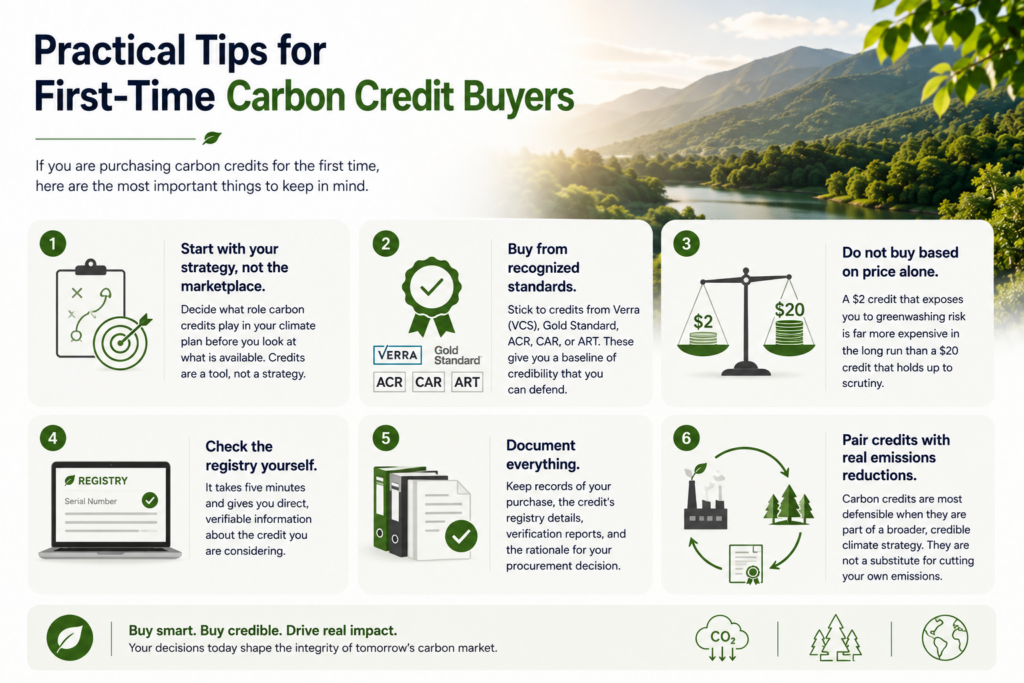
If you are purchasing carbon credits for the first time, here are the most important things to keep in mind.
Start with your strategy, not the marketplace. Decide what role carbon credits play in your climate plan before you look at what is available. Credits are a tool, not a strategy.
Buy from recognized standards. Stick to credits from Verra (VCS), Gold Standard, ACR, CAR, or ART. These give you a baseline of credibility that you can defend.
Do not buy based on price alone. A $2 credit that exposes you to greenwashing risk is far more expensive in the long run than a $20 credit that holds up to scrutiny.
Check the registry yourself. It takes five minutes and gives you direct, verifiable information about the credit you are considering.
Document everything. Keep records of your purchase, the credit’s registry details, verification reports, and the rationale for your procurement decision.
Pair credits with real emissions reductions. Carbon credits are most defensible when they are part of a broader, credible climate strategy. They are not a substitute for cutting your own emissions.
FAQ: What Buyers Look for When Purchasing Carbon Credits
Q: What is the most important thing buyers check when purchasing carbon credits?
Additionality is the most fundamental check. A credit must prove that the emissions reduction or removal would not have happened without the support of carbon credit revenue. Without additionality, a credit does not represent real climate action.
Q: What does ICVCM mean, and why do buyers care about it?
The ICVCM (Integrity Council for the Voluntary Carbon Market) is an independent governance body that has developed ten Core Carbon Principles to define high-quality carbon credits. Credits from programs that meet these principles can carry a CCP label, which gives buyers a standardized, globally recognized quality benchmark. Buyers use CCP status as a key procurement filter.
Q: Are carbon removal credits better than carbon avoidance credits?
Not necessarily better, but they serve different purposes. Removal credits are required for true net-zero claims under SBTi guidance. Avoidance credits are important for funding near-term climate action and typically cost less. Most sophisticated buyers use a portfolio approach that includes both.
Q: What is a carbon credit vintage?
Vintage refers to the year in which the emissions reduction or removal occurred. Recent vintages are generally preferred because they signal active, current projects aligned with modern standards. Most buyers prefer credits with a vintage no more than three to five years old.
Q: How can I check if a carbon credit is real?
Look it up in the relevant public registry (Verra, Gold Standard, ACR, or CAR). You can verify that the credit was issued, see the verification report, and confirm whether it has been retired or is still available for purchase.
Q: Do buyers care about social and community benefits?
Yes, increasingly so. Co-benefits such as biodiversity protection, clean water access, local job creation, and gender equity make a project more attractive, more defensible in public communications, and more aligned with ESG reporting frameworks. Gold Standard requires formal SDG documentation. Buyers who need to communicate their climate action to stakeholders give strong preference to projects with well-evidenced co-benefits.
Q: What is double counting, and why does it matter?
Double counting happens when the same tonne of CO2 reduction is claimed by two parties. Under the Paris Agreement, both companies and countries can claim the same carbon reduction unless a corresponding adjustment is made in the national inventory. Buyers who need internationally transferable credits check carefully for corresponding adjustment authorization from the host country.
Q: Are cheap carbon credits a red flag?
In most cases, yes. Credits priced significantly below market average for their type often reflect quality problems — outdated methodologies, weak additionality, or governance concerns. Treat unusually low prices as a signal to investigate more deeply, not as a bargain.
Q: What is the role of independent ratings agencies in carbon credit procurement?
Agencies like Sylvera, BeZero Carbon, and Calyx Global independently assess the quality of individual carbon projects and assign ratings. These ratings are used by buyers as part of due diligence to identify which projects are most likely to deliver on their claimed emissions impact. Credits with higher ratings command significant price premiums because buyers trust the independent quality signal.
Q: How do I know which standard to trust?
Stick to the five programs that have achieved CCP-Eligible status from the ICVCM: Verra (VCS), Gold Standard, ACR, ART, and CAR. These programs have been independently assessed against the most rigorous global quality benchmark for voluntary carbon credits.
Conclusion
Understanding what buyers look for when purchasing carbon credits is more important now than at any point in the market’s history.
The voluntary carbon market has matured sharply. The days of buying any offset and calling it done are over. Today’s buyers think carefully about additionality, permanence, verification, vintage, standard alignment, corresponding adjustments, co-benefits, and independent ratings — often all at once.
The buyers who get this right build credible, audit-ready carbon portfolios that genuinely support their climate goals and hold up to scrutiny from investors, regulators, and the public.
The buyers who get it wrong face greenwashing exposure, stranded assets, and reputational damage.
The good news is that the tools, frameworks, and information needed to make smart carbon credit purchases have never been more accessible. ICVCM has set a global quality benchmark. Registries are public and searchable. Independent rating agencies provide deep project analysis. And a growing number of brokers and platforms specialize in sourcing and vetting high-integrity credits.
If you are building a carbon credit procurement strategy, start with quality. Everything else follows from there.
Published on carbonmarketnetwork.com — your trusted resource for carbon market education, news, and insights.