Carbon Market Network


Every year, the world pumps billions of tonnes of carbon dioxide into the atmosphere. We have been doing this since the Industrial Revolution. And while cutting emissions is the most important step we can take, scientists and climate experts agree: cutting alone will not be enough.
We also need to pull CO₂ back out of the atmosphere.
That is where carbon removal credits come in.
If you have heard the term but are not entirely sure what it means, how it works, or whether it matters for your business or career, you are in the right place. This guide covers everything you need to know about carbon removal credits, from the basics to the latest developments in 2026.
What Are Carbon Removal Credits?
A carbon removal credit is a verified certificate that represents the removal of one metric tonne of carbon dioxide (or its equivalent) from the atmosphere.
When a project physically pulls CO₂ out of the air and stores it safely, it earns carbon removal credits. These credits can then be sold to companies, governments, or individuals who want to compensate for their emissions.
Think of it this way: if your business releases 1,000 tonnes of CO₂ in a year, buying and retiring 1,000 carbon removal credits means that 1,000 tonnes were pulled from the atmosphere on your behalf.
Carbon removal credits are part of the broader voluntary carbon market (VCM), and they sit in a separate, more specialized category than standard carbon offset credits.
Carbon Market Insider Newsletter
Weekly insights on carbon markets, climate policy, carbon credits, and sustainability.
Carbon Removal Credits vs Carbon Offset Credits: What Is the Difference?
This is one of the most common points of confusion. People often use the two terms interchangeably, but they are not the same thing.
Here is the core distinction:
Carbon offset credits cover both avoidance projects (preventing emissions from entering the atmosphere in the first place) and removal projects (pulling CO₂ out of the atmosphere). Offset is the broader umbrella term.
Carbon removal credits are specifically about removal. They only count when CO₂ is physically extracted from the atmosphere and stored.
To put it plainly:
- Protecting a forest from being cut down = avoidance credit (prevents emissions)
- Planting trees that absorb CO₂ = removal credit (pulls CO₂ out)
- Using a machine to capture CO₂ from the air = removal credit (pulls CO₂ out)
Both types of credits have value. But removal credits are increasingly seen as the gold standard, especially for companies with serious net-zero targets.
Why Does This Distinction Matter?
The Science Based Targets initiative (SBTi), one of the world’s most respected corporate climate frameworks, has stated that starting from 2030, it will only recognize carbon credits generated from carbon removal activities as valid offsets for hard-to-abate emissions.
In other words, avoidance credits are losing their long-term validity under the strictest net-zero frameworks. Removal credits are what serious climate commitments will require going forward.
How Do Carbon Removal Credits Work? A Step-by-Step Breakdown
Understanding the lifecycle of a carbon removal credit helps you see how real and traceable the process is meant to be.
Step 1: A carbon removal project is developed. A company, organization, or government develops a project that physically removes CO₂ from the atmosphere. This could be a direct air capture facility, a biochar production plant, a reforestation project, or any other approved method.
Step 2: The project follows an approved methodology. The project must operate according to a verified methodology approved by a recognized carbon standard (such as Verra, Gold Standard, or Puro.earth). The methodology sets out exactly how carbon removal will be measured, monitored, and reported.
Step 3: Third-party verification takes place. An independent auditor reviews the project and confirms that the stated amount of CO₂ was actually removed and securely stored. This step is critical for credibility.
Step 4: Credits are issued and listed on a registry. Once verified, credits are issued on a registry (like the Verra registry or Puro.earth registry). Each credit has a unique serial number so it can be tracked and cannot be sold twice.
Step 5: A buyer purchases and retires the credits. A company or individual buys the credits to compensate for their emissions. Once retired, the credit is permanently removed from circulation. It cannot be resold or reused.
Step 6: The buyer claims the removal. The buyer can now legitimately claim that the equivalent amount of CO₂ was removed from the atmosphere on their behalf.
The Main Types of Carbon Removal Credits
Not all carbon removal credits are created equal. They differ by the method used to remove CO₂, the durability of storage, the cost, and the level of verification possible.
Here are the major categories:
1. Nature-Based Carbon Removal Credits
These are the most common and most affordable type of removal credits available today. They rely on natural ecosystems to absorb and store CO₂.
Reforestation and Afforestation Planting trees in areas that previously had forest cover (reforestation) or in new areas (afforestation) allows trees to absorb CO₂ through photosynthesis. These projects make up a large portion of the nature-based removal market.
Peatland and Wetland Restoration Peatlands are among the most carbon-dense ecosystems on earth. Restoring degraded peatlands locks away significant quantities of CO₂ that would otherwise escape into the atmosphere.
Blue Carbon Projects These projects restore coastal ecosystems such as mangroves, seagrass meadows, and saltmarshes. These ecosystems sequester carbon at rates far higher than typical forests.
Soil Carbon Enhancement Agricultural practices like regenerative farming, cover cropping, and reduced tillage improve the ability of soils to capture and hold carbon.
The key limitation of nature-based removals: The storage is often temporary and reversible. A forest can burn down. A restored peatland can dry out. This is why these credits are often called “temporary removals.”
2. Technology-Based (Engineered) Carbon Removal Credits
These use engineering and technology to remove CO₂ from the atmosphere and store it permanently, often for hundreds to thousands of years. They are more expensive than nature-based credits but offer far greater durability and verifiability.
Direct Air Capture (DAC) DAC technology draws ambient air through a system and filters out the CO₂ using chemical processes. The captured CO₂ is then compressed and injected into underground geological formations for permanent storage. Climeworks (Switzerland) and Heirloom (USA) are two of the best-known DAC companies in the world today.
Biochar Biochar is produced by heating organic waste (crop residues, wood chips, animal waste) at high temperatures in a low-oxygen environment through a process called pyrolysis. The result is a carbon-rich solid material that can be added to soils, where it locks carbon away for hundreds to thousands of years while also improving soil health and agricultural productivity. Biochar is currently the leading durable carbon removal technology in terms of delivery and market liquidity.
Bioenergy with Carbon Capture and Storage (BECCS) BECCS generates energy from biomass (plants that absorbed CO₂ while growing), captures the CO₂ released during combustion, and stores it underground. Because the biomass absorbed CO₂ before burning, the net result is carbon removal from the atmosphere.
Enhanced Rock Weathering (ERW) This process speeds up a natural geological process. Crushed silicate rocks like basalt are spread on agricultural land. As rainwater reacts with the minerals in the rock, CO₂ is chemically absorbed and converted into stable carbonate compounds. The carbon can then be transported to the ocean where it remains locked away for millions of years.
Ocean-Based Carbon Removal Several newer approaches involve the ocean, including ocean alkalinity enhancement (adding minerals to seawater to absorb more CO₂) and kelp farming projects. These methods are still in early stages of development and verification methodology work.
Nature-Based vs Technology-Based Removal Credits: A Quick Comparison
| Feature | Nature-Based | Technology-Based |
|---|---|---|
| Cost per tonne | $5 to $50 | $100 to $500+ |
| Storage durability | Decades (reversible) | Centuries to millennia |
| Verification ease | Moderate | High |
| Scalability | High (today) | Growing rapidly |
| Co-benefits | Biodiversity, communities | Minimal direct co-benefits |
| Market share (2025) | ~95% of CDR credits issued | ~5% of CDR credits issued |
Who Issues and Verifies Carbon Removal Credits?
Several organizations set the standards and run the registries that make carbon removal credits trustworthy.
Verra (Verified Carbon Standard) Verra is the world’s largest voluntary carbon crediting program. It approves methodologies for carbon removal projects including reforestation, improved forest management, and biochar (under methodology VM0044). Credits issued on Verra’s registry are called Verified Carbon Units (VCUs).
Gold Standard Founded with the backing of WWF and other environmental organizations, Gold Standard certifies high-impact carbon projects that deliver both climate and sustainable development benefits.
Puro.earth Puro.earth is a specialist registry focused specifically on engineered and durable carbon removal. It covers biochar, enhanced rock weathering, bio-oil injection, and geological storage of biogenic CO₂. It is one of the most important registries for technology-based removal credits.
The EU Carbon Removal Certification Framework (CRCF) This is a major new development. The European Union adopted its Carbon Removals and Carbon Farming (CRCF) Regulation and in February 2026, the European Commission adopted the first Delegated Act covering permanent carbon removal activities. The CRCF establishes official certification methodologies for three categories: permanent carbon removals, carbon farming, and soil emission reductions. This framework is expected to significantly raise standards and influence global practices.
ICVCM Core Carbon Principles The Integrity Council for the Voluntary Carbon Market (ICVCM) launched its Core Carbon Principles (CCPs) as a benchmark for high-integrity credits. Credits that meet these principles are increasingly preferred by buyers seeking credibility in a scrutinized market.
Permanence: The Most Important Quality Factor
When evaluating carbon removal credits, permanence is the single most important quality factor. It refers to how long the removed CO₂ stays out of the atmosphere.
Here is how different removal methods compare:
- Reforestation: 20 to 100 years (can reverse if forest is lost)
- Soil carbon: Decades (sensitive to land use changes)
- Biochar: 100 to 1,000+ years
- Enhanced rock weathering: Thousands to millions of years
- Direct air capture with geological storage: Thousands to millions of years
- BECCS with geological storage: Thousands to millions of years
Buyers focused on net-zero alignment increasingly prefer credits with high permanence. The Oxford Offsetting Principles, a widely respected academic framework, recommend that companies progressively shift their purchases toward carbon removal with long-lived storage.
The Carbon Removal Credits Market in 2026: Where Things Stand
The carbon removal credit market is growing fast but it is still in its early stages. Here is a clear picture of the market as of mid-2026:
Market Size and Growth
The voluntary carbon market overall is valued at approximately €3 billion in 2026 and is projected to reach €15 billion by 2035, growing at around 20% per year. Within this market, removal credits are a small but rapidly growing share.
CDR Credits Still a Small Fraction
Despite enormous attention, CDR credits accounted for only about 5% of all carbon credit retirements in 2025. Nature-based removal projects (mainly forests and reforestation) make up 95% of all CDR credits issued, while high-durability engineered removals like DAC and BECCS make up the remaining 5% of CDR supply.
The Microsoft Effect
One buyer dominated the carbon removal market in 2025 to an extraordinary degree. Microsoft purchased approximately 90 to 93% of all carbon removal credits globally in 2025, according to data from CDR.fyi and BloombergNEF. In 2025, the company signed deals with 21 carbon removal companies across a broad spectrum of technologies and geographies.
In early 2026, Microsoft paused its carbon removal purchasing activity. This sent shockwaves through the sector because the industry had become so dependent on a single buyer. The pause highlighted a structural vulnerability in the CDR market: the need to broaden the buyer base beyond a handful of large technology companies.
Price Tiers
Carbon removal credit prices vary dramatically based on technology and quality:
- Nature-based offsets: €7 to €24 per tonne
- Biochar credits: €100 to €150 per tonne (Indian biochar is at the lower end)
- Engineered removal (DAC, BECCS): €150 to €500+ per tonne
- High-integrity, audit-ready portfolio blends: €25 to €80 per tonne
Offtake Commitments Far Outpace Deliveries
One of the most striking features of the current market is the gap between commitments and actual deliveries. Offtake agreements announced in 2025 totaled $13.7 billion, more than 14 times the value of credits actually retired. These commitments will deliver about 78 million credits spread across the next decade at an average price of $180 per credit. Actual durable CDR retirements in 2025 remained under 200,000 credits, representing just 0.11% of total retirements across the entire voluntary carbon market.
The 2050 Imperative
The scale of the challenge is enormous. The world needs to remove between 5 and 16 billion metric tonnes of CO₂ annually by 2050 to stay within 1.5°C of warming. Current levels are nowhere near this. But the momentum in both technology and policy is building fast.
Why Are Companies Buying Carbon Removal Credits?
Companies buy carbon removal credits for several important reasons.
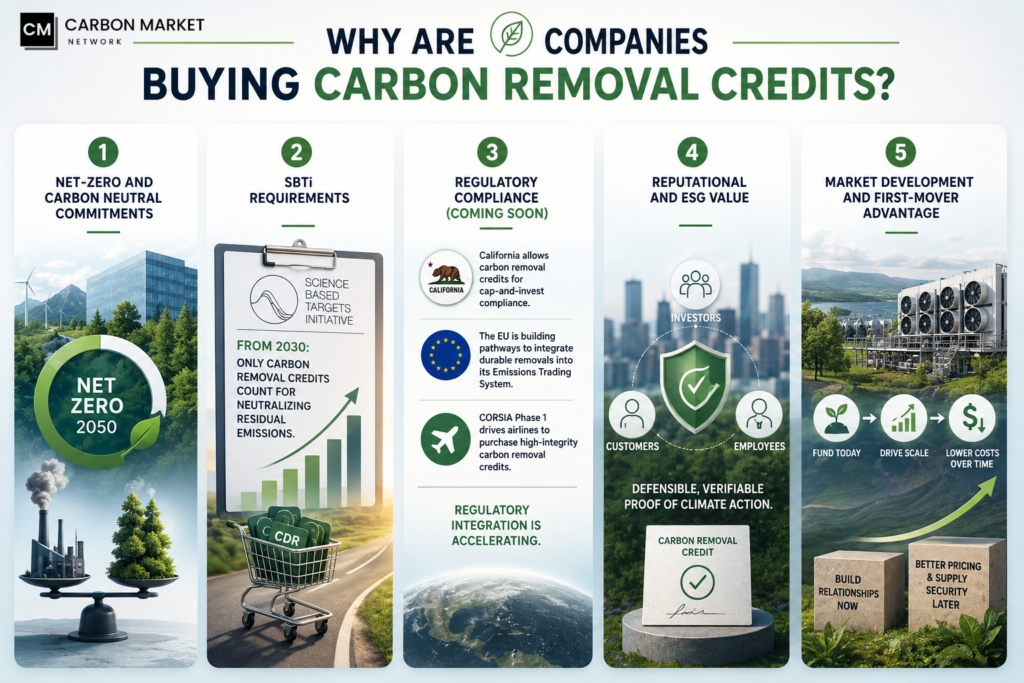
1. Net-Zero and Carbon Neutral Commitments Hundreds of major corporations have committed to net-zero or carbon-neutral targets. For the portion of their emissions that cannot be eliminated (hard-to-abate sectors), carbon removal credits provide the only credible path to true neutrality.
2. SBTi Requirements Companies following Science Based Targets initiative (SBTi) guidance know that from 2030, only carbon removal credits will count toward neutralizing residual emissions. Buying now locks in supply at today’s prices before demand spikes.
3. Regulatory Compliance (Coming Soon) California already allows companies to use carbon removal credits for compliance with its cap-and-invest program. The EU is building pathways to integrate durable removals into its Emissions Trading System. CORSIA Phase 1 (which covers international aviation emissions) is pushing airlines to buy high-integrity removal credits. Regulatory integration is accelerating.
4. Reputational and ESG Value Investors, customers, and employees increasingly scrutinize corporate climate claims. Purchasing high-quality carbon removal credits provides defensible, verifiable proof of climate action.
5. Market Development and First-Mover Advantage Early buyers help fund the scaling of carbon removal technologies, which drives down costs over time. Companies that build relationships with CDR suppliers now will benefit from better pricing and supply security in the future.
Real-World Examples of Carbon Removal Credit Projects
Climeworks (Switzerland) and DAC Climeworks operates the world’s largest commercial direct air capture plant in Iceland, called Mammoth, with a capacity of 36,000 tonnes of CO₂ per year. The company has signed multi-year offtake agreements with major buyers including Microsoft. Climeworks uses geothermal energy to power the process and permanently stores CO₂ in basaltic rock underground, where it mineralizes within two years.
Heirloom (USA) and Accelerated Mineral Carbonation Heirloom uses limestone’s natural ability to absorb CO₂ and dramatically speeds up the process from years to days. The company operates the first direct air capture facility in the United States that is permanently storing CO₂. It has struck major deals with Microsoft and is part of the US government-funded Project Cypress DAC hub in Louisiana.
Biochar Projects in India Indian biochar is emerging as one of the most cost-competitive sources of durable carbon removal globally. Projects verified under Verra’s VM0044 methodology and the Puro.earth standard are issuing credits at around €105 per tonne at industrial scale, making Indian biochar one of the most accessible entry points for buyers wanting permanence at a reasonable price.
Puro.earth Biochar in Finland (2026) One active project developed under the Puro.earth Biochar Methodology (2025, v2) commenced operations in Q1 2026 and is expected to issue its first credits in Q3 2026. At full capacity, the project will deliver 7,000 tonnes of net CO₂ removals per year, processing approximately 12,000 tonnes of waste biomass annually. The biochar is distributed to local farmers, improving soil health and agricultural productivity.
Grab (Singapore) and Carbon Credits Portfolio In 2025, Singapore-based superapp Grab avoided and removed 772,000 tonnes of CO₂e through verified carbon credit projects. This is equivalent to taking around 180,000 cars off the road for an entire year. Grab uses carbon credits as part of a broader climate strategy that includes direct emissions reductions.
How to Buy Carbon Removal Credits: A Practical Guide
If you are a business or individual looking to purchase carbon removal credits, here is how to approach it.
Step 1: Calculate Your Carbon Footprint Before buying any credits, understand how much CO₂ your activities produce. Use a carbon accounting tool or work with a carbon consultant to calculate your Scope 1, 2, and 3 emissions.
Step 2: Reduce First Carbon removal credits are a complement to emissions reduction, not a substitute. Prioritize cutting your actual emissions before looking to offset what remains.
Step 3: Decide What Quality Level You Need Are you buying for marketing claims, regulatory compliance, SBTi alignment, or genuine net-zero neutralization? The answer determines which type of credit is appropriate. For true neutralization of hard-to-abate emissions, opt for high-permanence engineered removal credits.
Step 4: Choose a Registry or Marketplace You can buy credits directly through:
- Verra registry (for a wide range of verified credits)
- Puro.earth (specialist in engineered durable removals)
- Gold Standard marketplace
- Specialized brokers and platforms like Senken, South Pole, or Terrapass
Step 5: Verify the Credit Quality Look for:
- Third-party verification
- Clear registry listing with a unique serial number
- Transparent methodology documentation
- Alignment with ICVCM Core Carbon Principles if possible
Step 6: Retire the Credits Once purchased, retire the credits in the registry. This permanently removes them from circulation and creates a documented record of your climate action.
Step 7: Report Transparently Disclose your purchase and retirement of carbon removal credits in your sustainability reports. Be specific about the project type, the amount retired, and why you chose removal credits over avoidance credits.
The EU Carbon Removal Certification Framework: A Game Changer
The EU Carbon Removal Certification Framework (CRCF) deserves special attention because it is the most significant regulatory development in carbon removals in recent years.
Enacted through a formal EU regulation, the CRCF organizes carbon activities into three families:
1. Permanent Carbon Removals These cover activities like DAC with geological storage, BECCS, biochar, enhanced rock weathering, and certain ocean-based methods. Projects in this category generate “Permanent Carbon Removal Units” with no expiry date. One unit = one tonne of CO₂e permanently removed.
2. Carbon Farming This covers land-based practices like peatland rewetting, agroforestry, cover cropping, and afforestation over periods of at least five years. These generate temporary units because the storage can reverse over time.
3. Soil Emission Reductions This covers practices that reduce greenhouse gas emissions from soils.
In February 2026, the European Commission adopted the first Delegated Act under the CRCF, setting out certification methodologies for permanent carbon removal activities. This is expected to be published in the Official Journal of the EU in early April 2026.
The CRCF is expected to become a global benchmark, raising the bar for carbon removal certification worldwide and influencing registries, corporate buyers, and financial institutions.
The Challenges Facing Carbon Removal Credits
The market is growing, but several real challenges remain.
High Costs Engineered carbon removal, especially DAC, is still expensive. Costs currently range from $150 to $500+ per tonne, compared to $5 to $20 for many avoidance credits. Scaling up production is the main path to reducing these costs over time.
Limited Supply Actual deliveries of durable CDR credits remain tiny compared to demand. Over 80% of high-durability carbon removal capacity is at risk of not being realized without additional buyer commitments. The market needs more buyers to provide the financial signals that enable project developers to invest.
Buyer Concentration Microsoft’s dominance as a buyer (approximately 90% of global CDR purchases in 2025) created a fragile market. When Microsoft paused new purchases in April 2026, it highlighted how dependent the industry had become on one company. Diversifying the buyer base is an urgent priority.
Verification Complexity Some removal methods, especially enhanced rock weathering and ocean-based approaches, are harder to measure and verify accurately than others. Robust measurement, reporting, and verification (MRV) systems need to improve significantly.
Permanence Risk Nature-based removal projects carry real risks of reversal. Fires, droughts, pests, and land-use changes can release stored carbon back into the atmosphere. Registries manage this through buffer pools and insurance mechanisms, but the risk remains.
Quality Inconsistency Less than 10% of CDR projects reviewed by Carbon Direct meet high-quality thresholds with minimal reservations. Buyers need to do careful due diligence rather than assume that any removal credit is automatically high-quality.
The Future of Carbon Removal Credits: What to Expect
The trajectory for carbon removal credits is clearly upward, despite near-term challenges. Here is what the coming years look like:
Prices Will Split Further The gap between high-integrity and low-integrity credits is already large and will continue to grow. High-quality removal credits are commanding 300% premiums over low-quality alternatives. As regulatory standards tighten, buyers who purchased cheap, low-quality credits will face growing scrutiny.
Technology Costs Will Fall Direct air capture costs have been falling steadily. With continued investment and scaling, DAC costs are expected to drop below $100 per tonne by the early 2030s, making the technology accessible to a far wider range of buyers.
Regulatory Integration Will Accelerate The EU ETS is building pathways to accept durable removals. California’s compliance market already allows them. CORSIA Phase 1 is creating aviation sector demand. The UK’s “contract for differences” policy will finance early-stage DAC and BECCS projects. Compliance demand will eventually dwarf today’s voluntary market.
Article 6 of the Paris Agreement Will Unlock New Flows COP30 in November 2025 brought clarity to Article 6.4 mechanisms, which govern internationally traded carbon credits between countries. This will unlock new cross-border carbon flows and create new channels for removal credits to reach compliance markets.
The Market Needs More Buyers The single most important near-term development needed is broadening the buyer base. Governments, financial institutions, airlines under CORSIA, and industrial companies in hard-to-abate sectors (steel, cement, aviation, shipping) all represent potential large-scale buyers that the market needs to engage.
Key Terms You Should Know
CDR (Carbon Dioxide Removal): The process of capturing CO₂ from the atmosphere and storing it.
VCM (Voluntary Carbon Market): The market where carbon credits are bought and sold voluntarily, outside of mandatory compliance schemes.
DAC (Direct Air Capture): A technology that uses chemical processes to extract CO₂ directly from ambient air.
BECCS (Bioenergy with Carbon Capture and Storage): A process that combines biomass energy generation with carbon capture and geological storage.
ERW (Enhanced Rock Weathering): Spreading crushed silicate rocks on land to accelerate natural carbon mineralization.
Biochar: A carbon-rich solid material produced from organic waste through pyrolysis, used to lock carbon in soils for centuries.
MRV (Measurement, Reporting, and Verification): The systems used to accurately quantify and document carbon removal.
Permanence: How long the removed carbon stays out of the atmosphere.
Additionality: The principle that a carbon removal project would not have happened without the revenue from carbon credits.
Retirement: The permanent cancellation of a carbon credit from a registry to prevent double-counting.
CRCF (Carbon Removal Certification Framework): The EU’s regulatory framework for certifying carbon removal activities.
ICVCM: Integrity Council for the Voluntary Carbon Market, the body that developed the Core Carbon Principles for high-integrity carbon credits.
FAQ: Carbon Removal Credits
Q: What is a carbon removal credit?
A carbon removal credit is a verified certificate that represents the removal of one metric tonne of CO₂ (or equivalent) from the atmosphere. Projects that physically extract CO₂ from the air and store it earn these credits, which can be sold to buyers who want to compensate for their emissions.
Q: Are carbon removal credits the same as carbon offsets?
Not exactly. Carbon offsets is a broader term that includes both emission avoidance projects (like protecting forests) and actual removal projects. Carbon removal credits specifically refer to projects that remove existing CO₂ from the atmosphere rather than simply preventing new emissions.
Q: What is the difference between nature-based and technology-based carbon removal?
Nature-based removal uses ecosystems like forests, wetlands, and soils to absorb CO₂. Technology-based removal uses engineered systems like direct air capture, biochar, and enhanced rock weathering. Technology-based methods generally offer greater permanence but are more expensive.
Q: How much do carbon removal credits cost?
Prices vary widely. Nature-based removal credits can cost as little as €7 to €24 per tonne. Biochar credits typically cost €100 to €150 per tonne. Engineered removals like direct air capture can cost €150 to €500 per tonne or more.
Q: Which companies are buying carbon removal credits?
Microsoft has been by far the largest buyer, accounting for approximately 90% of global CDR purchases in 2025. Other notable buyers include Airbus, Stripe (through the Frontier coalition), Shopify, and various airlines under CORSIA requirements.
Q: Are carbon removal credits regulated?
They operate primarily in the voluntary market, governed by standards like Verra, Gold Standard, and Puro.earth. However, regulation is increasing. The EU’s Carbon Removal Certification Framework (CRCF) is setting mandatory standards for the EU market, and compliance markets like California’s cap-and-invest program already accept removal credits.
Q: What is the most permanent form of carbon removal?
Geological storage (as used in DAC and BECCS projects) offers the most permanent form of carbon removal, with storage timescales of thousands to millions of years. Biochar and enhanced rock weathering also offer high durability, ranging from hundreds to millions of years.
Q: Can small businesses buy carbon removal credits?
Yes. Several platforms and brokers allow businesses of any size to purchase carbon removal credits. The minimum purchase amount varies by provider, but many platforms allow purchasing in small quantities.
Q: What is biochar and why is it a popular removal credit?
Biochar is produced from organic waste heated at high temperatures in a low-oxygen environment. It locks away carbon in a stable solid form that can persist in soils for hundreds to thousands of years. It is currently the most commercially delivered durable carbon removal technology and is relatively cost-competitive compared to direct air capture.
Q: What is the EU Carbon Removal Certification Framework?
The CRCF is the EU’s regulatory framework for certifying carbon removal activities. It defines three categories of carbon activities (permanent removals, carbon farming, and soil emission reductions) and sets out strict certification standards. The first Delegated Act covering permanent removals was adopted in February 2026.
Conclusion: Carbon Removal Credits Are Not Optional for the Future
The science is clear. Cutting emissions is essential, but it will not be enough to reach net-zero. We need to actively remove billions of tonnes of CO₂ from the atmosphere every decade between now and 2050.
Carbon removal credits are the financial mechanism that makes this possible. They turn the act of removing CO₂ into a tradable, verifiable, and investable asset. They fund the technologies and ecosystems doing the hard work of atmospheric cleanup.
The market is still early-stage. Supply is limited. Prices are high. Buyer concentration is a real challenge. But the direction of travel is unmistakable.
Regulatory frameworks like the EU CRCF are raising quality standards. Compliance markets are opening up to removal credits. Technology costs are falling. And the corporate community, despite some near-term uncertainty, is building long-term commitments that will sustain demand for decades.
If you are a business planning your climate strategy, a professional entering the carbon market sector, or simply someone who wants to understand where this market is heading, carbon removal credits are something you need to understand now, not later.
The companies that build knowledge and relationships in this space today will be far better positioned when the market scales into the trillions of dollars that most forecasters expect by mid-century.