Carbon Market Network


Every year, the world pumps billions of tonnes of carbon dioxide into the atmosphere. Scientists, governments, and businesses are scrambling for solutions. One of the most powerful tools available does not sit inside a laboratory or a government building. It sits right beneath your feet, in the soil of the world’s farms.
Carbon farming is one of the most talked-about solutions at the intersection of agriculture and climate action. It holds real promise for farmers, for ecosystems, and for the companies racing to meet their net-zero commitments.
If you have heard the term and want to understand what carbon farming actually is, how it works in practice, whether farmers can earn money from it, and what is happening right now in 2026, this article covers it all.
What Is Carbon Farming?
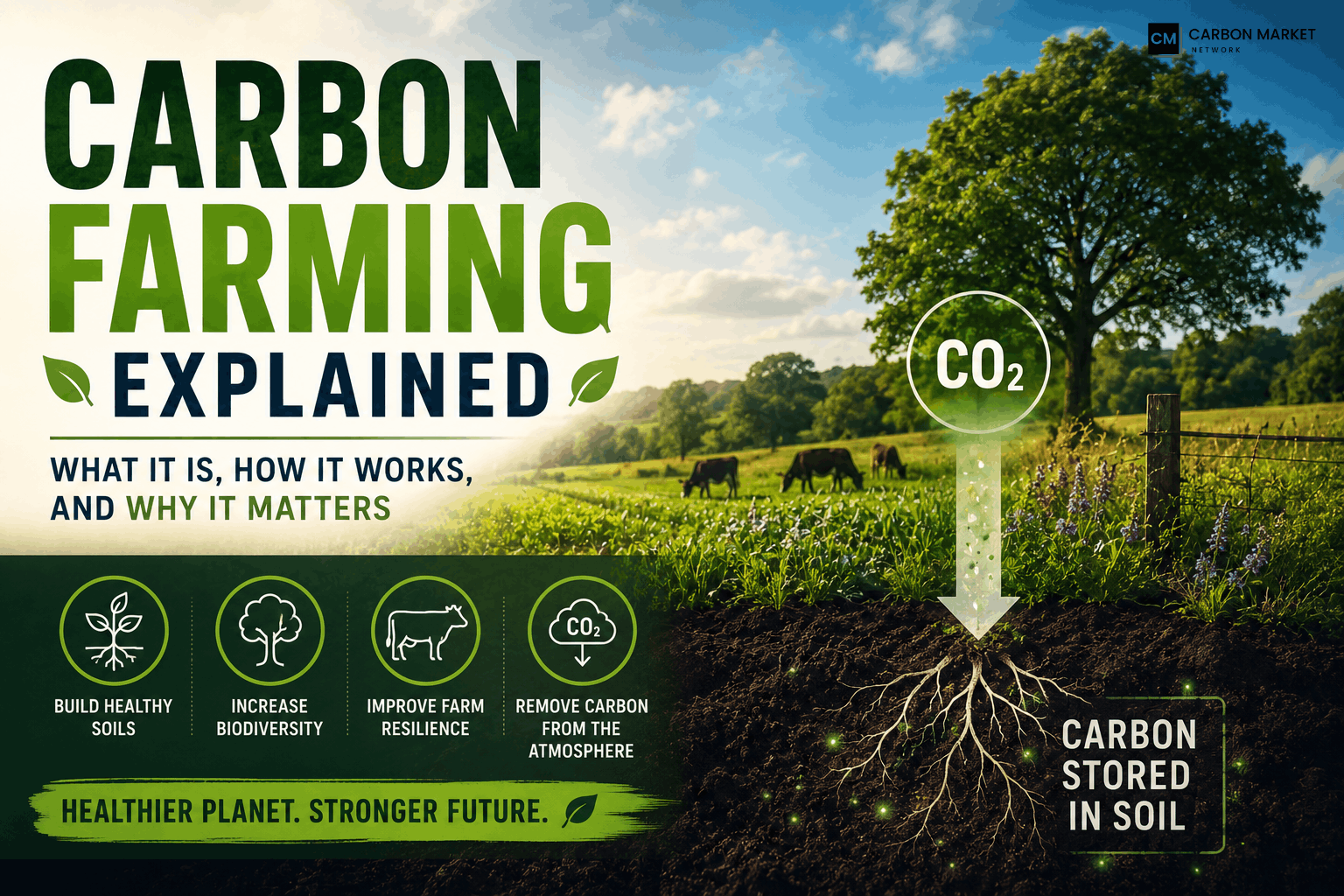
Carbon farming is the practice of managing agricultural land in ways that store more carbon in the soil and in plant biomass than the land releases into the atmosphere.
The technical term for this is carbon sequestration, which simply means capturing carbon dioxide from the air and locking it into the ground, into roots, and into organic matter.
The goal is straightforward: make farmland a net absorber of carbon dioxide rather than a net emitter of it.
When done well, carbon farming does two things at once. It fights climate change by pulling carbon out of the atmosphere. And it improves the health of the soil, which helps farmers grow more productive crops over the long term.
Carbon farming is not a single technique. It is an umbrella term for a range of agricultural practices that all share the same basic objective: getting more carbon into the ground and keeping it there.
Carbon Market Insider Newsletter
Weekly insights on carbon markets, climate policy, carbon credits, and sustainability.
Why Carbon Farming Matters
The numbers behind carbon farming explain why it gets so much attention.
Agricultural soils have lost enormous amounts of carbon over centuries of conventional farming. Practices like heavy tillage, leaving fields bare, and burning crop residue all release stored carbon back into the atmosphere.
Agriculture is responsible for roughly 30% of global greenhouse gas emissions. That makes the farming sector one of the most important arenas for climate action.
But here is the flip side: because farmland has lost so much carbon, it also has enormous potential to absorb more.
Research published in the Journal of the Indian Institute of Science in 2026 estimates that agricultural soils could sequester between 0.4 and 1.2 gigatons of carbon annually at the global level. In India alone, the annual potential for soil carbon sequestration ranges from 39 to 52 million tons.
That is a significant contribution to global climate targets, and it comes without building a single new piece of infrastructure. Farmers already own the land and work it every day.
How Does Carbon Farming Work?
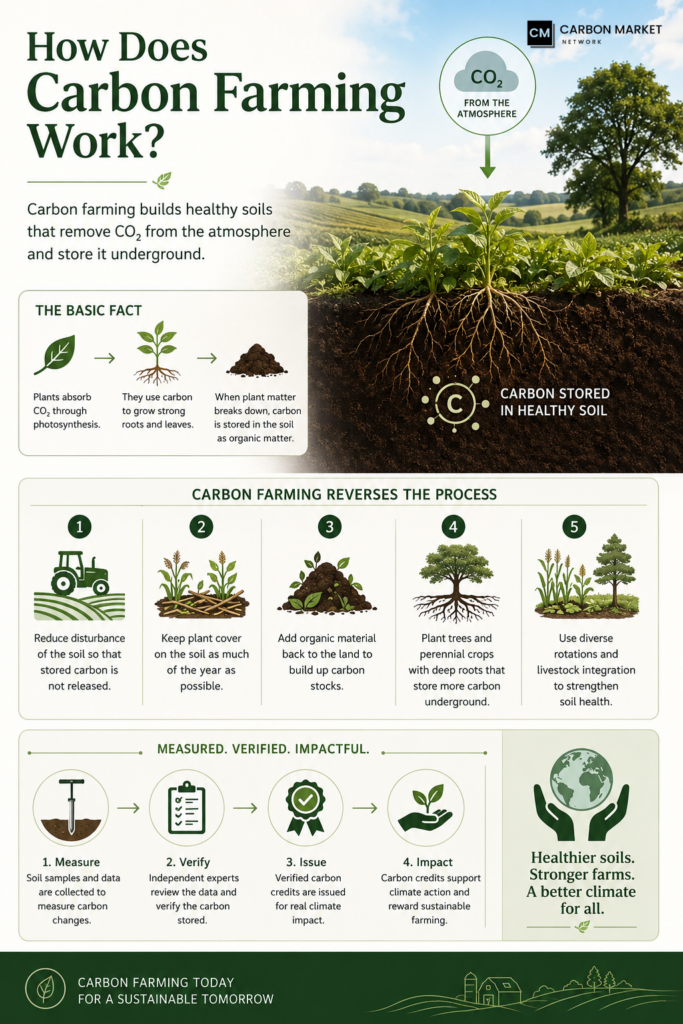
To understand carbon farming, you need to understand a basic fact about how plants and soil interact with carbon.
Plants absorb carbon dioxide from the atmosphere through photosynthesis. They use that carbon to build their roots, stems, and leaves. When plant matter dies and breaks down in the soil, much of that carbon gets stored in the soil as organic matter.
Healthy soils with rich organic matter are therefore natural carbon sinks. The problem is that many conventional farming practices disturb the soil repeatedly, release stored organic matter, and leave the land bare for parts of the year. This turns farmland from a carbon sink into a carbon source.
Carbon farming reverses this process by:
- Reducing disturbance of the soil so that stored carbon is not released.
- Keeping plant cover on the soil as much of the year as possible.
- Adding organic material back to the land to build up carbon stocks.
- Planting trees and perennial crops whose deep root systems pump more carbon underground.
The carbon that gets stored in the soil is measured, independently verified, and in many cases converted into tradeable carbon credits that farmers can sell.
Key Carbon Farming Practices
There is no single carbon farming method that works on every farm. The right combination of practices depends on the soil type, the climate, the crops grown, and the farming system already in place.
Here are the most widely used and proven carbon farming practices.
No-Till and Reduced Tillage
Conventional tillage increases the rate at which carbon dioxide is released from the soil. In the process, it also breaks up soil structure, which can lead to erosion and less productive cropland.
No-till farming means planting crops without ploughing the soil. Reduced tillage minimizes how much the soil gets disturbed. Both approaches help keep stored carbon in the ground where it belongs.
This is one of the most accessible starting points for any farmer looking to try carbon farming.
Cover Cropping
Cover crops are plants grown specifically to cover bare soil between the main cropping seasons. Common examples include clover, legumes, rye, and mustard.
Cover crops planted after the main crop is harvested help soils take in carbon year-round and can be ploughed under the ground as green manure that adds more carbon to the soil.
Cover cropping keeps roots in the ground for longer, feeds soil microbes, and steadily builds up organic matter.
Composting and Organic Amendments
Applying compost, crop residues, or other organic matter directly to fields adds carbon back to the soil. This approach also improves soil structure, water retention, and microbial activity.
Carbon farming practices include application of soil amendments like compost or biochar, conservation tillage, agroforestry, whole orchard recycling, and cover crops that maximize living roots.
Agroforestry
Agroforestry integrates trees and shrubs into farming systems. The deep root systems of trees store large amounts of carbon underground, while the canopy above ground stores carbon in wood and leaves.
Agroforestry also creates shade that reduces soil temperature, improves biodiversity, and can provide additional income through timber, fruit, or nuts.
The European Union’s Carbon Removal and Carbon Farming Certification Framework specifically identifies agroforestry as one of the key practices eligible for carbon credit certification.
Peatland Rewetting
Drained peatlands release enormous amounts of carbon dioxide and methane. Rewetting drained peat soils stops that release and, over time, allows peat to start accumulating again.
Peatland rewetting is one key measure in the evolving frameworks for carbon farming projects and an important nature-based solution.
This is a highly impactful practice, though it works best on lands where peat soils are present.
Rotational Grazing
Managed rotational grazing means moving livestock regularly across different sections of pasture. This prevents overgrazing, allows grassland to recover, and builds deeper root systems that store more carbon.
When done correctly, grasslands under rotational grazing can become significant carbon sinks.
Perennial Crops
Perennial crops, which do not die off every year, grow deep roots that help soils store more carbon.
Replacing annual crops with perennials where possible reduces the disruption of the soil and keeps root systems active through more of the year, continuously sequestering carbon.
Biochar Application
Biochar is a form of charcoal made by heating organic matter in the absence of oxygen. When added to soil, biochar is extremely stable and can store carbon for hundreds to thousands of years.
It also improves soil fertility, water retention, and nutrient availability, giving it a double benefit as both a carbon store and a soil health tool.
Carbon Farming and Carbon Credits: How Farmers Get Paid
One of the most important developments in carbon farming is the ability for farmers to turn stored carbon into income.
What Is a Carbon Credit?
A carbon credit represents one metric ton of carbon dioxide removed or prevented from entering the atmosphere.
When a farmer sequesters carbon through their land management practices, that carbon removal can be independently measured and verified. Each verified tonne becomes one carbon credit. Companies that need to offset their greenhouse gas emissions buy those credits to balance their own footprint.
How the Process Works
Here is how a typical carbon farming credit cycle works in practice:
- Baseline assessment. A farm establishes its starting point, documenting current soil carbon levels, crop history, and existing practices.
- Practice adoption. The farmer adopts eligible carbon farming practices such as no-till, cover cropping, or agroforestry.
- Monitoring. Carbon sequestration is monitored over time, increasingly using satellite technology and AI-powered models to reduce the cost of physical soil sampling.
- Verification. An independent third-party auditor verifies the amount of carbon stored against the baseline.
- Credit issuance. Verified carbon removals are issued as credits on a recognized registry such as Verra or the Gold Standard.
- Sale. The farmer or project developer sells those credits to corporate buyers, and the farmer receives payment.
How Much Can Farmers Earn?
The income from carbon credits varies widely depending on the farm’s soil type, the practices adopted, the carbon market program, and the verification standard used.
Most farmers earn between $10 and $50 per acre annually from carbon credits, based on sequestration rates of 0.1 to 1 ton per acre and market prices of $10 to $50 per credit through 2024 and 2025.
While average carbon credit prices fell to $4.8 per ton in 2024, premium soil carbon credits from high-quality, directly sampled projects command $25 to $50 per credit, highlighting the importance of robust verification methods for maximizing farmer returns.
For Indian farmers, estimates suggest some growers earn between ₹5,000 and ₹50,000 or more per hectare per year from carbon credit sales, in addition to their regular crop income.
Carbon farming income is not a get-rich-quick scheme. But for farmers who approach it seriously, commit to the practices, and choose reputable programs, it represents a genuine additional revenue stream on top of their existing farming operations.
Carbon Farming Certification and Standards
For a carbon credit to have value in the market, buyers need to trust that the carbon is real, measurable, and permanent. That is where certification standards come in.
The Major Global Standards
The most widely recognized certification standards for agricultural carbon credits include:
- Verra (Verified Carbon Standard): One of the world’s largest carbon credit registries. Verra’s VM0042 methodology specifically covers improved agricultural land management. Verra’s Methodology for Improved Agricultural Land Management quantifies greenhouse gas emission reductions and enhanced soil organic carbon storage resulting from the adoption of improved agricultural land management practices, incentivizing a range of practices such as reductions in fertilizer application and tillage, and improvements in water management, cash crop and cover crop planting, and livestock management.
- Gold Standard: Originally focused on energy projects, Gold Standard has expanded to cover land-based carbon removal projects.
- Climate Action Reserve: A North American standard with specific protocols for soil enrichment and other land-based projects.
The EU Carbon Removal and Carbon Farming Certification Framework (CRCF)
The most significant regulatory development in carbon farming in 2025 and 2026 is the EU’s Carbon Removal and Carbon Farming Certification Framework.
In December 2024, the EU’s Carbon Removal and Carbon Farming Certification Framework Regulation was published, with the aim of establishing a harmonized, voluntary certification system for three main activities: carbon removals, carbon farming, and carbon storage.
An Implementing Regulation adopted in November 2025 sets out the operational rules for certification schemes, audits, and reporting to ensure the Regulation is applied consistently across the EU.
A regulation covering carbon farming practices such as improved agricultural methods, agroforestry, peatland rewetting, and afforestation will allow farmers and foresters to earn payments for storing carbon, helping them diversify income and adopt resilient practices.
The 2026 methodology roadmap includes agriculture and agroforestry, peatland rewetting, and afforestation, all generating temporary units with monitoring periods typically 5 to 30 years. By December 2028, a unified EU registry will track every certified unit, ensuring full traceability and preventing double counting.
This framework is widely expected to raise global standards and influence how voluntary carbon markets treat agricultural carbon credits beyond Europe.
The Carbon Farming Market: Size and Growth
The financial momentum behind carbon farming is significant and growing.
The global carbon farming market was valued at USD 1.45 billion in 2025 and is projected to reach USD 2.25 billion by 2032, growing steadily year-on-year.
Other analysts project the carbon farming market will reach $2.34 billion by 2034 from $531.8 million in 2024, growing at a compound annual growth rate of 15.98% during the forecast period.
This growth is driven by rising corporate demand for high-quality agricultural carbon credits, improving measurement technology that reduces verification costs, stronger regulatory frameworks that increase market confidence, and growing awareness among farmers about the income potential.
Major corporations including Microsoft, Shopify, and Cargill are actively purchasing agricultural carbon credits to meet their sustainability targets, and that demand is only expected to grow.
Real-World Examples of Carbon Farming in Action
Understanding theory is one thing. Seeing it work in the real world makes the case far more convincingly.
Boomitra URVARA Project, India
One of the most significant recent milestones in global carbon farming happened in India in 2025.
The URVARA Project, named after the Sanskrit word for “fertile,” covers nearly 50,000 acres across six Indian states. It empowers farmers growing crops like rice, sugarcane, cotton, and soybeans to adopt regenerative methods such as reduced tillage, cover cropping, and improved irrigation. So far, 47,311 carbon credits have been verified, with 315,735 expected over 20 years.
Enabled by Boomitra’s satellite and AI-based MRV technology, the project makes it possible for smallholder farmers with plots as small as one acre to participate in soil carbon projects. The high cost of physical soil sampling has historically made this type of participation difficult.
Boomitra’s SOVIN project, registered under Verra’s VM0042 methodology, marks the company’s fifth Verra-registered soil carbon project globally. During its first monitoring period, the project includes 23,015 farmers across 88,000 acres and is expected to remove approximately 89,299 tonnes of CO₂ annually.
This is a landmark example of how carbon farming can work for the world’s smallest and most vulnerable farming communities.
Varaha, India
Another Indian company, Varaha, partners with smallholder farmers across South Asia to implement regenerative farming practices. Varaha has onboarded over 80,000 farmers covering 700,000 acres, and has secured agreements with companies like Google to purchase carbon credits generated from these practices.
Soil Capital, Europe
Soil Capital raised $16.2 million in Series B funding in September 2024 to scale its regenerative agriculture initiatives and expand to new regions, enabling over 1,600 farmers in Europe to adopt carbon farming practices.
These examples show that carbon farming is not just a concept. It is already working at scale across very different farming contexts.
The Role of Technology in Carbon Farming
One of the biggest practical challenges in carbon farming has been the cost and difficulty of measuring how much carbon a farm actually stores.
Traditional methods require extensive physical soil sampling, laboratory analysis, and complex calculations. This made carbon farming financially unviable for smaller farms, where verification costs would eat up most or all of the credit revenue.
Technology is changing this rapidly.
Satellite-Based Monitoring
Satellites can now observe changes in vegetation cover, soil moisture, and land management practices at scale. When combined with on-ground data, satellite imagery provides a cost-effective way to monitor carbon sequestration continuously without sending someone out to sample every field.
AI and Machine Learning
AI models trained on large soil datasets can now predict carbon sequestration rates with increasing accuracy, cross-referencing satellite data, climate records, soil classifications, and farming practice data.
Verified soil carbon increases are monetizable due to advancements in satellite-based MRV systems, thereby significantly slashing measurement expenses.
Digital Farming Platforms
A growing number of agritech companies now offer digital platforms that help farmers design carbon farming plans, track their practices, calculate their sequestration potential, and connect with carbon market programs.
Tools like the USDA’s free COMET-Farm tool (available online) allow farmers to estimate their current soil carbon baseline and model how different practices might improve sequestration on their specific land.
Challenges and Limitations of Carbon Farming
Carbon farming is not without its difficulties. Understanding these challenges honestly is important before any farmer or investor commits to it.
Measurement Uncertainty
Soil carbon varies enormously even within a single field. Natural soil variability exceeds 30% within fields, requiring 50 to 100 samples per field for 95% confidence in detecting carbon changes. This makes precise measurement difficult and expensive.
Permanence Risk
Carbon stored in soil can be released if farming practices change. A drought, a new owner, or a decision to revert to conventional tillage can undo years of carbon sequestration. Most carbon programs require farmers to commit to their practices for 10 to 30 years, which is a significant long-term obligation.
Additionality
For a carbon credit to be valid, the carbon sequestration must be “additional,” meaning it would not have happened anyway without the incentive of a carbon payment. Demonstrating additionality rigorously is complex, particularly for farms that were already using some sustainable practices.
Research suggests that 40 to 60% of enrolled farmers may lack true additionality, which is why credit quality and verification rigor matter so much.
Minimum Scale Requirements
Most programs require 50 or more acres, as verification costs are too high for smaller farms individually. Cooperative models, where farms group under a single project, offer a practical solution, though they are not yet widely available.
For Indian and African smallholder farmers, cooperative aggregation is becoming the primary route into carbon markets.
Market Fragmentation
The voluntary carbon market remains fragmented, with many different standards, methodologies, and price points. This can make it difficult for farmers to compare programs and understand which one offers the best terms.
Inconsistent standards, complex application processes, and limited awareness hinder participation. The vagueness around terms like “carbon farming” and “insetting” poses the risk of greenwashing, thereby affecting trust in the market.
Carbon Farming vs. Regenerative Agriculture: What Is the Difference?
These two terms are closely related, and they are often used interchangeably. But they are not exactly the same thing.
Regenerative agriculture is a broader farming philosophy that focuses on restoring and improving soil health, biodiversity, and ecosystem function. Its goals include soil restoration, water quality, biodiversity, animal welfare, and farmer livelihoods.
Carbon farming is specifically focused on maximizing carbon sequestration and quantifying that sequestration in a way that can generate carbon credits. Carbon farming uses many of the same practices as regenerative agriculture, but it adds a layer of measurement, verification, and market participation.
You could say that all carbon farming involves regenerative practices, but not all regenerative agriculture is formally tracked as carbon farming.
The two approaches are deeply complementary. Farmers pursuing carbon credits often find that the regenerative practices they adopt also improve their yields, reduce their input costs, and make their land more resilient to drought and extreme weather.
How to Get Started with Carbon Farming
If you are a farmer or landowner curious about carbon farming, here is a practical path forward.
Step 1: Understand Your Baseline
Before you can measure improvement, you need to know where you are starting. Use free tools like the USDA’s COMET-Farm to estimate your current soil carbon levels and your sequestration potential under different practices.
Step 2: Identify Suitable Practices
Not every practice works on every farm. Talk to an agronomist or consult with a carbon program provider about which practices make the most sense for your soil type, climate, and crop system.
For most farms, starting with one or two practices, such as adding cover crops or moving to reduced tillage, is more practical than overhauling the entire operation at once.
Step 3: Research Programs
Well-known certifiers include Verra, Gold Standard, and Climate Action Reserve. Gather 3 to 5 years of historical data on crops, yields, fertilizer use, and farming practices. This establishes a baseline against which improvements in carbon sequestration can be measured.
Compare at least three program partners. Look carefully at the revenue share, the contract length, the minimum acreage requirements, and how the program handles permanence and reversals.
Step 4: Start Small and Keep Records
Start by adopting one or two eligible practices and keep detailed records from day one. Documentation of everything you do, from the seed you plant to the inputs you apply, forms the foundation of your verification process.
Step 5: Partner with an Aggregator If Needed
If your farm is below the minimum size threshold for most programs (typically 50 to 100 acres), look for cooperative or aggregation models. In India, many Farmer Producer Organizations (FPOs) are beginning to pool small landholdings to enable collective participation in carbon markets.
Step 6: Undergo Verification and Sell Credits
Once you have adopted practices and collected sufficient monitoring data, work with a third-party verifier to certify your carbon removals. Credits can then be sold through the program’s market channels or directly to corporate buyers.
Carbon Farming for Small Farmers in India
Carbon farming is particularly relevant for India, which has one of the world’s largest agricultural sectors and a huge population of smallholder farmers who could benefit from additional income streams.
India’s agricultural soils hold significant sequestration potential. In India alone, the annual potential for soil carbon sequestration ranges from 39 to 52 million tons.
Several initiatives are already making this accessible at scale. The URVARA project by Boomitra and the work of Varaha are two prominent examples.
India’s Carbon Credit Trading Scheme (CCTS) is also developing frameworks that may eventually open compliance market pathways for agricultural carbon projects, though as of mid-2026 it remains primarily focused on the industrial sector.
For Indian farmers who want to explore carbon markets, the most practical entry point is through aggregator platforms or agritech companies that handle the measurement, verification, and market access on their behalf.
The Future of Carbon Farming
Carbon farming is moving from the experimental edges of agriculture to the mainstream.
Regulatory frameworks are strengthening. The EU’s CRCF is the most significant step toward standardization of carbon farming certification globally, and its influence is likely to shape voluntary carbon markets well beyond Europe.
Technology is lowering the barriers. Satellite monitoring, AI-powered soil models, and digital verification platforms are steadily reducing the cost of participating in carbon markets, making it viable for smaller and smaller farms.
Corporate demand is growing. As more companies commit to net-zero targets and face increasing scrutiny of their climate claims, the demand for high-quality, verified agricultural carbon credits is expected to keep rising.
And farmers themselves are starting to see the dual benefits: better soil, better yields, and a new income stream that rewards them for doing things that were already in their long-term interest.
Carbon farming has emerged as a transformative solution that enhances carbon storage and sequestration in soils and plants, while reducing greenhouse gas emissions from soils and improving operational efficiency.
The challenges are real: measurement uncertainty, permanence risk, market fragmentation, and access barriers for small farmers all need to be addressed. But the direction of travel is clear. Carbon farming is becoming an integral part of how the world’s agricultural systems will participate in the global effort to stabilize the climate.
Conclusion
Carbon farming is one of the most practical and scalable tools we have for fighting climate change. It works with nature rather than against it, restoring the carbon that has been lost from agricultural soils over generations of conventional farming.
For farmers, it offers the prospect of an additional income stream, healthier and more productive land, and a meaningful contribution to solving the defining challenge of our time.
For the planet, it offers the possibility of turning hundreds of millions of hectares of farmland from a source of greenhouse gases into a powerful carbon sink.
The science is solid. The market infrastructure is growing. The standards are improving. The technology is making it more accessible than ever.
Whether you are a farmer in Maharashtra, a rancher in the American Midwest, or a grain grower in the European plains, carbon farming deserves a serious look. The opportunity is here. The tools exist. The buyers are waiting.
The question now is simply: where do you start?
Frequently Asked Questions About Carbon Farming
What is carbon farming in simple words?
Carbon farming is the practice of managing agricultural land so that it absorbs and stores more carbon dioxide from the atmosphere. Farmers use techniques like reduced tillage, cover cropping, and planting trees to build up carbon in the soil, which helps fight climate change and can generate income through carbon credits.
How do farmers earn money from carbon farming?
Farmers earn money by adopting practices that store carbon in the soil. That stored carbon is measured and independently verified. Each verified tonne of carbon stored becomes one carbon credit. Farmers or project developers sell those credits to companies that need to offset their greenhouse gas emissions.
How much can a farmer earn from carbon credits?
Most farmers earn between $10 and $50 per acre annually from carbon credits, depending on the soil type, the practices adopted, and the program. Premium credits from high-quality verified projects can command $25 to $50 per tonne. In India, some farmers earn ₹5,000 to ₹50,000 or more per hectare per year through aggregated projects.
Is carbon farming the same as organic farming?
No, though they overlap. Organic farming avoids synthetic inputs and focuses on food quality and ecosystem health. Carbon farming specifically targets the measurement and sale of carbon sequestration. An organic farm can participate in carbon farming, but carbon farming does not require certified organic status.
Is carbon farming permanent?
Carbon stored in soil can be released if farming practices change, which is why most programs require farmers to maintain their practices for 10 to 30 years. Good programs also set aside a “buffer pool” of credits as insurance against reversal events like drought, fire, or land use change.
What is the minimum land size for carbon farming?
Most conventional carbon programs require 50 acres or more because the cost of verification makes smaller farms economically unviable on their own. However, cooperative aggregation models, where small farms pool their land under a single project, allow farmers with even 1 to 2 acres to participate.
What verification standards exist for carbon farming credits?
The main standards are Verra (Verified Carbon Standard), Gold Standard, and Climate Action Reserve. In Europe, the EU Carbon Removal and Carbon Farming Certification Framework (CRCF), which came into force in December 2024, is establishing a new harmonized standard for carbon farming certification.
How is carbon stored in soil measured?
Carbon sequestration is measured through a combination of physical soil sampling, satellite remote sensing, AI-based modeling, and established scientific methodologies. The field is advancing rapidly, with satellite and AI tools significantly reducing the cost of measurement compared to traditional soil sampling alone.
Can carbon farming improve crop yields?
Yes. Many carbon farming practices like cover cropping, composting, and reduced tillage improve soil organic matter, water retention, and microbial activity. Over time, these improvements typically lead to better crop yields and reduced input costs, creating a business case for carbon farming beyond credit revenue alone.
What is the EU Carbon Removal and Carbon Farming Certification Framework?
The CRCF is a regulation adopted by the European Union in December 2024. It establishes the first EU-wide voluntary certification system for carbon farming practices including agroforestry, cover cropping, peatland rewetting, and afforestation. It sets quality benchmarks for measurement, verification, and reporting, and is expected to influence global voluntary carbon market standards significantly.