Carbon Market Network


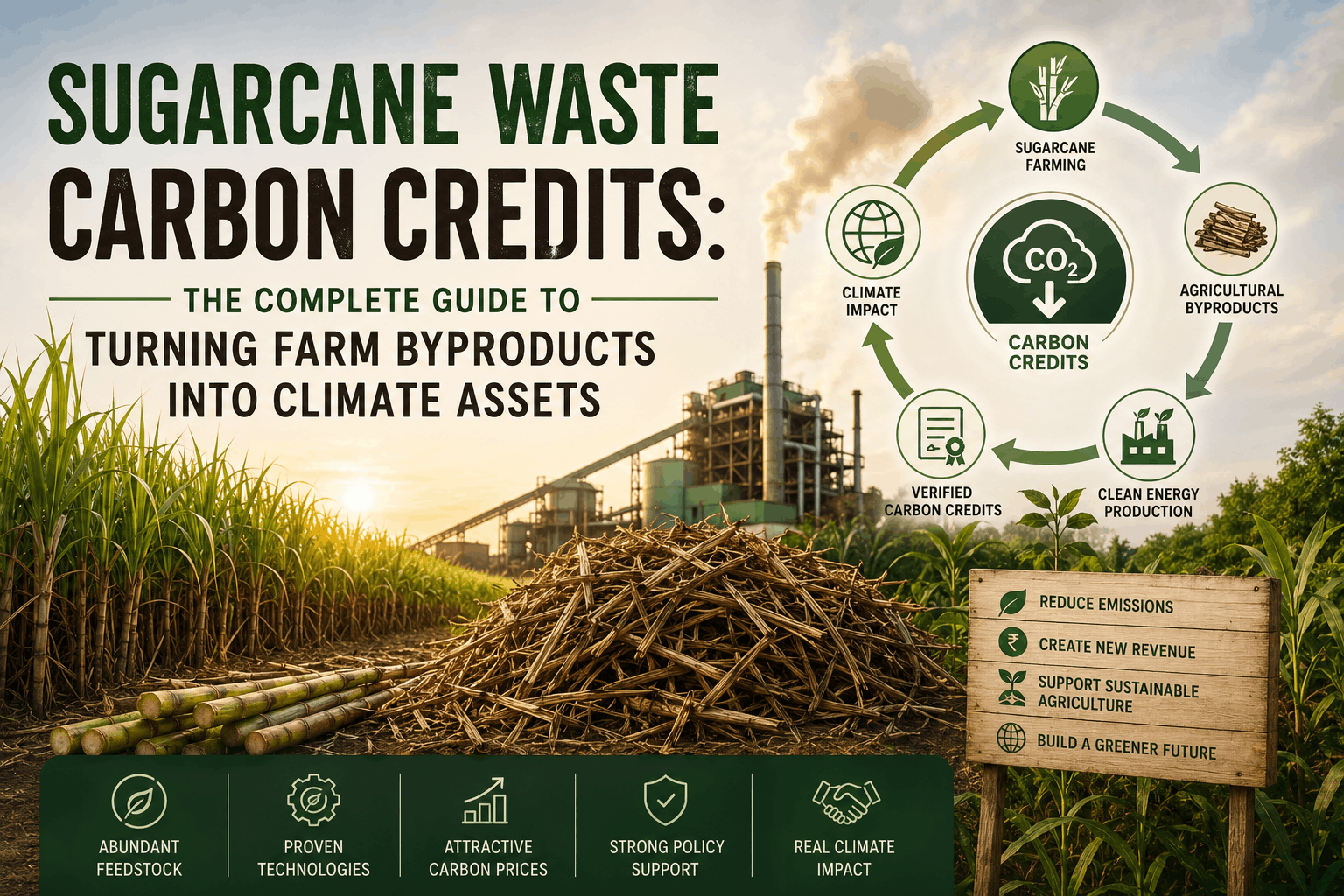
Every sugar mill on the planet produces mountains of waste. Bagasse piles up. Molasses drips from tanks. Vinasse fills lagoons. Sugarcane trash gets burned in fields.
For decades, this waste was treated as a disposal problem. Today, it is treated as a revenue opportunity.
Sugarcane waste carbon credits let mills, farmers, and project developers turn agricultural leftovers into verified emission reductions that companies buy to meet their climate targets. This guide breaks down exactly how that works, what the real numbers look like, and how you can get involved.
If you work in agriculture, sustainability, or carbon markets, this is one of the most practical and fast-growing niches in the entire carbon credit space.
What Are Sugarcane Waste Carbon Credits
Sugarcane waste carbon credits are verified emission reduction units generated by converting sugarcane byproducts into clean energy, soil amendments, or other uses that avoid greenhouse gas emissions.
Instead of letting waste rot in open lagoons, get burned in fields, or go unused, project developers apply an approved methodology to prove that a specific waste-to-value activity cuts emissions compared to a baseline scenario.
Each verified tonne of carbon dioxide equivalent (CO2e) avoided or removed becomes one carbon credit. These credits get listed on registries like Verra, Gold Standard, the American Carbon Registry (ACR) (website), or Puro.earth, and companies purchase them to offset residual emissions.
Sugarcane is one of the world’s largest agricultural crops by volume, and that scale is exactly why its waste streams matter so much for climate action.
Carbon Market Insider Newsletter
Weekly insights on carbon markets, climate policy, carbon credits, and sustainability.
Why Sugarcane Waste Has Become A Climate Opportunity
Sugarcane processing generates several distinct waste streams for every tonne of cane crushed. Each stream carries its own emissions profile, and each one can be turned into a credit-generating project.
Here is the short version of why this matters:
- Sugarcane is grown across more than 90 countries, producing well over a billion tonnes of cane annually.
- A single tonne of processed cane generates roughly 250 to 300 kilograms of bagasse.
- Left untreated, sugarcane waste streams release methane, nitrous oxide, and black carbon, all of which are far more potent greenhouse gases than plain CO2.
- Converting that waste into energy, biochar, or organic fertilizer prevents those emissions and often replaces fossil fuel use at the same time.
That combination of “avoid emissions” plus “avoid fossil fuel” is what makes sugarcane waste projects so attractive to carbon credit buyers.
The Main Types Of Sugarcane Waste Used In Carbon Projects
Before diving into methodologies, it helps to understand exactly what waste streams a sugar mill produces. Each one plays a different role in carbon credit generation.
1. Bagasse
Bagasse is the fibrous pulp left over after sugarcane stalks are crushed to extract juice. It is the largest waste stream by volume.
Most mills already burn bagasse to generate steam and electricity for their own operations. The carbon credit opportunity comes from upgrading that combustion into efficient cogeneration, so mills can export surplus renewable power to the grid instead of relying on fossil fuel plants.
Bagasse is also increasingly converted into biochar, a stable form of carbon that gets buried in soil instead of burned, locking carbon away for decades or longer.
2. Vinasse (Distillery Effluent)
Vinasse is the liquid byproduct left over after fermenting molasses into ethanol. It is highly organic and, if dumped into open lagoons, decomposes anaerobically and releases large volumes of methane.
Carbon projects capture this methane through covered lagoons or anaerobic digesters, then burn it for energy or flare it safely, avoiding the methane’s release into the atmosphere.
3. Press Mud (Filter Cake)
Press mud, also called filter cake, is the solid residue removed during juice clarification. It is rich in organic matter and nutrients.
Traditionally dumped in open piles where it decomposes and emits methane, press mud can instead be composted aerobically or converted into biochar, both of which cut emissions significantly.
4. Sugarcane Trash (Tops And Leaves)
Sugarcane trash refers to the leaves and tops left in the field after harvest. In many regions, farmers burn this trash to clear fields quickly, releasing CO2, black carbon, and other pollutants directly into the air.
Carbon projects that pay farmers to leave trash on the field as mulch, or collect it for bioenergy or biochar instead of burning it, generate credits by avoiding that open burning.
5. Molasses And Other Minor Residues
Molasses is usually a marketable product rather than waste, but low-grade or surplus molasses sometimes gets diverted into biogas or bioethanol projects that also qualify under certain methodologies.
The Environmental Cost Of Doing Nothing
It helps to understand what happens when sugarcane waste is left unmanaged, because that baseline scenario is exactly what carbon projects are measured against.
Open field burning releases carbon dioxide instantly, along with black carbon particles that settle on soil and reduce its reflectivity, which in turn accelerates local warming.
Open vinasse lagoons and press mud piles decompose without oxygen, and anaerobic decomposition produces methane, a gas with a warming potential many times stronger than CO2 over a twenty-year period.
Runoff from untreated vinasse can also acidify soil and waterways, harming aquatic life and reducing agricultural productivity in surrounding fields over time.
None of this is a hidden or new problem. Sugar-producing regions have dealt with waste disposal challenges for generations. What has changed is the financial incentive to solve it, thanks to carbon markets putting a price on the emissions that used to be a free externality.
Table: Sugarcane Waste Streams And Their Carbon Credit Pathways
| Waste Stream | Typical Disposal Without Intervention | Carbon Project Pathway | Main Greenhouse Gas Avoided |
|---|---|---|---|
| Bagasse | Open burning or inefficient boilers | Efficient cogeneration, biochar production | CO2, black carbon |
| Vinasse | Open anaerobic lagoons | Covered lagoon or digester with methane capture | Methane |
| Press mud (filter cake) | Open dump piles | Aerobic composting, biochar conversion | Methane |
| Sugarcane trash | Open field burning | Trash retention, mulching, bioenergy collection | CO2, black carbon |
| Molasses residue | Discarded or low-value disposal | Biogas or bioethanol conversion | Methane, CO2 |
Sugarcane Waste Carbon Credits Versus Other Agricultural Waste Credits
Sugarcane is not the only crop generating waste-based carbon projects. Rice husk, corn stover, palm oil residue, and coffee pulp all have their own credit pathways. So how does sugarcane compare?
- Volume advantage. Sugarcane mills process enormous tonnages at a single, fixed location, which makes waste collection logistics far simpler than crops harvested across scattered smallholder farms.
- Multiple waste streams from one facility. Few crops generate as many distinct, creditable waste streams (bagasse, vinasse, press mud, trash) from a single processing site.
- Existing infrastructure. Most sugar mills already have boilers, storage yards, and effluent treatment systems in place, which lowers the incremental cost of upgrading to a credit-generating setup compared to building from scratch.
- Established methodologies. Because bagasse cogeneration projects have existed for years, methodology frameworks are mature and well understood by validators and buyers alike.
This combination of scale, infrastructure, and methodology maturity is a major reason sugarcane waste has become one of the more investable niches within agricultural carbon credits.
A Simplified Example Calculation
Numbers help make this concrete. Here is a simplified, illustrative example of how a press mud composting project might estimate its emission reductions. Actual projects use far more detailed, methodology-specific formulas, but this shows the basic logic.
- Estimate baseline emissions. A mill dumps press mud in open piles, producing an estimated methane volume based on the organic content and typical decomposition rate.
- Convert methane to CO2e. Methane is converted to a carbon dioxide equivalent using its recognized global warming potential multiplier.
- Estimate project emissions. Under aerobic composting, methane generation drops sharply, though some residual emissions still occur and must be counted.
- Subtract project emissions from baseline emissions. The difference represents the net emission reduction achieved by the project.
- Apply any required buffer or discount. Some standards apply a conservative discount to account for uncertainty, ensuring credits represent real, verified reductions.
- Issue credits equal to net verified tonnes of CO2e. Each tonne becomes one tradable carbon credit once verified.
A mid-sized mill composting several thousand tonnes of press mud annually can realistically generate a meaningful volume of credits every year, though exact figures always depend on site-specific data and the approved methodology.
The Role Of Technology In Modern Sugarcane Waste Projects
Monitoring, reporting, and verification (MRV) used to rely heavily on manual data collection and periodic site visits. That is changing quickly across the carbon market, and sugarcane waste projects are benefiting from it.
- Remote sensing now helps detect open field burning events across large cane-growing regions, making it easier to verify that trash retention commitments are actually being honored.
- IoT sensors on biogas digesters and covered lagoons provide continuous gas flow data instead of relying only on periodic manual readings.
- Digital MRV platforms streamline data submission to registries, reducing the administrative burden on smaller mills and cooperatives.
- Blockchain-based registries are being piloted by some platforms to improve transparency around credit issuance and retirement, reducing the risk of double counting.
These technology improvements matter because they directly address one of the biggest buyer concerns in the voluntary carbon market: whether a credit represents a real, additional, and permanent emission reduction.
How Sugarcane Waste Carbon Credit Projects Actually Work
Every carbon credit project follows a similar lifecycle, regardless of which waste stream it targets. Here is the step-by-step process.
Step 1: Identify The Waste Stream And Baseline Practice
The project developer first documents exactly how the waste was being handled before the project started. This is the baseline scenario, and it matters enormously.
For example, a mill burning bagasse in an old, low-efficiency boiler has a very different baseline than a mill already using modern cogeneration equipment.
Step 2: Select An Approved Methodology
Carbon standards publish detailed methodologies that define how to calculate emission reductions for specific project types. Common methodology categories relevant to sugarcane waste include:
- Biomass-based energy generation, covering bagasse cogeneration and biomass power projects.
- Avoidance of methane production in wastewater or organic waste, covering vinasse and press mud treatment.
- Composting and organic waste management, covering press mud and trash composting.
- Biochar and soil carbon sequestration, covering bagasse and press mud converted into stable biochar.
- Avoided open burning of agricultural residues, covering sugarcane trash management.
The developer must follow the methodology’s exact formulas for baseline emissions, project emissions, and leakage.
Step 3: Prove Additionality
Additionality means proving the emission reduction would not have happened anyway without carbon finance. Regulators and buyers scrutinize this step closely because it separates genuine climate impact from projects that would have occurred regardless.
A mill that was already planning to install a biogas digester for cost reasons, with no carbon revenue involved, may struggle to prove additionality. A mill switching from open dumping to methane capture specifically because carbon credit revenue makes the investment viable has a much stronger case.
Step 4: Draft The Project Design Document
The Project Design Document (PDD) lays out the technical details: baseline calculations, monitoring plan, expected emission reductions, and safeguards for local communities and the environment.
Step 5: Independent Validation
A third-party auditor, accredited by the chosen carbon standard, reviews the PDD to confirm it meets all methodology requirements before the project is registered.
Step 6: Implementation And Monitoring
Once approved, the project gets built or upgraded, whether that means installing a covered lagoon, a new boiler, a composting yard, or a biochar kiln. Monitoring equipment tracks actual performance against the baseline.
Step 7: Verification And Credit Issuance
A separate independent verifier checks the monitoring data periodically, usually annually, and confirms the actual emission reductions achieved. Only after verification does the registry issue carbon credits.
Step 8: Sale And Retirement
Verified credits get listed on the registry and sold to buyers. When a buyer retires a credit, it is permanently removed from circulation and cannot be resold or reused, ensuring no double counting.
Key Carbon Credit Methodologies Relevant To Sugarcane Waste
Several established methodology families apply directly to sugarcane waste projects across major standards like Verra, Gold Standard, and the Clean Development Mechanism successor frameworks.
Biomass Cogeneration Methodologies
These methodologies quantify the emissions avoided when a mill generates electricity from bagasse instead of drawing power from a fossil-fuel-heavy grid. The calculation typically compares the grid emission factor against the actual biomass-based generation.
Avoidance Of Methane Emissions From Organic Waste
These methodologies apply to vinasse and press mud management. They calculate the methane that would have been released under the baseline scenario (open lagoons or dump piles) versus the methane actually released or captured under the improved project scenario.
Composting Methodologies
Composting methodologies quantify avoided methane from organic waste that would otherwise decompose anaerobically, while also crediting the reduced need for synthetic fertilizer when compost replaces it.
Biochar Methodologies
Biochar methodologies are among the fastest-growing categories in the entire carbon market. They quantify the durable carbon stored in biochar once bagasse, press mud, or trash is pyrolyzed and applied to soil.
Because biochar carbon can remain stable in soil for centuries, these credits are often classified as durable carbon removals rather than simple emission avoidance, which typically commands a premium price.
Avoided Field Burning Methodologies
These methodologies quantify emissions avoided when farmers stop burning sugarcane trash and instead retain it as mulch, incorporate it into soil, or collect it for bioenergy use.
Real-World Examples Of Sugarcane Waste Carbon Projects
Sugarcane-producing regions across Latin America, Southeast Asia, and elsewhere have implemented waste-to-credit projects for years. Here are the patterns seen across the industry.
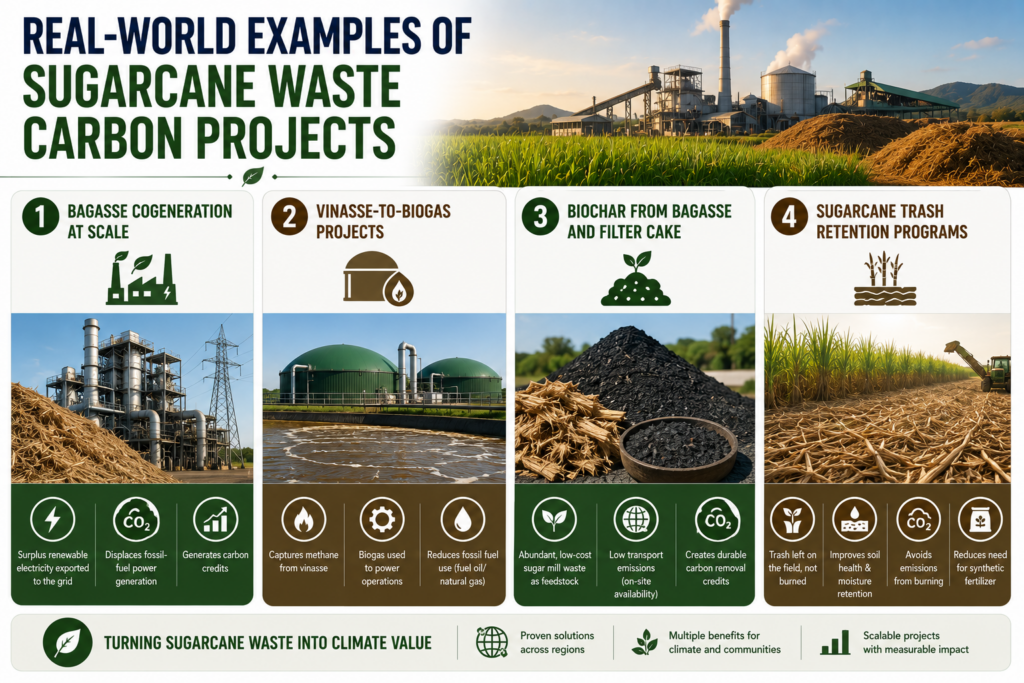
Bagasse Cogeneration At Scale
Large sugar and ethanol producers, particularly across Brazil’s cane belt, have installed high-pressure boilers and turbines that let mills export significant surplus renewable electricity to national grids. Many of these projects registered emission reduction credits by displacing fossil-fuel power generation.
Vinasse-To-Biogas Projects
Distilleries attached to sugar mills increasingly install covered anaerobic lagoons or engineered digesters that capture methane from vinasse. Some facilities use the captured biogas to fuel boilers, replacing fuel oil or natural gas, which stacks two benefits together: methane avoidance and fossil fuel displacement.
Biochar From Bagasse And Filter Cake
A growing number of biochar developers now specifically target sugar mill waste as feedstock, since bagasse and press mud are abundant, low-cost, and already concentrated at a single facility, which keeps transport emissions low.
Sugarcane Trash Retention Programs
In regions where mechanical harvesting is expanding, some programs pay farmers to leave trash on the field rather than burn it. This approach also improves soil health, moisture retention, and reduces the need for synthetic fertilizer over time.
Why Buyers Are Interested In Sugarcane Waste Carbon Credits
Corporate carbon credit buyers care about more than just the tonnes of CO2e avoided. Sugarcane waste projects tend to score well across several buyer priorities.
- Strong co-benefits. Farmers get better soil health, cleaner air replaces open burning, and rural jobs get created around collection and processing.
- Verifiable feedstock volume. Sugar mills already track their cane throughput closely, which makes waste volume easier to measure than diffuse agricultural sources.
- Clear additionality story. Waste-to-energy or waste-to-biochar investments are often genuinely unlocked by carbon finance, since the upfront capital cost can otherwise be a barrier.
- Alignment with methane reduction goals. Many governments and corporate buyers have made methane reduction a specific priority, and vinasse or press mud projects deliver directly on that goal.
- Durable removal potential. Biochar from sugarcane waste appeals to buyers seeking long-duration carbon removal rather than short-term avoidance.
Table: Typical Carbon Credit Price Ranges By Project Type
Carbon credit prices vary widely based on project type, co-benefits, standard, and buyer demand. The ranges below reflect general market patterns rather than fixed prices, since carbon markets move constantly.
| Project Type | General Price Range (USD per tonne CO2e) | Market Positioning |
|---|---|---|
| Bagasse cogeneration (avoidance) | Low single digits to low teens | Lower-cost avoidance credits |
| Vinasse or press mud methane capture | Mid single digits to twenties | Mid-tier avoidance with strong co-benefits |
| Avoided field burning | Mid single digits to twenties | Mid-tier, valued for air quality co-benefits |
| Biochar (durable removal) | Roughly one hundred and above | Premium durable removal category |
Biochar credits command a significant premium because they represent multi-decade or even multi-century carbon storage, which buyers increasingly want as part of a balanced net-zero strategy.
Who Is Involved In A Sugarcane Waste Carbon Project
Getting a project from idea to issued credits usually involves several distinct stakeholders, each playing a specific role.
The Mill Or Farmer Cooperative
This is the party generating the waste and hosting the project infrastructure. They provide access to the waste stream, operational data, and land or facility space needed for equipment.
The Project Developer
Developers handle methodology selection, documentation, and coordination between the mill, validators, and the registry. Many mills partner with an experienced developer rather than managing the process alone, since the technical and regulatory requirements can be demanding.
The Validation And Verification Body (VVB)
An independent, accredited auditor checks the project design before registration and later confirms actual performance during verification. This independence is what gives carbon credits their credibility.
The Carbon Standard Or Registry
Organizations like Verra, Gold Standard, ACR, or Puro.earth maintain the rules, approve methodologies, and operate the registry where credits are issued, tracked, and retired.
The Carbon Credit Buyer
Corporations, financial institutions, or individuals purchase credits to offset residual emissions as part of their climate commitments. Buyers increasingly conduct their own due diligence on project quality before purchasing.
Financing Partners
Because upfront capital costs can be significant, many projects rely on impact investors, green bonds, or forward purchase agreements where a buyer commits to purchasing future credits in exchange for financing the project today. This structure helps smaller mills access capital they otherwise could not secure.
How To Get Started If You Manage A Sugar Mill
If you operate a mill or represent a farmer cooperative and want to explore this opportunity, a practical starting sequence looks like this.
- Conduct an internal waste audit covering volume, current disposal method, and any existing partial treatment already in place.
- Speak with an experienced carbon project developer or consultant familiar with sugarcane-specific methodologies.
- Request a feasibility assessment comparing project types (cogeneration upgrade, methane capture, composting, biochar, trash retention) against your specific waste profile and budget.
- Evaluate financing options, including forward credit sale agreements, to cover upfront capital needs.
- Select a standard and methodology version that matches your project type and confirm it carries recognized quality credentials.
- Begin the formal validation process only once your baseline data collection is solid and consistent.
Rushing into registration before your data and infrastructure are ready is one of the most common and costly mistakes mills make in this process.
Challenges In Developing Sugarcane Waste Carbon Projects
These projects are not without obstacles. Understanding the challenges helps developers plan realistically.
Measuring Baseline Emissions Accurately
Every methodology depends on an accurate baseline. If a mill already partially treats its waste, calculating the true incremental improvement can get complicated and requires careful data collection.
Competing Uses For The Same Waste
Bagasse, in particular, has many competing demands, including paper production, animal feed, and construction materials. A project developer must confirm the waste is genuinely available and not already committed elsewhere.
Upfront Capital Costs
Covered lagoons, digesters, biochar kilns, and cogeneration upgrades all require significant capital investment before any carbon revenue arrives. Many smaller mills need external financing or a forward credit purchase agreement to bridge that gap.
Monitoring And Verification Complexity
Continuous monitoring of gas flows, waste volumes, or biochar application rates requires consistent equipment and diligent record keeping, which smaller operations sometimes struggle to maintain without dedicated staff.
Price Volatility
Voluntary carbon markets have experienced significant price swings over recent years, partly due to concerns about credit quality and additionality across the broader market. Developers should build financial models that do not depend on a single optimistic price scenario.
Market Standards Are Tightening
Independent oversight bodies such as the Integrity Council for the Voluntary Carbon Market have introduced Core Carbon Principles that raise the quality bar for methodologies across every standard. Sugarcane waste project developers should track which methodologies carry this recognized quality label, since buyers increasingly prefer labeled credits.
Actionable Takeaways For Mills, Farmers, And Developers
If you are considering entering this space, here are practical next steps.
- Map your waste streams first. Quantify bagasse, vinasse, press mud, and trash volumes before choosing a project type.
- Check for competing uses. Confirm your bagasse or press mud is not already committed to another buyer or internal use.
- Choose the right standard. Match your project type to a standard with an approved, ideally CCP-labeled, methodology.
- Model your baseline honestly. Overstating baseline emissions is one of the fastest ways to fail validation or damage credibility later.
- Budget for monitoring. Build ongoing measurement and reporting costs into your financial plan from day one.
- Consider stacking co-benefits. Projects that also improve soil health, air quality, or rural income tend to attract buyers faster and at better prices.
- Explore forward sale agreements. Many developers secure upfront financing by pre-selling future credits to corporate buyers, which helps cover capital costs.
- Stay updated on methodology revisions. Carbon standards regularly update methodologies, and using an outdated version can delay or block registration.
The Future Outlook For Sugarcane Waste Carbon Credits
Demand for high-integrity, high-co-benefit carbon credits continues to grow as more corporate buyers commit to science-based climate targets. Sugarcane waste projects sit in a strong position for several reasons.
Regulatory frameworks in multiple regions are moving toward standardized removal certification, which is likely to formalize how biochar and similar durable removal credits from sugarcane waste get verified and traded.
Methane-specific climate commitments from governments and corporations are also increasing demand for vinasse and press mud methane capture projects specifically, since methane has an outsized short-term warming effect compared to CO2.
At the same time, buyers are becoming more selective, favoring projects backed by CCP-labeled methodologies and transparent monitoring data over legacy projects with weaker additionality claims. Sugarcane waste developers who prioritize data quality and transparent reporting are best positioned to benefit from this shift toward higher-integrity demand.
Frequently Asked Questions
What exactly counts as sugarcane waste in carbon credit projects?
Sugarcane waste generally includes bagasse, vinasse, press mud (filter cake), and field trash such as tops and leaves left after harvest.
How many carbon credits can a sugar mill generate?
This depends entirely on mill size, waste volume, baseline practices, and the chosen methodology. Larger mills processing more cane naturally generate more waste and, therefore, more potential credit volume.
Is bagasse cogeneration still eligible for carbon credits?
Many bagasse cogeneration projects were registered years ago and some have reached the end of their crediting periods. New projects can still qualify if they demonstrate genuine additionality against current grid and technology baselines, though buyers now scrutinize these claims more carefully than in the past.
Why are biochar credits from sugarcane waste priced so much higher?
Biochar locks carbon into a stable form that can remain in soil for decades or centuries, classifying it as a durable carbon removal rather than a short-term avoidance credit, which buyers value at a premium.
Do sugarcane waste carbon credits help farmers directly?
Yes, particularly projects involving trash retention, composting, or biochar application, since these practices tend to improve soil fertility, moisture retention, and reduce dependence on synthetic fertilizer.
Which carbon standards accept sugarcane waste projects?
Verra, Gold Standard, the American Carbon Registry, and Puro.earth all have methodologies applicable to different sugarcane waste streams, including bioenergy, methane avoidance, composting, and biochar.
What is the biggest risk when developing one of these projects?
Weak additionality proof and inaccurate baseline data are the most common reasons projects fail validation or face buyer pushback later.
Conclusion
Sugarcane waste carbon credits turn an old agricultural headache into a genuine climate solution. Bagasse, vinasse, press mud, and field trash all carry real emission reduction potential once they are managed through a properly validated project.
The opportunity spans multiple pathways, from bagasse cogeneration and methane capture to composting and premium biochar removals, giving mills, farmers, and developers several ways to participate depending on their resources and goals.
Success in this space comes down to accurate baseline data, honest additionality claims, and choosing a methodology that matches your specific waste stream. Done well, sugarcane waste carbon credits deliver a rare combination of climate impact, rural income, and long-term soil health, making them one of the most practical entry points into the modern carbon credit economy.
As global demand for high-integrity carbon credits keeps rising, sugarcane waste projects are well positioned to grow from a niche opportunity into a mainstream pillar of agricultural carbon finance.
For more updates, guides, and resources on carbon markets, explore Carbon Market Network.