Carbon Market Network


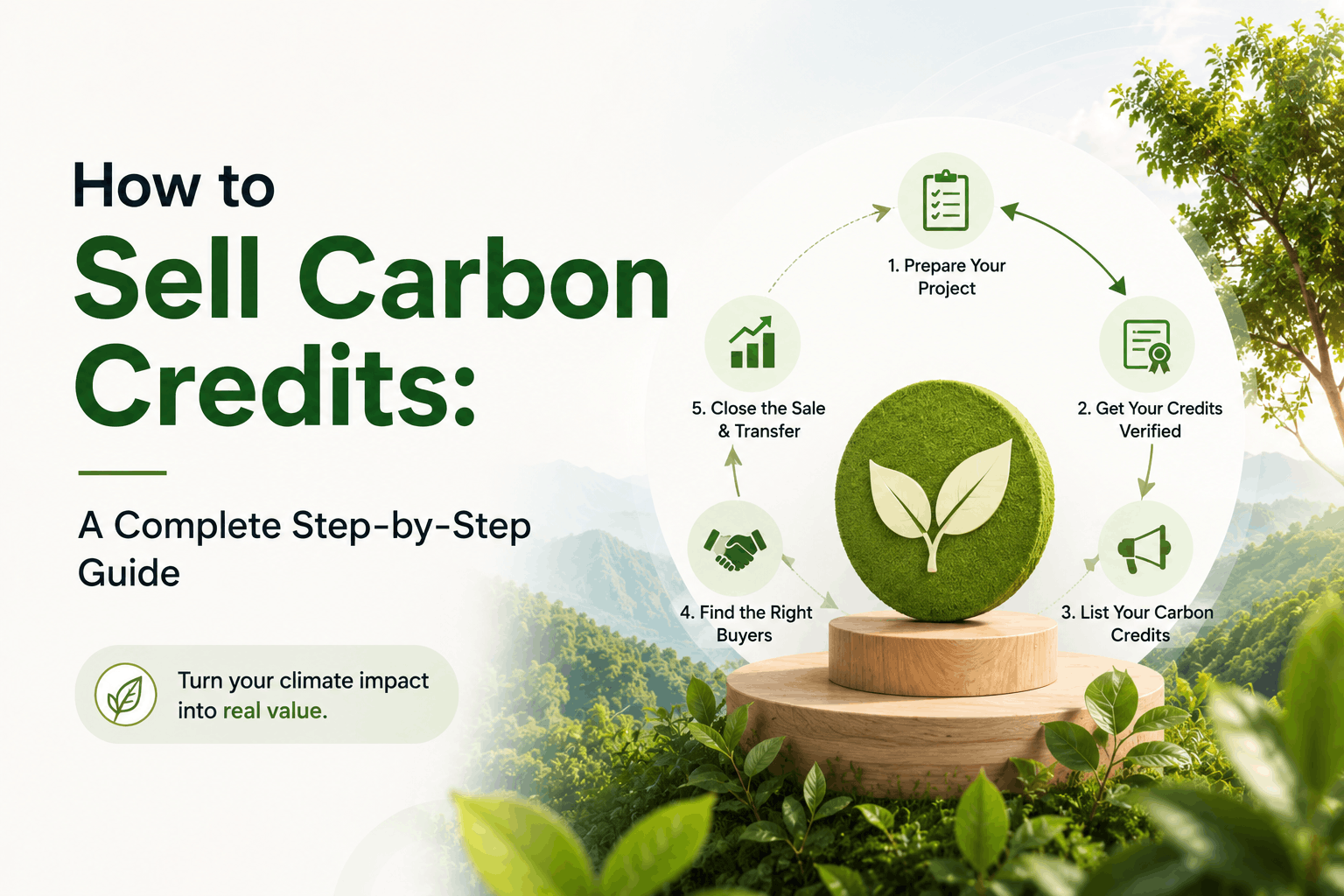
If you own land, run a business that reduces emissions, or manage a renewable energy project, you may be sitting on an asset you haven’t tapped yet.
Carbon credits have become one of the most talked-about tools in the global fight against climate change. And for the right sellers, they represent a genuine income stream.
But the process of selling carbon credits is not as simple as posting an ad online. It involves understanding markets, following specific standards, working with verifiers, and finding the right buyers.
This guide breaks down everything you need to know about how to sell carbon credits, from the basics to the details that actually determine whether your project makes money.
What Is a Carbon Credit?
Before we get into the selling process, it helps to be clear on what a carbon credit actually is.
One carbon credit represents one metric ton of carbon dioxide (CO2) or an equivalent greenhouse gas that has either been removed from the atmosphere or avoided entirely.
When a company or individual buys that credit, they can use it to offset their own emissions. This is the basic exchange that drives the entire carbon market.
Carbon credits are not physical things you can touch. They are verified certificates tracked on registries, with each one carrying a unique serial number to prevent it from being counted twice.
Carbon Market Insider Newsletter
Weekly insights on carbon markets, climate policy, carbon credits, and sustainability.
Who Can Sell Carbon Credits?
This is one of the first questions people ask, and the answer is broader than most expect.
You do not have to be a large corporation or a government agency to sell carbon credits. Many different types of entities can participate, provided they can generate and verify a genuine emission reduction or removal.
Here is a breakdown of who typically sells carbon credits:
| Seller Type | How They Generate Credits |
|---|---|
| Forest landowners | Carbon stored in standing trees or newly planted forests |
| Farmers and ranchers | Regenerative agriculture, no-till farming, cover cropping |
| Renewable energy developers | Wind, solar, hydro projects displacing fossil fuel generation |
| Methane capture projects | Landfill or livestock methane captured and destroyed |
| Industrial companies | Proven reductions below a regulated emission cap |
| Wetland and peatland owners | Carbon stored in restored or preserved ecosystems |
| Biochar producers | Carbon locked into stable biochar applied to soil |
| Direct air capture companies | Carbon physically removed from the atmosphere |
The common thread across all of these is additionality: the emission reduction or removal must be something that would not have happened without the carbon project.
Understanding the Two Types of Carbon Markets
Before you decide how to sell carbon credits, you need to understand which market you are selling into. The two are very different in how they work and who participates.
Compliance Carbon Markets
Compliance markets are legally regulated. Governments set a cap on how much carbon certain industries can emit, and companies must hold enough allowances or credits to cover their actual emissions.
Examples include:
- EU Emissions Trading System (EU ETS): The largest compliance market in the world, covering around 40% of EU greenhouse gas emissions
- California Cap-and-Trade Program: A joint market between California and Quebec
- UK Emissions Trading Scheme (UK ETS): Launched after Brexit
- Regional Greenhouse Gas Initiative (RGGI): A multi-state market in the northeastern United States
- New Zealand ETS, Australian Safeguard Mechanism, and others operating across several countries
Access to compliance markets is generally restricted to specific project types and methodologies approved by the relevant government body.
Voluntary Carbon Markets (VCM)
Voluntary carbon markets are open to a wider range of sellers. Companies, organizations, and individuals participate here because they choose to, not because a law requires it.
A company with a net-zero target might buy voluntary credits to compensate for emissions they cannot yet eliminate internally. Airlines offsetting passenger flights, consumer brands chasing carbon-neutral labels, and tech companies building climate commitments all buy here.
The voluntary market is where most first-time sellers begin, and it is where we focus much of this guide.
How Much Can You Earn Selling Carbon Credits?
This is one of the most searched questions, and the honest answer is: it varies enormously.
The price of a carbon credit depends on several factors:
- Project type: Technological removals like direct air capture command far higher prices than nature-based avoidance projects
- Quality and certification: Credits verified under rigorous standards and rated highly by third-party analysts fetch premiums
- Vintage: Newer credits are generally more valuable than older ones
- Co-benefits: Projects that deliver biodiversity protection, water quality improvements, or community benefits often sell at a premium
- Volume: Large projects with consistent supply attract better buyers and longer-term contracts
Here is a current pricing snapshot to give you a realistic picture:
| Project / Credit Type | Approximate Price Range |
|---|---|
| Nature-based avoidance (REDD+) | $3 to $10 per tonne |
| Afforestation and reforestation | $8 to $25 per tonne |
| Regenerative agriculture | $10 to $30 per tonne |
| Methane capture (landfill/livestock) | $5 to $20 per tonne |
| Blue carbon (mangroves, seagrass) | $15 to $50 per tonne |
| Engineered carbon removal (biochar, BECCS) | $50 to $200 per tonne |
| Direct air capture (DAC) | $300 to over $1,000 per tonne |
| EU ETS compliance allowances | Approximately €84 per tonne (as of August 2026) |
High-integrity credits rated at the top tier can reach $14 to $20 per tonne or more in the voluntary market. The market has split sharply into a two-tier structure: buyers willing to pay for quality are paying significant premiums, while low-quality legacy credits struggle to find buyers at even a few dollars per tonne.
If you are a forest landowner with 500 acres and strong carbon sequestration rates, you could generate several thousand credits per year. At $15 to $25 per credit, that represents meaningful annual income layered on top of any existing land use.
Step-by-Step: How to Sell Carbon Credits
Here is the complete process, from deciding whether your project is eligible to actually receiving payment.
Step 1: Determine Whether Your Project Qualifies
Not every emission reduction qualifies as a sellable carbon credit. The project must meet a set of fundamental requirements before it can be registered and verified.
The key eligibility criteria are:
- Real: The emission reduction or removal must have actually occurred, not just been projected
- Additional: It must be extra to what would have happened anyway, without any carbon finance. If you were already doing no-till farming for agronomic reasons, for example, proving additionality becomes harder
- Quantifiable: You must be able to measure the reduction in tonnes of CO2-equivalent using an approved methodology
- Permanent: For removal projects especially, the carbon must stay out of the atmosphere for a meaningful period (many standards require 25 to 100 years for forest projects)
- Unique: Each credit can only be issued and retired once. No double-counting
If your project ticks these boxes, you have a viable starting point.
Step 2: Choose the Right Carbon Standard
A carbon standard sets the rules your project must follow: how to measure emissions, how to prove additionality, how to handle risks, and how credits get issued.
Choosing the right standard is critical. Buyers look at which standard certified your credits. Buyers, rating agencies, and corporate sustainability teams scrutinize this.
The main global standards are:
| Standard | Best For | Key Feature |
|---|---|---|
| Verra (VCS) | Forestry, REDD+, agriculture, blue carbon | World’s largest voluntary standard by volume |
| Gold Standard | Renewable energy, clean cooking, water | Strong social co-benefits focus |
| American Carbon Registry (ACR) | North American land and energy projects | ICVCM CCP-approved |
| Climate Action Reserve (CAR) | North American projects, agriculture, methane | ICVCM CCP-approved |
| Plan Vivo | Small-scale community projects in developing regions | Community and biodiversity focus |
| Puro.earth | Engineered carbon removals (biochar, BECCS, mineralization) | Specialist in durable removals |
The Integrity Council for the Voluntary Carbon Market (ICVCM) has established a set of Core Carbon Principles (CCPs) that serve as a quality benchmark. Credits approved as CCP-eligible carry stronger credibility with buyers who are under scrutiny for greenwashing.
Verra recently announced a major partnership with S&P Global Commodity Insights to build a new-generation registry infrastructure, which will further increase transparency and traceability for credits issued under the Verified Carbon Standard.
For most landowners and project developers globally, Verra VCS is the most common starting point. For engineered removals, Puro.earth is increasingly the standard of choice.
Step 3: Select an Approved Methodology
Within each standard, you need to follow a specific methodology. A methodology is essentially a rulebook for your project type: how to measure your baseline, how to calculate your emission reductions, and how to handle uncertainty.
For example:
- A reforestation project on degraded land in Latin America would follow a VCS methodology specific to afforestation and reforestation
- A landfill gas capture project in Europe would use a methane-specific methodology
- A no-till agriculture project in North America might follow an ACR or CAR protocol for soil carbon
Methodologies are public documents. You can browse them on each standard’s website. If no approved methodology exists for your specific project type, some standards allow you to develop a new one, though this is expensive and time-consuming.
Working with a project developer who has experience with your project type can save you months of confusion here.
Step 4: Develop a Project Design Document (PDD)
The Project Design Document is the formal description of your project. Think of it as the application file that explains what your project does, why it qualifies, and how it will generate carbon credits.
A typical PDD includes:
- Project description and objectives
- Location and boundaries (including maps)
- Methodology used and how it applies to your project
- Baseline scenario (what emissions would look like without the project)
- How you will monitor and measure results
- Additionality demonstration
- Risk management plan (for forest projects: fire, pests, illegal logging)
- A buffer pool contribution (extra credits held back to cover potential reversals)
Writing a thorough PDD requires technical expertise. Most project developers work with specialists in carbon accounting, ecology, or remote sensing at this stage.
Step 5: Register Your Project With a Registry
Once your PDD is complete, you submit it to your chosen registry for review. The registry creates a public project page that any buyer or researcher can find.
The main registries you will encounter:
- Verra Registry: Tracks all VCS-issued Verified Carbon Units (VCUs)
- Gold Standard Impact Registry: Tracks Gold Standard-certified credits
- American Carbon Registry: Tracks credits under ACR standards
- Climate Action Reserve: Tracks CAR-certified credits
- Puro Registry (integrated with Patch’s CarbonOS): Tracks engineered removal credits
Registration fees and requirements vary by standard and project type. Some standards charge per credit issued; others charge flat project listing fees.
Key milestone: At registration, your project becomes publicly visible and formally enters the pipeline for verification.
Step 6: Get Third-Party Validation and Verification
This is one of the most important steps in the entire process. Before any credits are issued, an independent, accredited third party must validate and verify your project.
Validation happens at the start: an auditor confirms your project design, methodology choice, and claimed baseline are credible and comply with the standard.
Verification happens after your monitoring period: the same or a different auditor checks your actual data to confirm you delivered the emission reductions you claimed.
Both processes involve site visits (physical or remote), document reviews, and data audits. The verifier must be accredited by the relevant standard.
Examples of major third-party verifiers:
- Bureau Veritas
- DNV (Det Norske Veritas)
- SCS Global Services
- SGS Group
- Aster Global
The verification process typically takes several months and carries a cost. For large projects, this might be $10,000 to $50,000 or more. For smaller projects, working through aggregators (discussed below) helps manage this cost.
Step 7: Get Your Credits Issued
After successful verification, the registry issues your carbon credits to your account on the registry ledger. Each credit gets a unique serial number.
You now own verified carbon credits that you can sell.
Credits are typically measured in tonnes of CO2-equivalent (tCO2e). If your project is verified as having sequestered or avoided 10,000 tonnes during the monitoring period, 10,000 credits are issued to your account.
For forest projects, a percentage of issued credits goes into a buffer pool, which acts as an insurance reserve against future reversals (like a fire that releases stored carbon). Buffer contributions typically range from 10% to 40% depending on project risk.
Step 8: Choose How to Sell Your Credits
Now comes the commercial side. You have several options for actually selling your credits, each with different trade-offs.
Direct Sales to Corporate Buyers
This is often the most lucrative route. You approach companies directly, negotiate a price, and agree on a deal. Large buyers often want offtake agreements: long-term contracts that give them supply certainty and give you revenue predictability.
Pros: Better prices, direct relationships, multi-year income security
Cons: Requires outreach effort, relationships, and negotiation skills
Well-known brands, tech companies, airlines, and financial institutions are among the most active corporate buyers of voluntary carbon credits.
Carbon Brokers
Brokers act as intermediaries. They connect sellers with buyers, handle negotiations, and take a commission (typically 5% to 15% of the transaction value).
A good broker with an established buyer network can move your credits faster than going it alone. They also handle much of the paperwork and relationship management.
Carbon Exchanges and Trading Platforms
Carbon exchanges provide a marketplace where credits can be listed and traded. Some operate as spot markets; others facilitate forward contracts.
Examples of carbon trading platforms:
- Xpansiv / CBL: One of the largest voluntary carbon spot markets globally
- ACX (AirCarbon Exchange): Now operates as a regulated exchange through its Abu Dhabi entity within ADGM
- CTX (Carbon Trade Exchange): Online marketplace for voluntary credits
- South Pole, Anew Climate, and similar traders: Large intermediaries that buy project credits and redistribute to corporate buyers
Some platforms like Patch, Pachama, and Terrapass also aggregate demand from smaller buyers, making them useful for mid-sized projects.
Aggregators (For Small Landowners)
If you own a small parcel of land, selling directly may not be economical because the verification and registration costs outweigh your credit volume. This is where aggregators come in.
An aggregator pools credits from many small projects into a single larger project, splitting the fixed costs across many participants. The aggregator handles registration, verification, and sales on your behalf, and you receive payment per tonne minus their fee.
Programs like Indigo Ag, Nori, LandYield, and Family Forest Carbon Program operate as aggregators in the agriculture and forestry space.
What Buyers Look for When Purchasing Carbon Credits
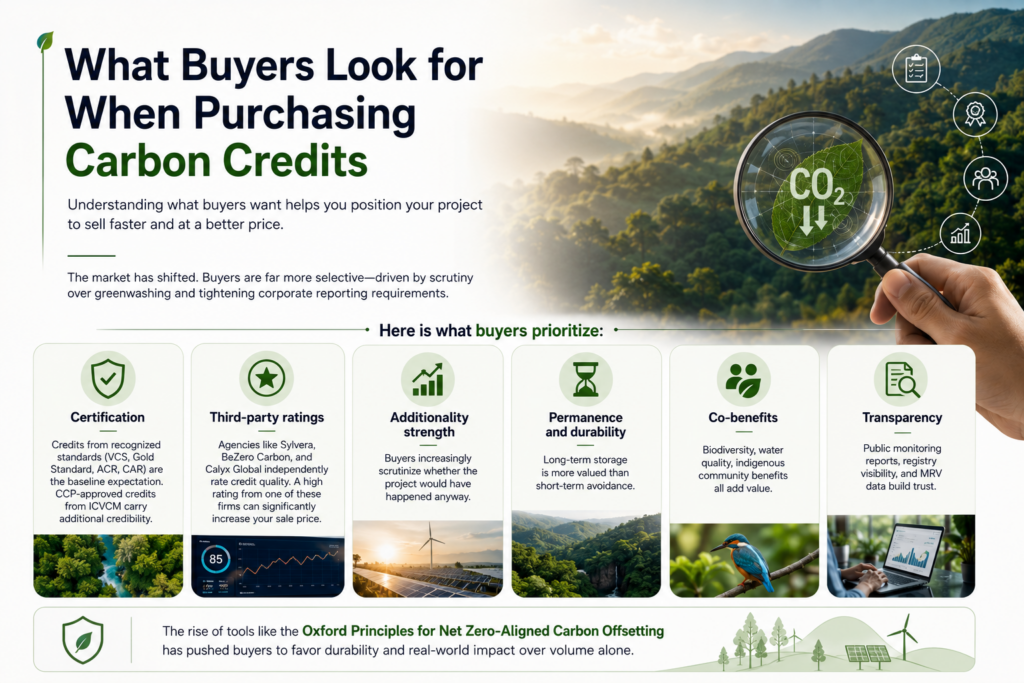
Understanding what buyers want helps you position your project to sell faster and at a better price.
The market has shifted significantly. Buyers are far more selective than they were several years ago, driven by scrutiny over greenwashing and tightening corporate reporting requirements.
Here is what buyers prioritize:
- Certification: Credits from recognized standards (VCS, Gold Standard, ACR, CAR) are the baseline expectation. CCP-approved credits from ICVCM carry additional credibility
- Third-party ratings: Agencies like Sylvera, BeZero Carbon, and Calyx Global independently rate credit quality. A high rating from one of these firms can significantly increase your sale price
- Additionality strength: Buyers increasingly scrutinize whether the project would have happened anyway
- Permanence and durability: Long-term storage is more valued than short-term avoidance
- Co-benefits: Biodiversity, water quality, indigenous community benefits all add value
- Transparency: Public monitoring reports, registry visibility, and MRV data build trust
The rise of tools like the Oxford Principles for Net Zero-Aligned Carbon Offsetting has pushed buyers to favor durability and removal over avoidance. Projects that remove carbon rather than simply avoid emissions are increasingly commanding premiums.
Types of Carbon Credit Projects You Can Develop
Not sure what kind of project fits your situation? Here is a practical overview of the most common project types for sellers.
Forest Carbon Projects
This is the largest category in the voluntary market. Forest projects generate credits by:
- REDD+: Reducing emissions from deforestation and forest degradation in developing countries
- Improved Forest Management (IFM): Changing timber harvesting practices to increase carbon storage
- Afforestation and Reforestation (AR): Planting trees on land that had no recent forest cover
Forest projects require long-term commitment. Many require 25 to 100-year agreements. They also carry reversal risk from fire, disease, and extreme weather, which is managed through buffer pool contributions.
Agricultural Carbon Projects
Farmers can generate credits through practices that increase soil carbon or reduce agricultural emissions:
- No-till and reduced-till farming
- Cover cropping
- Improved fertilizer management (reducing nitrous oxide emissions)
- Composting and organic matter additions
- Agroforestry (trees integrated with crops or livestock)
Soil carbon projects face methodological challenges around measurement precision, but standards and technology are improving rapidly. Remote sensing and satellite monitoring are reducing the cost and improving the accuracy of soil carbon accounting.
Renewable Energy Projects
Wind, solar, and hydropower projects that displace fossil fuel generation can generate credits in developing countries where the additionality case is strong.
However, this category has faced significant criticism. The ICVCM rejected all legacy renewable energy methodologies in its assessment, finding that many projects were not truly additional because renewables are now cost-competitive in most markets. New renewable projects need a stronger additionality case to generate credible credits.
Methane Capture Projects
These projects capture and destroy methane from landfills, coal mines, and livestock operations. Methane is roughly 80 times more potent than CO2 over a 20-year period, so destroying it generates substantial credits per project.
Methane projects tend to have strong additionality arguments and are well-established in compliance markets like RGGI and the California program.
Blue Carbon Projects
Coastal ecosystems like mangroves, salt marshes, and seagrass beds store enormous amounts of carbon per hectare, often more than terrestrial forests. Blue carbon projects restore or protect these habitats and can generate credits with strong biodiversity co-benefits.
Demand for high-quality blue carbon credits is growing, and prices reflect this. Offtake agreements for blue carbon have averaged over $20 per tonne, making this a compelling option for coastal landowners and conservation organizations.
Engineered Carbon Removal
This is the fastest-growing segment of the market. Technologies like biochar production, enhanced weathering, bioenergy with carbon capture (BECCS), and direct air capture physically remove CO2 from the atmosphere and store it permanently.
Puro.earth is the primary voluntary standard for most engineered removals. Companies including Microsoft, Stripe, Shopify, and Swiss Re have all signed offtake agreements for engineered removal credits.
Prices are high because costs are high, but demand from buyers seeking durable, permanent removal is strong and growing.
Common Mistakes to Avoid When Selling Carbon Credits
Many first-time sellers make avoidable errors that cost them time and money. Here are the most important ones to watch out for.
1. Skipping the additionality check early
Many projects fail at verification because the seller did not honestly assess whether their activities were truly additional from the start. Do this assessment before investing in PDD development.
2. Choosing the wrong standard for your project type
Not every standard accepts every project type. Make sure the standard you choose has an approved methodology for what you are doing.
3. Underestimating costs and timelines
Verification, PDD development, registry fees, and legal contracts take time and money. Small projects often spend $50,000 or more before the first credit is issued. Factor this into your projections.
4. Not locking in buyers before verification
Getting verified and then trying to find buyers is a risky sequence. Many experienced sellers negotiate offtake agreements before or during the verification process to ensure they have a market.
5. Ignoring the buffer pool
The buffer pool is not optional for most standards. Treat it as a cost of doing business, not a surprise deduction from your revenue.
6. Selling uncertified credits
Selling credits that have not been verified and registered on an official registry is not just bad practice, it exposes you to legal liability and destroys trust. Always sell through the registry system.
7. Overlooking the ongoing monitoring requirement
Carbon projects require continuous monitoring for the life of the project. This is not a one-time cost. Budget for annual measurement, reporting, and periodic re-verification.
How to Find Buyers for Your Carbon Credits
Finding the right buyers is one of the most practical challenges for new sellers. Here are the most effective channels.
Corporate sustainability teams: Many large companies have dedicated procurement teams for carbon credits. Reaching them directly through sustainability conferences, LinkedIn, and industry events is effective.
Carbon brokers and traders: Firms like South Pole, Anew Climate, Natural Capital Partners, and 3Degrees connect sellers with corporate buyers globally.
Carbon exchanges: Platforms like Xpansiv/CBL and ACX let you list or trade credits in a more liquid market.
Project-specific aggregator programs: If you are a landowner or farmer, enrolling in an aggregator program (Indigo Ag, Nori, Pachama, LandYield) connects you with their existing buyer networks.
Sustainability-focused investors: Some buyers purchase forward contracts from projects in development, providing early-stage capital in exchange for guaranteed credit delivery at a set price.
Online B2B marketplaces: Platforms like Patch and Terrapass allow smaller purchases and connect project developers with business buyers looking for smaller volumes.
The Role of Carbon Credit Quality Ratings
The carbon market now has its own version of credit ratings, similar to what bond markets use.
BeZero Carbon, Sylvera, and Calyx Global independently evaluate carbon projects on factors like additionality strength, permanence risk, measurement quality, and registry standards.
A project rated A or AA by one of these agencies will typically command significantly higher prices than an unrated or low-rated equivalent. Some corporate buyers now require a minimum rating as a procurement condition.
If you are developing a serious carbon project, getting your project rated by one of these agencies is worth considering. The cost of the rating can easily pay for itself in higher credit prices.
Carbon Credits and the Article 6 Opportunity
One of the most important developments in the carbon market is the finalisation of Article 6 of the Paris Agreement, which provides a framework for international carbon trading between countries.
Article 6.2 allows countries to trade emission reductions bilaterally. Article 6.4 establishes a centralized crediting mechanism supervised by the United Nations.
For project developers, Article 6 opens the possibility of generating credits that host-country governments can authorize for use in international compliance systems. These Internationally Transferred Mitigation Outcomes (ITMOs) may command significant premiums over standard voluntary credits.
The convergence of voluntary and compliance markets through Article 6 is already influencing how the best projects are structured and priced. Sellers who stay informed on these developments will be better positioned.
Practical Tips to Maximize Your Carbon Credit Revenue
Here is a summary of the practical strategies that experienced sellers use to get the best returns.
- Negotiate long-term offtake agreements early: Multi-year contracts give you revenue stability and give buyers supply certainty. Both parties benefit
- Bundle your credits with co-benefit certifications: Certifications like the Climate, Community and Biodiversity (CCB) Standards or SD VISta add a layer of value that buyers will pay for
- Track quality ratings actively: Know how your project is rated and what you need to do to improve the rating
- Maintain thorough documentation: Every monitoring report, field visit log, and satellite image adds to your project’s credibility
- Engage a specialist lawyer for offtake agreements: Carbon credit contracts have specific provisions around reversal liability, delivery obligations, and pricing mechanisms that general commercial lawyers may not be familiar with
- Consider forward sales: Selling credits before they are issued (on a forward basis) can provide working capital to fund verification costs
- Stay updated on ICVCM developments: New CCP approvals, methodology rejections, and standard updates directly affect which credits buyers will accept
Selling Carbon Credits in Compliance vs. Voluntary Markets: A Quick Comparison
| Factor | Compliance Market | Voluntary Market |
|---|---|---|
| Who participates | Regulated companies under a cap | Any eligible project developer |
| Price range | Varies widely by jurisdiction; EU ETS ~€84/tonne | $3 to over $1,000/tonne depending on project type |
| Verification requirements | Government-approved bodies | Standard-accredited third-party verifiers |
| Buyer motivation | Legal obligation | Net-zero commitments, brand value, sustainability targets |
| Market access | Restricted to eligible project types | Broader range of project types |
| Contract type | Usually spot or auction | OTC deals, exchanges, forward contracts |
| Liquidity | Generally higher | Improving, but still variable |
How Long Does It Take to Sell Carbon Credits?
One of the most important things to understand is that carbon credit development is not a quick process.
Here is a realistic timeline for a first-time seller:
| Stage | Typical Duration |
|---|---|
| Feasibility assessment and project scoping | 1 to 3 months |
| PDD development | 3 to 9 months |
| Registry review and project listing | 1 to 3 months |
| Validation by third-party verifier | 3 to 9 months |
| First monitoring period | 12 to 24 months |
| Verification of monitoring data | 2 to 6 months |
| Credit issuance and sale | Immediately after issuance |
| Total from start to first sale | 18 to 36 months |
This timeline varies significantly based on project complexity, the standard you use, and verifier availability. Some aggregator programs have streamlined processes that can move faster for eligible project types.
Frequently Asked Questions About Selling Carbon Credits
Q: Do I need to own land to sell carbon credits?
Not necessarily. Companies that reduce industrial emissions can sell credits in compliance markets. Renewable energy projects can generate credits without any land ownership. However, land-based credits (forestry, agriculture, blue carbon) do require ownership or a long-term leasehold agreement over the relevant land.
Q: Can small landowners realistically sell carbon credits?
Yes, but the economics only work if you join an aggregator program or have a large enough land area to justify the project development costs on your own. As a rough guide, forest landowners generally need at least 40 to 100 acres to make direct participation viable, though smaller parcels can work through aggregators.
Q: What is the difference between a carbon credit and a carbon offset?
The terms are often used interchangeably, but technically, a carbon offset is the broader concept (any action that compensates for emissions elsewhere), while a carbon credit is the unit of measurement used to quantify and trade offsets. In practice, both terms refer to the same tradeable instrument in most market conversations.
Q: How do I avoid greenwashing accusations as a seller?
Use recognized certification standards, get your project rated by an independent quality analyst, maintain transparent monitoring data, and only sell credits that have been formally verified and issued by a registry. Do not make marketing claims about your credits that go beyond what the registry and verification data actually support.
Q: Can I sell the same carbon credits twice?
No. This is explicitly prevented by the registry system. Each credit carries a unique serial number, and once it is sold and retired, it is permanently deactivated. Attempting to double-sell credits is fraud and would be identified through registry audits.
Q: What taxes apply to carbon credit sales?
Tax treatment varies by country and project structure. In many jurisdictions, proceeds from carbon credit sales are treated as ordinary income or capital gains. You should consult a tax advisor familiar with environmental markets in your country before selling.
Q: Is it worth developing a carbon project right now?
For the right project types and locations, yes. High-quality removal projects and well-structured nature-based projects with strong additionality are finding buyers willing to pay meaningful prices. The market has bifurcated sharply: low-quality credits face a difficult market, while high-integrity credits are in demand. If you can develop a project that meets current quality standards, there is a real market waiting.
Q: What is ICVCM and why does it matter for sellers?
The Integrity Council for the Voluntary Carbon Market (ICVCM) is an independent governance body that has established Core Carbon Principles (CCPs) as a quality benchmark for voluntary credits. Credits approved as CCP-eligible signal to buyers that they meet a high integrity standard. As a seller, having your credits issued under a CCP-approved program significantly improves marketability.
Q: Do I need a broker to sell carbon credits?
No, but a broker can make the process faster and more efficient, especially for first-time sellers. If you have an established buyer network or are selling through an exchange, you can transact without a broker.
Q: How are carbon credits different in the compliance market compared to the voluntary market?
Compliance market credits are created to help companies meet legally required emission limits. They are typically called allowances or permits and are governed by specific government rules. Voluntary market credits come from independently verified projects and are bought and sold by choice. Prices, rules, and participants differ significantly between the two.
Conclusion: Is Selling Carbon Credits Right for You?
Selling carbon credits is not passive income. It requires effort, investment, expertise, and patience.
But for the right project, in the right location, with the right standard and buyer relationship, it can deliver meaningful and lasting financial returns alongside genuine environmental impact.
The market is moving in a clear direction: quality wins. Buyers are more sophisticated, standards are tighter, and integrity expectations are higher than ever. The projects that thrive are the ones that take additionality seriously, choose the right standards, work with accredited verifiers, and target buyers who value long-term supply relationships.
Whether you are a forest landowner exploring how to earn from your trees, a farm manager considering soil carbon, a renewable energy developer in a growing market, or a company with a verified emission reduction to monetize, the carbon market has a pathway for you.
Start with a clear feasibility assessment. Engage with experienced project developers or aggregators. Choose your standard carefully. And plan for the long term.
The carbon credit market is still evolving, but the fundamentals are sound. For sellers who do it right, the rewards are real.
This article is published by Carbon Market Network, a global carbon markets education and resource platform. For more in-depth guides, market updates, and tools, visit carbonmarketnetwork.com