Carbon Market Network


Coastal forests that grow in saltwater may be the most underrated climate solution on the planet.
Mangroves cover less than 0.5% of the world’s tropical forest area. Yet they store more carbon per hectare than almost any other ecosystem on Earth. When these forests are protected or restored as part of structured carbon market programs, they generate some of the highest-quality and highest-priced carbon credits available today.
That is what mangrove carbon projects are all about. They sit at the intersection of climate finance, biodiversity conservation, and coastal community development. And right now, they are attracting serious attention from governments, corporations, investors, and NGOs around the world.
This guide explains exactly how mangrove carbon projects work, why they matter, what makes them different from other carbon projects, and what is happening in the field today.
What Are Mangrove Carbon Projects?
Mangrove carbon projects are structured programs that protect, restore, or improve the management of mangrove forests to generate verified carbon credits.
These projects fall under the broader category of blue carbon projects. Blue carbon refers to the carbon captured and stored by coastal and marine ecosystems, including mangroves, salt marshes, and seagrass meadows.
Among all blue carbon ecosystems, mangroves dominate. Mangroves account for almost 99% of all blue carbon credits issued in voluntary carbon markets.
The reason is straightforward. Mangroves are extraordinarily productive, they store carbon in both their biomass and their waterlogged soils, and they are supported by well-developed measurement methodologies. When a project protects mangroves from being cut down, or restores degraded mangrove areas, the climate benefit can be calculated and turned into tradable carbon credits.
Those credits are then sold to companies, governments, or individuals looking to offset their greenhouse gas emissions.
Carbon Market Insider Newsletter
Weekly insights on carbon markets, climate policy, carbon credits, and sustainability.
Why Mangroves Are Special: The Science of Blue Carbon
To understand why mangrove carbon projects command such high interest, you need to understand what makes mangroves extraordinary as carbon sinks.
Carbon Storage That Outperforms Tropical Forests
Mangroves are among the most carbon-dense ecosystems on Earth.
With a global area of 14.8 million hectares, mangroves store an estimated 6.4 billion tonnes of carbon in their biomass and soils.
On average, mangrove forests can hold a massive 738.9 tonnes of organic carbon per hectare. By comparison, temperate forests typically store 150 to 200 tonnes per hectare.
Compared to terrestrial tropical forests, mangroves can store three to five times more carbon per unit area. A significant proportion of this carbon is stored belowground in waterlogged, organic-rich soils.
Why Belowground Carbon Matters So Much
Most terrestrial forests store the bulk of their carbon in standing biomass. When a tree dies or is felled, much of that carbon is released relatively quickly.
Mangroves are different. Their waterlogged, oxygen-poor soils slow the decomposition of organic matter dramatically. Carbon accumulated in mangrove soils over centuries stays locked away as long as the ecosystem remains intact.
As long as mangrove ecosystems remain intact, this carbon can be locked away for hundreds to thousands of years, making mangroves highly effective natural carbon sinks.
The Cost of Losing Mangroves
When mangroves are destroyed, all of that stored carbon is released. The numbers are serious.
Scientists have warned that if mangrove forests continue to be cut down, we could add nearly 2.4 billion tonnes of greenhouse gases to the atmosphere by the end of this century.
Experts estimate that emissions from the degradation of mangroves can be as high as 10% of total emissions from deforestation globally, even though mangroves account for only 0.7% of tropical forest area.
Annual Sequestration Rates
Beyond storage, mangroves actively sequester carbon every year.
The average annual carbon sequestration rate for mangroves averages between 6 to 8 Mg CO₂e per hectare. These rates are roughly two to four times greater than those observed in mature tropical forests.
For project developers, these rates translate directly into the volume of carbon credits a project can generate each year.
How Mangrove Carbon Projects Work
A mangrove carbon project follows a structured lifecycle from site assessment through to credit issuance and sale. Here is how the process works, step by step.
Step 1: Site Selection and Feasibility Assessment
The project begins with identifying a suitable site. Developers look for coastal areas where mangroves are under threat from deforestation or where degraded mangrove areas can be ecologically restored.
Key questions at this stage include:
- Is the land tenure clear, and do all relevant rights-holders consent to the project?
- What is the historical rate of mangrove loss at this site?
- Are the biophysical conditions right for restoration (hydrology, soil type, salinity, sediment supply)?
- Is there a clear threat that the project can address?
Pre-field planning must consider the “additionality” of the mangrove restoration project, that is, the project’s contributions to additional benefits of greenhouse gas emission reduction and climate change mitigation, biodiversity conservation, ecosystem services provision, and livelihood development.
Step 2: Baseline Establishment
Before a project can generate credits, developers must establish a credible baseline. This shows what would have happened to the mangroves without the project.
The baseline captures carbon stocks, rates of deforestation, and emission levels as of the project start date. It becomes the reference point against which the project’s climate benefits are measured.
Satellite imagery, field surveys, and remote sensing data all feed into this calculation. Getting the baseline right is one of the most technically demanding parts of the entire process.
Step 3: Choosing a Methodology and Standard
Projects must operate under a recognized carbon crediting standard. The choice of standard determines which methodology applies, how carbon is measured, and which registry issues the credits.
The main options are covered in a later section of this guide.
Step 4: Community Engagement and Free, Prior, Informed Consent
This step is not optional. High-quality mangrove carbon projects require meaningful engagement with the communities who live alongside the mangrove ecosystem.
Ensuring equitable benefit sharing and upholding the principle of Free, Prior, and Informed Consent (FPIC) are paramount to prevent projects from inadvertently harming local communities.
Community engagement is not just an ethical requirement. Projects that have strong local support are also more durable and more likely to deliver on their carbon promises over the long term.
Step 5: Project Design Documentation
The project developer prepares a detailed Project Design Document (PDD). This document covers the project boundary, the additionality argument, the baseline scenario, the carbon accounting methodology, the monitoring plan, and the social and environmental safeguards.
The PDD is submitted to the relevant standard body and made publicly available for third-party review.
Step 6: Third-Party Validation
An accredited auditor reviews the PDD before the project begins generating credits. The validator checks whether the methodology has been applied correctly, whether the additionality claim is credible, and whether the project meets the standard’s requirements.
Only after validation can the project move into active implementation.
Step 7: Implementation, Monitoring, and MRV
The project is implemented on the ground. For conservation projects, this means putting active protection in place, engaging rangers, and working with communities to reduce illegal deforestation. For restoration projects, this involves the planting of mangrove propagules or seeds, and the restoration of hydrological conditions.
Throughout the project lifetime, the developer monitors carbon stocks, forest cover, and socioeconomic outcomes. This is the MRV process: Measurement, Reporting, and Verification.
Blue carbon project developers must comply with strict criteria such as quantifying GHG reductions or removals, developing credible baselines, accounting for leakages, following robust MRV protocols, safeguarding additionality and permanence, risk assessment and management, and using independent auditors to assess a project and ensure the integrity and quality of their carbon credits.
Step 8: Verification and Credit Issuance
At defined intervals, an independent auditor verifies the monitoring data and confirms how many tonnes of CO₂ equivalent have been reduced or removed. The verified amount is issued as carbon credits on the relevant registry.
Step 9: Credit Sale and Revenue Distribution
The issued credits are sold through the voluntary carbon market. Revenue flows back to the project, and a portion goes to the local communities who are the guardians of the ecosystem.
The Three Types of Mangrove Carbon Projects
Not all mangrove carbon projects are structured the same way. The three main project types reflect different starting conditions on the ground.
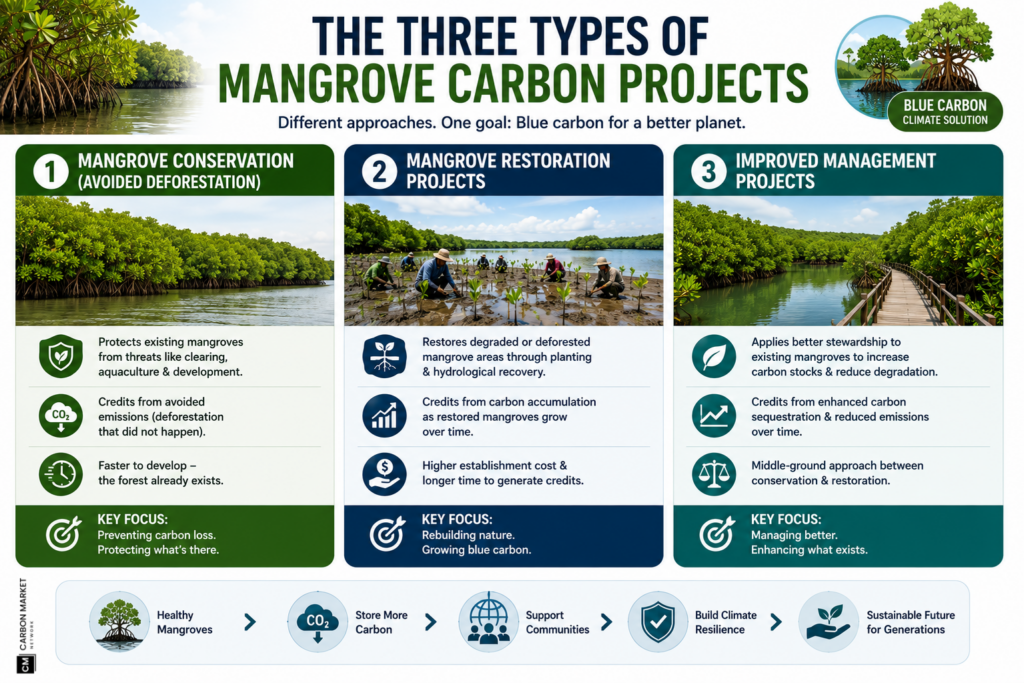
1. Mangrove Conservation Projects (Avoided Deforestation)
These projects protect standing mangrove forests that are under threat of being cleared for aquaculture ponds, coastal development, or fuelwood harvesting.
Credits are generated by calculating the carbon emissions that would have occurred if the mangroves had been cut down. This is the avoided emissions approach.
Conservation projects are typically faster to develop because the forest already exists and does not need to be planted. However, the additionality argument must be especially rigorous. The project needs to demonstrate that deforestation was a real and credible threat.
2. Mangrove Restoration Projects
These projects restore mangrove cover on degraded or deforested land. Propagules or seedlings are planted, and hydrological conditions are restored to allow natural regeneration.
Restoration projects generate credits from the carbon that accumulates as the restored mangroves grow. Credits build up gradually over the project’s lifetime.
These projects have a higher establishment cost and require careful site selection to ensure seedling survival. Restoration on sites where the underlying ecology has changed significantly can fail if the root causes of degradation, such as altered tidal flows, are not addressed.
3. Improved Management Projects
These projects apply better stewardship practices to existing mangrove forests to increase carbon stocks and reduce degradation over time. They occupy a middle ground between pure conservation and active restoration.
Key Carbon Standards and Methodologies for Mangrove Projects
The credibility of a mangrove carbon project depends heavily on the standard it operates under. Here are the main frameworks in use today.
Verra VCS (Verified Carbon Standard) and VM0033
Verra’s Verified Carbon Standard is the most widely used voluntary carbon standard globally, and it is the dominant framework for blue carbon projects.
VM0033 Methodology for Tidal Wetland and Seagrass Restoration (v2.1, active since September 2023) outlines procedures to quantify net greenhouse gas emission reductions and removals resulting from project activities implemented to restore tidal wetlands.
VM0033 is designed to be applicable globally, encompassing a wide range of tidal wetland systems including tidal forests such as mangroves, tidal marshes, and seagrass meadows. The methodology provides detailed procedures for estimating baseline emissions, project emissions, and net GHG reductions. It accounts for various carbon pools including biomass above and below ground, soil organic carbon, and in some cases wood products.
Verra’s VCS is frequently used alongside the Climate, Community and Biodiversity (CCB) Standards, which certify the social and biodiversity co-benefits of a project.
Gold Standard
On 22 August 2024, Gold Standard introduced the Methodology for the Sustainable Management of Mangroves, launching remote-sensing applications for measuring and quantifying the impact of sustainable mangroves. Gold Standard’s methodology is specifically designed for mangrove restoration projects, as distinct from Verra’s which applies to tidal wetlands more broadly.
A Singapore-based non-profit secured the first project registered under Gold Standard’s blue carbon methodology for a mangrove restoration project in Indonesia, marking the first blue carbon initiative approved under this framework.
Plan Vivo
Plan Vivo is a smaller standard with a strong emphasis on community-led projects and equitable benefit sharing. It is the standard under which the world’s first blue carbon project, Mikoko Pamoja in Kenya, was certified.
Plan Vivo projects tend to be smaller in scale but are recognized for rigorous social outcomes and community participation.
The Role of ICVCM Core Carbon Principles
The Integrity Council for the Voluntary Carbon Market (ICVCM) has introduced Core Carbon Principles (CCPs) that set a baseline quality threshold for carbon credits across all standards. High-quality mangrove carbon credits are increasingly expected to meet CCP criteria to attract premium buyers.
Carbon Credit Prices for Mangrove Projects
Mangrove carbon credits consistently trade at a premium over the average voluntary carbon market price. This reflects the combination of high carbon integrity, biodiversity co-benefits, and community development outcomes.
Between 2014 and 2025, nearly 7 million blue carbon credits were issued, with a weighted average price of US$27 per blue carbon credit.
According to S&P Global, mangrove carbon credits from projects in Asia and Central America cost $13 to $35 per metric ton of CO₂.
For mangrove restoration and afforestation/reforestation projects, carbon credits are currently priced at $50 to $70 per credit, and are expected to command above-market prices with the potential for additional premiums driven by sustainable development benefits.
The International Finance Corporation estimates that the price of carbon credits could rise to between $40 and $65 by 2040.
The table below provides a useful pricing reference across project and quality tiers.
| Credit Type | Typical Price Range | Key Drivers |
|---|---|---|
| Mangrove conservation (high integrity) | $25 to $70 per tonne | Strong MRV, CCB certified, community co-benefits |
| Mangrove restoration (certified) | $15 to $50 per tonne | Carbon removal, biodiversity uplift |
| General blue carbon (VCM average) | $13 to $35 per tonne | Registry, vintage, geography |
| Low-rated VCM credits (all types) | $3.50 to $7 per tonne | Weak integrity, legacy projects |
| High-rated VCM credits (all types) | $14 to $80+ per tonne | ICVCM CCP eligible, CSRD-ready |
Sources: S&P Global, LSE Grantham Research Institute, Senken, MSCI, IFC.
One factor that keeps demand strong for mangrove credits is their near-total sell-through rate. Growing recognition of blue carbon ecosystems as natural climate solutions is driving demand for credits worldwide. This was evident in the credit purchase records of registered blue carbon projects, as 99.5% of issued blue carbon credits have been sold.
Real-World Mangrove Carbon Projects Making an Impact
The following projects illustrate what mangrove carbon projects look like when they work well.
Mikoko Pamoja, Kenya: The World’s First Blue Carbon Project
Mikoko Pamoja, which means “Mangroves Together” in Swahili, launched in Gazi Bay on Kenya’s southern coast. It is a community-led mangrove conservation and restoration project and the world’s first blue carbon project. It involves both the prevention of deforestation of the local mangrove forest and community-based reforestation.
The project sequesters 2,500 tonnes of CO₂ equivalent each year and generates an income of approximately $30,000. The revenue is reinvested in the local community to improve access to water, sanitation, and education, as well as further environmental conservation.
The Mikoko Pamoja project, covering 117 hectares in Kwale County, was recognised with the UN in Kenya Person of the Year Award for 2023, the first time a project received the honour.
Delta Blue Carbon, Pakistan: The World’s Largest Mangrove Project
The Delta Blue Carbon project in the Indus Delta, Sindh, is the largest mangrove carbon project in existence. The aim is to protect and restore 350,000 hectares of mangrove and intertidal areas, which should generate 128 million carbon credits over the project’s 60-year lifetime.
The project generated significant market attention when it sold 250,000 credits in a single transaction, demonstrating that blue carbon supply could operate at scale.
Vida Manglar, Colombia: Community-Led Conservation
Vida Manglar, which means “mangrove life” in Spanish, is a blue carbon project to conserve and restore 7,500 hectares of coastal mangrove forests in Cispatá Bay in Colombia’s Sinú River basin. Over its 30-year lifespan, the Vida Manglar project expects to expand operations to protect a total of 11,000 hectares and sequester close to 1 million metric tons of carbon.
The Vida Manglar project returns 92 percent of its carbon credit proceeds to local people who decide how revenues are allocated. The project also achieved a 69% reduction in unplanned deforestation in its first monitoring period, a standout result.
The Sherbro River Estuary Project, Sierra Leone
In October 2025, a subsidiary of West Africa Blue signed a blue carbon offsetting deal with 124 communities on Sherbro Island in Sierra Leone. The agreement will reward the communities financially for conserving and restoring their mangroves, which act as a carbon sink. The funds will be generated by selling offsets on the voluntary carbon market, with revenues shared between West Africa Blue, the communities and the government of Sierra Leone.
Once all project areas are included, the project will cover roughly 94,000 hectares and has the potential to reduce or remove more than 3 million metric tons of CO₂ equivalent over its life.
Langkat Corridor, Indonesia
Launched in 2021 in Langkat Regency, the initiative established a strong foundation for community-led mangrove conservation, restoration, and livelihoods. Built on proven on-ground delivery, the corridor has expanded within Langkat and is now extending into Deli Serdang and Aceh, strengthening ecological connectivity and enabling regional scale-up.
The Co-Benefits of Mangrove Carbon Projects
Carbon credits are only one part of the value that mangrove projects create. High-quality projects deliver a wide range of co-benefits that make them attractive to buyers who care about more than just carbon.
Coastal Protection
Mangroves act as natural seawalls. Their root systems dissipate wave energy, reduce storm surge impacts, and protect shorelines from erosion. For low-lying coastal communities, this protection can be the difference between survival and displacement during extreme weather events.
Coastal states facing rising seas and intensifying storms are looking for measures that can reduce risk without relying solely on concrete seawalls or large engineering schemes.
Fisheries and Food Security
Mangrove root systems provide nursery habitat for fish, shrimp, and crustaceans. Many coastal fishing communities depend on healthy mangroves for their livelihoods. When mangroves are restored, fish populations recover, and local food security improves.
80% of the Gazi Bay community earn their livelihoods through fishing activities. However, they had seen a significant decrease in fish due to illegal logging of mangrove forests, which destroys fish nests. Projects like Mikoko Pamoja directly address this by linking conservation to community fishing benefits.
Biodiversity
Mangrove forests support high levels of biodiversity, including rare and endemic bird species, juvenile marine species, and terrestrial wildlife. Projects that earn CCB or similar certifications document and protect these biodiversity values, which adds value for buyers with biodiversity commitments.
Community Livelihoods
Well-designed mangrove carbon projects create direct income streams for coastal communities through employment in restoration, monitoring, and patrol activities. They also fund community development projects in education, clean water, and healthcare.
Mangrove protection is one of the few environmental interventions with visible implications for climate, biodiversity, and poverty reduction at once.
SDG Alignment
Mangrove restoration maps onto several of the United Nations Sustainable Development Goals. It connects directly to SDG 13, climate action, because of carbon storage and adaptation benefits. It also relates to SDG 14, life below water, through habitat protection and fisheries recovery, and SDG 1, no poverty, and SDG 8, decent work and economic growth, where coastal livelihoods depend on functioning ecosystems.
The Investment Case for Mangrove Carbon Projects
For investors and project developers, mangrove carbon projects present a compelling but complex investment case.
The Financial Upside
Mangrove credits consistently achieve premium prices relative to other voluntary carbon credit types. Demand has historically outpaced supply, with nearly all issued credits being sold.
Over the next two decades, restoration of mangroves would necessitate an investment of $40 to $52 billion, yielding net gains in ecosystem service value of $231 to $725 billion. The global benefit-cost ratio of mangrove restoration ranges from 6.35 to 15.0, demonstrating that such projects are highly cost-effective.
The Mangrove Breakthrough initiative, launched at COP27, aims to mobilize $4 billion to protect and restore 15 million hectares of mangroves by 2030.
Financing Mechanisms Beyond Carbon Credits
While carbon credits are the primary revenue driver, serious investors are looking at a broader set of financing tools.
The Mangrove Breakthrough initiative leverages a diverse range of financial mechanisms that not only address the climate mitigation benefits of mangroves but also drive investments in climate adaptation, coastal infrastructure, resilience, biodiversity, and food security. This includes the Mangrove Transition Bond Series, a regional investment vehicle that channels funds to local financial institutions.
Payment for Ecosystem Services (PES) frameworks, biodiversity credits, and blended finance structures are increasingly being explored alongside carbon revenue to improve project economics, especially for smaller-scale initiatives.
Challenges Facing Mangrove Carbon Projects
Mangrove carbon projects are not without serious challenges. Understanding these challenges is essential for anyone involved in developing, buying, or evaluating these projects.
Additionality
A project must demonstrate that its climate benefits would not have occurred without the project and the carbon finance it generates. This is the additionality requirement.
Blue carbon projects must demonstrate that carbon sequestration would not occur without conservation and restoration financed by carbon credits, by establishing robust baselines of carbon stocks and deforestation trends against which emissions reductions can be measured.
Proving additionality can be difficult in areas where mangrove loss is slow or where multiple overlapping pressures make the counterfactual scenario hard to define.
Permanence
Carbon stored in mangroves must remain stored over the long term for the credits to be credible. But mangroves face real threats that can reverse those carbon gains: sea level rise, tropical storms, land use change, and community pressure.
Socioeconomic and climate change permanence risks are likely to affect 85% of mangroves in Southeast Asia, limiting the potential of blue carbon credits as a strategy to finance mangrove conservation efforts.
Standards address permanence through non-permanence risk buffers, where a percentage of credits are held back in a reserve pool to cover potential losses.
Leakage
Leakage occurs when conservation activity in one area simply pushes destructive activity to another area outside the project boundary.
Expanding projects to include adjacent ecosystems can also reduce carbon leakage, which can otherwise occur when extractive activities such as timber or fuelwood collection shift to nearby plots.
Landscape-scale approaches, where large areas are managed together, are increasingly seen as the most effective way to address leakage.
The Risk of Ghost Carbon
A high-profile example from Senegal illustrates what can go wrong with poor monitoring.
A major mangrove restoration project launched in Senegal overestimated its climate benefits by failing to account for high seedling mortality, with only about 18 to 20% of planted mangroves surviving. Carbon credits were issued based on the assumption that all planted areas were successful, resulting in the sale of “ghost carbon,” credits not backed by actual carbon sequestration.
This example underlines the critical importance of rigorous post-planting monitoring and honest reporting.
High Upfront Costs
The successful development of mangrove carbon projects is hampered by numerous challenges related to accurate site selection, methodology standardization and accreditation, MRV processes, transparency, high initial project investment, market shifts and dynamics, co-benefit monetization and sharing, stakeholder participation, legitimacy with local actors, social impact, land use and climate change impacts, communication, and overall governance.
For smaller communities and developing country project developers, these costs can be prohibitive without grant funding or concessional finance to bridge the gap.
Land Tenure and Governance
Many mangrove forests sit on land where tenure is unclear or contested. Without clarity on who owns or manages the land, and who has the right to sell carbon credits generated from it, projects face serious legal and social risks.
Ambiguous land tenure systems, insufficient community participation, and deep-seated power asymmetries between global project developers and local, often Indigenous, communities frequently impede progress.
MRV Complexity
Measuring carbon in mangrove soils is technically challenging. Work takes place in tidal zones with difficult access, high water content in soil samples complicates field processing, and monitoring requires repeated surveys over long time periods.
Work in mangrove forests is more challenging than in terrestrial ecosystems. The logistics of using boats to access field sites, short windows of time between tides, and the difficult terrain preclude swift completion of tasks, which in turn increases costs and duration of fieldwork.
The State of the Market: Key Facts and Figures
Here is a snapshot of where the global mangrove carbon market stands today.
| Metric | Data |
|---|---|
| Global mangrove area | Approximately 14.8 million hectares |
| Total carbon stored in mangroves | An estimated 6.4 billion tonnes |
| Carbon sequestration rate | 6 to 8 tonnes CO₂e per hectare per year |
| Global blue carbon projects (active) | 81 projects as of October 2025 |
| Blue carbon coverage | Approximately 2 million hectares across 81 projects |
| Total blue carbon credits issued (2014 to 2025) | Nearly 7 million credits |
| Mangrove share of blue carbon credits issued | Almost 99% |
| Weighted average price per blue carbon credit | US$27 |
| Sell-through rate of issued blue carbon credits | 99.5% |
| Share of VCM total by volume (blue carbon) | Approximately 1% |
Sources: LSE Grantham Research Institute, Blue Carbon Initiative, Wiley Sustainable Development, ScienceDirect, BeZero Carbon.
The data tells a clear story. Blue carbon, and mangrove credits specifically, represent a tiny fraction of the overall voluntary carbon market by volume, but they punch well above their weight on price, demand, and integrity.
A 2025 assessment of 81 blue carbon projects found that they covered roughly 2 million hectares and were linked to projected long-term emissions reductions and removals, although that estimated contribution remained a small fraction of the wider global potential.
The gap between current supply and theoretical global potential is vast, which explains why investors, policymakers, and standard-setters are all focused on scaling up.
Who Buys Mangrove Carbon Credits?
Mangrove carbon credits attract buyers across a range of sectors and motivations.
Corporate net-zero buyers purchase mangrove credits as part of their residual emissions offsetting strategy, particularly where they want to demonstrate nature-based co-benefits alongside carbon claims.
Premium brand buyers in sectors like luxury goods, aviation, finance, and consumer products use mangrove credits to communicate both climate and community impact to their customers.
Impact investors and funds buy forward contracts for mangrove credits, locking in supply while funding the project development cycle.
Governments under Article 6 of the Paris Agreement are beginning to explore mangrove carbon as part of bilateral emissions trading arrangements, particularly in Southeast Asia and the Pacific.
Compliance market integration is a growing trend. Compliance markets are beginning to embrace interoperability with the voluntary carbon market, indicating acceptance of the common framework of emissions reductions and removals underlying both types of carbon market.
Emerging Trends in Mangrove Carbon Projects
The mangrove carbon sector is evolving quickly. Several trends are shaping where the market goes next.
Technology and Remote Sensing in MRV
Satellite-based monitoring is transforming how mangrove projects measure and verify carbon. Tools like Google Earth Engine, SAR imagery, and drone-based surveys are reducing the cost of field monitoring and improving the accuracy and frequency of carbon stock assessments.
Gold Standard’s new methodology creates a path for increased investments by enabling quality carbon credits from these projects. It launches remote-sensing applications for measuring and quantifying the impact of sustainable mangroves.
Jurisdictional Approaches
Rather than small, site-level projects, jurisdictional approaches operate at the scale of entire coastlines or national mangrove inventories. They offer a more robust solution to leakage and permanence risks, and they align more naturally with national climate commitments under the Paris Agreement.
Indonesia’s Ministry of Marine Affairs and Fisheries has projected that the country’s blue carbon ecosystems could absorb up to 10 million tonnes annually.
Biodiversity Credits and Stacking
Developers are exploring the possibility of issuing biodiversity credits alongside carbon credits from the same mangrove project. This would allow buyers to simultaneously satisfy carbon and biodiversity commitments, increasing overall revenue per hectare of mangrove protected.
Expanding Geography
The development of mangrove carbon projects has gained momentum over the past decade. The majority of projects in various stages of application are located in Southeast Asia, which also has the highest mangrove extent.
However, African mangroves are attracting growing attention. Countries in the African continent have 23 of the 74 registered projects in various stages of the application process, with Senegal having the most projects.
West Africa, in particular, is emerging as a significant new frontier, driven by projects like the Sherbro River Estuary initiative in Sierra Leone.
Article 6 and Compliance Integration
The rules agreed at COP29 for Article 6 of the Paris Agreement are beginning to clarify how mangrove carbon credits can flow between countries and be used in compliance frameworks.
COP29 saw new Article 6 rules and a two-tier registry system that will blur the line between voluntary and regulated markets. This infrastructure will be key to bringing much-needed transparency and credibility to the global carbon market by preventing double-counting across borders.
How to Evaluate a Mangrove Carbon Project
If you are a buyer, investor, or partner evaluating a mangrove carbon project, here is a practical checklist.
Carbon Integrity
- Is the project registered under a recognized standard (Verra VCS, Gold Standard, Plan Vivo)?
- Has additionality been clearly demonstrated with a credible counterfactual scenario?
- Does the project have a non-permanence risk buffer in place?
- Has leakage been measured and addressed?
Monitoring Quality
- Does the project use remote sensing combined with field verification?
- Are carbon stock surveys conducted at regular intervals by accredited verifiers?
- Is monitoring data publicly available on the registry?
Social and Community Outcomes
- Has Free, Prior, and Informed Consent been secured from all relevant communities?
- Do local communities receive a meaningful share of carbon revenues?
- Are community co-benefit claims backed by evidence and independent assessment?
Financial Transparency
- Are revenue sharing arrangements publicly disclosed?
- Does the project have sufficient funding to operate through the full crediting period?
Third-Party Ratings
- Has the project been independently rated by firms such as BeZero Carbon, Sylvera, or Calyx Global?
- A high third-party rating significantly reduces the reputational and financial risk of buying the credits.
The Path Forward: Scaling Mangrove Carbon Finance
The case for scaling up mangrove carbon projects is strong. The ecosystems are highly productive, the science is well-established, the market demand is growing, and the co-benefits are well-documented.
But getting there requires coordinated action.
Public funding remains essential, particularly for early-stage planning, tenure clarification, scientific assessment, and enforcement against illegal destruction. Standards bodies need to maintain conservative accounting rules and avoid rewarding projects that make climate claims unsupported by ecological realities.
Our findings are not an argument against mangrove restoration, far from it. Mangroves remain one of the most effective natural tools for tackling climate change. But for blue carbon projects to play a credible role in climate action, carbon claims must be honest, independently verified, and based on sound science.
The market needs more project developers with the technical capacity to develop high-quality projects. It needs buyers willing to pay premium prices for genuine co-benefits, not just the cheapest offset. And it needs standardized methodologies, transparent registries, and fair revenue-sharing arrangements that put coastal communities at the center.
When all of those pieces are in place, mangrove carbon projects represent one of the most powerful intersections of climate finance, nature conservation, and human development available today.
FAQ: Mangrove Carbon Projects
What is a mangrove carbon project?
A mangrove carbon project is a structured program that protects, restores, or improves the management of mangrove forests to generate verified carbon credits. These credits are sold through the voluntary carbon market, and the revenue funds conservation activities and community development.
Why do mangrove carbon credits cost more than other credits?
Mangrove carbon credits command a premium because mangroves store exceptional amounts of carbon, the credits are rigorously verified, and the projects deliver co-benefits including biodiversity conservation, coastal protection, and community livelihoods. All of these factors make the credits more credible and more valuable to buyers.
What standard is used for mangrove carbon projects?
The most commonly used standard is Verra’s Verified Carbon Standard, specifically the VM0033 Methodology for Tidal Wetland and Seagrass Restoration. Gold Standard introduced its own mangrove-specific methodology in 2024. Plan Vivo is used for community-led projects at smaller scales.
How much carbon does a mangrove forest sequester per year?
On average, mangrove forests sequester between 6 and 8 tonnes of CO₂ equivalent per hectare per year. This is roughly two to four times higher than the sequestration rate of mature tropical terrestrial forests.
What is the difference between a conservation mangrove project and a restoration project?
A conservation project protects standing mangrove forest from being cleared, and generates credits from avoided emissions. A restoration project plants mangroves or restores degraded areas, and generates credits as new carbon accumulates in the growing forest. Conservation projects are generally faster to develop, while restoration projects build carbon stocks over a longer timeframe.
How are local communities involved in mangrove carbon projects?
Community involvement is a core requirement of high-quality mangrove carbon projects. It includes Free, Prior, and Informed Consent before the project begins, employment of local people in monitoring and patrol activities, a meaningful share of carbon revenues flowing to the community, and governance arrangements that give communities a voice in how revenues are used.
What is “ghost carbon” in mangrove projects?
Ghost carbon refers to carbon credits issued for carbon sequestration that did not actually occur, most commonly because planted mangrove seedlings failed to survive and grow. High seedling mortality rates that are not properly accounted for can result in credits that overstate the actual climate benefit of a restoration project.
Can mangrove carbon credits count toward corporate net-zero targets?
Yes, subject to the quality of the credits and the framework a company is using. High-quality, ICVCM CCP-eligible mangrove carbon credits from recent vintages are increasingly accepted under SBTi guidance and CSRD reporting frameworks. Buyers should seek credits that have been independently rated by credible third-party rating firms.
Are mangrove carbon projects suitable for small coastal communities to develop?
Smaller communities face real barriers, including high upfront development costs, technical MRV requirements, and the need for independent auditors. However, community-led models like Mikoko Pamoja in Kenya show that it is possible at modest scale. Grant funding, technical assistance providers, and aggregation models that bundle multiple small projects together are all pathways that lower the barriers for community-based developers.
What is blue carbon?
Blue carbon is the term for carbon captured and stored by coastal and marine ecosystems, including mangroves, salt marshes, and seagrass meadows. Mangroves are the dominant source of blue carbon credits in voluntary carbon markets, accounting for almost 99% of all credits issued to date.
Published on Carbon Market Network — Your trusted source for carbon market education, news, and resources. Visit: carbonmarketnetwork.com