Carbon Market Network


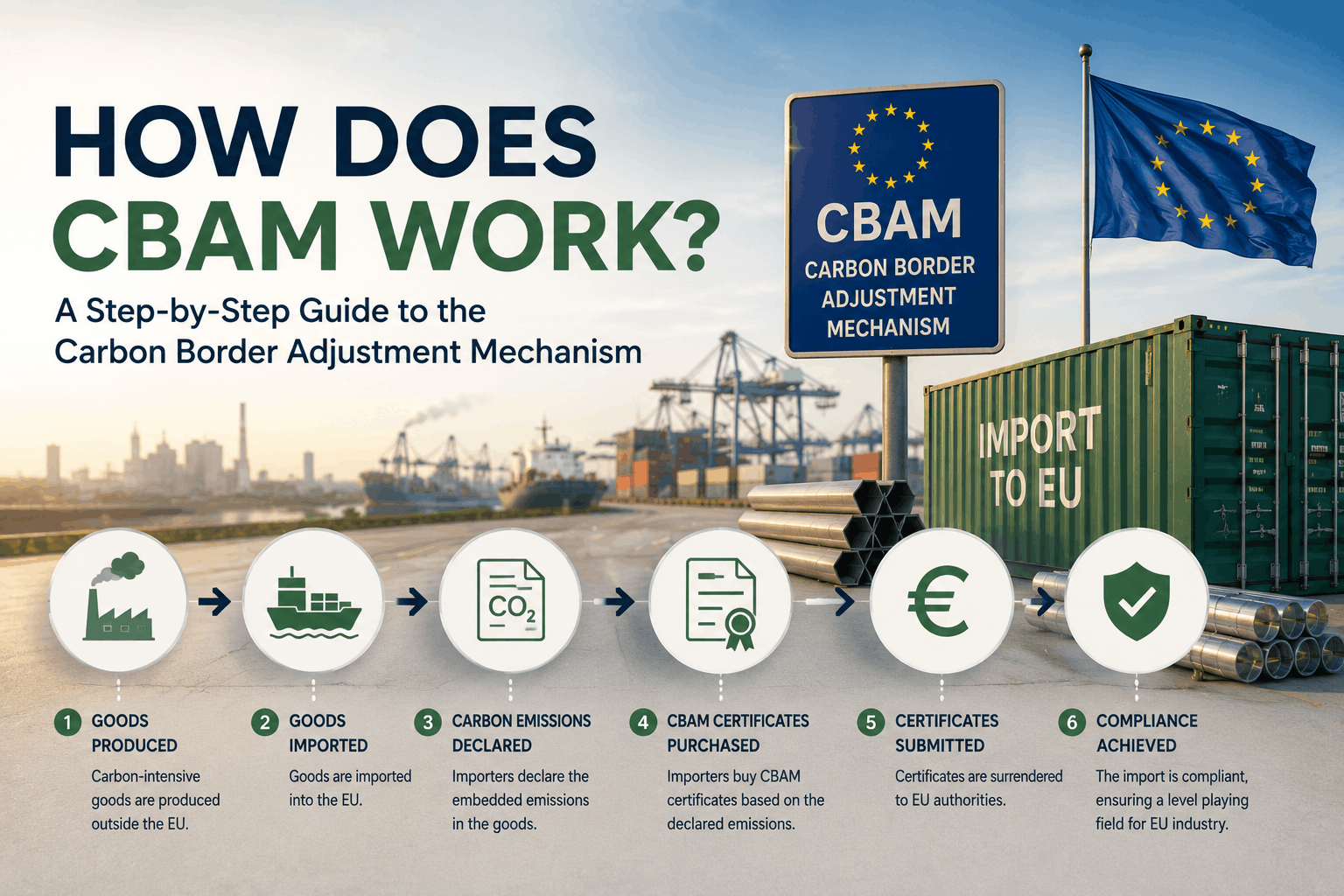
If you import carbon-intensive goods into the European Union, the Carbon Border Adjustment Mechanism is now one of the most important regulations you need to understand.
CBAM is not just another trade rule. It fundamentally changes how the carbon cost of production is accounted for at the border. Whether you are a manufacturer in a non-EU country, an EU importer, a trader, or simply someone curious about climate policy, this guide will walk you through exactly how CBAM works, step by step, from start to finish.
No jargon. No fluff. Just a clear, practical breakdown of the entire CBAM process.
What Is CBAM and Why Does It Exist?
CBAM stands for the Carbon Border Adjustment Mechanism. It is a European Union regulation established under Regulation (EU) 2023/956.
At its core, CBAM is designed to solve one specific problem: carbon leakage.
Carbon leakage happens when companies move their production from the EU to countries with weaker (or no) carbon pricing rules. This allows them to avoid paying for their emissions under the EU Emissions Trading System (EU ETS), while still selling their products into the EU market.
This creates an uneven playing field. EU producers pay for every tonne of CO2 they emit. Foreign producers, in many cases, pay nothing.
CBAM fixes this by placing an equivalent carbon cost on certain imported goods.
Think of it this way: if a steel producer in the EU pays a carbon price of €75 per tonne of CO2 under the EU ETS, a steel importer bringing the same product from a country with no carbon pricing should now pay a similar cost at the EU border.
This levels the playing field, protects EU industry from unfair competition, and – importantly – creates a global incentive for non-EU countries to adopt stronger climate policies.
Carbon Market Insider Newsletter
Weekly insights on carbon markets, climate policy, carbon credits, and sustainability.
The CBAM Timeline: From Reporting to Full Compliance
Before diving into the steps, it helps to understand the overall timeline.
CBAM rolled out in two major phases:
| Phase | Period | Key Obligation |
|---|---|---|
| Transitional Phase | October 2023 to December 2025 | Report embedded emissions quarterly. No certificate payments required. |
| Definitive (Compliance) Phase | From January 2026 onwards | Authorised declarant status required. Annual declarations and certificate surrender obligations apply. |
The first CBAM certificate sales open via the EU’s central platform in February 2027.
The first annual declaration and certificate surrender, covering all goods imported during 2026, is due by September 30, 2027.
From 2027 onwards, certificate prices will be calculated and published on a weekly basis (compared to quarterly in 2026).
This gradual rollout was intentional. It gave businesses, governments, and verification bodies time to build the infrastructure, systems, and expertise needed for full compliance.
Which Goods and Sectors Does CBAM Cover?
CBAM currently covers six carbon-intensive sectors. These were chosen because they carry the highest risk of carbon leakage and account for a significant share of industrial greenhouse gas emissions.
| Sector | Key Products | Emissions Priced |
|---|---|---|
| Iron and Steel | Pig iron, flat-rolled products, bars, wire, tubes, pipes | Direct emissions only |
| Cement | Clinker, Portland cement | Direct and indirect emissions |
| Aluminium | Unwrought aluminium, alloys, semi-finished products | Direct emissions only |
| Fertilisers | Ammonia, nitric acid, urea, mixed fertilisers | Direct and indirect emissions |
| Electricity | Imported electrical power | Direct emissions only |
| Hydrogen | Grey, blue, and green hydrogen | Direct emissions only |
A few important notes on scope:
Cement and fertilisers are the only two sectors where both direct and indirect emissions (from electricity used in production) are currently priced under CBAM.
For iron, steel, and aluminium, only direct emissions are counted. This reflects the complexity of verifying electricity-related emissions across different production routes.
Grey hydrogen, produced through steam methane reforming, carries approximately 9 to 12 tonnes of CO2 per tonne of hydrogen. Green hydrogen from renewable electrolysis carries close to zero. This makes the production method critically important for CBAM cost exposure.
The EU has also proposed expanding CBAM’s scope from 2028 to include certain downstream products containing significant quantities of iron, steel, or aluminium, such as industrial radiators, some appliances, and base metal components. This expansion is not yet in force.
Countries currently exempt from CBAM include Iceland, Liechtenstein, Norway, and Switzerland because they either operate the EU ETS directly or run equivalent qualifying carbon pricing systems.
Step-by-Step: How the CBAM Process Works
Here is the complete, step-by-step breakdown of how CBAM works in practice.
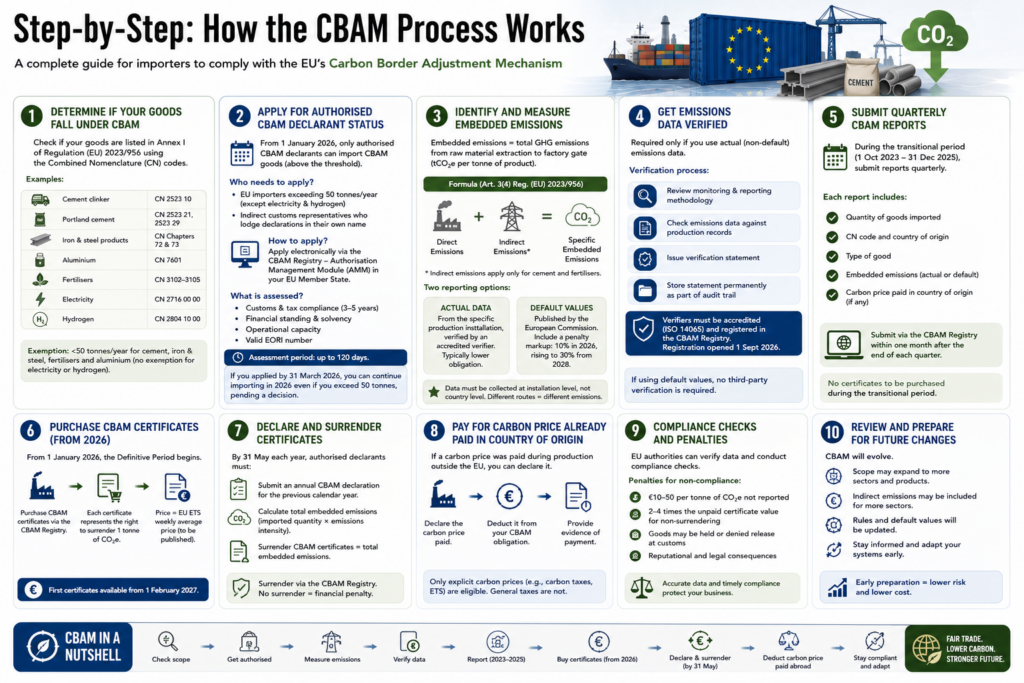
Step 1: Determine If Your Goods Fall Under CBAM
The first step for any EU importer is to check whether the goods they are importing fall within CBAM’s scope.
This is done by checking the Combined Nomenclature (CN) codes listed in Annex I of Regulation (EU) 2023/956.
Each product covered under CBAM is identified by a specific CN code. For example, cement clinker falls under CN codes 2523 10, Portland cement under 2523 21 and 2523 29, and iron and steel products span multiple codes across Chapters 72 and 73 of the Combined Nomenclature.
If your goods match a CN code in Annex I, CBAM applies to your imports.
A key exemption to note: Importers bringing in less than 50 tonnes of CBAM goods per year from the cement, iron and steel, fertiliser, and aluminium sectors are currently exempt from the authorised declarant requirement. However, no such tonnage exemption applies to electricity or hydrogen.
Step 2: Apply for Authorised CBAM Declarant Status
From January 1, 2026, only authorised CBAM declarants can legally import CBAM-covered goods into the EU above the applicable threshold.
This is a mandatory legal status. Without it, customs authorities will block your goods at the border.
Who needs to apply?
- EU-established importers who expect to exceed the 50-tonne annual threshold for CBAM goods (except electricity and hydrogen, which have no threshold)
- Indirect customs representatives (such as freight forwarders) who lodge customs declarations in their own name
How do you apply?
Applications are submitted electronically through the CBAM Registry, specifically via the Authorisation Management Module (AMM), in the EU Member State where the importer is established.
What do authorities assess?
Authorities review the applicant’s:
- Customs and tax compliance record (typically covering the past 3 to 5 years, with no serious violations)
- Financial standing and solvency (no significant tax arrears, ability to cover certificate liabilities)
- Operational capacity to manage emissions data and certificate handling
- Valid Economic Operators Registration and Identification (EORI) number
The assessment period is up to 120 days from submission.
Importers who submitted applications by March 31, 2026 were granted provisional permission to continue importing CBAM goods throughout 2026, even if they exceeded the 50-tonne threshold, pending a decision on their application.
Step 3: Identify and Measure Embedded Emissions
This is the technical heart of the CBAM mechanism. And it is where most of the complexity lies.
What are embedded emissions?
Embedded emissions are the total greenhouse gases released during the production of CBAM-covered goods, from raw material extraction to the factory gate. They are expressed in tonnes of CO2 equivalent per tonne of product.
The legal definition comes from Article 3(4) of Regulation (EU) 2023/956: embedded emissions are direct plus, where applicable, indirect emissions.
The formula is:
Specific Embedded Emissions = Direct Emissions + Indirect Emissions (where applicable)
Direct emissions come from the fuels burned, chemical reactions, and other processes that occur inside the production facility. For example, a cement kiln burning coal to heat limestone releases CO2 directly.
Indirect emissions come from the electricity consumed during the production process. CBAM currently prices indirect emissions only for cement and fertilisers. For an electric arc furnace steel producer, electricity can represent 40 to 60 percent of total embedded carbon, but this is not currently included under CBAM for steel.
Actual vs. Default Values
Importers have two options for reporting emissions:
- Actual verified data from the specific production installation. This requires monitoring systems at the facility and third-party verification by an accredited verifier. Actual data almost always results in a lower certificate obligation for producers using modern, efficient technology.
- Default values published by the European Commission. These are standardised emission intensity values that apply when actual data cannot be obtained. Default values carry a mark-up above typical actual values as a penalty for non-reporting. Importers using defaults in 2026 face a 10 percent surcharge, rising to 30 percent from 2028 onwards.
This financial penalty structure strongly incentivises non-EU producers to invest in emissions monitoring and data transparency.
Emissions data must be collected at the production installation level, not the country level. Carbon intensity varies significantly between individual plants. A blast furnace route for steel carries approximately 2.0 tonnes of CO2 per tonne of steel. An electric arc furnace scrap route carries approximately 0.5 tonnes of CO2 per tonne. Using the wrong default for the wrong production route is a costly compliance error.
Step 4: Get Emissions Data Verified
For importers who want to use actual (non-default) emissions data, the data must be verified by an accredited third-party verifier before it can be used in a CBAM declaration.
Verification follows accreditation standards under Regulation (EU) 2025/2083. Verifiers must be accredited under the ISO 14065 standard and registered in the CBAM Registry. The verifier registration window in the CBAM Registry opened on September 1, 2026, ahead of the first certificate sales in February 2027.
The verification process involves:
- Reviewing the monitoring and reporting methodology used at the production installation
- Checking that emissions data matches production records
- Issuing a formal verification statement
Once verified, this statement must be stored permanently as part of the compliance audit trail.
If importers are using default values, third-party verification of those specific values is not required. However, the overall CBAM declaration still remains subject to scrutiny by national competent authorities.
Step 5: Submit the Annual CBAM Declaration
The annual CBAM declaration is the central compliance document. It covers all CBAM goods imported during the prior calendar year and must be submitted by May 31 each year (with the first declaration, covering 2026 imports, due by May 31, 2027 under current timelines, with the final surrender deadline of September 30, 2027).
The declaration must include:
- The quantity of each CBAM good imported (in tonnes)
- The country of origin of each good
- The production installation that manufactured the goods
- The total embedded emissions (in tonnes of CO2 equivalent)
- The number of CBAM certificates to be surrendered
- Any carbon price already paid in the country of production (to support deductions)
This is not a simple form. It requires linking every import entry number to its corresponding embedded emissions figure. Compliance professionals often recommend maintaining a single, auditable database that connects customs entries to emissions data throughout the year.
Step 6: Purchase CBAM Certificates
This is where the financial obligation becomes real.
EU importers must purchase CBAM certificates corresponding to the embedded emissions in their imported goods. These certificates are bought through the EU’s centralised CBAM platform, which opened for sales on February 1, 2027.
How is the certificate price set?
The price of CBAM certificates mirrors the price of EU ETS allowances. Specifically, it is calculated as the weighted average of EU ETS auction clearing prices.
In 2026, the European Commission publishes one quarterly price for each of the four calendar quarters. From 2027, this shifts to weekly pricing, giving importers more frequent price signals aligned with the ETS market.
The Q1 2026 official CBAM certificate price was €75.36 per tonne of CO2 equivalent. The Q2 2026 price, published on July 6, 2026, was €75.28 per tonne of CO2 equivalent.
This price tracks the EU ETS daily auction market, which has moved from around €25 per tonne of CO2 in early 2020 to above €90 in early 2023 before settling in the €60 to €80 range in subsequent periods.
The CBAM Factor: A Gradual Phase-In
In 2026, importers do not pay full CBAM costs. A CBAM factor applies, which reduces the certificate obligation in line with the share of free allocations still available to EU producers under the EU ETS.
The phase-in schedule works as follows:
| Period | CBAM Factor (% of free allocations remaining) | Effective CBAM Obligation |
|---|---|---|
| 2026 | 97.5% free allocations remain | Only 2.5% of embedded emissions require certificate coverage |
| 2027 | 95% | 5% |
| 2028 | ~87.5% (proposed) | ~12.5% |
| 2030 | ~51.5% | ~48.5% |
| 2034 | 0% (no more free allocations) | 100% full CBAM cost |
This means that in 2026, the net certificate cost is only 2.5 percent of the gross cost. The full CBAM financial burden phases in gradually as EU ETS free allocations are phased out, reaching full effect in 2034.
Example: If you import 10,000 tonnes of cement with embedded emissions of 8,500 tonnes of CO2 at a certificate price of €75 per tonne, the gross cost would be €637,500. In 2026, your actual net obligation is 2.5 percent of this, meaning approximately €15,938 in certificates for 2026 imports.
Step 7: Maintain Quarterly Certificate Holdings
While the annual declaration and final surrender happen once per year, importers also have a quarterly holding requirement throughout the year.
From 2027 onwards, authorised CBAM declarants must ensure that by the end of each quarter, they hold CBAM certificates covering at least 50 percent of the cumulative embedded emissions in their imports to date for that calendar year.
This quarterly check prevents importers from leaving certificate purchases entirely to the last moment before the annual surrender deadline.
Certificates can be repurchased or sold back to the national authority, but only within limits. Importers can sell back up to one-third of their certificates during the buyback window. Unused certificates at year-end must be returned.
Step 8: Surrender Certificates and Complete the Annual Cycle
The annual CBAM declaration triggers the final certificate surrender obligation.
For 2026 imports, the first surrender of certificates must be completed by September 30, 2027.
This covers:
- Submitting the verified annual declaration of all CBAM goods imported during the calendar year
- Surrendering the exact number of certificates matching the embedded emissions reported (adjusted for any deductions)
- Reconciling quarterly holdings against the final annual figure
After this, the cycle resets for the following year.
Carbon Price Deductions: Avoiding Double Counting
One of CBAM’s most important features is the carbon price deduction mechanism.
If a non-EU manufacturer has already paid a carbon price in their own country on the production of the goods being imported, the importer can claim a reduction in the number of CBAM certificates they need to surrender.
This prevents double taxation. A producer who already pays a meaningful carbon price at home should not pay again at the EU border for the same emissions.
On May 13, 2026, the European Commission published a draft implementing regulation on how this deduction works in practice. The rules establish two options:
- Default carbon price approach: Uses standardised carbon price values for the producing country
- Actual carbon price approach: Uses the verified carbon price actually paid at the specific production facility
The draft regulation takes a strict equivalence approach: only carbon prices paid under a formal tax, levy, fee, or a binding emissions trading system with compliance obligations on all operators qualify for the deduction.
This effectively means that voluntary carbon credits purchased on the voluntary carbon market do not qualify as a deduction under the current draft rules.
Countries with strong, binding carbon pricing systems (such as countries with functioning ETSs or carbon taxes) are in a much stronger position to support their exporters in claiming CBAM deductions.
CBAM and the EU ETS: How They Connect
CBAM does not exist in isolation. It is deeply connected to the EU Emissions Trading System, the world’s largest carbon market.
The EU ETS works by setting a cap on total greenhouse gas emissions from heavy industry and power generation across the EU. Companies receive or buy emission allowances and must surrender one allowance for every tonne of CO2 they emit.
EU industrial producers in CBAM-covered sectors currently receive a portion of their allowances for free (known as free allocations). This was originally designed to protect EU industries from carbon leakage when no equivalent mechanism existed at the border.
Now that CBAM exists, the free allocations for CBAM-covered sectors are being phased out in tandem with the CBAM phase-in. In 2026, free allocations are reduced by 2.5 percent. By 2034, they are eliminated entirely, and CBAM takes on the full role of preventing carbon leakage.
This parallel phasedown is the key design feature that makes CBAM and the EU ETS work together as a coherent climate policy system.
Note: On July 17, 2026, the European Commission proposed slowing the phase-out of free EU ETS allocations for CBAM-covered sectors and potentially extending it to 2038. This proposal is not yet law, but it signals that policymakers are closely monitoring the pace of transition and may adjust the timeline.
CBAM Around the World: A Growing Global Trend
The EU was the first major economy to implement a CBAM, but it will not be the last.
The United Kingdom is developing its own CBAM, with implementation planned from 2027. The UK CBAM broadly mirrors the EU approach, covering similar sectors and using the UK ETS as the reference carbon price.
Australia and Canada have been exploring CBAM-style policies as part of broader carbon pricing reform discussions.
Turkey is studying the mechanism closely given its deep trade ties with the EU and significant potential CBAM exposure in steel and aluminium exports.
Several developing nations face significant adjustment pressures from CBAM, particularly smaller economies that export cement, steel, or fertilisers to the EU and have limited carbon pricing infrastructure. The EU has committed to supporting least developed countries (LDCs) in greening their industries and adapting to CBAM requirements.
The United States has seen bipartisan legislative proposals for domestic CBAM-style policies (such as the Clean Competition Act), though no federal legislation has passed as of mid-2026.
The global spread of CBAM-type instruments is accelerating. The mechanism is increasingly seen not just as a trade tool but as a driver of global carbon pricing convergence.
What CBAM Is NOT
There is considerable confusion in the market about what CBAM actually is. Here is a clear breakdown:
| What people think | The reality |
|---|---|
| CBAM is a carbon tax | It is not a tax. It is a certificate-based mechanism that mirrors EU ETS pricing. |
| CBAM is a tariff | It is not a tariff. It applies to carbon, not to value or quantity of goods in a traditional customs sense. |
| CBAM is a trade barrier | Its legal basis is climate policy, not protectionism. It does not restrict trade; it prices carbon equivalently. |
| CBAM only affects large companies | The 50-tonne exemption covers small importers in most sectors, but the mechanism affects all scales of trade in CBAM goods. |
| Voluntary carbon credits offset CBAM | Under current draft rules, they do not. Only compliance carbon pricing schemes qualify for deductions. |
Practical Compliance Checklist for Importers
If you import or plan to import CBAM-covered goods into the EU, here is a practical checklist to work through:
Immediate actions:
- Check whether your products fall under CBAM using the CN code list in Annex I
- Apply for authorised CBAM declarant status through the CBAM Registry in your Member State
- Obtain a valid EORI number if you do not already have one
Data and systems:
- Contact your non-EU suppliers to begin collecting production-level emissions data
- Determine whether you will use actual verified data or default values (actual data almost always costs less)
- Build or adopt an internal tracking system that links every import entry to its corresponding emissions figure
- Engage an accredited third-party verifier to review emissions data
Financial planning:
- Forecast your CBAM certificate exposure for the current year
- Assess whether your suppliers in non-EU countries pay a carbon price that qualifies for deduction
- Monitor the quarterly CBAM certificate price publications from the European Commission
- Budget for the quarterly 50 percent holding requirement from 2027
Annual compliance:
- Prepare your annual CBAM declaration covering all imports from the prior calendar year
- Surrender the required number of certificates by the annual deadline
- Store all supporting documentation, including verification statements, as part of your audit trail
CBAM Penalties: What Happens If You Do Not Comply?
Non-compliance with CBAM carries serious consequences.
Importing without authorised declarant status results in your goods being blocked at the EU border. In addition, national authorities can impose financial penalties for the goods imported above the threshold without the required status.
Using default values instead of actual verified data results in higher embedded emissions being attributed to your goods (since defaults carry a mark-up). In 2026, using defaults adds a 10 percent surcharge on the certificate obligation. From 2028, this rises to 30 percent. This is a strong financial incentive for suppliers to invest in monitoring and reporting infrastructure.
Failing to surrender sufficient certificates by the annual deadline results in penalties that mirror the structure of EU ETS non-compliance penalties, which are significant.
Submitting inaccurate declarations can lead to enforcement action by national competent authorities, including financial penalties and potential suspension of declarant status.
The message is clear: CBAM compliance is not optional, and the cost of non-compliance regularly exceeds the cost of getting it right.
How CBAM Affects Non-EU Manufacturers
Here is something many people miss: CBAM is an EU regulation, but its primary practical burden falls on non-EU manufacturers.
EU importers need to report embedded emissions. To do that, they need verified production-level data from their suppliers abroad.
This means that a steel mill in Turkey, a cement plant in Egypt, or an aluminium smelter in Bahrain now needs to:
- Measure and monitor the CO2 emissions from their production process
- Provide verified emissions data to their EU customers
- Potentially engage third-party verifiers accredited to EU standards
- Track any carbon price they are paying domestically to support deduction claims
Manufacturers who cannot provide this data either lose EU customers to competitors who can, or they accept that default values will apply to their products (resulting in higher certificate costs for the EU importer and likely lower demand for their goods).
In this way, CBAM is creating a powerful global incentive for industrial decarbonisation that extends far beyond EU borders.
Non-EU manufacturers with low-carbon production processes are at a competitive advantage under CBAM. A steel producer using an electric arc furnace with a clean electricity supply will have a dramatically lower certificate obligation than a blast furnace competitor using coal. CBAM makes this difference visible and financially meaningful.
Key CBAM Keywords and Concepts Reference
Here is a quick-reference summary of the most important CBAM terms and their meanings:
| Term | Meaning |
|---|---|
| CBAM | Carbon Border Adjustment Mechanism. The EU’s carbon border pricing regulation. |
| Embedded Emissions | Total CO2e from the production of imported goods, cradle to gate. |
| Authorised CBAM Declarant | An EU importer with legal status to import CBAM goods in the definitive phase. |
| CBAM Certificate | A unit representing 1 tonne of CO2e. Importers must surrender these annually. |
| EU ETS | EU Emissions Trading System. The carbon market whose price CBAM certificates mirror. |
| Default Values | Commission-published emission factors used when actual supplier data is unavailable. |
| Direct Emissions | Emissions from fuels and processes within the production facility. |
| Indirect Emissions | Emissions from electricity consumed in production. Currently priced for cement and fertilisers only. |
| CBAM Factor | The phase-in multiplier that determines what share of embedded emissions require certificates. Starts at 2.5% in 2026, reaches 100% by 2034. |
| Carbon Price Deduction | A reduction in CBAM certificate obligations for carbon already priced in the country of production. |
| CBAM Registry | The EU’s central IT system for authorisations, declarations, and certificate transactions. |
FAQ: How CBAM Works
Q: What is the CBAM mechanism in simple terms?
CBAM requires EU importers of certain carbon-intensive goods to buy certificates that represent the carbon emissions embedded in those goods. The certificate price mirrors what EU producers pay under the EU ETS, ensuring a level playing field on carbon costs.
Q: Who is responsible for CBAM compliance: the importer or the foreign manufacturer?
The legal compliance obligation sits with the EU importer (the authorised CBAM declarant). However, the importer depends on the foreign manufacturer to provide accurate emissions data. Without it, costly default values apply.
Q: What is the CBAM process from start to finish?
At a high level: get authorised, identify your goods, collect and verify emissions data from your supplier, purchase CBAM certificates, meet the quarterly holding requirement, then submit your annual declaration and surrender the certificates.
Q: Can carbon credits from voluntary markets offset CBAM obligations?
Under the current draft rules, no. Only carbon prices paid under compliance carbon pricing systems (like a carbon tax or binding ETS) qualify for deductions. Voluntary market credits are not currently recognised.
Q: What does CBAM cost in practice for 2026?
In 2026, the net obligation is only 2.5 percent of the full gross CBAM cost, because 97.5 percent of EU ETS free allocations still apply. Full costs phase in gradually, reaching 100 percent by 2034.
Q: When do I actually need to buy and surrender CBAM certificates?
Certificate sales opened in February 2027. The first certificate surrender, covering goods imported during 2026, is due by September 30, 2027.
Q: What sectors does CBAM cover?
Iron and steel, cement, aluminium, fertilisers, electricity, and hydrogen. Scope expansion to certain downstream products is proposed from 2028.
Q: What happens if I do not become an authorised CBAM declarant?
Your CBAM-covered goods will be blocked at the EU border. You may also face penalties from national authorities for non-compliance.
Q: Does CBAM apply to small importers?
Importers bringing in less than 50 tonnes per year of CBAM goods in the cement, steel, aluminium, and fertiliser sectors are exempt from the authorised declarant requirement. No such exemption applies to hydrogen and electricity.
Q: Is CBAM a permanent policy?
CBAM is a permanent component of the EU’s climate architecture. The European Commission conducts ongoing reviews and has already published significant refinements to the mechanism since its introduction. The system is designed to scale up as EU ETS free allocations are phased out.
Final Thoughts: Why Understanding CBAM Is Now Essential
CBAM has moved from policy proposal to live financial obligation. The definitive phase is already underway. Certificates will flow from 2027. And the financial exposure grows every year as the CBAM factor increases.
For non-EU manufacturers, the message is clear: get your emissions data in order, invest in monitoring infrastructure, and communicate proactively with your EU customers. Your ability to provide verified, accurate emissions figures is now a competitive asset.
For EU importers, the message is equally clear: get authorised, map your supply chain emissions, and build the internal systems needed to manage annual declarations efficiently.
For policymakers, researchers, and carbon market professionals, CBAM represents the most significant development in trade-linked carbon pricing in history. Its ripple effects on global carbon markets, industrial competitiveness, and supply chain decarbonisation will be felt for decades.
Understanding exactly how CBAM works is not just a compliance necessity. It is a strategic advantage.
Looking for more in-depth guidance on carbon markets, CBAM compliance, and the global carbon economy? Explore the resources at Carbon Market Network for free educational content, tools, and insights.