Carbon Market Network


If you have been watching the news about climate change, you have probably heard about carbon markets. But lately, these markets are not just a policy story. They are becoming a financial, business, and investment story — and a big one.
The global carbon market is changing fast. New rules are being written. New technologies are entering the picture. Carbon prices are moving. And companies everywhere are scrambling to figure out what it all means for them.
Whether you are a business owner, an investor, a sustainability professional, or simply someone curious about how the world is pricing carbon, this guide is for you.
Let us walk through the most important global carbon market trends you need to understand right now.
What Is the Global Carbon Market?
Before we dive into trends, let us make sure the basics are clear.
A carbon market is a system where organizations can buy and sell carbon credits. One carbon credit represents one tonne of carbon dioxide (CO2) that has been either reduced or removed from the atmosphere.
There are two main types of carbon markets:
- Compliance markets — also called cap-and-trade systems. Governments set a legal limit (cap) on emissions. Companies that emit more than their allowance must buy credits from companies that emit less.
- Voluntary carbon markets (VCM) — companies or individuals buy carbon credits voluntarily, typically to meet net-zero or sustainability goals without a legal requirement to do so.
Both markets are growing. Both markets are changing. And understanding where they are heading is more valuable than ever.
Carbon Market Insider Newsletter
Weekly insights on carbon markets, climate policy, carbon credits, and sustainability.
The Big Picture: How Large Is the Global Carbon Market?
The numbers here are remarkable.
The global compliance carbon market reached a trading value of approximately $1.5 trillion in recent years, up from $950 billion the year before. That is a massive jump in a short period.
On the voluntary side, the market is valued at around €2.5 to €3 billion and is projected to hit €15 billion by 2035, growing at a compound annual growth rate of over 20%.
The broader carbon credit market — combining both voluntary and compliance segments — is on a steep upward trajectory, with some forecasts putting the global market near $1.3 trillion and projecting it to grow to nearly $20 trillion by 2035.
These are not small numbers. This is a market that is rapidly moving into the financial mainstream.
| Market Segment | Current Estimated Value | Projected Growth |
|---|---|---|
| Global Compliance Market | ~$1.5 trillion (trading value) | Expanding with new ETS launches |
| Voluntary Carbon Market | ~€2.5 to €3 billion | ~20% CAGR, reaching €15B by 2035 |
| Carbon Credit Market (combined) | ~$1.3 trillion | Forecast near $20 trillion by 2035 |
Trend 1: Compliance Carbon Markets Are Expanding Globally
One of the clearest signals in the carbon market space is that compliance markets are growing everywhere.
More governments are launching or strengthening their Emissions Trading Systems (ETS). The trend is unmistakable. If you emit carbon dioxide in a growing number of countries, you now have to pay for it legally.
The EU ETS Remains the Gold Standard
The European Union Emissions Trading System (EU ETS) is the world’s largest and most established compliance carbon market. It covers power plants, heavy industry, aviation, and maritime transport.
EU carbon allowance prices have been trading in the €74 to €80+ per tonne range, reflecting both policy developments and energy market dynamics. The EU ETS has delivered significant results — covered sector emissions dropped by roughly half compared to 2005 levels.
A major EU ETS review was tabled in July, proposing updates to the system’s structure, including potential pathways for high-quality international credits to be used toward the EU’s 2040 climate target from 2036 onward. A new ETS2 for road transport and buildings is also set to begin operating in the near future, dramatically expanding the number of economic sectors under carbon pricing.
The European Commission also launched an open coalition with Brazil and China on carbon market compliance, focused on developing shared monitoring, reporting, and verification (MRV) standards. New Zealand and Germany were among the first to join.
China’s ETS: The World’s Largest by Volume
China’s national Emissions Trading System is the largest in the world by volume, covering the power sector and billions of tonnes of CO2. China is now moving toward expanding sectoral coverage and, critically, shifting from an intensity-based system to an absolute cap approach by 2027.
This is a pivotal shift. An absolute cap means there is a hard ceiling on total emissions, not just a target for efficiency. It brings China’s system much closer in design to the EU ETS.
Current carbon prices in China remain below $20 per tonne — significantly lower than Western markets. But with the EU’s Carbon Border Adjustment Mechanism (CBAM) now in force, Chinese exporters selling to European markets face carbon costs regardless. This gives China a strong incentive to raise its own carbon price domestically.
China is also exploring cross-border carbon trade under Article 6 of the Paris Agreement and plans to set domestic rules for intergovernmental carbon transactions — a move that could open Chinese credits to international buyers.
New and Emerging ETS Markets
Beyond the EU and China, carbon pricing is spreading:
- South Korea maintains the K-ETS, one of Asia’s most developed systems.
- Canada runs both a federal carbon tax and Output-Based Pricing Systems for large industries.
- The UK operates its own UK ETS following its departure from the EU system.
- Taiwan is targeting a pilot ETS launch by 2028.
- California’s cap-and-trade system remains one of the most active in North America, with RGGI allowance futures also active across Northeastern US states.
The takeaway is simple: more sectors and more countries are coming under legally binding carbon pricing. This will only accelerate.
Trend 2: Voluntary Carbon Markets Are at a Crossroads
The voluntary carbon market is one of the most talked-about corners of the carbon space. And for good reason. It is undergoing a profound shift.
Here is what is happening:
Credit retirements in the voluntary market actually fell by 7% in the most recent tracking period, even as corporate climate commitments surged by an extraordinary 227%. This gap — between ambition and action — is one of the defining tensions in carbon markets right now.
Why are companies committing more but buying less?
Several reasons:
- Scandals over low-quality credits damaged buyer confidence. Companies became cautious about purchasing credits that might not deliver real emissions reductions.
- Tighter standards from frameworks like the Science Based Targets initiative (SBTi) made it harder to use credits as a first resort rather than a last resort.
- Regulatory uncertainty around how voluntary credits would be treated under new compliance frameworks left buyers hesitant.
But the market is not dying. It is evolving.
The Shift to High-Integrity Credits
The biggest story inside the VCM is the move toward quality over quantity.
High-integrity credits — those with strong verification, measurable additionality, and durable impact — now command significantly higher prices. Current voluntary carbon market credit prices range from approximately €8 to €30 per tonne, but premium high-integrity credits cost dramatically more than low-quality ones. Some data suggests high-integrity credits now cost 300% more than their low-quality counterparts.
The market is essentially splitting into two tiers:
| Credit Tier | Characteristics | Price Range |
|---|---|---|
| High-integrity | Strong MRV, additionality verified, durable, traceable | Significantly above market average |
| Low-integrity | Old methodologies, weak verification, questionable additionality | Near floor prices or unsaleable |
Buyers who paid for low-quality credits in the past and faced public criticism are now much more selective. Credibility is now a core requirement, not a nice-to-have.
SBTi’s New Standard Will Be a Market Mover
The Science Based Targets initiative is finalizing its revised Corporate Net Zero Standard V2.0. This standard will clarify for the over 10,000 companies signed up to SBTi exactly how and when carbon credits can be used in their climate plans.
When this standard is published, it will reshape purchasing decisions across the entire voluntary market. Companies will finally have clear guidance on what kinds of credits count and when they can count them.
Nature-Based Solutions Still Dominate
Nature-based solutions (NBS) — think forests, wetlands, mangroves, and soil carbon — still account for nearly half of all voluntary carbon credit demand. Reforestation and afforestation projects are popular because they deliver climate benefits while also supporting biodiversity and local communities.
But nature-based solutions carry a risk: impermanence. A forest can burn. A wetland can be drained. This is pushing buyers to diversify into engineered carbon removal as well.
Trend 3: Article 6 of the Paris Agreement Is Finally Becoming Real
For years, Article 6 of the Paris Agreement existed mostly on paper. Negotiators argued. Rules were unclear. Markets waited.
After the breakthrough at COP29 in late 2025, that is changing.
What Is Article 6?
Article 6 establishes the framework for countries to cooperate on carbon markets under the Paris Agreement. There are two key mechanisms:
- Article 6.2: Countries can trade Internationally Transferred Mitigation Outcomes (ITMOs) directly with each other through bilateral agreements.
- Article 6.4: A UN-supervised mechanism that creates a new type of internationally recognized carbon credit, called Article 6.4 Emission Reductions (A6.4ERs).
What COP29 Changed
COP29 resolved several long-standing disputes:
- Revocation risk was addressed: Once credits have been “first transferred,” they cannot be revoked. This makes international carbon investments significantly safer.
- Unilateral authorizations were clarified: Countries can authorize credits for use under schemes like CORSIA or voluntary markets without requiring a bilateral agreement.
- Early bilateral deals are happening: Singapore and Peru have already signed a bilateral transfer agreement, giving Singaporean companies access to Peruvian carbon credits under the Article 6.2 framework.
What This Means for Markets
The activation of Article 6 rules creates an entirely new layer of the global carbon market. Developing countries with forests, clean energy potential, and low-cost mitigation opportunities can now access international finance more easily.
Buyers can purchase credits that come with a corresponding adjustment, meaning the host country removes those emissions from its own national accounting. This prevents the double-counting problem that has plagued carbon markets.
A growing number of countries — including in Southeast Asia, Sub-Saharan Africa, and Latin America — are preparing to supply credits into this new international system.
Trend 4: The Rise of Carbon Dioxide Removal
Here is a trend that is small today but will define the carbon market for decades.
Carbon Dioxide Removal (CDR) refers to technologies and approaches that actively pull CO2 out of the atmosphere, rather than simply avoiding new emissions.
The IPCC estimates the world will need between 5 and 16 gigatonnes of CO2 removal per year by mid-century to stay aligned with Paris Agreement goals. Current removal capacity is a tiny fraction of that. The market will need to grow 140 to 180 times current levels.
The Two CDR Tracks
The CDR market is developing along two parallel tracks:
Nature-Based Removals (NBS Removals)
- Projects like reforestation, soil carbon, blue carbon (mangroves, seagrass), and enhanced rock weathering
- Faster to scale
- Lower cost
- But face permanence and measurement challenges
Technology-Based Removals (Tech CDR)
- Direct Air Capture (DAC), Bioenergy with Carbon Capture and Storage (BECCS), biochar, ocean-based methods
- Highly durable, permanent storage
- High cost (DAC can exceed $600 per tonne currently)
- But cost curves are declining as technology matures
| CDR Method | Permanence | Current Cost | Scale Potential |
|---|---|---|---|
| Reforestation / Afforestation | Medium (reversible) | Low | High |
| Soil Carbon | Medium | Low-Medium | High |
| Biochar | High | Medium | Medium-High |
| Enhanced Rock Weathering | High | Medium | Medium |
| Direct Air Capture (DAC) | Very High | Very High ($300-$600/t) | Scaling up |
| BECCS | Very High | High | Scaling up |
| Ocean-Based Methods | Variable | Emerging | Early stage |
Who Is Buying CDR?
Right now, CDR purchasing is concentrated among a small group of large technology companies. Microsoft, Google, Stripe, Meta, Shopify, and Salesforce have been among the most active buyers. Microsoft alone has accounted for a dominant share of tracked CDR offtake volumes.
This concentration is a challenge. The market needs more buyers to scale up supply and bring costs down. Early movers, however, are already locking in long-term supply through offtake agreements, gaining a significant first-mover advantage.
Trend 5: CORSIA Is Turning Aviation Into a Major Carbon Market Player
The aviation sector has its own carbon offsetting scheme: CORSIA (Carbon Offsetting and Reduction Scheme for International Aviation), run by the International Civil Aviation Organization (ICAO).
Under CORSIA Phase 1, airlines need to purchase CORSIA-eligible credits for emissions above 85% of 2019 levels. This makes airlines anchor buyers in the carbon credit market.
Demand from CORSIA between recent years is expected to reach between 101 and 148 million credits. That is significant volume.
The rules for which credits qualify for CORSIA are strict. Only high-integrity credits with corresponding adjustments (authorized under Article 6) are eligible. This is pushing aviation buyers toward the top tier of the voluntary market and toward Article 6.4 credits.
CORSIA is effectively functioning as a bridge between the voluntary and compliance worlds — and it is pulling the quality bar upward for everyone.
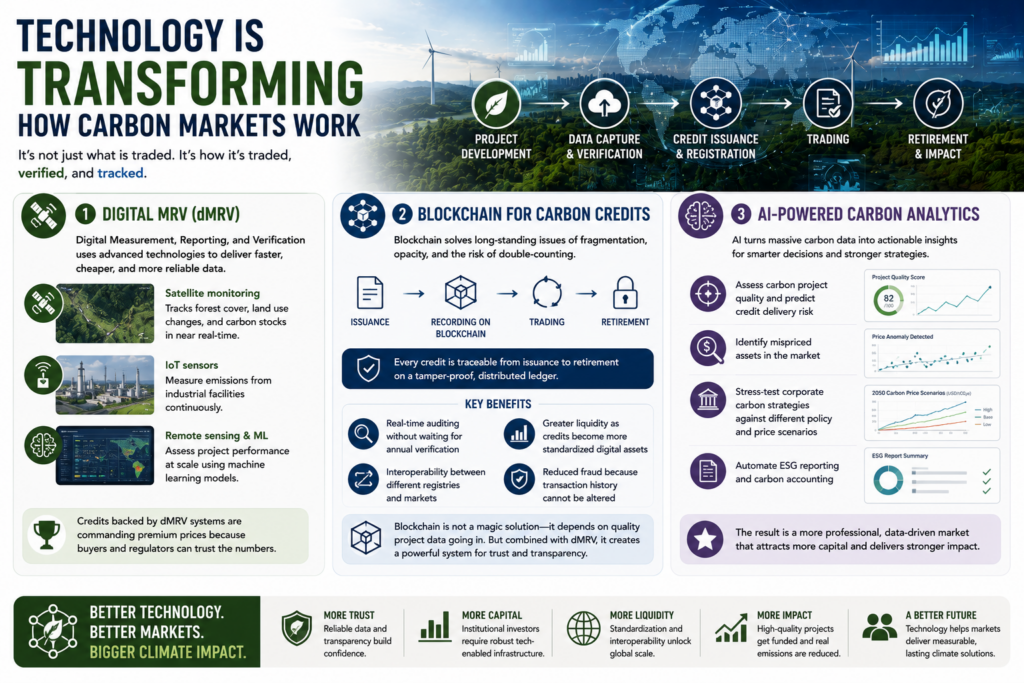
Trend 6: Technology Is Transforming How Carbon Markets Work
This is not just about what is being traded. It is also about how it is being traded, verified, and tracked.
Digital MRV (dMRV)
Traditional carbon project verification relied on annual audits by third-party verifiers visiting project sites. That process was slow, expensive, and occasionally unreliable.
Digital Measurement, Reporting, and Verification (dMRV) changes that. It uses:
- Satellite monitoring to track forest cover, land use changes, and carbon stocks in near real-time
- IoT sensors to measure emissions from industrial facilities continuously
- Remote sensing and machine learning to assess project performance at scale
Credits backed by dMRV systems are commanding premium prices because buyers and regulators can trust the numbers.
Blockchain for Carbon Credits
Blockchain technology is being applied to carbon markets to solve some of the oldest problems: fragmentation, opacity, and the risk of double-counting.
By recording carbon credits on a distributed ledger, blockchains make every credit traceable from issuance to retirement. Companies like JPMorgan and Nasdaq have explored institutional platforms for tokenized carbon credits.
The benefits include:
- Real-time auditing without waiting for annual verification
- Interoperability between different registries and markets
- Greater liquidity as credits become more standardized digital assets
- Reduced fraud because transaction history cannot be altered
Blockchain is not a magic solution — it depends on quality project data going in. But combined with dMRV, it creates a powerful system for trust and transparency.
AI-Powered Carbon Analytics
Artificial intelligence is entering the space as well. Companies are using AI to:
- Assess carbon project quality and predict credit delivery risk
- Identify mispriced assets in the market
- Stress-test corporate carbon strategies against different policy and price scenarios
- Automate ESG reporting and carbon accounting
The result is a more professional, data-driven market where buyers and sellers have much better information to make decisions.
Trend 7: Carbon Prices Are Becoming More Complex
One of the most important things to understand about carbon prices today is this: there is no single carbon price.
There are hundreds of micro-markets, and each has its own dynamics.
Compliance Market Prices (Recent Snapshots)
| Market | Recent Price Range |
|---|---|
| EU ETS | ~€74 to €80+ per tonne |
| China ETS | Below $20 per tonne |
| California Cap-and-Trade | $30-$40 range |
| UK ETS | Tracking near EU levels |
| RGGI (US Northeast) | ~$15-$20 range |
EU ETS prices averaged approximately $85 per tonne in the most recent full year, making it the highest-priced large compliance market in the world.
Voluntary Market Prices
On the voluntary side, prices vary enormously by project type, vintage, and certification:
- Low-quality legacy credits: As low as $0.25 to $4 per tonne
- Standard voluntary credits: Roughly €8 to €30 per tonne
- High-integrity removal credits: Significantly higher, often $100+ per tonne for tech CDR
The quality split is the most important pricing story in the VCM right now. Two credits that both say “one tonne of CO2” on paper can differ in real-world value by a factor of 100 or more.
Trend 8: The Line Between Voluntary and Compliance Markets Is Blurring
Here is something that would have seemed surprising a few years ago: voluntary and compliance carbon markets are increasingly overlapping.
Several forces are driving this:
CORSIA integration: Airlines using voluntary carbon credits must now meet compliance-grade standards. Voluntary credits are entering compliance use cases.
Article 6 corresponding adjustments: Voluntary market purchases of Article 6-authorized credits involve host country government decisions. That is not voluntary in the traditional sense.
EU Carbon Removal Certification Framework (CRCF): The EU is building pathways to integrate durable carbon removals into its official ETS framework in the second half of this decade. Voluntary CDR projects are preparing for potential compliance eligibility.
ESG reporting mandates: New reporting requirements in the EU, UK, and elsewhere are making carbon disclosures quasi-mandatory for large companies, even if the underlying carbon purchases remain voluntary.
The practical implication for companies is clear: carbon strategies can no longer treat voluntary and compliance markets as separate universes. A credit’s future compliance eligibility (or lack of it) matters when making purchasing decisions today.
Trend 9: Geography Matters More Than Ever
The carbon market is global in aspiration but regional in practice. Understanding the geographic picture is essential.
East Asia and the Pacific: The Fastest-Growing Region
The largest and fastest growth in carbon credit project development is happening in East Asia and the Pacific region. South Asia and Sub-Saharan Africa are close behind as major project development hubs.
These regions have large forests, significant renewable energy potential, and cost-effective mitigation opportunities — exactly what international carbon buyers need.
Europe: The Regulatory Pace-setter
Europe continues to lead on carbon pricing stringency and policy innovation. The EU ETS is the model that most new markets study. The EU’s CBAM, now in force, is reshaping trade flows and pressuring trading partners to raise their own carbon prices.
North America: A Fragmented but Active Market
The US lacks a federal carbon price, but remains the single largest VCM buyer. North America retired about 66.8 million voluntary credits in a recent tracking period — more than any other region. State-level systems like California’s continue to innovate.
Canada’s carbon pricing system covers both individuals (via fuel charges) and large industry (via output-based pricing), making it one of the most comprehensive national approaches.
Asia-Pacific: A Region in Transition
Beyond China, markets like South Korea, Singapore, Japan, and Australia are all expanding carbon pricing. Singapore in particular is emerging as a carbon market hub, with bilateral Article 6 agreements and active regulatory development.
Trend 10: Corporate Climate Commitments Are Being Stress-Tested
More than 10,000 companies have signed up to science-based climate targets. Hundreds of major corporations have made public net-zero commitments. But the gap between commitments and action remains wide.
Regulators, investors, and civil society are now scrutinizing these commitments much more carefully. Greenwashing claims are facing legal and reputational consequences.
The shift is from “we have a net-zero commitment” to “show us your verified emissions reductions, your credible offset strategy, and your transition plan.”
Over 400 companies have now implemented an internal carbon price to guide investment decisions. This is a significant tool: when every business unit and project is assessed against a carbon cost, it changes capital allocation in favor of low-carbon solutions.
For carbon market participants, this trend means:
- Buyers will face more scrutiny over which credits they purchase
- Transparency in carbon accounting will become a minimum expectation
- Companies that take action early will be better positioned than those who wait
Key Challenges Facing the Global Carbon Market
Not everything in the carbon market picture is rosy. There are real challenges that need to be addressed.
1. The quality crisis in the VCM: Too many low-quality credits have been issued and retired over the years. Rebuilding trust requires tougher standards and better verification.
2. Supply constraints in CDR: Over 80% of high-durability carbon removal capacity is at risk of not being realized without sufficient buyer commitments. Supply and demand need to come together earlier.
3. Fragmentation: Hundreds of different registries, methodologies, and standards make it hard for buyers to compare credits or move capital efficiently. Standardization is needed.
4. Price volatility in compliance markets: EU ETS prices react to energy market swings, political events, and policy announcements. Volatility creates planning challenges for industrial companies.
5. Article 6 implementation gaps: While COP29 delivered important clarity, Article 6.4 credits are still coming online. Registries, methodologies, and governance structures are still being built.
6. Greenwashing risk: Companies that make bold claims without delivering real reductions face legal and reputational damage. The scrutiny from regulators and NGOs is intensifying.
What Should Businesses Do Right Now?
If you are a business trying to navigate global carbon market trends, here is a practical framework:
Step 1: Measure your emissions accurately You cannot manage what you do not measure. Get a verified greenhouse gas inventory using an established methodology like the GHG Protocol.
Step 2: Reduce first, offset second Science-based frameworks are clear: deep reductions in your own operations come first. Carbon credits are for residual emissions that you genuinely cannot eliminate.
Step 3: Be selective about carbon credits Not all credits are equal. Prioritize credits with:
- Strong, third-party verification
- Transparent methodology and additionality
- A corresponding adjustment where relevant
- Alignment with recognized standards (Gold Standard (website), Verra VCS, Article 6.4)
Step 4: Consider building a carbon credit portfolio Mix near-term nature-based credits with longer-term removal credits. Diversify across project types and geographies.
Step 5: Plan for compliance even if you are in the voluntary space Today’s voluntary purchase could be tomorrow’s compliance requirement. Buy credits with an eye on their potential future compliance eligibility.
Step 6: Stay informed on regulatory developments Article 6.4, CBAM, SBTi V2.0, and ETS expansions are all moving fast. Carbon strategy needs to be reviewed regularly, not just once a year.
The Outlook: Where Is the Global Carbon Market Heading?
The trajectory of global carbon markets points clearly in one direction: up, and toward greater rigor.
Here is what the medium-term picture looks like:
- More countries will launch or expand ETS programs, especially as CBAM creates economic pressure to price carbon domestically.
- Article 6 will gradually unlock a new layer of international carbon trade, with host country governments playing a larger role.
- CDR will scale up, driven by corporate demand, regulatory support, and declining technology costs. The next decade will be defined by the diversification of removal capacity.
- VCM integrity will improve, pushed by frameworks like SBTi V2.0, the CRCF, and investor pressure. The low-quality end of the market will shrink.
- Digital tools will become standard, with dMRV, blockchain tracking, and AI analytics raising the bar on transparency.
- Carbon prices in compliance markets will rise over time as caps tighten and free allowances are phased out.
The market is professionalizing. Early movers who build carbon literacy, invest in quality, and engage with emerging frameworks now will have a clear advantage.
Frequently Asked Questions (FAQ)
What are the biggest global carbon market trends right now?
The top trends include the expansion of compliance carbon markets (especially the EU ETS and China ETS), the shift toward high-integrity voluntary credits, the activation of Article 6 of the Paris Agreement, the rise of carbon dioxide removal technologies, and the growing use of digital tools like blockchain and satellite monitoring.
What is the difference between a compliance and a voluntary carbon market?
Compliance markets are legally mandated systems where governments set a cap on emissions and require companies to hold allowances for every tonne they emit. Voluntary markets are where companies or individuals purchase carbon credits without a legal obligation, typically to meet climate commitments.
What is Article 6 of the Paris Agreement and why does it matter?
Article 6 creates the framework for countries to cooperate on carbon markets internationally. After COP29 resolved key disputes, Article 6 is now enabling bilateral carbon trade deals between countries and laying the groundwork for a new UN-supervised carbon credit mechanism.
How are carbon credit prices determined?
Carbon credit prices are driven by supply and demand, credit quality, regulatory environment, and project type. Compliance market prices (like EU ETS) are set by market trading of government-issued allowances. Voluntary market prices vary enormously — high-integrity removal credits can cost many times more than standard avoidance credits.
What is CORSIA and how does it affect carbon markets?
CORSIA is the international aviation industry’s carbon offsetting scheme. Airlines are required to offset emissions above 2019 levels by purchasing eligible carbon credits. This makes airlines a significant and growing source of demand for high-quality credits.
What is carbon dioxide removal (CDR) and why is it growing?
CDR refers to methods of actively removing CO2 from the atmosphere. These range from nature-based approaches (reforestation, enhanced weathering) to engineered technologies (direct air capture, BECCS, biochar). The IPCC estimates that billions of tonnes of CDR per year will be needed by mid-century to meet Paris Agreement goals, making it one of the most important growth areas in carbon markets.
Is the voluntary carbon market reliable?
The voluntary carbon market has faced challenges around credit quality and greenwashing. But the market is improving rapidly, with tougher standards, better verification technology, and greater transparency. Buyers today who focus on high-integrity credits and established verification standards can find reliable, credible offsets.
What should my company do to prepare for rising carbon market requirements?
Start by measuring your emissions accurately, then focus on reducing them within your operations. Use carbon credits selectively for residual emissions you genuinely cannot eliminate, and prioritize quality over cost. Stay current on evolving compliance requirements in your sector and geography.
Conclusion: The Carbon Market Is Maturing Fast
The global carbon market is no longer a niche corner of climate policy. It is becoming a core part of the global financial system.
The global carbon market trends shaping the current moment are clear: compliance markets are expanding, voluntary markets are raising their standards, Article 6 is coming online, carbon removal is scaling up, and technology is transforming how the whole system works.
For anyone who participates in these markets — as a buyer, seller, investor, or policymaker — the rewards of understanding these trends are significant. And the risks of ignoring them are growing.
The carbon market is professionalizing. Quality is winning. Early movers are defining the rules. Now is the time to get informed, build your strategy, and act with confidence.
Want to learn more about carbon markets? Explore in-depth guides, tools, and resources at Carbon Market Network.