Carbon Market Network


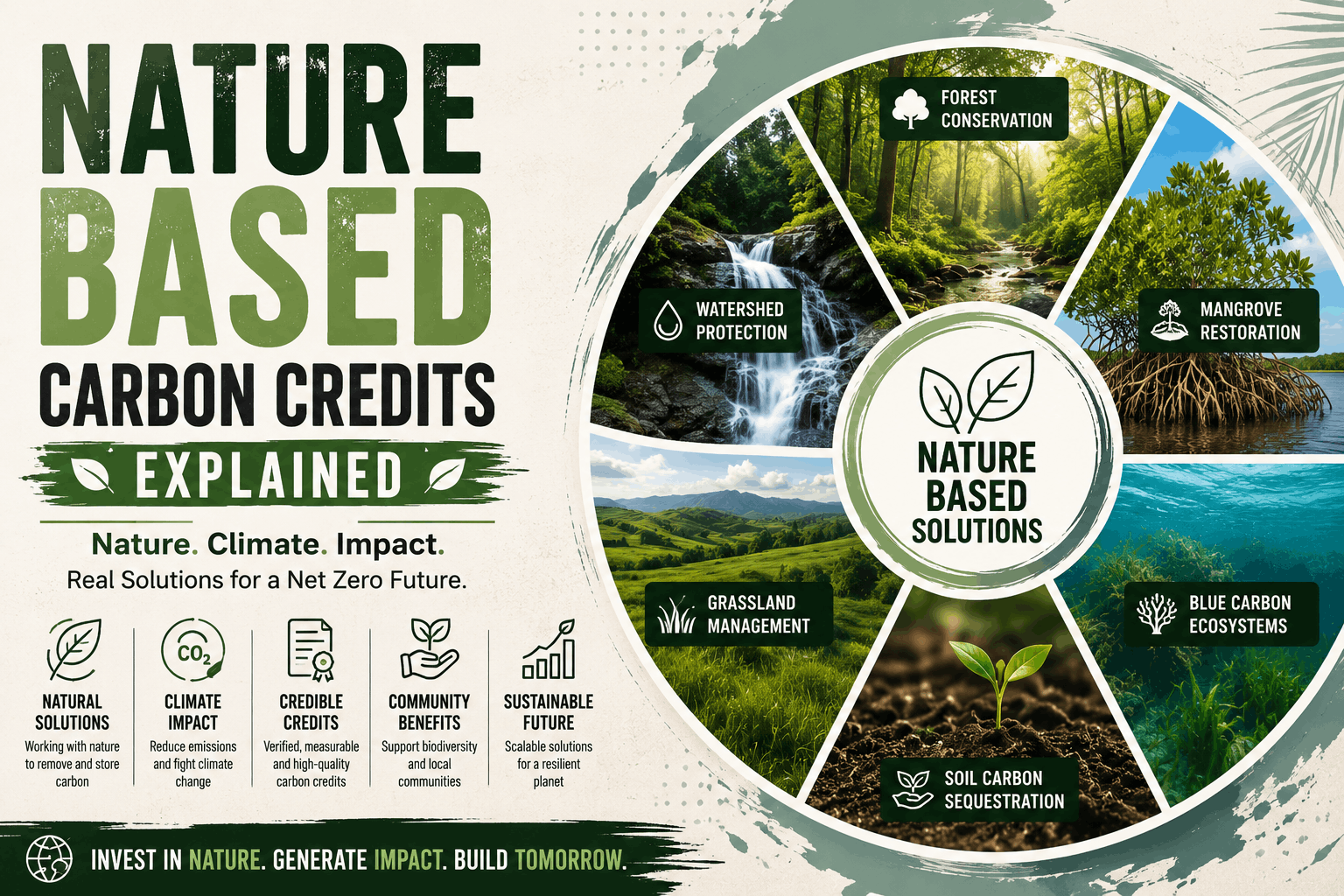
Trees, wetlands, soil, and oceans have been quietly storing carbon for millions of years. Now, that natural ability has turned into one of the most talked-about tools in the fight against climate change: nature based carbon credits.
If you have ever wondered how planting mangroves or restoring a grassland can turn into a tradable financial asset, you are in the right place.
This guide breaks down everything you need to know about nature based carbon credits. No jargon overload. No confusing technical language. Just clear, practical, and accurate information.
Whether you are a business exploring carbon offsetting, a student researching climate finance, or simply a curious reader, this article will give you a complete picture.
What Are Nature Based Carbon Credits
Nature based carbon credits are certificates that represent one metric ton of carbon dioxide either removed from the atmosphere or prevented from being released, through natural ecosystems.
These credits come from projects that protect, restore, or better manage forests, wetlands, grasslands, soils, and oceans.
Each credit acts like a receipt. It proves that a specific amount of carbon has been captured or kept out of the atmosphere because of a particular project.
Companies and individuals buy these credits to offset their own emissions. The money from these purchases funds conservation and restoration work on the ground.
In simple terms, nature based carbon credits let nature do the heavy lifting, while carbon markets provide the financial incentive to protect and expand that natural capacity.
Carbon Market Insider Newsletter
Weekly insights on carbon markets, climate policy, carbon credits, and sustainability.
Why Nature Based Carbon Credits Matter
Nature already removes a significant portion of human caused carbon emissions every year through forests, oceans, and soil.
Nature based carbon credits matter for a few clear reasons:
- They put a financial value on standing forests and healthy ecosystems, which were previously seen as having no direct economic worth once left untouched.
- They give governments, landowners, and communities a reason to protect natural habitats instead of clearing them for short-term profit.
- They support biodiversity, clean water, and local livelihoods alongside carbon capture.
- They offer companies a credible way to take climate action while long-term decarbonization strategies are being built.
Without this financial incentive, many forests and wetlands would continue to be cleared for agriculture, logging, or development.
How Nature Based Carbon Credits Work
Understanding the mechanics helps you see why these credits carry both promise and complexity.
Step 1: Project Design
A project developer identifies land or an ecosystem, such as a forest, mangrove, or peatland, that can either be protected from destruction or restored.
They design a project following an approved methodology, which is a detailed technical rulebook that defines how carbon benefits will be measured.
Step 2: Baseline Setting
The developer establishes a baseline. This is an estimate of what would have happened to the land without the project, sometimes called the business-as-usual scenario.
For example, if a forest would likely have been logged without intervention, the baseline reflects that expected carbon loss.
Step 3: Additionality Check
The project must prove additionality. This means the carbon benefit would not have happened without the revenue generated by selling carbon credits.
Additionality is one of the most scrutinized parts of any nature based carbon project, because it separates genuine climate impact from business as usual.
Step 4: Third-Party Validation
An independent auditor reviews the project design and confirms it meets the requirements of the chosen carbon standard.
Step 5: Monitoring and Verification
Once the project is running, ongoing monitoring tracks actual carbon storage or emission reductions. This often combines satellite imagery, ground surveys, and soil or biomass sampling.
A separate independent verifier then confirms the reported results are accurate.
Step 6: Credit Issuance
After verification, the carbon registry issues credits. Each credit is assigned a unique serial number to prevent double counting.
Step 7: Sale and Retirement
Buyers purchase these credits, often through brokers, marketplaces, or direct deals with project developers.
Once a buyer uses a credit to offset emissions, it gets retired in the registry, meaning it can never be sold or used again.
Main Types of Nature Based Carbon Credit Projects
Nature based carbon credits come from a wide range of ecosystems. Here is a breakdown of the major categories.
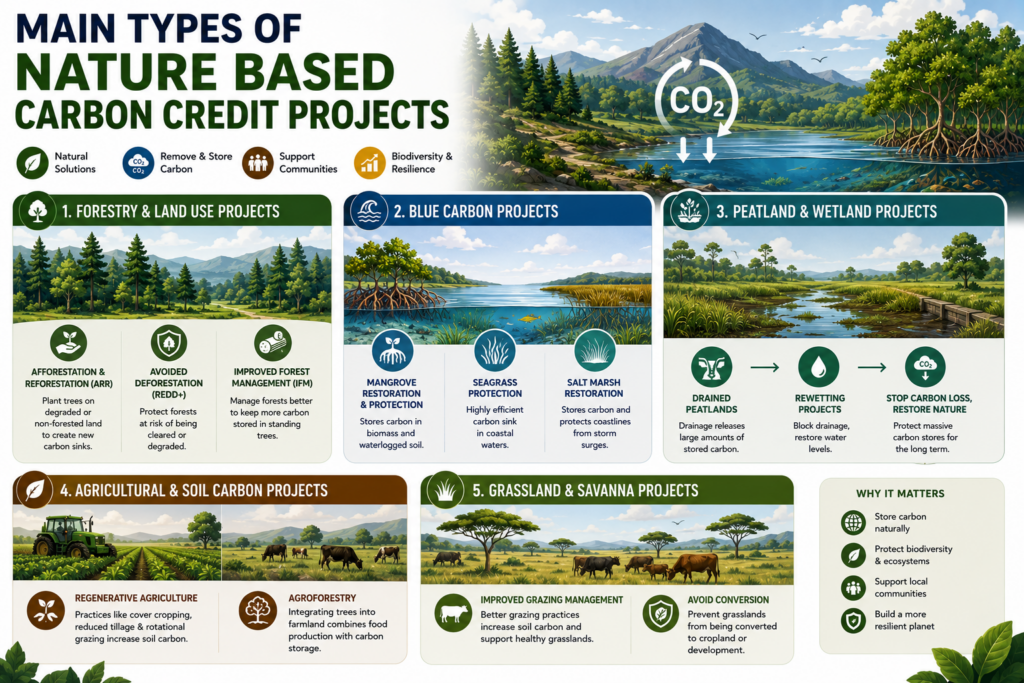
Forestry and Land Use Projects
This is the largest and most well known category of nature based carbon credits.
Afforestation and Reforestation (ARR) These projects plant trees on land that was previously non-forested or degraded, creating new carbon sinks over time.
Avoided Deforestation (REDD+) REDD+ stands for Reducing Emissions from Deforestation and Forest Degradation. These projects protect existing forests that are at risk of being cleared.
Improved Forest Management (IFM) These projects change logging or forestry practices to keep more carbon locked in standing trees, such as extending harvest cycles or reducing damage during logging operations.
Blue Carbon Projects
Blue carbon refers to carbon stored in coastal and marine ecosystems.
- Mangrove restoration and protection, which store carbon in both biomass and waterlogged soil for long periods
- Seagrass meadow protection, an often overlooked but highly efficient carbon sink
- Salt marsh restoration, which also protects coastlines from storm surges
Peatland and Wetland Projects
Peatlands store enormous amounts of carbon in waterlogged soil built up over thousands of years. When drained for agriculture, they release large amounts of carbon dioxide.
Peatland rewetting projects block drainage channels, restore water levels, and stop this carbon loss.
Agricultural and Soil Carbon Projects
Regenerative agriculture credits reward farmers for practices like cover cropping, reduced tillage, and rotational grazing, which increase carbon storage in soil.
Agroforestry credits come from integrating trees into farmland, combining food production with carbon storage.
Grassland and Savanna Projects
These projects focus on improved grazing management and preventing conversion of grasslands into cropland, which keeps carbon locked in root systems and soil.
Comparison Table: Types of Nature Based Carbon Credit Projects
| Project Type | Ecosystem Focus | Typical Permanence Risk | Common Co-Benefits |
|---|---|---|---|
| Afforestation and Reforestation | New tree planting | Medium | Biodiversity, timber, jobs |
| REDD+ (Avoided Deforestation) | Existing forests | Medium to High | Biodiversity, indigenous livelihoods |
| Improved Forest Management | Managed forests | Medium | Sustainable timber, habitat |
| Blue Carbon (Mangroves, Seagrass) | Coastal ecosystems | Low to Medium | Coastal protection, fisheries |
| Peatland Restoration | Wetlands | Low | Water quality, flood control |
| Regenerative Agriculture | Farmland soil | Medium to High | Soil health, farmer income |
| Grassland Conservation | Grasslands, savanna | Medium | Grazing resilience, biodiversity |
Nature Based Carbon Credits vs Technology Based Carbon Credits
People often confuse these two categories, so here is a simple comparison.
| Factor | Nature Based Credits | Technology Based Credits |
|---|---|---|
| Source | Forests, soil, wetlands, oceans | Direct air capture, enhanced rock weathering, biochar |
| Cost | Generally lower per ton | Generally higher per ton |
| Permanence | Can face reversal risk from fire, drought, or land use change | Often stores carbon for centuries or longer |
| Co-benefits | Strong biodiversity and community benefits | Limited co-benefits, more industrial |
| Scalability | Land dependent, limited by available area | Can scale with infrastructure and investment |
| Verification complexity | Higher, due to natural variability | Lower, due to controlled processes |
Neither type is inherently better. Many corporate climate strategies now blend both, using nature based credits for near-term, lower-cost action and technology based removals for long-term durability.
Key Standards and Certification Bodies
Nature based carbon credits are only as trustworthy as the standard that certifies them. Here are the major players.
Verra (Verified Carbon Standard) The largest carbon credit registry globally, hosting a large share of nature based projects including REDD+, ARR, and wetland restoration.
Gold Standard Known for strong sustainable development criteria alongside carbon accounting, often favored for projects with strong community impact.
American Carbon Registry (ACR) A well established registry active in forestry, agricultural, and grassland methodologies.
Climate Action Reserve (CAR) Focused primarily on North American projects, including forestry and agricultural soil carbon.
Plan Vivo Specializes in smallholder and community-led nature based projects, often smaller in scale but strong in community benefit.
The Role of the Integrity Council for the Voluntary Carbon Market
A newer and increasingly important layer of oversight comes from the Integrity Council for the Voluntary Carbon Market, known as ICVCM.
This independent body created the Core Carbon Principles, a set of ten science-based criteria that carbon crediting programs and methodologies must meet to earn a quality label called the CCP label.
The Core Carbon Principles cover requirements such as robust independent validation and verification, additionality, permanence with measures to address reversal risk, robust quantification based on conservative methods, and avoidance of double counting.
Nature based credits have historically faced criticism for weak baselines and overstated impact. The CCP label is designed to fix that by setting a global quality bar that buyers can trust, no matter which registry or project type issued the credit.
A reforestation protocol became the first nature-based methodology to receive the CCP label with no conditions attached, with the developer expecting to issue several million credits annually within a few years.
Other nature based methodologies, including forestry and mangrove restoration approaches, have also been approved or are moving through this assessment process, signaling a broader shift toward higher integrity standards across the nature based credit market.
Benefits of Nature Based Carbon Credits
Climate Benefits
Nature based projects capture and store carbon while the world continues developing technology based removal solutions at scale.
Biodiversity Protection
Protecting a forest or wetland for carbon also protects the plants and animals living there, creating a ripple effect of conservation value.
Community and Economic Benefits
Many nature based projects create jobs, support indigenous land rights, and provide alternative income sources for communities that previously relied on activities like logging or slash-and-burn farming.
Water and Soil Benefits
Forests and wetlands regulate water cycles, prevent soil erosion, and improve water quality in surrounding regions.
Cost Efficiency
Nature based credits are often more affordable than technology based removals, making them accessible for companies just starting their climate journey.
Faster Deployment
Planting trees or protecting a wetland can often begin faster than building large scale industrial carbon removal infrastructure.
Challenges and Criticisms of Nature Based Carbon Credits
It would be misleading to only discuss the positives. Nature based carbon credits face real challenges that every buyer and reader should understand.
Permanence Risk
Forests can burn, be illegally logged, or die from drought and disease. If carbon stored in a project is later released, the climate benefit is reversed.
Most standards address this through buffer pools, which are reserves of unsold credits set aside to cover potential losses across a portfolio of projects.
Overestimated Baselines
Some past projects were criticized for setting baselines that assumed unrealistically high deforestation rates, making the claimed carbon savings look bigger than they actually were.
Leakage
Leakage happens when protecting one area simply pushes deforestation or land conversion to a nearby, unprotected area, canceling out some of the climate benefit.
Measurement Uncertainty
Estimating carbon stored in soil, biomass, and root systems is inherently more complex than measuring emissions from a smokestack or a machine.
Land Rights and Community Concerns
Some projects have faced criticism for excluding local or indigenous communities from decision making, or for restricting traditional land use without fair compensation.
Market Fragmentation
With multiple registries, methodologies, and rating agencies, buyers can find it hard to compare credit quality across projects.
These challenges are exactly why organizations like the Integrity Council for the Voluntary Carbon Market and independent rating agencies have become more prominent, pushing the market toward stronger baselines, better monitoring technology, and clearer accountability.
How to Evaluate a High-Quality Nature Based Carbon Credit
If you are considering buying nature based carbon credits, use this checklist.
- Check the registry and methodology. Confirm the project uses an approved, up to date methodology from a recognized standard.
- Look for CCP labeling. A CCP label signals the credit has passed a rigorous, independent integrity assessment.
- Review the additionality case. Ask how the project proves the carbon benefit would not have happened anyway.
- Understand the permanence plan. Check whether a buffer pool or insurance mechanism protects against reversal risk.
- Look at co-benefits. Strong projects report measurable benefits for biodiversity, water, or community livelihoods, not just carbon numbers.
- Check the vintage. Recent vintages, generally issued within the last few years, tend to reflect updated methodologies and monitoring standards.
- Review third-party ratings. Independent rating agencies assess project quality beyond registry approval alone.
- Confirm retirement transparency. Make sure the registry publicly tracks credit retirement to prevent double counting or double selling.
Real World Examples of Nature Based Carbon Credit Projects
Large Scale REDD+ Forest Protection Various rainforest protection projects across South America, Africa, and Southeast Asia generate credits by preventing deforestation in high-risk areas, often working directly with local communities and governments.
Mangrove Restoration Programs Coastal mangrove restoration projects combine carbon storage with storm protection and fisheries support, since mangroves also serve as nurseries for marine life.
Grassland and Rangeland Management Ranch-scale projects in various regions use improved grazing rotation to increase soil carbon while maintaining livestock productivity.
Corporate-Backed Nature Restoration Coalitions A coalition formed by major technology companies has committed to removing a significant volume of carbon through nature-based solutions, reflecting a growing private sector push into large scale natural carbon removal.
These examples show the range of nature based carbon credits, from small community-led projects to large corporate-backed restoration coalitions.
Nature Based Carbon Credits and the Voluntary vs Compliance Markets
Nature based carbon credits are mostly traded in the voluntary carbon market, where companies and individuals buy credits by choice, not because a law requires it.
However, they are increasingly connected to compliance frameworks too.
Voluntary Carbon Market Companies buy credits to support corporate sustainability goals, net-zero pledges, or brand positioning. Prices vary widely depending on project type, quality rating, and co-benefits.
Compliance Markets Some regulated carbon markets and international frameworks allow limited use of nature based credits to meet legal emission reduction obligations, subject to strict eligibility rules.
Article 6 and International Carbon Trading International frameworks under global climate agreements now allow countries to trade carbon credits between each other, including nature based credits, provided strict accounting rules prevent double counting between the buying and selling country.
This shift is creating a more structured, government-recognized layer for high-quality nature based credits alongside the traditional voluntary market.
Pricing of Nature Based Carbon Credits
Nature based carbon credit prices vary significantly based on quality, methodology, co-benefits, and market demand.
| Credit Category | General Price Range (per ton) | Notes |
|---|---|---|
| Generic nature-based avoidance | Low, often under 10 dollars | Increasingly filtered out by quality-focused buyers |
| Verified REDD+ with strong co-benefits | Moderate, roughly 12 to 25 dollars | Higher end reflects strong baselines and community impact |
| Mangrove and blue carbon restoration | Moderate, roughly 10 to 50 dollars | Premium for coastal protection co-benefits |
| Regenerative agriculture soil carbon | Moderate, roughly 15 to 60 dollars | Wide range depending on measurement rigor |
| High-integrity, CCP-labeled nature credits | Higher, reflecting quality premium | Commands a clear premium over unlabeled credits |
A consistent trend across the market is a growing price gap between low-quality and high-quality credits, sometimes called the flight to quality. Buyers increasingly prefer paying more for verified, high-integrity nature based credits rather than buying the cheapest available option.
Practical Steps to Buy Nature Based Carbon Credits
If you or your organization want to purchase nature based carbon credits, follow this practical roadmap.
- Calculate your carbon footprint first. Offsetting only makes sense once you understand your actual emissions.
- Set an internal reduction plan. Carbon credits should complement direct emission reduction, not replace it.
- Define your buying criteria. Decide how much weight you place on price, co-benefits, geography, and CCP labeling.
- Choose a reputable marketplace or broker. Work with platforms that provide transparent registry data and independent ratings.
- Verify registry details. Cross-check the project ID, methodology, and vintage directly on the registry website.
- Retire the credits properly. Ensure the credits are retired in your name so they cannot be resold or reused.
- Report transparently. Disclose your carbon credit purchases clearly, distinguishing between direct emission cuts and offsetting through nature based credits.
The Future of Nature Based Carbon Credits
The nature based carbon credit market is moving through a period of significant change, driven by three major forces.
Stronger Integrity Standards Independent bodies are tightening quality requirements, phasing out weak baselines, and rewarding projects with strong scientific backing and transparent monitoring.
Better Monitoring Technology Satellite imagery, remote sensing, and digital monitoring, reporting, and verification tools are making it easier to track real-time changes in forest cover, soil carbon, and biomass, reducing reliance on outdated estimates.
Government and Regulatory Integration International carbon trading frameworks are beginning to formally recognize high-quality nature based credits, connecting the voluntary market with government-backed compliance systems.
Together, these forces point toward a nature based carbon credit market that is smaller in volume of low-quality credits, but stronger in overall trust and climate impact.
Key Takeaways
- Nature based carbon credits turn the natural carbon storage ability of forests, wetlands, soil, and oceans into tradable climate assets.
- They come from forestry, blue carbon, peatland, agricultural, and grassland projects.
- Quality varies widely, so checking registry standards, CCP labeling, and additionality claims matters more than looking at price alone.
- Permanence risk, leakage, and measurement uncertainty remain real challenges that the market is actively working to solve.
- The market is shifting toward higher integrity, better monitoring technology, and stronger government recognition.
- Nature based credits work best as part of a complete climate strategy, alongside genuine emission reduction efforts.
Frequently Asked Questions
What is the difference between nature based carbon credits and carbon offsets?
Carbon offsets is a broader term covering any credit used to compensate for emissions. Nature based carbon credits are a specific category of offset generated through natural ecosystems like forests and wetlands, as opposed to technology based methods like direct air capture.
Are nature based carbon credits reliable?
Reliability depends heavily on the specific project, methodology, and standard. High-integrity, independently verified, and CCP-labeled credits are far more reliable than generic, low-cost credits with weak baselines.
How much does one nature based carbon credit cost?
Prices vary widely based on project type and quality, ranging from a few dollars for lower-quality generic credits to considerably higher prices for high-integrity, verified projects with strong co-benefits.
Can nature based carbon credits fully offset a company’s emissions?
Nature based credits can help balance emissions on paper, but genuine climate strategy requires direct emission reduction first, with credits used as a complement rather than a replacement.
What is REDD+ in carbon markets?
REDD+ stands for Reducing Emissions from Deforestation and Forest Degradation. It is a nature based carbon credit approach that funds forest protection in areas facing deforestation risk.
What is a buffer pool in nature based carbon projects?
A buffer pool is a reserve of unsold carbon credits set aside to cover potential losses if a project’s stored carbon is later released, for example through fire or illegal logging.
Why do some nature based carbon credits get criticized?
Common criticisms include overestimated baselines, permanence risk, leakage to nearby areas, and measurement uncertainty. Stronger standards and monitoring technology are actively addressing these concerns.
What is the CCP label in carbon markets?
The CCP label, issued by the Integrity Council for the Voluntary Carbon Market, indicates that a carbon crediting program and methodology meet a strict, science-based set of quality criteria covering additionality, permanence, and robust quantification.
Do nature based carbon credits help biodiversity?
Yes. Since these projects protect or restore natural ecosystems, they typically deliver strong biodiversity co-benefits alongside carbon storage.
Where can I buy nature based carbon credits?
Nature based carbon credits can be purchased through registries like Verra and Gold Standard, carbon marketplaces, brokers, or directly from project developers, with independent ratings helping guide quality decisions.
Conclusion
Nature based carbon credits sit at a powerful intersection of climate science, finance, and conservation. They give forests, wetlands, and soil a real economic value, encouraging protection instead of destruction.
At the same time, they come with genuine challenges around permanence, measurement, and quality that the industry is actively working to solve through stronger standards and better technology.
Used thoughtfully, as part of a complete climate strategy rather than a shortcut, nature based carbon credits remain one of the most impactful tools available for funding the protection and restoration of the natural world, while supporting global climate goals.
Whether you are a business building a credible net-zero strategy or simply curious about how carbon markets work, understanding nature based carbon credits gives you a clearer view of one of the most important climate finance tools of our time.
For more updates, guides, and resources on carbon markets, explore Carbon Market Network.