Carbon Market Network


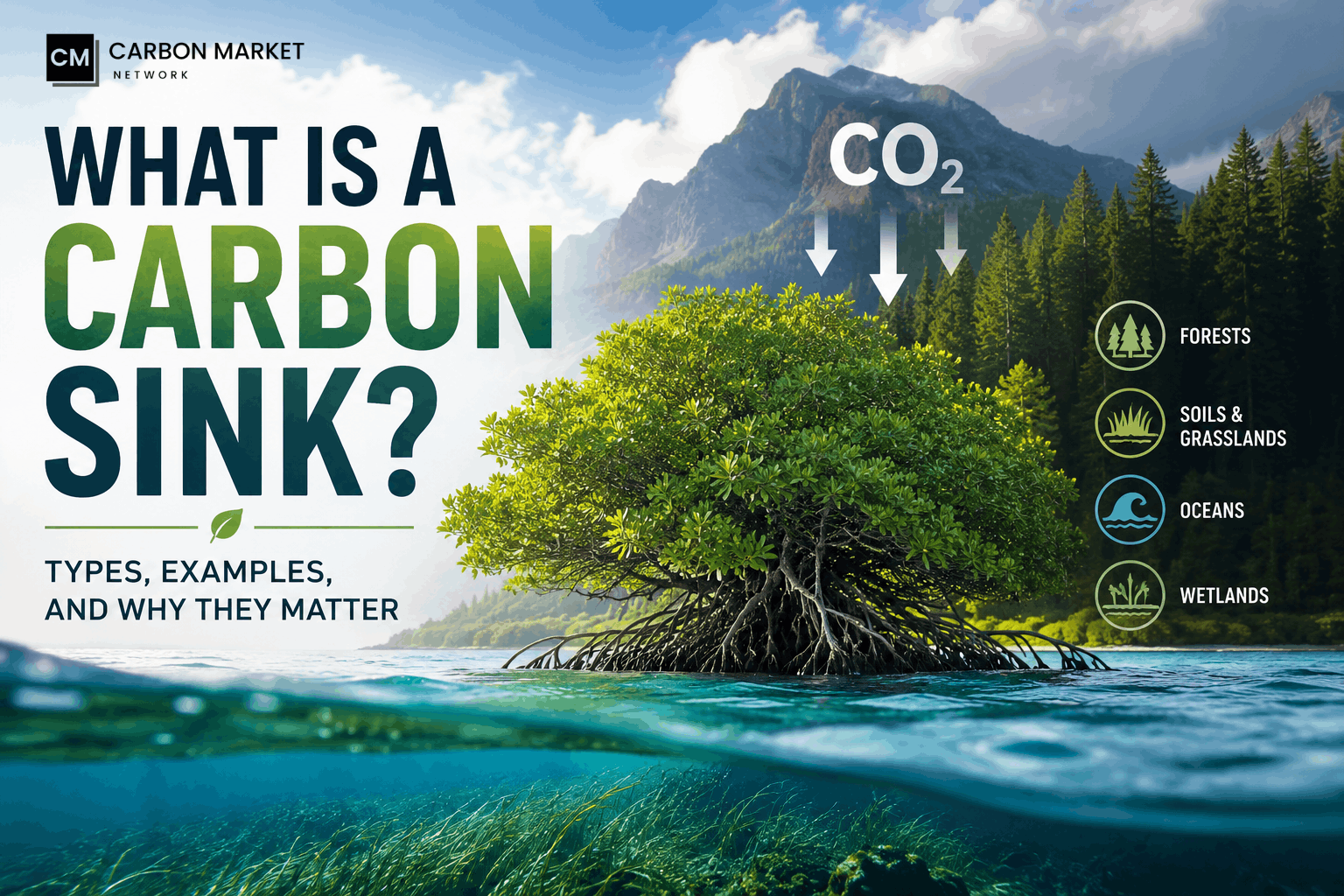
Every year, humans pump billions of tonnes of carbon dioxide into the atmosphere. But here is the surprising part: nature quietly absorbs almost half of it on our behalf.
The systems responsible for this massive feat are called carbon sinks. They are among the most powerful tools the planet has to slow climate change. And yet, most people have never heard the term.
If you work in sustainability, climate policy, or carbon markets, understanding carbon sinks is non-negotiable. Even if you are just someone who cares about the planet, this topic directly affects the future you will live in.
This guide breaks it all down simply and clearly. By the end, you will know exactly what a carbon sink is, how each type works, why they are under threat, and what their role is in the carbon markets shaping climate action today.
What Is a Carbon Sink?
A carbon sink is any system, natural or artificial, that absorbs more carbon dioxide (CO2) from the atmosphere than it releases.
Think of it like a sponge. A carbon sink soaks up CO2 and holds it, keeping it out of the air where it would otherwise trap heat and drive global warming.
The opposite of a carbon sink is a carbon source. A carbon source releases more carbon than it absorbs. Burning coal, deforestation, and wildfires are all examples of carbon sources.
There is also a third term worth knowing: a carbon store (or carbon stock). A carbon store holds a relatively stable amount of carbon without actively absorbing or releasing much. An old-growth forest that has reached maturity is a good example. It stores vast amounts of carbon but may not be actively absorbing large new quantities.
These distinctions matter a lot in carbon markets, where projects are measured and credited based on how much carbon they actively remove or avoid releasing.
Carbon Market Insider Newsletter
Weekly insights on carbon markets, climate policy, carbon credits, and sustainability.
Why Do Carbon Sinks Matter?
The Earth’s carbon cycle is a constant flow of carbon between the atmosphere, oceans, land, and living things. This cycle has kept the planet’s temperature within a livable range for millions of years.
The problem is that human activity has pushed far more carbon into the atmosphere than the cycle can naturally handle.
Since the Industrial Revolution, we have burned fossil fuels, cleared forests, and degraded soils at an unprecedented rate. Atmospheric CO2 levels hit 423 parts per million (ppm) in 2024, a level not seen in human history, and human-induced warming reached 1.36°C, already dangerously close to the 1.5°C threshold set by the Paris Agreement.
Carbon sinks are the planet’s natural defence against this. According to research published in Nature in 2026, natural land and ocean sinks absorb a significant portion of human-produced CO2 emissions every year, playing a critical role in slowing the pace of warming. Without them, atmospheric CO2 levels would rise far faster than they already are.
The stakes could not be higher. And as we will see, these sinks are under serious and growing pressure.
How Does a Carbon Sink Work?
Carbon sinks work through a range of biological, chemical, and physical processes. The core mechanisms vary depending on the type of sink.
Photosynthesis (The Engine of Most Natural Sinks)
Plants, trees, algae, and phytoplankton absorb CO2 from the air during photosynthesis. They use sunlight, water, and CO2 to produce glucose and oxygen. The carbon gets stored in their leaves, stems, roots, and wood.
When those organisms die, some of that carbon moves into the soil. Some gets released back into the atmosphere through decomposition. The portion that stays locked in the ground contributes to long-term carbon storage.
Ocean Absorption
Oceans absorb CO2 directly from the atmosphere through gas exchange at the water’s surface. CO2 dissolves into seawater and can be taken up by marine organisms like phytoplankton and seagrasses. Some of it gets incorporated into shells and skeletons and eventually sinks to the ocean floor.
Geological Storage
Over millions of years, carbon accumulates in rock formations, fossil fuel deposits, and deep ocean sediments. This is carbon that has been out of circulation for extremely long timescales.
The Major Types of Carbon Sinks
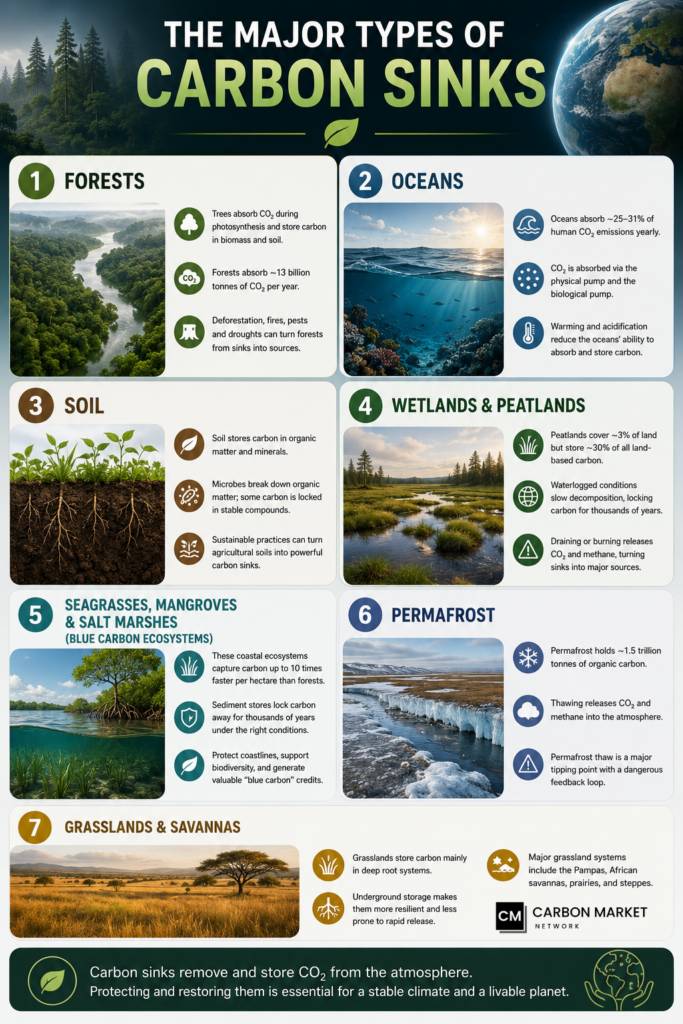
1. Forests
Forests are one of the most powerful carbon sinks on Earth. Trees absorb CO2 during photosynthesis and store carbon in their trunks, branches, roots, and the surrounding soil.
Globally, forests absorb an estimated 13 billion tonnes of CO2 per year over recent decades. Intact forests can absorb between 10 and 20 tonnes of carbon per hectare annually depending on the type and location.
Some of the world’s most important forest carbon sinks include:
- The Amazon Rainforest in South America, often called the “lungs of the Earth”
- The Congo Basin in Central Africa, the second-largest tropical rainforest
- Boreal forests (taiga) stretching across Canada, Russia, and Scandinavia
- Southeast Asian rainforests in Indonesia and Malaysia
However, forests can also flip from carbon sinks to carbon sources. When trees are cut down, burned, or killed by pests, the stored carbon gets released back into the atmosphere. In 2024 alone, tree cover loss reached approximately 30 million hectares, pushing roughly 4.1 gigatonnes of greenhouse gases into the atmosphere.
Europe has seen a particularly sharp drop in forest sink capacity. The EU’s 2025 greenhouse gas inventory showed an even steeper decline in the European forest carbon sink compared to previous years, driven by drought, bark beetle outbreaks, wildfires, and increasing harvesting.
2. Oceans
The world’s oceans are the largest natural carbon sinks on the planet. They absorb approximately 25 to 31 percent of human CO2 emissions every year.
Ocean carbon absorption works through two main pathways:
The physical pump: CO2 from the atmosphere dissolves into cold surface waters, particularly near the poles. These denser, carbon-rich waters sink to the deep ocean, where carbon can remain stored for centuries.
The biological pump: Phytoplankton and other marine organisms absorb CO2 through photosynthesis. When they die, their carbon-rich bodies sink to the ocean floor. Corals and shellfish lock carbon into their shells and skeletal structures.
Ocean carbon sinks are vast, but they are under stress. Rising ocean temperatures reduce the ability of cold water to absorb CO2. Additionally, as the ocean absorbs more CO2, it becomes more acidic, threatening coral reefs and marine life, which in turn weakens the biological pump.
Research published in 2025 and 2026 as part of the Global Carbon Budget series confirms that both land and ocean sinks are absorbing less carbon than expected as climate change weakens their capacity. This is one of the most alarming findings in recent climate science.
3. Soil
Soil is the second-largest carbon sink on Earth after the oceans. Healthy soils store carbon in organic matter from decayed plants and animals, as well as in minerals.
Microbes and fungi break down organic matter in the soil, and through complex biochemical processes, some of that carbon gets locked into stable compounds that persist for decades or centuries.
Agricultural soils are often carbon sources due to intensive tillage, synthetic fertilizers, and monoculture farming. But when managed correctly, through practices like no-till farming, cover cropping, composting, and agroforestry, agricultural soils can become significant carbon sinks.
The global land carbon sink absorbs roughly 3.2 billion metric tonnes of carbon per year on average, though estimates vary considerably across research groups and methodologies.
4. Wetlands and Peatlands
Wetlands, including marshes, swamps, and especially peatlands, are extremely dense carbon stores that can also function as active sinks.
Peatlands form in waterlogged conditions where oxygen is limited. In these low-oxygen environments, organic matter decomposes very slowly, allowing carbon to accumulate over thousands of years. Peatlands cover only about 3 percent of the Earth’s land surface but store roughly 30 percent of all land-based carbon, more carbon per hectare than any other ecosystem.
Tropical peatlands in Indonesia, Malaysia, and the Congo Basin are particularly significant. When drained and burned for agriculture, they release enormous quantities of CO2 and methane, turning from some of the planet’s densest carbon stores into major emission sources.
A 2024 global study found that warming temperatures may reduce the amount of carbon stored in wetlands, with serious implications for climate stability.
5. Seagrasses, Mangroves, and Salt Marshes (Blue Carbon Ecosystems)
Blue carbon refers to the carbon captured and stored by coastal and marine ecosystems. Seagrasses, mangroves, and salt marshes are remarkably efficient carbon sinks, absorbing carbon up to 10 times faster per hectare than mature tropical forests.
What makes blue carbon ecosystems especially valuable is not just absorption rate but permanence. Carbon stored in coastal sediments can remain locked away for thousands of years under the right conditions.
These ecosystems also protect coastlines from erosion, support fisheries, and provide critical habitat for marine biodiversity. Their carbon sequestration value is increasingly recognized in carbon markets, with blue carbon credits emerging as a growing asset class.
6. Permafrost
Permafrost is ground that stays frozen at or below 0°C for at least two consecutive years. It covers roughly a quarter of the Northern Hemisphere’s land area, particularly in Siberia, Canada, and Alaska.
Permafrost is a massive carbon store. It holds an estimated 1.5 trillion tonnes of organic carbon, almost twice the amount currently in the atmosphere.
As global temperatures rise, permafrost thaws and begins releasing this stored carbon as CO2 and methane. This creates a dangerous feedback loop: warming melts permafrost, which releases carbon, which causes more warming, which melts more permafrost.
Permafrost thaw is one of the key tipping points that climate scientists watch most closely. Once it crosses a threshold, the carbon release could become self-sustaining, regardless of what humans do.
7. Grasslands and Savannas
Grasslands often get overlooked compared to forests, but they are underrated carbon sinks, particularly through their extensive root systems that push carbon deep into the soil.
Unlike trees, which store most of their carbon above ground and can release it rapidly through fire or logging, grasslands store the majority of their carbon underground. This makes them more resilient sinks over the long term in many environments.
The Argentine Pampas, African savanna, North American prairies, and Eurasian steppes all represent significant carbon-holding grassland systems.
Carbon Sink vs Carbon Source: A Clear Comparison
| Concept | Definition | Example |
|---|---|---|
| Carbon Sink | Absorbs more carbon than it releases | A growing forest, healthy ocean |
| Carbon Source | Releases more carbon than it absorbs | Burning coal, deforestation |
| Carbon Store | Holds a stable amount of carbon | Mature old-growth forest |
A single ecosystem can shift between these categories depending on conditions. A forest recovering from a fire acts as a strong carbon sink. That same forest, if hit by a severe drought, could temporarily become a carbon source.
Are Carbon Sinks Under Threat?
Yes, and the threat is accelerating.
A 2025 report authored by 70 scientists from 21 countries, including researchers from the Potsdam Institute for Climate Impact Research, warned that natural carbon sinks are reaching critical limits. The planet’s forests, soils, and oceans are absorbing fewer emissions than expected as climate change weakens their capacity.
The key threats include:
Deforestation: Clearing forests for agriculture, logging, and development removes active sinks and releases stored carbon. Between 2000 and 2022, global tree cover shrank by about 12 percent.
Wildfire: Increasingly frequent and severe wildfires release massive amounts of stored carbon. The Amazon, Australia, Canada, and Siberia have all experienced record-breaking fire seasons in recent years.
Ocean acidification and warming: As oceans absorb more CO2 and heat, their capacity to absorb additional CO2 decreases. Warmer water holds less dissolved gas, and acidification damages the organisms that power the biological pump.
Peatland drainage: Draining peatlands for palm oil, pulpwood, and agriculture releases ancient, dense stocks of carbon.
Permafrost thaw: Thawing permafrost releases CO2 and methane, creating a positive feedback loop that accelerates warming.
Agricultural intensification: Intensive farming practices strip soil of organic matter, degrading one of the world’s most important carbon stores.
Artificial Carbon Sinks: Technology Steps In
Natural sinks are being pushed to their limits. This is driving significant investment in artificial or technological carbon sinks.
Direct Air Capture (DAC)
Direct air capture technology uses machines and chemical processes to pull CO2 directly from the atmosphere. The captured CO2 can then be stored underground in geological formations or used to make products.
In 2025, researchers at the University of Chicago published a breakthrough in Science Advances, describing a nanofiber-based air filter that can capture CO2 at low concentrations from building ventilation systems, potentially turning every office or home into a small-scale carbon sink.
Companies like Climeworks (Switzerland) and 1PointFive (USA) are scaling up large DAC facilities. The Climeworks Mammoth plant in Iceland and the Stratos facility in Texas represent the leading edge of commercial DAC today.
DAC is still expensive, currently costing hundreds of dollars per tonne of CO2. However, costs are falling as technology improves and scale increases. Microsoft, Airbus, Shopify, and other major corporations are already buying DAC-based carbon removal credits through the voluntary carbon market.
Bioenergy with Carbon Capture and Storage (BECCS)
BECCS involves growing plants that absorb CO2, using that biomass for energy, and then capturing and storing the resulting CO2 emissions underground. When done well, this can achieve net negative emissions.
BECCS has large theoretical potential but faces practical challenges around land use, water, and competition with food production.
Enhanced Weathering
This approach spreads crushed silicate rocks, like basalt, over agricultural land. As the rock weathers, it chemically reacts with CO2 and draws it out of the atmosphere while also improving soil fertility.
Several companies are now piloting enhanced weathering projects and generating carbon credits from this method. In June 2026, Isometric opened its enhanced weathering modeling rules to public input, a sign of the sector’s growing maturity.
Ocean-Based Carbon Removal
Researchers are exploring several ocean-based approaches, including:
- Ocean alkalinity enhancement: Adding alkaline minerals to seawater to increase its CO2 absorption capacity
- Kelp and seaweed farming: Cultivating large-scale seaweed that absorbs CO2 and sinks to the ocean floor
- Iron fertilization: Adding iron to iron-deficient ocean areas to stimulate phytoplankton growth
These approaches are still largely in the research and pilot phase, but the science is advancing rapidly. A 2025 review in Frontiers in Marine Science highlighted the growing interdisciplinary focus on ocean carbon sinks spanning marine ecology, biogeochemistry, and economics.
Biochar
Biochar is a form of charcoal made by heating organic material (crop residues, wood waste) in a low-oxygen environment through a process called pyrolysis. When mixed into soil, biochar locks carbon away for centuries while also improving soil health and crop yields.
Biochar projects are already generating carbon credits in the voluntary market and are growing quickly as a nature-based carbon removal strategy.
Carbon Sinks and the Carbon Market
Carbon sinks sit at the very heart of carbon markets. Understanding the connection helps make sense of how projects generate value.
When a verified project protects, restores, or creates a carbon sink, it can generate carbon credits. Each carbon credit represents one metric tonne of CO2 removed from or kept out of the atmosphere.
These credits can be sold to companies or individuals who want to offset their emissions. In the voluntary carbon market, buyers include corporations trying to meet net-zero pledges and individuals looking to reduce their personal carbon footprint.
Common carbon sink project types in the market include:
- REDD+ (Reducing Emissions from Deforestation and Degradation): Projects that protect existing forests and prevent their conversion to other land uses
- Afforestation and reforestation: Planting new forests on land that was previously not forested or was deforested
- Improved forest management: Changing harvesting practices to increase carbon storage in managed forests
- Blue carbon projects: Protecting and restoring mangroves, seagrasses, and salt marshes
- Soil carbon projects: Transitioning to regenerative agricultural practices that build soil organic matter
- Biochar: Converting agricultural waste into stable carbon and adding it to soil
- Direct air capture: Technological carbon removal with geological storage
The quality of carbon credits varies significantly based on the type of sink, the project methodology, the verification standard used, and the permanence of the carbon storage.
Standards like Verra’s Verified Carbon Standard (VCS), Gold Standard, and Plan Vivo provide the frameworks for measuring, reporting, and verifying carbon sequestration from sink projects.
One important distinction in the market is between avoidance credits (preventing carbon from being released) and removal credits (actively pulling carbon out of the atmosphere). Removal credits, particularly those from durable geological storage, are increasingly preferred by buyers who want to back up net-zero claims with the highest-integrity offsets.
What Makes a Good Carbon Sink for Carbon Markets?
Not all carbon sinks are equal in the eyes of carbon markets. Buyers, standards bodies, and regulators look for several key qualities:
Additionality: The carbon sink activity must be additional, meaning the sequestration would not have happened without the project. A forest that would never have been cut down anyway does not qualify for credits.
Permanence: The carbon must stay stored for a meaningful period. Biological sinks like forests carry reversal risk, since the trees can burn or be logged. This is why geological storage from DAC is increasingly valued.
Measurability and verifiability: The amount of carbon absorbed must be measurable, transparent, and verifiable by an independent third party.
No leakage: The project should not simply push deforestation or other harmful activities to a different location.
Co-benefits: The best projects deliver additional environmental and social benefits, including biodiversity protection, watershed services, local community livelihoods, and improved soil health.
Recent Developments in Carbon Sink Science (2025 to 2026)
Carbon sink science is moving fast. Here are the most significant recent developments:
Sinks are weakening faster than expected. A landmark paper published in Nature in late 2025 and cited in 2026 by Friedlingstein, Le Quéré, O’Sullivan, and colleagues confirmed an emerging climate impact on carbon sinks in the consolidated carbon budget. Their analysis found that rising temperatures are reducing the efficiency of both land and ocean sinks, raising the risk that climate targets will be missed even with current emissions reductions.
Land sink estimates are being revised. A 2026 study in npj Climate and Atmospheric Science improved the methodology for estimating the natural land carbon sink by accounting for today’s human-altered landscapes, rather than assuming fixed pre-industrial land cover. This matters because previous estimates may have overstated the land sink.
Beavers are creating new carbon sinks. A March 2026 study from the University of Birmingham found that beavers, through their dam-building activity, are turning rivers and riparian zones into surprisingly powerful carbon sinks. It is a reminder that biodiversity and carbon cycles are deeply interconnected.
Building ventilation as a DAC system. Research published in Science Advances in October 2025 demonstrated that nanofiber air filters can be integrated into standard building ventilation systems to capture CO2, opening the possibility of distributed direct air capture at massive scale.
Enhanced weathering governance is maturing. In June 2026, Isometric opened its enhanced weathering modeling rules to public input, signaling that this nascent approach is moving closer to market-ready standardization.
How You Can Support Carbon Sinks
You do not have to be a scientist or a policymaker to play a role. Here are practical ways individuals, businesses, and investors can support carbon sinks:
For individuals:
- Reduce your personal carbon footprint to lower the demand on sinks
- Support organizations working on reforestation, peatland restoration, and ocean conservation
- Choose products certified under sustainable forestry standards (look for FSC or PEFC labels)
- Eat a diet lower in meat and dairy, reducing pressure on land that could otherwise be forested
- Purchase high-quality carbon removal credits to offset unavoidable emissions
For businesses:
- Invest in nature-based solutions projects as part of your net-zero strategy
- Purchase carbon credits with strong additionality and permanence from verified projects
- Incorporate carbon sink protection into your supply chain sustainability requirements
- Support suppliers who use regenerative agricultural practices
- Consider allocating a portion of your carbon credit portfolio to durable removal credits like DAC
For investors:
- Carbon sink-related assets, from forest carbon funds to DAC technology companies, represent a growing investment theme
- Blue carbon and soil carbon projects offer both environmental and economic returns
- Follow developments in Article 6 of the Paris Agreement, which will shape how carbon sinks are valued in international compliance markets
The Future of Carbon Sinks
The science is clear: we cannot rely on natural carbon sinks alone to stabilize the climate, especially as those sinks are already showing signs of weakening under the pressure of rising temperatures.
We need a three-part strategy:
- Protect existing natural sinks at all costs. Every hectare of forest, peatland, or mangrove lost is a double loss: the stored carbon gets released, and the future absorption capacity disappears.
- Restore degraded sinks. Reforestation, peatland rewetting, coastal ecosystem restoration, and regenerative agriculture can rebuild carbon-absorbing capacity over time.
- Scale artificial sinks. DAC, BECCS, enhanced weathering, biochar, and ocean-based removal methods need significant investment and policy support to reach the scale required to make a meaningful difference.
The carbon market is one of the most powerful mechanisms for financing all three. When carbon credits are verified with integrity and purchased with genuine intent, they direct capital toward the projects and technologies that protect and expand Earth’s carbon sinks.
That is why the work being done by platforms like Carbon Market Network matters. Connecting professionals, learners, and decision-makers to the latest knowledge on carbon sinks, carbon credits, and climate solutions is part of building the ecosystem needed for climate action to succeed.
Conclusion
A carbon sink is any system that absorbs more carbon than it releases. Forests, oceans, soils, wetlands, peatlands, blue carbon ecosystems, and permafrost are nature’s primary carbon sinks. They absorb nearly half of human CO2 emissions every year and play an irreplaceable role in keeping global temperatures within a livable range.
But these sinks are under growing pressure. Climate change is already weakening the capacity of both land and ocean sinks, and the consequences of losing them would be catastrophic.
Protecting, restoring, and expanding carbon sinks is not optional. It is one of the most critical actions we can take alongside cutting emissions. And the carbon market, when designed and governed well, provides a powerful financial mechanism to make that happen.
Whether you are a carbon market professional, a business leader working toward net zero, or someone just learning about climate action, understanding carbon sinks gives you a clearer picture of both the problem and the solution.
The planet’s sinks need all the help they can get.
Frequently Asked Questions (FAQ)
What is a carbon sink in simple terms?
A carbon sink is any natural or artificial system that absorbs more CO2 from the atmosphere than it releases. Forests, oceans, and soils are the most well-known examples.
What is the largest carbon sink on Earth?
The world’s oceans are the largest carbon sink, absorbing approximately 25 to 31 percent of human CO2 emissions each year. On land, forests and soils are the dominant carbon sinks.
Is soil a carbon sink?
Yes. Healthy soil stores carbon in organic matter and minerals, making it one of the most important land-based carbon sinks. Agricultural practices like no-till farming and composting can enhance soil’s carbon-absorbing capacity.
What is the difference between a carbon sink and a carbon source?
A carbon sink absorbs more carbon than it releases. A carbon source releases more carbon than it absorbs. A growing forest is a sink. A burning forest is a source.
How do carbon sinks relate to carbon credits?
Carbon credits are generated when a verified project protects or creates a carbon sink, keeping CO2 out of the atmosphere or actively removing it. One carbon credit typically represents one tonne of CO2 removed or avoided.
Are artificial carbon sinks effective?
Technology-based carbon sinks like direct air capture are effective and produce durable, verifiable removals, but they are currently expensive. Costs are falling and the sector is scaling rapidly. They are increasingly valued in carbon markets for their permanence.
Can a carbon sink turn into a carbon source?
Yes. A forest hit by wildfire, drought, or deforestation can shift from a carbon sink to a carbon source, releasing stored carbon back into the atmosphere. This is one of the biggest risks in carbon sink management and credit accounting.
What is a blue carbon sink?
Blue carbon refers to carbon captured by coastal marine ecosystems like mangroves, seagrasses, and salt marshes. These are among the most efficient carbon sinks on Earth and are an emerging category in voluntary carbon markets.
Why are carbon sinks weakening?
Carbon sinks are weakening because rising temperatures reduce their efficiency. Warmer oceans absorb less CO2. Droughts and heatwaves stress forests. Permafrost thaw releases ancient stored carbon. Research published in 2025 and 2026 confirms that this trend is accelerating.
What is a peatland carbon sink?
Peatlands are wetland ecosystems where waterlogged, low-oxygen conditions cause organic matter to decompose very slowly, accumulating carbon over thousands of years. They are among the densest carbon stores on land and are considered critical to protecting.