Carbon Market Network


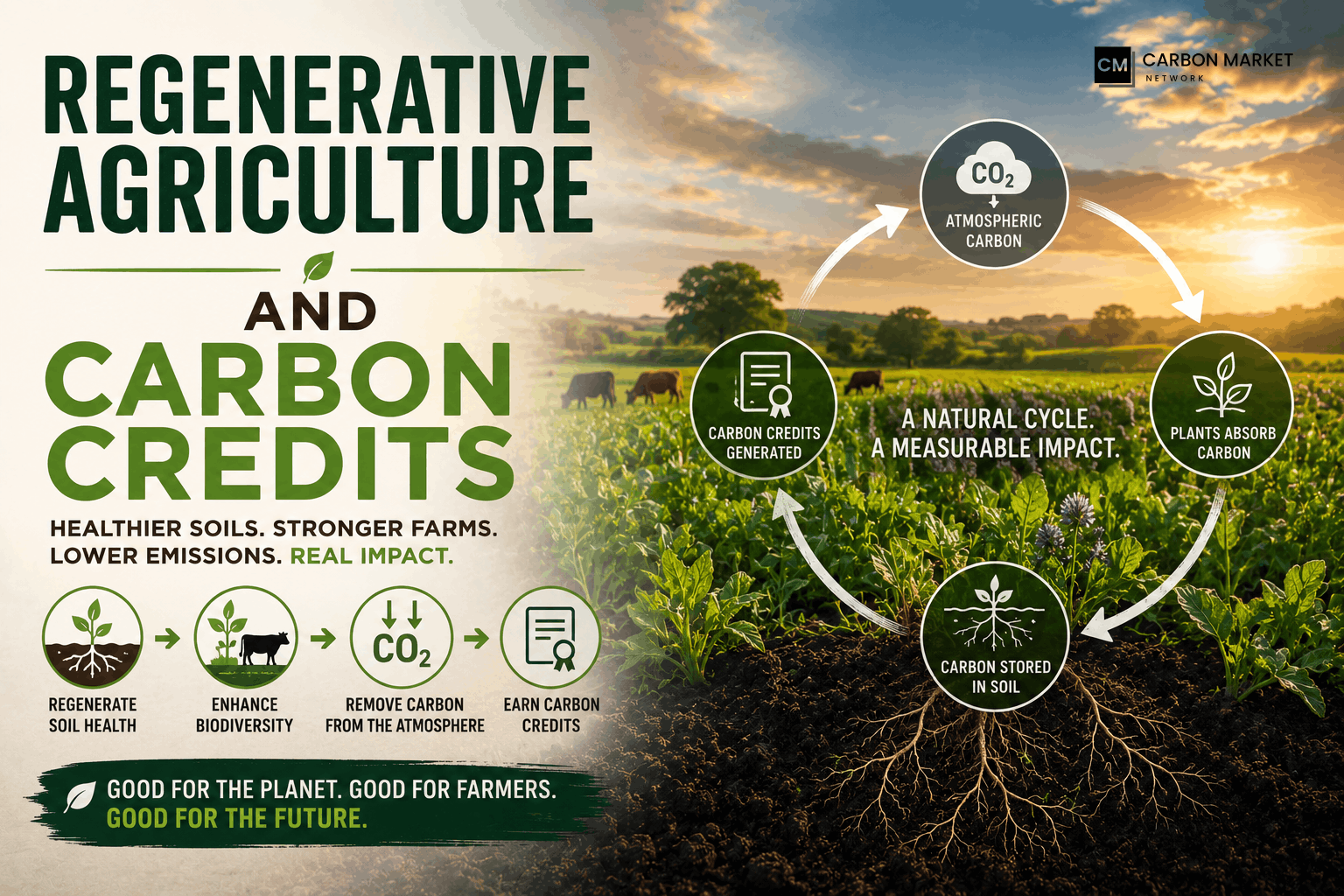
Imagine a farming method that heals the soil, fights climate change, and pays farmers extra money for doing it. That is exactly what regenerative agriculture and carbon credits offer together.
If you have heard these terms floating around but still feel a bit confused, you are in the right place.
This guide breaks down everything in simple language. No jargon overload. Just clear, practical information you can actually use.
By the end, you will understand how regenerative agriculture works, how carbon credits are earned from it, and why this combination is becoming one of the biggest trends in sustainable farming and climate finance.
Let’s dig in.
What Is Regenerative Agriculture?
Regenerative agriculture is a farming approach that focuses on restoring soil health instead of depleting it.
Unlike conventional farming, which often strips nutrients from the land over time, regenerative agriculture works with nature to rebuild it.
The goal is simple: leave the land healthier than you found it.
Core Principles of Regenerative Agriculture
Farmers who practice regenerative agriculture usually follow a set of core principles:
- Minimize soil disturbance: This means reducing or eliminating tillage so soil structure stays intact.
- Keep the soil covered: Cover crops protect soil from erosion and help retain moisture.
- Maintain living roots: Living roots in the ground year-round feed soil microorganisms.
- Increase biodiversity: Diverse crop rotations and integrated livestock improve ecosystem balance.
- Reduce chemical inputs: Lower reliance on synthetic fertilizers and pesticides supports natural soil function.
These principles are not new ideas. Many indigenous farming communities have used similar practices for centuries.
What is new is the science backing these methods and the financial systems now rewarding farmers for using them.
Common Regenerative Farming Practices
Here are some of the most widely used regenerative agriculture practices:
- No-till or reduced-till farming: Seeds are planted directly into undisturbed soil.
- Cover cropping: Non-cash crops are grown between main crop seasons to protect and enrich soil.
- Crop rotation: Different crops are grown in sequence to break pest cycles and balance nutrients.
- Rotational grazing: Livestock are moved between pastures to prevent overgrazing and boost grass regrowth.
- Composting and organic amendments: Natural materials replace synthetic fertilizers.
- Agroforestry: Trees and shrubs are integrated into farmland to improve biodiversity and carbon storage.
Each of these practices plays a role in pulling carbon dioxide from the air and storing it in the soil. That is where carbon credits enter the picture.
Carbon Market Insider Newsletter
Weekly insights on carbon markets, climate policy, carbon credits, and sustainability.
What Are Carbon Credits?
A carbon credit represents one metric ton of carbon dioxide, or its equivalent in other greenhouse gases, that has been reduced, avoided, or removed from the atmosphere.
Companies and organizations buy these credits to offset their own emissions and meet climate goals.
Farmers and landowners can generate carbon credits by adopting practices that either store more carbon in the soil or release less of it in the first place.
How Carbon Credits Work in Simple Terms
Here is the basic flow:
- A farmer adopts a regenerative practice, such as no-till farming or cover cropping.
- This practice increases soil carbon levels or reduces emissions from the farm.
- A third-party verifier measures and confirms the carbon benefit using approved methodologies.
- A carbon credit is issued for each ton of CO2 equivalent that is sequestered or avoided.
- The farmer sells this credit on a carbon market, often through a carbon credit program or aggregator.
- A company buys the credit to offset part of its own carbon footprint.
This system creates a direct financial incentive for farmers to switch to climate-friendly practices.
Why Regenerative Agriculture and Carbon Credits Make a Powerful Combination
Soil is one of the planet’s largest natural carbon sinks. Healthy soil can store significant amounts of carbon for long periods.
According to UN FAO data, 33% of the world’s soils are degraded, and agriculture contributes meaningfully to global greenhouse gas emissions.
Regenerative agriculture directly addresses this problem by rebuilding soil organic matter, which locks carbon underground instead of letting it escape into the atmosphere.
When this carbon sequestration is measured and verified, it becomes a tradable asset in the form of a carbon credit.
This creates a win-win-win situation:
- Farmers earn extra income from carbon credit sales.
- The planet benefits from reduced emissions and restored soil.
- Companies get access to high-quality carbon credits to support their climate commitments.
How Farmers Can Earn Carbon Credits Through Regenerative Practices
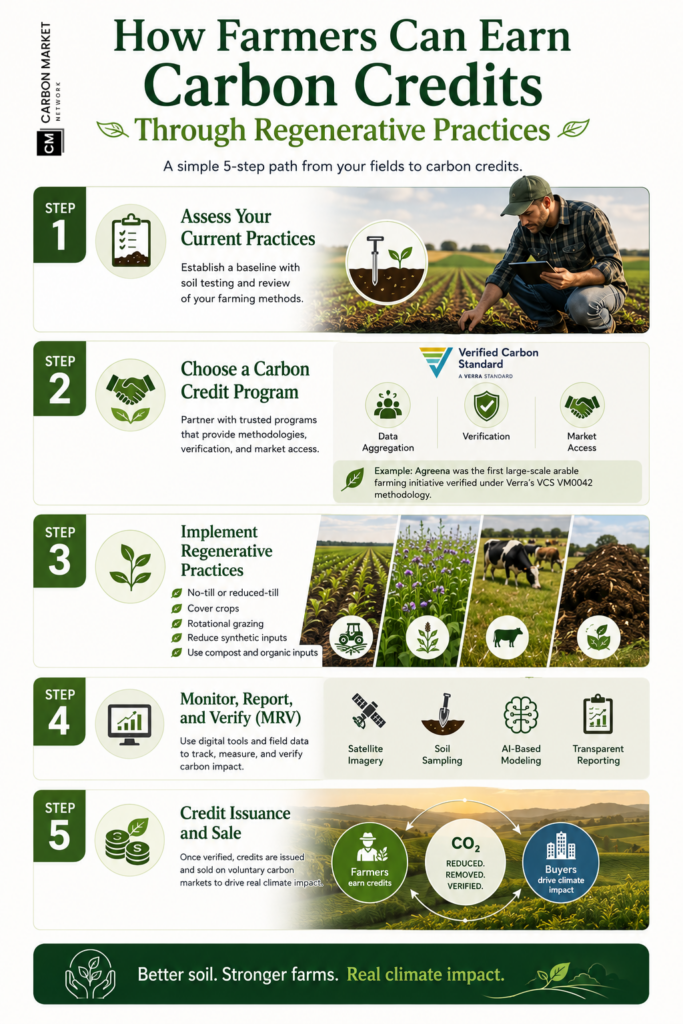
Getting started with agricultural carbon credits involves a few clear steps. Here is a simplified breakdown.
Step 1: Assess Your Current Practices
Before anything else, farmers need a baseline. This usually involves soil testing and a review of current farming methods.
A baseline helps establish how much carbon the land currently stores, which is important for measuring future improvements.
Step 2: Choose a Carbon Credit Program
Several programs and companies help farmers transition to regenerative practices and monetize the results. Some well-known approaches in the industry include:
- Programs built around Verra’s Verified Carbon Standard (VCS), including methodologies designed for agricultural land management.
- Private companies that aggregate farmer data, manage verification, and connect farms with corporate buyers.
- Regional voluntary carbon market platforms that are expanding rapidly in places like the Middle East and North America.
For example, Agreena became the first large-scale arable farming initiative verified under Verra’s Verified Carbon Standard VM0042 Improved Agricultural Land Management methodology, supporting verified, traceable, and compliance-ready credits backed by field-level data.
Step 3: Implement Regenerative Practices
This is where the actual farming changes happen. Common transitions include:
- Switching from conventional tillage to no-till or reduced-till methods.
- Introducing cover crops during off-seasons.
- Adopting rotational grazing for livestock operations.
- Reducing synthetic fertilizer use through composting and organic inputs.
Step 4: Monitor, Report, and Verify (MRV)
This step is critical for credit quality.
Modern carbon programs increasingly rely on digital measurement, reporting, and verification, often called dMRV. This can include satellite imagery, soil sampling, and AI-based modeling to track changes over time.
Accurate MRV ensures that credits represent real, measurable climate benefits rather than estimates alone.
Step 5: Credit Issuance and Sale
Once verification is complete, credits are issued and can be sold on voluntary carbon markets.
Buyers range from large corporations looking to offset Scope 3 emissions in their supply chains to smaller companies wanting to support sustainable agriculture.
Real-World Examples of Regenerative Agriculture Carbon Programs
Seeing real examples helps make this topic less abstract. Here are a few notable initiatives shaping the space.
Rice Methane Reduction Programs in the United States
Rice farming traditionally produces significant methane emissions due to flooded paddy fields.
Programs focused on climate-smart rice production help farmers adjust water management practices to cut methane while generating verified carbon credits.
One such program reported cumulative results of 175,965 tonnes of verified emission reductions and 51.1 billion gallons of water saved across 3,128 fields in 5 states.
This shows how regenerative water management in rice farming can deliver both environmental and financial benefits at scale.
Soil Carbon Sequestration Initiatives
Some companies focus specifically on soil organic carbon (SOC) sequestration, issuing credits based on measurable increases in soil carbon content.
These programs often combine on-the-ground sampling with remote sensing technology to track changes across thousands of acres.
Regional Expansion in the Middle East
Interest in regenerative agriculture credits is growing beyond traditional markets.
In the Gulf region, Saudi Arabia restored its first million hectares of degraded land and planted over 159 million trees under the Saudi Green Initiative, which is part of a broader target to plant 10 billion trees across the country.
At the same time, the UAE’s National Register for Carbon Credits came into force in late December 2024, creating a formal pathway for registering and retiring carbon credits in the region.
These developments highlight how regenerative agriculture and carbon credit systems are becoming global, not just regional, trends.
Benefits of Regenerative Agriculture Beyond Carbon Credits
While carbon credits provide a financial incentive, regenerative agriculture delivers many other benefits that matter just as much.
Improved Soil Health
Healthier soil holds more water, resists erosion better, and supports stronger root systems.
This often leads to more resilient crops, especially during droughts or extreme weather events.
Better Water Retention
Practices like cover cropping and reduced tillage help soil absorb and retain more water.
This is especially valuable in regions facing water scarcity or extreme heat.
Increased Biodiversity
Diverse crop rotations and reduced chemical use support healthier ecosystems both above and below the ground.
This includes beneficial insects, pollinators, and soil microorganisms that all play a role in farm productivity.
Long-Term Cost Savings
While transitioning to regenerative practices may require upfront investment, many farmers see reduced costs over time.
Lower fertilizer and pesticide use, combined with improved yields from healthier soil, can improve overall farm economics.
Climate Resilience
Farms practicing regenerative agriculture tend to recover faster from floods, droughts, and other climate-related shocks.
This resilience is increasingly important as weather patterns become less predictable.
Challenges and Considerations
It would not be fair to paint this topic as perfect. There are real challenges worth understanding.
Measurement Complexity
Measuring soil carbon accurately is more complex than measuring emissions from a smokestack.
Soil carbon levels can vary across small areas of land, and changes happen slowly over years, not days.
Permanence Concerns
Carbon stored in soil can be released again if land management practices change in the future.
This is why many programs include monitoring requirements that extend well beyond the initial credit issuance.
Credit Quality Variation
Not all carbon credits are created equal.
Buyers increasingly look for credits with strong additionality, meaning the carbon benefit would not have happened without the program, along with solid verification and long-term monitoring.
Transition Costs for Farmers
Switching to regenerative practices often requires new equipment, training, and patience during a transition period where yields may temporarily dip.
Carbon credit income can help offset these costs, but farmers need realistic expectations about timelines.
How Businesses Can Benefit From Agricultural Carbon Credits
Companies are not just bystanders in this story. Many are actively investing in agricultural carbon credits as part of their climate strategy.
Supporting Net Zero Goals
Agricultural carbon credits, especially removal-based credits, can play a role in corporate net zero commitments.
High-quality removal credits from regenerative agriculture often command premium prices compared to avoidance credits because they represent active carbon drawdown rather than simply preventing future emissions.
Strengthening Supply Chains
Companies that source agricultural products can support regenerative transitions directly within their own supply chains.
This approach, sometimes called insetting, allows businesses to reduce Scope 3 emissions while building more resilient sourcing relationships with farmers.
Meeting Consumer Demand
Consumers are increasingly interested in how their food is produced.
Brands that support regenerative agriculture often highlight this in their sustainability messaging, which can strengthen brand trust and loyalty.
The Growing Market for Regenerative Agriculture
The numbers tell a clear story about where this industry is heading.
The global regenerative agriculture practices market was valued at 11.64 billion dollars in 2023 and is expected to reach 42.49 billion dollars by 2034, growing at a strong annual rate.
This growth is being driven by rising consumer demand for organic foods, supportive government policies, and increasing carbon credit prices.
As more verification technology becomes available and more buyers enter the market, this trend is expected to continue.
Practical Tips for Farmers Interested in Carbon Credits
If you are a farmer considering this path, here are some practical, actionable steps to get started.
- Start small. Pilot one or two regenerative practices on a portion of your land before scaling up.
- Document everything. Keep detailed records of your farming practices, inputs, and any soil testing results.
- Research programs carefully. Different carbon credit programs have different requirements, timelines, and payment structures.
- Talk to other farmers. Farmers who have already gone through the process can offer valuable insights.
- Be patient with timelines. Soil carbon changes take time to measure and verify, so credit income may not be immediate.
- Consider co-benefits. Even without carbon credit income, many regenerative practices improve soil health and reduce input costs.
Practical Tips for Businesses Buying Agricultural Carbon Credits
For companies exploring agricultural carbon credits, consider these steps:
- Define your goals clearly. Decide whether you are prioritizing carbon removal, supply chain emissions reductions, or broader sustainability storytelling.
- Check verification standards. Look for credits issued under recognized methodologies with transparent monitoring.
- Understand additionality. Confirm that the carbon benefit would not have occurred without the program’s support.
- Diversify your portfolio. Combining different types of credits, including removal and avoidance credits, can balance cost and impact.
- Engage directly when possible. Programs that connect buyers directly with farming projects often provide more transparency and stronger relationships.
The Future of Regenerative Agriculture and Carbon Credits
This space is evolving quickly, and a few trends are worth watching.
Better Technology for Measurement
AI-driven digital measurement, reporting, and verification tools are making it easier and more affordable to track soil carbon changes accurately.
This reduces costs for farmers and increases confidence for buyers.
Expanding Regional Markets
Voluntary carbon markets are expanding beyond traditional regions like North America and Europe.
Growth in areas such as the Gulf states shows that regenerative agriculture and carbon credit systems are becoming a global movement.
Stronger Quality Standards
As the market matures, buyers are becoming more selective about credit quality.
This pushes the industry toward higher standards, better data, and more transparent verification processes, which benefits everyone involved in the long run.
Integration With Food Supply Chains
More food and beverage companies are likely to integrate regenerative agriculture support directly into their sourcing strategies.
This could make carbon credit generation a built-in part of how certain crops are grown and sold, rather than a separate add-on program.
Conclusion
Regenerative agriculture and carbon credits represent one of the most practical and promising approaches to addressing climate change while supporting farmers economically.
By focusing on soil health, biodiversity, and sustainable practices, regenerative agriculture restores the land while pulling carbon out of the atmosphere.
Carbon credits then turn that environmental benefit into a financial reward, creating a system where doing right by the planet also makes economic sense.
Whether you are a farmer exploring new income streams, a business looking for meaningful climate solutions, or simply someone curious about sustainable food systems, regenerative agriculture and carbon credits offer a path worth understanding.
As technology improves and markets expand, this combination is likely to play an increasingly important role in both agriculture and climate strategy for years to come.
Frequently Asked Questions
What is the difference between regenerative agriculture and organic farming?
Organic farming focuses mainly on avoiding synthetic chemicals, while regenerative agriculture focuses on actively improving soil health, biodiversity, and carbon storage. A farm can be regenerative without being certified organic, and vice versa.
How much can a farmer earn from agricultural carbon credits?
Earnings vary widely depending on the program, the practices adopted, the size of the farm, and current market prices for carbon credits. Removal-based credits from regenerative agriculture often sell at a premium compared to other types of credits.
How long does it take to see results from regenerative agriculture?
Soil health improvements can begin within a few growing seasons, but significant changes in soil carbon levels usually take several years to measure accurately. Patience is important during this transition period.
Are carbon credits from regenerative agriculture reliable?
Quality varies by program. Credits verified under recognized methodologies, supported by strong monitoring, reporting, and verification systems, tend to be more reliable and credible.
Can small farms participate in carbon credit programs?
Yes, many programs aggregate data from multiple small farms to make participation more accessible. However, requirements vary, so it is worth researching specific programs to find one that fits your farm size and practices.
Do regenerative practices reduce farm input costs?
Often, yes. Reduced reliance on synthetic fertilizers and pesticides, combined with improved soil health, can lower input costs over time, even before factoring in carbon credit income.
Is regenerative agriculture only for crop farms?
No. Regenerative principles apply to livestock operations as well, particularly through practices like rotational grazing, which can improve pasture health and support carbon sequestration in grasslands.