Carbon Market Network


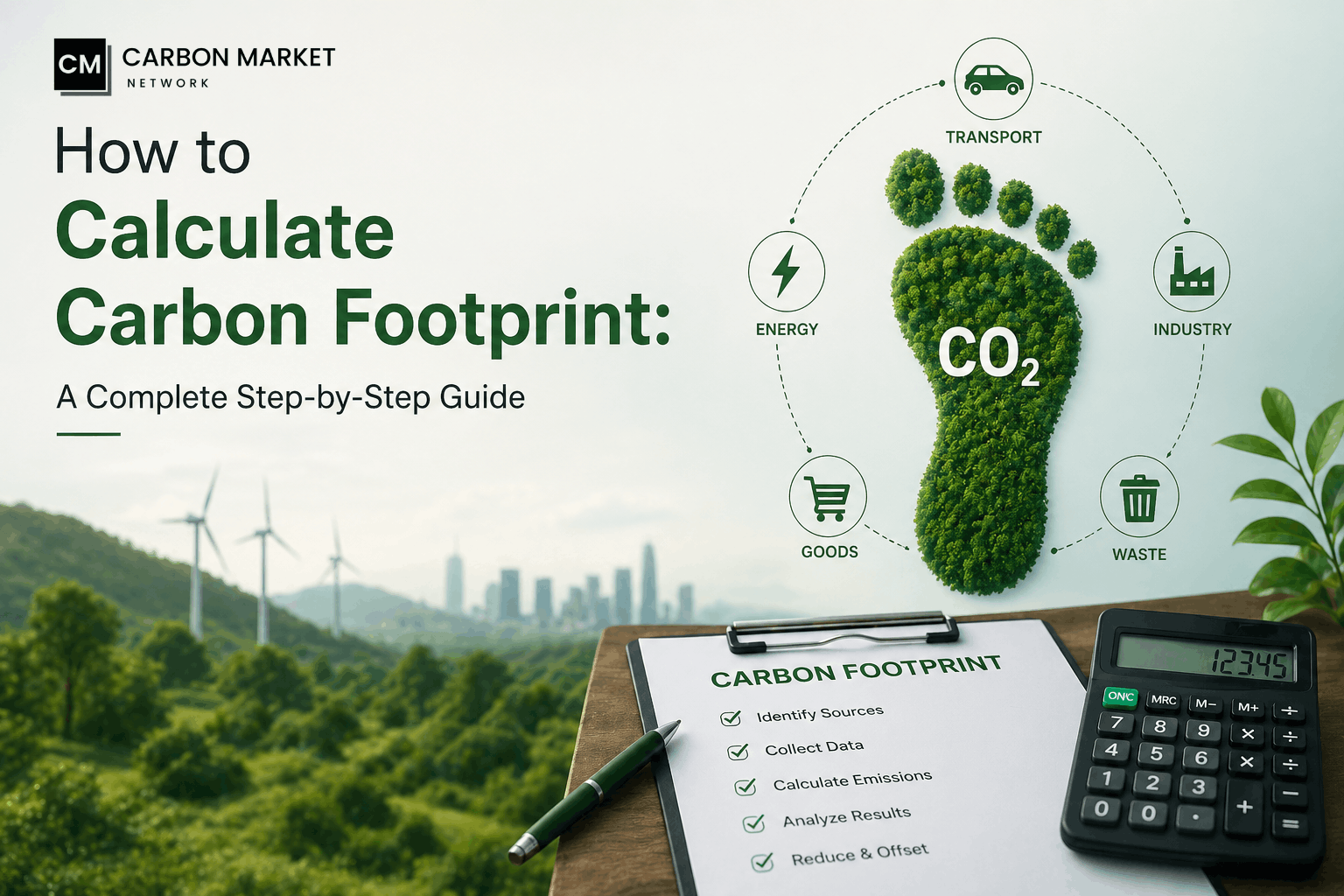
Most people agree that climate change is a serious problem. But very few people actually know how much they personally contribute to it. That is where learning how to calculate your carbon footprint becomes important.
Your carbon footprint is the total amount of greenhouse gases you produce through your everyday activities.
Driving your car, using electricity at home, eating food, buying clothes – all of it adds up.
When you calculate your carbon footprint, you get a real number that reflects your actual environmental impact. That number gives you the power to make smarter choices and take meaningful action.
This guide walks you through everything – what a carbon footprint is, why it matters, what goes into the calculation, how to reduce your number, and which tools to use.
You will also find real-world examples and a detailed FAQ section at the end.
Let us get started.
What Is a Carbon Footprint?
A carbon footprint is the total amount of greenhouse gases (GHGs) a person, household, organisation, or country releases into the atmosphere as a result of its activities.
These greenhouse gases include:
- Carbon dioxide (CO2) from burning fossil fuels like petrol, coal, and natural gas
- Methane (CH4) from livestock farming, landfills, and natural gas leaks
- Nitrous oxide (N2O) from fertilisers and agriculture
- Hydrofluorocarbons (HFCs) from air conditioners and refrigerants
Because these gases have different warming effects, scientists convert all of them into a single unit called CO2 equivalent (CO2e). This makes it easy to compare and add up your total impact regardless of which gas caused it.
For example, 1 kg of methane is roughly 28 times more potent than 1 kg of CO2 over a 100-year period. So 1 kg of methane equals 28 kg CO2e.
Direct vs Indirect Carbon Emissions
Your carbon footprint has two main parts.
Direct emissions are the ones you produce personally. Driving a petrol car, cooking on a gas stove, or burning wood for heating are all direct emissions.
Indirect emissions are the ones produced on your behalf. The electricity that comes to your home from a coal-powered grid, the manufacturing of the smartphone you bought, the shipping of your online orders – all of these count as your indirect emissions.
Both direct and indirect emissions matter when you calculate your carbon footprint. Many people only track the obvious stuff and miss the bigger picture.
Carbon Market Insider Newsletter
Weekly insights on carbon markets, climate policy, carbon credits, and sustainability.
Why Should You Calculate Your Carbon Footprint?
You cannot manage what you do not measure. That principle is true for health, finances, and the environment.
Here is why calculating your personal carbon footprint is worth the effort:
Clarity. You see exactly where your emissions come from instead of guessing or assuming.
Prioritisation. You discover which habits carry the biggest environmental cost so you can tackle them first.
Accountability. Tracking your footprint over time shows whether your lifestyle changes are actually working.
Offset planning. If you know your total footprint, you can choose to offset it through verified carbon credit projects.
Climate awareness. Understanding your number connects you more deeply to the global climate conversation and helps you engage more meaningfully.
According to the United Nations Environment Programme (UNEP), individual action, particularly in high-income countries, can contribute meaningfully to global emission reductions when it happens at scale. Calculating your footprint is step one.
What Is the Average Carbon Footprint Per Person?
Before you calculate your own number, it helps to understand what the global averages look like.
| Country / Region | Average Annual Carbon Footprint |
|---|---|
| Global Average | ~4 tonnes CO2e per year |
| United States | ~14 to 16 tonnes CO2e per year |
| European Union | ~7 to 9 tonnes CO2e per year |
| India | ~2.0 to 2.5 tonnes CO2e per year |
| China | ~8 to 9 tonnes CO2e per year |
| Australia | ~13 to 15 tonnes CO2e per year |
| Paris Agreement Target | Under 2 tonnes CO2e per year by 2050 |
The global target to limit warming to 1.5 degrees Celsius requires the average person to bring their footprint down to under 2 tonnes CO2e annually by 2050. Most people in developed nations are several times above that target today.
Key Categories That Make Up Your Carbon Footprint
To calculate your carbon footprint accurately, you need to know the main categories where emissions come from.
1. Home Energy Use
This is often the single largest category for most households.
Home energy emissions come from:
- Electricity consumption from the grid, especially if the grid runs on coal or gas
- Natural gas or LPG used for heating, cooking, and hot water
- Heating oil or biomass burning
The carbon intensity of your electricity depends heavily on where you live. In India, every unit (kWh) of electricity from the grid emits approximately 0.82 kg CO2e (based on Central Electricity Authority data). In the UK, thanks to a higher share of renewables, the factor is around 0.23 kg CO2e per kWh.
This is why the same electricity bill can represent very different carbon footprints in different countries.
2. Transportation
How you get around is often the second biggest category for most people.
| Mode of Transport | Approximate CO2e Per km Per Person |
|---|---|
| Petrol car (driven alone) | 170 to 200 g CO2e per km |
| Diesel car (driven alone) | 150 to 180 g CO2e per km |
| Electric car (average grid) | 50 to 80 g CO2e per km |
| Bus | 80 to 100 g CO2e per km |
| Electric train | 20 to 40 g CO2e per km |
| Domestic flight | 250 to 300 g CO2e per km per passenger |
| Long-haul flight | 150 to 200 g CO2e per km per passenger |
| Bicycle or walking | 0 g CO2e per km |
Flying deserves special attention. A single long-haul return flight – say, Mumbai to London – can add roughly 2 to 4.5 tonnes CO2e to your footprint in just one trip. That is the equivalent of an average Indian person’s entire annual footprint.
3. Diet and Food
What you eat has a surprisingly large carbon impact, and most people do not think about it this way.
| Food Type | Approximate CO2e Per kg of Food |
|---|---|
| Beef | 27 to 60 kg CO2e per kg |
| Lamb and mutton | 24 to 30 kg CO2e per kg |
| Cheese | 10 to 13 kg CO2e per kg |
| Pork | 7 to 12 kg CO2e per kg |
| Chicken | 5 to 7 kg CO2e per kg |
| Eggs | 4 to 5 kg CO2e per kg |
| Rice | 2 to 3 kg CO2e per kg |
| Tofu and legumes | 1 to 3 kg CO2e per kg |
| Local seasonal vegetables | 0.1 to 0.5 kg CO2e per kg |
Beef produces up to 20 times more CO2e than lentils per gram of protein. Food waste also matters because decomposing food in landfills releases methane, a potent greenhouse gas.
4. Shopping and Consumer Goods
Every product you buy has emissions baked into it from raw material extraction, manufacturing, transport, and eventual disposal.
This includes clothing and fast fashion, electronics and appliances, furniture, packaging, and single-use plastics.
The fashion industry alone accounts for approximately 10 percent of global carbon emissions according to UNEP (2024).
That pair of jeans you bought has an embedded footprint of roughly 8 to 33 kg CO2e depending on where it was made and how it was shipped.
5. Services and Digital Activity
This category is smaller but growing fast.
Streaming video, sending emails, cloud storage, online banking, healthcare services, and government services all have carbon footprints because they require data centres, office buildings, and infrastructure that consume energy.
The global digital sector now accounts for about 3.5 percent of total global greenhouse gas emissions, and that share is rising year on year.
How to Calculate Carbon Footprint: Step-by-Step
Now that you understand the categories, here is a practical step-by-step guide to calculating your personal carbon footprint from scratch.
Step 1: Gather Your Data
Before you start calculating, collect the following information. You do not need exact figures — reasonable estimates work fine for personal calculations.
- Monthly electricity bill in kWh or the bill amount
- Monthly gas or LPG usage in cubic metres, litres, or bill amount
- Annual distance driven by car and the fuel type (petrol, diesel, CNG, electric)
- Number of flights taken in the last year with destinations
- Rough monthly food spend and your general diet type (vegan, vegetarian, omnivore, or heavy meat eater)
- Rough monthly spend on clothing, electronics, and other consumer goods
If you cannot find your electricity consumption in kWh, look at your electricity bill. Most Indian bills show units consumed per month, and one unit equals one kWh.
Step 2: Apply Emission Factors to Each Activity
Each type of activity has an emission factor, which is the amount of CO2e produced per unit of that activity.
The basic formula is:
Carbon Footprint = Activity Data x Emission Factor
Here are three worked examples:
Example 1 (Electricity): You use 300 kWh of electricity per month in India. Monthly footprint = 300 kWh x 0.82 kg CO2e per kWh = 246 kg CO2e = 0.246 tonnes CO2e per month. Annual footprint from electricity = 0.246 x 12 = approximately 2.95 tonnes CO2e.
Example 2 (Car travel): You drive 1,000 km per month in a petrol car. Monthly footprint = 1,000 km x 0.185 kg CO2e per km = 185 kg CO2e = 0.185 tonnes CO2e per month. Annual footprint from driving = 0.185 x 12 = approximately 2.22 tonnes CO2e.
Example 3 (Flight): You take one Delhi to Dubai return flight (approximately 8,800 km round trip). Flight footprint = 8,800 km x 0.175 kg CO2e per km = 1,540 kg CO2e = approximately 1.54 tonnes CO2e.
Step 3: Calculate Each Category Separately
Work through each major category and find a sub-total for each one.
| Category | Annual CO2e (Example Person) |
|---|---|
| Home energy (electricity + gas) | 1.8 tonnes CO2e |
| Transportation (car + one return flight) | 2.5 tonnes CO2e |
| Diet (omnivore, moderate meat) | 1.5 tonnes CO2e |
| Shopping and consumer goods | 0.8 tonnes CO2e |
| Services and miscellaneous | 0.4 tonnes CO2e |
| Total | 7.0 tonnes CO2e per year |
Step 4: Add Up Your Total
Sum all category totals. The result is your annual personal carbon footprint in tonnes CO2e.
Compare your total against the global average of 4 tonnes and the Paris Agreement target of under 2 tonnes. This gives you a meaningful benchmark to work from.
Step 5: Find Your Hotspots
Look at which categories contribute the most to your total footprint.
For most people in India, home energy and transportation are the top two. For people in Western countries, flying and diet often dominate.
Focus your reduction efforts on your biggest two or three categories first. That is where you will get the most impact per action.
Calculate Your Personal Carbon Footprint Right Now
Curious how much CO2 you personally emit every year? You do not need to do all the maths yourself.
Use a free Personal Carbon Footprint Calculator to find out your number in minutes. Enter your travel habits, home energy use, diet, and shopping patterns to get your personalised carbon score along with actionable tips to reduce it.
Try the CMN Personal Carbon Footprint Calculator and know your number today.
Carbon Footprint Calculation Methods Explained
There are three main approaches to calculating a carbon footprint. Knowing the difference helps you choose the right method for your purpose.
Activity-Based Method
This is the most detailed and accurate method. You collect data on every activity you do (driving, flying, energy use, food consumption) and multiply each by its specific emission factor.
This is the method used in most personal calculators and in detailed corporate footprint assessments.
Best for: Individuals who want a precise number and are willing to gather their own data.
Spend-Based Method
Here you use your spending data and apply average emission intensity values for each spending category. For example, you spent Rs. 5,000 on clothing this month, and each rupee spent on clothing has an average embedded emission figure.
Best for: People who find it easier to track spending than activity data, or for businesses estimating supply chain emissions.
Input-Output Model
This approach uses economic models to estimate the total emissions embedded in goods and services across an entire supply chain. It is mainly used for national accounts, lifecycle assessments, and macro-level research.
Best for: Researchers, governments, and companies performing comprehensive lifecycle assessments.
For personal use, the activity-based method using a reliable online calculator is the most practical and accurate approach.
Best Tools to Calculate Your Carbon Footprint
You do not need to do all these calculations manually. Several excellent free tools handle it quickly and produce clear visual results.
| Calculator | Best For | Coverage |
|---|---|---|
| CMN Personal Calculator | Quick, clean personal calculation | Global |
| WWF Footprint Calculator | Beginner-friendly with visual output | Global, UK-focused |
| Carbon Footprint Ltd Calculator | Detailed travel and home energy | Global |
| EPA Carbon Footprint Calculator | US households specifically | United States |
| Climate Hero | Gamified, mobile-friendly | Global |
| Shrink That Footprint | Deep dive with research references | Global |
When you use any calculator, have your electricity bill, a rough idea of your monthly driving distance, and your diet type ready. The more data you provide, the more accurate your result.
What a Good Calculator Should Include
A reliable personal carbon footprint calculator should cover:
- Home energy inputs with country-specific emission factors
- Car travel, public transport, and flight options
- Diet type selector with food-specific emission factors
- Shopping and consumer goods section
- Output in tonnes CO2e broken down by category
- Comparison against your country average and the Paris Agreement target
- Personalised reduction tips based on your specific results
How to Calculate Carbon Footprint for Specific Activities
Sometimes you want to calculate the footprint of just one activity. Here is how to do that quickly and accurately.
How to Calculate Carbon Footprint of a Flight
Formula: Flight CO2e = Distance in km x Emission Factor x Radiative Forcing Multiplier
The radiative forcing multiplier accounts for the additional warming effect of contrails and other high-altitude effects. A commonly used multiplier is between 1.9 and 2.7.
Example: Mumbai to London return (approximately 14,400 km round trip). Without multiplier: 14,400 x 0.158 kg = 2,275 kg CO2e. With a 2x radiative forcing multiplier: approximately 4,550 kg CO2e = 4.55 tonnes CO2e.
That single round trip alone represents the entire annual footprint of an average Indian person.
How to Calculate Carbon Footprint of Your Electricity Use
Formula: Electricity CO2e = kWh Consumed x Grid Emission Factor
| Country | Grid Emission Factor (kg CO2e per kWh) |
|---|---|
| India | 0.82 |
| China | 0.55 |
| USA (national average) | 0.37 |
| UK | 0.23 |
| Germany | 0.30 |
| France (high nuclear share) | 0.06 |
| Norway (high hydro share) | 0.02 |
Example: You use 250 kWh per month in India. Monthly CO2e = 250 x 0.82 = 205 kg CO2e = 0.205 tonnes CO2e.
How to Calculate Carbon Footprint of Your Diet
Formula: Diet CO2e = Sum of (Food Weight in kg x Emission Factor per kg)
Example: You eat 200g of chicken, 100g of rice, and 150g of vegetables in a meal. CO2e = (0.2 x 6) + (0.1 x 2.7) + (0.15 x 0.3) = 1.2 + 0.27 + 0.045 = approximately 1.5 kg CO2e for that one meal.
Multiply this across your daily meals and the annual impact of diet becomes very clear.
How to Calculate Carbon Footprint of a Car Journey
Formula: Car CO2e = Distance in km x Emission Factor per km
Alternatively: Fuel Consumed in litres x Emission Factor for Fuel Type.
| Fuel Type | Emission Factor |
|---|---|
| Petrol | 2.31 kg CO2 per litre |
| Diesel | 2.68 kg CO2 per litre |
| LPG (autogas) | 1.51 kg CO2 per litre |
| CNG | 2.75 kg CO2 per kg |
Example: You fill 40 litres of petrol per month. Monthly footprint = 40 x 2.31 = 92.4 kg CO2e = 0.09 tonnes CO2e per month. Annual = approximately 1.1 tonnes CO2e.
Carbon Footprint Calculation for Businesses
If you run a business or work in sustainability, understanding how to calculate carbon footprint at the organisational level is essential. Many companies now face regulatory and investor pressure to measure and disclose their emissions formally.
The GHG Protocol Corporate Standard
The most widely accepted framework for corporate carbon accounting is the Greenhouse Gas Protocol (GHG Protocol). It divides emissions into three scopes:
Scope 1 covers direct emissions from sources your organisation owns or controls. This includes company vehicles, on-site boilers, and refrigerant leaks.
Scope 2 covers indirect emissions from purchased energy. This means the electricity and heat your office or factory buys from the grid.
Scope 3 covers all other indirect emissions across your entire value chain. This includes employee commuting, business travel, supplier manufacturing, product use by customers, and waste disposal.
Scope 3 is usually the largest category for most businesses, often accounting for 70 to 90 percent of total corporate footprint. It is also the hardest to measure.
Steps for Business Carbon Footprint Calculation
- Define your organisational and operational boundary
- Collect activity data across all three scopes
- Apply relevant emission factors from IPCC, EPA, DEFRA, or country-specific sources
- Convert all gases to CO2e and total by scope
- Report using GHG Protocol, ISO 14064, or TCFD guidelines
- Set a reduction target aligned with the Science Based Targets initiative (SBTi)
How to Reduce Your Carbon Footprint After Calculating It
Once you know your number, here is how to bring it down systematically. Focus on your biggest categories first.
Reduce Home Energy Emissions
- Switch to a renewable energy tariff or install rooftop solar panels
- Upgrade to energy-efficient LED lighting and A+++ rated appliances
- Improve home insulation to reduce the need for heating and cooling
- Unplug appliances on standby and avoid leaving chargers plugged in
- Use a smart or programmable thermostat to optimise energy use
Switching to rooftop solar in India can reduce your electricity-related carbon footprint by 50 to 80 percent depending on your system size and household consumption.
Reduce Transport Emissions
- Use public transport or cycle instead of driving alone whenever possible. Taking a bus instead of a solo car journey can cut your transport emissions by up to 60 percent.
- If you are buying a new car, seriously consider an electric vehicle. Over its lifetime, an EV emits 50 to 70 percent less CO2 than a comparable petrol car.
- Reduce the number of flights you take. Cutting one long-haul return flight per year can save 1 to 3 tonnes CO2e depending on the route.
- Work from home when your job allows it. Even two remote working days per week eliminates a significant share of your commuting footprint.
- When you do need to fly, choose direct routes and economy class. First class and business class seats have a much larger footprint per passenger because they take up more space on the plane.
Reduce Diet-Related Emissions
- Cut back on red meat, especially beef and lamb. Removing beef from your diet just once a week saves roughly 0.3 to 0.5 tonnes CO2e annually.
- Shift toward more plant-based meals. A fully plant-based diet produces about 50 to 70 percent fewer emissions than a heavy meat diet.
- Buy local and seasonal produce to reduce transport and cold storage emissions.
- Reduce food waste. Compost kitchen scraps instead of throwing them in the bin.
- Avoid imported out-of-season produce when local alternatives are available.
Reduce Shopping and Consumer Goods Emissions
- Buy second-hand clothing and electronics before buying new
- Choose products with longer lifespans and good repairability
- Avoid fast fashion brands with poor sustainability records
- Borrow or rent items you use rarely instead of buying them
- Repair items before replacing them
Carbon Offsetting: A Complement, Not a Replacement
Once you have reduced your footprint as much as you reasonably can, you can offset the remaining emissions by purchasing verified carbon credits.
Good offset projects include:
- Afforestation and reforestation projects
- Renewable energy projects in developing countries
- Community cookstove projects that reduce biomass burning
- Avoided deforestation through REDD+ projects
Make sure any offset you buy is verified by a credible standard such as Gold Standard, Verra (Verified Carbon Standard), or American Carbon Registry. In India, projects registered under the BIS (Bureau of Indian Standards) carbon credit framework are also credible as of 2025.
Important: Carbon offsetting should complement, not replace, genuine emission reductions. Offsetting is not a licence to keep emitting freely. It is a bridge while you continue making real changes.
Carbon Footprint vs Carbon Offset vs Carbon Neutral: What Is the Difference?
These terms get used interchangeably, but they mean very different things.
| Term | What It Means |
|---|---|
| Carbon Footprint | The total CO2e you emit from all your activities |
| Carbon Offset | A unit representing the removal or avoidance of 1 tonne CO2e somewhere else |
| Carbon Neutral | Your net emissions are zero because you have offset everything you emit |
| Net Zero | You have reduced emissions as far as technically possible and only offset the residual |
| Carbon Negative / Climate Positive | You remove more carbon than you emit |
Most people and organisations aiming for carbon neutrality are primarily using offsets to balance their emissions. Genuine net zero requires deep emission cuts first, with offsets only for what cannot be eliminated.
Common Mistakes When Calculating Your Carbon Footprint
Avoid these errors to get a more accurate and useful result.
Ignoring indirect emissions. Many people only count petrol and electricity. But the goods you buy, the food you eat, and the services you use all have large embedded footprints that count as yours.
Forgetting flights. Air travel is one of the most carbon-intensive activities an individual can do, but people often overlook it because it happens infrequently throughout the year.
Using generic emission factors. The carbon intensity of electricity varies enormously by country and even by season. Always use country-specific emission factors for accuracy.
Calculating once and forgetting. Your footprint changes year to year as your lifestyle changes, as technology improves, and as the energy grid evolves. Recalculate at least once a year.
Assuming EVs are zero emission. Electric vehicles have significantly lower emissions than petrol cars, but their footprint depends on the electricity grid they charge from. In a coal-heavy grid like India’s, EVs still emit carbon, just less than petrol cars.
Counting household emissions as individual. If four people live together, divide shared household energy emissions by four to get your personal share, unless you are calculating for the whole household.
Treating offsetting as a solution. Carbon offsets are useful, but they are not a substitute for actually reducing your footprint. Always prioritise reduction first.
Carbon Footprint in India: What You Need to Know
India has a national average carbon footprint of approximately 2.0 to 2.5 tonnes CO2e per person per year. That is well below the global average of 4 tonnes and far below the US average of 14 to 16 tonnes.
However, per capita emissions in India are rising as the economy grows, urban populations expand, and consumption patterns shift toward higher-carbon lifestyles.
Key Drivers of Carbon Footprint in India
- A coal-heavy electricity grid, with roughly 70 percent of power from fossil fuels as of 2024 to 2025
- Growing private vehicle ownership and rising fuel consumption, especially in metros
- Increasing air travel among the urban middle class
- Livestock farming contributing significantly to methane emissions, particularly in rural areas
- Rapid construction and manufacturing growth with high energy demands
- Rising demand for cooling through air conditioners as temperatures increase
India’s Climate Commitments
India has committed under the Paris Agreement to:
- Reduce the emission intensity of its GDP by 45 percent by 2030 compared to 2005 levels
- Achieve 50 percent of cumulative electric power installed capacity from non-fossil fuel sources by 2030
- Create an additional carbon sink of 2.5 to 3 billion tonnes CO2e through forest and tree cover by 2030
India also launched its domestic carbon credit market framework in 2023 through the Energy Conservation (Amendment) Act, 2022 and the BIS carbon credit standard. This gives Indian businesses and project developers a domestic pathway to participate in carbon markets.
These national commitments mean the Indian electricity grid will become progressively cleaner over the next decade. That will gradually reduce the carbon footprint of electricity consumption across the country, even without individual action. But individual action still matters and still adds up at scale.
The Role of Individual Action vs Systemic Change
There is an ongoing debate about whether individuals or governments and corporations should bear the primary responsibility for cutting emissions.
The honest answer is that both matter.
Large systemic changes, such as decarbonising power grids, building efficient mass transit, transitioning to clean industrial processes, and reforming agriculture, are necessary. They happen faster and at a scale that individual action cannot match.
But individual choices aggregate into market signals. When enough people shift toward plant-based diets, the food industry responds. When enough people buy EVs, car manufacturers shift production. When enough people demand green energy, utilities invest in it. Individual and systemic change are not opposites. They reinforce each other.
Calculating your carbon footprint is not about guilt or self-punishment. It is about information. A clear number in hand helps you decide where to focus your energy, what changes to make first, and how to advocate for policy changes that reflect your values.
How to Track Your Carbon Footprint Over Time
Calculating your footprint once is useful. Tracking it year on year is transformational.
Here is a simple system:
- Calculate your annual footprint at the start of each year using the same methodology
- Record your total and sub-totals by category in a simple spreadsheet or app
- Set one or two reduction goals for the year, for example switching to solar or cutting flights
- Recalculate at the end of the year and compare
- Celebrate genuine reductions and investigate why emissions increased in any category
Even small progress is meaningful. A 10 percent annual reduction in footprint, maintained consistently, adds up to a 65 percent reduction over a decade.
What Is the Relationship Between Carbon Footprint and Climate Change?
The science is clear on this. Greenhouse gas emissions from human activities are the dominant cause of the rapid warming observed since the mid-20th century.
Every tonne of CO2e emitted adds to the cumulative concentration of greenhouse gases in the atmosphere. That concentration traps heat, raises global temperatures, disrupts weather patterns, accelerates glacier and ice sheet melting, raises sea levels, and affects ecosystems on every continent.
The Intergovernmental Panel on Climate Change (IPCC) Sixth Assessment Report (AR6), completed in 2022 and reviewed with 2025 updates, confirms that limiting warming to 1.5 degrees Celsius requires reaching global net zero CO2 emissions around the early 2050s. To do that, every sector and every part of society needs to decarbonise.
Your personal footprint is one small thread in that larger fabric. It matters both in itself and as a signal to the market and political systems around you.
Conclusion: Start Calculating Your Carbon Footprint Today
Learning how to calculate your carbon footprint is one of the most empowering steps you can take as someone who cares about the planet.
The process is not complicated. Gather your basic data on energy, transport, food, and shopping. Apply emission factors to each category. Add up your total. Compare it to global benchmarks. Find your biggest hotspots. Then start making targeted, practical changes in the areas where you have the most impact.
Small, consistent actions add up. Switching one meat meal per week to a vegetarian option, avoiding one unnecessary flight, or shifting to LED lighting all create real reductions when millions of people do them year after year.
The Paris Agreement requires the world to bring the average personal footprint down to under 2 tonnes CO2e per year by 2050. Whether you are starting from 2 tonnes or 16 tonnes, the direction is the same: down.
Know your number. Own it. Reduce it.
Use a trusted carbon footprint calculator, find out where you stand, and take your first step today. Try the CMN Personal Carbon Footprint Calculator to get your personalised score in minutes.
Frequently Asked Questions (FAQ)
What is the easiest way to calculate my carbon footprint?
The easiest way is to use a free online carbon footprint calculator. You input your electricity usage, fuel consumption, diet type, and travel habits and the tool applies emission factors to show your total in tonnes CO2e. Tools like the Fuzen.io Personal Carbon Footprint Calculator make this process quick, visual, and beginner-friendly.
How accurate are carbon footprint calculators?
Most online calculators are reasonably accurate for personal use. They apply standard emission factors sourced from the IPCC, EPA, or country-specific energy bodies. For a more precise corporate or scientific result you would need detailed activity data and certified emission factors. For individual use, a good calculator gets you within 10 to 15 percent of your actual footprint, which is accurate enough to guide meaningful action.
What is a good carbon footprint number?
A carbon footprint under 2 tonnes CO2e per year per person is the target needed to align with the Paris Agreement goal of limiting warming to 1.5 degrees Celsius. The global average today is around 4 tonnes. In developed countries, anything below 5 tonnes reflects significant effort, and anything approaching 2 tonnes reflects genuine lifestyle commitment.
What is the biggest contributor to a personal carbon footprint?
For most people in developed countries, it is a combination of home energy use, transportation (especially flying), and diet (especially red meat consumption). For people in India and other developing nations where coal dominates the power grid, electricity consumption is often the single biggest factor.
Can I reduce my carbon footprint to zero?
It is extremely difficult to reach absolute zero in modern society. However, you can get very close by switching to renewable energy, adopting a plant-based diet, avoiding flying, and shopping consciously. Any remaining emissions can be offset through verified carbon credit projects to reach carbon neutrality.
How is a company’s carbon footprint different from a personal one?
A company’s carbon footprint covers Scope 1 (direct emissions), Scope 2 (purchased energy), and Scope 3 (value chain emissions) under the GHG Protocol framework. Corporate footprints require formal data collection, third-party verification, and annual reporting. They are typically disclosed through frameworks like CDP, TCFD, or GRI.
Does my carbon footprint include things I buy?
Yes. Your footprint includes both direct emissions from energy and travel, and indirect emissions from goods and services you consume. These consumption-based emissions can represent 30 to 60 percent of a person’s total footprint in higher-income countries and are just as real as the direct emissions.
How often should I recalculate my carbon footprint?
Recalculate at least once a year. Also recalculate after major lifestyle changes like moving home, buying a new vehicle, changing your diet significantly, or switching to renewable energy. Annual tracking shows real progress over time and keeps you accountable to your goals.
What does CO2 equivalent (CO2e) mean?
CO2 equivalent is a standard unit that converts all greenhouse gases into a single comparable measure based on their warming potential relative to carbon dioxide. Methane has a global warming potential of about 28 times CO2 over 100 years, so 1 kg of methane = 28 kg CO2e. This allows all greenhouse gases to be added into one meaningful total.
Is it possible to have a negative carbon footprint?
Yes. If you actively remove more carbon from the atmosphere than you emit, through planting trees, investing in carbon removal technology, or purchasing high-quality carbon dioxide removal offsets, your net footprint can be negative. This is called being climate positive or carbon negative, and it represents the most ambitious level of individual climate action.