Carbon Market Network


Every year, billions of tonnes of carbon dioxide pour into the atmosphere from factories, planes, cars, farms, and data centers.
No company, country, or individual can eliminate all of those emissions overnight. Switching to renewables takes decades. Redesigning supply chains takes time. So what do you do with the emissions you cannot cut yet?
That is exactly where a carbon offset comes in.
A carbon offset is one of the most discussed, most debated, and most misunderstood tools in the climate conversation.
Used correctly, it helps fund real action on the ground. Used carelessly, it becomes a green smokescreen.
This guide breaks down everything you need to know about carbon offsets, from the basics to the latest market developments in 2026.
Whether you are a curious individual, a sustainability professional, or a business leader, this is your complete starting point.
What Is a Carbon Offset?
A carbon offset is a reduction, avoidance, or removal of greenhouse gas emissions that a company or individual funds elsewhere to compensate for their own emissions.
Think of it like a balance sheet for carbon.
On one side, you have your emissions. On the other side, you have a funded project somewhere in the world that either stops emissions from happening or pulls carbon out of the atmosphere.
When the two sides balance out, your net carbon impact reaches zero for that activity.
One carbon offset unit typically equals one tonne of CO₂ equivalent (tCO₂e) reduced, avoided, or removed from the atmosphere.
So if your flight emits 0.5 tonnes of CO₂, you can purchase 0.5 carbon offset credits to “offset” that flight. The money goes to a project that prevents or removes the equivalent amount of CO₂ elsewhere.
Carbon Market Insider Newsletter
Weekly insights on carbon markets, climate policy, carbon credits, and sustainability.
Carbon Offset vs. Carbon Credit: Is There a Difference?
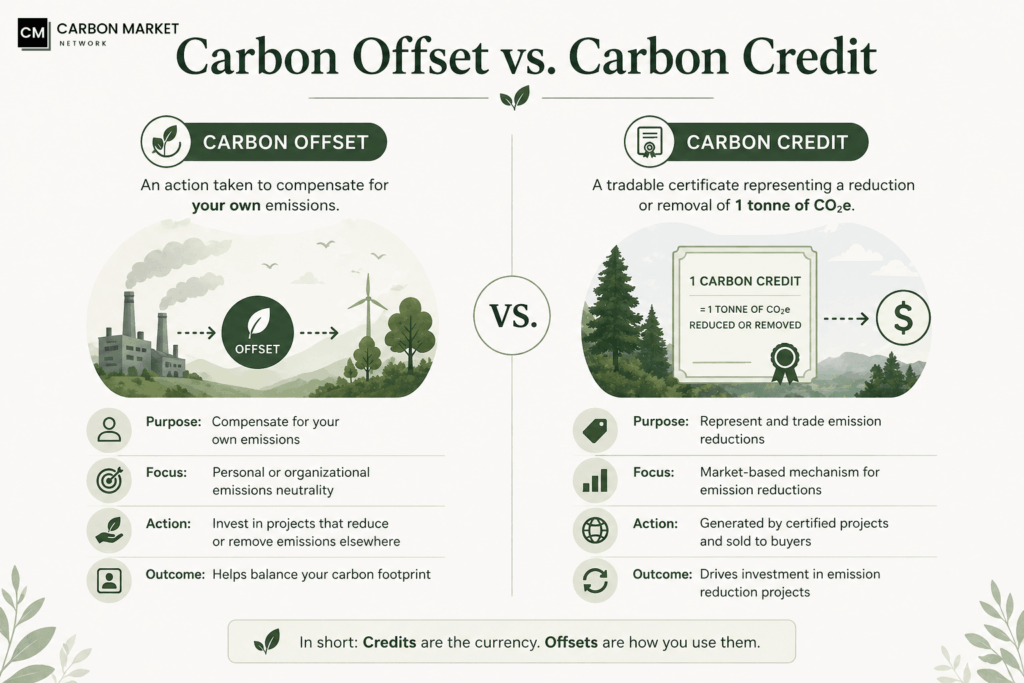
The terms are often used interchangeably, but here is a useful distinction.
A carbon credit is a broader term used in both compliance markets (where companies are legally required to manage emissions) and voluntary markets (where companies choose to act).
A carbon offset usually refers specifically to credits used in voluntary markets, where businesses or individuals choose to compensate for their emissions without a legal obligation.
In practice, both terms refer to the same unit: one tonne of CO₂ equivalent.
Why Do Carbon Offsets Exist?
The climate crisis demands rapid emissions cuts. But the world runs on systems built around fossil fuels, and changing those systems takes time and money.
Carbon offsets exist because of a simple, uncomfortable reality: some emissions are unavoidable in the short term.
A steel manufacturer cannot switch off its furnaces tomorrow.
An airline cannot ground its fleet while electric planes are still in development.
A logistics company cannot instantly electrify its entire truck fleet.
Carbon offsets allow those entities to take responsibility for emissions they have not yet managed to eliminate, while also funding projects that deliver real climate benefits today.
They also serve another purpose. Many high-impact climate projects, like protecting a rainforest or restoring a wetland, need funding.
Carbon offset markets channel private money into those projects, often in places where governments lack the budget to act.
How Does a Carbon Offset Work? A Step-by-Step Explanation
Understanding how a carbon offset actually functions helps you make better decisions when buying or evaluating one.
Step 1: A Project Is Developed
A project developer identifies an activity that will reduce or remove greenhouse gas emissions.
This could be planting trees, protecting a forest from deforestation, building clean cookstoves in rural communities, capturing methane from landfills, or running direct air capture machines.
The developer drafts a Project Design Document (PDD) that outlines the project’s scope, what emissions it will reduce, how those reductions will be measured, and what would have happened without the project (the “baseline scenario”).
Step 2: Independent Validation
A third-party auditor reviews the Project Design Document to confirm the project meets the standard’s requirements.
The auditor checks whether the project is additional, meaning the emissions reductions would not have happened without the carbon finance.
This is one of the most important criteria in the entire process.
Step 3: Monitoring and Verification
Once the project is active, the developer continuously monitors and records the actual emissions reductions.
A second independent auditor then verifies the monitored data, confirming that the claimed reductions actually occurred.
Step 4: Credits Are Issued
Once verified, the relevant registry (Verra, Gold Standard, etc.) issues carbon credits to the project. Each credit gets a unique serial number, which makes it traceable and prevents double counting.
Step 5: Credits Are Sold and Retired
The project developer sells the credits to buyers, which can be corporations, governments, or individuals.
When a buyer uses the credits to offset their emissions, the credits are “retired” in the registry. That means they are permanently removed from circulation. A retired credit can only be used once.
Types of Carbon Offsets
Not all carbon offsets work the same way. The market broadly divides them into two categories based on how they deliver climate benefits.
Avoidance and Reduction Offsets
These offsets prevent greenhouse gas emissions from entering the atmosphere in the first place.
Examples include:
- REDD+ (Reducing Emissions from Deforestation and Forest Degradation): Pays landowners and communities to keep forests standing instead of cutting them down.
- Renewable energy projects: Funding solar, wind, or hydropower in regions that would otherwise rely on coal.
- Methane capture: Capturing methane from landfills, coal mines, or livestock operations before it escapes into the atmosphere.
- Clean cookstoves: Replacing wood-burning stoves in developing countries with fuel-efficient alternatives, reducing emissions and improving health.
- Improved forest management (IFM): Changing how existing forests are managed to preserve more carbon than they would under standard logging practices.
Carbon Removal Offsets
These offsets actively pull carbon dioxide out of the atmosphere and store it.
Examples include:
- Afforestation and reforestation (ARR): Planting new trees on land that previously had no forest cover.
- Soil carbon sequestration: Farming practices that increase the amount of carbon stored in agricultural soils.
- Biochar: Converting organic material into a stable carbon-rich material that is buried in soil, locking carbon away for centuries.
- Direct air capture (DAC): Machines that physically pull CO₂ from the air and store it underground.
- Bioenergy with carbon capture and storage (BECCS): Growing biomass, burning it for energy, and capturing the emitted CO₂ before it reaches the atmosphere.
- Enhanced rock weathering (ERW): Spreading crushed silicate rocks on agricultural land to accelerate a natural process that absorbs atmospheric CO₂.
Carbon removal offsets are generally considered more durable and harder to dispute than avoidance offsets. However, they are also more expensive and currently scarcer in volume.
The Two Carbon Markets: Compliance vs. Voluntary
Carbon offsets operate within two distinct market structures. Understanding the difference matters whether you are buying, selling, or studying offsets.
Compliance Carbon Markets
These are government-mandated systems where companies face legal limits on their emissions.
Under a cap-and-trade system, regulators set a maximum total emissions cap for an industry or economy. Companies that emit less than their allowed amount can sell their surplus allowances to companies that emit more.
Some compliance systems also allow regulated entities to use verified carbon offsets to meet a portion of their obligations.
Well-known compliance systems include:
- The EU Emissions Trading System (EU ETS), the world’s largest carbon market
- The California Cap-and-Trade Program
- The UK Emissions Trading Scheme
- China’s national carbon market
EU compliance permits reached €82.85 per tonne in 2026, up over 21% year-over-year. Regreener
Voluntary Carbon Markets (VCM)
In voluntary carbon markets, companies and individuals choose to buy carbon offsets beyond what any regulation requires.
Corporations use voluntary offsets to meet net-zero pledges, satisfy ESG investor expectations, respond to stakeholder pressure, or get ahead of anticipated regulations.
Individuals use them to offset the carbon footprint of flights, events, or everyday consumption.
The voluntary carbon market was valued at approximately €2.5 billion in 2025 and is projected to reach €3 billion in 2026, with forecasts showing growth to €15 billion by 2035.
Carbon Offset Verification Standards: Who Sets the Rules?
Without independent verification, carbon offsets are just promises. Verification standards are the organizations that set the rules, audit the projects, and issue the credits.
Here are the most important ones.
Verra (Verified Carbon Standard)
The Verified Carbon Standard (VCS) Program is the world’s most widely used greenhouse gas crediting program.
As of 2024, more than 2,300 projects were registered under the VCS, spanning sectors such as agriculture, forestry, energy, transport, waste, and manufacturing.
These projects have collectively issued over 1.3 billion credits, with more than 776 million credits retired to date.
Verra is the go-to standard for forest and nature-based credits, particularly REDD+ projects. It offers the broadest range of methodologies and the deepest market liquidity.
Gold Standard
The Gold Standard is a carbon offset program that focuses on the United Nations’ 17 Sustainable Development Goals, ensuring meaningful benefits to both the climate and the local communities where projects are implemented.
Gold Standard was first started in 2003.
Gold Standard credits typically command a price premium of 20 to 40% above comparable Verra credits because of the standard’s stricter social and environmental requirements.
It is the preferred standard for buyers who want to tell a compelling story about community impact alongside emissions reductions.
American Carbon Registry (ACR)
Founded in 1996, the American Carbon Registry is the world’s first private voluntary greenhouse gas registry.
It is widely respected for its rigorous project protocols in North America, covering areas such as natural climate solutions, methane destruction, and industrial processes.
Climate Action Reserve (CAR)
The Climate Action Reserve, established in 2001, is known for its rigorous project protocols in natural climate solutions, waste handling, methane destruction, and industrial processes. CAR projects are primarily in North America.
The ICVCM and Core Carbon Principles
In recent years, the fragmented nature of the voluntary carbon market created confusion about what actually counts as a high-quality carbon offset.
The Integrity Council for the Voluntary Carbon Market (ICVCM) responded by publishing the Core Carbon Principles (CCPs), a set of global benchmark standards for high-integrity credits.
Credits that meet these principles earn a CCP label in registries like Verra and Gold Standard. Those that do not are increasingly seen as higher-risk by auditors, investors, and regulators.
As of late 2025, programs covering approximately 98% of market volume are CCP-Eligible, and over 30 methodologies across nature, methane, and removals have been approved.
The CCP label is quickly becoming the gold standard for buyers who want to minimize greenwashing risk.
What Makes a Carbon Offset High Quality?
Not every carbon offset is created equal. The quality of an offset depends on several key criteria.
Additionality
Additionality is the most fundamental requirement. It asks: would this emissions reduction have happened without the carbon offset funding?
A solar project in a country that already mandates renewable energy is not additional. The emissions reduction would have happened anyway.
True additionality means the carbon finance is what makes the project possible.
Permanence
Permanence refers to how long the carbon stays stored.
A tree that gets cut down or burned in a wildfire releases all its stored carbon back into the atmosphere.
High-quality offset projects account for this risk through insurance buffers, where a portion of credits are held in reserve to replace any that get invalidated due to unforeseen losses.
Measurability
The emissions reduction must be quantifiable using accepted scientific methods. Vague estimates do not qualify.
Good projects use rigorous monitoring systems, satellite data, and third-party verification to confirm actual results.
Leakage
Leakage happens when an offset project reduces emissions in one place but causes emissions to increase somewhere else.
For example, protecting a forest from logging in one region might push logging activity into another forest nearby. High-quality projects measure and account for this risk.
No Double Counting
Each tonne of emissions reduced can only be counted once.
When a buyer uses carbon credits to offset their emissions, those units are “retired” and taken out of circulation so they can only be used for that purpose once.
Double counting becomes especially complex at the international level, where both a project host country and a corporate buyer might want to claim the same reduction.
The Paris Agreement’s Article 6 framework introduced rules to address this through corresponding adjustments, though implementation is still evolving.
Carbon Offset Pricing: How Much Does It Cost?
Carbon offset prices vary enormously depending on project type, quality, vintage, and certification standard.
In 2026, the carbon credit market is experiencing a dramatic split between quality tiers, with high-integrity credits now costing around 300% more than lower-quality alternatives.
Here is a rough pricing guide based on 2026 market data:
- ARR (Afforestation, Reforestation, Revegetation): approximately $22 per tonne
- Improved Forest Management (IFM): approximately $15 per tonne
- REDD+: approximately $6 per tonne
- Biochar: approximately $177 per tonne
- Direct Air Capture (DAC): over $500 per tonne
- Enhanced Rock Weathering (ERW): over $200 per tonne
The wide price range reflects a fundamental truth: cheap offsets are often cheap for a reason. Buyers who prioritize quality over price increasingly pay a premium for credits with strong verification, high additionality, and CCP approval.
Who Buys Carbon Offsets and Why?
Large Corporations
Major corporations are the dominant buyers of voluntary carbon offsets.
They purchase credits to support net-zero pledges, respond to investor ESG expectations, comply with sustainability reporting frameworks, and differentiate their brands.
In 2025, US technology company Microsoft emerged as a dominant force in the carbon market, accounting for four of the five largest forward offset deals of the year and securing offsets equivalent to 64 million tonnes of CO₂.
Airlines
Aviation is one of the hardest-to-decarbonize sectors. The international aviation industry participates in CORSIA (the Carbon Offsetting and Reduction Scheme for International Aviation), a global framework under the International Civil Aviation Organization (ICAO) that requires airlines to offset growth in international aviation emissions above 2019 levels.
Industry participants note that 2026 will be a significant year for CORSIA, with more project issuances and eligibility confirmations expected as the market moves toward greater liquidity.
Small and Medium Enterprises (SMEs)
A major trend in the carbon offset market is the rise of voluntary participation by small and medium enterprises, which are joining to achieve net-zero goals and participate in carbon credit trading.
Individuals
Individual consumers can also purchase carbon offsets to compensate for personal emissions from flights, road trips, home energy use, or events. Many airlines, travel platforms, and e-commerce sites now offer offset programs at checkout.
Real-World Examples of Carbon Offset Projects
1. The Envira Amazonia REDD+ Project, Brazil
One of the largest REDD+ projects in the world, this project protects over 1 million hectares of Amazon rainforest in Brazil. It funds local communities to monitor and protect the forest instead of converting it to agriculture, generating millions of credits each year under Verra’s VCS program.
2. Climeworks Orca and Mammoth Plants, Iceland
Climeworks operates direct air capture facilities in Iceland that physically remove CO₂ from the atmosphere and inject it into basalt rock underground, where it mineralizes permanently.
Climeworks secured major equity transactions in 2025 as demand for high-durability removal credits grew among premium corporate buyers.
3. Clean Cookstoves Projects, East Africa
Projects across Uganda, Kenya, and Ethiopia distribute efficient cookstoves to households that previously burned wood or charcoal on open fires.
These projects reduce deforestation, cut indoor air pollution, and generate Gold Standard-certified carbon credits while improving health outcomes in local communities.
4. Biochar Projects, Europe and North America
Biochar producers convert agricultural waste into a stable carbon-rich material that is mixed into soil. The carbon stays locked in the ground for hundreds to thousands of years.
Biochar credits are sold at a significant premium because of the durability of the storage.
The State of the Carbon Offset Market in 2025 and 2026
The carbon offset market went through a major restructuring in 2025, and 2026 is shaping up to be a defining year.
Volume Fell, But Value Rose
In 2025, total credit retirements fell to about 168 million tonnes, down 4.5% year-on-year, and new issuances reached roughly 270 million tonnes, the lowest level since 2020.
Yet total spending on carbon credits rose to around $1.04 billion, up from about $980 million in 2024.
Less volume, more money. That story signals the market is maturing and pricing quality more accurately.
The Shift to Quality Over Quantity
Buyers are moving away from older REDD+ projects and toward improved forest management, afforestation, reforestation, and agriculture-based projects.
Renewable energy credits saw the sharpest drop, as many buyers now see them as low impact due to long-standing questions around additionality.
Carbon Removal Is Growing Fast
In 2025, afforestation, reforestation, and revegetation (ARR) led sub-sectors with $4.5 billion in funding, followed closely by bioenergy with carbon capture and storage (BECCS) at $4.3 billion.
Carbon dioxide removal (CDR) credits accounted for only 5% of 2025 retirements but have a more active forward market, where buyers commit today to purchase credits that will be delivered in the future, providing crucial early-stage financing for projects.
Supply Constraints Are Intensifying
In 2026, supply constraints for high-quality credits are likely to persist. New issuances are not rising fast enough to meet demand for BBB+ rated credits.
Prices for trusted nature-based projects are likely to remain firm or increase.
The Gap Between Ambition and Action
SBTi reported a 227% surge in companies setting both near-term and net-zero targets in the 18 months leading up to mid-2025, while carbon credit retirements in the voluntary carbon market fell 7% in 2025.
Companies are making more climate promises than ever, but market action is not keeping pace. Closing this gap is the central challenge for the market in 2026 and beyond.
Criticisms and Controversies Around Carbon Offsets
Carbon offsets are not without significant criticism. Honest engagement with these concerns is essential for any serious discussion of offsets.
The Greenwashing Problem
The biggest risk is that companies use carbon offsets as a way to avoid actually cutting their emissions.
A company that buys cheap offsets while continuing to grow its absolute emissions is not solving the climate problem. It is paying to look like it is.
Critics argue that offset markets give polluters permission to keep polluting rather than driving genuine transformation.
High-integrity frameworks like the ICVCM’s Core Carbon Principles are designed specifically to address this risk by ensuring offsets only complement real decarbonization efforts, not replace them.
The Quality Scandal
Investigations published in 2023 found that approximately 94% of rainforest carbon offsets certified under Verra’s program were likely phantom credits, meaning they delivered no real emissions reductions.
These findings triggered massive scrutiny of REDD+ and nature-based offset projects and accelerated the shift toward stricter verification standards.
Verra has since updated its methodologies and oversight processes, but the controversy underlined how critical independent verification is for the entire market’s credibility.
Permanence Risk
Forests burn. Soils erode. Land use policies change. When a forest that generates carbon offsets is destroyed by wildfire or drought, the stored carbon returns to the atmosphere. Buffer pools and insurance mechanisms help manage this risk, but they do not eliminate it entirely.
Technology-based removal like direct air capture or enhanced rock weathering offers far more durable storage. The market is gradually pricing this permanence differential into credit prices.
Social and Indigenous Rights
Some forest protection projects have displaced or restricted the activities of indigenous communities who have lived in and depended on those forests for generations.
Social justice issues have become increasingly prominent in carbon market reform discussions, with calls for community consultation, benefit-sharing, and protection of indigenous land rights to be enforceable requirements.
High-quality standards now require projects to demonstrate genuine community engagement and equitable benefit sharing.
Double Counting
As host countries increasingly claim emissions reductions from projects on their territory to meet their own Paris Agreement commitments, the risk grows that the same tonne of CO₂ gets counted twice.
Article 6 of the Paris Agreement is designed to prevent this through corresponding adjustments, but full implementation across all markets is still in progress.
How to Choose a High-Quality Carbon Offset
If you or your organization wants to purchase carbon offsets, use this framework to make a sound choice.
1. Prioritize Additionality
Choose projects where the carbon finance clearly enables something that would not happen otherwise. Avoid projects in sectors where regulations or economics already drive the same outcome.
2. Look for Independent Verification
Only buy credits that are certified by a recognized standard body, such as Verra, Gold Standard, ACR, or CAR. Better yet, look for credits carrying the ICVCM Core Carbon Principles (CCP) label for the highest integrity assurance.
3. Favor Carbon Removal Over Pure Avoidance
Removal credits, especially durable ones like biochar, DAC, or BECCS, offer stronger climate guarantees than avoidance credits. They cost more, but they deliver more certainty.
4. Check the Registry
Verify your credit in the public registry before and after purchase. Confirm it has a unique serial number and that it gets marked as retired after you use it.
5. Use Offsets to Complement, Not Replace, Decarbonization
Offsets should be the last resort, applied to emissions that cannot yet be reduced. Prioritize direct emission cuts first. Use offsets to address what remains.
6. Be Transparent About What You Are Doing
Disclose which credits you bought, from what project, under which standard, and for what emissions. Transparency dramatically reduces greenwashing risk.
Carbon Offsets for Individuals: How to Offset Your Personal Carbon Footprint
You do not have to be a corporation to participate in carbon offset markets. Individuals can offset their personal emissions too.
Step 1: Calculate Your Carbon Footprint
Use a reputable carbon footprint calculator to estimate your annual emissions. Several free tools are available, including those from Carbon Footprint Ltd, the WWF, or individual airline offset calculators.
Key emission sources to include: flights, car travel, home energy use, food choices, and purchases.
Step 2: Reduce What You Can
Before buying offsets, make every reduction you reasonably can. Swap to green energy, fly less, eat less meat, insulate your home. Offsets work best as a complement to reduction, not a shortcut around it.
Step 3: Choose a Verified Offset Provider
Several platforms offer individual carbon offsetting, including:
- Gold Standard Marketplace: Credits certified under the Gold Standard framework
- Cool Effect: Curated selection of verified projects with transparent pricing
- Atmosfair: Specializes in aviation offsets with rigorous methodology
- Pachama: Uses satellite and AI monitoring for forest carbon projects
Always verify that the provider uses credits from Verra, Gold Standard, or another recognized registry.
Step 4: Retire the Credits in Your Name
Ask the provider to retire the credits specifically in your name in the registry. This gives you a verifiable proof of the offset and prevents the credits from being resold.
How Businesses Should Integrate Carbon Offsets Into Their Climate Strategy
Build a Decarbonization Roadmap First
Before touching offset markets, build a credible plan to reduce your Scope 1, 2, and 3 emissions in line with a science-based target.
The Science Based Targets initiative (SBTi) offers a widely respected framework for setting credible net-zero targets.
Quantify Your Residual Emissions
Identify the emissions that remain after you have applied all feasible reduction measures. These are the emissions for which offsets are appropriate.
Use the ICVCM CCP Standard as Your Minimum Bar
In your sustainability disclosures, document the percentage of credits that carry the CCP label, and create an audit-ready pack that includes registry screenshots showing CCP labels, links to ICVCM assessment status, and a table mapping your portfolio to CCP categories.
This proves due diligence and reduces greenwashing risk.
Think Long-Term
On average, corporate buyers anticipate that about two-thirds of their carbon reductions will come from actions within their own operations or value chains, 28% from grid or other decarbonization, and only the remaining 7% as residual emissions to be offset through carbon removals.
The offset portion of any credible net-zero strategy should shrink over time as direct reductions grow.
The Future of Carbon Offsets
The carbon offset market is not going away. If anything, it is growing in sophistication and scale.
Compliance Will Dominate
Modeling suggests compliance use of carbon credits could exceed voluntary demand as early as 2027, driven by CORSIA Phase 1 and expanding domestic cap-and-trade systems.
By the mid-2030s, domestic compliance markets could become the largest source of demand.
Carbon Removal Will Expand
Carbon removal credits will remain scarce in the short term, and actual retirements will lag forward commitments. However, strong investment and long-term offtake agreements signal sustained long-term growth.
As methodologies mature and costs fall, removal credits will play a larger role in both voluntary and compliance settings.
Technology Will Improve Monitoring
Satellite imagery, AI-powered monitoring, and blockchain-based registries are making it increasingly difficult to inflate or fabricate offset claims.
Better monitoring means better quality, and better quality means more buyer confidence.
Article 6 and International Carbon Markets
The Paris Agreement’s Article 6 framework, which governs the use of carbon credits for meeting national climate pledges, is gradually being implemented.
As more countries adopt corresponding adjustment rules, international carbon markets will gain legitimacy and enable larger cross-border credit flows.
Actionable Takeaways
Here are the most important things to remember about carbon offsets.
- A carbon offset represents one tonne of CO₂ equivalent reduced, avoided, or removed from the atmosphere
- Only buy credits verified by recognized standards like Verra, Gold Standard, or ICVCM-approved programs
- Prioritize additionality, permanence, measurability, and no double counting when evaluating any credit
- Use offsets as a complement to decarbonization, not a substitute for it
- Carbon removal credits are more durable than avoidance credits, though they cost more
- The 2026 market rewards quality, and cheap offsets frequently deliver little or no real climate benefit
- Transparency in your offset claims is the best defense against greenwashing accusations
Frequently Asked Questions About Carbon Offsets
Q1. What is a carbon offset in simple terms?
A carbon offset is a way to compensate for the greenhouse gas emissions you produce by funding an equivalent reduction or removal of emissions somewhere else in the world. Each offset unit equals one tonne of CO₂ equivalent.
Q2. Do carbon offsets actually work?
High-quality, independently verified carbon offsets can deliver real climate benefits. However, many offsets in the market have historically been of poor quality. Buying credits certified under rigorous standards, particularly those carrying the ICVCM Core Carbon Principles label, gives you the strongest assurance that your offset is delivering genuine results.
Q3. How much does a carbon offset cost?
Prices vary widely. In 2026, nature-based offset credits range from approximately $6 to $24 per tonne, while technology-based carbon removal credits like direct air capture can exceed $500 per tonne. Higher quality generally means higher price.
Q4. What is the difference between a carbon offset and a carbon credit?
The terms overlap significantly. A carbon credit is the broader term used in both compliance and voluntary markets. A carbon offset usually refers to voluntary market credits used to compensate for emissions. Both represent one tonne of CO₂ equivalent reduced, avoided, or removed.
Q5. Can individuals buy carbon offsets?
Yes. Individuals can purchase verified carbon offsets through platforms like Cool Effect, Atmosfair, and the Gold Standard Marketplace to compensate for personal emissions from flights, home energy use, or other activities.
Q6. What is greenwashing in the context of carbon offsets?
Greenwashing refers to companies using carbon offsets to claim environmental credentials without making genuine efforts to reduce their actual emissions. Buying low-quality offsets while continuing to grow absolute emissions is a common form of offset-related greenwashing.
Q7. What is CORSIA?
CORSIA stands for the Carbon Offsetting and Reduction Scheme for International Aviation. It is a global framework managed by the International Civil Aviation Organization (ICAO) that requires airlines to offset growth in their international aviation emissions above 2019 levels.
Q8. What are Core Carbon Principles?
The Core Carbon Principles (CCPs) are a set of global quality standards developed by the Integrity Council for the Voluntary Carbon Market (ICVCM). Credits that meet these principles earn a CCP label, signaling high integrity to buyers, investors, and regulators.
Q9. Are carbon offsets a long-term solution to climate change?
No. Carbon offsets are a transitional tool, not a permanent fix. The ultimate solution is eliminating emissions at their source. Offsets play a useful role in the transition by funding real climate projects today while longer-term decarbonization efforts take hold. Used well, they accelerate the journey to net zero. Used carelessly, they delay it.
Conclusion
A carbon offset is far more than a feel-good purchase. Done right, it channels real money into real projects that protect forests, fund clean energy, restore ecosystems, and develop breakthrough carbon removal technologies.
Done wrong, it becomes a fig leaf that lets polluters keep polluting.
The difference between those two outcomes comes down to quality, transparency, and how seriously buyers treat the offset as part of a genuine climate strategy rather than a shortcut to a green label.
The market in 2026 is maturing fast. Supply of high-quality credits is tight. Prices for trusted projects are rising. Scrutiny from regulators, investors, and the public is higher than ever. That is actually good news. It means the market is moving in the right direction.
If you want to use carbon offsets well, the formula is simple. Reduce everything you can first. Offset what you cannot yet reduce, using only verified, high-integrity credits. Be transparent about what you are doing and why.
That approach will not just protect your reputation. It will contribute to a world that genuinely needs every tonne of avoided or removed emissions it can get.