Carbon Market Network


Every minute, the world emits roughly 2,500 tonnes of CO2 into the atmosphere. And while much of the conversation around climate change focuses on cutting emissions, a growing number of companies are tackling the other side of the equation: pulling carbon out of the air and putting it back where it belongs — in forests, soils, wetlands, and oceans.
These are nature-based carbon removal companies, and they are fast becoming one of the most important forces in the global fight against climate change.
Whether you’re a sustainability professional, a curious beginner, or a business looking to understand the carbon market, this guide gives you a clear, honest, and up-to-date picture of who these companies are, what they actually do, and why they matter.
What Is Nature-Based Carbon Removal?
Nature-based carbon removal (also called natural carbon dioxide removal or natural CDR) refers to using ecosystems and biological processes to capture and store carbon dioxide from the atmosphere.
Instead of building a machine to suck CO2 out of the sky, nature-based solutions work with trees, soil microbes, mangroves, kelp forests, and agricultural land to do that work naturally.
These approaches fall under a broader umbrella called Nature-Based Solutions (NbS) and include:
- Reforestation and afforestation
- Soil carbon sequestration through regenerative agriculture
- Wetland and mangrove restoration (blue carbon)
- Agroforestry (combining trees with crops or livestock)
- Biochar production from agricultural waste
- Enhanced rock weathering on farmlands
Nature-based carbon removal is not a new idea. What is new is the level of investment, rigour, technology, and corporate interest it is attracting right now.
Carbon Market Insider Newsletter
Weekly insights on carbon markets, climate policy, carbon credits, and sustainability.
Why Nature-Based Carbon Removal Is Having Its Moment
The market for nature-based carbon removal has grown dramatically in recent years.
The global nature-based carbon removal market was valued at around $12.4 billion and is projected to reach $95.8 billion by 2034, growing at a compound annual rate of over 22%. Afforestation and reforestation alone hold the largest share of that market, at about 35%.
Tech giants are driving much of the demand. Microsoft, Google, Meta, and Salesforce have collectively committed to contracting up to 20 million tonnes of nature-based carbon removal credits through the Symbiosis Coalition, an advance market commitment initiative they launched together.
Nature-based credits also make up the vast majority of what gets traded. Of all carbon dioxide removal credits issued in the voluntary carbon market, roughly 95% come from nature-based pathways. That tells you how dominant these solutions still are in the real-world market.
At the same time, buyers are getting smarter. Companies are no longer chasing cheap, unverified credits. They want high-integrity removal credits that are measurable, permanent, and independently verified. This “flight to quality” is reshaping which companies win and which fall behind.
How Nature-Based Carbon Removal Companies Work
Before diving into specific companies, it helps to understand the basic business model.
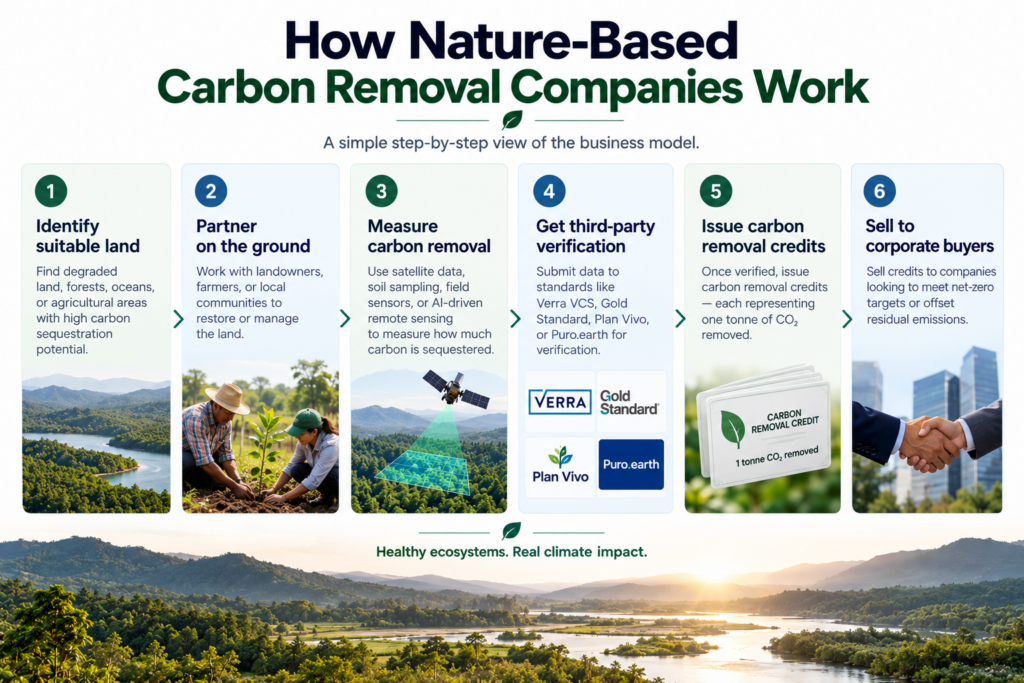
Most nature-based carbon removal companies operate like this:
- They identify degraded land, forests, oceans, or agricultural areas with high carbon sequestration potential.
- They partner with landowners, farmers, or local communities to restore or manage that land.
- They measure how much carbon gets sequestered using satellite data, soil sampling, field sensors, or AI-driven remote sensing.
- They submit that data to a third-party standard like Verra’s Verified Carbon Standard (VCS), Gold Standard, Plan Vivo, or Puro.earth for verification.
- Once verified, they issue carbon removal credits — each credit representing one tonne of CO2 removed.
- They sell those credits to companies looking to meet net-zero targets or offset residual emissions.
The landowners or farmers typically receive a share of the revenue, creating a financial incentive for long-term conservation.
The Main Types of Nature-Based Carbon Removal
| Type | How It Works | Key Players |
|---|---|---|
| Reforestation / Afforestation | Planting native trees on degraded or bare land | Mombak, South Pole |
| Soil Carbon Sequestration | Regenerative agriculture builds organic carbon in soil | Agreena, Varaha, Boomitra |
| Blue Carbon (Mangroves / Seagrass) | Restoring coastal ecosystems that store carbon underwater | Blue Carbon Projects, FORLIANCE |
| Agroforestry | Integrating trees into farmland | Varaha, Rabo Carbon Bank |
| Biochar | Burning organic waste to create stable carbon-rich charcoal | Varaha, Carbo Culture |
| Enhanced Rock Weathering | Spreading crushed minerals on farmland to speed up natural CO2 absorption | Varaha, InPlanet |
Each method has different permanence, cost, co-benefits, and verification challenges. A well-rounded portfolio approach — mixing several of these — is increasingly how leading companies differentiate themselves.
Top Nature-Based Carbon Removal Companies to Know
1. Mombak — Amazon Reforestation at Industrial Scale
Founded: 2021 | HQ: São Paulo, Brazil | Focus: Amazon reforestation
Mombak is arguably the most high-profile pure-play nature-based carbon removal company in the world right now.
Founded by Peter Fernandez and Gabriel Silva, the company operates in the Brazilian Amazon with one clear mission: turn degraded cattle pasture into native, biodiverse rainforest.
What makes Mombak different from older reforestation companies is the approach. Rather than planting a monoculture of fast-growing trees, Mombak plants over 80 native Amazon species, creating forests that closely replicate the original ecosystem. The company either buys land outright or partners with farmers, plants the trees, manages the forest long-term, and earns revenue entirely from selling high-quality carbon removal credits.
The model has attracted some of the biggest corporate buyers in the world:
- Microsoft signed a deal for up to 1.5 million carbon removal credits from Mombak’s Amazon projects — one of the largest nature-based deals in history.
- Google signed an agreement for 200,000 tonnes of reforestation-based removal.
- McKinsey also signed a removal agreement, and Mombak delivered credits two years ahead of schedule.
- Mombak was selected as the first nature restoration project by the Symbiosis Coalition.
On the funding side, Mombak secured 100 million reais from Santander Brasil and Brazil’s development bank BNDES — the first reforestation project backed by Brazil’s New Climate Fund.
The company is also using satellite imagery and bioacoustic sensors to monitor biodiversity and optimize results. That combination of rigorous science, indigenous-species planting, and verified impact is why companies like Microsoft trust Mombak with large, multi-year contracts.
Why it matters for the carbon market: Mombak is proving that high-integrity, large-scale, native-forest reforestation can be financially viable and commercially scalable. It is setting the standard that other forest-based removal companies will need to match.
2. Varaha — Multi-Pathway Carbon Removal from the Global South
Founded: 2022 | HQ: Gurugram, India | Focus: Regenerative agriculture, biochar, agroforestry, enhanced rock weathering
Varaha is one of the most impressive climate tech success stories to emerge from Asia in recent years.
Founded in 2022 by Madhur Jain, Ankita Garg, Vishal Kuchanur, and Awani Giri, Varaha has become the largest carbon project developer in Asia in just a few years. The company works with smallholder farmers in India, Nepal, and Bangladesh to sequester carbon through regenerative agricultural practices, while also boosting their incomes and soil health.
What sets Varaha apart is that it operates across four carbon removal pathways simultaneously: regenerative agriculture, agroforestry, biochar, and enhanced rock weathering. Most companies focus on just one. This multi-pathway approach gives Varaha flexibility and resilience as the market evolves.
Key numbers that tell the story:
- Works with over 150,000 farmers across 20 carbon projects
- Has issued over 700,000 verified carbon removal credits
- Signed a deal with Microsoft for 100,000 tonnes of biochar removal over three years
- Google signed two 100,000 metric tonne biochar deals with Varaha — separately the largest biochar deals ever at that point
- Raised $30 million from Mirova, sustainable investment firm — the largest investment in soil carbon removal to date
- Has long-term offtake agreements with Lufthansa, Swiss Re, Google, Capgemini, and others
Varaha also holds a 1.5 to 3x cost advantage over European and North American competitors while meeting the same international verification standards. That cost edge comes from operating in the Global South, where land costs, labour, and logistics are more affordable.
Why it matters for the carbon market: Varaha is showing that high-quality, multi-method carbon removal does not have to be expensive, and that smallholder farmers in developing countries can be central — not peripheral — to the global carbon removal economy.
3. Agreena — Europe’s Leading Soil Carbon Platform
Founded: 2018 | HQ: Copenhagen, Denmark | Focus: Soil carbon sequestration in European agriculture
Agreena dominates the European regenerative agriculture market in a way that very few companies have managed in any segment of the carbon space.
The company works with farmers across Europe to transition to regenerative practices — reducing tillage, planting cover crops, managing crop residues — that build organic carbon in agricultural soils. Farmers earn carbon certificates that Agreena verifies and sells to corporate buyers.
What makes Agreena stand out is scale and verification rigour. The company scaled from 2 million to 4.5 million hectares in just 18 months, making it the largest soil carbon program in Europe. It runs the first Verra-certified agricultural cropland carbon project, which is a significant quality marker.
Agreena has raised $77.7 million in total funding, including a major Series B round, and is expanding operations beyond Europe into new agricultural markets.
For farmers, Agreena offers a simple value proposition: adopt better farming practices, get paid for the carbon you store. For buyers, it offers verified, Verra-certified credits with transparent monitoring and reporting.
Why it matters for the carbon market: Soil carbon is enormous in scale. Agricultural soils have the potential to remove 2 to 5 gigatons of CO2 per year — more than all the world’s forests combined. Agreena is building the infrastructure to tap that potential at a commercial level, starting in Europe and expanding outward.
4. Boomitra — Satellite-Powered Carbon Removal for Smallholders
Founded: 2016 | HQ: San Mateo, California, USA | Focus: Soil carbon in the Global South
Boomitra calls itself a “friend of the earth” — the literal translation of its Sanskrit name — and the company lives up to that description in how it approaches carbon removal at the grassroots level.
Founded by Aadith Moorthy, Boomitra uses AI and remote sensing satellite technology to measure, report, and verify soil carbon sequestration by smallholder farmers and ranchers across the Global South — including India, Mexico, Kenya, Argentina, Paraguay, and Brazil.
By relying on satellite-based MRV (Measurement, Reporting, and Verification), Boomitra dramatically lowers the cost of verifying carbon removals compared to expensive on-the-ground soil sampling. That cost reduction is what makes working with small farms in developing countries economically viable.
Key highlights:
- Works with over 150,000 farmers and ranchers globally
- Has sequestered more than 10 million tonnes of CO2 to date
- Registered South America’s first grassland restoration project, covering over 76,000 acres in Argentina and Paraguay
- Registered India’s first biochar project under the Social Carbon standard
- Won the 2023 Earthshot Prize, one of the most prestigious environmental awards in the world
- Named in TIME100 Most Influential Companies list
Boomitra recently launched a biomass burial carbon removal program — removing and burying woody biomass underground to store carbon for over 100 years — diversifying beyond soil carbon.
Why it matters for the carbon market: Boomitra proves that the carbon market can work for the world’s smallest farmers, not just large landowners. Its technology model makes verification affordable enough to include communities that would otherwise be locked out of the market.
5. Loam Bio — Unlocking Soil Carbon Through Fungi
Founded: 2019 | HQ: Orange, Australia | Focus: Microbial carbon farming
Loam Bio is doing something genuinely novel in the nature-based carbon removal space.
Rather than paying farmers to change their farming practices, Loam Bio develops fungal seed treatments that, when applied to grains like wheat, barley, and canola, stimulate underground networks of fungi that lock atmospheric carbon into stable forms in the soil — for centuries.
Think of it as using biology to upgrade how much carbon a field naturally captures, without requiring major changes to farming systems. Farmers apply the treatment at planting time and receive payments based on verified carbon sequestration.
Loam Bio is Australia’s most-funded agritech startup, having raised $99.7 million to commercialise this technology. The company recently launched a new product called FurrowMate, a next-generation biological for carbon farming, as it moves from research into commercial scale.
The science is compelling. The fungi create underground carbon networks that are far more stable and durable than surface-level organic matter. This means the carbon stays in the ground, which is exactly what quality buyers want to see.
Why it matters for the carbon market: Loam Bio represents the frontier of what “nature-based” can mean. Rather than just planting trees or changing tillage practices, it is engineering biological processes at a molecular level to enhance the planet’s natural carbon cycle. If it scales, it could be transformative.
6. South Pole — The Global Carbon Project Developer
Founded: 2006 | HQ: Zürich, Switzerland | Focus: Carbon project development, trading, sustainability consulting
South Pole is one of the oldest and most established names in the carbon market, and it remains a significant player in the nature-based space.
The company develops, finances, and manages nature-based carbon projects globally — spanning reforestation, improved forest management, REDD+ (Reducing Emissions from Deforestation and Forest Degradation), wetland restoration, and agroforestry. It also offers corporate sustainability consulting, helping large businesses set science-based targets and buy carbon credits to meet them.
South Pole works with clients across aviation, fashion, finance, food and beverage, and the public sector. It operates across both the Verra VCS and Gold Standard certification systems, and its credits span both carbon reduction and carbon removal.
The company has faced scrutiny in recent years over the quality of some of its REDD+ projects, which led to a period of significant restructuring. South Pole has since doubled down on transparency, verification rigour, and high-integrity project development as the market has shifted toward quality over quantity.
Why it matters for the carbon market: South Pole’s global reach and two-decade track record make it a gateway to a wide range of nature-based projects. For large enterprises seeking to build diversified carbon portfolios, it remains one of the few companies with the scale to deliver.
7. Terrasos — Biodiversity and Carbon in Colombia’s Ecosystems
Founded: 2013 | HQ: Bogotá, Colombia | Focus: Biodiversity credits and habitat banking
Terrasos is one of the most pioneering companies in the carbon and biodiversity space, and it operates at the intersection of both.
As Colombia’s leading environmental investment company, Terrasos structures and operates Habitat Banks — areas of protected or restored natural habitat that generate biodiversity credits. The company protects over 6,950 hectares across Colombia, focusing on some of the country’s most endangered ecosystems, including tropical cloud forest.
Terrasos developed the Tebu, a Biodiversity Unit that guarantees protection of 10 square metres of ecosystem for 30 years, tracked via blockchain technology. This makes biodiversity credits traceable, verifiable, and commercially tradeable.
The company has won multiple industry awards, including being named Best Project Developer for Biodiversity at the Environmental Finance Voluntary Carbon Market Rankings for two consecutive years.
Terrasos is also working with the Colombian government to build a national biodiversity credit registry — a model that other governments in Brazil, Australia, and New Zealand are reportedly studying.
Why it matters for the carbon market: Nature-based carbon removal often delivers biodiversity co-benefits, but very few companies have found a way to turn those co-benefits into a standalone tradeable asset. Terrasos is building that market from the ground up in Latin America, pioneering a model the world will eventually need at scale.
8. FORLIANCE — Mangrove and Blue Carbon Project Developer
Founded: Germany | Focus: Blue carbon, mangrove restoration, nature-based climate solutions
FORLIANCE is one of the specialist players in blue carbon — the carbon stored in coastal and marine ecosystems like mangroves, salt marshes, and seagrasses.
The company develops and implements high-quality mangrove restoration projects, with a strong emphasis on direct community involvement, ecosystem monitoring, and rigorous verification under internationally recognised standards.
Its active projects include:
- Mangroves in Tabasco, Mexico — restoring 930 hectares of mangrove ecosystems along the Gulf Coast in partnership with local communities
- Mangroves Myanmar — rehabilitating degraded mangrove forests, supporting biodiversity and improving water access for local people
FORLIANCE also contributed to the development of the Gold Standard methodology for sustainable mangrove restoration, which gives it a standard-setting role in how the industry certifies blue carbon projects.
Why does blue carbon matter so much? Mangroves store up to four times more carbon per hectare than tropical rainforests, making coastal ecosystems disproportionately powerful carbon sinks. They also protect coastlines, support fisheries, and shelter communities from storm surges.
Why it matters for the carbon market: As corporate buyers look for nature-based credits with strong co-benefits and ecosystem restoration stories, blue carbon projects like FORLIANCE’s offer a compelling combination of high sequestration, biodiversity protection, and community benefit.
9. Rabo Carbon Bank — Connecting Farmers to the Carbon Market
Founded: Netherlands | Focus: Agroforestry carbon credits, smallholder farmers
Rabo Carbon Bank, an initiative of Dutch banking giant Rabobank, operates a unique farmer-to-business carbon model through its Acorn programme.
The programme sources agroforestry carbon removal credits from smallholder farmers in developing countries, certified under Plan Vivo standards. Farmers plant trees on their land — integrating them with crops or livestock — and earn payments based on verified carbon sequestration and biodiversity impact.
What makes Rabo Carbon Bank interesting is its positioning. Rather than being a standalone startup, it is backed by a major financial institution with deep roots in agricultural finance. That gives it credibility, a global farming network, and the financial infrastructure to connect rural farmers in Africa, Latin America, and Asia directly to corporate buyers in Europe and North America.
The Acorn programme has particular appeal for companies in the food and agriculture supply chain who want carbon credits directly tied to the farming systems their products depend on.
Why it matters for the carbon market: Rabo Carbon Bank brings institutional financial credibility to smallholder agroforestry — a segment of the market that has historically struggled to attract large-scale investment. Its Plan Vivo certification focus also keeps quality standards high.
A Comparison of Top Nature-Based Carbon Removal Companies
| Company | Location | Main Method | Key Buyers / Partners | Verification Standard |
|---|---|---|---|---|
| Mombak | Brazil | Amazon reforestation | Microsoft, Google, McKinsey | Verra VCS |
| Varaha | India | Regen ag, biochar, ERW, agroforestry | Microsoft, Google, Lufthansa, Swiss Re | Verra, Puro.earth |
| Agreena | Denmark | Soil carbon | European corporates | Verra VCS |
| Boomitra | USA | Soil carbon, biomass burial | Global corporates | Social Carbon, Verra |
| Loam Bio | Australia | Fungal seed treatment / soil carbon | Australian grain farmers | ACCU Standard |
| South Pole | Switzerland | Forest, REDD+, agroforestry | Global enterprises | Verra VCS, Gold Standard |
| Terrasos | Colombia | Biodiversity credits, habitat banking | ISA, global buyers | National registry + Verra |
| FORLIANCE | Germany | Mangrove / blue carbon | Maritime, aviation industries | Gold Standard |
| Rabo Carbon Bank | Netherlands | Agroforestry credits | Food & agriculture companies | Plan Vivo (Acorn) |
What Makes a Nature-Based Carbon Removal Company High Quality?
Not all nature-based carbon removal companies are the same. Here is what separates the best from the rest:
Additionality The carbon removal must be genuinely additional — meaning it would not have happened without the project and the carbon credit revenue. If a forest was never going to be cut down anyway, protecting it does not add new carbon removal.
Permanence The carbon stored must stay stored. A reforestation project that burns down five years later adds nothing to the climate. Leading companies use legal land protections, insurance buffers, and diversified planting strategies to ensure durability.
Verification and Transparency Third-party verification from bodies like Verra, Gold Standard, or Plan Vivo is non-negotiable. The best companies go further, publishing monitoring data openly and using independent ratings from agencies like BeZero Carbon or Sylvera.
Co-Benefits High-quality nature-based projects do more than remove carbon. They restore biodiversity, create local jobs, protect watersheds, improve soil health, and support indigenous communities. Buyers increasingly pay a premium for credits with strong co-benefits.
Use of Technology Companies using satellite imagery, AI-powered MRV, bioacoustic monitoring, blockchain traceability, and remote sensing produce more accurate and trustworthy verification data than those relying purely on manual field checks.
Key Certification Standards in Nature-Based Carbon Removal
| Standard | Who Runs It | What It Covers |
|---|---|---|
| Verra VCS (Verified Carbon Standard) | Verra | The most widely used standard; covers forests, soil, wetlands, agriculture |
| Gold Standard | Gold Standard Foundation | Strong focus on sustainable development co-benefits alongside climate |
| Plan Vivo | Plan Vivo Foundation | Smallholder-focused; covers agroforestry and community land projects |
| Puro.earth | Nasdaq subsidiary | Covers durable removals including biochar and enhanced rock weathering |
| Social Carbon | SOCIALCARBON | Community-focused projects in developing countries |
| ICVCM Core Carbon Principles | Integrity Council for VCM | New cross-standard quality benchmark for all credit types |
The Role of Technology in Nature-Based Carbon Removal
Technology is now central to everything happening in the nature-based carbon removal sector.
Satellite Monitoring Companies like Boomitra and Pachama (now integrated into Carbon Direct) use hundreds of satellites and computer vision to track forest cover and soil carbon changes in real time — without expensive on-the-ground surveys.
AI and Machine Learning AI models trained on ecosystem data help companies predict carbon sequestration potential, detect deforestation, and verify project claims far faster and more accurately than human auditors alone.
Bioacoustic Sensors Mombak uses audio sensors in the Amazon to measure biodiversity recovery by listening to the sounds of the ecosystem. Google DeepMind’s Perch AI model is now helping Mombak quantify biodiversity benefits from reforestation using this bioacoustic data.
Blockchain Traceability Terrasos uses blockchain technology through a platform called Biotrust to register every biodiversity credit transaction in an immutable public ledger, allowing buyers to verify their impact instantly.
These technologies are not just making verification cheaper. They are making it more trustworthy — which is exactly what the market needs to mature.
Who Is Buying Nature-Based Carbon Removal Credits?
Corporate buyers are the engine of the nature-based carbon removal market. Here is a snapshot of major buyers and their nature-based commitments:
| Buyer | What They Are Buying |
|---|---|
| Microsoft | 1.5 million tonnes from Mombak (Amazon reforestation); 100,000 tonnes biochar from Varaha |
| 200,000 tonnes from Mombak; 100,000+ tonnes biochar from Varaha | |
| McKinsey | Reforestation credits from Mombak |
| Lufthansa | Long-term offtake from Varaha |
| Swiss Re | Long-term offtake from Varaha |
| Capgemini | Nature-based removal from Varaha |
| Kellanova | Regenerative agriculture credits from Varaha |
The Symbiosis Coalition — jointly created by Google, Meta, Microsoft, and Salesforce — has committed to contracting up to 20 million tonnes of nature-based removal. Mombak was the first project selected. This kind of advance market commitment is critical for giving carbon removal companies the long-term revenue certainty they need to invest and scale.
Nature-Based Carbon Removal vs. Other Carbon Removal Methods
Buyers often ask: why choose nature-based over engineered solutions like direct air capture (DAC)?
Here is a clear comparison:
| Factor | Nature-Based Removal | Direct Air Capture (DAC) |
|---|---|---|
| Cost per tonne | $5 to $50 (soil/forest) | $150 to $800+ |
| Permanence | Medium (decades to centuries, varies by type) | Very high (geological storage) |
| Speed to deploy | Fast (trees grow, soils improve) | Slow (plants take years to build) |
| Co-benefits | High (biodiversity, livelihoods, water) | Low to none |
| Scale potential | Very high (billions of tonnes possible) | Currently very limited at scale |
| Verification difficulty | Medium to high | Low (direct measurement) |
Nature-based is not better or worse than DAC. They serve different needs. For cost-effective, co-benefit-rich removal at scale today, nature-based wins. For permanent, auditable removal with no reversal risk, DAC is superior. Most sophisticated buyers are buying both.
Challenges Facing Nature-Based Carbon Removal Companies
The sector has enormous potential, but it also faces real challenges.
Impermanence and Reversal Risk Forests can burn. Droughts can kill reforestation projects. Soil carbon can be released if farming practices change. These reversal risks mean nature-based credits need buffer pools, insurance mechanisms, and long-term monitoring commitments.
Quality Credibility Crisis The voluntary carbon market went through a difficult period when investigative reports questioned the integrity of certain REDD+ and forest protection projects. This led to tighter standards and lower demand for low-quality credits — which is ultimately healthy for the market, but painful for companies in the short term.
Baseline Methodology Debates Calculating what would have happened without the project — the baseline — is complex and contested. Different methodologies produce very different credit volumes. The shift toward dynamic baselines is improving accuracy but adding complexity.
Long Payback Timelines Reforestation projects take years or decades to produce significant credits. This mismatches with corporate annual reporting cycles and makes it hard for companies to secure upfront financing without long-term offtake agreements.
Land Tenure and Community Rights Some projects have faced criticism for not adequately protecting the land rights and livelihoods of local and indigenous communities. The best companies treat community benefit as a core part of the model, not an afterthought.
How to Evaluate a Nature-Based Carbon Removal Company
If you are a buyer, investor, or researcher looking to assess companies in this space, use these questions as a checklist:
- Does the project have third-party verification from a recognised standard like Verra, Gold Standard, or Plan Vivo?
- Has the project been independently rated by BeZero Carbon, Sylvera, or a similar quality rating agency?
- Does the company use satellite monitoring and remote sensing for MRV, or rely entirely on manual field checks?
- What is the reversal risk management strategy — buffer pools, insurance, legal land protection?
- Does the project deliver clear co-benefits for local communities and biodiversity?
- Is the carbon removal additional — would the forest or soil carbon increase have happened anyway without the project?
- Does the company publish transparent monitoring reports and project data?
A company that answers all of these questions clearly and honestly is operating at the high-integrity end of the market.
The Future of Nature-Based Carbon Removal
The nature-based carbon removal sector is moving fast. Here are the trends shaping where it goes next.
Quality over Quantity Buyers are paying premiums for high-integrity credits. The ICVCM’s Core Carbon Principles are becoming a de facto quality floor. Companies that cannot meet these standards will struggle to sell credits at competitive prices.
Biodiversity Integration Carbon and biodiversity are converging. Companies like Terrasos are showing that nature-positive investing — protecting and restoring ecosystems for their full ecological value, not just their carbon content — is viable as a standalone market. Expect more companies to integrate biodiversity credits alongside carbon credits.
Expansion in the Global South Asia Pacific already dominates the nature-based carbon removal market at about 38% of global value. India, Brazil, Colombia, Kenya, and Indonesia will see the most project development activity. Companies like Varaha and Mombak are already leading this geography.
AI-Powered Verification The cost of MRV is dropping as satellite resolution improves, AI models become more accurate, and automation replaces manual auditing. This will make smaller projects in harder-to-reach geographies commercially viable.
Advance Market Commitments Long-term offtake agreements and advance market commitments — where buyers pre-purchase credits years before they are issued — are becoming the funding mechanism that allows nature-based companies to finance operations without depending on spot market prices.
FAQ: Nature-Based Carbon Removal Companies
What are nature-based carbon removal companies? They are businesses that use natural ecosystems — forests, soils, wetlands, mangroves, and agricultural land — to capture and store CO2 from the atmosphere. They generate and sell carbon credits based on verified carbon removal to companies trying to meet climate targets.
What is the difference between carbon removal and carbon offsets? Carbon removal credits represent CO2 that is actively pulled out of the atmosphere. Carbon offsets can include avoided emissions — for example, protecting a forest that would otherwise have been cut down. Removal is generally considered higher quality because it adds carbon to the system rather than just preventing further emissions.
Which nature-based carbon removal method removes the most carbon? Agricultural soils have the highest theoretical removal potential — up to 2 to 5 gigatons per year globally. However, forests and tropical reforestation projects currently dominate the voluntary carbon market in terms of credit volume.
How much do nature-based carbon removal credits cost? Prices vary widely by project type and quality. Soil carbon and reforestation credits typically range from $5 to $50 per tonne. Blue carbon credits from mangroves command higher prices — often $15 to $35 per tonne for high-quality projects. Biochar removal credits are typically priced around $100 to $200 per tonne.
Is nature-based carbon removal permanent? It depends on the method. Soil carbon can be released if farming practices revert. Forests can be destroyed by fire or disease. This is why the best companies use legal land protections, buffer pools, and insurance mechanisms to manage reversal risk. Enhanced rock weathering and biochar offer greater durability than biological methods alone.
Can small businesses buy nature-based carbon removal credits? Yes. Platforms like South Pole and Regreener make it possible for businesses of all sizes to access verified nature-based carbon credits. Small and medium businesses can buy credits in smaller volumes than large corporates, often starting from just a few tonnes per year.
What certification should I look for when buying nature-based carbon credits? Look for projects verified under Verra’s Voluntary Carbon Standard (VCS), Gold Standard, or Plan Vivo. For biochar and enhanced rock weathering, look for Puro.earth certification. Additionally, independent quality ratings from BeZero Carbon or Sylvera add another layer of credibility.
Are nature-based carbon removal companies profitable? It depends on the company and model. Some, like Varaha, have reached profitability by combining multiple carbon pathways with low operational costs. Others are pre-revenue or in early-stage growth. The sector overall is maturing, and long-term offtake agreements are making unit economics more predictable.
Conclusion: Why Nature-Based Carbon Removal Companies Matter Right Now
The world cannot reach net zero without drawing down carbon that is already in the atmosphere. Technology alone cannot move fast enough. Nature, guided by smart companies and backed by rigorous science, is currently the most scalable, affordable, and co-benefit-rich way to do that.
The top nature-based carbon removal companies — from Mombak’s Amazon reforestation to Varaha’s multi-pathway approach in India, from Agreena’s soil carbon network in Europe to Terrasos’s biodiversity-first model in Colombia — are proving that restoring the natural world is not just the right thing to do. It is a viable, growing, and increasingly high-integrity business.
The shift in the market is clear. Buyers want quality. Investors want permanence. Communities want fair participation. And the companies that deliver all three are the ones that will shape the carbon market for the next decade.
For anyone tracking the carbon market — whether as a buyer, investor, project developer, or informed citizen — watching these nature-based carbon removal companies closely is not optional. It is essential.
This article is published by Carbon Market Network – your resource for clear, practical, and up-to-date education on the global carbon markets.