Carbon Market Network


Imagine a forest that stores five times more carbon than a tropical rainforest and has been quietly doing so for thousands of years. Now imagine that this forest sits along coastlines, submerged in tidal water, and most people have never heard of it.
That is the story of blue carbon. And a growing number of companies and organizations around the world are turning that story into one of the most promising climate solutions of our time.
Whether you are a corporate sustainability professional, a curious investor, or simply someone trying to understand how the world fights climate change, this guide will walk you through the top blue carbon companies in the world, what they do, why they matter, and how to make sense of this fast-growing market.
What Is Blue Carbon? A Quick Primer
Before diving into the companies, it helps to understand what “blue carbon” actually means.
Blue carbon refers to the carbon that coastal and marine ecosystems capture and store. The main ecosystems involved are mangrove forests, seagrass meadows, and tidal salt marshes.
These ecosystems are remarkable. They sequester carbon at a rate far higher than terrestrial forests. When left undisturbed, the carbon they lock into their waterlogged soils can stay there for centuries or even millennia.
The problem is that these ecosystems are disappearing fast. Mangroves are lost to aquaculture, agriculture, and coastal development. Seagrass meadows are dying from pollution and rising sea temperatures. When these habitats are destroyed, they release enormous amounts of stored carbon back into the atmosphere.
That is where blue carbon companies come in.
How Blue Carbon Credits Work
Blue carbon companies develop, manage, and verify projects that protect or restore these coastal ecosystems. When a verified project keeps carbon stored or removes it from the atmosphere, it generates blue carbon credits.
Each credit represents one tonne of carbon dioxide equivalent (tCO2e) that has been sequestered or avoided.
Corporations and governments can purchase these credits to offset their own emissions, fund conservation, and meet their net-zero commitments.
Blue carbon credits are verified under internationally recognized standards, with Verra’s Verified Carbon Standard (VCS) being the most widely used. Plan Vivo and Gold Standard also certify blue carbon projects.
Here is a quick breakdown of how the process works:
| Step | What Happens |
|---|---|
| 1. Project Development | A company or NGO identifies a coastal ecosystem for protection or restoration |
| 2. Methodology Selection | A verified methodology is chosen (e.g., Verra VM0033 for wetlands) |
| 3. Baseline Assessment | Scientists measure the current carbon stored and the risk of loss |
| 4. Project Implementation | Conservation or restoration activities begin on the ground |
| 5. Monitoring and Verification | Third-party auditors verify the carbon benefits |
| 6. Credit Issuance | Verified credits are issued and listed on a registry |
| 7. Credit Sale | Companies purchase credits to offset their emissions |
Why Blue Carbon Companies Matter Right Now
The voluntary carbon market is growing rapidly. Multiple market analysts estimate the global voluntary carbon credit market is already worth several billion dollars and growing at a compound annual growth rate of over 20%.
Blue carbon credits sit at a premium within this market. Verified credits from mangrove and seagrass projects typically trade in the range of $20 to $35 per tonne, compared to cheaper forestry credits. That premium reflects both the scarcity of supply and the high co-benefits these projects deliver: coastal protection, marine biodiversity, food security, and local livelihoods.
The blue carbon segment remains small as a share of the overall voluntary carbon market, but it is growing fast. Strong corporate demand, tightening credit quality standards, and new methodology approvals are all driving expansion.
This is the landscape that the following companies are operating in.
Top Blue Carbon Companies and Organizations in the World
The blue carbon ecosystem includes project developers, scientific consultancies, conservation organizations, and NGOs. They all play different but complementary roles. Here are the most important players.
1. Indus Delta Capital (Pakistan)
Role: Project Developer Focus: Mangrove restoration and conservation
Indus Delta Capital is widely recognized as the world’s largest blue carbon project developer. The company developed and manages the Delta Blue Carbon (DBC) project in the Indus River Delta of Pakistan’s Sindh province, a project that is also the single largest blue carbon project anywhere on Earth.
The Delta Blue Carbon project spans 350,000 hectares of tidal wetlands, mangrove forests, river channels, and intertidal areas. It operates under a 60-year public-private partnership between Indus Delta Capital and the Government of Sindh, running from 2015 to 2075. Over its lifetime, the project aims to remove approximately 142 million tonnes of CO2 equivalent.
The project uses Verra’s VM0033 methodology for wetland restoration and is registered on the Verra public registry.
What makes this project stand out is not just its scale. It also operates with a strong community focus. Local communities act as mangrove stewards, receiving training, employment, clean water access, educational support, and infrastructure improvements in exchange for protecting the mangroves.
The project’s early buyers included Microsoft, Trafigura, Respira International, and Carbon Growth Partners, all drawn by the project’s verified impact and premium credit quality.
Silvestrum Climate Associates, one of the world’s leading blue carbon science consultancies, partners with Delta Blue Carbon to refine sampling protocols and monitor carbon accounting with cutting-edge drone and satellite technology.
Key facts:
- Location: Sindh, Pakistan
- Ecosystem: Mangroves (Indus River Delta)
- Project Area: 350,000 hectares
- Lifetime Credits: ~142 million tCO2e
- Standard: Verra VCS (VM0033)
- Founded: 2015
2. Conservation International
Role: Conservation NGO and Blue Carbon Project Developer Focus: Mangroves, tidal wetlands, seagrass
Conservation International is one of the most influential organizations shaping the global blue carbon market. It co-founded and coordinates the Blue Carbon Initiative (BCI) alongside UNESCO’s Intergovernmental Oceanographic Commission (IOC) and the International Union for Conservation of Nature (IUCN).
The Blue Carbon Initiative develops the scientific frameworks, accounting methodologies, and policy guidance that the entire industry relies on.
Conservation International also develops real-world blue carbon projects. One landmark example is the Blue Carbon Project in the Gulf of Morrosquillo in Colombia, the first blue carbon conservation project ever registered under Verra’s VCS standard. That project was developed by Conservation International with technical support from South Pole.
More recently, Conservation International joined forces with The Nature Conservancy to launch BC+ (Blue Carbon Plus), a global initiative announced in early 2025. BC+ aims to secure $30 to $50 million in grant funding to support coastal businesses that make mangrove and seagrass protection a core part of how they operate and earn revenue. Its long-term goal is to help conserve and restore up to 16.9 million hectares of coastal ecosystems by 2050, delivering climate benefits of up to 2.2 gigatonnes of CO2 equivalent.
Conservation International also co-leads the Blue Carbon Suppliers Alliance alongside The Nature Conservancy, Blue Ventures, TerraCarbon, Rare, Silvestrum Climate Associates, and Wetlands International. This alliance promotes high-quality, community-centered blue carbon projects globally.
Key facts:
- Headquarters: Arlington, Virginia, USA
- Ecosystems: Mangroves, seagrass, tidal marshes
- Key Initiative: Blue Carbon Initiative (BCI), BC+ Program
- Global Presence: Operations across Latin America, Africa, Southeast Asia, and beyond
3. The Nature Conservancy (TNC)
Role: Conservation NGO and Blue Carbon Project Developer Focus: Mangroves, tidal marshes, seagrass
The Nature Conservancy is one of the world’s largest conservation organizations, and blue carbon is a significant part of its climate strategy.
TNC develops blue carbon projects across Central America, North America, China, Indonesia, Papua New Guinea, and Australia. Several of these projects already generate blue carbon credits on the voluntary market.
TNC also co-launched the BC+ initiative with Conservation International, positioning itself as a leader in scaling regenerative business models for coastal conservation.
One of TNC’s most innovative contributions is the Blue Carbon Explorer, a Google Earth Engine tool developed in collaboration with Planet Labs that maps mangroves and seagrass around the world using high-resolution satellite imagery. This tool helps governments and coastal managers make evidence-based decisions about where to protect and restore blue carbon ecosystems.
TNC’s approach goes beyond single projects. It works at the policy level to mainstream blue carbon into national climate plans and develop investment-grade financing models for coastal conservation.
Its work spans the Blue Carbon Suppliers Alliance and the Blue Carbon Cost Tool, developed alongside Bain & Company, Vizzuality, and partners to help investors and NGOs understand the true cost of developing high-quality blue carbon projects.
Key facts:
- Headquarters: Arlington, Virginia, USA
- Ecosystems: Mangroves, seagrass, tidal marshes
- Key Tools: Blue Carbon Explorer, BC+ Program, Blue Carbon Cost Tool
- Projects: Central America, South America, Australia, Asia-Pacific
4. South Pole
Role: Climate Solutions Company and Blue Carbon Project Developer Focus: Mangroves, wetlands, nature-based solutions
South Pole is one of the largest climate solutions companies in the world. Founded in Zurich in 2006, the firm operates across more than 50 countries and has enabled over 850 climate action projects globally.
South Pole is active in blue carbon both as a technical partner and as a project developer. It provided the technical support for the Gulf of Morrosquillo Blue Carbon Project in Colombia, the first Verra-registered blue carbon conservation project. It also developed the Muskitia blue carbon project in Honduras and supports the Rimba Raya Biodiversity Reserve in Borneo, Indonesia, a massive peatland conservation project.
South Pole has a dedicated team for blue carbon within its nature-based solutions division, and its experts sit on Verra’s Blue Carbon Working Group, contributing to the development and revision of global carbon methodologies.
For corporate buyers seeking blue carbon credits, South Pole acts as one of the most experienced intermediaries and project developers, combining technical expertise with a global network of verified projects.
Key facts:
- Headquarters: Zurich, Switzerland
- Founded: 2006
- Presence: 50+ countries, 6 continents
- Blue Carbon Projects: Colombia, Honduras, Indonesia, and others
- Standard Used: Verra VCS
5. Silvestrum Climate Associates
Role: Blue Carbon Science Consultancy and Methodology Developer Focus: Scientific, technical, and policy support for blue carbon
Silvestrum Climate Associates is a small but extraordinarily influential firm in the blue carbon world. Founded in Europe in 2008 and now headquartered in San Francisco, Silvestrum is one of the world’s foremost authorities on blue carbon science and policy.
The firm’s co-founders, Steve Crooks and Igino Emmer, are lead authors of Verra’s VM0033 methodology, the primary framework used for wetland restoration projects in the voluntary carbon market. They also co-founded the Seascape Carbon Initiative, a program launched with Verra, Blue Marine Foundation, the Blue Carbon Initiative, and Oceans 2050 to unlock carbon and conservation value from a broader range of marine ecosystems, including seaweed, marine protected areas, and open ocean systems.
Silvestrum advises governments, NGOs, and project developers across the globe on blue carbon science, GHG inventories, and Nationally Determined Contributions (NDCs) related to coastal wetlands.
The firm works with the world’s flagship blue carbon projects, including Delta Blue Carbon in Pakistan, and is a core member of Verra’s Blue Carbon Working Group.
Key facts:
- Headquarters: San Francisco, California, USA
- Founded: 2008 (expanded to USA in 2016)
- Specialties: Blue carbon methodology, VM0033 development, GHG policy
- Key Partnerships: Verra, Delta Blue Carbon, Blue Carbon Initiative
6. GreenCollar (Australia)
Role: Environmental Markets Investor and Carbon Project Developer Focus: Nature-based carbon projects, including blue carbon ecosystems
GreenCollar is Australia’s largest environmental markets investor and one of the most prominent nature-based carbon developers in the Asia-Pacific region. Founded in 2008, the company pioneered many of Australia’s early carbon farming projects and now manages over 200 projects covering more than 10 million hectares.
While GreenCollar’s core portfolio focuses on terrestrial Australian Carbon Credit Units (ACCUs), the firm also has expertise in blue carbon ecosystems. Its international team, expanded through the merger with Sigma Global in 2021, has conducted technical feasibility studies for blue carbon mitigation projects in The Bahamas, Indonesia, Vietnam, and the USA.
GreenCollar’s team member Dr. Blanca Bernal also serves on Verra’s Blue Carbon Working Group, linking the company to the cutting edge of global blue carbon methodology development.
GreenCollar is backed by Ontario Teachers’ Pension Plan (OTPP), giving it institutional-grade capital for expanding its environmental market activities.
Key facts:
- Headquarters: Australia (with international operations from Washington DC)
- Founded: 2008
- Portfolio: 200+ projects, 10+ million hectares
- Expertise: Nature-based ACCUs, blue carbon feasibility studies, Reef Credits
7. EcoSecurities
Role: Carbon Project Developer Focus: Nature-based solutions including blue carbon
EcoSecurities is a globally recognized carbon credit developer with a long history in the voluntary carbon market. The company develops a wide range of nature-based solutions, with blue carbon forming a growing part of its portfolio.
At the Environmental Finance Voluntary Carbon Market Rankings, EcoSecurities was named the runner-up for Best Project Developer in Blue Carbon, signaling its credibility and track record in this specialized field.
EcoSecurities has been involved in the Rajang-Belawai Delta mangrove conservation project in Malaysia, collaborating with Blue Natural Capital to gather foundational data for a VCS-certified blue carbon project in one of Southeast Asia’s most important coastal ecosystems.
The company develops blue carbon projects by working with local partners, governments, and communities, using verified methodologies to ensure both environmental integrity and community benefit.
Key facts:
- Focus: Nature-based solutions, blue carbon, REDD+
- Key Projects: Rajang-Belawai Delta (Malaysia) and others in Latin America
- Standard: Verra VCS, CCB Standards
8. Blue Ventures
Role: Conservation NGO and Community-Based Blue Carbon Developer Focus: Mangroves, community-led coastal conservation
Blue Ventures is a UK-based conservation organization that works at over 120 coastal sites around the world, with a particular focus on supporting local communities as the stewards of their own ecosystems.
Blue Ventures is a founding member of the Blue Carbon Suppliers Alliance and a key partner in the development of the Blue Carbon Cost Tool. The organization brings deep expertise in community engagement, which is widely recognized as one of the most critical factors in determining whether a blue carbon project succeeds over the long term.
Blue Ventures has also been instrumental in the development of the Google Earth Engine Mangrove Mapping Methodology (GEM), a cloud-based tool that enables non-specialists to monitor mangrove cover and change quickly and accurately. This tool removes a major barrier for communities developing their own blue carbon projects.
The organization’s work spans Madagascar, East Africa, Southeast Asia, and beyond, making it one of the most geographically diverse blue carbon organizations in the world.
Key facts:
- Headquarters: UK
- Operating Sites: 120+ coastal sites globally
- Focus: Community-led mangrove conservation, capacity building
- Key Tool: Google Earth Engine Mangrove Mapping Methodology (GEM)
9. TerraCarbon
Role: Blue Carbon Advisory and Project Developer Focus: Blue carbon methodology, wetland restoration
TerraCarbon is a leading advisory firm that specializes in blue carbon and wetland restoration. The company has a strong track record of developing high-quality offset projects in coastal ecosystems and contributing to the scientific foundation of the blue carbon market.
TerraCarbon is a founding member of the Blue Carbon Suppliers Alliance and sits on Verra’s Blue Carbon Working Group. Its expertise spans project feasibility, GHG accounting, methodology development, and ongoing monitoring and verification.
The firm was also recognized in the Blue Catalyst Fund, a financing mechanism designed to accelerate high-quality blue carbon projects, as one of the key technical advisors.
TerraCarbon works across multiple regions and ecosystem types, supporting both new project development and the improvement of existing carbon accounting frameworks.
Key facts:
- Focus: Blue carbon science, project development, wetland restoration
- Role: Founding member, Blue Carbon Suppliers Alliance
- Key Contribution: Methodology development and GHG accounting
10. SeaTrees (Sustainable Surf)
Role: Nonprofit Blue Carbon Project Developer Focus: Mangroves, kelp forests, seagrass, coral reefs
SeaTrees, the flagship program of the US-based nonprofit Sustainable Surf, takes a unique approach to blue carbon by engaging the surfing and ocean sports community in restoration efforts.
The organization develops blue carbon restoration projects across five ecosystem types: mangrove forests, kelp forests, seagrass meadows, coral reefs, and coastal watersheds. This multi-ecosystem approach is unusual in the industry and reflects SeaTrees’ mission to regenerate the health of the ocean planet as a whole.
SeaTrees works directly with local communities around the world to plant and protect coastal ecosystems. Corporate partners purchase restoration units to support the organization’s projects, with pricing accessible to businesses of all sizes.
Projects are active in locations including Indonesia, Kenya, Mexico, and the United States, among others.
Key facts:
- Headquarters: California, USA
- Ecosystems: Mangroves, kelp, seagrass, coral, coastal watersheds
- Model: Community-centered, corporate sponsorship-based
- Global Reach: Indonesia, Kenya, Mexico, USA, and more
11. The Ocean Foundation
Role: Nonprofit Supporting Blue Carbon and Seagrass Conservation Focus: Seagrass restoration
The Ocean Foundation is a community foundation based in Washington DC that supports conservation work across ocean ecosystems. Its SeaGrass Grow program focuses specifically on seagrass planting, one of the most underutilized but carbon-dense blue carbon ecosystems.
Seagrass meadows are sometimes overlooked in the blue carbon conversation because of methodological challenges around measuring their carbon stocks and the difficulty of restoration at scale. The Ocean Foundation’s SeaGrass Grow program works to address both challenges by funding practical seagrass restoration and advancing the science behind it.
Corporate buyers can purchase blue carbon offsets through the SeaGrass Grow program, with proceeds funding both restoration and research.
Key facts:
- Headquarters: Washington DC, USA
- Focus: Seagrass restoration
- Program: SeaGrass Grow
12. Mikoko Pamoja (ACES and KMFRI)
Role: Community-Led Blue Carbon Project Focus: Community mangrove conservation and carbon credit trading
Mikoko Pamoja is not a company in the traditional sense. It is the world’s first community-led blue carbon project to successfully trade mangrove carbon credits on the voluntary market, and its story deserves a prominent place in any conversation about blue carbon.
Located at Gazi Bay in Kenya’s Kwale County, Mikoko Pamoja means “Mangroves Together” in Swahili. Launched in 2013, the project brings together local communities to conserve and restore approximately 117 hectares of mangrove forest.
The project is managed by a community organization with scientific support from the Kenya Marine and Fisheries Research Institute (KMFRI) and the Association for Coastal Ecosystem Services (ACES), which handles the sale of carbon credits.
Carbon revenue directly funds community priorities. The project has improved clean water access for 3,500 residents, provided educational materials for 700 school children, and supported repairs to schools and healthcare facilities. Around 4,000 mangrove seedlings are planted every year.
Mikoko Pamoja has become a global blueprint for what community-led blue carbon looks like when it works. It demonstrates that small-scale, community-governed projects can generate both verified carbon credits and transformative social impact.
The project is now registered under Verra’s VCS (Project 3660), having originally operated under the Plan Vivo standard.
Key facts:
- Location: Gazi Bay, Kwale County, Kenya
- Area: ~117 hectares of mangroves
- Launched: 2013
- Standard: Verra VCS (VCS 3660), formerly Plan Vivo
- Unique Distinction: World’s first community-led blue carbon credit project
Summary Table: Top Blue Carbon Companies at a Glance
| Organization | Type | Ecosystem Focus | Region |
|---|---|---|---|
| Indus Delta Capital | Project Developer | Mangroves | Pakistan |
| Conservation International | NGO / Developer | Mangroves, seagrass, marshes | Global |
| The Nature Conservancy | NGO / Developer | Mangroves, seagrass, marshes | Global |
| South Pole | Climate Solutions Company | Mangroves, wetlands | Global |
| Silvestrum Climate Associates | Science Consultancy | Mangroves, wetlands | Global |
| GreenCollar | Environmental Markets Investor | Nature-based, blue carbon | Australia / Global |
| EcoSecurities | Project Developer | Mangroves, coastal ecosystems | Global |
| Blue Ventures | Conservation NGO | Mangroves | Africa, Asia-Pacific |
| TerraCarbon | Advisory / Developer | Wetlands, blue carbon | Global |
| SeaTrees | Nonprofit Developer | Mangroves, kelp, seagrass | USA / Global |
| The Ocean Foundation | Nonprofit | Seagrass | USA / Global |
| Mikoko Pamoja | Community Project | Mangroves | Kenya |
Key Standards and Registries in Blue Carbon
Understanding who validates blue carbon credits is just as important as understanding who develops them. Here are the main standards used by these companies:
Verra VCS (Verified Carbon Standard) Verra is the most widely used standard for blue carbon projects. Its key methodologies for coastal ecosystems include VM0033 (Tidal Wetland and Seagrass Restoration) and VM0007 (REDD+ for tidal wetland conservation). Verra maintains the public registry where verified credits are listed.
Plan Vivo Plan Vivo is a community-focused standard particularly suited to small-scale, community-led projects. Mikoko Pamoja originally certified under Plan Vivo before transitioning to Verra VCS.
Gold Standard Gold Standard certifies carbon projects with an emphasis on sustainable development co-benefits. Some blue carbon projects use this standard, particularly those with strong community or biodiversity outcomes.
What Makes a Blue Carbon Company Trustworthy?
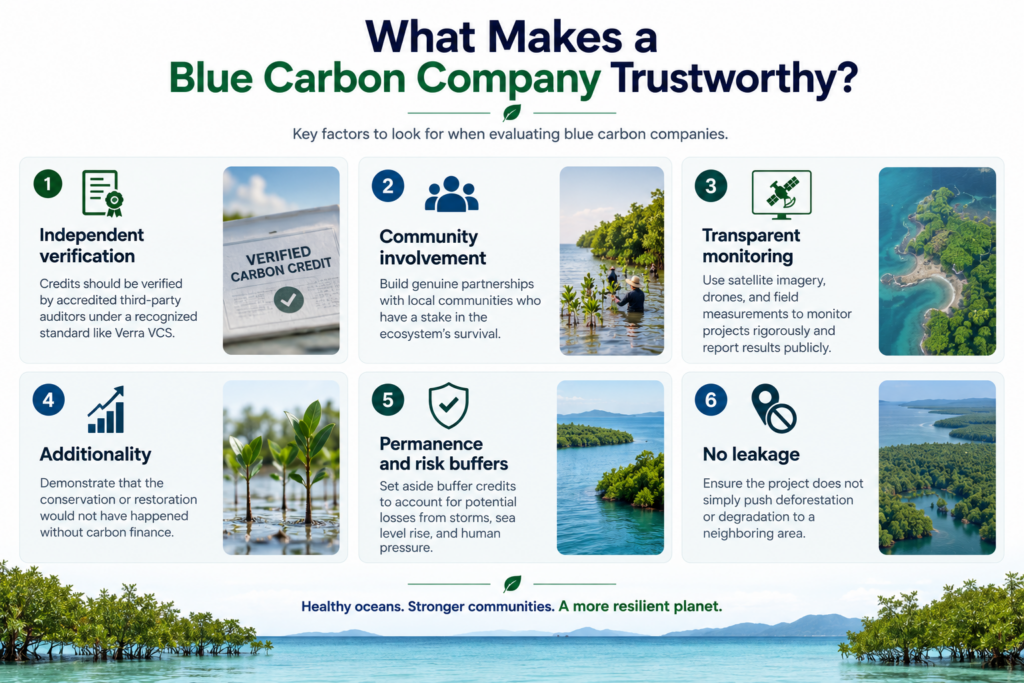
Not all blue carbon projects deliver on their promises. As the market grows, buyers need to apply careful due diligence. Here is what separates the best blue carbon companies from the rest:
Independent verification. Credits should be verified by accredited third-party auditors under a recognized standard like Verra VCS.
Community involvement. The most durable projects build genuine partnerships with local communities who have a stake in the ecosystem’s survival.
Transparent monitoring. Leading companies use satellite imagery, drone technology, and field measurements to monitor their projects rigorously and report results publicly.
Additionality. A credible project must demonstrate that the conservation or restoration would not have happened without carbon finance.
Permanence and risk buffers. Blue carbon ecosystems face risks from storms, sea level rise, and human pressure. Reputable projects set aside buffer credits to account for potential losses.
No leakage. A project should not simply push deforestation or degradation to a neighboring area.
Challenges Facing Blue Carbon Companies
The blue carbon sector faces real headwinds alongside its momentum. Being aware of these challenges helps you assess any company or project more realistically.
Supply is still limited. Blue carbon credits make up a very small fraction of total voluntary carbon market issuances. Growing supply requires more projects, more verified methodologies, and more patient capital.
Methodological gaps. Seagrass projects, in particular, face challenges around measurement and permanence that make them harder to certify than mangrove projects.
Price volatility. Blue carbon credits trade at a premium, but prices vary widely depending on project type, certification body, and market conditions.
Community risks. Projects that fail to genuinely engage local communities face higher risks of failure, conflict, or abandonment over time.
Climate risk. Coastal ecosystems are on the front lines of climate change. Rising sea levels, more intense storms, and ocean warming all threaten both the ecosystems and the carbon they store.
Despite these challenges, the fundamentals of blue carbon remain compelling. The ecosystems are real, the carbon they store is measurable, and the co-benefits for communities and biodiversity are well documented.
How Companies and Investors Can Engage with Blue Carbon
If you want to participate in the blue carbon market, whether as a buyer, an investor, or a project partner, here are the practical steps to consider:
Step 1: Define your objective Are you looking to offset emissions, invest in carbon-generating projects, or support conservation? Your objective shapes which type of engagement makes sense.
Step 2: Understand the credit types Blue carbon credits include both avoidance credits (from conservation) and removal credits (from restoration). Removal-based credits tend to command higher prices and face stricter scrutiny.
Step 3: Choose a verified standard Only purchase credits verified under a recognized standard. Verra VCS is the most established, with Plan Vivo and Gold Standard also recognized.
Step 4: Assess co-benefits The best blue carbon projects also deliver biodiversity, community livelihood, food security, and coastal protection benefits. Look for projects aligned with the UN Sustainable Development Goals.
Step 5: Work with an experienced intermediary or developer Companies like South Pole, EcoSecurities, and Conservation International can help buyers identify projects that match their needs, values, and budget.
Step 6: Retire credits transparently Once purchased, credits should be retired on a public registry so they cannot be sold or claimed again. Verra’s registry provides this function.
The Future of Blue Carbon Companies
The blue carbon sector stands at an inflection point. Corporate net-zero commitments are multiplying. Regulatory pressure on emissions is intensifying. And the demand for high-quality, nature-based carbon credits is growing faster than supply.
Several trends will shape which companies lead this space in the coming years:
Digital MRV. Measurement, reporting, and verification is going digital. Drone surveys, satellite imaging, and AI-driven carbon accounting are making blue carbon projects more accurate, more auditable, and more scalable.
Expanded ecosystem coverage. Seagrass, kelp, and even open-ocean blue carbon are moving from research into the realm of verified projects. New methodologies are unlocking ecosystems that were previously too difficult to measure.
Government and policy support. Countries including Australia, Indonesia, Kenya, Colombia, and Pakistan are integrating blue carbon into national climate plans and NDCs, creating stable policy environments for project development.
Institutional investment. Blue carbon is attracting serious institutional capital. Public-private partnerships, blended finance models, and conservation investment funds are growing in both number and scale.
Community-centered models. The market is learning that projects built on genuine community partnership last longer and deliver more. The next wave of leading blue carbon companies will be those that put people at the center of their conservation work.
Frequently Asked Questions About Blue Carbon Companies
What is a blue carbon company?
A blue carbon company develops, manages, finances, or advises on projects that protect or restore coastal ecosystems like mangroves, seagrass meadows, and tidal salt marshes to generate verified carbon credits.
Who is the largest blue carbon project developer in the world?
Indus Delta Capital, through its Delta Blue Carbon project in Pakistan, is widely recognized as the world’s largest blue carbon project developer. The Delta Blue Carbon project covers 350,000 hectares and aims to remove approximately 142 million tonnes of CO2 equivalent over its 60-year life.
How are blue carbon credits different from forest carbon credits?
Blue carbon credits come from coastal and marine ecosystems rather than terrestrial forests. These ecosystems store carbon in waterlogged sediments for much longer periods than land-based forests. Blue carbon credits typically trade at a higher price due to their scarcity and the additional co-benefits they provide.
How much do blue carbon credits cost?
Blue carbon credits typically trade in the range of $20 to $35 per tonne of CO2 equivalent, though prices vary depending on the project, ecosystem type, certification standard, and market conditions. This is generally higher than credits from many forestry or renewable energy projects.
What standards certify blue carbon projects?
The most widely used standard is Verra’s Verified Carbon Standard (VCS), using methodologies like VM0033 for wetland restoration. Plan Vivo and Gold Standard also certify blue carbon projects, particularly those with strong community and development outcomes.
Can a company buy blue carbon credits to meet net-zero goals?
Yes. Many companies use blue carbon credits as part of their broader climate strategy to offset hard-to-abate emissions. However, high-integrity frameworks like the Science Based Targets initiative (SBTi) recommend using credits alongside, not instead of, deep emission reductions.
What are the main ecosystems involved in blue carbon?
The three primary blue carbon ecosystems are mangrove forests, seagrass meadows, and tidal salt marshes. All three store carbon in their biomass and in waterlogged sediments. Emerging research is also exploring the carbon potential of kelp forests and broader marine ecosystems.
Are there community-led blue carbon projects?
Yes. Mikoko Pamoja in Kenya is the world’s first community-led blue carbon project to successfully trade carbon credits. Many other projects, including Delta Blue Carbon in Pakistan, also operate through partnerships with local communities, recognizing that community engagement is essential for long-term project success.
Conclusion
The top blue carbon companies in the world are doing more than fighting climate change. They are protecting coastlines, supporting fishing communities, restoring marine biodiversity, and demonstrating that markets can be a force for conservation.
From the vast mangrove forests of Pakistan’s Indus Delta to the community-managed shores of Kenya’s Gazi Bay, blue carbon companies are turning some of the planet’s most overlooked ecosystems into some of its most valuable climate assets.
The market is still young, but it is growing. Standards are tightening. Science is advancing. And the number of companies choosing blue carbon credits to back their net-zero claims is rising year after year.
If you want to understand the future of climate action, keeping a close eye on the top blue carbon companies in the world is one of the best places to start.
Explore more resources on carbon markets, carbon credits, and climate finance at carbonmarketnetwork.com.