Carbon Market Network


If you have ever wondered who is actually watching the world’s carbon emissions, you are not alone.
Governments make big climate promises. Businesses publish sustainability reports. But someone has to verify what is actually happening on the ground, in the atmosphere, and across supply chains. That is exactly what carbon monitoring companies do.
These firms are among the most important players in the global push toward net zero. They build the infrastructure of trust that makes carbon markets, corporate disclosures, and climate regulations credible.
In this article, we cover the top carbon monitoring companies in the world. We explain what each one does, who they serve, and what makes them stand out. Whether you are a business leader, investor, climate professional, or simply curious, this guide gives you a clear, practical picture.
What Is Carbon Monitoring and Why Does It Matter?
Carbon monitoring refers to the process of measuring, tracking, and verifying greenhouse gas emissions from various sources. These sources can be individual industrial facilities, supply chains, entire sectors, or even regions of the atmosphere.
The data produced by carbon monitoring companies feeds into several important processes:
- Corporate emissions reporting under frameworks like the GHG Protocol, CSRD, and TCFD
- Carbon credit verification in voluntary and compliance markets
- Regulatory compliance under emissions trading schemes like the EU ETS
- Investment decisions by asset managers and banks assessing climate risk
- Government policy on national and international climate targets
Without reliable carbon monitoring, none of these systems can function properly. It is the foundation of credibility in the entire carbon ecosystem.
Carbon Market Insider Newsletter
Weekly insights on carbon markets, climate policy, carbon credits, and sustainability.
Types of Carbon Monitoring Companies
Not all carbon monitoring companies work the same way. The space broadly divides into three categories.
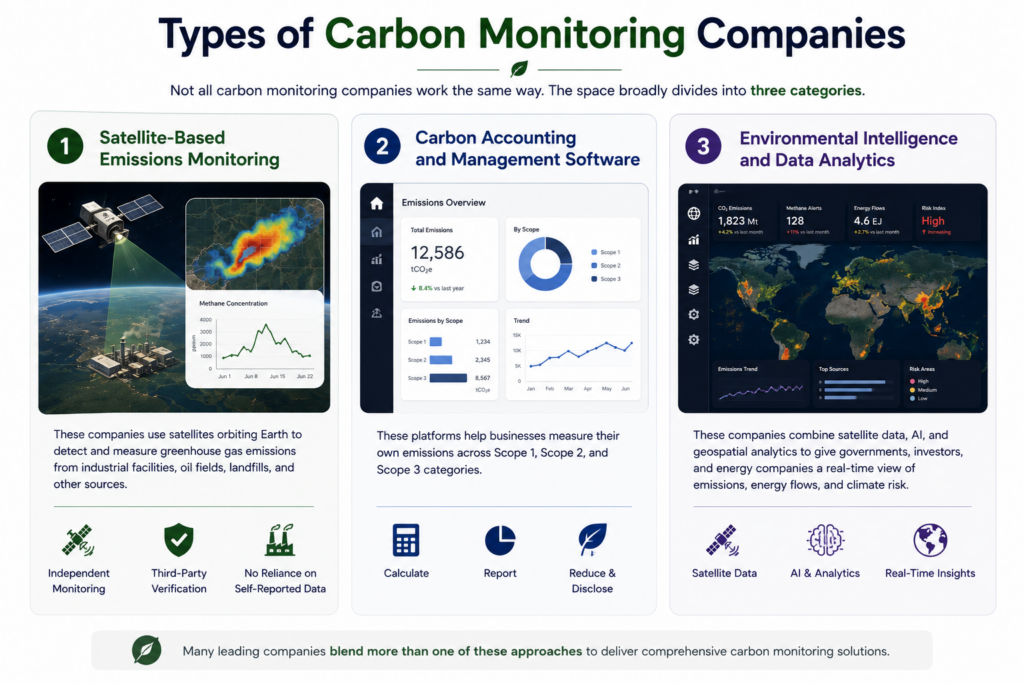
1. Satellite-Based Emissions Monitoring
These companies use satellites orbiting Earth to detect and measure greenhouse gas emissions from industrial facilities, oil fields, landfills, and other sources. They provide independent, third-party verification that does not rely on self-reported data.
2. Carbon Accounting and Management Software
These platforms help businesses measure their own emissions across Scope 1, Scope 2, and Scope 3 categories. They provide the tools companies need to calculate, report, reduce, and disclose their carbon footprint.
3. Environmental Intelligence and Data Analytics
These companies combine satellite data, AI, and geospatial analytics to give governments, investors, and energy companies a real-time view of emissions, energy flows, and climate risk.
Many leading companies blend more than one of these approaches.
Top Carbon Monitoring Companies in the World
Here is a detailed look at the leading carbon monitoring companies operating at scale today.
1. GHGSat
Headquarters: Montreal, Canada Focus: Satellite-based methane and CO2 monitoring Clients: Oil and gas companies, governments, financial institutions, UN organizations
GHGSat is arguably the most advanced commercial satellite emissions monitoring company in the world right now.
The company operates the world’s largest fleet of satellites dedicated to greenhouse gas monitoring. As of mid-2026, GHGSat has successfully launched 18 satellites. Its constellation gives it the unique ability to monitor methane emissions from individual industrial facilities on a near-daily basis, anywhere on Earth.
What makes GHGSat special is its patented Wide-Angle Fabry-Perot (WAF-P) imaging spectrometer. This sensor gives the company a 25-metre spatial resolution, meaning it can pinpoint emissions from a single oil well, a coal mine vent, or a section of pipeline, not just a broad area.
In recent years, GHGSat has expanded beyond methane. Its Vanguard satellite provides the world’s first commercial high-resolution CO2 monitoring capability, attributing emissions directly to specific industrial sites like steel mills and power stations.
Key facts:
- Surveys more than 4 million sites annually
- Delivers emissions alerts within hours of detection
- Partners include ExxonMobil, Saudi Aramco, the UK Space Agency, UNEP, NASA, and ESA
- Research programs validated through scientific publications
GHGSat serves clients who need independent, verifiable data they can trust for regulatory reporting, investor disclosures, and operational decision-making.
2. Kayrros (Now Part of Energy Aspects)
Headquarters: Paris, France (founded); now integrated into Energy Aspects (London, UK) Focus: Environmental intelligence, satellite-based emissions and energy monitoring Clients: Asset managers, financial institutions, energy traders, insurers, regulators
Kayrros was founded in 2016 and quickly became one of the most recognized names in environmental intelligence globally. TIME Magazine named it one of its 100 Most Influential Companies. Fast Company ranked it among the 10 Most Innovative Companies in Energy and Sustainability.
In 2026, UK-based energy analytics company Energy Aspects completed its acquisition of Kayrros. The combined entity brings together satellite monitoring and geospatial intelligence with deep energy market expertise.
Kayrros processes satellite imagery from ESA Copernicus satellites and other sources, using AI and advanced analytics to deliver actionable insights in near real time.
Key products:
- Carbon Watch: Real-time EU and UK ETS emissions monitoring by country and sector, helping carbon traders understand physical demand for carbon credits
- Methane Tracker: Monitors methane and CO2 emissions from the oil, gas, and industrial sectors globally
- Imported Deforestation Tracker: Helps companies comply with EU deforestation regulations
- Wildfire and Climate Risk Assessment: Quantifies physical climate risk for insurers and financial institutions
Kayrros is particularly strong in the financial sector, where speed and independence of data are critical for trading decisions and climate risk assessments.
3. Carbon Mapper
Headquarters: Pasadena, California, USA Focus: Satellite and airborne methane and CO2 point-source monitoring Type: Nonprofit public-private partnership Partners: Planet Labs, NASA JPL, High Tide Foundation, Bloomberg Philanthropies, and others
Carbon Mapper is a nonprofit initiative but deserves its place on any list of top carbon monitoring companies. It operates at the frontier of emissions science.
Its Tanager-1 satellite, launched in August 2024 and fully operational by early 2025, uses a NASA JPL-designed imaging spectrometer to detect methane and CO2 plumes from individual facilities with a spatial resolution of 30 metres.
The organization makes its data publicly available through a free data portal with a public API. This means researchers, journalists, regulators, and governments around the world can access verified emissions data without cost.
In April 2026, Carbon Mapper announced the development of its next-generation Advanced Emissions Monitoring Imaging Spectrometer (AEMIS) with JPL. This aircraft-mounted instrument will detect methane emissions as small as 5 kg per hour, with resolutions as fine as one metre. It is designed to cover diffuse agricultural emissions, including livestock, that satellites currently miss.
Why it matters:
Carbon Mapper fills a critical gap by providing high-resolution, facility-level data in regions where satellites have poor coverage due to cloud cover and tropical conditions.
4. Watershed
Headquarters: San Francisco, California, USA Focus: Enterprise carbon accounting and decarbonization software Best for: Large enterprises, tech companies, pre-IPO firms
Watershed has consistently ranked as the top enterprise carbon management platform in independent evaluations. In the 2026 Verdantix Green Quadrant, Watershed led all 21 evaluated vendors on both capabilities and momentum, the second consecutive year in that position.
The platform is built around a clear philosophy: measuring emissions is only valuable when it leads to reducing them. Watershed connects the emissions number in a disclosure report directly to the decisions that will move that number.
Core capabilities:
- Scope 1, 2, and 3 emissions measurement using CEDA (Comprehensive Environmental Data Archive), one of the largest emissions factor databases in the world
- Supplier engagement tools for accurate Scope 3 data
- Regulatory disclosure aligned with CSRD, ISSB, CDP, GRI, and more
- Scenario modelling for decarbonization planning and SBTi target alignment
- AI-assisted drafting for disclosure reports
Watershed was also named a Leader in the 2026 IDC MarketScape for carbon accounting and management.
| Framework Support | CSRD, ISSB, TCFD, CDP, GRI, SASB, UK SRS, CA SB 253/261, SFDR |
|---|---|
| Scope Coverage | Scope 1, 2, 3 including financed emissions |
| Key Strength | Carbon-native data infrastructure and decarbonization planning |
| Best For | Large enterprises, sophisticated sustainability teams |
5. Persefoni
Headquarters: Tempe, Arizona, USA Focus: AI-powered carbon accounting, regulatory disclosure, financial services Best for: Financial institutions, investor-grade disclosure, complex regulatory reporting
Persefoni positions itself as the ERP of carbon accounting, meaning it functions as the central system of record for all emissions-related data, in the same way Oracle or SAP manages financial data.
It was built from the ground up with financial institutions in mind. Its PCAF-aligned financed emissions methodology is the gold standard for banks, asset managers, private equity firms, and insurers tracking portfolio-level carbon exposure.
Key features:
- AI Copilot for data ingestion, emission factor matching, and anomaly detection
- Purpose-built modules for CSRD, ISSB, SEC climate rules, TCFD, and PCAF standards
- Carbon ledger model with full audit trails for assurance and regulatory scrutiny
- Supplier portal for real Scope 3 data collection
- Portfolio analytics dashboard for Private Equity and Venture Capital firms
Persefoni was recognized as a Leader in the 2026 IDC MarketScape and regularly appears alongside Watershed in top enterprise carbon accounting evaluations.
6. Sweep
Headquarters: Paris, France (with offices in London and Denver) Focus: Supply chain emissions, multi-framework reporting, collaborative carbon management Best for: Multi-entity organizations, value chain emissions, CSRD compliance
Sweep is built around a single, governed dataset called the Sweep Tree. This model maps one set of emissions data across multiple regulatory and voluntary reporting frameworks simultaneously, reducing duplication and the risk of inconsistencies between reports.
It is a member of the World Bank’s Carbon Pricing Leadership Coalition and partners with major firms including Capgemini, CDP, and KPMG.
Notable clients: L’Oreal, SSE, Lacoste
Key strengths:
- AI-powered data automation and anomaly detection via Sweepy, its built-in AI assistant
- Structured supplier data collection at scale
- Simultaneous alignment with CSRD, ISSB, GRI, CDP, SASB, and UK SRS
- Reduction planning workflows tied directly to supplier responses
Sweep was named a Leader in both the 2026 Verdantix Green Quadrant and the 2026 IDC MarketScape, making it one of a small group of platforms recognized across multiple independent research evaluations.
7. Normative
Headquarters: Stockholm, Sweden Focus: Science-based carbon accounting, Scope 3 and supply chain emissions Best for: Enterprises with complex global supply chains and heavy Scope 3 exposure
Normative is the original enterprise carbon accounting platform, built on rigorous scientific methodology and independently verified by TÜV SÜD.
It is particularly strong in Scope 3 accounting. Normative’s Carbon Network allows organizations to collect verified supplier data, helping businesses move from estimates to actual supplier-level emissions figures over time.
Key differentiators:
- GHG Protocol-aligned methodology verified against ISO 25051
- Dedicated Climate Strategy Advisors who work alongside the software
- AI-driven data ingestion, emission factor matching, and anomaly detection
- Carbon Network for structured supplier engagement
The company is best suited for enterprises that want both a rigorous methodology and expert human support as they build their carbon inventory.
8. Greenly
Headquarters: Paris, France Focus: SMB and mid-market carbon accounting, ESG management Best for: Small to medium businesses, European companies, fast onboarding
Greenly has grown to serve more than 3,500 clients globally. It is one of the most accessible carbon monitoring and management platforms available, with a design built for teams that are earlier in their emissions journey.
Its EcoPilot AI gives users on-demand climate expertise and handles repetitive tasks like data collection and categorization.
Notable clients: Huawei, HSBC, Ubisoft
Greenly covers the full spectrum of ESG including GHG Assessment, Life Cycle Analysis, and ESG Management, with a tailored approach by industry sector.
It is SOC 2 compliant and recognized in the 2026 IDC MarketScape as a Major Player.
9. IBM Envizi
Headquarters: Armonk, New York, USA Focus: Enterprise energy and carbon data management, large-scale operations Best for: Multinational enterprises with hundreds of facilities and high data volumes
IBM Envizi (part of IBM’s broader sustainability portfolio) is the platform of choice for large, complex organizations that need to consolidate enormous volumes of utility, energy, and emissions data from hundreds of sites.
It supports more than 500 data types, which makes it one of the most comprehensive data consolidation platforms on the market.
IBM Envizi was recognized as a Major Player in the 2026 IDC MarketScape and as a strong alternative to pure-play carbon platforms for enterprises already embedded in IBM and enterprise IT ecosystems.
Core strengths:
- High-volume utility and energy data ingestion from meters, invoices, and ERP systems
- Governed, auditable reporting aligned with major disclosure frameworks
- Strong integration with existing IBM, SAP, and enterprise infrastructure
- Built for organizations with complex global facilities footprints
10. Sphera
Headquarters: Chicago, Illinois, USA Focus: Industrial sustainability, life cycle assessment, EHS and carbon management Best for: Heavy industry, manufacturing, supply chain LCA
Sphera is a risk management and sustainability software company with deep roots in environmental, health, safety, and quality (EHSQ) management. Its carbon management capabilities are tightly integrated with its broader operational risk and life cycle assessment tools.
This makes Sphera particularly strong for industrial organizations, chemical companies, and manufacturers where carbon accounting cannot be separated from operational and product-level sustainability management.
Sphera was recognized as a Major Player in the 2026 IDC MarketScape for carbon accounting.
Quick Comparison: Top Carbon Monitoring Companies
| Company | Type | Best For | Key Strength | Notable Framework/Standard |
|---|---|---|---|---|
| GHGSat | Satellite monitoring | Industrial emitters, regulators, financiers | Facility-level methane and CO2 detection | GHG Protocol, UNEP IMEO |
| Kayrros | Environmental intelligence | Energy traders, financial institutions | Real-time satellite + AI analytics | EU ETS, carbon markets |
| Carbon Mapper | Satellite and airborne | Researchers, regulators, public sector | Free public emissions data portal | NASA JPL validated |
| Watershed | Carbon accounting software | Large enterprises | Carbon-native data and decarbonization planning | CSRD, ISSB, CDP, GRI |
| Persefoni | Carbon accounting software | Financial institutions | Investor-grade audit trail and PCAF alignment | PCAF, ISSB, CSRD, TCFD |
| Sweep | Carbon accounting software | Multi-entity, CSRD compliance | One governed dataset across frameworks | CSRD, ISSB, CDP, GRI |
| Normative | Carbon accounting software | Scope 3 heavy enterprises | Science-verified methodology, supplier network | GHG Protocol, TÜV SÜD |
| Greenly | Carbon accounting software | SMBs and mid-market | Fast onboarding, ESG breadth | GHG Protocol, CSRD |
| IBM Envizi | Enterprise data platform | Large multi-site operations | High-volume data consolidation | Multiple frameworks |
| Sphera | Industrial sustainability | Manufacturing, heavy industry | LCA and operational risk integration | GHG Protocol, ISO |
How Satellite Carbon Monitoring Works
Satellite-based carbon monitoring is one of the most exciting areas of climate technology. Here is a simple breakdown of how it works.
Step 1: The satellite passes over an emissions site. The satellite uses a spectrometer to measure the unique light absorption patterns of greenhouse gases like methane (CH4) and carbon dioxide (CO2). Each gas absorbs specific wavelengths of light, creating a kind of fingerprint.
Step 2: The sensor captures emissions data. At 25-metre resolution (as with GHGSat), the satellite can see emissions from individual pieces of equipment, not just a broad industrial zone.
Step 3: Data is processed using AI and algorithms. Raw spectral data is processed through proprietary algorithms to calculate the concentration and flow rate of emissions. AI helps filter noise and identify genuine emission events.
Step 4: Results are validated and delivered. Data is cross-checked against ground-based measurements and reference instruments. Results are delivered to clients within hours of detection, often as alerts for high-emission events.
Step 5: Clients take action. Industrial operators use the data to locate and fix leaks. Regulators use it to enforce compliance. Investors use it to assess climate risk in their portfolios.
What Is Scope 1, 2, and 3 Emissions Monitoring?
If you are new to carbon monitoring, understanding Scope 1, 2, and 3 emissions is essential.
| Scope | Definition | Examples |
|---|---|---|
| Scope 1 | Direct emissions from sources owned or controlled by the company | Company vehicles, on-site boilers, manufacturing processes |
| Scope 2 | Indirect emissions from purchased electricity, heat, or cooling | Electricity used in offices and factories |
| Scope 3 | All other indirect emissions in the value chain | Supplier emissions, product use, business travel, logistics |
Most carbon monitoring software platforms cover all three scopes. Scope 3 is the most challenging because it requires data from hundreds or thousands of external suppliers and partners.
Companies like Normative, Sweep, and Watershed have built specific tools to help businesses collect verified Scope 3 data from their supply chains.
Key Reporting Frameworks That Carbon Monitoring Companies Support
Carbon monitoring does not happen in a vacuum. Companies need to report their emissions according to globally recognized standards. Here are the main ones you will encounter.
| Framework | Full Name | Who Uses It |
|---|---|---|
| GHG Protocol | Greenhouse Gas Protocol | Global standard for most corporate emissions accounting |
| CSRD | Corporate Sustainability Reporting Directive | EU companies and large non-EU companies with EU operations |
| ISSB | International Sustainability Standards Board | Global standard for investor-grade climate disclosures |
| TCFD | Task Force on Climate-related Financial Disclosures | Financial institutions and investors |
| CDP | Carbon Disclosure Project | Companies disclosing to investors and customers via CDP platform |
| PCAF | Partnership for Carbon Accounting Financials | Banks and asset managers tracking financed emissions |
| SBTi | Science Based Targets initiative | Companies setting science-aligned emissions reduction targets |
All leading carbon monitoring companies align their platforms with one or more of these frameworks. The more frameworks a platform supports, the less duplication a company faces when producing multiple reports.
How to Choose the Right Carbon Monitoring Company for Your Business
There is no single best carbon monitoring company for every organization. The right choice depends on your size, industry, regulatory environment, and what you want to do with your emissions data.
Here is a practical framework to guide your decision.
1. Identify your primary need. Are you trying to measure and report your own emissions? Or do you need independent, third-party verification of emissions from industrial sources? Software platforms serve the first need. Satellite monitoring companies serve the second.
2. Know which regulatory frameworks apply to you. If you operate in the EU, CSRD compliance is mandatory. If you are a financial institution, PCAF and TCFD alignment matters most. Match your platform to your actual regulatory requirements.
3. Consider your Scope 3 challenge. Scope 3 emissions are often 70 to 90 percent of a company’s total footprint. If supplier data is a major challenge, choose platforms like Normative or Sweep that have dedicated supplier engagement tools.
4. Think about your team’s capacity. Enterprise platforms like Watershed and Persefoni require dedicated sustainability teams to get the most value. Platforms like Greenly are designed for teams that are just getting started.
5. Plan for auditability. If your disclosures will be subject to third-party assurance, choose a platform that provides a full audit trail and transparent methodology documentation. Persefoni and Watershed are both built for this.
The Role of AI in Carbon Monitoring
Artificial intelligence is transforming carbon monitoring at every level.
In satellite monitoring, AI processes enormous volumes of spectral data from orbit, separating genuine methane plumes from background noise, and estimating emission rates in near real time. GHGSat and Kayrros both use AI extensively at this stage.
In carbon accounting software, AI handles tasks like:
- Automatically categorizing emissions data from invoices, meter readings, and expense reports
- Matching activities to the right emission factors from databases of thousands of options
- Detecting anomalies that may indicate data errors or missing sources
- Generating first drafts of regulatory disclosures
Persefoni’s AI Copilot, Watershed’s AI-assisted drafting tools, and Sweep’s Sweepy assistant all reduce the manual burden of emissions accounting significantly. Greenly’s EcoPilot similarly handles repetitive tasks for smaller teams.
The trend is clear: AI is not replacing carbon monitoring professionals. It is making their work faster, more accurate, and more scalable.
The Global Carbon Monitoring Landscape: Key Trends
Regulatory pressure is accelerating adoption. The EU’s CSRD now requires large companies and their supply chains to report verified emissions data. The ISSB’s global sustainability standards are being adopted by regulators across Asia, the UK, and beyond. This is pushing thousands of companies to invest in carbon monitoring tools for the first time.
Satellite monitoring is expanding rapidly. GHGSat is planning to near-double its constellation size by late 2026. Carbon Mapper is developing next-generation aircraft instruments. The era of truly independent, continuous, global emissions verification from space is arriving faster than most people expected.
Financial institutions are driving demand. Banks, asset managers, and insurers now need emissions data not just for their own operations but for every company in their loan books and investment portfolios. This has created massive demand for financed emissions monitoring, an area where Persefoni, Watershed, and Kayrros are all competing.
Scope 3 remains the hardest problem. Most corporate carbon footprints are dominated by Scope 3 emissions, but Scope 3 data quality is still poor for most industries. The next frontier in carbon monitoring is bringing verified, supplier-level data into Scope 3 calculations at scale.
Verification is becoming non-negotiable. Greenwashing scandals and regulatory scrutiny have shifted the market from self-reported data to independently verified data. This is good news for satellite monitoring companies and for platforms that provide auditable, methodology-transparent accounting.
Carbon Monitoring and the Voluntary Carbon Market
Carbon monitoring companies also play a critical role in the voluntary carbon market (VCM).
When a company buys a carbon credit, it is buying a verified claim that a certain quantity of emissions has been reduced or removed somewhere in the world. For that claim to be credible, the underlying project needs rigorous monitoring, reporting, and verification (MRV).
Companies like CarbonFuture specialize in digital MRV infrastructure for carbon removal projects. They build automated data pipelines and standardized methodologies to track carbon removal from project origin through credit issuance.
Kayrros provides data to carbon ratings agencies like BeZero Carbon, helping them assess the credibility of carbon offset projects.
GHGSat’s emissions data is increasingly used to verify that industrial facilities claiming carbon credits have actually reduced their emissions as claimed.
As the voluntary carbon market matures and demands higher quality, the role of carbon monitoring companies in providing independent verification is growing significantly.
FAQ
What is a carbon monitoring company? A carbon monitoring company measures, tracks, and verifies greenhouse gas emissions from industrial sources, corporate supply chains, or entire regions. They provide the data that businesses, governments, and investors need to make credible climate decisions.
What is the difference between carbon monitoring and carbon accounting? Carbon monitoring typically refers to the technical measurement of emissions, often using satellites or sensors. Carbon accounting refers to the process of calculating and reporting a company’s total greenhouse gas footprint using a recognized methodology like the GHG Protocol.
Which is the best carbon monitoring company in the world? There is no single best company for all purposes. GHGSat leads in satellite-based emissions detection. Watershed leads in enterprise carbon accounting software. Persefoni leads for financial institutions. The right choice depends on your specific needs.
How do satellite carbon monitoring companies detect emissions? They use spectrometers to measure the unique light absorption patterns of greenhouse gases in the atmosphere. At high spatial resolutions, they can attribute emissions to specific facilities and even individual pieces of equipment.
What is Scope 3 emissions monitoring? Scope 3 covers all indirect emissions in a company’s value chain, including those from suppliers, logistics, product use, and end-of-life disposal. It is the hardest category to measure because it requires data from external partners, not just the company’s own operations.
Do carbon monitoring companies work with small businesses? Most enterprise platforms are designed for mid-to-large organizations. However, platforms like Greenly are specifically built for small and medium-sized businesses with simplified onboarding and accessible pricing.
How is AI used in carbon monitoring? AI is used in satellite data processing to detect emission plumes, in carbon accounting software for data categorization and anomaly detection, and in disclosure report generation. It makes the entire carbon monitoring process faster, more accurate, and more scalable.
What is the role of carbon monitoring in the carbon market? Carbon monitoring provides the independent verification that makes carbon credits credible. Without reliable monitoring of emissions reductions and removals, buyers cannot trust that the credits they purchase represent real climate action.
Are carbon monitoring companies regulated? The data and methodologies they use are often aligned with or required by regulatory standards like the EU ETS, CSRD, and ISSB. However, the monitoring companies themselves are not universally regulated as financial institutions are. Third-party verification bodies like TÜV SÜD play an important quality assurance role.
What is financed emissions monitoring? Financed emissions monitoring tracks the greenhouse gas emissions associated with a financial institution’s loan book and investment portfolio. Banks and asset managers use PCAF standards to calculate and disclose these emissions, and platforms like Persefoni and Watershed provide the tools to do so.
Final Thoughts
The world cannot reach net zero without knowing exactly where its emissions are coming from, how large they are, and whether they are going down.
Carbon monitoring companies are the ones making that knowledge possible.
Whether they are flying satellites over oil fields, helping global corporations map their supply chain footprint, or giving financial institutions a credible picture of their portfolio emissions, these companies are doing some of the most consequential environmental work in the world today.
As regulations tighten, investor expectations rise, and the voluntary carbon market matures, the demand for reliable carbon monitoring will only grow.
If you are building a sustainability strategy, exploring carbon markets, or simply trying to understand how climate accountability actually works, understanding these companies is a great place to start.
Explore more resources on carbon markets, carbon credits, and emissions monitoring at Carbon Market Network.
Disclaimer: This article is for educational purposes only. Company descriptions are based on publicly available information. Always consult directly with service providers for the most current product details and pricing.