Carbon Market Network


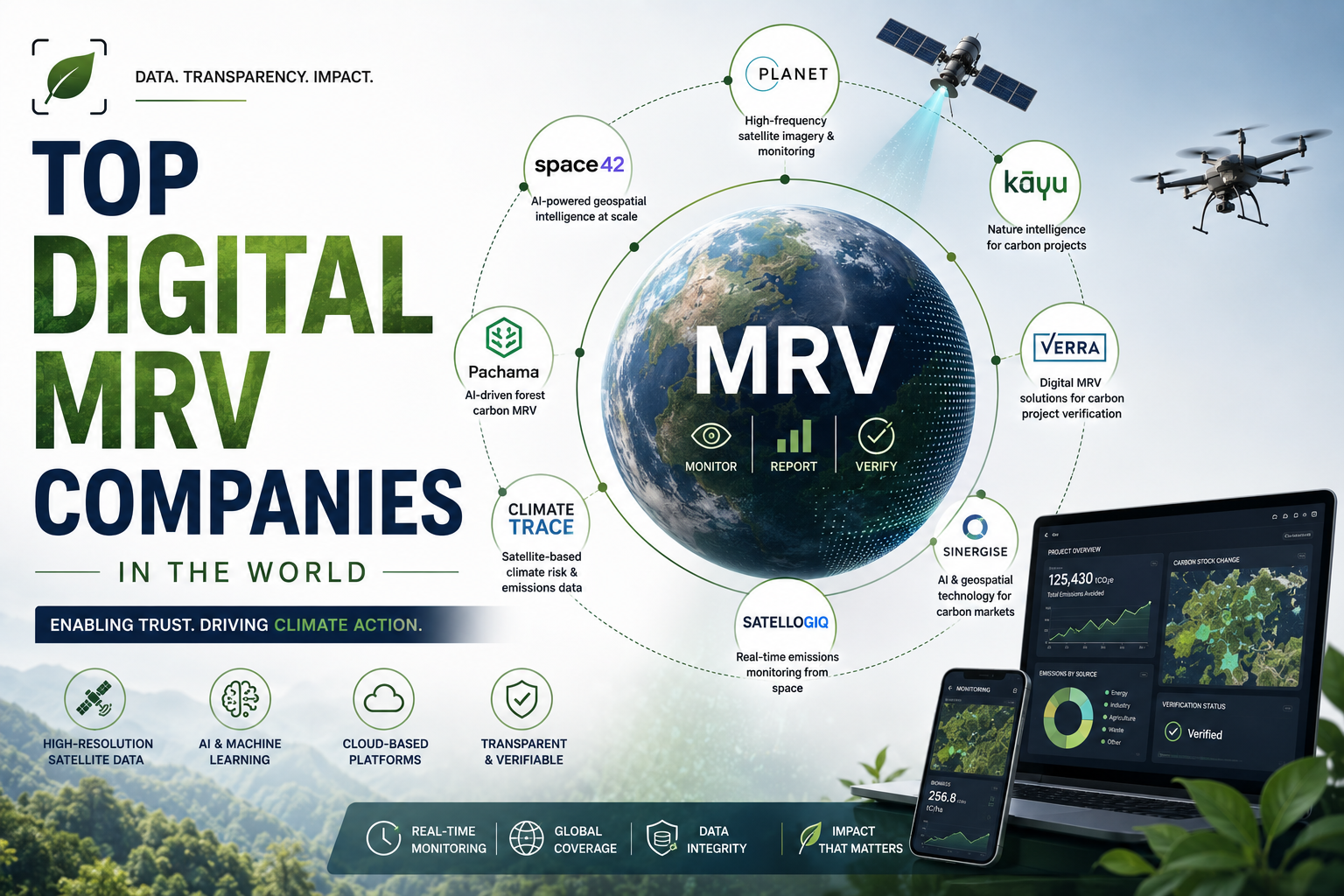
Carbon markets are changing fast. And at the center of that change is one technology that is quietly becoming the backbone of the entire system: digital MRV.
If you have ever wondered why some carbon credits are trusted more than others, or why buyers are willing to pay a premium for certain projects, the answer often comes back to how those credits were measured, reported, and verified. That is exactly what digital MRV companies do, and they are reshaping the credibility of carbon markets at a global scale.
In this article, you will find a detailed breakdown of the top digital MRV companies in the world, what each one does, why they matter, and how they are pushing carbon markets toward a higher standard of integrity and transparency.
What Is Digital MRV and Why Does It Matter?
MRV stands for Measurement, Reporting, and Verification. It is the process that ensures a carbon credit actually represents a real reduction or removal of greenhouse gas emissions.
Traditional MRV relied on manual field surveys, spreadsheets, and periodic audits that sometimes happened only once every few years. That approach was slow, expensive, and, as multiple scandals in the voluntary carbon market revealed, prone to error and fraud.
Digital MRV, often written as dMRV or DMRV, replaces that manual process with continuous, automated, data-driven monitoring. It uses technologies like satellite imagery, artificial intelligence (AI), IoT sensors, and blockchain to collect, process, and verify emissions data in near real time.
The result? Faster credit issuance, lower verification costs, and significantly higher trust from buyers and regulators alike.
The global digital MRV market is projected to grow from around USD 6.3 billion to USD 28.8 billion by 2036, at a compound annual growth rate (CAGR) of 16.4%. That level of growth tells you everything about how seriously the market is taking this technology.
Carbon Market Insider Newsletter
Weekly insights on carbon markets, climate policy, carbon credits, and sustainability.
What Technologies Power Digital MRV?
Before diving into the top companies, it helps to understand the core tools they use.
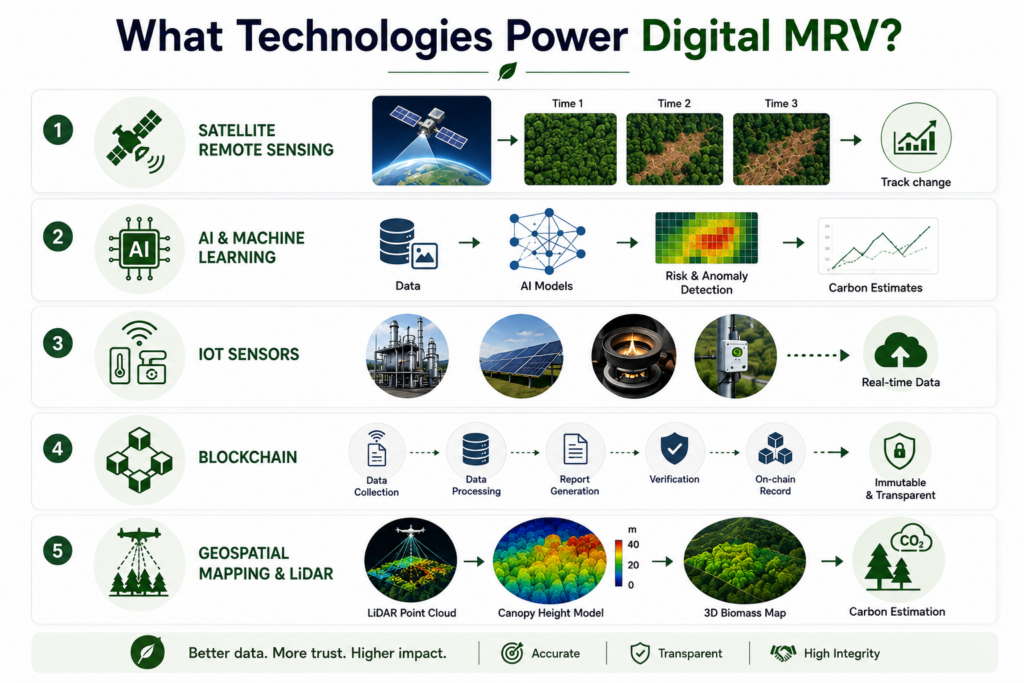
Satellite Remote Sensing Satellites capture high-resolution images of forests, farmland, and industrial sites. These images can track carbon stock changes, deforestation, and land-use shifts over time without any human needing to visit the project site.
Artificial Intelligence and Machine Learning AI models process massive amounts of satellite and sensor data to estimate carbon stocks, detect anomalies, identify leakage risks, and generate baseline scenarios. Machine-learning models trained on satellite imagery can now detect deforestation events within 48 hours.
IoT Sensors Internet of Things sensors installed at project sites, such as pyrolysis plants, solar arrays, or cookstove installations, capture real-time operational data that feeds directly into digital reporting systems.
Blockchain Blockchain technology strengthens trust in digital MRV by creating immutable, tamper-resistant records of data collection, processing, and reporting events. Each data point can be time-stamped and securely recorded, ensuring transparency across the MRV lifecycle.
Geospatial Mapping and LiDAR LiDAR (Light Detection and Ranging) technology, combined with satellite remote sensing, enables the creation of detailed canopy height models and 3D biomass maps, critical for forest carbon projects.
How Does Digital MRV Work? A Simple Step-by-Step Overview
Understanding how dMRV works makes it easier to appreciate what these companies are actually building.
Step 1: Data Collection Sensors, satellites, drones, and mobile apps gather raw data from the project site, whether that is a reforestation area in Brazil, a solar farm in Comoros, or a biochar facility in Germany.
Step 2: Data Processing AI and machine learning algorithms process the raw data, calculate emissions reductions or removals, and flag any inconsistencies or risks.
Step 3: Standardized Reporting The processed data is formatted into structured, standard-aligned reports that can be submitted directly to a carbon registry like Verra, Gold Standard, or Isometric.
Step 4: Digital Verification An independent verification body reviews the digital data trail, often remotely, and confirms that the reported outcomes are accurate and credible.
Step 5: Credit Issuance Once verified, carbon credits are issued and recorded on a public registry with a full, transparent data trail attached. Buyers can audit the underlying data themselves.
This process, which once took years, can now happen monthly or even more frequently with digital MRV systems in place.
The Top Digital MRV Companies in the World
Here is a detailed look at the companies leading this space globally, organized by their primary focus area.
1. Pachama (now part of Carbon Direct)
Headquarters: San Francisco, USA Focus: Forest carbon MRV using satellite imagery and AI
San Francisco-based Pachama established itself as the leading technology platform for forest carbon verification. Using a combination of satellite imagery, LiDAR data, and machine learning, the company can assess carbon stocks across forest projects with unprecedented accuracy and efficiency.
Carbon Direct, the global leader in science-driven carbon management, acquired Pachama. The acquisition augmented Carbon Direct’s scientific expertise and advisory services with Pachama’s proprietary technology and digital platform for forest carbon project MRV.
What makes Pachama stand out is its ability to validate carbon claims for existing projects, not just new ones. Its technology has analyzed hundreds of forest carbon projects globally, flagging those where claims exceeded actual sequestration. That kind of independent quality control was missing from the market for a long time.
Isometric, a leading carbon registry, selected Pachama as its first partner for digital MRV of reforestation credits, recognizing that LiDAR and satellite remote sensing can now generate robust canopy height models and advanced spatial algorithms can be used for dynamic baselining.
Key Technologies: Satellite imagery, LiDAR, machine learning, AI-based dynamic baselines
Best For: Forest carbon, reforestation, REDD+ projects
2. GHGSat
Headquarters: Montreal, Canada Focus: Satellite-based industrial emissions monitoring
GHGSat, described as the world leader in emissions monitoring from space, uses its own satellites and aircraft sensors to measure greenhouse gas emissions directly from industrial sites, providing actionable insights to businesses, governments, and regulators. With proprietary remote-sensing and patented technology, GHGSat enables strategic decision-making through monitoring and analytics services, with better accuracy, more frequently, and at a fraction of the cost of other technologies.
GHGSat focuses specifically on industrial emitters, oil and gas facilities, power plants, mines, landfills, and agricultural operations. It gives operators precise, facility-level data on methane and CO2 emissions, which is exactly what regulators and compliance frameworks demand.
The company plans to increase its methane-monitoring satellites from 12 to 21 by the end of the decade, with significant expansion into CO2 monitoring through its Vanguard satellite, the world’s first commercial satellite for measuring carbon dioxide emissions.
Aramco contracted GHGSat to monitor methane emissions based on the success of an earlier pilot program, and the two companies have since joined forces to address greenhouse gas emissions at scale.
Key Technologies: Proprietary satellite constellation, aircraft sensors, high-resolution remote sensing
Best For: Industrial emissions monitoring, methane leak detection, regulatory compliance
3. Kayrros
Headquarters: Paris, France Focus: Environmental intelligence using satellite data and AI
Kayrros is an environmental intelligence company an environmental intelligence company that tracks methane and carbon dioxide emissions, analyses carbon sinks, and assesses the risk of wildfires, landslides, floods, and other climate events. It also monitors the fuel mix and the progress of the green transition, evaluating the fossil fuel supply chain and facilitating the introduction of renewable energy sources.
Kayrros uses public and private satellite data, including imagery from the European Space Agency’s Copernicus program, and processes it with AI to deliver real-time environmental insights. Its methane tracking capabilities, in particular, have helped expose major unreported emission events from oil and gas facilities around the world.
The company has been recognized by TIME Magazine as one of the 100 Most Influential Companies and by Fast Company as one of the 10 Most Innovative Companies in Energy and Sustainability.
Kayrros raised a total of USD 83.9 million in funding from investors including NewSpace Capital, Index Ventures, and the European Investment Bank. It was subsequently acquired by Energy Aspects, which added satellite and geospatial analytics capabilities to its platform.
Key Technologies: Satellite imagery, AI-driven environmental analytics, geospatial data processing
Best For: Methane tracking, carbon sink analysis, climate risk monitoring
4. Carbonfuture
Headquarters: Freiburg, Germany Focus: End-to-end digital MRV for durable carbon removal
Carbonfuture describes itself as the Trust Infrastructure for durable carbon removal. At its core is Carbonfuture MRV+, a fully integrated, end-to-end solution for monitoring, reporting, and verification of carbon removal projects. Carbonfuture MRV+ supports the entire carbon removal lifecycle, from initial project support and due diligence to third-party verification and certification, ensuring the highest standards of integrity and transparency.
Carbonfuture focuses on high-permanence carbon removal technologies like biochar, BECCS (Bioenergy with Carbon Capture and Storage), DACCS (Direct Air Carbon Capture and Storage), and mineralization. Its platform connects suppliers, verifiers, and buyers in a single digital ecosystem.
Carbonfuture MRV+ underpins the world’s largest biochar carbon removal deal to date: 1.24 million tonnes over 10 years between Microsoft and Exomad Green.
The platform offers automated, standardized reporting aligned with leading third-party certification standards such as Carbon Standards International (CSI), Isometric, Puro, and Verra.
Key Technologies: Automated data pipelines, standardized digital reporting, third-party verification integration
Best For: Biochar, DACCS, BECCS, and other durable carbon removal technologies
5. SustainCERT
Headquarters: Luxembourg Focus: Digital verification for carbon credit standards
SustainCERT is a verification body that has placed digital MRV at the center of its operations. It works directly with Verra’s Verified Carbon Standard (VCS) Program and has been a pioneer in demonstrating what fully digital verification looks like in practice.
Verra approved the first carbon credits issued under a digital MRV pilot initiative for high-frequency issuances, enabling projects to receive credits monthly or bi-monthly rather than waiting for traditional multi-year verification cycles. SustainCERT acted as the validation and verification body, conducting an entirely digital verification of the monitoring data submitted by Aera Group.
SustainCERT is co-leading a World Bank Working Group on digital MRV to shape best practices and data interoperability, and is participating in pilots with both Verra and the Gold Standard to validate digital MRV in action.
The company is one of the few verification bodies actively building the institutional infrastructure that makes dMRV credible, not just the technology, but the standards, governance, and interoperability frameworks around it.
Key Technologies: Digital verification workflows, secure data transfer systems, Verra Project Hub integration
Best For: Renewable energy projects, high-frequency credit issuance, standards-aligned digital verification
6. Sylvera
Headquarters: London, United Kingdom Focus: Carbon credit rating and quality assessment
UK-based Sylvera has developed what many consider the most comprehensive rating system for carbon credits. Its technology combines multiple data sources, satellite imagery, project documentation, scientific literature, and financial information, to assess the quality and reliability of carbon offset projects.
Sylvera evaluates projects across several dimensions: carbon performance, permanence risk, co-benefits, and additionality. The company uses satellite and LiDAR data combined with machine learning to deliver continuous monitoring of rated projects, not just a one-time assessment.
As of the current period, Sylvera, BeZero Carbon, and Calyx Global have converged on the same eight-point letter scale from AAA to D, making cross-agency comparisons easier for buyers.
Sylvera is not a project developer or broker. It sits independently in the market, providing ratings that buyers use to make more informed purchasing decisions and that increasingly influence the prices carbon credits command.
Key Technologies: Satellite data, LiDAR, machine learning, multi-source data integration
Best For: Buyers seeking independent credit quality ratings, portfolio due diligence
7. BeZero Carbon
Headquarters: London, United Kingdom Focus: Carbon credit ratings and risk assessment
BeZero Carbon is one of the most influential independent rating agencies in the voluntary carbon market. Like a financial credit rating agency, it rates carbon projects on a scale from AAA to D, signaling the probability that each tonne of CO2 claimed actually represents a genuine climate benefit.
BeZero does not trade or develop carbon projects, and does not advise clients on any part of the auditing, accreditation, or MRV processes, maintaining strict independence across all its operations.
BeZero uses remote sensing, machine learning, and expert analysis to conduct its assessments. Its ratings have become widely referenced by institutional buyers, financial institutions, and trading desks that need confidence before committing capital to carbon purchases.
The company also provides research tools and data platforms that help buyers understand project risks across dimensions like additionality, permanence, leakage, and baseline credibility.
Key Technologies: Remote sensing, machine learning, expert panel review, financial analysis
Best For: Institutional buyers, financial institutions, traders needing structured credit quality analysis
8. Calyx Global
Headquarters: USA / Global Focus: Carbon credit ratings and ESG impact assessment
Calyx Global holds over 1,100 GHG ratings and 500+ SDG ratings across 25+ project types. Its methodology is human expert-led and conservative, and it explicitly does not sell ratings to project developers, maintaining financial independence as a formal company policy.
Calyx covers a broader range of sustainable development goal (SDG) metrics than many of its peers, giving buyers visibility into the social and environmental co-benefits of a project, not just the carbon numbers.
Its ratings are accessible via Bloomberg Terminal and Carbonplace, making them visible to institutional investors who may not have specialized carbon market teams.
Key Technologies: Human expert analysis, satellite cross-referencing, SDG assessment frameworks
Best For: Buyers who need carbon + SDG impact ratings, ESG-focused investors
9. Isometric
Headquarters: London, United Kingdom Focus: Carbon removal registry with integrated digital MRV
Isometric is a carbon registry built from the ground up with digital MRV at its core. Unlike legacy registries that adapted paper-based processes for the digital age, Isometric designed its certification platform specifically to support continuous, fast, and transparent credit issuance.
Isometric released a digital MRV platform specifically to speed up the verification and issuance of carbon removal credits. The platform powers end-to-end transparency of Isometric credits, allowing buyers to have confidence in the provenance and calculations underpinning every tonne verified, and dramatically speeds up verification, moving credit issuance from an annual exercise to a monthly one.
Isometric has partnered with seven leading dMRV providers, Mangrove Systems, Carbonfuture, Cula, Alcove, Offstream, Terraspect, and Bluelayer, enabling their users to access Isometric’s certification platform to issue high-quality credits on time, every month.
Isometric has also gained approval from the ICVCM (Integrity Council for the Voluntary Carbon Market), CORSIA, and ICROA, making it one of the most credentialed registries operating today.
Key Technologies: Proprietary digital certification platform, real-time data integration with dMRV providers
Best For: Carbon removal project developers seeking monthly or frequent credit issuance
10. TraceX Technologies
Headquarters: Bangalore, India Focus: Digital MRV for agriculture, agroforestry, and nature-based solutions
TraceX provides advanced digital MRV solutions to address critical challenges in food traceability, sustainability, carbon management, and regulatory compliance, including EUDR, CSRD, and CS3D. The company emphasizes natural solutions such as agroforestry, which integrates vegetation components into agricultural landscapes to help sequester atmospheric carbon while enhancing soil fertility, biodiversity, and ecosystem health.
TraceX is particularly strong in the Global South, where many high-potential carbon projects exist but where digital infrastructure for verification has historically been lacking. Its platform combines satellite monitoring, GIS-based geo-mapping, blockchain-secured audit trails, and farm-level data capture into one unified system.
The TraceX DMRV platform enables farm and plot-level geolocation, establishing accurate project boundaries and defensible baselines critical for additionality and compliance. Its batch and activity-level tracking links field actions, environmental outcomes, and reported credits into a single traceable system.
As the Global Carbon Council’s TRACE platform demonstrated when it launched as the first approved dMRV platform for that registry, digital MRV is becoming standard infrastructure across the world’s major carbon registries.
Key Technologies: Satellite monitoring, GIS mapping, blockchain, IoT sensors, mobile data collection apps
Best For: Agroforestry, smallholder agriculture, nature-based solutions, REDD+ projects in the Global South
Quick Comparison: Top Digital MRV Companies
| Company | HQ | Primary Focus | Key Technology | Best For |
|---|---|---|---|---|
| Pachama / Carbon Direct | USA | Forest carbon MRV | Satellite, LiDAR, AI | Forests, reforestation |
| GHGSat | Canada | Industrial emissions monitoring | Satellite constellation, sensors | Oil & gas, mining, landfills |
| Kayrros | France | Environmental intelligence | Satellite, AI analytics | Methane tracking, climate risk |
| Carbonfuture | Germany | Durable carbon removal MRV | Automated pipelines, digital certification | Biochar, DACCS, BECCS |
| SustainCERT | Luxembourg | Digital verification body | Digital audit trails, Verra integration | Renewable energy, standard-aligned verification |
| Sylvera | UK | Carbon credit ratings | Satellite, LiDAR, ML | Buyer due diligence |
| BeZero Carbon | UK | Carbon credit ratings | Remote sensing, expert review | Institutional buyers, traders |
| Calyx Global | USA / Global | Carbon + SDG ratings | Expert analysis, satellite cross-referencing | ESG investors, SDG-focused buyers |
| Isometric | UK | Digital MRV registry | Certification platform, dMRV integrations | Carbon removal developers |
| TraceX Technologies | India | Agriculture and NbS MRV | Satellite, GIS, blockchain, IoT | Agroforestry, Global South projects |
How Digital MRV Is Changing Carbon Market Standards
The impact of digital MRV companies goes beyond individual projects. They are changing the rules of the game for the entire carbon market.
Registries are integrating digital MRV into their core processes.
Verra launched a digital MRV working group to develop protocols, guidance, and frameworks for the use of third-party dMRV platforms in its Verified Carbon Standard Program, and is piloting digital platforms as a critical first step in building an ecosystem that improves efficiency and accuracy of MRV processes.
Gold Standard launched a pilot program to integrate digital MRV solutions into its certification system, assessing the potential of digital technologies to enhance the accuracy, transparency, and efficiency of monitoring and reporting for carbon credits and verified impacts under Gold Standard for the Global Goals.
High-frequency credit issuance is becoming possible.
Traditional carbon projects waited years between verification cycles. Digital MRV makes monthly or bi-monthly credit issuance a reality. The Verra pilot framework for digital MRV-based high-frequency issuances could reshape credit supply timelines and data integrity across renewable energy, CCS, and clean cooking projects.
Buyers are factoring dMRV into price decisions.
Credits verified using digital MRV systems increasingly command price premiums in the voluntary carbon market. Independent rating agencies like Sylvera and BeZero Carbon factor dMRV capabilities into their quality assessments, and buyers are paying attention.
Verification costs are falling dramatically.
Digital MRV reduces audit costs by up to 70% compared with traditional manual verification methods, accelerating timelines from months to days.
The Four Layers of the Digital MRV Ecosystem
It helps to think of the digital MRV landscape as four distinct but interconnected layers. Understanding this structure makes it easier to see how the companies above fit together.
Layer 1: Data Collection and Monitoring Companies like GHGSat and Kayrros operate here, gathering raw emissions and environmental data from satellites, sensors, and aircraft.
Layer 2: Data Processing and MRV Platforms Companies like Pachama, TraceX, and Carbonfuture operate here, turning raw data into structured, standard-aligned reports and managing the full project lifecycle.
Layer 3: Verification and Certification Companies like SustainCERT and registries like Isometric and Verra operate here, conducting independent review and issuing certified carbon credits.
Layer 4: Rating and Quality Assessment Companies like Sylvera, BeZero Carbon, and Calyx Global operate here, providing buyers with independent views of credit quality and risk.
Each layer depends on the others. A strong dMRV ecosystem requires all four to function with high integrity.
Key Trends Shaping Digital MRV Companies Right Now
AI is accelerating everything. From detecting deforestation to estimating biomass to flagging anomalous project data, AI is making digital MRV faster and more accurate than ever. Most leading companies now have AI-powered analytics at the center of their platforms.
Satellite data is getting more precise. A new generation of commercial satellites offers higher resolution, more frequent passes, and lower costs. This has dramatically expanded what is possible in remote sensing-based MRV.
Standards bodies are formalizing dMRV requirements. Both Verra and Gold Standard are actively building digital MRV into their program rules. A distinct layer of rating, verification, and assurance providers is emerging to build the trust infrastructure that high-integrity markets require, with traditional verification bodies including SGS, Bureau Veritas, and DNV digitizing validation and expanding into emissions assurance.
The Global South is scaling up. Many of the world’s most valuable carbon projects, in forests, agriculture, and clean energy, are in developing countries. Digital MRV companies that can operate cost-effectively in these regions, like TraceX, are filling a critical gap.
Regulations are driving demand. California’s SB 253 requires companies with revenues above USD 1 billion to disclose emissions with third-party assurance, sustaining demand for emissions MRV and verification software, while a large voluntary carbon market and a growing pipeline of forest, soil, and durable removal projects support demand for carbon credit MRV.
How to Choose the Right Digital MRV Company for Your Project
Not every dMRV company is right for every project. Here is a simple framework to help you choose.
Identify your project type first. Are you working on a forest carbon project, a biochar removal project, a renewable energy project, or an agricultural soil carbon project? Different dMRV tools are built for different project types.
Check for standards alignment. Make sure the platform is aligned with or approved by the registry you plan to use, whether that is Verra VCS, Gold Standard, Isometric, Puro, or another standard.
Evaluate the data trail. Strong dMRV platforms produce a complete, auditable data trail from raw measurement through to credit issuance. Ask providers to show you what that trail looks like.
Consider verification speed. If faster credit issuance matters to your project’s cash flow, prioritize platforms that enable high-frequency verification.
Assess geographic capabilities. Some platforms are built for high-income countries with strong digital infrastructure. Others are designed for the Global South. Match the platform to your project’s geography.
Look at cost reduction potential. Digital MRV should reduce your verification costs significantly over time. Ask providers for estimates and case studies that show this in practice.
FAQ: Digital MRV Companies
What does a digital MRV company actually do?
A digital MRV company builds or operates technology platforms that measure, report, and verify carbon emissions or removals using tools like satellites, AI, IoT sensors, and blockchain, replacing slower, more expensive manual verification methods.
Are digital MRV companies the same as carbon registries?
No, but they increasingly work together. Registries like Verra and Gold Standard set the rules. Digital MRV companies provide the technology to meet those rules more efficiently. Some registries, like Isometric, have built their own dMRV platforms.
Which digital MRV companies work with Verra?
Pachama, SustainCERT, and Carbonfuture all work with Verra’s Verified Carbon Standard program. Verra has also built its own Project Hub platform to enable digital data submission.
Can small project developers use digital MRV platforms?
Yes, and it is increasingly important that they do. Platforms like TraceX are specifically designed to be accessible for smaller projects in regions like Asia, Africa, and Latin America. Digital MRV can actually lower barriers to entry for smaller developers by reducing the cost of verification.
How does digital MRV improve carbon credit quality?
By replacing periodic manual audits with continuous data-driven monitoring, digital MRV catches problems faster, reduces the risk of over-crediting, and provides buyers with transparent, auditable evidence for every credit they purchase.
Is digital MRV only relevant for voluntary carbon markets?
No. It is increasingly used for compliance markets, corporate ESG reporting under frameworks like CSRD and California’s SB 253, and national carbon accounting systems. The technology is broadly applicable wherever emissions need to be measured and verified reliably.
Which digital MRV company is best for forest carbon projects?
Pachama (now part of Carbon Direct) is widely regarded as the leading platform for forest carbon MRV, using satellite imagery, LiDAR, and machine learning to monitor forest carbon stocks continuously.
How much does digital MRV reduce verification costs?
Estimates vary, but many providers report reductions in audit and verification costs of 50% to 70% compared with traditional manual methods, with verification timelines cut by up to 60%.
Conclusion
Digital MRV companies are not a niche corner of the carbon market. They are becoming its foundation.
As registries, regulators, and buyers all push for higher integrity and faster transparency, the companies that build and operate digital MRV systems are gaining enormous influence over how carbon credits are created, rated, and trusted.
The top digital MRV companies in the world, from Pachama and GHGSat to Carbonfuture, Isometric, and TraceX, are doing the hard work of turning abstract climate commitments into credible, verifiable data. They are closing the trust gap that held back carbon markets for years.
For anyone working in or entering the carbon market, whether as a project developer, a corporate buyer, an investor, or a policy maker, understanding who these companies are and what they do is no longer optional. It is essential.
The future of carbon markets runs on data. And digital MRV companies are the ones building the pipes.
This article is published by Carbon Market Network, your trusted resource for carbon market education, news, and insights. Visit carbonmarketnetwork.com to explore more guides on carbon credits, voluntary carbon markets, and climate finance.