Carbon Market Network


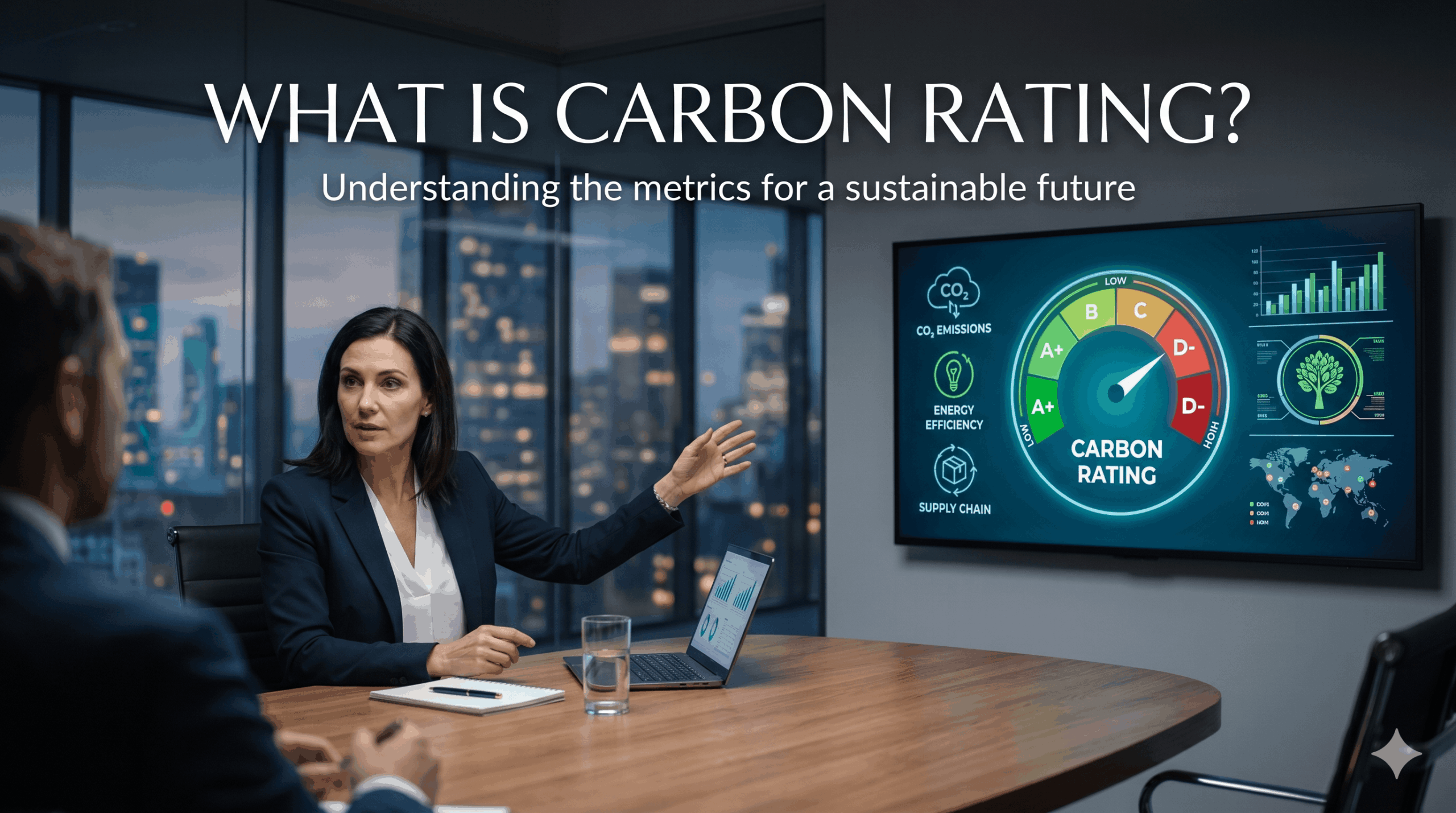
You have probably seen words like “carbon-rated,” “carbon score,” or “low-carbon certified” on a product label, a company report, or a news headline.
But what do they actually mean?
If you have been wondering what a carbon rating is, how it works, and why it matters, you are in exactly the right place.
This guide breaks it all down in simple, plain language – no jargon, no fluff, just clear answers.
What Is a Carbon Rating? The Simple Definition
A carbon rating is a score or grade that measures how much greenhouse gas (primarily carbon dioxide, or CO2) an entity produces, manages, or reduces.
It works like a report card for emissions.
The “entity” being rated can be many things – a company, a product, a carbon credit project, or even a ship.
The rating tells you how well that entity is managing its carbon footprint, and sometimes how trustworthy or high-quality its emissions reduction efforts are.
Think of it this way: just like a credit rating tells you how financially reliable a borrower is, a carbon rating tells you how environmentally reliable a company, product, or project is when it comes to carbon emissions.
Carbon Market Insider Newsletter
Weekly insights on carbon markets, climate policy, carbon credits, and sustainability.
Why Carbon Ratings Matter
Climate change is accelerating. Governments, investors, and consumers are all putting more pressure on organizations to cut emissions and prove they are doing so honestly.
This is where carbon ratings come in.
Without a rating system, it is nearly impossible to compare one company’s climate efforts to another’s.
It is hard to know whether a carbon offset project is actually removing emissions or just creating the illusion of action.
Carbon ratings solve this problem by creating a transparent, standardized way to measure, compare, and communicate carbon performance.
Here is why carbon ratings matter for everyone:
- For businesses: They signal credibility, attract investors, and help manage climate-related financial risk.
- For investors: They help identify which companies are genuinely transitioning to low-carbon operations and which are not.
- For consumers: They make it easier to choose products with a lower climate impact.
- For policymakers: They provide data to design more effective climate regulations.
- For carbon market participants: They signal the quality and integrity of carbon credits being bought and sold.
Carbon ratings are not a nice-to-have anymore. As we head deeper into the 2020s, they are becoming a baseline requirement for doing business responsibly.
The Four Main Types of Carbon Ratings
When people talk about “carbon rating,” they could mean four different things. Each applies to a different context.
Understanding which type of carbon rating someone is referring to is key to understanding what the score actually means.
1. Corporate Carbon Ratings (Company-Level)
This type of rating measures a company’s overall carbon performance.
It looks at how much greenhouse gas a company emits, how transparently it reports those emissions, and how seriously it is taking steps to reduce them.
Corporate carbon ratings are used by investors, banks, procurement teams, and regulators to evaluate climate risk and sustainability commitment.
The most widely recognized system for corporate carbon ratings is the CDP (Carbon Disclosure Project) scoring system.
2. Carbon Credit Ratings (Project-Level)
Carbon credits are certificates that represent the removal or reduction of one tonne of CO2 from the atmosphere.
A carbon credit rating assesses whether a specific carbon credit is high-quality and trustworthy.
It answers the question: “Does this carbon credit actually represent real, measurable, additional, and permanent emissions reductions?”
Organizations like BeZero Carbon, Sylvera, and Calyx Global provide these ratings.
3. Product Carbon Ratings (Product-Level)
A product carbon rating assesses the carbon footprint of a specific item across its entire life cycle.
This includes emissions from raw material extraction, manufacturing, transport, use, and disposal.
Product carbon ratings help consumers make greener purchasing decisions.
4. Ship Carbon Intensity Ratings (CII Ratings)
Ships are a major source of global CO2 emissions.
The International Maritime Organization (IMO) introduced a mandatory rating system called the Carbon Intensity Indicator (CII) to measure how efficiently ships operate in terms of carbon emissions.
Each of these four types is explored in detail in the sections below.
Corporate Carbon Ratings: How Companies Are Graded
What the CDP Scoring System Is
The Carbon Disclosure Project (CDP) is a non-profit organization founded in 2000.
It runs the world’s most widely used framework for corporate environmental disclosure.
Every year, CDP sends questionnaires to thousands of companies globally. Companies respond by sharing data on their greenhouse gas emissions, climate risks, energy use, and reduction strategies.
CDP then assigns each responding company a score based on four levels: Disclosure, Awareness, Management, and Leadership.
How CDP Scores Work
CDP uses a scoring scale from D to A, with an additional F score for companies that are asked to respond but refuse to disclose.
Here is what each level means:
- D (Disclosure): The company has shared some information but is at a basic level.
- C (Awareness): The company understands its environmental impact and shows some awareness of climate risks.
- B (Management): The company is actively managing and reducing its environmental impact.
- A (Leadership): The company is a best-in-class environmental leader, demonstrating strategic action, transparency, and strong governance.
- F (Failure to Disclose): The company was asked to participate but did not respond at all.
The top performers each year earn A-List status, published publicly every December.
In 2025, 877 companies achieved A-List status – a 70% increase from 2024 – and 23 companies earned Triple A scores across climate, water, and forests simultaneously.
What CDP Evaluates
CDP does not just look at how much a company emits. It looks at the full picture of climate management.
Key areas of assessment include:
- Scope 1, 2, and 3 emissions: Direct emissions from owned operations (Scope 1), indirect emissions from purchased energy (Scope 2), and all other value chain emissions (Scope 3).
- Emissions reduction targets: Whether the company has set science-based targets.
- Climate risk management: How the company identifies and manages physical and transition climate risks.
- Value chain engagement: Whether the company works with suppliers and customers to reduce Scope 3 emissions.
- Carbon pricing: Whether the company uses an internal carbon price to guide investment decisions.
- Governance: Whether executive leadership is accountable for climate performance.
As of 2026, CDP uses a single Integrated Questionnaire that consolidates multiple environmental themes like climate, water, and forests into one streamlined disclosure process.
The GHG Protocol: The Foundation of Corporate Carbon Measurement
Before a company can be rated, it needs to measure its emissions.
The most widely used and internationally recognized methodology for doing this is the Greenhouse Gas (GHG) Protocol.
Developed jointly by the World Resources Institute (WRI) and the World Business Council for Sustainable Development (WBCSD) in 1998, the GHG Protocol provides a standardized framework for measuring and reporting corporate emissions.
It categorizes emissions into three scopes:
Scope 1 – Direct emissions: These come from sources a company owns or controls directly. Examples include fuel burned in company vehicles and emissions from on-site manufacturing processes.
Scope 2 – Indirect energy emissions: These come from the generation of purchased electricity, steam, heat, or cooling that a company consumes. Even though the emissions happen at the power plant, they are attributed to the buyer of the energy.
Scope 3 – All other indirect emissions: This is the broadest and often largest category. It includes emissions from a company’s supply chain, employee commuting, business travel, product use, and end-of-life disposal.
Getting Scope 3 right is challenging, but it is increasingly important. Scope 3 often accounts for more than 70% of a company’s total carbon footprint.
Sustainalytics Carbon Risk Ratings
Apart from CDP, another major player in corporate carbon ratings is Sustainalytics.
Sustainalytics provides Carbon Risk Ratings that assess how exposed a company is to carbon-related financial risks as the global economy transitions to a low-carbon model.
These ratings evaluate both a company’s exposure to carbon risk (how much of its business model depends on high-emission activities) and its management of that risk (how well it is reducing or preparing for regulatory, reputational, and physical climate pressures).
Investors use Sustainalytics ratings to build climate-aware portfolios and screen for ESG (Environmental, Social, and Governance) risk.
Carbon Credit Ratings: How Projects Are Graded
What Carbon Credits Are
A carbon credit is a tradable certificate that represents the removal or avoidance of one metric tonne of CO2 (or an equivalent amount of another greenhouse gas) from the atmosphere.
Companies and governments use carbon credits to offset emissions they cannot yet eliminate.
Carbon credits come from projects like:
- Protecting forests that would otherwise be cut down (REDD+ projects)
- Installing renewable energy in place of fossil fuels
- Capturing methane from landfills and coal mines
- Direct air capture technology that pulls CO2 directly from the atmosphere
- Restoring peatlands, mangroves, and other natural carbon sinks
But not all carbon credits are equal.
Some projects deliver exactly what they promise. Others overestimate their impact, fail to create truly additional emissions reductions, or produce benefits that do not last.
This is where carbon credit rating agencies come in.
What Carbon Credit Rating Agencies Do
Carbon credit rating agencies are independent organizations that analyze carbon projects and assign them a rating based on their quality, integrity, and risk.
They act similarly to financial credit rating agencies like Moody’s or S&P but for carbon.
The main agencies currently operating in the voluntary carbon market include:
BeZero Carbon Founded in 2020, BeZero is widely considered the market’s leading carbon credit rating agency. It uses a Generalized Rating Analytical Framework along with sector-specific risk assessments. BeZero is the only major agency to make its headline ratings publicly available. It uses a scale similar to financial credit ratings, ranging from D (lowest) to AAA (highest).
Sylvera Sylvera provides independent ratings and risk analytics for carbon credits. It combines remote-sensing data, on-the-ground field teams, and proprietary models to assess project quality. Sylvera uses a tiered system from Tier 1 to Tier 5, with higher tiers indicating higher quality.
Calyx Global Founded in 2021, Calyx Global offers comprehensive independent carbon credit ratings. It provides a subscription-based ratings service alongside detailed project reports. Calyx uses the Calyx Carbon Integrity Index to evaluate trends in credit quality across the broader market.
MSCI Carbon MSCI entered the carbon credit ratings space and offers ratings that are increasingly used by institutional buyers. In 2025, credits rated A or higher by MSCI Carbon accounted for 36% of the total $1.4 billion retirement value in the voluntary market – a clear signal of growing demand for independently verified quality.
What Carbon Credit Ratings Evaluate
Rating agencies assess carbon credits across several critical dimensions:
Additionality This asks: “Would the emissions reduction have happened anyway, without the carbon project?”
A project that prevents deforestation in an area that was genuinely at risk of being cleared is additional. A project that claims credit for a forest that was never in danger of being cut down is not additional.
Permanence This asks: “Will the emissions reduction or carbon removal last?”
A forest protected today could burn down or be cleared in the future, releasing the stored carbon back into the atmosphere. Permanence assesses how durable the carbon storage is. Technology-based removals like direct air capture with geological storage score highest on permanence.
Measurability (Quantification) This asks: “Was the amount of emissions reduced or removed measured accurately?”
Rating agencies look at whether the project used rigorous monitoring, reporting, and verification (MRV) methods to quantify its impact.
Leakage This asks: “Did the project just push emissions somewhere else?”
For example, if a forest protection project in one area simply shifts logging activity to a neighboring forest, the net benefit is reduced or eliminated.
Co-benefits Many high-quality projects also deliver social and environmental benefits beyond carbon, such as protecting biodiversity, supporting local communities, or improving watershed health.
Rating agencies often assess co-benefits alongside carbon integrity.
How Carbon Credit Quality Affects Price
The market is clear: quality commands a premium.
In 2025, investment-grade credits rated BBB or higher by BeZero averaged $14.80 per tonne. Lower-rated credits averaged just $3.50 per tonne.
This price gap is growing, not shrinking.
Demand for high-quality, highly rated credits is outpacing supply, and this imbalance has been consistent for three consecutive years. Buyers are increasingly choosing integrity over cost savings.
The “Integrity Reset” in the Carbon Markets
Between 2021 and 2023, the voluntary carbon market experienced a period of rapid growth followed by significant controversy, as investigations exposed low-quality projects delivering far fewer emission reductions than claimed.
Between 2024 and 2025, the market underwent what experts now call the “integrity reset” – a collective industry effort to raise the bar for what counts as a credible carbon credit.
This reset was driven by:
- The introduction of the ICVCM Core Carbon Principles (CCP) label, which sets a global baseline standard for high-integrity credits.
- Growing influence of independent rating agencies providing project-level analysis.
- Stricter requirements from major standards bodies like Verra, Gold Standard, and American Carbon Registry.
- Regulatory clarity from the Article 6 of the Paris Agreement mechanisms, finalized at COP30 in November 2025.
As of 2026, the carbon market has entered what analysts describe as a “professionalization phase” – characterized by more data, clearer regulatory frameworks, and sharper differentiation between high- and low-quality assets.
Product Carbon Ratings: How Products Are Graded
What a Product Carbon Rating Is
A product carbon rating assesses the carbon footprint of a specific good or service across its entire life cycle.
This is called a Life Cycle Assessment (LCA) approach.
It tracks emissions from the moment raw materials are extracted all the way through to when the product is discarded or recycled.
The Life Cycle Stages of a Product
Here is how emissions are calculated at each stage of a product’s life:
- Raw material extraction: Mining, harvesting, or growing the inputs needed.
- Manufacturing: Converting those materials into a finished product.
- Transport and distribution: Moving the product from factory to retailer to customer.
- Product use phase: Emissions generated when the customer uses the product (especially relevant for energy-consuming products like appliances or vehicles).
- End-of-life: How the product is disposed of, recycled, or composted.
A carbon rating for a product summarizes the total emissions across all these stages – usually expressed in kilograms of CO2 equivalent (kgCO2e).
Why Product Carbon Ratings Help Consumers
Product carbon ratings give consumers a simple, comparable signal about climate impact.
Imagine two laptops sitting side by side on a shelf. One has a carbon label showing its footprint was 300 kgCO2e across its lifecycle. The other shows 600 kgCO2e.
Even without knowing exactly what those numbers mean in absolute terms, a consumer can instantly see that the first laptop has half the carbon impact.
This kind of transparency is driving real change in purchasing decisions, particularly among climate-conscious consumers.
ISO Standards for Product Carbon Footprints
The main international standards governing product carbon measurement are:
- ISO 14064: Covers greenhouse gas accounting and verification.
- ISO 14067: Specifically covers the carbon footprint of products.
- PAS 2050: A publicly available specification developed by the British Standards Institution for measuring product carbon footprints.
Companies that want their product carbon ratings to be credible need to follow one of these recognized methodologies.
Ship Carbon Ratings: The IMO’s CII System
What the CII Is
The Carbon Intensity Indicator (CII) is a mandatory rating system for ships introduced by the International Maritime Organization (IMO) under MARPOL Annex VI.
It came into force on January 1, 2023.
The CII measures how efficiently a ship transports cargo or passengers in terms of CO2 emissions per tonne-mile.
It applies to all cargo ships, RoPax vessels, and cruise ships above 5,000 gross tonnes operating internationally.
How the CII Is Calculated
The CII is calculated by dividing a ship’s annual CO2 emissions by its transport work – which is its cargo-carrying capacity multiplied by the distance sailed.
The unit is: grams of CO2 per cargo-carrying capacity and nautical mile.
Correction factors are applied for specific ship types and voyage circumstances to ensure a fair comparison.
The CII Rating Scale
Based on its calculated CII value, each ship receives one of five annual ratings:
- A (Major Superior): The ship is significantly more carbon-efficient than the required target.
- B (Minor Superior): The ship performs above the required target.
- C (Moderate): The ship meets the required target. This is the minimum acceptable rating.
- D (Minor Inferior): The ship falls below the required target.
- E (Inferior): The ship significantly fails the required target.
Ships that receive a D rating for three consecutive years or an E rating for even one year must submit a corrective action plan showing how they will reach a C rating or above.
The CII’s Moving Target
One of the most important things to understand about the CII is that it is a moving target.
The IMO raises the required performance standard every year through 2030, requiring a 40% reduction in carbon intensity compared to 2008 levels.
In 2026, the required CO2 reduction factor from the 2019 reference line is 11%.
This means a ship that achieved a C rating in one year may slip to a D rating the following year – even if its actual emissions did not change – simply because the benchmark got stricter.
This design forces continuous improvement, not just a one-time fix.
What Ships Can Do to Improve Their CII Rating
Ships have several strategies to improve their CII ratings:
- Slow steaming: Reducing sailing speed significantly cuts fuel consumption and emissions.
- Fuel switching: Moving from heavy fuel oil to LNG, methanol, ammonia, or biofuels.
- Hull and propeller optimization: Reducing hydrodynamic drag improves fuel efficiency.
- Voyage planning: Choosing more efficient routes and reducing unnecessary ballast voyages.
- Energy-saving devices: Installing technologies like air lubrication systems, waste heat recovery, or wind-assist propulsion.
How Carbon Ratings Differ From Carbon Taxes and Carbon Trading
People often confuse carbon ratings with carbon taxes and emissions trading systems. These are related but distinct concepts.
Carbon ratings are measurement and communication tools. They tell you how well an entity is managing its emissions.
Carbon taxes are financial penalties applied to emissions. Companies pay a set price for each tonne of CO2 they emit above a threshold.
Emissions Trading Systems (ETSs) are cap-and-trade schemes where the government sets a limit on total emissions. Companies buy and sell permits to emit within that cap.
Carbon ratings can inform carbon markets – for example, high-rated carbon credits trade at a premium in the voluntary carbon market – but they are not the same as a carbon price or a permit.
The Role of Third-Party Verification in Carbon Ratings
A carbon rating is only as good as the data behind it.
This is why third-party verification is a critical part of any credible carbon rating process.
Third-party verifiers are independent auditors who check that the data a company or project has reported is accurate.
For corporate carbon footprints, verifiers follow standards like ISO 14064-3 to audit emissions reports.
For carbon credits, verifiers called Validation and Verification Bodies (VVBs) assess whether a project meets the requirements of carbon standards like Verra’s Verified Carbon Standard (VCS) or Gold Standard.
Independent rating agencies like Sylvera and BeZero add a further layer of scrutiny on top of verification — they assess not just whether the numbers are accurate but whether the underlying project design and assumptions are sound.
This multi-layer system of standards, verification, and ratings is what gives the carbon market its credibility — when it works well.
Challenges and Limitations of Carbon Ratings
Carbon ratings are valuable, but they are not perfect. It is important to understand their limitations.
Inconsistency Between Rating Agencies
Different rating agencies sometimes reach very different conclusions about the same project.
A 2023 review by Carbon Market Watch found that the same carbon projects received notably different ratings from BeZero, Calyx, Sylvera, and Renoster.
For example, an avoided deforestation project in the Amazon received a high rating from one agency and a low rating from others.
This inconsistency highlights the fact that rating methodologies are still evolving and that no single universal standard for carbon credit quality exists yet.
Data Quality and Availability
Calculating accurate emissions, especially for Scope 3 or for land-based carbon projects in remote areas, requires high-quality data that is often hard to collect.
Satellite data, ground surveys, and emissions factors all come with uncertainty ranges.
Rating agencies have to make assumptions, and those assumptions can differ significantly.
Greenwashing Risk
Some companies use carbon ratings selectively – highlighting favorable scores while downplaying areas where they perform poorly.
A company might achieve a high CDP score for disclosure without actually making meaningful emissions reductions.
Ratings communicate commitment and management quality, but they do not guarantee that emissions are falling fast enough to meet climate targets.
Evolving Methodologies
Rating methodologies change every year as new scientific evidence emerges and standards tighten.
A company or project that scored well under an older methodology might score lower under a revised framework.
This makes historical comparisons complicated.
Who Uses Carbon Ratings and How
Institutional Investors
Asset managers and pension funds use carbon ratings to screen investments, build low-carbon portfolios, and manage transition risk.
Ratings from providers like Sustainalytics and MSCI Carbon are widely integrated into ESG investment platforms.
Corporate Buyers of Carbon Credits
Companies buying carbon credits to offset their emissions increasingly require credits to carry a rating of BBB or above from agencies like BeZero or Sylvera.
Some large corporates will only accept credits with the ICVCM Core Carbon Principles (CCP) label – a further quality filter applied on top of project-level ratings.
Banks and Lenders
Financial institutions use carbon ratings to assess climate risk in their loan portfolios and to meet their own sustainability reporting obligations.
Procurement Teams
Large companies use supplier carbon ratings to manage Scope 3 emissions in their supply chains, increasingly requiring suppliers to disclose and reduce their carbon footprint as a condition of doing business.
Regulators
Governments and regulatory bodies use carbon ratings and carbon intensity data to design and enforce climate policies, including emissions trading schemes and carbon border adjustment mechanisms.
Carbon Ratings and the Future: Where This Is Heading
Growing Standardization
The carbon rating ecosystem is maturing rapidly.
Work is underway to create more consistent, comparable standards across rating agencies, so that a BBB from one agency means something comparable to a BBB from another.
The ICVCM (Integrity Council for the Voluntary Carbon Market) is playing a key role here by establishing core principles that all high-quality credits must meet, providing a shared foundation for rating agencies to build on.
Mandatory Disclosure Requirements
Across major economies, voluntary carbon disclosure is steadily becoming mandatory.
The EU’s Corporate Sustainability Reporting Directive (CSRD) already requires large European companies to publish detailed sustainability reports.
The EU Carbon Border Adjustment Mechanism (CBAM), which began its full phase-in in 2026, requires companies importing certain goods into the EU to pay for their embedded carbon, creating strong new incentives for accurate carbon measurement and reporting.
In the US, the SEC has been moving toward requiring climate-related disclosures for public companies, though implementation timelines have shifted.
As mandates spread, carbon ratings will become more standardized and more widely integrated into financial and regulatory systems.
Article 6 and Carbon Market Maturation
The finalization of Article 6 of the Paris Agreement at COP30 in November 2025 brought much-needed clarity to how carbon credits can flow between countries under internationally agreed rules.
This development is expected to increase demand for high-quality, highly rated credits – particularly those that meet both voluntary market standards and emerging compliance requirements like CORSIA for international aviation.
The Rise of Technology-Based Carbon Removal
As nature-based carbon removal faces growing scrutiny around permanence and additionality, technology-based removal methods like Direct Air Capture (DAC), biochar, and enhanced rock weathering are gaining attention.
These methods offer higher permanence and more measurable outcomes, and are beginning to attract high ratings from agencies like BeZero.
DAC pioneer Climeworks’ Orca facility has received the market’s first AAA rating from BeZero – the highest possible score – reflecting the exceptional permanence of its geological CO2 storage.
How to Improve Your Carbon Rating: Practical Steps for Businesses
If you run or work for a business that wants to improve its carbon rating, here is a practical roadmap.
Step 1: Measure Your Emissions
You cannot manage what you do not measure.
Start by calculating your Scope 1, 2, and 3 emissions using the GHG Protocol methodology.
Use recognized tools, software platforms, or engage a sustainability consultant to ensure accuracy.
Step 2: Set Science-Based Targets
Set emission reduction targets aligned with the Science Based Targets initiative (SBTi) – the recognized global standard for corporate climate targets.
SBTi targets require companies to reduce emissions in line with limiting global warming to 1.5°C above pre-industrial levels.
Having SBTi-validated targets significantly boosts CDP scores and improves your standing with investors.
Step 3: Disclose Through CDP
Submit your data to CDP each year.
Even a first-year submission typically earns a C or D score, but it gets your company on the disclosure radar.
Over two to three years of consistent improvement, companies regularly move up to B and eventually A.
Step 4: Reduce Before Offsetting
Carbon ratings reward actual emissions reductions, not just offsetting.
Focus first on reducing your Scope 1 and 2 emissions through energy efficiency, renewable energy procurement, and process improvements.
Use high-quality carbon credits to offset residual emissions only after you have made meaningful direct reductions.
Step 5: Engage Your Supply Chain
Work with your suppliers to reduce Scope 3 emissions.
CDP scores increasingly reward value chain engagement. Ask your key suppliers to measure and disclose their own emissions.
Step 6: Verify Your Data
Third-party verification of your emissions data strengthens credibility and is required for higher CDP scores.
Engage an accredited verification body to audit your data annually.
Step 7: Communicate Transparently
Use your carbon rating as a communication tool – in annual reports, investor presentations, procurement pitches, and customer-facing materials.
But always be honest about where you are in your decarbonization journey. Overstating progress is a greenwashing risk that can backfire badly.
Carbon Rating vs. Carbon Footprint vs. Carbon Offset: Key Differences
These three terms are often confused. Here is a quick summary:
Carbon Footprint This is the total amount of greenhouse gases an entity emits, measured in tonnes of CO2 equivalent (tCO2e).
It is a raw number, not a judgment.
Carbon Rating This is a grade or score assigned based on how well an entity measures, manages, or reduces its carbon footprint relative to a benchmark, peer group, or standard.
It puts the footprint in context.
Carbon Offset This is a mechanism to compensate for emissions by funding equivalent emissions reductions or removals elsewhere.
Carbon credits are the unit of account for offsets. Their quality is assessed through carbon credit ratings.
Glossary of Key Carbon Rating Terms
Additionality: The principle that a carbon project must create emissions reductions that would not have happened without the project.
Article 6: The section of the Paris Agreement that governs the use of international carbon markets between countries.
CBAM: Carbon Border Adjustment Mechanism, an EU policy requiring importers of carbon-intensive goods to pay for embedded emissions.
CDP: Carbon Disclosure Project, the leading global framework for voluntary corporate environmental disclosure and scoring.
CII: Carbon Intensity Indicator, the IMO’s mandatory ship carbon rating system.
CORSIA: Carbon Offsetting and Reduction Scheme for International Aviation, the aviation industry’s carbon offset program.
GHG Protocol: The most widely used international standard for measuring and reporting corporate greenhouse gas emissions.
ICVCM: Integrity Council for the Voluntary Carbon Market – the body that sets Core Carbon Principles for high-integrity carbon credits.
LCA: Life Cycle Assessment, a methodology for calculating the carbon footprint of a product across its entire life cycle.
Permanence: The durability of carbon storage in a carbon removal project.
Scope 1, 2, 3 Emissions: The GHG Protocol’s categorization of direct emissions (Scope 1), purchased energy emissions (Scope 2), and value chain emissions (Scope 3).
VCM: Voluntary Carbon Market – the market where companies and organizations voluntarily buy and sell carbon credits to offset their emissions.
Frequently Asked Questions About Carbon Rating
Q: What is a carbon rating in simple terms?
A carbon rating is a score that tells you how well a company, product, carbon credit project, or ship is managing its greenhouse gas emissions. It works like a report card for carbon performance.
Q: What is a good carbon rating for a company?
In the CDP system, an A or A- is considered an excellent score, indicating leadership-level environmental performance. A B score indicates strong management. C or below means there is significant room for improvement.
Q: What is a carbon credit rating?
A carbon credit rating is an independent assessment of a carbon credit project that evaluates whether the emissions reductions it claims are real, additional, measurable, and permanent. Higher-rated credits are more trustworthy and trade at a premium.
Q: What does a CII rating mean for a ship?
A CII rating measures how carbon-efficiently a ship operates. Ratings run from A (best) to E (worst). Ships must maintain at least a C rating; those that fall to D for three years in a row or E for one year must submit a corrective action plan.
Q: How does the CDP carbon rating work?
CDP collects annual environmental disclosures from thousands of companies and scores them from D (basic disclosure) to A (leadership). Companies that are asked to participate but refuse receive an F. The methodology rewards transparency, active management, and climate leadership.
Q: What is the difference between a carbon rating and a carbon footprint?
A carbon footprint is the raw number – the total amount of greenhouse gases an entity emits. A carbon rating is a contextual score that evaluates how well the entity is managing that footprint relative to benchmarks or standards.
Q: Are carbon ratings mandatory?
This depends on the context. CII ratings for ships are mandatory under IMO regulations. CDP reporting is technically voluntary, but in practice, over 740 financial institutions representing $142 trillion in assets request company disclosures, making participation near-essential. Product carbon labels are mostly voluntary but are becoming more standardized. Corporate sustainability reporting is becoming mandatory in the EU and other jurisdictions.
Q: Can small businesses get a carbon rating?
Yes. CDP has introduced a simplified SME questionnaire with fewer data points specifically designed to help smaller organizations participate in carbon disclosure without the full complexity of the large-company questionnaire.
Q: What is an “investment-grade” carbon credit?
In carbon market terminology, investment-grade credits are typically those rated BBB or higher by agencies like BeZero or Calyx Global. In 2025, these credits averaged $14.80 per tonne, compared to $3.50 for lower-rated credits.
Q: How do I check a company’s carbon rating?
You can look up a company’s CDP score on the CDP website (cdp.net) – scores for publicly reporting companies are available for free. For investor-grade ratings, Sustainalytics and MSCI Carbon publish ratings accessible through financial data platforms.
Conclusion: Why Carbon Ratings Are the Future of Climate Accountability
Carbon ratings are not just a technical tool for climate scientists or financial analysts.
They are becoming the common language of climate accountability.
Whether you are a business owner trying to win investors, a consumer trying to make greener choices, a ship operator trying to stay compliant, or a company buying carbon credits to meet net-zero commitments, carbon ratings affect you.
The core message is this: measuring emissions is not enough on its own. What matters is whether the measurement is honest, rigorous, and improving over time.
That is what carbon ratings verify.
As climate regulation tightens, supply chains demand more transparency, and investors price climate risk more carefully, carbon ratings will only grow in importance.
Understanding what a carbon rating is and how to improve yours, puts you ahead of the curve.
The organizations that take carbon ratings seriously today will be the ones that lead their industries tomorrow.