Carbon Market Network


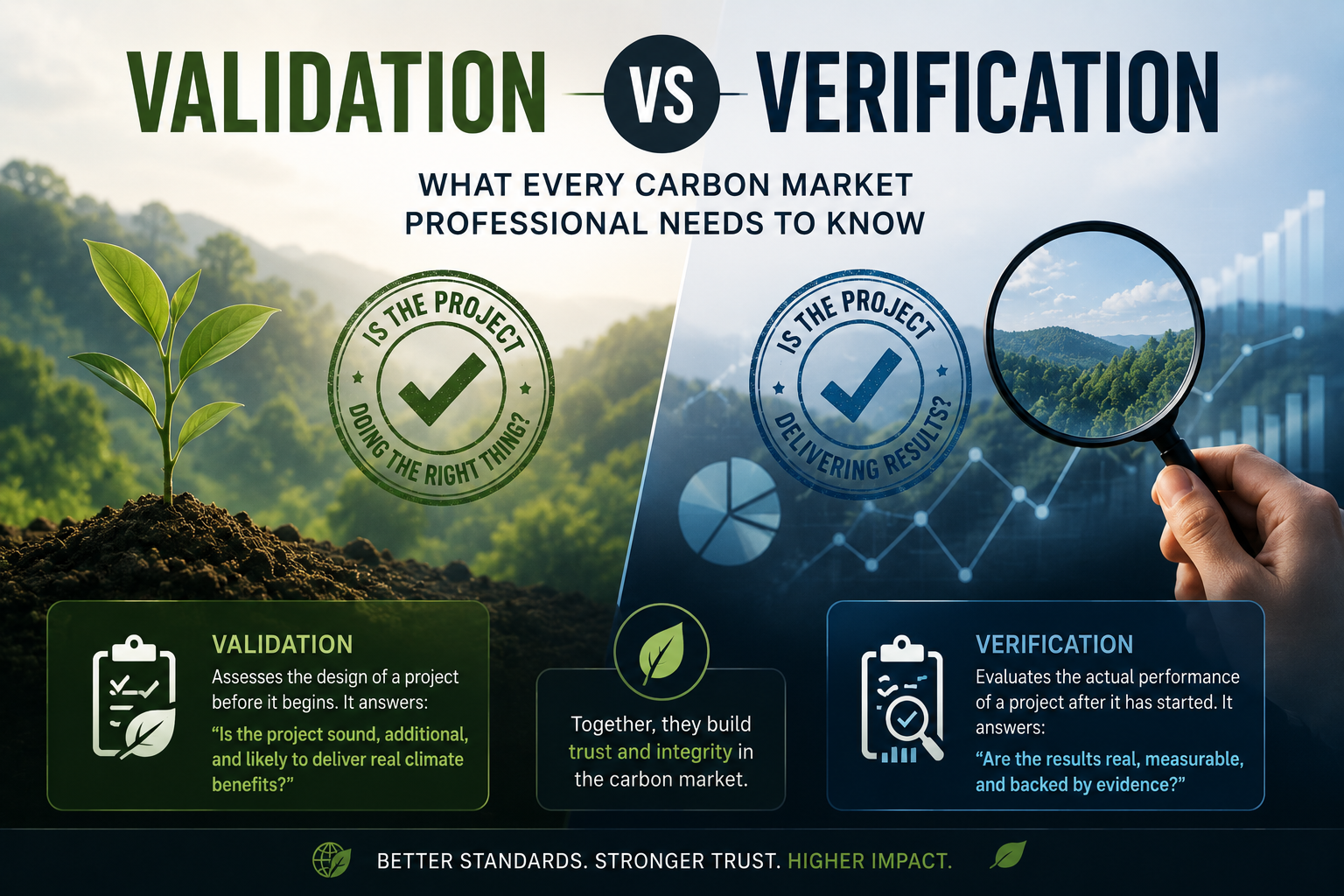
Every carbon credit you see traded, retired, or used to back a “carbon neutral” claim has passed through two critical checkpoints.
Those checkpoints are validation and verification.
Many people use these two words as if they mean the same thing. That mix-up causes real problems, from rejected project registrations to credits that buyers later distrust.
Validation and verification are two separate processes that happen at two separate points in a carbon project’s life. Each one answers a different question.
This guide explains validation vs verification in plain, simple language. You will learn what each term means, how each process actually works, who performs them, and why getting this distinction right matters so much in carbon markets, ESG reporting, and climate finance.
By the end, you will know exactly when a project needs validation, when it needs verification, and how the two processes work together to turn a project idea into a credible, tradable carbon credit.
What Is Validation?
Validation happens before a carbon project starts generating any credits.
It is the process of checking a project’s design against an approved methodology to confirm the project can realistically achieve the emission reductions it claims.
Think of validation like an engineer reviewing house blueprints before construction begins. The engineer is not checking the finished house. They are checking whether the plan makes sense and meets the required standards.
Validation works the same way for carbon projects. It checks the plan, not the outcome.
Carbon Market Insider Newsletter
Weekly insights on carbon markets, climate policy, carbon credits, and sustainability.
What Validation Actually Checks
An independent auditor looks closely at several things during validation:
- The Project Design Document (PDD): This document explains the project’s goals, location, technology, and expected climate impact.
- The baseline scenario: This is what would have happened to emissions if the project never existed.
- Additionality: This proves the project would not happen without revenue from carbon credits. Projects that would happen anyway cannot generate genuine credits.
- Methodology fit: The auditor confirms the developer picked the right methodology for the project type, whether that is reforestation, renewable energy, methane capture, or improved cookstoves.
- Stakeholder consultation and safeguards: This includes proof that local communities were consulted and that the project avoids social or environmental harm.
Why Validation Matters
Validation protects buyers, investors, and registries from funding projects that look impressive on paper but cannot deliver real climate benefits.
Without validation, anyone could register a project, claim huge emission reductions, and sell credits backed by little to no actual impact.
Validation is the gatekeeper that keeps weak or fraudulent projects out of the carbon market before they ever generate a single credit.
Who Performs Validation
Validation is carried out by an accredited, independent third-party auditor called a Validation and Verification Body, usually shortened to VVB.
A VVB has no financial stake in the project’s success. This independence is what keeps the entire process credible.
Major carbon credit registries that require formal validation include Verra (through the Verified Carbon Standard), Gold Standard, the American Carbon Registry, and the Climate Action Reserve. The Clean Development Mechanism under the UNFCCC also followed this same approach for many years.
What Is Verification?
Verification happens after a project has been operating for some time.
It is the process of confirming that a project actually achieved the emission reductions it monitored and reported during a specific period.
If validation checks the blueprint, verification checks the finished, occupied building.
What Verification Actually Checks
During verification, the VVB reviews real, on-the-ground evidence instead of plans and projections:
- The monitoring report: This document contains actual performance data collected during the reporting period, sometimes called a crediting period.
- Field data and instrumentation records: This can include meter readings, soil samples, satellite imagery, or sensor logs, depending on the project type.
- Calculation accuracy: The auditor checks the math used to convert raw monitoring data into a final emission reduction figure.
- Methodology compliance: The project must still follow the same methodology and conditions that were approved during validation.
- Any project changes: If anything about the project changed since validation, the auditor checks whether those changes affect the results.
Why Verification Matters
Verification is what turns a planned emission reduction into a confirmed, real one.
Only after a project successfully passes verification can a registry issue actual, tradable carbon credits. These are commonly called Verified Emission Reductions, or VERs, and were historically called Certified Emission Reductions, or CERs, under the Clean Development Mechanism.
Without verification, carbon credits would simply be promises. Buyers need proof, not promises.
Who Performs Verification
Verification is also carried out by an accredited VVB. Depending on the registry’s rules, this can be the same body that did the validation or a different one, which helps avoid conflicts of interest.
Verification is not a one-time event. It repeats throughout the project’s crediting period, typically once every one to five years, depending on the project type and registry requirements.
Validation vs Verification: The Core Difference at a Glance
| Aspect | Validation | Verification |
|---|---|---|
| When it happens | Before the project starts or very early in its life | After the project has operated for a defined period |
| What it checks | The project design and planned outcomes | Actual, measured results |
| Main document reviewed | Project Design Document (PDD) | Monitoring Report |
| Key question answered | “Can this project work as described?” | “Did this project actually deliver what it claimed?” |
| Frequency | One time, usually at project start | Repeats periodically throughout the crediting period |
| Outcome if successful | Project gets registered with a carbon standard | Registry issues real, tradable carbon credits |
| Performed by | Accredited VVB | Accredited VVB (same or different one) |
Step-by-Step: How the Validation Process Works
- Project design: The developer selects an approved methodology and writes the Project Design Document.
- Public comment period: Many registries require a public review window so stakeholders can raise concerns.
- Document submission: The developer submits the PDD and supporting evidence to a chosen VVB.
- Desk review: The VVB studies the documents to check methodology fit, baseline assumptions, and additionality.
- Site visit: In most cases, the VVB visits the project location to confirm conditions match what was described.
- Findings and corrective requests: The VVB flags any gaps and asks the developer to fix them.
- Validation report and opinion: The VVB issues a formal validation opinion confirming the project meets the standard’s requirements.
- Registration: The registry reviews the validation report and formally registers the project, allowing it to begin generating credits once verified.
Learn more about carbon credits: https://carboncreditcourse.com/
Step-by-Step: How the Verification Process Works
- Monitoring period ends: The project completes a defined monitoring or crediting period, often a calendar year.
- Data collection: The developer gathers all monitoring data required by the methodology.
- Monitoring report preparation: The developer compiles this data into a formal monitoring report.
- Submission to a VVB: The report and supporting evidence go to an accredited verification body.
- Desk review and data checks: The VVB checks calculations, sampling methods, and data quality.
- Site visit or remote audit: The VVB confirms the monitoring equipment and processes match what is described.
- Verification report: The VVB issues a formal opinion on whether the claimed emission reductions are accurate.
- Credit issuance: Once approved, the registry issues the verified carbon credits, which can then be sold, traded, or retired.
Validation vs Verification Across Major Carbon Standards
Different registries use slightly different terms, but the core validation and verification concept stays consistent across the industry.
| Standard | Validation Term | Verification Term | Issued Credit |
|---|---|---|---|
| Verra (VCS) | Validation | Verification | Verified Carbon Unit (VCU) |
| Gold Standard | Design Certification | Performance Certification | Gold Standard Verified Emission Reduction |
| American Carbon Registry | Validation | Verification | Emission Reduction Ton (ERT) |
| Climate Action Reserve | Listing and Validation | Verification | Climate Reserve Tonne (CRT) |
| Clean Development Mechanism (legacy) | Validation | Verification | Certified Emission Reduction (CER) |
ISO standards also formalize this process. ISO 14064-2 covers project design and quantification, while ISO 14064-3 sets out the principles for validation and verification of greenhouse gas statements. Many VVBs operate under ISO 14065 accreditation, which defines competence requirements for bodies performing this work.
Real-World Example: From Validation to Verified Carbon Credits
Picture a community-based clean cookstove project that wants to issue carbon credits.
Step one, validation: The developer writes a PDD explaining how the new stoves reduce wood consumption compared to traditional open fires. A VVB visits the community, checks the baseline assumptions, confirms additionality, and validates the project design. The registry then registers the project.
Step two, project operation: Households start using the new stoves. The developer tracks fuel usage, stove adoption rates, and other data required by the methodology.
Step three, verification: After one year, the developer submits a monitoring report showing actual wood savings. A VVB reviews the data, conducts spot checks, and confirms the numbers are accurate.
Step four, issuance: The registry issues verified carbon credits based on the confirmed reductions, and these credits become available for purchase on the carbon market.
This same pattern applies to solar projects, forest conservation projects, landfill gas capture projects, and almost every other carbon credit category.
Validation vs Verification Beyond Carbon Markets
The terms validation and verification also appear in other fields, and the underlying logic stays similar.
In quality management systems like ISO 9001, validation confirms a product or process meets the intended use, while verification confirms it meets specified requirements.
In software development, validation asks “are we building the right product,” while verification asks “are we building the product right.”
In manufacturing, validation checks whether a design will perform as intended, and verification checks whether the finished item actually matches the design specifications.
Across every industry, the same pattern repeats. Validation looks forward and checks a plan. Verification looks backward and checks results.
Common Mistakes Project Developers Make
Many new carbon project developers run into the same avoidable problems.
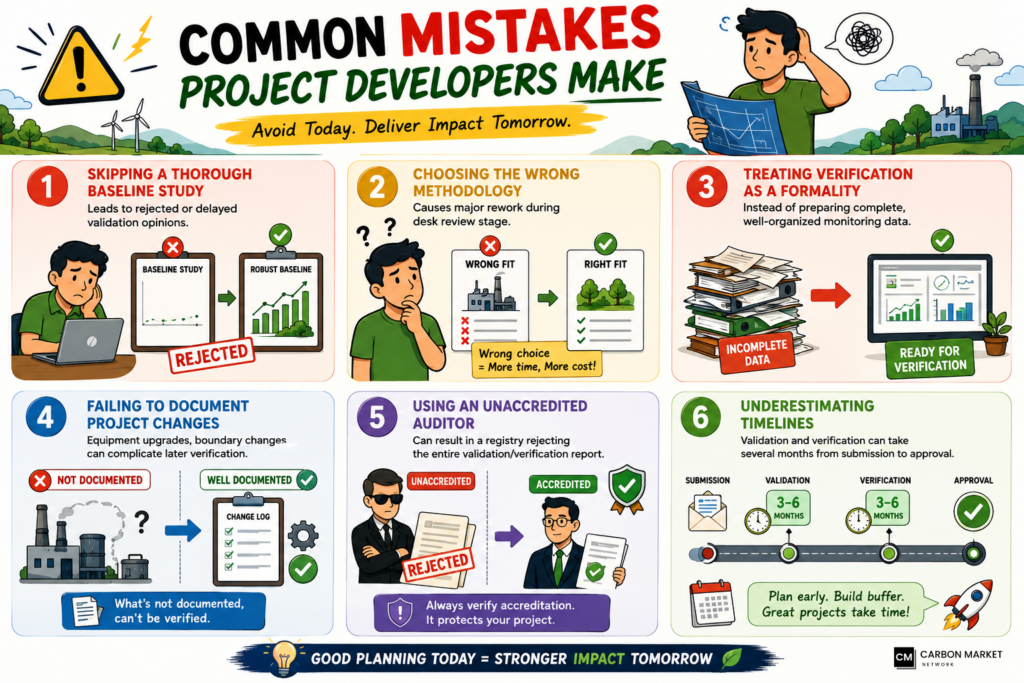
- Skipping a thorough baseline study before validation, which often leads to rejected or delayed validation opinions.
- Choosing the wrong methodology for the project type, which causes major rework during the desk review stage.
- Treating verification as a formality instead of preparing complete, well-organized monitoring data in advance.
- Failing to document project changes, such as equipment upgrades or boundary changes, which can complicate later verification cycles.
- Using an unaccredited auditor, which can result in a registry rejecting the entire validation or verification report.
- Underestimating timelines, since both validation and verification can take several months from submission to final approval.
How Validation and Verification Fit Into the Bigger MRV Picture
Validation and verification are two pieces of a larger system called MRV, which stands for Monitoring, Reporting, and Verification.
Monitoring is the ongoing collection of project data. Reporting is compiling that data into formal documents. Verification, as covered above, is the independent check of that reported data.
Validation sits slightly outside this cycle since it happens once at the start, but it sets the rules that monitoring and reporting must follow for the rest of the project’s life.
Strong MRV systems are what give carbon credits real credibility in voluntary and compliance carbon markets alike.
Actionable Checklist for Project Developers
Use this simple checklist before starting either process.
Before validation:
- Confirm the methodology matches the project type
- Build a defensible baseline scenario
- Document additionality clearly
- Complete stakeholder consultations
- Choose an accredited VVB early
Before verification:
- Organize monitoring data as it comes in, not at the last minute
- Calibrate and maintain monitoring equipment regularly
- Keep a clear log of any project changes
- Cross-check calculations before submission
- Schedule the VVB site visit with enough lead time
Frequently Asked Questions
What is the simplest way to remember validation vs verification?
Validation checks the plan before a project starts. Verification checks the results after the project runs for a period of time.
Can the same company perform both validation and verification?
In many cases yes, but some registries require a different accredited body for verification to avoid any conflict of interest.
Does every carbon project need both validation and verification?
Yes. A project must pass validation to get registered, and it must pass verification before any credits can actually be issued.
How long does carbon credit validation usually take?
Timelines vary by registry and project complexity, but validation commonly takes a few months from document submission to a final validation opinion.
How often does verification need to happen?
Most projects undergo verification once every one to five years throughout their crediting period, depending on the methodology and registry rules.
What happens if a project fails verification?
The VVB raises corrective action requests. The developer must fix the data or process issues and resubmit before any credits get issued.
Is validation the same as accreditation?
No. Accreditation refers to the VVB itself being certified as competent to perform validation and verification work. Validation refers to the actual review of a specific project.
Are VVB-issued credits guaranteed to be high quality?
Validation and verification significantly improve credibility, but credit quality also depends on the methodology’s rigor and the registry’s overall standards, so buyers should still review project details.
Conclusion
Validation vs verification is not just industry jargon. It represents two distinct, essential checkpoints that protect the integrity of every carbon credit on the market.
Validation confirms a project’s design can realistically deliver the emission reductions it promises. Verification confirms that the project actually delivered those reductions in practice.
Together, validation and verification form the backbone of trust in carbon markets. They give buyers, investors, and regulators confidence that a carbon credit represents a real, measurable, and additional climate benefit.
Whether you are a project developer, an ESG analyst, or simply trying to understand how carbon credits work, remembering this one distinction will help you navigate the carbon market with far more clarity and confidence.
For more insights on carbon markets, environmental finance, and sustainability mechanisms, explore the resources at Carbon Market Network.