Carbon Market Network


Every day, factories run, planes take off, and power plants burn fuel.
All of that releases carbon dioxide into the atmosphere, and the planet is warming because of it.
But here is the interesting part: someone figured out a way to put a price on pollution. And that idea turned into a trillion-dollar global market.
That market is the carbon market, and it is changing how governments, companies, and even farmers think about climate change.
If you have ever wondered how the carbon market works, who participates in it, what a carbon credit actually is, and whether any of this actually helps the planet, this guide covers all of it, from scratch.
No jargon. No fluff. Just a clear, honest explanation of one of the most important financial and environmental systems in the world today.
What Is the Carbon Market?
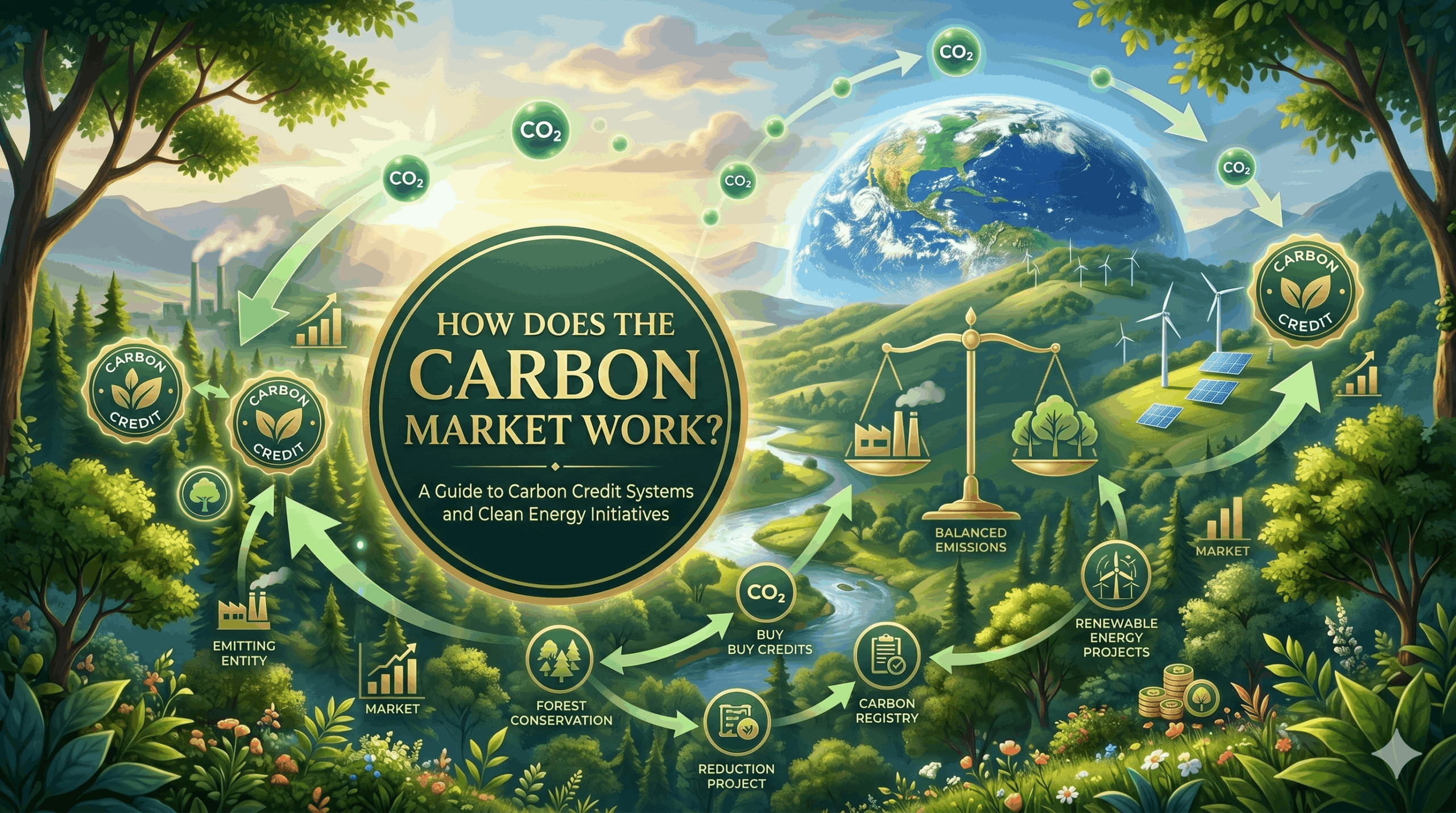
The carbon market is a system where carbon dioxide emissions are given a price.
It allows companies and governments to buy and sell the “right to emit” greenhouse gases, or to trade credits earned by reducing or removing those gases from the atmosphere.
The core logic is simple: if emitting carbon costs money, companies will work harder to emit less of it.
Think of it like a cap on pollution. Governments set a limit. Companies that stay under the limit can sell their extra allowance. Companies that go over the limit must buy more from others or pay a penalty.
This creates a financial incentive to pollute less.
The carbon market does not eliminate emissions overnight. But it creates economic pressure that pushes businesses toward cleaner choices over time.
Carbon Market Insider Newsletter
Weekly insights on carbon markets, climate policy, carbon credits, and sustainability.
Why Was the Carbon Market Created?
Climate scientists have been warning about the dangers of greenhouse gas emissions for decades.
The problem is that emitting carbon dioxide has traditionally been free. Companies could release as much as they wanted without any direct financial consequence.
Economists call this a “negative externality.” The damage gets spread across society, but the polluter does not pay for it.
The carbon market was designed to fix this by making pollution expensive.
The idea gained serious traction in the 1990s. The United States actually used a similar cap-and-trade system to reduce sulfur dioxide emissions that caused acid rain. It worked remarkably well and served as a model for carbon markets later.
The Kyoto Protocol in 1997 was the first major international agreement to use carbon trading as a climate tool.
Since then, carbon markets have expanded to cover dozens of countries and hundreds of billions of dollars in annual trade.
The Two Main Types of Carbon Markets
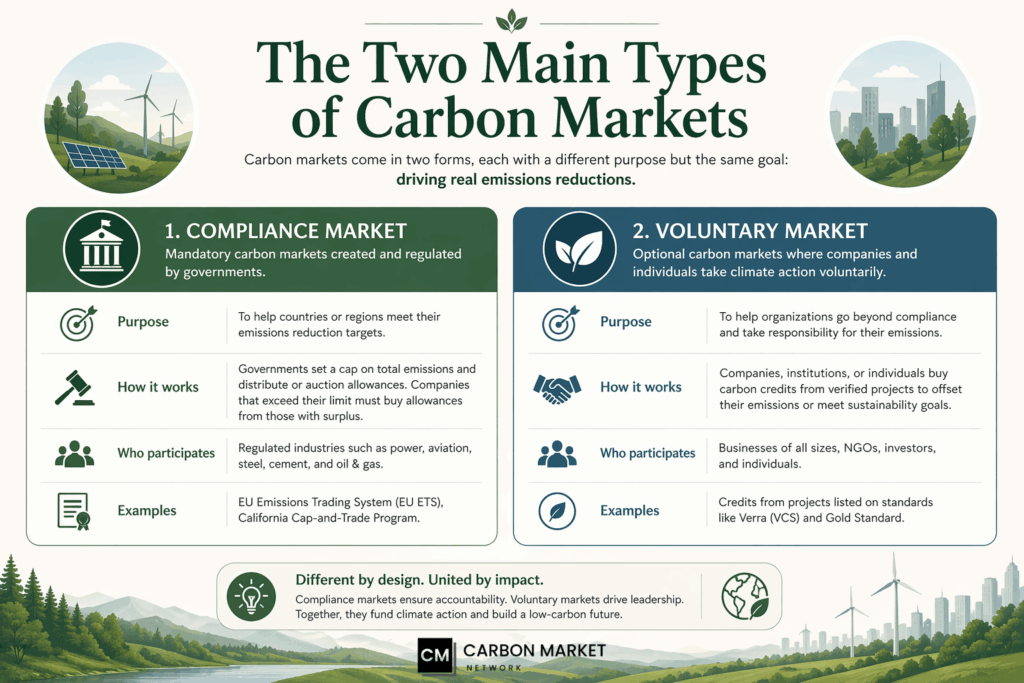
Before diving deeper, you need to understand the two broad categories of carbon markets.
They operate differently, serve different purposes, and involve different types of buyers and sellers.
1. Compliance Carbon Markets (Regulated Markets)
Compliance markets are created and enforced by law.
A government or regulatory authority sets a hard limit on how much carbon a company or industry can emit. Companies that operate within these regulated sectors must comply with the rules or face legal penalties.
These markets are also called “mandatory” markets because participation is not optional.
Examples of compliance markets:
- EU Emissions Trading System (EU ETS): The world’s largest carbon market, covering power plants, airlines, and heavy industries across Europe.
- California Cap-and-Trade Program: One of the most well-developed compliance markets in the United States.
- China National ETS: The world’s largest by emissions volume, covering the power sector.
- UK ETS: Launched after Brexit, covering energy and industrial sectors.
- India’s Carbon Credit Trading Scheme (CCTS): India’s domestic compliance market currently being developed under the Energy Conservation (Amendment) Act, 2022.
In compliance markets, the main unit traded is called an emissions allowance or permit.
One allowance typically equals the right to emit one metric ton of CO2 equivalent (CO2e).
2. Voluntary Carbon Markets (VCMs)
Voluntary markets are driven by choice, not law.
Any company, organization, or even individual can participate.
Buyers purchase carbon credits to offset their emissions voluntarily, usually to meet sustainability goals or net-zero commitments.
These credits are generated by projects that reduce, avoid, or remove carbon from the atmosphere.
Think solar farms in rural areas, forest conservation projects, or community cookstove programs in Africa.
Key players in voluntary markets:
- Companies with net-zero pledges (like Microsoft, Google, Apple)
- Airlines offering carbon offset options to passengers
- Startups building carbon removal technologies
- Nonprofits and conservation groups
The voluntary market has grown rapidly, with billions of dollars now flowing through it annually, although it also faces serious criticism around quality and verification, which we will cover later.
What Is a Carbon Credit?
A carbon credit is a certificate that represents the reduction or removal of one metric ton of CO2 equivalent from the atmosphere.
When a project reduces or removes emissions, it earns carbon credits. Those credits can then be sold to companies or individuals who want to offset their own emissions.
Here is a simple example:
A company in India installs solar panels in a rural village, replacing diesel generators. The project avoids emitting, say, 10,000 tons of CO2 over five years. It earns 10,000 carbon credits. It then sells those credits to a European airline that wants to offset its flight emissions.
The airline “retires” the credits, meaning they are permanently removed from circulation. The credit cannot be sold again.
Carbon credits are sometimes called carbon offsets, though the two terms have slightly different technical meanings depending on the context.
What Is a Carbon Allowance?
A carbon allowance is different from a carbon credit.
Allowances exist only in compliance markets. They are issued by the government and represent the permission to emit a certain amount of greenhouse gas.
Credits are earned by doing something good for the climate.
Allowances are issued as part of the cap.
Think of it this way:
- Allowance = a permit to pollute (issued by regulators)
- Credit = a reward for reducing pollution (earned by project developers)
In some compliance markets, companies can use a limited number of credits (from offset projects) to meet their allowance obligations. But in most cases, allowances and credits are different instruments traded in different systems.
How Does Cap-and-Trade Work? (Step by Step)
Cap-and-trade is the most widely used mechanism in compliance carbon markets.
Here is exactly how it works, step by step.
- The Cap Is Set
The government (or regulatory body) sets a total limit, called the “cap,” on how much CO2 a covered sector can emit in a given period.
For example, the regulator might cap total emissions from power plants at 500 million tons of CO2 per year. - Allowances Are Distributed
The regulator divides the cap into individual allowances. Each allowance permits one ton of CO2 emissions.
These allowances are either given free to companies (based on historical emissions) or auctioned off. Over time, most systems shift toward more auctioning. - Companies Operate and Emit
Companies go about their business. They produce goods, generate power, and run operations. All of this emits carbon.
- Companies Account for Their Emissions
At the end of each compliance period, each company must surrender allowances equal to its actual emissions.
If a factory emitted 100,000 tons of CO2, it must hand over 100,000 allowances. - Trading Happens
Here is where the market kicks in.
Some companies emit less than their allowance. They have surplus permits.
Other companies emit more than their allowance. They need more permits.
The companies with surplus sell to the ones with a deficit.
This trading happens on carbon exchanges, through brokers, or in bilateral deals. - The Cap Is Tightened Over Time
Each year (or compliance period), the cap is reduced. Fewer allowances are available in the market.
This gradually makes carbon more scarce and more expensive, pushing companies to invest in cleaner technology rather than keep buying permits.
The Key Insight:
Cap-and-trade lets the market find the cheapest way to reduce emissions. Companies that can cut emissions cheaply do so, and sell their surplus. Companies that cannot cut emissions cheaply buy permits from others. Overall, the same total reduction is achieved at a lower cost to society.
How Does the Voluntary Carbon Market Work?
The voluntary carbon market (VCM) operates very differently from compliance markets.
There is no government-imposed cap. No mandatory surrender of credits. Just a marketplace where emissions reductions are bought and sold based on choice.
Here is how it works end to end.
Project Development
A developer (a company, NGO, government, or community group) designs a project that will reduce or remove carbon emissions.
Examples:
- Protecting a forest that would otherwise be cut down (REDD+ projects)
- Planting new trees on degraded land (afforestation)
- Building renewable energy plants to replace coal
- Distributing efficient cookstoves to rural households
- Capturing methane from landfills or farms
- Direct air capture of CO2 using technology
Baseline Setting
Before any credits can be generated, the project must establish a baseline, which is an estimate of what emissions would have looked like without the project.
This is critical and controversial. If the baseline is too generous (overstated), the project appears to reduce more emissions than it actually does.
Third-Party Verification
The project is reviewed and certified by an independent standard body.
Major verification standards include:
- Verra’s Verified Carbon Standard (VCS): The most widely used voluntary standard globally.
- Gold Standard: Known for strong co-benefits like poverty reduction and biodiversity.
- American Carbon Registry (ACR)
- Climate Action Reserve (CAR)
- Plan Vivo: Focused on smallholder farmers and community-based projects.
These bodies check the methodology, verify the emission reductions, and issue certified carbon credits (often called VCUs, or Verified Carbon Units, under Verra’s system).
Credit Issuance and Listing
Once certified, the credits are listed on a carbon registry.
The registry tracks ownership, prevents double-counting, and records when credits are retired.
Buying and Selling
Buyers purchase credits through:
- Carbon exchanges (like Xpansiv CBL, ACX, or AirCarbon Exchange)
- Brokers who match buyers and sellers
- Direct deals with project developers
- Retail platforms that let individuals offset their personal carbon footprint
Retirement
When a company uses a credit to offset its emissions, the credit is “retired” in the registry.
Retirement is permanent and public. It proves the offset was used and cannot be sold again.
Who Participates in the Carbon Market?
The carbon market brings together a diverse set of players.
Emitters (Buyers of allowances/credits):
- Power plants and utilities
- Steel, cement, and aluminum manufacturers
- Airlines and shipping companies
- Oil and gas companies
- Large corporations with net-zero pledges
Project Developers (Sellers of credits):
- Renewable energy companies
- Forest conservation organizations
- Agricultural project operators
- Tech startups working on carbon removal
Intermediaries:
- Carbon brokers
- Investment banks
- Commodity trading firms
- Carbon consultancies
Regulators and Standard Bodies:
- Government agencies (EU, California ARB, China’s MEE)
- Verra, Gold Standard, Plan Vivo, ACR
Investors and Speculators:
- Hedge funds and commodity traders
- ESG-focused investors
- Carbon-focused ETFs and funds
Retailers:
- Platforms like Terrapass, South Pole, and Cool Effect that sell offsets to individuals and small businesses
How Is the Price of Carbon Determined?
Carbon prices are not fixed. They fluctuate based on supply and demand, just like any other market.
Factors that push carbon prices up:
- A tighter cap (fewer allowances available)
- Strong economic growth (more industrial activity, more demand for permits)
- High energy prices (coal becomes more expensive to run, creating more demand to reduce coal use)
- Policy signals favoring stricter climate rules
- Low renewable energy availability (e.g., less wind means more gas, more need for permits)
Factors that push carbon prices down:
- A looser cap (more allowances than needed)
- Economic slowdown (less industrial activity, less demand for permits)
- Political uncertainty or weak climate policy
- An oversupply of low-quality offset credits flooding the voluntary market
Current carbon price ranges (approximate, 2024-2025):
- EU ETS: Around €50 to €70 per ton (has peaked above €100 in 2023)
- California Cap-and-Trade: Around $30 to $40 per ton
- China ETS: Around $10 to $15 per ton (still in early stages)
- Voluntary market credits: Wide range, from as low as $1 to over $100 per ton, depending on quality and co-benefits
Many climate economists argue that to meet Paris Agreement targets, the global carbon price needs to reach $100 to $200 per ton or more by 2030. Most markets are still well below that level.
What Are Carbon Offsets, and Do They Work?
Carbon offsets are credits purchased to compensate for emissions made elsewhere.
The idea is that a ton of CO2 not emitted in one place is equivalent to a ton of CO2 emitted somewhere else, as long as the reduction is real, measurable, and permanent.
In theory, this is sound. In practice, it is complicated.
The Case For Carbon Offsets
- They channel money into conservation, clean energy, and community development in the developing world.
- They allow companies to take immediate climate action while transitioning their own operations.
- High-quality offsets fund projects that would never happen without carbon finance, like protecting remote forests or distributing cookstoves to rural households.
- They create jobs and co-benefits in local communities.
The Case Against Carbon Offsets (and the Criticisms)
Several major investigations and research studies have raised serious questions about offset quality.
Additionality problems: This is the big one. A carbon credit is only valid if the emission reduction would not have happened anyway.
If a forest was never going to be cut down, protecting it does not actually reduce emissions. But it might still generate credits.
A 2023 investigation by The Guardian and academic researchers found that a large share of REDD+ forest credits from Verra did not represent genuine carbon reductions.
Permanence risk: A forest protected today might burn down in a wildfire tomorrow. The carbon returns to the atmosphere. The company that bought the offset already retired it.
Most standards now require “buffer pools” of extra credits to account for this risk, but critics argue it is not enough.
Leakage: If you protect one forest, loggers might simply move to the next one. The emissions get displaced rather than reduced.
Overestimated baselines: Some projects calculate what emissions would have been without the project using inflated assumptions, making the reduction look bigger than it really is.
The Bottom Line on Offsets
Offsets are not a substitute for cutting your own emissions.
Every serious climate framework, including the Science Based Targets initiative (SBTi), requires companies to first cut their own emissions as deeply as possible.
Offsets are meant to address only residual, hard-to-abate emissions.
When used correctly, high-quality offsets do contribute to climate action.
The problem is that not all credits are equal, and the market has struggled to ensure consistent quality.
Carbon Markets in India: What You Need to Know
India is one of the most important emerging carbon markets in the world.
As a large and rapidly industrializing economy, India has both significant emissions and significant potential to generate carbon reductions.
India’s Carbon Credit Trading Scheme (CCTS)
The Energy Conservation (Amendment) Act, 2022 gave the Indian government the legal authority to establish a domestic carbon market.
The Carbon Credit Trading Scheme (CCTS) is being developed by the Bureau of Energy Efficiency (BEE) under the Ministry of Power.
It is designed to be a compliance market where designated consumers (large industrial facilities) will be required to meet emissions intensity targets and can trade credits for compliance.
The scheme is expected to cover sectors like:
- Aluminium
- Cement
- Chlor-alkali
- Iron and steel
- Paper and pulp
- Petrochemicals
- Petroleum refineries
- Textile
India’s PAT Scheme (Perform, Achieve, and Trade)
India already has an energy efficiency trading mechanism called the PAT scheme under BEE.
Under PAT, energy-intensive industries are given specific energy consumption targets. Those that outperform their targets earn Energy Saving Certificates (ESCerts). Those that fall short must buy ESCerts from the overachievers.
The CCTS is expected to eventually align with and build upon the PAT framework.
India and the Voluntary Carbon Market
India is also one of the world’s largest suppliers of voluntary carbon credits.
Indian projects in areas like solar energy, wind power, improved cookstoves, and forest conservation have generated millions of credits traded on international markets.
With Article 6 of the Paris Agreement now operational (more on this below), India is expected to play an even larger role in international carbon trading.
Renewable Energy Certificates (RECs)
Alongside carbon credits, India also has a market for Renewable Energy Certificates (RECs).
RECs are issued to renewable energy generators and can be traded on power exchanges like IEX and PXIL. They are distinct from carbon credits but serve a related purpose of incentivizing clean energy.
Article 6 of the Paris Agreement: International Carbon Trading
One of the most complex and important recent developments in carbon markets is the operationalization of Article 6 of the Paris Agreement.
Article 6 creates a framework for countries to cooperate on emissions reductions and trade carbon credits internationally.
Article 6.2: Bilateral Deals Between Countries
Article 6.2 allows two countries to enter into bilateral agreements to trade emissions reductions.
For example, Switzerland has signed agreements with Ghana and Vanuatu to fund emission reduction projects in those countries and count the reductions toward Switzerland’s own national targets.
These internationally traded mitigation outcomes are called ITMOs (Internationally Transferred Mitigation Outcomes).
To prevent double-counting, the host country must make a “corresponding adjustment” to its own national emissions inventory, essentially giving up the reduction so the buying country can count it.
Article 6.4: The UN Carbon Market
Article 6.4 creates a centralized, UN-supervised international carbon market.
It replaces the Clean Development Mechanism (CDM) from the Kyoto Protocol era and is designed to generate high-integrity carbon credits that countries and eventually private entities can use.
The Article 6.4 rulebook was substantially agreed upon at COP29 in Baku in 2024, marking a major milestone after years of negotiations.
Why Article 6 Matters
Article 6 matters because it has the potential to channel hundreds of billions of dollars in climate finance from wealthy countries to developing nations.
It also creates rules to prevent double-counting of carbon reductions, which has been a major problem in the past.
India, as a developing country with enormous mitigation potential, stands to be one of the biggest beneficiaries of Article 6 if the framework is implemented effectively.
Carbon Removal vs. Carbon Avoidance: What Is the Difference?
Not all carbon credits are the same type.
Understanding the difference between carbon removal and carbon avoidance (or reduction) is important for evaluating credit quality.
Carbon Avoidance / Emission Reduction Credits
These credits are generated when an activity prevents emissions that would otherwise have occurred.
Examples:
- Protecting a forest from deforestation (avoids emissions from burning trees)
- Installing solar panels instead of using coal (avoids emissions from burning coal)
- Distributing efficient cookstoves (avoids emissions from burning biomass inefficiently)
Avoidance credits are generally cheaper and more abundant.
The challenge is that they rely on counterfactual reasoning: what would have happened without the project? This makes them harder to verify and more susceptible to over-crediting.
Carbon Removal Credits
These credits are generated when carbon is physically removed from the atmosphere and stored.
Examples:
- Planting trees that absorb CO2 as they grow (nature-based removal)
- Biochar production (carbon from biomass locked into a stable form)
- Bioenergy with Carbon Capture and Storage (BECCS)
- Direct Air Capture (DAC) using machines that pull CO2 directly from the air
- Enhanced weathering of rocks that naturally absorb CO2
Removal credits are generally considered higher quality because they physically reduce atmospheric CO2.
They are also generally more expensive, especially technological removal methods like DAC, which currently costs $300 to $1,000 per ton or more.
As the carbon market matures, there is a growing push to shift the market toward removal credits, especially for companies claiming to be “carbon neutral” or “net zero.”
The Controversy Around Corporate Carbon Neutrality Claims
Saying “we are carbon neutral” has become a marketing staple for hundreds of companies.
But many of these claims are built on a shaky foundation of cheap, low-quality offsets.
Greenwashing in the Carbon Market
Greenwashing happens when a company uses carbon offsets to claim climate credentials without actually reducing its own emissions significantly.
A company might offset a million tons of CO2 by purchasing cheap REDD+ credits at $3 each, while making little effort to cut emissions from its own supply chain.
This is problematic for two reasons:
- It misleads consumers and investors.
- It allows emissions to continue when they should be cut.
Regulatory Crackdown
Regulators are starting to take action.
The European Union has moved to ban the use of “carbon neutral” claims in consumer advertising unless backed by certified, high-quality offsets.
The UK Competition and Markets Authority has also issued guidance warning companies against misleading green claims.
Several class-action lawsuits have been filed against airlines and consumer brands for greenwashing related to carbon offset claims.
The Science Based Targets Initiative (SBTi)
SBTi is a framework that helps companies set emissions reduction targets in line with the Paris Agreement.
SBTi requires companies to cut their own emissions by at least 90% before using offsets for residual emissions.
This is a much stricter standard than simply buying credits to “neutralize” everything.
More and more companies are adopting SBTi-aligned targets, which represents a shift toward more credible climate commitments.
How Carbon Markets Help Fight Climate Change (And Their Limits)
Carbon markets are a tool. Like any tool, they can be used well or badly.
What Carbon Markets Do Well
They put a price on carbon. This is foundational. When emitting carbon costs money, businesses have a direct financial reason to reduce emissions.
They drive investment in clean technology. Higher carbon prices make solar, wind, and efficiency investments more attractive compared to fossil fuels.
They are economically efficient. Markets find the cheapest emission reductions first, which reduces the overall cost of meeting climate targets.
They channel money to developing countries. The voluntary carbon market and Article 6 both route climate finance to places like India, Brazil, and sub-Saharan Africa, where emissions can often be cut cheaply and communities benefit from the investment.
They create a measurable record. Registries, verification, and retirement records create a paper trail for emission reductions.
What Carbon Markets Cannot Do
They cannot replace direct regulation and technology mandates. Markets are a complement to policy, not a replacement. Efficiency standards, clean energy mandates, and technology investments are also essential.
They cannot solve the quality problem on their own. Without rigorous standards and enforcement, the market fills with low-quality credits that deliver no real climate benefit.
They do not always capture the full social cost of carbon. Even at €70 per ton, the EU ETS price may still be below the true social cost of carbon emissions.
They are politically vulnerable. Carbon prices can be cut, weakened, or eliminated by political decisions. Australia scrapped its carbon pricing mechanism in 2014, and Poland has repeatedly lobbied to weaken the EU ETS.
Real-World Examples of Carbon Markets in Action
Example 1: The EU ETS and the Steel Industry
ArcelorMittal, one of the world’s largest steelmakers, operates across Europe and falls under the EU ETS.
As the EU has tightened the cap and reduced free allowances, the cost of carbon compliance has grown significantly.
This has pushed ArcelorMittal and its competitors to invest in hydrogen-based steelmaking and electric arc furnaces as alternatives to the carbon-intensive blast furnace route.
The carbon price signal from the EU ETS is directly driving investment in green steel technology.
Example 2: California Cap-and-Trade and Cement
Cement production is one of the most carbon-intensive industries in the world.
Under California’s cap-and-trade program, cement companies receive fewer free allowances each year.
This creates a growing compliance cost that is pushing producers to invest in blended cements that use less clinker (the most carbon-intensive component) and to explore carbon capture and storage options.
Example 3: Forest Conservation in the Amazon
The Surui Forest Carbon Project in Brazil was one of the first indigenous-led REDD+ projects.
The Paiter-Surui tribe used carbon finance to protect 250,000 hectares of Amazon rainforest that was at risk of deforestation.
Credits from the project were purchased by companies including Google.
The project generated both carbon benefits and significant co-benefits: funding for community schools, health programs, and sustainable livelihoods.
However, the project also illustrates the challenges of REDD+ credits. Deforestation continued in surrounding areas, raising leakage concerns, and the project was eventually suspended from Verra’s registry due to governance issues.
Example 4: India’s Solar Credits on the Voluntary Market
Hundreds of solar energy projects across India have generated voluntary carbon credits under the CDM and VCS standards.
A solar park in Rajasthan, for example, avoids coal emissions by generating clean power for the grid. The emission reductions are measured, verified, and sold as credits to European or American companies seeking to offset their footprint.
This creates a direct flow of capital from wealthy-country corporations to Indian renewable energy projects.
Example 5: Microsoft’s Carbon Removal Strategy
Microsoft has committed to being carbon negative by 2030 and to remove all historical emissions by 2050.
Rather than relying on cheap avoidance credits, Microsoft has invested heavily in high-quality removal credits, including:
- Direct air capture (DAC) from companies like Climeworks and 1PointFive
- Biochar from Charm Industrial
- Enhanced weathering projects
Microsoft’s approach is considered a gold standard for corporate carbon strategy and has helped drive demand for high-quality removal credits.
Carbon Market Integrity: The Push for Higher Standards
One of the biggest challenges facing carbon markets, especially the voluntary market, is ensuring that credits represent genuine, high-quality emission reductions.
The Integrity Council for the Voluntary Carbon Market (ICVCM)
The ICVCM was established in 2021 to develop Core Carbon Principles (CCPs) for the voluntary market.
These principles set a high bar for what counts as a credible carbon credit, covering:
- Additionality
- Permanence
- Robust quantification
- No double-counting
- Sustainable development contributions
- No net harm
Credits that meet CCP standards can carry an “approved” label, making it easier for buyers to identify high-quality credits.
The Voluntary Carbon Markets Integrity Initiative (VCMI)
The VCMI works on the demand side, helping companies make credible claims about their use of carbon credits.
It has developed the VCMI Claims Code of Practice, which defines what types of climate claims companies can make and under what conditions.
Carbon Border Adjustment Mechanism (CBAM)
This is a landmark EU policy that took effect in 2023.
CBAM puts a carbon price on imported goods from countries with weaker climate policies, like steel, cement, aluminum, fertilizers, and electricity.
It is designed to prevent “carbon leakage,” where companies move production to countries with no carbon price to avoid compliance costs.
CBAM is significant for countries like India because it means Indian manufacturers exporting to Europe will increasingly need to account for the carbon embedded in their products.
How to Buy Carbon Credits: A Practical Guide
Interested in participating in the carbon market? Here is a practical overview.
For Companies
Step 1: Measure your emissions. Use the GHG Protocol Corporate Standard to calculate your Scope 1, 2, and 3 emissions.
Step 2: Set a reduction target. Ideally aligned with SBTi or a similar science-based framework. Focus on cutting your own emissions first.
Step 3: Identify residual emissions. These are the emissions that are genuinely hard to eliminate, even with significant effort.
Step 4: Choose high-quality credits. Look for credits that are:
- Verified by a reputable standard (Verra, Gold Standard, ACR)
- Ideally ICVCM-approved
- Additional, permanent, and verifiable
- From project types with strong track records (removal credits or well-monitored avoidance projects)
Step 5: Purchase and retire credits through a reputable registry. Use Verra’s Markit registry, Gold Standard Impact Registry, or a trusted broker or exchange platform.
Step 6: Make accurate claims. Do not claim “carbon neutral” unless you meet the full requirements of a recognized standard. Refer to VCMI guidelines for what you can and cannot say.
For Individuals
You can also offset your personal carbon footprint.
Calculate your footprint: Use tools like the WWF Carbon Footprint Calculator, the EPA carbon calculator, or similar platforms.
Buy credits from verified platforms: Look for platforms that clearly state which standard the credits follow and allow you to see the retirement certificate.
Reputable platforms include:
- Gold Standard Marketplace
- Cool Effect (US-based, focuses on high-quality projects)
- Atmosfair (focused on aviation offsets)
- Terrapass
Be skeptical of extremely cheap offsets. A $1 per ton credit is almost certainly not delivering real climate benefits.
The Future of Carbon Markets
Carbon markets are evolving rapidly. Here is where things are heading.
Higher Carbon Prices
Most analysts expect carbon prices to rise significantly over the next decade as caps tighten and climate targets become more ambitious.
The EU ETS price is expected to rise to €100 to €150 per ton or more by 2030, according to multiple analyst forecasts.
Higher prices will drive more investment in clean technology and make low-carbon options more competitive.
A Shift Toward Carbon Removal
The voluntary market is shifting away from cheap avoidance credits toward high-quality removal credits.
Technological removal (DAC, biochar, BECCS) is scaling up, and major buyers are increasingly willing to pay a premium for removal over avoidance.
Article 6 Implementation
The operationalization of Article 6 will create a more connected global carbon market.
Developing countries like India will be able to generate high-integrity credits for international sale while managing their own national accounting carefully.
AI and Digital MRV
Monitoring, Reporting, and Verification (MRV) is the backbone of carbon market integrity.
AI, satellite imagery, and remote sensing are making MRV faster, cheaper, and more accurate.
Companies like Pachama and Sylvera use machine learning to assess forest carbon projects from satellite data, reducing reliance on expensive on-the-ground verification.
Standardization and Convergence
There is growing pressure to consolidate the fragmented voluntary market into a smaller number of high-integrity standards and registries.
The ICVCM’s Core Carbon Principles are a major step in this direction. More standardization will improve market liquidity and buyer confidence.
Emerging Carbon Market Economies
India, Brazil, Indonesia, and several African nations are developing domestic carbon markets and positioning themselves as major suppliers of international credits.
As Article 6 matures, these countries will need to balance selling credits internationally with meeting their own national climate commitments.
Common Misconceptions About the Carbon Market
Let us clear up a few things that often confuse people.
“Buying carbon credits means you do not have to cut emissions.”
No. Credits are meant to address residual emissions that cannot be cut, not to substitute for cutting emissions. Anyone claiming otherwise is misusing the system.
“All carbon credits are the same.”
Absolutely not. Credit quality varies enormously by project type, methodology, verification standard, and implementation. A $3 REDD+ credit from a poorly monitored project is not equivalent to a $100 direct air capture credit.
“Carbon markets are just a way for polluters to keep polluting.”
This is a legitimate concern, but it misunderstands the mechanics. A well-designed cap-and-trade system ensures total emissions go down over time because the cap is gradually tightened. The market allocates where the reductions happen, but the total is fixed.
“The voluntary carbon market is a scam.”
It has real problems, and some projects have been deeply flawed. But dismissing the whole system ignores the genuine impact of high-quality projects on forests, communities, and clean energy. The right response is better standards and enforcement, not abandoning carbon markets altogether.
“Carbon markets are only for big companies.”
Individuals can participate too, through retail offset platforms. And small and medium businesses increasingly engage with the voluntary market as part of their sustainability strategies.
Conclusion: Understanding How the Carbon Market Works Is Not Optional Anymore
The carbon market is no longer a niche topic for environmental economists.
It is a fast-growing financial system that touches every industry, every country, and increasingly, every company that makes or moves anything.
Understanding how the carbon market works, whether you are a policy professional, a corporate sustainability manager, an investor, or simply a curious reader, gives you a clearer picture of how the world is trying to solve its biggest challenge.
The system is imperfect. Carbon prices are often too low. Credit quality is uneven. Greenwashing is real.
But the direction is clear: the world is putting a price on carbon, and that price is going up.
Companies that understand the carbon market today will be better positioned to navigate the regulations, risks, and opportunities of tomorrow.
Whether you are buying credits, selling them, designing projects, setting policy, or just trying to understand the news, the carbon market is a system worth knowing well.
And now you do.
Frequently Asked Questions (FAQ)
What is the carbon market in simple terms?
The carbon market is a system where the right to emit greenhouse gases is bought and sold. Companies that emit less than their allowed limit can sell their surplus to companies that emit more. This creates a financial incentive to reduce emissions.
What is the difference between a carbon credit and a carbon allowance?
A carbon allowance is a permit issued by a government in a compliance market that allows a company to emit one ton of CO2. A carbon credit is earned by a project that reduces or removes one ton of CO2 and is primarily used in voluntary markets.
How much does a carbon credit cost?
Prices vary widely. In compliance markets, EU ETS allowances currently trade between €50 and €70 per ton. In the voluntary market, credit prices range from under $5 for low-quality credits to over $100 for high-quality removal credits.
Do carbon credits actually reduce emissions?
High-quality credits that are additional, permanent, and well-verified do contribute to real emission reductions. However, many low-quality credits on the market do not deliver the reductions they claim. Quality verification is critical.
What is cap-and-trade?
Cap-and-trade is a system where the government sets a total limit (cap) on emissions, issues allowances equal to that cap, and lets companies trade those allowances. Companies that reduce emissions can sell surplus allowances; those that exceed the cap must buy more.
What is the voluntary carbon market?
The voluntary carbon market is where companies and individuals buy and sell carbon credits without being legally required to do so. It is driven by voluntary climate commitments and sustainability goals rather than government mandates.
What is Article 6 of the Paris Agreement?
Article 6 creates a framework for countries to trade carbon credits internationally. It includes rules for bilateral deals between countries (Article 6.2) and a UN-supervised global carbon market (Article 6.4). It is designed to prevent double-counting and channel climate finance to developing nations.
What is carbon offsetting?
Carbon offsetting is the practice of compensating for your own emissions by funding emission reductions or removals elsewhere. A company might offset its flight emissions by purchasing credits from a forest conservation project.
What is the difference between carbon removal and carbon avoidance?
Carbon avoidance credits are generated by preventing emissions that would otherwise occur (like protecting a forest). Carbon removal credits are generated by physically removing CO2 from the atmosphere (like planting trees or using direct air capture technology). Removal credits are generally considered higher quality.
What is India’s carbon market?
India is developing the Carbon Credit Trading Scheme (CCTS) under the Bureau of Energy Efficiency. It will be a compliance market covering major industrial sectors. India also participates actively in the voluntary carbon market as a large supplier of project-based credits.
Is the carbon market working?
The evidence is mixed. Well-designed compliance markets like the EU ETS have contributed to significant emission reductions in covered sectors. The voluntary market has delivered genuine benefits in some cases but has also been plagued by quality issues. Overall, carbon markets are a useful tool but work best alongside other climate policies.
How can my company start participating in the carbon market?
Start by measuring your emissions using the GHG Protocol standard. Then set a science-based reduction target. Purchase high-quality carbon credits only for residual emissions you cannot eliminate. Work with a reputable broker or exchange and always retire credits through a verified registry.