Carbon Market Network


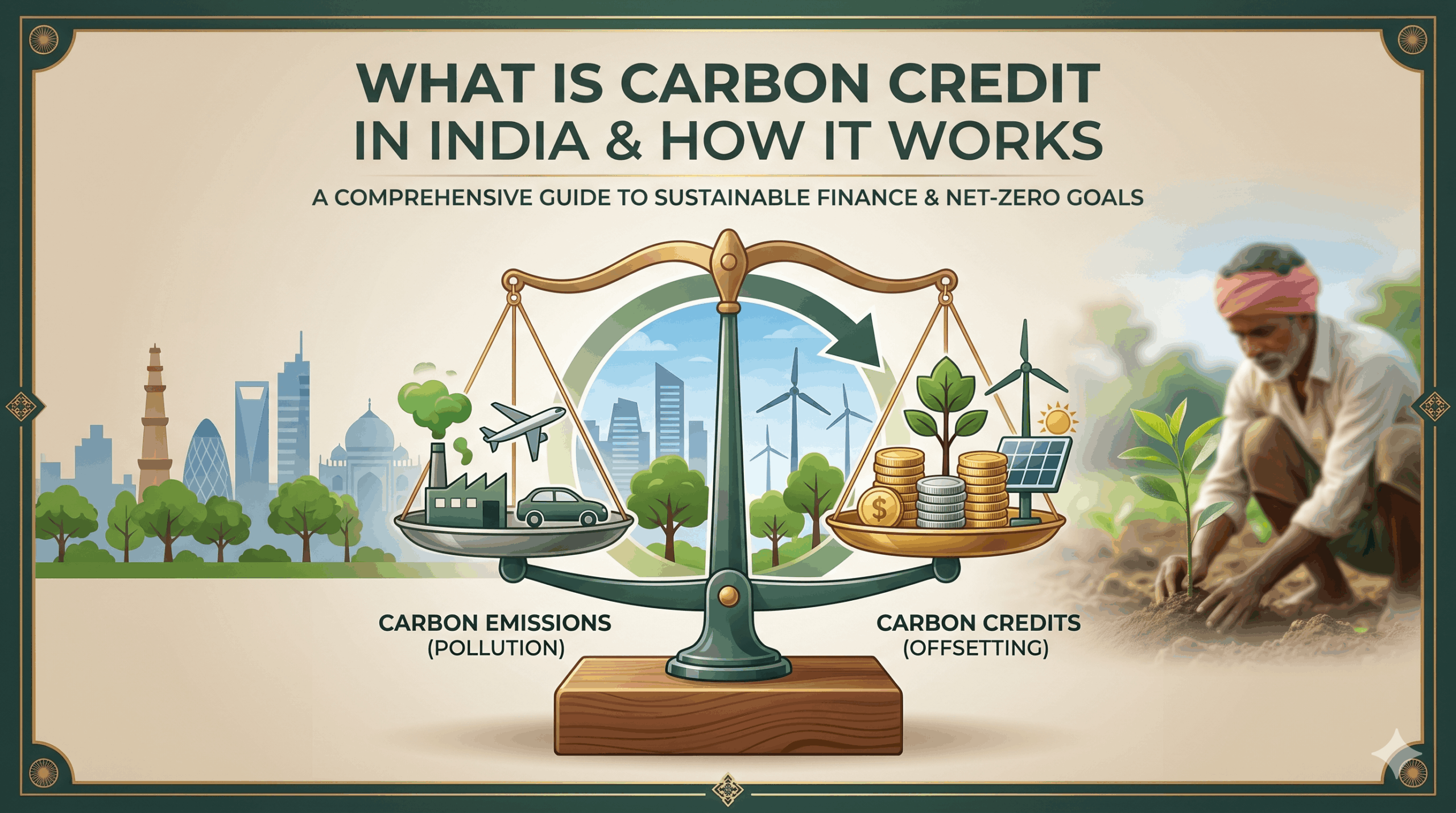
India is on the verge of running one of the largest carbon markets in the world.
If you have been hearing the term “carbon credit in India” more often lately, there is a very good reason for that.
The country is actively building a structured system to put a price on pollution and reward businesses that pollute less.
Whether you are a factory owner, a renewable energy developer, a student, or just someone curious about climate policy, understanding carbon credits in India is becoming increasingly important.
This guide covers everything. What carbon credits are, how they work in India, which industries are affected, how to earn them, how much they are worth, and what the Indian Carbon Market means for you going forward.
What Is a Carbon Credit?
A carbon credit is a tradable certificate that represents the reduction, removal, or avoidance of one tonne of carbon dioxide (CO₂) or its equivalent in other greenhouse gases.
Think of it like a permission slip, but in reverse. Instead of giving you permission to pollute, a carbon credit proves that you have prevented or removed pollution.
One carbon credit = one tonne of CO₂ equivalent (CO₂e) reduced or avoided.
If a company reduces its emissions by 10,000 tonnes of CO₂ in a year, it earns 10,000 carbon credits. It can then sell those credits to another company that is struggling to meet its emission targets.
This creates a financial incentive to go green. Companies that clean up their act profit. Companies that fall short must pay.
Carbon Market Insider Newsletter
Weekly insights on carbon markets, climate policy, carbon credits, and sustainability.
Why Carbon Credits Matter for India
India is the third-largest emitter of greenhouse gases in the world.
At the same time, India has made ambitious climate commitments. Under its updated Nationally Determined Contribution (NDC) to the Paris Agreement, India aims to reduce the emissions intensity of its GDP by 47% below 2005 levels by 2035, and achieve net zero by 2070.
Carbon credits are one of the primary tools to get there.
They create a market-based mechanism where reducing emissions is not just good for the environment. It is good for the balance sheet too.
For a fast-growing economy like India, this balance matters enormously. Carbon credits allow industry to decarbonize gradually without grinding economic growth to a halt.
The History of Carbon Credits in India
India’s journey with carbon markets goes back further than most people realize.
The Early Days: CDM and Voluntary Markets
India was one of the most active participants in the Clean Development Mechanism (CDM) under the Kyoto Protocol.
Indian companies, especially in renewable energy and industrial efficiency, generated millions of carbon credits that were sold to buyers in Europe and other developed nations.
At its peak, India was the second-largest supplier of CDM credits in the world, behind only China.
After the CDM market declined post-2012, many Indian companies shifted to voluntary carbon standards like Verra’s Verified Carbon Standard (VCS) and the Gold Standard.
Projects in solar energy, cookstoves, afforestation, and waste management continued to generate credits for the global voluntary market.
The PAT Scheme: India’s First Domestic Market
The real foundation of a domestic carbon market in India was laid with the Perform, Achieve and Trade (PAT) scheme.
Launched under the National Mission for Enhanced Energy Efficiency (NMEEE), the PAT scheme assigned energy consumption targets to over 1,000 large industrial units across 13 sectors.
Units that overperformed their targets earned Energy Saving Certificates (ESCerts), which could be traded on India’s power exchanges. Units that fell short had to buy ESCerts to comply.
PAT was not a carbon market in the purest sense. It targeted energy efficiency, not emissions directly. But it built the institutional muscle that India needed to run a trading-based compliance system.
The Game Changer: Energy Conservation (Amendment) Act, 2022
The real turning point came in December 2022, when Parliament passed the Energy Conservation (Amendment) Act, 2022.
This amendment explicitly empowered the central government to create a carbon credit trading scheme. It gave the Bureau of Energy Efficiency (BEE) the authority to issue Carbon Credit Certificates (CCCs) and set the legal foundation for a full domestic carbon market.
This was the law that made the Indian Carbon Market possible.
What Is the Carbon Credit Trading Scheme (CCTS)?
The Carbon Credit Trading Scheme (CCTS) was notified by the Ministry of Power in June 2023 under the Energy Conservation Act.
It established a structured market for greenhouse gas reductions, creating a system where emission efficiency can be traded, monetized, and tracked like any other commodity.
The CCTS is built on two main pillars.
Pillar 1: The Compliance Mechanism
The compliance mechanism applies to energy-intensive industries, identified as “obligated entities.”
These are large industrial units that emit significant amounts of greenhouse gases.
The government assigns them Greenhouse Gas Emission Intensity (GEI) targets, which define how many tonnes of CO₂e they are allowed to emit per unit of output.
If a factory produces one tonne of cement and its assigned target is 0.75 tonnes of CO₂e per tonne of cement, it must either hit that target or pay a penalty.
Companies that emit less than their target can sell Carbon Credit Certificates (CCCs). Those that exceed their target must buy credits.
This is the “cap-and-trade” logic in action, adapted for India’s intensity-based approach.
Pillar 2: The Offset Mechanism
The offset mechanism is for everyone else, including smaller businesses, startups, NGOs, and individuals.
The offset mechanism allows non-covered entities to register eligible projects for GHG emission reduction, removal, or avoidance and receive CCCs.
This component aims to incentivize emission reductions in sectors outside the compliance market.
If you run a solar farm, plant mangroves, or operate a compressed biogas plant, you can register your project under the offset mechanism and earn credits.
Those credits can then be sold to obligated entities or other buyers who want to voluntarily reduce their carbon footprint.
What Is the Indian Carbon Market (ICM)?
The Indian Carbon Market (ICM) is the broader umbrella that encompasses both the CCTS compliance mechanism and the voluntary offset framework.
The Indian Carbon Market is expected to be officially launched by mid-2026, according to an announcement by Power Minister Manohar Lal Khattar at the Prakriti 2025 International Conference on Carbon Markets.
The ICM represents India’s most ambitious attempt yet to use market forces to drive decarbonization at scale.
Which Sectors Are Covered Under the CCTS?
The CCTS covers India’s most energy-intensive industries.
In 2025, India notified mandatory GEI targets for the first batch of energy-intensive sectors, including aluminium, cement, chlor-alkali, and pulp and paper industries, covering approximately 282 obligated entities.
The 2026 expansion brought additional industries such as textiles and petrochemicals into the compliance fold.
The government added 208 additional carbon-intensive industries, increasing total obligated entities to 490, including sectors like petroleum refineries, petrochemicals, textiles, and secondary aluminium.
As of April 2026, the nine sectors covered under CCTS are:
- Aluminium
- Cement
- Chlor-Alkali
- Pulp and Paper
- Petroleum Refineries
- Petrochemicals
- Textiles
- Secondary Aluminium
- Iron and Steel (targets expected to be notified soon)
Once all nine energy-intensive sectors are notified, around 740 entities will have legally binding emission intensity targets for the compliance years 2025-26 and 2026-27, using fiscal year 2023-24 as the baseline.
The CCTS compliance mechanism is set to initially cover over 700 million tonnes of CO₂e, placing India among the world’s largest emissions trading systems.
How Does the CCTS Work? A Step-by-Step Explanation
Understanding the mechanics helps you see where opportunities and obligations lie.
Step 1: Target Setting
The Ministry of Environment, Forest and Climate Change (MoEFCC) notifies Greenhouse Gas Emission Intensity (GEI) targets for each covered sector.
These targets are based on sector-specific decarbonization potential and are updated every three years to become progressively stricter.
For instance, in the aluminium industry, Vedanta Limited’s Smelter II in Odisha had an emissions intensity of 13.4927 tCO₂e per tonne of aluminium in 2023-24. Under the CCTS, this target is set to reduce to 13.2260 tCO₂e in 2025-26 and further to 12.8259 tCO₂e by 2026-27.
Step 2: Monitoring and Reporting
Covered entities must conduct annual monitoring of GHG emissions based on a monitoring plan, using a “gate-to-gate” approach to cover emissions along the entire value chain (scope 1 and 2).
BEE provides a standardized monitoring template for monitoring and reporting.
Step 3: Verification
An accredited third-party carbon verification agency audits the company’s emissions data and confirms whether it has met, exceeded, or fallen short of its target.
BEE maintains a list of accredited Carbon Verification Agencies for this purpose.
Step 4: Issuance of Carbon Credit Certificates
If a company’s verified emissions intensity is below its assigned target, it earns Carbon Credit Certificates (CCCs).
The Bureau of Energy Efficiency (BEE) is authorized to issue Carbon Credit Certificates. The registry for issuance is being operated by Grid Controller of India Limited.
Step 5: Trading on Power Exchanges
The Central Electricity Regulatory Commission (CERC) acts as the primary regulatory body for overseeing the trading of carbon credits on power exchanges.
Carbon Credit Certificates issued by BEE and approved by the government can be traded on any of the power exchanges.
Step 6: Compliance Submission
Covered entities must submit a performance assessment document within four months after the end of the compliance year, for example, by July 31.
Companies that are short on credits must buy them from the market to meet their compliance obligation. Failure to comply invites financial penalties.
How Much Is One Carbon Credit Worth in India?
This is the question everyone wants answered.
The answer depends on which market you are in.
Voluntary Market
In 2025, the price of one carbon credit in the voluntary market is expected to be between ₹200 to ₹400 per tonne, which is around US $2 to $5.
Compliance Market (CCTS)
The price of one tonne of carbon credit in India under CCTS is expected to range from ₹600 to ₹900 per tonne once market-driven trading commences.
From 2026 onwards, in the compliance market, the cost of one carbon credit is expected to rise to ₹800 to ₹1,200 per tonne, which is around US $10 to $15.
Premium Nature-Based Projects
Carbon credits from high-quality nature-based projects, like planting trees or protecting forests, especially those that also bring other benefits to local communities or the environment, can be sold at a higher price.
These may cost around ₹1,200 to ₹2,000 per tonne, which equals roughly US $15 to $25.
Factors That Influence Carbon Credit Prices in India
Several factors affect the price you can command or must pay:
- Project type: Nature-based solutions fetch higher prices than standard renewable energy projects.
- Co-benefits: Projects that deliver community development, biodiversity, or gender equity benefits trade at a premium.
- Verification standard: Credits verified under globally recognized standards like Verra or Gold Standard are valued higher.
- Vintage: Older credits are generally worth less than newer ones.
- Compliance demand: As more sectors come under CCTS, demand for credits will push prices up.
Types of Carbon Credits in India
Not all carbon credits in India are the same. Here is a breakdown of the main types you will encounter.
1. Carbon Credit Certificates (CCCs)
These are the official credits issued by BEE under the CCTS. They are used for compliance under the Indian Carbon Market.
2. Renewable Energy Certificates (RECs)
RECs were India’s original market-based instrument for clean energy.
One REC represents one megawatt-hour (MWh) of renewable electricity fed into the grid.
It is expected that existing Renewable Energy Certificates and Energy Savings Certificates will transition to become Carbon Credit Certificates by 2026.
3. Energy Saving Certificates (ESCerts)
These were issued under the PAT scheme for overperforming energy efficiency targets.
A gradual transition from the PAT scheme to the CCTS started in 2025, with seven sectors successfully shifting to the CCTS from FY2026.
4. Voluntary Carbon Credits
These are generated under globally recognized voluntary standards like Verra’s Verified Carbon Standard (VCS), Gold Standard, or the American Carbon Registry.
Indian companies have been generating these for years and selling them internationally.
Who Are the Key Institutions in India’s Carbon Market?
Understanding who runs what helps you navigate the system.
Bureau of Energy Efficiency (BEE)
BEE, under the Ministry of Power, is the administrator of the CCTS. It issues Carbon Credit Certificates, maintains the national registry, sets procedures, and oversees overall market functioning.
Ministry of Environment, Forest and Climate Change (MoEFCC)
MoEFCC notifies the GHG emission intensity targets for each covered sector. Without MoEFCC’s notification, a sector cannot enter the compliance mechanism.
Central Electricity Regulatory Commission (CERC)
CERC oversees the trading of CCCs on power exchanges, ensuring market stability and taking corrective action when needed.
Grid Controller of India Limited (GRID-INDIA)
GRID-INDIA operates the national registry for CCC issuance, retirement, and transfer. Think of it as the database that tracks who holds what credits.
National Steering Committee for Indian Carbon Market (NSCICM)
The Central Government constituted the National Steering Committee for Indian Carbon Market (NSCICM) under the CCTS. The NSCICM will oversee the functioning of the ICM. The committee consists of members from different Ministries and relevant organizations, under the Chairmanship of the Secretary, Ministry of Power, and Co-Chairmanship of the Secretary, Ministry of Environment, Forest and Climate Change.
Power Exchanges
India’s power exchanges (IEX and PXIL) are the platforms where CCCs will actually be bought and sold.
The Offset Mechanism: Opportunities for Non-Industrial Players
One of the most exciting aspects of India’s carbon market is that it is not just for large industries.
The offset mechanism under the CCTS opens the door for a much wider group of participants.
In March 2025, BEE released Version 1 of the Detailed Procedure for the Offset Mechanism of the CCTS, and the government approved eight methodologies for the domestic voluntary market.
These methodologies cover renewable energy (including hydro and pumped storage), green hydrogen production (through electrolysis and biomass), industrial energy efficiency, landfill methane recovery, mangrove afforestation and reforestation, renewable energy with storage, offshore wind, and compressed biogas.
On June 6, 2025, the Bureau of Energy Efficiency announced the opening of registrations for entities to register themselves as non-obligated entities under the offset mechanism.
This means that if you run any of the following, you can potentially earn carbon credits:
- A solar power plant
- A wind farm (including offshore)
- A green hydrogen production facility
- A biogas or compressed biogas plant
- A landfill gas recovery project
- A mangrove plantation or reforestation project
- An industrial energy efficiency project
How to Earn Carbon Credits in India: A Step-by-Step Guide
Here is how the process works for a non-obligated entity looking to earn credits under the offset mechanism.
Step 1: Check Eligibility
Make sure your project falls under one of the eight approved methodologies. Your project must not be concurrently registered with any other carbon market standard.
Step 2: Register as a Non-Obligated Entity
Visit the BEE website and register your organization as a non-obligated entity under the offset mechanism. BEE opened this registration in June 2025.
Step 3: Submit a Project Information Form
Submit details about your project activity, including the type of emission reduction, location, scale, and expected annual reduction in tonnes of CO₂e.
Step 4: Prepare a Project Design Document (PDD)
This is the detailed technical document explaining your project, the methodology you are using, and how you will measure, report, and verify your emissions reductions.
Step 5: Third-Party Validation
A BEE-accredited verification agency reviews and validates your PDD before your project officially starts generating credits.
Step 6: Implement the Project and Monitor Emissions
Run your project and collect emissions data following the approved monitoring plan.
Step 7: Verification
At the end of each monitoring period (usually annually), an accredited verifier audits your data and confirms the actual emission reductions achieved.
Step 8: Issuance of CCCs
BEE issues Carbon Credit Certificates based on the verified reduction. These are deposited in your account in the national registry.
Step 9: Trade or Retire the Credits
You can either sell your CCCs to obligated entities or voluntary buyers through the power exchanges, or retire them to claim a carbon neutrality statement for your own organization.
The Transition from PAT to CCTS: What Changed?
Many industries in India are familiar with the PAT scheme. The shift to CCTS is significant, and it is worth understanding the key differences.
| Feature | PAT Scheme | CCTS |
|---|---|---|
| Focus | Energy efficiency | GHG emissions directly |
| Unit of measurement | Energy consumption (toe) | Emissions intensity (tCO₂e/unit output) |
| Certificates | ESCerts | Carbon Credit Certificates (CCCs) |
| Gases covered | Implied CO₂ via energy | CO₂ and perfluorocarbons (PFCs) |
| Target update cycle | Every cycle | Every 3 years |
| Sectors | 13 sectors | 9 sectors (expanding) |
| Global alignment | Indirect | Directly aligned with Paris Agreement |
The CCTS brings several game-changing elements. Instead of energy consumption, facilities are assigned emissions intensity targets.
These targets are based on sector-specific decarbonization potential and will be updated every three years.
The CCTS is a sharper tool. By targeting emissions directly rather than energy use, it creates a more honest accounting of a company’s environmental impact and aligns India’s industrial policy with global climate standards.
India’s Carbon Market and the EU Carbon Border Adjustment Mechanism (CBAM)
One reason India has accelerated its carbon market development is the European Union’s Carbon Border Adjustment Mechanism (CBAM).
CBAM is a carbon tariff that the EU applies to imports from countries that do not have comparable carbon pricing.
Starting from 2026, exporters from countries without strong carbon pricing may have to pay extra to sell goods like steel, cement, aluminium, and fertilizers in the EU.
Without a domestic carbon market, Indian exports could suffer from carbon tariffs such as the EU CBAM.
For India’s manufacturing exporters, having a credible domestic carbon market is not just good climate policy. It is competitive business strategy.
By pricing carbon domestically through the CCTS, India can demonstrate to the EU that Indian industry is already paying for its emissions at home. This reduces the CBAM levy that Indian exporters would otherwise face.
Carbon Credits in India: Real-World Examples
Let us look at how carbon credits actually work in practice for Indian businesses.
Example 1: A Cement Company Overperforms
Shree Cement has an assigned GEI target of 0.56 tCO₂e per tonne of cementitious material for 2025-26.
By investing in waste heat recovery and switching to alternative fuels, the company achieves an actual emissions intensity of 0.52 tCO₂e per tonne.
For every tonne of cement produced, the company has avoided 0.04 tCO₂e more than required.
Across millions of tonnes of annual production, this adds up to hundreds of thousands of Carbon Credit Certificates.
The company can sell these on the power exchange to a competitor that fell short of its target.
Example 2: A Solar Developer Earns Offset Credits
A 50 MW solar power plant in Rajasthan registers under the CCTS offset mechanism.
By displacing coal-based electricity from the grid, the plant avoids approximately 80,000 tonnes of CO₂ annually.
After annual verification, the developer receives 80,000 CCCs, which can be sold to industries looking to voluntarily offset their emissions or to obligated entities that need compliance credits.
Example 3: A Mangrove Restoration NGO
An NGO in Odisha undertakes a mangrove afforestation project covering 500 hectares in coastal areas.
The project stores carbon in mangrove biomass and sediments, reduces coastal erosion, and supports local fishing communities.
Under the approved mangrove afforestation and reforestation methodology, the project earns premium-priced carbon credits that command higher market rates due to strong co-benefits.
Benefits of Carbon Credits for Indian Businesses
Carbon credits offer multiple layers of value for businesses beyond just climate compliance.
1. Additional Revenue Stream
Companies that outperform their emission targets turn surplus credits into cash. For capital-intensive industries with thin margins, this can be meaningful income.
2. Cost Savings Through Efficiency
The process of reducing emissions almost always involves becoming more energy efficient. Lower energy costs directly improve profitability.
3. CBAM Preparedness
As the EU CBAM expands, domestic carbon pricing helps Indian exporters document and demonstrate their emissions costs, reducing their CBAM liability.
Global institutional investors and ESG-focused funds look favorably at companies with strong carbon market participation. A robust carbon credit portfolio signals climate seriousness.
5. Brand and Reputational Value
Consumers and B2B buyers are increasingly evaluating suppliers on their sustainability credentials. Carbon credit participation provides concrete, verifiable proof of action.
6. Early Mover Advantage
India has an opportunity to learn from international experience and embed market stability mechanisms. A credible, sustained carbon price can steer a fast-growing economy towards a competitive low-carbon path.
Companies that build carbon market expertise now will be better positioned as the market matures and prices rise.
Challenges Facing the Carbon Credit Market in India
No emerging market is without its problems. Here is an honest look at the challenges India’s carbon market faces.
1. Price Uncertainty
Carbon credit prices in India remain relatively low compared to global markets.
The EU Emissions Trading System (EU ETS) trades at over €50-70 per tonne. Indian CCTS credits are expected to trade at ₹600-1,200 per tonne, which is far lower.
Low prices reduce the financial incentive to invest in deep decarbonization.
2. MRV Complexity
Monitoring, Reporting, and Verification (MRV) requires significant data infrastructure, trained personnel, and accredited verifiers.
Smaller companies often lack the capacity to implement these systems without external support.
3. Limited Accredited Verifiers
India currently has very few BEE-accredited Carbon Verification Agencies. Scaling up the verification ecosystem is critical for the market to function at the intended pace.
4. Regulatory Uncertainty
The iron and steel sector, one of India’s largest emitters, still does not have notified GEI targets as of April 2026.
Gaps in coverage create uncertainty for market participants.
5. Awareness Gap
A large number of potential offset project developers, especially in agriculture, forestry, and small renewable energy, simply do not know how to access the market. Outreach and capacity building remain underdeveloped.
Who Can Participate in India’s Carbon Market?
India’s carbon market is designed to be inclusive. Here is a quick guide to who can play and how.
Obligated Entities (Compliance Market)
Large industrial units in covered sectors with legally binding emission intensity targets. These companies must monitor, verify, and report their emissions annually.
Overperformers earn credits to sell. Underperformers must buy credits.
Non-Obligated Entities (Offset Market)
Any entity outside the compliance sectors can register a carbon-reducing project under approved methodologies and earn CCCs.
This includes:
- Renewable energy developers
- Green hydrogen producers
- Forestry and land use project developers
- Waste management companies
- Biogas operators
- NGOs with afforestation or ecosystem restoration projects
Traders and Intermediaries
Financial institutions, carbon brokers, and trading firms can participate in the secondary market on the power exchanges, providing liquidity and price discovery.
Voluntary Buyers
Corporations, MSMEs, and even individuals that want to offset their carbon footprint can buy credits from the market, even if they are not obligated to do so.
India’s Carbon Market vs Global Carbon Markets
To understand where India stands, it helps to compare.
| Market | Type | Price Range (2025) | Coverage |
|---|---|---|---|
| EU ETS | Cap-and-trade | €50-70/tonne | Power, industry, aviation |
| China ETS | Intensity-based | ~$10-12/tonne | Power sector only |
| India CCTS | Intensity-based | ₹600-1200/tonne (~$7-14) | 9 industrial sectors |
| Voluntary (Global) | Project-based | $3-30/tonne | All sectors |
India’s approach is closer to China’s intensity-based system than the EU’s absolute cap-and-trade. This makes sense for a developing economy still growing its industrial base.
The director of the bureau says that the Indian carbon market will become the world’s largest carbon market by 2030.
Given the scale of India’s industrial sector and the expansion of covered entities, this ambition is not unrealistic.
India’s Carbon Market Roadmap: What Happens Next
Here is the timeline of where India’s carbon market stands and where it is headed.
2022: Energy Conservation (Amendment) Act passed, laying the legal foundation.
June 2023: CCTS officially notified by Ministry of Power.
July 2024: BEE publishes Detailed Procedure for Compliance Mechanism (v1.0).
October 2025: MoEFCC notifies GEI targets for aluminium, cement, chlor-alkali, and pulp and paper.
January 2026: Final GEI targets notified for petroleum refineries, petrochemicals, textiles, and secondary aluminium. Total obligated entities reach 490.
March 2025: BEE approves 8 methodologies for the voluntary offset mechanism.
June 2025: BEE opens registrations for non-obligated entities under the offset mechanism.
Mid-2026: Full official launch of the Indian Carbon Market anticipated.
2026-27: First full compliance year under CCTS for covered entities.
2030: India aims to have one of the world’s largest carbon markets operational.
Beyond 2030, the CCTS is expected to tighten its targets, expand to more sectors, and potentially introduce absolute caps rather than just intensity-based targets, moving closer to the EU ETS model as India approaches its net zero pathway.
How Carbon Credits Connect to India’s Climate Goals
India’s carbon credit system is not an isolated policy. It plugs directly into India’s broader climate architecture.
NDC Commitments: India’s updated NDC commits to reducing emissions intensity by 47% below 2005 levels by 2035. The CCTS is the primary market mechanism to deliver this.
National Solar Mission: Renewable energy projects that displace fossil fuels earn offset credits under the CCTS, creating a financial feedback loop between clean energy deployment and climate policy.
Green Hydrogen Mission: India’s National Green Hydrogen Mission, with a target of producing 5 million metric tonnes of green hydrogen by 2030, is directly supported by CCTS offset methodology for green hydrogen production.
Net Zero by 2070: The long-term signal of net zero gives the carbon market a clear direction. Carbon prices are only expected to rise over time, making early investment in low-carbon technologies increasingly rewarding.
Carbon Credits for Small and Medium Enterprises (SMEs)
The CCTS compliance mechanism focuses on large industrial units. But SMEs are not left out.
Under the voluntary offset mechanism, SMEs in eligible sectors can register projects and earn credits.
The BEE is also expected to introduce aggregated project approaches, allowing multiple smaller projects to be bundled together for cost-effective MRV and verification.
This lowers the entry barrier for smaller players.
Additionally, carbon credit generation can unlock green financing.
Banks and development finance institutions are more likely to extend green loans to businesses that can demonstrate carbon credit generation as proof of their sustainability efforts.
Frequently Asked Questions (FAQs)
Q1: What is a carbon credit in India?
A carbon credit in India is a tradable certificate issued under the Carbon Credit Trading Scheme (CCTS) representing one tonne of CO₂ equivalent reduced, removed, or avoided. It is officially called a Carbon Credit Certificate (CCC) and is issued by the Bureau of Energy Efficiency.
Q2: How much is 1 carbon credit worth in India?
In the voluntary market, one carbon credit in India is currently priced between ₹200 to ₹400 per tonne. In the compliance market under CCTS, prices are expected to range from ₹800 to ₹1,200 per tonne from 2026 onwards.
Q3: Who can sell carbon credits in India?
Any entity, whether obligated or non-obligated, that reduces, removes, or avoids greenhouse gas emissions through an eligible project can earn and sell Carbon Credit Certificates under the CCTS.
Q4: What is the difference between PAT and CCTS?
The PAT scheme targeted energy efficiency and issued Energy Saving Certificates. The CCTS directly targets GHG emissions and issues Carbon Credit Certificates. The CCTS is more comprehensive, covers more greenhouse gases, and is better aligned with global climate standards.
Q5: Is carbon credit trading legal in India?
Yes. Carbon credit trading is fully legal in India under the Energy Conservation (Amendment) Act, 2022, and the Carbon Credit Trading Scheme notified in June 2023.
Q6: Can individuals earn carbon credits in India?
Not directly as individuals, but individuals can earn credits through organizations or projects they own. For instance, if you own a solar farm or manage a forest restoration project, you can register it under the CCTS offset mechanism.
Q7: Which sectors are covered under CCTS?
As of April 2026, the covered sectors are aluminium, cement, chlor-alkali, pulp and paper, petroleum refineries, petrochemicals, textiles, and secondary aluminium. Iron and steel targets are expected soon.
Q8: Where are carbon credits traded in India?
Carbon Credit Certificates are traded on India’s power exchanges under the regulatory oversight of the Central Electricity Regulatory Commission (CERC).
Q9: What is the difference between compliance carbon credits and voluntary carbon credits?
Compliance credits are mandatory, earned and used under the CCTS to meet legal emission targets. Voluntary credits are earned by any entity choosing to reduce emissions and can be sold to buyers who want to offset their footprint without any legal obligation.
Q10: What is the Indian Carbon Market (ICM)?
The Indian Carbon Market is the collective name for India’s domestic carbon trading ecosystem, comprising the CCTS compliance mechanism and the voluntary offset mechanism. It is expected to be officially launched by mid-2026.
Conclusion
Carbon credit in India is no longer a concept for the future. It is happening right now.
The Government of India has officially notified the Carbon Credit Trading Scheme, aimed at reducing, removing, and avoiding greenhouse gas emissions by introducing a structured framework for pricing emissions through the trading of Carbon Credit Certificates.
With 490 obligated entities now covered, eight approved offset methodologies, an open registration process for voluntary participants, and an official market launch expected by mid-2026, India’s carbon market is well past the drawing board.
For industries, the message is clear: start measuring your emissions now, invest in reducing them, and earn credits that have real monetary value.
For renewable energy developers, green hydrogen producers, forestry project developers, and waste management companies, the offset mechanism opens a new and growing revenue channel.
For everyone watching India’s climate journey, the carbon credit market is the proof that India is serious about putting a real price on pollution.
The market will deepen, prices will rise, and the rules will tighten over time. The sooner you understand carbon credits in India, the better positioned you will be to profit from the transition and contribute to the country’s climate goals.
India’s carbon market is open for business. The only question is whether you are ready to participate.