Carbon Market Network


India is sitting on one of the biggest green income opportunities of this decade, and most people have no idea.
The Indian Carbon Market (ICM) is now real, it is regulated, and it is open.
Whether you are a farmer in Maharashtra, a renewable energy startup in Rajasthan, or an industrial plant manager in Gujarat, you can earn carbon credits in India. And those credits have real monetary value.
India is now one of the fastest-growing carbon credit markets in Asia, with over 40 million tonnes of CO2 offset through voluntary and compliance markets in 2026.
The market is no longer a policy paper on a government shelf. It is live.
This guide walks you through everything you need to know about how to earn carbon credits in India, step by step. We cover what carbon credits are, how the Indian Carbon Market works, who can participate, what types of projects qualify, and exactly how to get started today.
What Are Carbon Credits and Why Do They Matter in India?
Before diving into the “how,” let us get clear on the “what.”
A carbon credit is a certificate that represents the reduction or removal of one metric tonne of carbon dioxide (CO2) or an equivalent greenhouse gas from the atmosphere.
When you reduce, avoid, or sequester one tonne of emissions, you earn one carbon credit.
These credits have financial value because companies and industries that emit greenhouse gases need to either reduce their own emissions or buy credits from others who have. It creates a market where being green literally pays.
Why does this matter specifically in India?
India is the world’s third-largest emitter of greenhouse gases. At the same time, it has committed to ambitious climate targets.
India aims to reduce emissions intensity by 47% below 2005 levels by 2035, and achieve Net Zero by 2070.
To reach these goals, India needs both industries and individuals to act. The carbon credit system is the financial mechanism that makes that action worth it for everyone involved.
The India Carbon Credit Market is projected to grow from around $6 billion today to nearly $50 billion by 2030. This is not a niche climate experiment. It is a massive economic opportunity.
Carbon Market Insider Newsletter
Weekly insights on carbon markets, climate policy, carbon credits, and sustainability.
The Indian Carbon Market: How It Is Structured
India’s carbon market operates under the Carbon Credit Trading Scheme (CCTS), which was created after the Energy Conservation Act was amended in 2022.
The CCTS is designed to reduce greenhouse gas emissions through carbon pricing.
It involves two key elements: a compliance mechanism for obligated entities (primarily industrial sectors) and an offset mechanism for voluntary participation. Press Information Bureau
Understanding this two-track structure is essential before you figure out where you fit in.
Track 1: The Compliance Mechanism (For Large Industries)
The compliance mechanism applies to energy-intensive industries, identified as “obligated entities.” These entities must meet specific GHG emission targets for every compliance year, starting April 2025.
If an entity beats its target, it earns tradable Carbon Credit Certificates (CCCs). If it falls short, it must purchase additional CCCs to balance the gap.
The targets for seven industrial sectors, including aluminium, cement, chlor-alkali, pulp and paper, petroleum refining, petrochemicals, and textiles, covering approximately 490 units, were notified in two phases.
The first four energy-intensive sectors were notified in October 2025, with the remaining three notified in January 2026.
Nine sectors are currently designated as obligated under the CCTS: aluminium, cement, iron and steel, chlor-alkali, fertilizer, paper and pulp, petrochemical, refinery, and textile.
This track rewards industrial efficiency. If your cement plant emits less CO2 per tonne of cement than the government’s target, you earn credits you can sell.
Track 2: The Offset Mechanism (For Everyone Else)
This is the track that opens the door to farmers, NGOs, startups, renewable energy companies, and any non-industrial entity.
Non-obligated entities can independently earn CCCs via the Offset Mechanism by registering on the ICM portal and developing a Project Design Document (PDD) as per BEE-approved methodologies, such as renewables, energy efficiency, waste-gas capture, afforestation, and green hydrogen.
January 1, 2025 is the official start date for ICM project registrations, and it serves as a domestic crediting mechanism. Any entity can register as a non-obligated entity under the Offset Mechanism.
This is India’s voluntary carbon market, and it is already operational.
Who Runs the Indian Carbon Market?
Several government bodies together manage the ICM. Knowing who does what will help you navigate the system.
Bureau of Energy Efficiency (BEE) BEE acts as the market administrator, accrediting verification agencies, maintaining digital infrastructure, and issuing Carbon Credit Certificates.
Grid Controller of India (GCI) GCI serves as the central registry, recording all transactions and linking with international systems.
Central Electricity Regulatory Commission (CERC) CERC regulates trading, ensuring fairness and transparency.
National Steering Committee for Indian Carbon Market (NSCICM) The NSCICM provides policy direction and ensures alignment between ministries, regulators, and market participants.
Accredited Carbon Verification Agencies (ACVAs) These are independent bodies that verify your emission reductions before any credits are issued. You cannot earn credits without their sign-off.
The 8 Approved Methodologies: What Projects Can Earn Carbon Credits?
This is the most important section if you want to earn carbon credits in India. The government does not accept just any project. You must use a methodology that the Ministry of Power has formally approved.
In March 2025, the Ministry of Power approved eight voluntary methodologies for CCC issuance.
Here are the eight approved project types:
1. Renewable Energy (Including Hydro and Pumped Storage)
Solar farms, wind energy, small hydropower projects, and pumped storage facilities all qualify.
India already has massive renewable energy capacity, but there is room for much more, especially from smaller developers and community-level projects.
Renewable energy projects reduce dependence on fossil fuels and qualify for substantial carbon credits. Solar parks in Rajasthan, Gujarat, and Tamil Nadu, and wind farms in Karnataka and Maharashtra offer strong opportunities. Investors and startups can sell credits in international voluntary markets like Gold Standard and Verra.
2. Green Hydrogen Production
Green hydrogen production through electrolysis and biomass is an approved methodology.
Green hydrogen is produced by using renewable electricity to split water into hydrogen and oxygen, with zero carbon emissions. While this is a more capital-intensive space, it is one of the highest-value project types available. India targets production of 5 MMT of green hydrogen per year by 2030.
3. Industrial Energy Efficiency
Factories, manufacturing plants, and industrial facilities that cut their energy consumption per unit of output can earn credits under this methodology.
This is the most accessible pathway for mid-sized manufacturers who are not formally obligated under CCTS but want to participate.
Think of it as rewarding a paper mill that upgrades its machinery to use 20% less energy per tonne of paper produced.
4. Landfill Methane Recovery
Landfills emit methane, which is over 80 times more potent as a greenhouse gas than CO2 over a 20-year period. Projects that capture this methane and either flare it or convert it to energy qualify for carbon credits.
Reducing landfill waste cuts methane emissions. Setting up city-level waste collection and recycling hubs and registering credits under plastic waste reduction methodologies are growing opportunities in India.
5. Mangrove Afforestation and Reforestation
India has thousands of kilometres of coastline with the potential to restore mangrove ecosystems. These projects both sequester carbon and protect coastal communities.
A coastal conservation NGO in the Sundarbans region of West Bengal that plants 500 hectares of mangroves, using the BEE-approved Mangrove Afforestation and Reforestation methodology, could earn 25,000 CCCs over a 10-year period through verified monitoring.
Selling at around Rs 900 per tonne, that translates to total revenue of Rs 2.25 crore, money that flows back into conservation and local community employment.
6. Renewable Energy with Storage
This methodology covers renewable energy projects that include battery storage or other forms of energy storage.
Storage projects solve the intermittency problem of solar and wind, and they earn additional credit recognition for that grid-stabilizing benefit.
7. Offshore Wind
India’s offshore wind sector is still in early stages, but it has enormous potential, especially along the Gujarat and Tamil Nadu coasts.
Projects that go through the formal development process and qualify under this methodology can earn credits.
8. Compressed Biogas (CBG)
Biogas from agricultural waste and animal dung not only helps in clean cooking but also cuts methane emissions. Installing rural biogas units with local farmers and setting up urban waste segregation and composting units are strong project opportunities.
Compressed biogas projects convert organic waste (agricultural residues, food waste, animal dung) into clean fuel. These are particularly viable in rural India where agricultural waste is abundant and underutilized.
How to Earn Carbon Credits in India: Step-by-Step Process
Now let us get into the exact process. Whether you are going through the compliance track or the offset track, the journey involves these core steps.
For Non-Obligated Entities (Offset Mechanism)
This is the pathway for farmers, startups, NGOs, renewable energy developers, and any individual or company that is not an obligated industrial unit.
Step 1: Check If Your Project Is Eligible
Check BEE’s approved list of sectors and methodologies. Renewable energy, green hydrogen, landfill methane, mangroves, biogas, and offshore wind are currently supported.
Your project must also:
- Have a start date of January 1, 2025 or later
- Not be registered with any other carbon market simultaneously
- Demonstrate additionality (meaning the emissions reduction would not have happened without the carbon credit incentive)
Step 2: Register on the ICM Portal
BEE opened a window for non-obligated entities to register as voluntary participants on the ICM Portal, launched in June 2025.
You register as a non-obligated entity on the official ICM portal managed by BEE.
All entities participating in the Indian Carbon Market must register with the ICM Registry and pay the prescribed fees as per procedures set by the Central Electricity Regulatory Commission.
Step 3: Prepare Your Project Design Document (PDD)
Prepare a Project Design Document (PDD) that outlines the methodology, baseline scenario, estimated emission reductions, monitoring plan, and alignment with Sustainable Development Goals (SDGs).
A PDD is essentially your project’s blueprint. It explains:
- What the project is and how it reduces emissions
- What the baseline scenario is (what emissions would have occurred without the project)
- How you will measure and monitor the reductions
- The crediting period (how long the project will earn credits)
This document requires technical expertise. Most project developers work with environmental consultants or carbon market specialists to prepare it.
Step 4: Get Validated by an Accredited Carbon Verification Agency (ACVA)
The project is validated by an accredited ACVA, followed by submission to BEE for registration. A Technical Committee reviews monthly. Approved projects are listed as ICM Offset Projects.
Validation is a third-party review of your PDD.
The ACVA checks that your methodology is applied correctly, your baseline is realistic, and your monitoring plan is credible.
BEE maintains a list of accredited verification agencies on its portal. Lead verifiers must hold ISO 14064 certification and relevant industry experience.
Step 5: Implement the Project and Monitor Emissions
Once your project is registered, you begin implementation. This means:
- Installing the renewable energy system, planting trees, setting up biogas units, or applying whatever intervention the project involves
- Tracking and recording data per your approved monitoring plan
- Maintaining documentation of all activities
The monitoring period is typically annual. Good record-keeping at this stage is critical, because your credits depend entirely on verified data.
Step 6: Get Verified by a Separate ACVA
A separate ACVA conducts ex-post verification and provides periodic updates to BEE. The ACVA compiles a Verification Report and requests CCC issuance through the ICM portal.
Note that the verifier at this stage must be different from the validator in Step 4. This separation ensures independent review and prevents conflicts of interest.
Step 7: Carbon Credit Certificates (CCCs) Are Issued to Your Account
Following a successful review, the Administrator issues CCCs to the non-obligated entity upon the NSCICM’s recommendation. Requests for issuance must be submitted in a chronological order and within two years after the end of the crediting period.
Once CCCs are in your ICM registry account, you own them. You can bank them, sell them, or use them.
Step 8: Sell Your Credits on the Exchange
CCCs must be traded only through power exchanges unless the CERC permits otherwise. There will be two market segments: the compliance market for obligated entities and the offset market for non-obligated entities.
The first CCC trading is expected to be launched by mid-2026. Once trading goes live, you can list your credits on designated power exchanges and receive cash proceeds.
Unlimited banking of CCCs is allowed. Banked CCCs can be sold within ICM or used for future compliance. Borrowing is not allowed.
For Obligated Industrial Entities (Compliance Mechanism)
If you run a plant in one of the nine designated sectors, here is your compliance journey.
Step 1: Understand Your Target
Entities that reduce their GHG emission intensity beyond their assigned targets will be eligible to receive Carbon Credit Certificates, which can be traded on power exchanges.
Your target is defined as tonnes of CO2 per unit of output, not as an absolute cap. This means that even if your production grows, you earn credits by becoming more efficient per unit produced.
Step 2: Register on the ICM Registry
In practice, once an obligated entity is issued CCCs by BEE after target assessment, it has four weeks to register on the ICM Registry with GCIL by submitting details and fees as per CERC rules.
Step 3: Create a GHG Monitoring Plan
Within three months of the cycle beginning, create the official GHG Monitoring Plan and submit it to BEE. Determine emission limits and measurement procedure. Internal QA/QC must include calibration, fuel sampling, and attendance records to guarantee reliable information.
Step 4: Commission Fuel and Emission Testing
Commission fuel testing including proximate and ultimate analysis for your primary fuels such as coal and natural gas to establish NCV and carbon content. Arrange metering and reporting for all fuel and material flows.
Step 5: Hire an Accredited Carbon Verification Agency
Shortlist and hire ACVAs for upcoming validation and verification tasks. Lead verifiers need to have industry experience and ISO 14064 certification.
Step 6: Submit Performance Assessment and Get Credits
Covered entities must submit a performance assessment document within four months after the end of the compliance year, for example by July 31.
If the verified results show the entity undershot its target, BEE will issue a corresponding number of CCCs. The company can then sell or bank these credits. If the company overshot its target, it must purchase CCCs from the market equal to the shortfall.
How Farmers Can Earn Carbon Credits in India
Farmers represent one of the most exciting new categories of carbon credit earners in India.
Budget 2026 announced a Rs 20,000 crore Carbon Capture, Utilisation, and Storage support programme.
The initiative formalises India’s carbon market, allowing both industries and farmers to participate in carbon trading while contributing to a cleaner environment.
Here is how the farmer pathway works in practice.
What Practices Qualify?
Farmers earn credits by adopting practices that store carbon in the soil or reduce methane and nitrous oxide emissions from agricultural activities. These include:
- Agroforestry: Planting trees on farmland alongside crops
- Regenerative farming: No-till or reduced-till agriculture that builds organic matter in the soil
- Biogas from crop residue and animal waste: Converting organic matter to clean fuel instead of burning it
- Natural farming: Reducing synthetic fertilizer use, which itself generates nitrous oxide emissions
- Mangrove planting along coastal agricultural areas
How Farmers Join a Project
The programme integrates farmers into India’s carbon market through a structured process. The journey begins with participation in a project via a farmer-producer organisation (FPO), cooperative, or aggregator. Farmers will not go alone.
Aggregators, project developers, or NGOs running carbon projects handle the paperwork, audits, and methodology. The farmer’s job is to implement and maintain the practices on their land.
This is important to understand. Individual small farmers typically cannot register projects on their own, because the minimum scale needed for a viable carbon project is large.
Instead, they join a group project run by an FPO, cooperative, agri-tech company, or NGO.
What Is the Green Credit Programme?
Separate from the CCTS, India’s Ministry of Environment, Forest and Climate Change launched the Green Credit Programme, which allows individuals and farmers to earn credits for actions like tree planting and water conservation.
The Green Credit Programme is meant to reward farmers who take care of the earth. Once checks are done, payouts are made based on how many carbon credits were earned.
The Green Credit Programme is a complementary system to the ICM. It targets more grassroots-level actions and is meant to bring even small landholders into climate action.
Practical Income Potential for Farmers
The income depends on the type and scale of the project, the number of tonnes of CO2 sequestered, and the market price of credits at the time of sale.
As a rough benchmark, an agroforestry project across 10 acres might generate 30 to 60 tonnes of CO2 sequestration per year. At a price of Rs 800 to Rs 1,200 per tonne, that is Rs 24,000 to Rs 72,000 per year, purely from carbon. On top of your regular farm income.
By participating, farmers supplement their income while contributing to India’s climate goals.
How Businesses and Corporates Can Earn Carbon Credits in India
Businesses that are not obligated industrial units can still earn credits through the offset mechanism. Here are the main routes.
Solar and Wind Energy Projects
Develop or fund a renewable energy project using BEE-approved methodology. Install a solar park, register it on the ICM portal, get it verified, and earn CCCs for every tonne of CO2 that your clean energy displaces from the grid.
Tree plantation, agroforestry, mangrove restoration, renewable energy, and waste management projects all generate carbon credits. R
eforestation and Miyawaki forest projects are particularly popular in 2026 due to their high co-benefit value and biodiversity impact.
Afforestation and Reforestation
Businesses can invest in tree plantation on degraded or unused land. Tata Group and Infosys are among the Indian corporates leading this space.
Tata Group has invested in afforestation projects across Maharashtra and Jharkhand through verified carbon programmes.
Infosys became carbon neutral and continues to invest in high-quality reforestation carbon projects across India, partnering with certified land managers to ensure each planted tree contributes to measurable, verified carbon sequestration.
Energy Efficiency in Buildings and Manufacturing
Retrofitting factories, warehouses, and commercial buildings with energy-efficient equipment can generate credits under the industrial energy efficiency methodology.
HVAC upgrades, LED lighting replacements, and variable frequency drives on motors are common interventions.
Waste Management and Biogas
Setting up community-level biogas digesters or municipal solid waste processing units qualifies under multiple approved methodologies.
Compressed biogas projects are especially attractive in urban-fringe and rural industrial areas.
International Voluntary Carbon Markets
While the ICM’s own exchange is preparing for launch, Indian project developers can also sell credits through international voluntary standards. These include:
- Verra VCS (Verified Carbon Standard): The world’s most widely used voluntary standard
- Gold Standard: Known for high co-benefit projects involving communities
- American Carbon Registry (ACR)
Verra VCS and Gold Standard are most widely recognized for voluntary market projects. For compliance market projects under India’s CCTS, BEE certification is required.
Note that a project should not be concurrently registered with any other carbon market under the ICM’s offset mechanism rules, so choose your registration path carefully.
Carbon Credit Prices in India: What Can You Expect to Earn?
Price matters. Here is what the current market looks like.
CCCs will be traded within a floor price and forbearance price range, as approved by the CERC upon a proposal from the BEE.
This price collar system protects both buyers and sellers from extreme volatility, a deliberate design choice by the Indian government to build market confidence.
In the voluntary market, prices vary by project type:
- Renewable energy credits: Rs 500 to Rs 1,200 per tonne depending on co-benefits and certification
- Forestry and agroforestry: Rs 800 to Rs 2,000 per tonne, especially where biodiversity or community benefits are documented
- Biogas and waste management: Rs 600 to Rs 1,500 per tonne
- Green hydrogen: Still emerging, but expected to command premium prices
In early 2026, prices stabilized, but they can still be unpredictable. Price volatility, like the stock market, means the price of a carbon credit can swing.
A best practice is to work with project developers or aggregators who have offtake agreements with corporate buyers.
This gives you a guaranteed price before you even start the project, reducing your financial risk significantly.
Real-World Examples of Carbon Credit Projects in India
Theory is useful, but examples make it real.
Example 1: The Maharashtra Farmer
A small-scale farmer in rural Maharashtra named Rajesh switched to regenerative farming, practices that trap carbon dioxide in the soil instead of releasing it. By doing so, he is not just selling cotton. He is selling Carbon Credit Certificates.
Example 2: The Sundarbans Mangrove Project
A coastal conservation NGO in the Sundarbans region of West Bengal planted 500 hectares of mangroves starting in 2025. Using the BEE-approved methodology, and over a 10-year period of verified monitoring, the project sequestered emissions equivalent to 25,000 tCO2e. The NGO earned 25,000 CCCs, which it sold on the market at Rs 900 per tonne. Total revenue came to Rs 2.25 crore, money that flows back into conservation activities and local community employment.
Example 3: Google’s India Biochar Deal
In early 2025, Google announced a massive deal to buy 100,000 tonnes of carbon credits from the Indian Biochar Initiative. This turned agricultural waste into black gold for Indian farmers.
Example 4: Torrent Power and Adani Green
Major power sector players like Torrent Power and Adani Green are now earning more from their carbon offsets than from some of their traditional energy sales.
Key Challenges You Should Know About
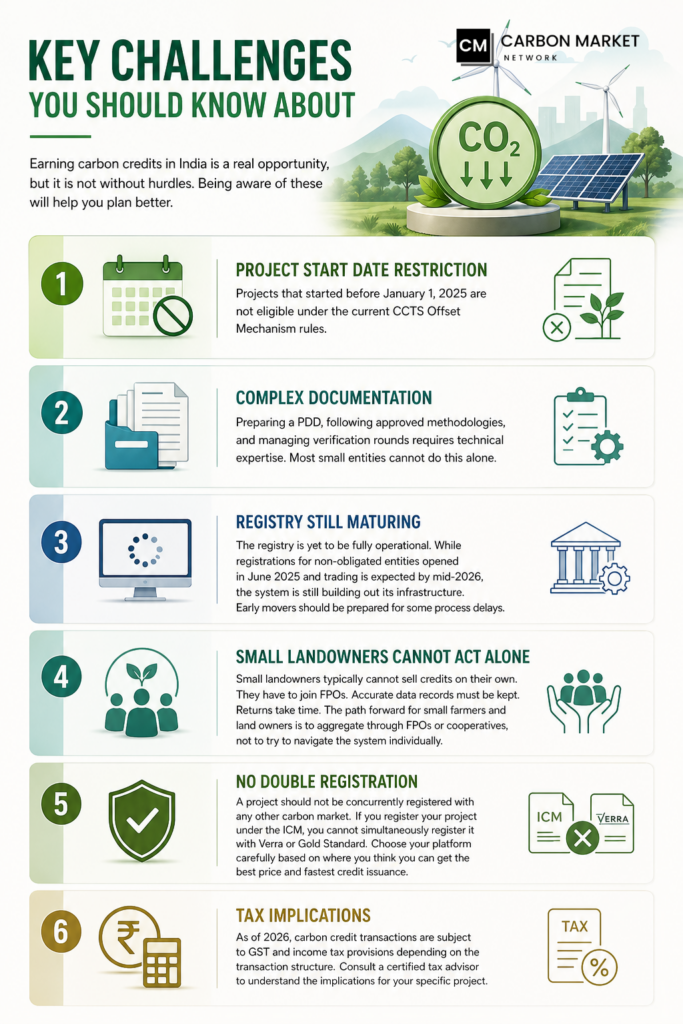
Earning carbon credits in India is a real opportunity, but it is not without hurdles. Being aware of these will help you plan better.
1. Project Start Date Restriction
Projects that started before January 1, 2025 are not eligible under the current CCTS Offset Mechanism rules.
If you have been running a solar plant since 2022, you cannot retroactively register it under the ICM offset mechanism. You would need to explore international voluntary standards for such projects.
2. Complex Documentation
Preparing a PDD, following approved methodologies, and managing verification rounds requires technical expertise. Most small entities cannot do this alone.
The solution: Work with aggregators, carbon project developers, or consultants who specialize in ICM registration. Several Indian startups and established environmental consultancies now offer end-to-end project development services.
3. Registry Still Maturing
The registry is yet to be fully operational. While registrations for non-obligated entities opened in June 2025 and trading is expected by mid-2026, the system is still building out its infrastructure. Early movers should be prepared for some process delays.
4. Small Landowners Cannot Act Alone
Small landowners typically cannot sell credits on their own. They have to join FPOs. Accurate data records must be kept. Returns take time.
The path forward for small farmers and land owners is to aggregate through FPOs or cooperatives, not to try to navigate the system individually.
5. No Double Registration
A project should not be concurrently registered with any other carbon market.
If you register your project under the ICM, you cannot simultaneously register it with Verra or Gold Standard. Choose your platform carefully based on where you think you can get the best price and fastest credit issuance.
6. Tax Implications
As of 2026, carbon credit transactions are subject to GST and income tax provisions depending on the transaction structure. Consult a certified tax advisor to understand the implications for your specific project.
Tips to Maximize Your Carbon Credit Income
Here are practical tips to get the most out of your participation in the Indian carbon market.
Choose High-Value Project Types Nature-based solutions like agroforestry and mangrove restoration tend to command higher prices because they deliver biodiversity and community benefits on top of carbon sequestration. Buyers pay a premium for these co-benefits.
Get Internationally Verified Too (If Eligible) For projects that qualify under both Indian ICM and international standards, understand the trade-off. International voluntary markets may currently offer higher prices per credit than the nascent domestic market. Evaluate which platform suits your project best.
Partner with Aggregators Early Joining an established project developer or aggregator reduces your paperwork burden and gives you access to their buyer network. Look for organizations already registered on the ICM portal with a track record of project execution.
Keep Impeccable Records Your credits are only as good as your monitoring data. Invest in good measurement tools, keep meticulous records, and document every change in your operations.
Stay Updated on BEE Notifications The Indian Carbon Market is evolving rapidly. BEE regularly publishes new notifications on methodology approvals, target updates, and registration procedures. Subscribe to BEE’s official communications and check the ICM portal regularly.
Bank Credits Strategically Unlimited banking of CCCs is allowed, and banked CCCs can be sold within ICM or used for future compliance. If you earn credits early but market prices are low, you can hold them and sell later when demand from obligated industrial buyers increases. Do not rush to sell at unfavorable prices.
The Road Ahead: India’s Carbon Market by 2030
The Indian carbon market is building momentum fast, and the next few years will define its scale.
The Indian Carbon Market, comprising both the CCTS compliance mechanism and the voluntary Offset Mechanism, is expected to be officially launched by mid-2026, according to an announcement by Power Minister Manohar Lal Khattar at the Prakriti 2025 International Conference on Carbon Markets in February 2025.
The director of BEE says that India’s carbon market will become the world’s largest carbon market by 2030.
Several forces are driving this growth:
The EU Carbon Border Adjustment Mechanism (CBAM): Starting in 2026, the EU is taxing imports based on their carbon footprint. Without a domestic carbon market, Indian exporters would pay that tax to Europe. With CCTS, they can pay a lower price within India and avoid double taxation. This creates strong economic motivation for Indian exporters to participate.
Budget 2026 Support: Budget 2026 announced a Rs 20,000 crore Carbon Capture, Utilisation, and Storage support programme, formalising India’s carbon market and allowing both industries and farmers to participate in carbon trading.
Expanding Sector Coverage: More sectors will be brought under the compliance mechanism in subsequent phases, dramatically increasing the number of obligated buyers and the overall demand for credits.
International Carbon Finance: India’s alignment with Article 6 of the Paris Agreement creates potential for Indian credits to be sold internationally, opening up a global buyer pool beyond domestic exchanges.
Conclusion: The Time to Start Is Now
Earning carbon credits in India is no longer a futuristic idea. It is a present-day opportunity backed by law, government infrastructure, and real market demand.
Whether you run a renewable energy project, manage farmland, lead an NGO, or operate an industrial facility, the Indian Carbon Market has a pathway for you. The offset mechanism is live, registrations are open, and the first round of credit trading is expected by mid-2026.
The window to establish early projects under the January 1, 2025 eligibility start date is now. Projects registered, validated, and monitored today will be the first to earn and sell Carbon Credit Certificates when trading goes live.
India needs millions of tonnes of emissions reductions to meet its 2030 and 2035 climate targets. The carbon credit system is how it will pay for that transformation. And that payment goes directly to you, the project developer, the farmer, the entrepreneur, the company that chooses to act.
Start by identifying which approved methodology fits your situation. Connect with an aggregator or carbon project consultant. Register on the BEE portal. Build your monitoring plan. And get ready to earn.
The green economy is not coming. It is here.
Frequently Asked Questions (FAQ)
Q1: Who can earn carbon credits in India?
Any entity, including farmers, NGOs, renewable energy companies, startups, and industrial plants, can earn carbon credits in India. Industrial units in the nine obligated sectors earn through the compliance mechanism, while all others participate through the voluntary offset mechanism.
Q2: What is the minimum project size to earn carbon credits in India?
There is no fixed minimum defined in tonnes, but projects need to be large enough to justify the cost of preparation, validation, and verification. For farmers and small landholders, joining a group project through an FPO or cooperative is the most practical path.
Q3: How long does it take to earn your first carbon credits in India?
It typically takes one to three years from project registration to your first credit issuance. However, once certified, you can sell credits on an annual basis as your project generates reductions over time.
Q4: Can I register my project under both the Indian ICM and international standards like Verra?
No. Under the ICM Offset Mechanism, a project should not be concurrently registered with any other carbon market. Choose your registration platform based on where you expect better pricing and faster issuance.
Q5: What are Carbon Credit Certificates (CCCs)?
Each CCC represents one tonne of CO2 equivalent saved. Overachievers in the compliance market earn CCCs. Underachievers must buy CCCs from the market to meet their shortfall. Trading occurs on designated power exchanges within a price collar of floor and ceiling prices.
Q6: Do farmers need to handle the paperwork themselves?
No. Aggregators, project developers, or NGOs running carbon projects handle the paperwork, audits, and methodology. The farmer’s job is to implement and maintain the practices on their land.
Q7: Where will carbon credits be traded in India?
CCCs must be traded only through power exchanges unless CERC permits otherwise. Initially, the system will not allow over-the-counter trading. All transactions will take place through regulated exchanges.
Q8: What is the Green Credit Programme and how is it different from carbon credits?
The Green Credit Programme, run by the Ministry of Environment, Forest and Climate Change, rewards individuals and communities for pro-environment actions like tree planting and water conservation. It is separate from the CCTS and targets a broader set of grassroots actions. Carbon credits under the ICM are specific, verified, and tradable financial instruments.
Q9: Are carbon credit earnings taxable in India?
Carbon credit transactions are subject to GST and income tax provisions depending on the transaction structure. You should consult a certified tax advisor to understand the implications for your specific project.
Q10: What is the expected carbon credit price in India in 2026?
Prices vary by project type and market segment. Voluntary market prices currently range from approximately Rs 500 to Rs 2,000 per tonne, depending on co-benefits, verification standard, and buyer demand. The compliance market will have a price collar set by CERC once trading officially launches.