Carbon Market Network


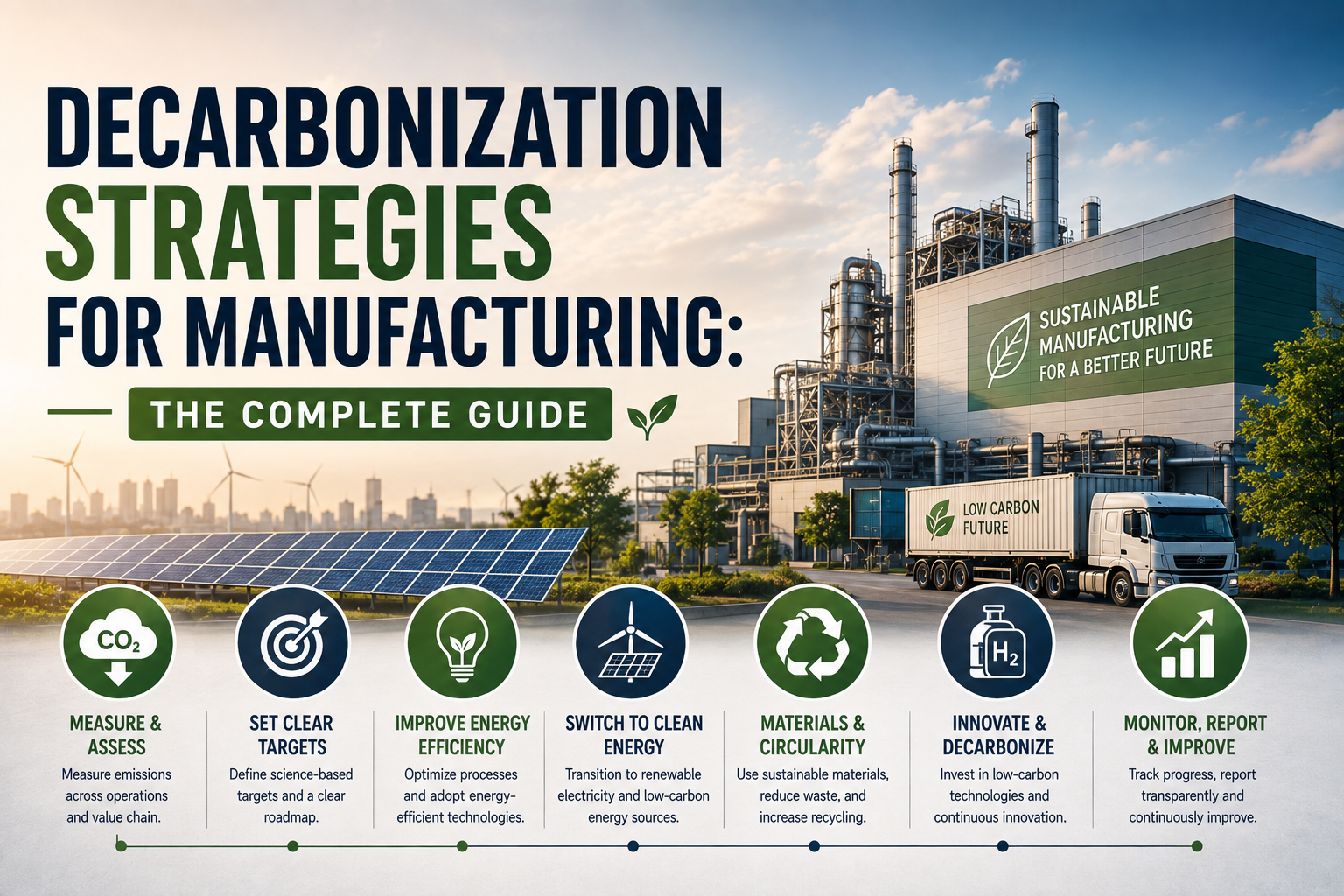
Manufacturing keeps the world running. But it also accounts for roughly one-fifth of global greenhouse gas emissions, making it one of the hardest sectors to clean up.
The good news? Manufacturers around the world are proving that cutting carbon does not mean cutting productivity. With the right decarbonization strategies, factories are slashing emissions, lowering energy costs, and positioning themselves to win in a world where regulators, customers, and investors all demand cleaner operations.
If you work in manufacturing, this guide is for you. Whether you are just starting your sustainability journey or you are already knee-deep in net-zero planning, this article breaks down everything you need to know about decarbonization strategies for manufacturing in a clear, practical way.
Let us dive in.
What Is Decarbonization in Manufacturing?
Decarbonization means reducing or eliminating carbon dioxide (CO2) and other greenhouse gas (GHG) emissions from industrial processes.
In manufacturing, this involves switching away from fossil fuels, improving energy efficiency, adopting cleaner technologies, and rethinking how products are designed, made, and disposed of.
The goal is not just to meet regulations. It is to build a resilient, future-proof business.
Manufacturers that decarbonize early gain:
- Lower and more predictable energy costs
- Stronger relationships with sustainability-focused customers
- Better access to green finance and investor capital
- A competitive edge as carbon pricing spreads globally
- Reduced exposure to regulatory risk
Why Decarbonization in Manufacturing Is Urgent Right Now
Several forces are converging to make decarbonization a top business priority for manufacturers worldwide.
Carbon Regulations Are Tightening
Governments across the EU, UK, Canada, Japan, and beyond have adopted legally binding net-zero targets. The EU is targeting a 90% reduction in emissions by 2040. The UK has pledged an 81% cut from 1990 levels by 2035.
These targets come with real teeth through policies like Emissions Trading Systems (ETS) and carbon taxes that directly affect operating costs.
The EU Carbon Border Adjustment Mechanism (CBAM) Is Now in Effect
This is a big one for global manufacturers.
The EU’s Carbon Border Adjustment Mechanism (website) entered its definitive phase on 1 January 2026, becoming the world’s first fully operational border carbon adjustment policy. It now charges importers based on the emissions intensity of their goods.
CBAM currently covers cement, steel, aluminium, fertilizers, electricity, and hydrogen. The European Commission has already proposed expanding it to include 180 downstream products in sectors like machinery, vehicle components, and domestic appliances.
What this means for manufacturers: if you export to Europe, your carbon footprint is now a trade issue. Manufacturers with lower emissions will enjoy a direct competitive advantage. Those with high-carbon production will face significant new costs.
The UK plans a similar mechanism in 2027. Australia and Canada are exploring their own versions. This trend is only going in one direction.
Customers and Investors Are Demanding It
Major brands like Apple, IKEA, Walmart, and Microsoft have committed to net-zero supply chains. They are asking their manufacturing suppliers to provide verified emissions data and reduction roadmaps.
Meanwhile, global reporting standards from bodies like the ISSB (International Sustainability Standards Board) are being adopted in over 40 countries, making sustainability disclosure the norm rather than the exception.
Understanding Scope 1, 2, and 3 Emissions in Manufacturing
Before building a decarbonization strategy, you need to know where your emissions actually come from.
| Scope | Definition | Manufacturing Examples |
|---|---|---|
| Scope 1 | Direct emissions from sources you own or control | Boilers, furnaces, on-site vehicles, chemical processes |
| Scope 2 | Indirect emissions from purchased energy | Electricity, steam, heat, or cooling bought from suppliers |
| Scope 3 | All other indirect emissions across the value chain | Raw material extraction, logistics, product use, end-of-life disposal |
For most manufacturers, Scope 3 emissions dominate the carbon footprint, often far exceeding Scope 1 and 2 combined. But Scopes 1 and 2 are typically the starting point because manufacturers have the most direct control over them.
A common mistake is focusing only on operational emissions while ignoring the value chain. The most effective decarbonization strategies for manufacturing address all three scopes over time.
The 8 Core Decarbonization Strategies for Manufacturing
Here is a detailed breakdown of the strategies that are making the biggest difference for manufacturers globally.
1. Energy Efficiency: The Foundation of Every Decarbonization Strategy
Before you switch to cleaner energy, use less of it.
Energy efficiency is the lowest-cost, highest-impact decarbonization lever available to almost every manufacturer. It reduces Scope 1 and Scope 2 emissions while cutting energy bills simultaneously.
Key energy efficiency actions include:
- Replacing legacy equipment with high-efficiency alternatives (electric motors, variable-speed drives, heat exchangers)
- Upgrading to LED lighting and smart building management systems
- Conducting regular energy audits to identify waste
- Optimizing compressed air systems, which are notoriously inefficient in most factories
- Implementing heat recovery systems to capture and reuse waste heat from industrial processes
- Switching from hydraulic to electric machinery (for example, electric injection molding machines use up to 70% less energy than hydraulic equivalents)
An important point: Energy efficiency investments often pay back within two to five years. They reduce the scale of the renewable energy supply needed later, making subsequent decarbonization steps cheaper and faster.
Think of energy efficiency as shrinking the problem before you solve it.
2. Switching to Renewable Energy
Once you have reduced energy demand, the next step is to power your operations with clean electricity.
Manufacturing facilities are increasingly generating or procuring renewable energy through several routes:
On-site generation: Installing rooftop solar panels or on-site wind turbines. This gives manufacturers direct control over clean energy supply and protects against energy price volatility.
Power Purchase Agreements (PPAs): Long-term contracts to buy renewable electricity directly from wind or solar farm developers. PPAs provide price certainty and are now widely accessible for medium and large manufacturers.
Green tariffs: Purchasing certified renewable electricity from the grid through green tariff programs offered by utilities.
Energy storage: Pairing solar or wind with battery storage ensures clean energy is available when production demands it, not just when the sun shines or the wind blows.
RE100: Manufacturers serious about renewable energy often join the RE100 initiative, committing to 100% renewable electricity across their operations. Hundreds of major manufacturers have already done this.
Renewable energy directly reduces Scope 2 emissions and, in many cases, also helps cut Scope 1 emissions by powering electrified processes.
3. Electrification of Industrial Processes
Electrification means replacing fossil-fuel-powered equipment and processes with electrically powered alternatives — and then running those on renewable electricity.
This strategy is one of the most important decarbonization trends in manufacturing right now.
Where electrification works well:
- Replacing gas-fired boilers with electric heat pumps
- Switching from diesel forklifts to electric forklifts
- Using electric arc furnaces (EAF) instead of blast furnaces in steelmaking
- Industrial heat pumps for low-to-medium temperature processes
Industrial heat pumps are a particularly exciting development. Research has shown that industrial heat pumps offer significant decarbonization potential across food and beverage manufacturing, chemical processing, and other sectors requiring process heat below 200°C.
The challenge is that not all industrial processes can be easily electrified. Very high-temperature applications in cement, glass, ceramics, and primary metals often require alternative solutions — which brings us to the next strategy.
4. Green Hydrogen for Hard-to-Abate Sectors
Not everything in manufacturing can run on electricity. For high-temperature industrial processes where direct electrification is not yet practical, green hydrogen is emerging as a critical solution.
Green hydrogen is produced by using renewable electricity to split water into hydrogen and oxygen through a process called electrolysis. It produces zero carbon emissions at the point of use.
Where green hydrogen plays a role in manufacturing:
| Sector | Application |
|---|---|
| Steel | Hydrogen-based Direct Reduced Iron (H-DRI) replacing coal-fired blast furnaces |
| Chemicals | Replacing fossil-fuel-derived feedstocks for ammonia and fertilizer production |
| Cement | High-temperature kiln heating as an alternative to coal or gas |
| Glass | Hydrogen co-firing in melting furnaces |
| Refining | Replacing grey hydrogen with green hydrogen in refining processes |
A real-world example: Siemens Energy’s hydrogen solutions helped Brazilian petrochemical manufacturer Braskem cut emissions by 40% and establish a hydrogen-rich cogeneration plant for thermoplastics production. Siemens Energy also operates a Gigawatt Electrolyzer Factory in Berlin to scale green hydrogen production to industrial levels.
The cost of green hydrogen has been falling steadily as electrolyzer technology matures and renewable energy costs continue to drop. While it remains more expensive than fossil alternatives today, pilot projects are expanding rapidly across Europe, the Middle East, and North America.
Blue hydrogen (made from natural gas with carbon capture) serves as an important bridge technology while green hydrogen scales up. It can reduce the emissions of conventional hydrogen production by around 90%.
5. Carbon Capture, Utilization, and Storage (CCUS)
For some manufacturing processes, eliminating emissions at the source is not yet technologically or economically feasible. This is where carbon capture, utilization, and storage (CCUS) comes in.
CCUS technology captures CO2 emissions from industrial processes and either stores them permanently underground or puts them to use in other products.
Key CCUS approaches for manufacturers:
Carbon Capture and Storage (CCS): CO2 is captured at the point of emission (from a factory chimney or industrial process), compressed, transported, and stored in geological formations deep underground. This permanently removes carbon from the atmosphere.
Carbon Capture and Utilization (CCU): Instead of storing captured CO2, manufacturers use it as a feedstock. It can be used to produce synthetic fuels, building materials, chemicals, and even plastics.
Mineralization: A promising subset of CCU. A notable real-world example: Forterra opened North America’s first green cement facility in Redding, California, which captures CO2 from cement production and sequesters it into usable cement through mineralization. The CO2 is effectively locked away in a stable product.
Where CCUS is most relevant in manufacturing:
- Cement production: Process emissions from limestone calcination are almost impossible to eliminate through efficiency or fuel switching alone. CCUS is considered the only technology that can significantly curtail these emissions.
- Steel production: When combined with hydrogen-based processes, CCUS can capture residual emissions.
- Chemical plants and refineries: Where high-concentration CO2 streams make capture economically attractive.
CCUS is not a magic wand, and it works best as part of a wider strategy rather than a standalone solution. But for certain hard-to-abate manufacturing sectors, it is an indispensable tool.
6. Digital Technology and Smart Factory Solutions
Technology is transforming how manufacturers manage, monitor, and reduce emissions. Smart factory solutions are not just about productivity anymore — they are central to decarbonization.
Key digital tools for manufacturing decarbonization:
AI and Machine Learning: Predictive AI systems optimize energy consumption in real time. Schneider Electric’s EcoStruxure system, for example, helped one manufacturing customer decrease emissions by 40% with ROI achieved in less than six months.
A study using an Edge AI-based Smart Factory framework demonstrated a reduction in energy consumption from 1,000 kWh to 820 kWh and a drop in carbon emissions from 700 kg per day to 540 kg per day — in a single facility.
Digital Twins: Virtual replicas of manufacturing systems allow engineers to model and optimize processes without disrupting real production. By fine-tuning systems virtually before real-world deployment, manufacturers can find the most energy-efficient configurations.
Industrial IoT (IIoT): Sensors across the factory floor capture real-time data on energy use, equipment performance, and process efficiency. Factory Energy Management Systems (FEMS) use this data to adjust operations automatically and eliminate energy waste.
Predictive Maintenance: AI-powered maintenance systems identify equipment that is about to fail or run inefficiently. Addressing these issues proactively reduces both unplanned downtime and unnecessary energy consumption.
Research from McKinsey shows that AI-driven technologies can help manufacturers reduce CO2 emissions by up to 10% and cut energy costs by 10 to 20%. Digital Europe estimates that digital technologies overall have the potential to reduce global CO2 emissions by 20% by 2030.
The combination of IIoT, AI, and digital twins is rapidly becoming the backbone of the decarbonized smart factory.
7. Circular Economy Principles
A circular economy reduces emissions not by changing how energy is generated, but by transforming how materials are used. For manufacturers, this means designing products and production systems that minimize waste and keep materials in use for as long as possible.
Circular economy strategies for manufacturing decarbonization:
Design for longevity and repairability: Products that last longer reduce the emissions associated with producing new ones. Modular product design allows for easy repair and replacement of individual parts rather than discarding entire products.
Material efficiency: Using less material in production, substituting high-carbon materials with lower-carbon alternatives, and eliminating unnecessary components.
Closed-loop manufacturing: Recovering and reusing materials from end-of-life products as inputs for new production. The automotive industry is already doing this at scale, with manufacturers running used-car take-back programs and recycling lithium-ion batteries from electric vehicles.
Remanufacturing: Restoring used products to like-new condition uses significantly less energy and raw material than manufacturing from scratch.
Sustainable procurement: Sourcing materials from suppliers with verified lower-carbon production methods. Walmart’s Project Gigaton, for example, has mobilized thousands of suppliers to reduce their own emissions, creating measurable Scope 3 reductions for Walmart.
Circular economy principles are especially effective at addressing Scope 3 upstream emissions (from raw material extraction and processing) and Scope 3 downstream emissions (from product use and disposal).
8. Supply Chain Decarbonization
For many manufacturers, the majority of their carbon footprint sits not in their own factory but in their supply chain. Ignoring Scope 3 upstream and downstream emissions means ignoring the bulk of the problem.
Strategies for supply chain decarbonization:
- Supplier engagement programs: Work with your key suppliers to help them measure and reduce their own emissions. This is the single most impactful Scope 3 lever for most manufacturers.
- Low-carbon sourcing: Prioritize suppliers who use renewable energy, efficient processes, or lower-carbon materials.
- Logistics optimization: Reduce transportation emissions by optimizing routes, consolidating shipments, switching to rail where possible, and transitioning fleets to electric or hydrogen vehicles.
- Product carbon footprints: Use Life Cycle Assessment (LCA) to understand where in the product value chain emissions concentrate, and then prioritize accordingly.
- Collaborative decarbonization: Industry consortia and cross-company initiatives allow manufacturers to share the costs and risks of decarbonizing shared supply chains.
Building a Manufacturing Decarbonization Roadmap
Having strategies is one thing. Executing them in a structured way is another. Here is how to build a credible decarbonization roadmap for your manufacturing operation.
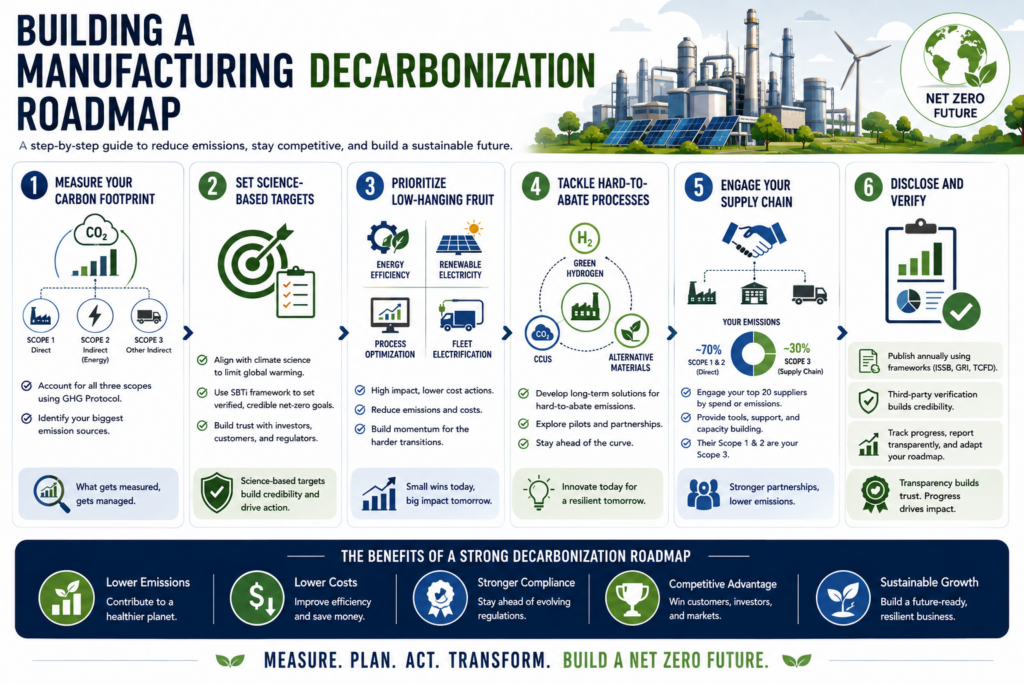
Step 1: Measure Your Carbon Footprint
You cannot manage what you cannot measure.
Start with a comprehensive carbon accounting exercise covering all three scopes. Use internationally recognized standards like the Greenhouse Gas (GHG) Protocol. Identify your biggest emission sources — these are your highest-priority targets.
Step 2: Set Science-Based Targets
Align your emission reduction targets with what climate science says is necessary to limit global warming. The Science Based Targets initiative (SBTi) provides a framework for manufacturers to set verified, credible net-zero goals.
Companies with SBTi-approved targets signal credibility to investors, customers, and regulators alike.
Step 3: Prioritize Low-Hanging Fruit
Start with high-impact, lower-cost interventions:
- Energy audits and efficiency upgrades
- Renewable electricity procurement (PPAs or green tariffs)
- Process optimization using digital tools
- Fleet electrification
These actions reduce emissions, cut costs, and generate momentum for the harder stuff.
Step 4: Tackle Hard-to-Abate Processes
For processes that cannot be electrified or run on renewables alone, develop a longer-term roadmap involving green hydrogen, CCUS, or alternative materials. Participate in industry pilot programs to stay at the leading edge.
Step 5: Engage Your Supply Chain
Roll out supplier engagement programs. Prioritize your top 20 suppliers by spend or emission intensity. Provide tools and support to help them reduce their emissions — because their Scope 1 and 2 are your Scope 3.
Step 6: Disclose and Verify
Publish an annual sustainability report aligned with established frameworks (ISSB, GRI, TCFD). Third-party verification builds credibility. Track progress against targets and adjust the roadmap as technologies and regulations evolve.
Sector-Specific Decarbonization Strategies
Different manufacturing sectors face very different technical challenges. Here is a snapshot of the priority strategies by sector.
| Manufacturing Sector | Biggest Emission Source | Priority Decarbonization Strategies |
|---|---|---|
| Steel | Blast furnace ironmaking (coal) | Green hydrogen DRI, electric arc furnaces, CCUS |
| Cement | Limestone calcination | CCUS, alternative binders, biomass fuel, electrification of grinding |
| Chemicals | Fossil feedstocks and energy | Green hydrogen feedstocks, electrification, process efficiency |
| Automotive | Energy use in assembly and supply chain | Renewable electricity, supply chain engagement, EV transition |
| Food & Beverage | Process heat, refrigeration, logistics | Heat pumps, energy efficiency, electric boilers, circular packaging |
| Textiles/Apparel | Dyeing and finishing processes, supply chain | Renewable energy, waterless dyeing, circular design, supplier programs |
| Electronics | Upstream material extraction, energy use | Circular design, recycled materials, renewable energy, supplier programs |
| Paper & Pulp | Energy-intensive pulping and drying | Biomass energy, cogeneration, energy efficiency |
Steel is particularly significant — it accounts for around 7% of all global greenhouse gas emissions, making it one of the most important sectors for decarbonization.
The Business Case for Manufacturing Decarbonization
Decarbonization is not just a cost center. Done right, it creates real business value.
Cost Savings
Energy efficiency reduces fuel and electricity bills. Companies that have implemented comprehensive energy management programs regularly report savings of 15 to 30% on energy costs.
Regulatory Risk Reduction
As carbon pricing and border adjustment mechanisms spread globally, manufacturers with high-carbon operations face growing financial risk. Early movers protect themselves from future regulatory shocks.
Access to Green Finance
Banks and investors increasingly offer preferential financing rates for manufacturers with credible sustainability plans. Green bonds, sustainability-linked loans, and ESG-focused investors all favor decarbonized businesses.
Customer and Brand Advantage
Global brands are increasingly selecting suppliers based on carbon performance. Manufacturers with verified low emissions can command premium pricing and longer-term contracts.
Talent Attraction
Particularly among younger workers, sustainability credentials are a genuine factor in employment decisions. Companies known for their climate leadership find it easier to attract and retain skilled workers.
Common Barriers to Manufacturing Decarbonization (and How to Overcome Them)
| Barrier | Reality Check | Solution |
|---|---|---|
| High upfront costs | Many solutions pay back within 2-5 years | Start with efficiency, access green finance, use PPAs |
| Technology immaturity | Some solutions (especially green H2) are still scaling | Pilot projects now, scale as costs fall |
| Data gaps | Hard to measure Scope 3 in complex supply chains | Start with Scope 1 and 2, expand to Scope 3 over time using LCA |
| Regulatory uncertainty | Policy can shift | Focus on no-regrets actions (efficiency, renewables) that pay off regardless |
| Supplier reluctance | Suppliers may resist engagement | Offer support, share best practices, make sustainability part of procurement criteria |
| Legacy infrastructure | Older plants are harder to retrofit | Plan phased upgrades aligned with natural equipment replacement cycles |
Carbon Credits and Offsets: Where Do They Fit?
One tool that often comes up in manufacturing decarbonization discussions is the use of carbon credits or carbon offsets.
Carbon credits allow manufacturers to offset residual emissions they cannot yet eliminate through operational changes. They can be purchased through voluntary carbon markets and represent verified emission reductions made elsewhere — for example, reforestation projects, renewable energy in developing markets, or industrial methane capture.
Important: Carbon credits should never substitute for operational decarbonization. They work best as a bridge tool to cover hard-to-abate residual emissions while the manufacturer continues working toward deeper reductions.
The quality of carbon credits varies enormously. Look for credits verified under robust standards (like Gold Standard or Verra VCS) and prioritize high-permanence removals over avoidance credits where possible.
As manufacturing decarbonization deepens globally, the role of high-quality carbon markets will remain important for bridging gaps — which is exactly why understanding them is valuable for anyone in this space.
Key Policies and Frameworks Shaping Manufacturing Decarbonization
Manufacturers do not operate in a policy vacuum. Here are the key frameworks shaping the global decarbonization landscape:
EU Emissions Trading System (ETS): Requires covered industries to purchase allowances for their emissions. The price of EU allowances directly affects the cost competitiveness of carbon-intensive manufacturing.
EU Carbon Border Adjustment Mechanism (CBAM): Now in full effect for cement, steel, aluminum, fertilizers, hydrogen, and electricity. Expanding to downstream products.
Science Based Targets initiative (SBTi): The global standard for corporate climate target-setting. The SBTi’s Net-Zero Standard provides a framework specifically for manufacturing companies.
ISO 14001 Environmental Management Systems: Provides a structured framework for managing environmental performance, including GHG emissions.
RE100: A global corporate initiative committing members to 100% renewable electricity.
Nationally Determined Contributions (NDCs): Countries’ climate commitments under the Paris Agreement. Updated NDCs increasingly include sectoral industrial decarbonization requirements.
What Manufacturers Should Start Doing Right Now
If you are a manufacturer and you are not yet on a clear decarbonization path, here is a practical starting point:
- Conduct a baseline carbon footprint assessment covering all three scopes.
- Commission an energy audit across your facilities to identify quick-win efficiency opportunities.
- Explore a Power Purchase Agreement for renewable electricity if you do not already have one.
- Set an internal carbon price to incentivize decision-making that accounts for carbon costs.
- Map your top 10 suppliers by estimated emission intensity and begin engagement conversations.
- Join an industry peer network on decarbonization — the learning curve is much gentler when you are not doing it alone.
- Assign accountability at the leadership level. Decarbonization plans that live only in sustainability teams without C-suite ownership tend to stall.
The Future of Manufacturing Decarbonization
The trajectory is clear. Manufacturing decarbonization is accelerating, and the technologies needed to achieve it are increasingly available and affordable.
Green industrialization is becoming a competitive strategy, not just a climate obligation. Industrial decarbonization is increasingly linked to job creation, skills development, and domestic value chains. Countries and companies that lead the transition are positioning themselves to compete in a global economy shaped by clean industry.
A few trends to watch:
Scaling of green hydrogen: Electrolyzer manufacturing is expanding rapidly. Costs are falling. More manufacturers will access green hydrogen for hard-to-abate processes in the next few years.
Digitalization at every level: AI, digital twins, and IIoT are becoming standard tools in advanced manufacturing. Their application to energy and emissions management will deepen.
CCUS for cement and chemicals: These two sectors have very few alternatives to carbon capture for deep decarbonization. Expect significant policy support and investment in CCUS infrastructure globally.
Supply chain transparency: Life cycle carbon data will become standard commercial data, embedded in procurement decisions, customer contracts, and trade regulations.
Nature-based and technological carbon removal: As manufacturers drive operational emissions toward zero, high-quality carbon removal credits will become the final tool to address residual emissions.
Frequently Asked Questions (FAQ)
What is the first step in manufacturing decarbonization?
The first step is measuring your baseline emissions across all three scopes. You need to know where your emissions come from before you can prioritize actions effectively. An energy audit and a GHG inventory using the GHG Protocol are the standard starting points.
Which manufacturing sectors are hardest to decarbonize?
Steel, cement, chemicals, glass, and aluminium are considered the hardest-to-abate manufacturing sectors because they require very high process temperatures and use fossil fuels as chemical feedstocks, not just energy sources. These sectors rely most heavily on green hydrogen, CCUS, and alternative materials.
How much does manufacturing decarbonization cost?
Costs vary enormously by sector, technology, and scale. Energy efficiency and renewable electricity are typically the most cost-effective starting points and can generate positive returns. More advanced technologies like green hydrogen and CCUS currently carry higher costs, but these are falling steadily. Many manufacturers find that a phased approach keeps costs manageable while delivering consistent progress.
Can small manufacturers afford to decarbonize?
Yes, but the strategies need to be scaled appropriately. Small manufacturers should focus on energy efficiency first — it typically pays back quickly. Renewable electricity procurement through green tariffs or collective purchasing programs is becoming accessible at smaller scales. Industry associations often help smaller manufacturers participate in shared decarbonization programs.
What is the difference between net zero and carbon neutral?
Carbon neutral typically means that a company offsets all of its emissions using carbon credits, without necessarily reducing them at the source. Net zero is a more rigorous standard that requires deep, science-based emission reductions across all scopes, with only a small residual offset with high-quality carbon removal. Net zero is the standard that leading manufacturers and frameworks like SBTi now apply.
What role do carbon markets play in manufacturing decarbonization?
Carbon markets provide manufacturers with two important tools. Compliance markets (like the EU ETS) create a financial cost for emissions, incentivizing reduction. Voluntary carbon markets allow manufacturers to offset residual emissions they cannot yet eliminate. High-quality carbon credits from verified projects can bridge the gap while deeper operational decarbonization continues.
How does CBAM affect manufacturers outside Europe?
The EU CBAM means that manufacturers in any country who export to the EU now face a carbon cost on their products based on their emissions intensity. Higher-carbon producers pay more. This creates a direct competitive advantage for lower-carbon manufacturers regardless of where they are based. As more countries adopt similar mechanisms, this dynamic will extend beyond the EU.
What is green hydrogen and why does it matter for manufacturing?
Green hydrogen is hydrogen produced using renewable electricity through a process called electrolysis. It creates no carbon emissions. It matters for manufacturing because it can provide high-temperature heat and clean chemical feedstocks for processes that cannot be electrified directly — like steelmaking, cement production, and ammonia manufacturing.
Conclusion
The manufacturing sector sits at the heart of global decarbonization. The technologies are ready, the business case is solid, and the regulatory pressure is building. Manufacturers who act now — starting with energy efficiency, moving to renewables, and building out a phased roadmap across all scopes — will be better positioned on costs, customer relationships, talent, and market access than those who wait.
Decarbonization strategies for manufacturing are not a single action. They are an integrated, long-term program of energy efficiency, clean energy procurement, process electrification, green hydrogen adoption, carbon capture, digital optimization, circular economy integration, and supply chain engagement.
The window to act early is still open, but it is narrowing. Every year of delay increases both the physical cost of climate impact and the financial cost of catching up.
The manufacturers who thrive in the coming decades will be those who treat decarbonization not as a compliance burden, but as a genuine business strategy.
Start measuring. Start planning. Start moving.
Explore more resources on carbon markets, decarbonization, and sustainability at carbonmarketnetwork.com.