Carbon Market Network


If you import steel, aluminium, cement, fertilisers, hydrogen, or electricity into the EU, your business is now operating under the most significant carbon trade regulation in history. The EU Carbon Border Adjustment Mechanism (CBAM) entered its definitive phase on 1 January 2026, and the clock is no longer ticking. It has started.
For large corporations with dedicated compliance teams, CBAM is a challenge. For small and medium enterprises (SMEs), it can feel like a mountain.
This guide breaks down every major CBAM SMEs challenge in plain language. You will learn exactly what CBAM demands from your business, where smaller companies struggle most, and what practical steps you can take right now to stay compliant and protect your margins.
What Is CBAM and Why Does It Matter for SMEs?
The Carbon Border Adjustment Mechanism (CBAM) is the EU’s tool to prevent carbon leakage. Carbon leakage happens when companies move production to countries with weaker environmental rules to avoid carbon costs. CBAM stops this by placing a carbon price on certain imported goods, matching what EU producers already pay under the EU Emissions Trading System (ETS).
CBAM currently applies to six sectors:
- Iron and steel
- Aluminium
- Cement
- Fertilisers
- Electricity
- Hydrogen
Certain downstream products, like screws, bolts, pipes, and bridge sections, are already included. From 2028, the scope is expected to expand to around 180 additional downstream products made primarily from steel or aluminium, covering machinery, industrial equipment, vehicles, and even selected household goods.
For SMEs, this matters enormously. You may not manufacture these materials, but if you import them into the EU, you are now legally required to track, report, and pay for the carbon embedded in their production.
Carbon Market Insider Newsletter
Weekly insights on carbon markets, climate policy, carbon credits, and sustainability.
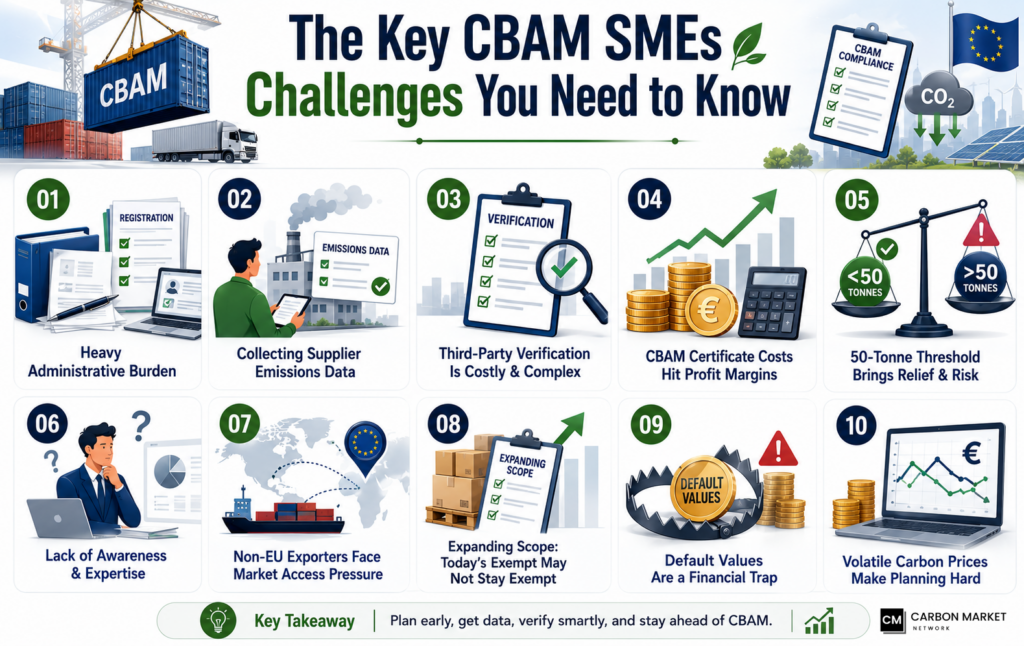
The Key CBAM SMEs Challenges You Need to Know
The CBAM SMEs challenges fall into several distinct categories. Understanding each one helps you build a realistic compliance plan.
Challenge 1: The Administrative Burden Is Heavy
The sheer weight of CBAM paperwork catches many SMEs off guard.
Under CBAM’s definitive phase, any importer bringing more than 50 tonnes of CBAM-covered goods into the EU per year must register as an Authorised CBAM Declarant (ACD). This registration happens through the EU’s CBAM Registry, and each national authority handles approvals independently.
The process involves:
- Setting up an EU Login account with two-factor authentication.
- Completing the Authorisation Management Module (AMM) in the CBAM Registry.
- Submitting company details, EORI number, financial records, and evidence of internal compliance controls.
- Waiting for your National Competent Authority (NCA) to review and approve, a process that can take up to 120 days.
Once registered, you must file an annual CBAM declaration, due by 30 September of the year following importation. Your first full declaration, covering 2026 imports, is due by 30 September 2027. You also must hold a minimum of 50% of the CBAM certificates you will need for that year at the end of each quarter.
For a large company with a dedicated compliance team, this is manageable. For an SME owner juggling ten other responsibilities, it quickly becomes overwhelming.
The practical challenge: Most SMEs lack the in-house expertise to set up monitoring systems, navigate the registry, interpret the methodology rules, and stay on top of changing deadlines. External consultants and software tools exist, but they come at a cost.
Challenge 2: Collecting Supplier Emissions Data Is the Biggest Blocker
Ask any CBAM compliance expert what the number one challenge is, and the answer is almost always the same: getting emissions data from suppliers.
CBAM requires importers to declare the embedded emissions of their goods at the product and installation level. This means you need to know exactly how much carbon was emitted during the production of the specific products you imported, at the specific facility where they were made.
During the transitional phase (2023 to 2025), importers could rely on EU default values to fill gaps. That flexibility is now heavily restricted. In the definitive phase, if you use default values for more than 20% of your total reported emissions for complex goods, you trigger a penalty markup, which directly inflates your CBAM costs.
The reality is blunt: most suppliers still are not ready to provide this data.
Many non-EU manufacturers have never tracked production-level carbon emissions. They may lack monitoring systems, carbon accounting knowledge, and even the language skills to engage with EU-standard methodology requirements. Suppliers in countries like India, Turkey, China, and Brazil face genuine capacity gaps when it comes to producing verified, installation-level emissions data.
For the SME importer, this creates a domino effect:
- You request emissions data from your supplier.
- Your supplier does not have it, cannot calculate it, or provides numbers that do not meet EU verification standards.
- You fall back on default values.
- Default values are deliberately conservative and punitive, meaning you pay more in certificate costs.
- You cannot claim deductions for carbon prices already paid in the country of origin.
The result is a higher CBAM bill than necessary, entirely because your supply chain is not data-ready.
Practical step: Contact your suppliers immediately. Explain what CBAM requires. Share sample reporting templates. Consider bringing a consultant to support smaller suppliers in setting up basic emissions monitoring systems. Companies that invested in supplier engagement early reported significantly fewer compliance difficulties.
Challenge 3: Third-Party Verification Is Complex and Costly
CBAM does not just ask you to report emissions. It asks you to prove them.
When you submit actual (non-default) embedded emissions data, that data must be independently verified by an accredited third-party verifier. The first year requires an on-site audit at the production installation, and verified data must fall within a 5% variance threshold.
For an SME importing from multiple suppliers across multiple countries, organising and funding these verifications is a major challenge. Accredited verifiers capable of conducting CBAM audits are not universally available in all exporting countries. Language barriers, methodological gaps, and limited local capacity add further friction.
The European Commission published the delegated regulation on verifier accreditation requirements in November 2025, which took effect from 1 January 2026. This has helped standardise the process, but demand for qualified verifiers is rising fast and supply has not yet caught up.
What this means for SMEs: If you cannot secure timely third-party verification, default values apply. That removes your cost control at exactly the moment your financial liability begins.
Practical step: Identify and engage accredited verifiers early. Do not wait until your annual declaration deadline approaches. Book slots in advance and work with your suppliers to prepare documentation before the verifier arrives.
Challenge 4: CBAM Certificate Costs Hit Profit Margins Directly
CBAM is no longer just a reporting exercise. It is a real financial obligation.
Here is how the cost works:
CBAM Cost = Quantity of goods (tonnes) × Embedded emissions (tCO₂e per tonne) × CBAM certificate price
The certificate price is directly linked to the EU ETS carbon price. For Q1 2026, the European Commission set the official CBAM certificate price at €75.36 per tonne of CO₂ equivalent. Prices will be published quarterly throughout 2026 and then weekly from 2027 onwards, meaning costs will fluctuate with the carbon market.
To give you a concrete sense of scale: using default values for steel imports from India, CBAM costs in Q1 2026 came to approximately €254 per tonne. For Turkish origin steel, costs were around €100 per tonne. For Chinese aluminium, the figure was approximately €144 per tonne. These are not trivial numbers for a small manufacturer who relies on affordable imported raw materials.
For SMEs operating on thin margins, this financial exposure changes procurement decisions, pricing strategies, and supplier relationships.
The good news is that if a carbon price has already been paid in the country of origin, you can deduct it. However, you must be able to prove it with documentation. Standard and default carbon prices for countries with existing carbon pricing mechanisms can be used if actual data is unavailable, though this approach adds complexity.
Practical step: Build a CBAM cost forecasting model now. Use the formula above, apply a conservative ETS price assumption in the range of €70 to €100 per tonne, and map your exposure across your product portfolio. This gives your finance team the numbers they need to plan procurement, adjust pricing, and manage margins proactively.
Challenge 5: The 50-Tonne Threshold Brings Both Relief and Risk
One of the most important recent changes for CBAM SMEs challenges is the 50-tonne de minimis threshold introduced under Regulation (EU) 2025/2083, which took effect in October 2025.
Under this rule, importers bringing in less than 50 tonnes (cumulative net mass) of CBAM-covered goods per year are exempt from CBAM reporting and certificate obligations. The European Commission estimates this exempts approximately 90% of importers, mostly SMEs and individuals, while still covering 99% of embedded emissions from CBAM-regulated imports.
This is a meaningful relief measure. SMEs below the threshold no longer need to register as CBAM declarants, calculate and verify embedded emissions, or purchase certificates. Industries like specialty steel, aluminium, fertiliser, and cement importers that bring in small annual volumes benefit the most.
However, there are important caveats:
- Electricity and hydrogen are explicitly excluded from the de minimis exemption. If you import either of these, full CBAM obligations apply regardless of volume.
- The threshold is calculated per legal entity per calendar year, not per shipment. Customs tracks this at EORI level across all EU entry points.
- If your imports exceed 50 tonnes at any point during the year, you move into the full CBAM regime for the entire year, not just from the date you crossed the threshold.
- If you are a fast-growing SME, this edge case can catch you completely unprepared. You may believe you are exempt, place several orders, cross the threshold mid-year, and suddenly face retroactive compliance obligations with no systems in place.
The Commission will conduct an annual review of the threshold to ensure 99% emissions coverage is maintained. If trade patterns or emission intensities change, the threshold may be adjusted.
Practical step: Track your annual import volumes of CBAM goods at the EORI level from January each year. If you are approaching 50 tonnes, start preparing for full CBAM compliance immediately. Do not wait until you cross the line.
Challenge 6: Lack of Awareness and Expertise Within SMEs
One of the most underreported CBAM SMEs challenges is simply not knowing what you do not know.
Awareness and understanding of CBAM monitoring and reporting processes vary significantly among both EU importers and non-EU manufacturers. Many SME business owners first encountered CBAM when a customs agent or supplier mentioned it, not through proactive regulatory monitoring.
Within SME organisations, CBAM sits at the intersection of customs, sustainability, finance, and procurement. Few small businesses have dedicated people in all four of these functions, let alone professionals who understand how they connect under CBAM.
This knowledge gap creates three distinct risks:
- Missed compliance deadlines, including failing to register as an authorised declarant before importing CBAM goods, triggering border delays or penalties.
- Incorrect emissions calculations, resulting in either overpaying for certificates or facing penalties for underreporting.
- Failure to claim legitimate deductions for carbon prices already paid in the country of origin, leading to unnecessarily high certificate costs.
Practical step: Assign clear internal ownership for CBAM. Designate one person or team to own compliance, connect with your customs broker and sustainability advisor, and subscribe to regulatory updates from your National Competent Authority and the European Commission.
Challenge 7: Non-EU Exporting SMEs Face Market Access Pressure
CBAM SMEs challenges do not only affect EU importers. They also hit non-EU SMEs that export to EU customers.
If you manufacture goods in India, Turkey, Vietnam, Brazil, or any other non-EU country and sell to EU buyers, your customers now need your emissions data to comply with CBAM. Without that data, they fall back on punitive default values and may reconsider their sourcing decisions.
This creates a harsh dynamic for non-EU exporters. You are not directly regulated by CBAM, but your access to the EU market now depends on your ability to:
- Set up production-level emissions monitoring systems.
- Calculate embedded emissions using EU-aligned methodologies.
- Submit verified data through the EU CBAM Registry.
- Engage with your EU customer’s reporting requirements and deadlines.
For countries like India, which have been vocal critics of CBAM at the WTO, the stakes are significant. Indian iron and steel exports to the EU face estimated CBAM tariffs of approximately €5 billion between 2026 and 2030. For small Indian exporters in these sectors, losing EU customers because they cannot provide emissions data is a real and immediate threat.
Practical step: If you are a non-EU exporter to the EU, register your production installation in the EU CBAM Registry as a non-EU operator. This allows you to upload emissions data directly, which your EU customers can then access and use in their declarations. Acting now protects your EU market access and positions you as a preferred supplier over competitors who cannot provide data.
Challenge 8: Expanding Scope Means Today’s Exempt SMEs May Not Stay Exempt
Even SMEs currently outside CBAM’s scope need to pay attention to what is coming.
The European Commission has proposed extending CBAM to approximately 180 additional downstream products from steel and aluminium from 2028 onwards. This includes:
- Stranded wires, ropes, and cables.
- Industrial radiators and cylinders.
- Metal fasteners, nails, tacks, and staples.
- Casting machinery and base metal mountings.
- Certain vehicles and white goods.
This expansion would bring around 7,500 new importers into CBAM scope. If your business imports any of these product categories, you could move from exempt to fully regulated within the next two years.
The Commission is also assessing potential future extensions to downstream products in the cement, fertiliser, and hydrogen sectors. By 2030, CBAM is expected to eventually cover more than 50% of emissions in all EU ETS sectors.
Practical step: Review your product portfolio now using the EU’s Combined Nomenclature (CN) codes. Identify any products that could fall under the proposed downstream expansion. Set up internal alerts to track legislative progress on the scope expansion proposal. Early preparation puts you months ahead of competitors who will scramble when the expansion becomes law.
Challenge 9: Default Values Are a Financial Trap
Many SMEs enter the CBAM definitive phase planning to use EU default values while they sort out supplier data. This is understandable, but it is an expensive strategy.
Default values are deliberately set at the highest emission intensity observed among countries with reliable data for the given product type. They are designed to incentivise the use of actual, verified data rather than estimates.
In addition, default values carry a penalty markup that is being phased in over three years. For imports from countries with high carbon intensity, using default values can push your certificate costs significantly above what verified supplier data would generate.
A real example helps illustrate this. For Chinese aluminium imports in Q1 2026, using default values generated a CBAM cost of approximately €144 per tonne. For Turkish origin aluminium, the figure was around €36 per tonne. The difference is enormous, and it is driven entirely by which values you use to calculate embedded emissions.
Furthermore, for complex goods in the definitive phase, default values can only account for up to 20% of total reported embedded emissions. Beyond that cap, non-compliance penalties apply.
Practical step: Treat default values as a short-term emergency bridge, not a long-term compliance strategy. Invest in getting real supplier data verified as quickly as possible. The savings on certificate costs will often cover the cost of verification and data collection tools within a single compliance year.
Challenge 10: Volatile Carbon Prices Make Financial Planning Hard
CBAM certificate prices move with the EU ETS carbon market, and that market is volatile.
In Q1 2026, EUA prices rose above €90 per tonne in January, then fell to the low €60s by mid-March, before recovering to around €70 at the time of the quarterly price calculation. The official Q1 2026 certificate price landed at €75.36 per tonne.
From 2027 onwards, CBAM prices switch to a weekly average calculation, making them even more responsive to market fluctuations. For an SME that imports significant volumes, this uncertainty makes budgeting, pricing, and supplier contract negotiations genuinely difficult.
Large corporations handle this through dedicated carbon market teams, hedging strategies, and real-time price monitoring. Most SMEs do not have these capabilities.
Practical step: Build your CBAM cost forecasts using a range of EU ETS price scenarios, typically €60 to €100 per tonne as a reasonable planning band. Communicate proactively with your finance team and, where applicable, build CBAM cost clauses into supplier and customer contracts to allow for price adjustments as the carbon price changes.
A Step-by-Step CBAM Compliance Checklist for SMEs
Here is a practical action plan to address the CBAM SMEs challenges head-on:
Step 1: Determine your scope Check your import portfolio against the CBAM-covered CN codes. Identify which products are in scope and confirm your annual import volumes at EORI level.
Step 2: Assess the 50-tonne threshold If your total annual imports of CBAM goods (excluding electricity and hydrogen) are below 50 tonnes, you currently qualify for the de minimis exemption. Monitor your volumes carefully throughout the year.
Step 3: Register as an Authorised CBAM Declarant if required If you import more than 50 tonnes of CBAM goods per year, apply for ACD status through the CBAM Registry. Apply early, the review process can take up to 120 days.
Step 4: Identify your non-EU installation operators Map each CBAM-covered import to its production installation. These are the facilities whose emissions data you need.
Step 5: Request verified emissions data from suppliers Send your suppliers clear, documented requests explaining what CBAM requires. Provide example templates. Where suppliers cannot deliver, engage a consultant to assist them.
Step 6: Secure an accredited verifier Book a third-party verifier early. Ensure they are accredited under the requirements set by Regulation (EU) 2025/2083. Plan for an on-site audit in year one.
Step 7: Build your CBAM cost model Use the formula: Quantity × Embedded emissions × CBAM certificate price. Scenario-test against a range of EU ETS prices. Present findings to your finance and commercial teams.
Step 8: File your annual declaration Submit your CBAM declaration by 30 September of the year following importation. Your first full declaration, covering 2026 imports, is due by 30 September 2027.
Step 9: Purchase and surrender CBAM certificates Certificates go on sale from February 2027. Purchase sufficient certificates to cover your embedded emissions. Hold at least 50% of your annual requirement in your CBAM account at the end of each quarter. Surrender the final amount by the declaration deadline.
Step 10: Stay ahead of scope expansion Monitor the proposed downstream expansion and prepare your systems before any new products are brought into scope.
What the EU Has Done to Help SMEs
The EU has taken several steps to ease CBAM SMEs challenges, and it is worth understanding what relief is already available.
The 50-tonne de minimis exemption is the most significant measure. It exempts roughly 90% of importers, the vast majority of whom are SMEs, from full CBAM compliance. This was introduced under Regulation (EU) 2025/2083 and reflects months of pressure from industry bodies across Europe and from trading partners including the United States.
Simplified authorisation processes make it easier for importers to understand and engage with the system. The CBAM Registry now allows non-EU operators to upload emissions data directly, which declarants can pull automatically into their reports.
Streamlined emissions calculation guidance provides clearer, more consistent rules and reduces room for error. Default values for countries lacking reliable data are now set at the highest emission intensity observed, removing ambiguity.
Deduction recognition for third-country carbon prices means that if your supplier’s country already charges a carbon price, you can deduct the equivalent from your CBAM certificate obligation, reducing your costs.
The certificate sale date was postponed from 1 January 2026 to 1 February 2027, giving businesses an extra year to prepare financially before cash payments are due.
The declaration deadline was extended from 31 May to 30 September of the year following importation, providing more time to collect, verify, and submit accurate data.
The quarterly certificate holding requirement was reduced from 80% to 50% of embedded emissions, easing cash flow pressure throughout the year.
These are meaningful concessions, but they do not eliminate the core compliance obligations. For SMEs above the 50-tonne threshold, CBAM remains a serious and financially material regulation.
Real-World Examples of CBAM SMEs Challenges
Example 1: A Small Steel Parts Manufacturer in Germany
A 45-person German manufacturer imports steel components from Turkey to produce custom brackets. They import around 80 tonnes per year, placing them above the 50-tonne threshold.
Their CBAM challenge: their Turkish supplier had never measured production-level carbon emissions. Getting verified data took four months and required engaging a local consultant in Turkey. During that period, the German importer had to use default values, resulting in Q1 2026 CBAM costs of approximately €100 per tonne. Once verified supplier data was available, costs dropped significantly because the Turkish facility runs a relatively modern electric arc furnace.
Lesson: The investment in supplier data collection paid back within two quarters. Starting the process early would have eliminated the default value period entirely.
Example 2: A UK-Based Aluminium Distributor Exporting to EU Customers
A UK SME supplying speciality aluminium alloys to German automotive manufacturers found its EU customers increasingly demanding verified emissions data as part of procurement requirements. Without this data, the German buyers would need to use default values, inflating their CBAM costs and making the UK supplier less competitive compared to EU-based alternatives.
The UK SME registered as a non-EU operator in the CBAM Registry, set up basic production monitoring at its main facility, and hired a consultant to align its reporting with EU methodology. It retained its largest EU customer as a direct result.
Lesson: Non-EU exporters that proactively provide verified emissions data protect their EU market access and build stronger, stickier customer relationships.
Frequently Asked Questions About CBAM SMEs Challenges
Q: Does CBAM apply to all SMEs that import goods into the EU?
No. CBAM applies only to SMEs importing goods in the six covered sectors: iron and steel, aluminium, cement, fertilisers, electricity, and hydrogen, along with specified downstream products. SMEs importing below 50 tonnes per year (excluding electricity and hydrogen) qualify for the de minimis exemption.
Q: What happens if my imports cross the 50-tonne threshold mid-year?
If you exceed 50 tonnes at any point during the calendar year, full CBAM obligations apply for the entire year, not just from the point you cross the threshold. You must already have authorised declarant arrangements in place and be collecting emissions data.
Q: Can I use a customs agent or freight forwarder to handle CBAM for me?
Yes. You can appoint an indirect customs representative who holds Authorised CBAM Declarant status to manage CBAM obligations on your behalf. However, as the importer, you retain legal accountability. Any representative must hold their own ACD status.
Q: What are the penalties for non-compliance with CBAM?
Unauthorised imports exceeding the 50-tonne threshold trigger penalties equal to the full volume of embedded emissions. Failing to register as an authorised declarant before importing CBAM goods can result in your goods being denied release at the EU border. Repeated or systemic violations attract heightened regulatory scrutiny.
Q: What is the Q1 2026 CBAM certificate price?
The European Commission set the Q1 2026 CBAM certificate price at €75.36 per tonne of CO₂ equivalent, published on 7 April 2026. The Q2 2026 price is expected to be published in July 2026.
Q: Do I have to pay for CBAM certificates in 2026?
No cash payment for certificates is due in 2026. However, your 2026 imports generate financial liability that is settled in 2027. Certificate sales open in February 2027, and you must surrender the full required amount by 30 September 2027.
Q: Will CBAM expand to cover more products?
Yes. The European Commission has proposed extending CBAM to approximately 180 downstream steel and aluminium products from 2028, including certain machinery, equipment, and household goods. Future extensions to other sectors are also under consideration.
Q: I am a non-EU exporter. Do I need to do anything?
You are not directly regulated, but your EU customers need your emissions data. Register your production installation in the EU CBAM Registry and upload verified emissions data. This protects your EU market access and helps your customers avoid punitive default values.
Q: What if my supplier refuses to provide emissions data?
You can still comply using default values for up to 20% of total embedded emissions. Beyond that, you face penalty markups. If a key supplier cannot provide data, consider engaging a consultant to support them, or evaluate alternative suppliers who can.
Q: Where do I find the CBAM Registry?
Access the CBAM Registry through the European Commission’s Customs Trader Portal at webgate.ec.europa.eu. Register using an EU Login account, complete two-factor authentication, and follow the onboarding instructions for importers or non-EU operators respectively.
Conclusion: CBAM SMEs Challenges Are Real, But They Are Manageable
CBAM is reshaping global trade for carbon-intensive goods. For SMEs, the CBAM SMEs challenges are significant: administrative complexity, supplier data gaps, verification costs, volatile certificate prices, and the risk of scope expansion. These are not theoretical risks. They are live obligations with real financial and legal consequences.
But they are manageable.
The EU has already introduced meaningful simplifications, including the 50-tonne de minimis threshold, extended deadlines, and clearer calculation rules. More importantly, the businesses that are navigating CBAM most successfully are not the largest. They are the most organised. They started early. They engaged their suppliers. They assigned clear ownership. They invested in understanding the rules before the rules cost them money.
The worst mistake an SME can make right now is to assume CBAM is too complex to deal with and do nothing.
Start with your product portfolio. Confirm your import volumes. Check the threshold. If you are above it, begin your authorised declarant application. If you are below it, track your volumes carefully and prepare for the crossing.
CBAM is a permanent feature of EU trade policy. It will only expand. The SMEs that treat it as a strategic challenge rather than an administrative nuisance will find themselves better positioned in a world where verified, low-carbon supply chains become a genuine competitive advantage.
This article is published by Carbon Market Network. For the latest CBAM updates, guidance, and compliance tools, visit carbonmarketnetwork.com.