Carbon Market Network

Germany runs one of the most advanced carbon pricing systems on the planet, and it touches almost everyone who lives, works, or does business there.
If you drive a car, heat your home, or run a company in Germany, the carbon market Germany has built already shapes your costs, whether you notice it or not.
This guide breaks down the Germany carbon market in plain language. It covers how carbon pricing works, who pays, how prices move, and what changes are coming next.
Whether you are a business owner, a student, an investor, or simply a curious citizen, this article gives you a clear, practical, and factually grounded picture of carbon trading in Germany.
Let’s get into it.
What Is the Germany Carbon Market?
The Germany carbon market is not one single system. It is actually a combination of three interlocking mechanisms that work together to put a price on greenhouse gas emissions.
Here is the simple version:
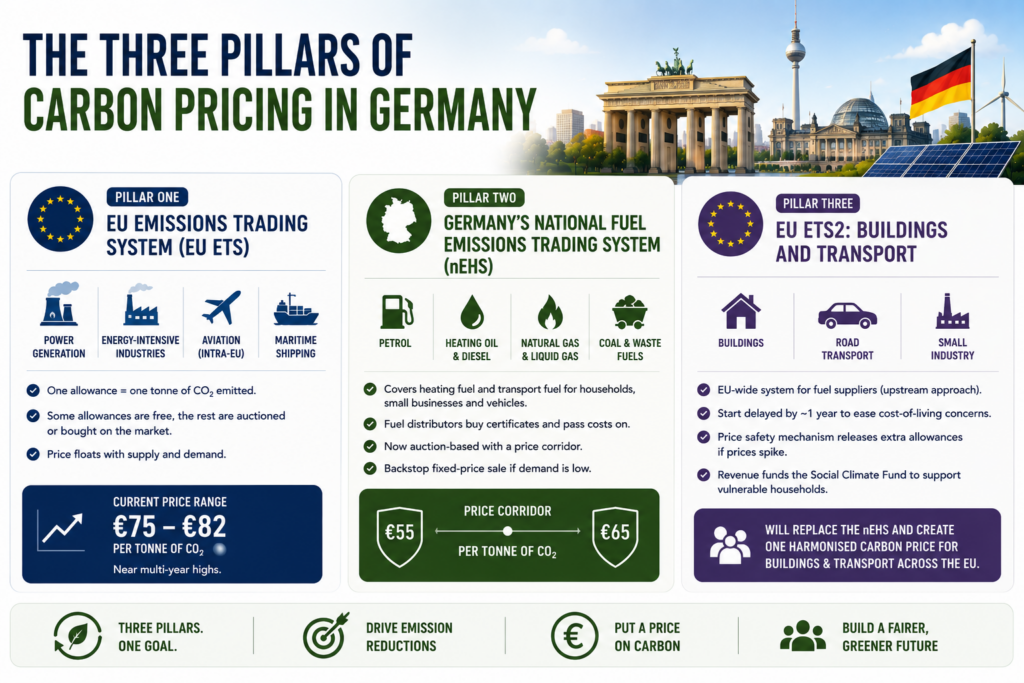
- The EU Emissions Trading System (EU ETS) covers large power plants, heavy industry, and aviation.
- Germany’s national fuel emissions trading system (nEHS) covers heating fuel and transport fuel that the EU ETS does not reach.
- The upcoming EU-wide system for buildings and road transport (EU ETS2) will eventually replace most of the national system.
Together, these systems place a price on carbon emissions from energy production, industry, heating, and transport. That price then flows through to electricity bills, fuel prices, and heating costs.
Germany did not build this system overnight. It has layered new rules on top of older ones for more than two decades, starting with its entry into the EU carbon market and later adding its own national scheme to cover the gaps.
Carbon Market Insider Newsletter
Weekly insights on carbon markets, climate policy, carbon credits, and sustainability.
Why Germany Needs a Carbon Market
Germany is Europe’s largest economy and one of its biggest greenhouse gas emitters. Putting a price on carbon gives companies and households a financial reason to cut emissions.
The logic is straightforward:
- Emitting carbon costs money.
- Cutting emissions saves money.
- Companies and individuals naturally shift toward cleaner choices over time.
This approach is often called “cap and trade.” Regulators set a cap on total emissions, hand out or auction allowances up to that cap, and let the market decide the price. Every year, the cap shrinks, which pushes prices higher unless emissions fall fast enough to keep up.
Germany has folded this idea into a broader climate law that sets legally binding reduction targets. The country aims to cut greenhouse gas emissions by a large margin compared with levels recorded around the early 1990s, with an even steeper cut required in the following decade, and full climate neutrality targeted for around the middle of the century.
The carbon market is the financial engine designed to help Germany reach these targets without needing constant new legislation for every sector.
The Three Pillars of Carbon Pricing in Germany
Pillar One: The EU Emissions Trading System (EU ETS)
The EU ETS is the original and largest carbon market in Europe, and Germany has participated in it since the system launched.
It covers:
- Power stations and heat generation plants
- Energy-intensive industries such as steel, cement, chemicals, and refineries
- Commercial aviation within Europe
- Maritime shipping, which was added more recently and is being phased in gradually
Companies covered by the EU ETS (website) must hold one allowance for every tonne of CO2 they emit. They receive some allowances for free, especially in sectors exposed to international competition, but they must buy the rest at auction or on the secondary market.
The price of these allowances is not fixed. It floats based on supply and demand, much like a stock price. In recent months, EU carbon allowance prices have traded in the range of roughly 75 to 82 euros per tonne, a level near multi-year highs, reflecting a shrinking supply of allowances and tighter caps under ongoing reforms.
Pillar Two: Germany’s National Fuel Emissions Trading System (nEHS)
The EU ETS never covered everyday heating fuel and transport fuel used by households, small businesses, and vehicles. Germany closed this gap with its own national scheme, commonly called the nEHS, based on the Fuel Emissions Trading Act.
Here is how it works in practice:
- Fuel distributors, not individual drivers or homeowners, are the ones legally required to buy certificates.
- These distributors include companies selling petrol, diesel, heating oil, natural gas, liquid gas, coal, and certain waste fuels.
- The cost of these certificates gets passed down the chain, eventually showing up in the price you pay at the pump or on your heating bill.
The nEHS started with a fixed price that increased gradually year after year, giving businesses time to plan ahead. It has now moved into an auction-based phase, where the price floats within a set corridor rather than being fixed by law.
The current price corridor sits between 55 and 65 euros per tonne of CO2, with a backstop fixed-price sale available at a higher rate if auction demand runs short. This is a major shift from the early fixed-price years, when the starting price was only a fraction of today’s level.
Pillar Three: EU ETS2, the New System for Buildings and Transport
The European Union is rolling out a brand-new emissions trading system that will eventually absorb most of what the German nEHS currently does. This new system is called EU ETS2, and it applies EU-wide rather than just in Germany.
Key facts about EU ETS2:
- It targets fuel suppliers for buildings, road transport, and small industrial users, using the same “upstream” approach as the German national system.
- It was originally due to start collecting full compliance obligations soon, but EU governments recently agreed to push the start back by roughly a year, citing concerns about high energy prices and the cost of living.
- It includes a built-in price safety mechanism, releasing extra allowances automatically if prices spike above a defined threshold, to protect consumers from sudden shocks.
- Revenue raised through EU ETS2 is meant to fund a Social Climate Fund, which is designed to help lower-income households cope with rising energy costs.
Once EU ETS2 becomes fully operational, Germany’s national nEHS will largely fold into it, creating one harmonized carbon price for buildings and transport across the whole European Union rather than a patchwork of national systems.
Current Carbon Prices in Germany: A Quick Reference Table
Carbon prices move constantly, but here is a snapshot of the price structure across Germany’s carbon pricing systems as they currently stand.
| System | Covers | Current Price Structure | Who Pays Directly |
|---|---|---|---|
| EU ETS (EU-wide) | Power plants, heavy industry, aviation, shipping | Market-based, roughly 75 to 82 euros per tonne recently | Large industrial operators and utilities |
| National fuel trading (nEHS) | Heating oil, petrol, diesel, natural gas, coal, waste fuel | Auction-based corridor of 55 to 65 euros per tonne | Fuel distributors and suppliers |
| EU ETS2 (upcoming) | Buildings and road transport EU-wide | Not yet finalized, capped near 45 euros in early years under the safety mechanism | Fuel suppliers, later reflected in consumer prices |
Keep in mind that these prices shift as the systems evolve, caps tighten, and demand changes. Always check current auction results if you need up-to-date pricing for compliance or investment decisions.
How This Actually Affects You
The carbon market Germany operates does not send you a direct bill. Instead, it works quietly through the supply chain.
If You Are a Household
You feel the cost of carbon pricing through:
- Higher prices at the petrol pump
- Slightly higher heating oil and natural gas bills
- Indirect effects on electricity prices, especially where coal or gas power plants are involved
For a typical household using natural gas for heating, the added cost from national fuel trading currently comes out to a modest number of cents per unit of energy, though this depends heavily on how much fuel a household actually uses.
If You Are a Business
Businesses experience carbon pricing very differently depending on size and sector.
Small and medium businesses mostly feel indirect costs through higher fuel and energy bills, similar to households, unless they operate heavy machinery or industrial processes.
Large industrial companies and utilities face direct compliance obligations under the EU ETS. They must:
- Monitor and report their emissions accurately every year.
- Surrender enough allowances to match their verified emissions.
- Buy additional allowances at auction or through brokers if their free allocation and holdings fall short.
- Face financial penalties for every tonne of emissions left uncovered.
Fuel distributors carry the direct legal burden under the national fuel trading system, since they are the ones required to buy nEHS certificates before selling regulated fuels.
Step-by-Step: How Compliance Works Under the EU ETS
For companies directly covered by the EU ETS, the compliance cycle repeats every year. Here is a simplified breakdown of that cycle:
- Monitor emissions. Facilities track fuel use, production output, and related emissions using approved monitoring methods.
- Verify data. An accredited independent verifier checks the emissions report for accuracy before submission.
- Report to authorities. The verified emissions report goes to the relevant national authority, which in Germany is the German Emissions Trading Authority, often referred to by its German abbreviation DEHSt.
- Reconcile allowances. The company compares its verified emissions against the allowances it holds, whether received for free or purchased.
- Buy or sell allowances. If short, the company buys allowances at auction or on the secondary market. If it holds a surplus, it can sell the extra allowances or bank them for future use.
- Surrender allowances. The company surrenders enough allowances to cover its verified emissions by the compliance deadline.
- Face penalties for shortfalls. Any uncovered tonne triggers a steep financial penalty, and the company still has to make up the missing allowance the following year.
This cycle creates constant demand for allowances, which is exactly what keeps the secondary carbon trading market active and liquid.
Who Manages the Germany Carbon Market?
A handful of key institutions run the carbon market Germany depends on. Knowing who does what helps make sense of the system.
| Institution | Role |
|---|---|
| German Emissions Trading Authority (DEHSt), part of the Federal Environment Agency | Administers compliance, monitoring, and reporting for both the EU ETS and the national fuel trading system in Germany |
| European Energy Exchange (EEX), based in Leipzig | Runs the auctions for EU ETS allowances and national fuel trading certificates |
| European Commission | Sets EU-wide caps, rules, and reforms for the EU ETS and EU ETS2 |
| Federal Ministry for Economic Affairs and Climate Action | Shapes national climate and energy policy, including funding programs linked to carbon revenue |
| Federal Environment Agency (Umweltbundesamt, UBA) | Oversees environmental monitoring and supports policy implementation |
Revenue raised from carbon pricing in Germany does not simply disappear into general government funds. A large share flows into the Climate and Transformation Fund, which supports building renovation, industrial decarbonization, renewable energy expansion, and electric mobility programs.
The Voluntary Carbon Market in Germany
Alongside the compliance-driven systems above, Germany also has an active voluntary carbon market. This is separate from the mandatory EU ETS and national fuel trading rules.
In the voluntary market:
- Companies buy carbon credits to offset emissions they cannot yet eliminate, often as part of corporate sustainability commitments.
- Credits come from certified projects such as reforestation, renewable energy, methane capture, or soil carbon initiatives.
- Standards like Verra and Gold Standard certify these projects and issue tradable credits.
- German companies, especially in sectors like aviation, logistics, and consumer goods, are active buyers in this space.
The voluntary carbon market operates on trust and credibility. Buyers want credits that represent real, additional, and permanent emissions reductions, so due diligence on project quality matters enormously here.
CBAM and Germany’s Role in Global Carbon Trade
Germany, as an EU member state, also participates in the Carbon Border Adjustment Mechanism, known as CBAM. This mechanism places a carbon cost on certain imported goods, such as steel, cement, aluminum, fertilizers, and electricity, based on the emissions embedded in their production.
Why does this matter for the Germany carbon market?
- It prevents “carbon leakage,” where companies simply move production to countries with weaker climate rules to dodge EU carbon costs.
- German importers of these goods must account for embedded carbon emissions and eventually purchase CBAM certificates.
- It levels the playing field between EU producers, who already pay for carbon under the EU ETS, and foreign competitors who previously did not.
CBAM effectively extends the logic of the Germany carbon market beyond German and EU borders, influencing how German companies source raw materials and industrial inputs from abroad.
Opportunities in the Germany Carbon Market
The carbon market is not only a cost center. It also creates real business and career opportunities.
For businesses:
- Companies that cut emissions faster than required can sell surplus allowances for profit.
- Energy efficiency investments often pay for themselves faster once carbon costs are factored in.
- Renewable energy and heat pump installers benefit from rising demand as fossil fuel costs climb.
- Carbon project developers can create and sell voluntary carbon credits from qualifying projects.
For professionals and job seekers:
- Carbon accounting and emissions reporting have become specialized, in-demand skills.
- Compliance consulting for EU ETS and nEHS obligations is a growing niche field.
- ESG and sustainability roles increasingly require an understanding of carbon markets.
- Carbon trading and brokerage roles exist at exchanges, banks, and specialized trading firms.
For investors:
- EU carbon allowances themselves are a tradable financial instrument, and various funds now offer exposure to carbon prices.
- Companies with strong decarbonization strategies may become more resilient as carbon costs rise over time.
Common Challenges and Criticisms
No carbon market is perfect, and the Germany carbon market faces real criticism worth understanding.
Affordability concerns. Rising fuel and heating costs disproportionately affect lower-income households, which is part of why the EU built in price safety mechanisms and a Social Climate Fund for the new buildings and transport system.
Policy uncertainty. The recent delay to the EU-wide buildings and transport system shows how political pressure over energy prices can shift timelines, creating planning uncertainty for businesses.
Carbon leakage risk. Without measures like CBAM, there is a real risk that emissions simply shift to countries with weaker carbon rules rather than actually falling.
Complexity. Businesses operating across multiple sectors sometimes have to navigate the EU ETS, the national fuel trading system, and voluntary market rules simultaneously, which adds administrative burden.
Free allocation debates. Some member states are pushing to extend free allowances for industry longer than currently planned, arguing that energy costs already strain competitiveness, while environmental groups warn this slows the pace of decarbonization.
The Future of the Germany Carbon Market
Several major shifts are already shaping what comes next for carbon pricing in Germany.
- Merging systems. As the EU-wide buildings and transport system matures, Germany’s separate national fuel trading system will gradually fade out and merge into it.
- Tightening caps. The overall EU ETS cap keeps shrinking each year, and reforms under discussion could tighten it further, pushing prices upward over time absent major emissions cuts.
- Growing sector coverage. Maritime shipping has recently been folded more fully into the EU ETS, and further sector expansions remain possible.
- Stronger border measures. CBAM is expected to expand to cover more product categories over time, reinforcing the link between domestic carbon pricing and international trade.
- Renewable energy growth. Germany continues to expand wind, solar, and storage capacity, which should gradually reduce the carbon intensity of its power sector and ease some pricing pressure over the long run.
For businesses and households alike, the clearest long-term signal is this: carbon costs in Germany are structurally built to rise over time, not fall, as caps tighten and free allocations phase out. Planning around that reality now is far cheaper than adapting under pressure later.
Practical Takeaways
If you want to actually act on this information, here are concrete next steps depending on who you are.
For business owners:
- Map out exactly which carbon pricing system applies to your operations.
- Track your fuel and energy consumption closely, since this directly determines your exposure.
- Consider energy efficiency upgrades now, before carbon costs climb further.
- If you import goods covered by CBAM, start tracking embedded emissions in your supply chain today.
For households:
- Compare heating systems, since heat pumps and efficient boilers reduce long-term exposure to rising fuel-linked carbon costs.
- Factor rising fuel costs into any vehicle purchase decisions.
- Look into home insulation upgrades, which often qualify for government support tied to climate funding.
For students and professionals:
- Build skills in carbon accounting, ESG reporting, or emissions verification, since demand for this expertise keeps growing.
- Follow policy updates from the German Emissions Trading Authority and the European Commission to stay current.
Frequently Asked Questions
What is the Germany carbon market in simple terms?
It is a set of systems that make companies pay for the greenhouse gases they emit, covering large industry through the EU-wide system and heating and transport fuel through Germany’s own national scheme.
Who actually pays for carbon pricing in Germany?
Legally, large industrial operators, power producers, and fuel distributors pay directly. In practice, part of that cost gets passed down to consumers through fuel, heating, and electricity prices.
Is carbon pricing the same as a carbon tax?
Not exactly. A carbon tax sets a fixed price per tonne of emissions. Germany’s systems are cap-and-trade markets, where the price floats based on supply and demand within a capped total number of allowances, though the national fuel system currently uses a temporary price corridor that behaves somewhat like a tax.
How is the carbon price in Germany decided?
For the EU ETS, the price is set by the market through auctions and trading. For the national fuel trading system, the price currently floats within a government-set corridor, with a fixed backstop price if auction demand exceeds supply.
Will carbon prices in Germany keep rising?
Most signs point to gradually rising costs over time, driven by shrinking emissions caps and the phase-out of free allowances, though short-term price swings can go in either direction based on energy markets and policy decisions.
How does the carbon market affect my heating bill?
If you heat your home with natural gas, heating oil, or other fossil fuels, the fuel supplier pays for carbon certificates and typically passes some of that cost on to you as part of your fuel or heating price.
What is the difference between the EU ETS and the national fuel trading system in Germany?
The EU ETS covers large industrial installations, power plants, and aviation across the whole European Union. Germany’s national fuel trading system was created specifically to cover heating and transport fuel until the new EU-wide buildings and transport system takes over that role.
Can individuals trade carbon allowances directly?
Generally no. Compliance trading is designed for regulated companies and financial institutions. Individuals interested in carbon markets typically gain exposure through specialized investment funds or by supporting voluntary carbon credit projects.
Final Thoughts
The Germany carbon market is a genuinely ambitious attempt to price greenhouse gas emissions across nearly every corner of the economy, from steel mills to home heating systems.
It combines EU-wide industrial carbon trading, a dedicated national system for fuel emissions, and an upcoming EU-wide mechanism for buildings and transport, all backed by strict climate targets written into German law.
Understanding carbon market Germany dynamics is no longer optional for businesses operating in energy-intensive sectors, and it increasingly matters for everyday households managing fuel and heating costs too.
The direction of travel is clear. Carbon costs will keep shaping decisions across German industry, transport, and housing for years to come, and those who understand the system early will be far better positioned to manage the costs and seize the opportunities it creates.
If you want to keep learning about carbon markets, ESG strategy, and sustainability trends, explore more resources on Carbon Market Network.