Carbon Market Network


Every carbon credit that a company buys to meet its climate goals starts with someone, somewhere, doing the hard work of building a project on the ground. That someone is a carbon project developer.
Whether it is restoring a degraded peatland in Southeast Asia, deploying clean cookstoves in sub-Saharan Africa, or pulling carbon directly from the air in Iceland, carbon project developers are the engine behind the voluntary carbon market (VCM). They find the opportunities, build the projects, get them verified, and connect climate finance to real-world climate action.
But who are the biggest players? What do they actually do? And how do you tell a credible developer from one that is cutting corners?
This guide answers all of that. You will learn how carbon project developers operate, what makes a great one, and which organizations are leading the global market as of June 2026.
What Is a Carbon Project Developer?
A carbon project developer is an organization (or sometimes an individual) that designs, builds, and manages projects that reduce or remove greenhouse gas (GHG) emissions from the atmosphere.
When a project successfully reduces or removes a verified amount of emissions, it earns carbon credits. Each credit represents one metric ton of carbon dioxide equivalent (CO2e) that was reduced, avoided, or removed.
Developers then sell these credits to companies, governments, and individuals who want to offset their emissions or fund broader climate action.
Think of carbon project developers as the “producers” of the carbon market. Just like a farmer grows food that ends up on store shelves, carbon project developers grow climate impact that ends up in a company’s sustainability report.
Carbon Market Insider Newsletter
Weekly insights on carbon markets, climate policy, carbon credits, and sustainability.
What Does a Carbon Project Developer Actually Do?
Being a carbon project developer is not a single job. It is a multistep journey that can take years from concept to first credit issuance. Here is how the process typically works.
Step 1: Project Identification and Feasibility
The developer identifies an opportunity. This might be a large forest at risk of deforestation, a landfill emitting methane, or farmland that could store more carbon in the soil.
They run a feasibility study to assess:
- How much carbon the project can reduce or remove
- Which methodology and registry to use
- Whether the project is “additional” (meaning it would not happen without carbon finance)
- The likely cost of development versus potential revenue from credits
Step 2: Project Design and Methodology Selection
The developer writes a Project Description Document (PDD). This is a detailed blueprint of the project that explains:
- The project’s baseline (what would have happened without it)
- The methodology used to calculate emissions reductions
- How the project will be monitored over time
- Any risks such as fires, floods, or policy changes
The methodology must come from an approved standard such as Verra’s Verified Carbon Standard (VCS), Gold Standard, the American Carbon Registry (ACR), or the Climate Action Reserve (CAR).
Step 3: Third-Party Validation
An independent Validation and Verification Body (VVB) reviews the PDD and confirms it meets the chosen standard’s requirements. This validation step is the first major quality checkpoint.
Step 4: Project Registration
Once validated, the project is officially registered on the relevant registry. At this point, the project is publicly listed and tracked. Registration does not yet mean credits have been issued.
Step 5: Implementation and Monitoring
The developer implements the project on the ground. They collect data, monitor emissions, manage risks, and document progress according to the methodology’s monitoring plan.
Step 6: Verification and Credit Issuance
The VVB returns periodically (often annually or every few years) to verify that the claimed emissions reductions actually happened. If verification is approved, the registry issues Verified Carbon Units (VCUs) or equivalent credits to the developer’s account.
Step 7: Sales, Retirement, and Reporting
The developer sells credits to buyers. When a buyer uses a credit to offset their emissions, the credit is “retired” in the registry. Retirement means the credit is permanently removed from circulation and can never be used again by anyone else.
Why Carbon Project Developers Matter So Much
Carbon project developers are not just paperwork factories. They are the link between climate finance and real-world change.
Carbon project developers bring fresh ideas and initiatives to the table, creating innovative projects that reduce greenhouse gas emissions. These projects, whether they involve renewable energy installations, reforestation efforts, or emissions-reducing technologies, are designed to contribute to a more sustainable and environmentally friendly future.
Project developers design and operate carbon projects across methodologies and geographies. Corporate buyers purchase credits as part of their climate strategies.
Without project developers, there would be no credits for companies to buy. Without buyers, there would be no revenue to keep projects funded. The whole market depends on this relationship working well.
The Global Carbon Market: Setting the Scene for 2026
Before we dive into the leading developers, it helps to understand just how big this market has become.
The global carbon credit market was estimated at around $887 billion in 2025 and is projected to reach about $1.22 trillion in 2026, driven by stricter rules and corporate demand for offsets.
Companies retired more credits in the first half of 2025 than in any previous period, while more than $10 billion was committed to new carbon credit generation — three times 2024 levels.
2026 is shaping up to be a defining year for the voluntary carbon market. After years of criticism, uncertainty, and volatility, the market is entering a more mature phase. Corporate climate ambition is higher than ever. Investment is flowing in at record levels. At the same time, integrity standards are tightening, regulators are stepping in, and the supply of truly high-quality credits remains tight.
The result is a market that rewards well-run, credible carbon project developers more than ever before.
Types of Carbon Projects Developers Work On
Carbon project developers operate across a wide range of project types. Each type generates credits differently and comes with its own standards, risks, and opportunities.
Nature-Based Solutions (NBS)
These are the most widely known project types. They include:
- REDD+ (Reducing Emissions from Deforestation and Forest Degradation): Projects that protect forests that would otherwise be cleared
- Afforestation and Reforestation (ARR): Planting trees on degraded or previously forested land
- Improved Forest Management (IFM): Managing existing forests to store more carbon
- Wetland and Peatland Restoration: Protecting or restoring carbon-rich ecosystems like mangroves and peat bogs
- Soil Carbon: Changing agricultural practices to store more carbon in farmland soils
- Blue Carbon: Restoring coastal ecosystems like seagrasses and mangroves
Removal credits tend to trade at a premium to avoidance credits, not just because of the higher level of investment required by the underlying project, but because of the tighter supply for these types of credits. They are also believed to be a more impactful tool in the fight against climate change.
Technology-Based Carbon Removal
These are newer, faster-growing project categories:
- Direct Air Capture (DAC): Technology that pulls CO2 directly from the atmosphere and stores it underground permanently
- Biochar: Converting organic waste into charcoal that locks carbon in the soil for hundreds of years
- Enhanced Weathering: Spreading crushed silicate rocks on land to accelerate natural carbon absorption
- Bioenergy with Carbon Capture and Storage (BiCRS): Combining biomass energy with carbon capture to generate negative emissions
- Mineral Carbonation: Locking CO2 into construction materials like concrete
Household and Community Projects
These projects deliver both carbon and social benefits:
- Clean Cookstoves: Replacing traditional fires with efficient stoves that reduce fuel use and emissions
- Safe Drinking Water: Eliminating the need to boil water with fuel
- Renewable Energy Access: Bringing solar or clean energy to off-grid communities
Industrial and Energy Projects
- Methane Capture: Capturing methane from landfills, coal mines, or livestock operations
- Renewable Energy: Solar, wind, and hydro projects in regions where coal or diesel would otherwise be used
- Industrial Gas Destruction: Eliminating potent greenhouse gases like HFCs from industrial processes
What Makes a High-Quality Carbon Project Developer?
Not all carbon project developers are equal. In 2026, the market has become far more sophisticated about separating credible developers from poor-quality ones.
Here are the key markers of a trustworthy developer:
1. Rigorous Methodology Selection A good developer picks an approved, science-based methodology that honestly reflects how much carbon the project reduces or removes. They do not inflate baselines to claim more credits than the project actually delivers.
2. Independent Verification Every credit should be independently verified by an accredited third-party auditor. A developer that avoids independent scrutiny is a red flag.
3. Transparent Registry Listing Reputable developers register their projects on publicly accessible registries like Verra, Gold Standard, ACR, or Puro.earth. Anyone can look up a project’s issuance history, verification reports, and retirement records.
4. Additionality The project must prove that it would not have happened without carbon finance. If a forest was already legally protected with no development threat, protecting it generates no real “additional” climate benefit.
5. Permanence For removal projects especially, the carbon must stay stored for a long time. Good developers address reversal risks through buffer pools, insurance, or conservative accounting.
6. Co-Benefits The best developers do not just reduce carbon. They also create jobs, protect biodiversity, support indigenous communities, and improve public health.
7. ICVCM Core Carbon Principles (CCP) Alignment The ICVCM’s 10 Core Carbon Principles were established to set an independent global standard of quality and integrity in the VCM. They fall into three categories — governance, emissions impact, and sustainable development — and touch on several key points, including transparency, third-party validation, additionality, permanence, and more.
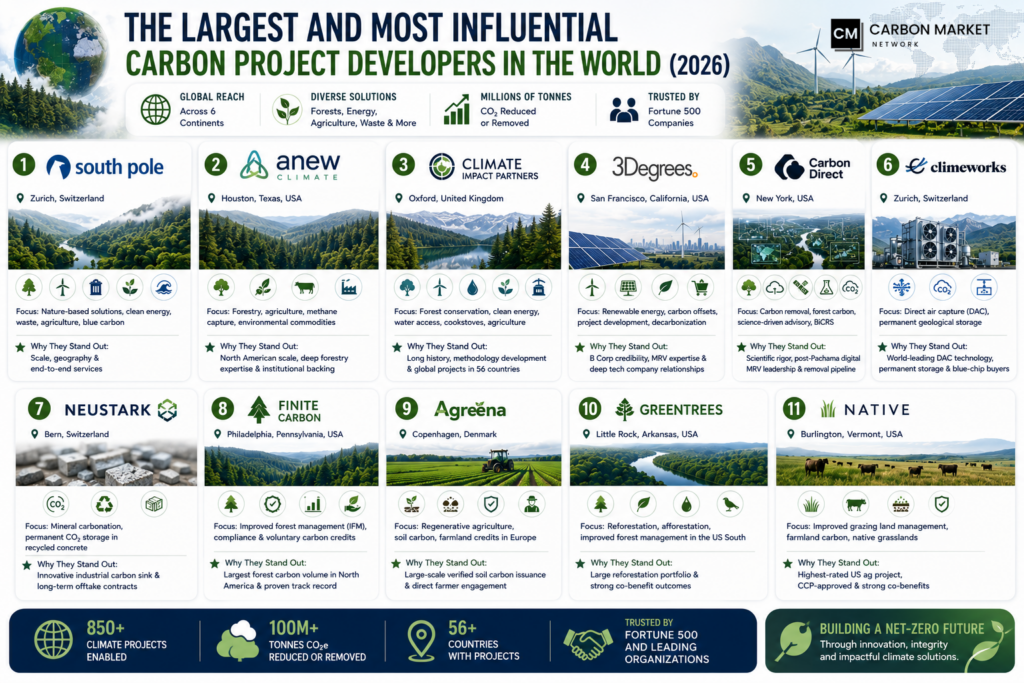
The Largest and Most Influential Carbon Project Developers in the World
1. South Pole Group
Headquarters: Zurich, Switzerland Project Focus: Nature-based solutions, clean energy, waste management, agriculture, blue carbon
South Pole has been helping organisations decarbonise and navigate the complexities of climate since 2006. With over 500 employees in more than 20 countries, they create global impact by helping organisations decarbonise and navigate the complexities of climate in ways that are good for business, people and planet.
With more than 850 climate projects enabled across over 20 countries, South Pole’s experts span 6 continents.
South Pole operates what many consider the world’s largest portfolio of climate action projects in the voluntary carbon market. They do not just sell credits. They act as a developer, consultant, and full-service partner for companies trying to meet science-based net-zero targets.
Their project pipeline spans every major category: REDD+ forest protection, afforestation and reforestation, methane capture from landfills, clean cookstoves, solar energy, and marine carbon removal. South Pole also offers Article 6-aligned projects that allow companies to meet increasingly strict standards tied to the Paris Agreement.
As a leading Carbon Asset Developer, South Pole acts as a crucial expert partner throughout this complex journey. They assist project developers with everything from initial design and financing to navigating the entire validation and verification process, ensuring their projects are of the highest integrity and successfully generate verifiable carbon credits.
South Pole is also one of the few developers actively building new project pipelines in Asia, which is emerging as the fastest-growing region for carbon market activity.
Why They Stand Out: Scale, geography, and end-to-end services. South Pole guides projects from conception all the way to credit issuance and buyer delivery.
2. Anew Climate (formerly Bluesource + Element Markets)
Headquarters: Houston, Texas, USA Project Focus: Forestry, agriculture, methane capture, environmental commodities
Formally founded in 2001, Blue Source has a new brand name called Anew after merging with the Element Markets last June. It gets the top one slot when it comes to providing offset credits from improved forest management, carbon capture, and other projects. It has offices in the U.S., Canada, and Europe, and an environmental commodities portfolio that extends across 5 continents.
Anew is a climate-solutions company formed through the 2022 merger of environmental credit leaders Bluesource and Element Markets, creating one of North America’s largest environmental commodity firms. It works across carbon, renewable fuels, and other environmental markets.
Anew has a large transaction track record, with over 150 Mt CO2 transacted and millions of acres under projects. Their multi-commodity expertise helps clients manage different compliance and voluntary obligations.
Anew is backed by TPG Rise Climate, one of the most active climate-focused investors globally. Their primary strength lies in North American forest carbon, particularly improved forest management (IFM) projects that have generated some of the largest volumes of compliance-grade credits in the California cap-and-trade program.
What sets Anew apart from other project developers is that it serves the multiple functions of a broker, trader, retailer, and advisor in the carbon space.
Anew is also the supply partner for Rubicon Carbon, a major carbon solutions firm, which gives them a powerful distribution channel to large corporate buyers.
Why They Stand Out: North American scale, deep forestry expertise, multi-role capabilities, and institutional backing.
3. Climate Impact Partners
Headquarters: Oxford, United Kingdom Project Focus: Forest conservation, clean energy, water access, cookstoves, agriculture
Climate Impact Partners was formed through the merger of two long-standing industry leaders: ClimateCare and Natural Capital Partners. Together, they brought more than two decades of combined experience in voluntary carbon market development.
Climate Impact Partners provides a comprehensive network of partners with access to more than 600 projects, reducing and removing carbon emissions across 56 countries. They have global reach, long-standing industry expertise, extensive project development capabilities, and unrivalled experience of working with the world’s largest brands.
The combined group has been responsible for the reduction or removal of more than 100 million tonnes of CO2e. They have developed new projects in countries including Chile, Guatemala, India, Kenya, the Philippines, and the UK.
Climate Impact Partners is notable for developing new methodologies where none exist, actively working with standard bodies like Verra and Gold Standard to create frameworks for emerging project types including blue carbon. Their track record with Fortune 500 companies makes them one of the most trusted names in the market.
Why They Stand Out: Long history, Fortune 500 client base, methodology development, global project development across 56 countries.
4. 3Degrees
Headquarters: San Francisco, California, USA Project Focus: Renewable energy, carbon offsets, carbon project development, supply chain decarbonization
3Degrees is a trailblazer in climate solutions, empowering organizations worldwide to achieve renewable energy and carbon reduction goals. Founded in 2007, the company has facilitated over 10 million metric tons of CO2 reductions, equivalent to the annual energy use of about 1.2 million homes.
3Degrees is a certified B Corporation with a strong focus on environmental integrity. They have pioneered several first-of-their-kind offset projects, including the first carbon offset project registered under the Regional Greenhouse Gas Initiative (RGGI).
3Degrees applies its monitoring, reporting, and verification expertise to an extensive pipeline of managed projects and conducts a rigorous due diligence process on their portfolio of partner projects.
Their work spans multiple sectors and continents. They have helped major corporations including Google, Microsoft, and LinkedIn meet their sustainability commitments through verified carbon credit portfolios.
Why They Stand Out: B Corporation credibility, market pioneering history, strong MRV expertise, and deep relationships with global tech companies.
5. Carbon Direct (with Pachama)
Headquarters: New York, USA Project Focus: Carbon dioxide removal, forest carbon, science-driven advisory, BiCRS
Carbon Direct, the global leader in science-driven carbon management, announced the acquisition of climate technology pioneer Pachama in November 2025.
Science-based carbon management firm Carbon Direct acquired climate technology company Pachama in a move set to reshape how nature-based carbon projects are verified and scaled. The deal brings together Carbon Direct’s scientific advisory strength with Pachama’s advanced digital monitoring platform to improve the integrity and transparency of carbon credits.
Founded in 2020, New York-based Carbon Direct provides an end-to-end carbon management platform, enabling companies to set targets, measure their emissions, implement reductions across operations and supply chain, and build high-quality carbon dioxide removal into their climate plans.
Carbon Direct is driven by science first. Their team of over 70 scientists evaluates projects with the same rigor applied to peer-reviewed research. After acquiring Pachama, they now also offer cutting-edge AI-powered and satellite-based MRV tools for forest carbon projects, closing a major transparency gap in the market.
They are also active in BiCRS (Bioenergy with Carbon Removal and Storage), including the Beaver Lake Biofuels project in Louisiana that produces both biofuel and carbon removal credits from forestry byproducts.
Why They Stand Out: Scientific rigor, post-Pachama digital MRV leadership, strong removal credit pipeline, trusted by some of the world’s largest corporate buyers.
6. Climeworks
Headquarters: Zurich, Switzerland Project Focus: Direct air capture (DAC), permanent geological carbon storage
Climeworks is the world’s most recognized commercial direct air capture developer. They do not work with forests or farms. They build machines that physically pull CO2 out of the atmosphere and permanently lock it underground in basalt rock formations.
Climeworks removes carbon directly from the air and mineralises it underground. This is not avoided emissions; it is engineered removal with permanent storage. In May 2024, they switched on Mammoth, at the time the world’s largest operating DAC plant.
Climeworks sells carbon removal credits at the high end of the market. Prices exceed $400 per tonne because the technology is expensive and the permanence is unmatched. Their buyers include Microsoft, which has signed major multi-year offtake agreements.
The Mammoth plant in Iceland has been a landmark for the entire carbon removal industry, proving that DAC can operate commercially at scale and generating significant attention from buyers who want durable, high-integrity removal credits.
Why They Stand Out: World-leading DAC technology, truly permanent carbon storage, blue-chip buyer roster, at the frontier of the engineered removal market.
7. Neustark
Headquarters: Bern, Switzerland Project Focus: Mineral carbonation, permanent CO2 storage in recycled concrete
Neustark is a Swiss developer that locks carbon into demolition concrete aggregate by mineralisation. The feedstock CO2 is captured at nearby biogenic point sources such as biogas plants, liquefied, and injected into recycled concrete granulate; carbonates form and the CO2 is durably stored within the material.
Neustark is built for multi-year offtakes. Microsoft signed 27,600 t over six years, and in August 2025, SWISS became its first airline partner under a contract running to 2030.
Neustark turns industrial waste streams into permanent carbon stores. Their model is elegant: take CO2 from biogas plants and inject it into old demolition concrete, where it mineralizes and stays locked permanently. It is local, industrial, and verifiable. Buyers who want European siting and tangible permanence find it compelling.
Why They Stand Out: Innovative industrial carbon sink, European siting, long-term offtake contracts with major brands, highly permanent storage.
8. Anew’s Partner Ecosystem: Finite Carbon
Headquarters: Philadelphia, Pennsylvania, USA Project Focus: Improved forest management (IFM), compliance and voluntary carbon credits
Finite Carbon, founded in 2009, is North America’s biggest developer of forest carbon offsets by volume. It focuses mainly on improved forest management projects. With offices in 7 US states, it combines unparalleled project development experience with extensive carbon market knowledge. The developer generated over one-third of all compliance offset supply.
Finite Carbon works exclusively with large forest landowners, with a minimum threshold of 5,000 acres. They are responsible for delivering hundreds of millions of dollars to North American landowners through carbon revenue, making them one of the most impactful developers for rural and timber-industry communities.
Their compliance-grade credits have been used extensively in the California cap-and-trade system, giving them a credibility record that few forest developers can match.
Why They Stand Out: Largest forest carbon volume in North America, compliance-grade quality, deep landowner relationships, proven track record in regulated markets.
9. Agreena
Headquarters: Copenhagen, Denmark Project Focus: Regenerative agriculture, soil carbon, farmland-based credits in Europe
Agreena runs one of Europe’s largest soil-carbon programmes, paying farmers to adopt regenerative practices and issuing credits under Verra’s VCS. The project secured Verra registration in early 2025 and has now achieved verification and issuance, with approximately 2.3 million VCUs under VM0042 v2.0.
Agreena works with farmers across Europe to shift to regenerative practices: reduced tillage, cover cropping, and soil health improvements that measurably increase the amount of carbon stored in the soil. This is one of the fastest-growing project categories in the VCM because agricultural land is vast and relatively underrepresented in existing project portfolios.
Their model is particularly appealing to European buyers who want local projects with visible agricultural co-benefits.
Why They Stand Out: European geography, large-scale verified soil carbon issuance, direct farmer engagement, and alignment with the growing demand for agricultural climate solutions.
10. GreenTrees
Headquarters: Little Rock, Arkansas, USA Project Focus: Reforestation, afforestation, improved forest management in the US South
GreenTrees is one of the most active reforestation and afforestation developers in North America. Their work focuses on the Lower Mississippi Alluvial Valley, an area where converting marginal farmland back to native forest delivers significant carbon and biodiversity benefits.
GreenTrees is among the major companies operating in the voluntary carbon credit market.
They operate a landowner model where farmers and landowners can enroll their unproductive land, receive upfront payments and ongoing revenue from carbon credit sales, and transition marginal cropland back to functional forest ecosystems.
Why They Stand Out: Large reforestation portfolio, landowner-friendly model, high co-benefit credentials including wildlife habitat and water quality.
11. Native (formerly NativeEnergy)
Headquarters: Burlington, Vermont, USA Project Focus: Improved grazing land management, farmland carbon, native grasslands
Native focuses on building high-integrity, project-level carbon credits from North American agricultural land. They are particularly active in grazing land management, using rotational grazing techniques that measurably restore soil carbon.
The Northern Great Plains Regenerative Grazing Project, developed by Native, works with cattle ranchers across Montana to implement higher-intensity rotational grazing that restores grassland ecosystem function and measurably increases soil organic carbon. With over 250,000 acres enrolled in Phase 1, it is one of the largest registered grazing land carbon projects in the US, verified under Verra’s VM0026 methodology.
This project received a BeZero Carbon A-rating in July 2025 — the highest of any US agriculture project — and CAR SEP v1.1 CCP-approved status from the ICVCM in October 2025.
Why They Stand Out: Highest-rated US agricultural project in 2025, CCP-approved methodology, strong co-benefit story for ranching communities and grassland ecosystems.
Emerging Carbon Project Developers to Watch in 2026
The market is not just dominated by established names. A new generation of developers is building innovative projects that are reshaping expectations.
Puro.earth
A Finnish registry and developer platform focused entirely on durable carbon removal. Puro.earth is the leading marketplace for biochar, enhanced rock weathering, and construction material-based removal credits. Their engineering-grade quality standards make them a benchmark for durable removals.
AgriCapture
AgriCapture’s Soil Enrichment Project is the largest regenerative row-crop agriculture carbon project in the southern United States, with over 130,000 acres enrolled across eight states. They focus on mid-South row crops and have built one of the first CCP-approved soil enrichment protocols in North America.
Klim
A German platform working directly with European farmers to develop soil carbon credits. Their focus on data transparency and annual verification positions them well as European regulation of climate claims tightens.
goodcarbon
goodcarbon is a Berlin-based platform focused on nature-based portfolios. Their positioning is clear: nature projects for the long term, high-quality credits, and support that goes beyond the logo soup of standards. The company is also a project developer itself, with deep expertise in what it takes to reduce carbon from the atmosphere.
How Carbon Project Developers Get Their Projects Certified
The certification journey is critical to every developer’s credibility. Here is a simplified look at the major standards that govern the market.
Verra (VCS)
The VCS Program has become the largest GHG crediting program in the world because of its rigorous rules and requirements; its adaptiveness to new scientific, technological, and regulatory developments; and the transparent information about its projects and their activities, which is publicly available on the Verra Registry.
As of 2026, over 2,300 projects are registered under VCS. Verra is the dominant registry for nature-based solutions globally, particularly REDD+ and agriculture projects.
Gold Standard
Gold Standard certifies projects with a focus on sustainable development and social impact. Gold Standard credits often command a price premium because their standards for verifying social and community co-benefits are stricter than Verra’s.
American Carbon Registry (ACR)
ACR is one of the oldest bodies in the VCM. It is particularly strong in North American forestry and agriculture projects and has several ICVCM-approved methodologies for the compliance market.
Climate Action Reserve (CAR)
Focused primarily on North American projects, CAR is widely used by developers working in the California compliance offset market. Their protocols are among the most rigorous in the industry.
Puro.earth
Puro.earth focuses specifically on durable engineered carbon removals including biochar, enhanced rock weathering, and mineral carbonation. It is the go-to registry for the newest generation of CDR developers.
ICVCM Core Carbon Principles (CCP)
In 2026, Verra’s VCS is also designated as a CCP-Eligible program under the ICVCM’s Core Carbon Principles benchmark, meaning projects using approved methodologies can carry the CCP label, the market’s emerging quality standard for corporate buyers.
The CCP label is fast becoming the minimum quality bar that serious corporate buyers require when sourcing credits.
The Difference Between Carbon Project Developers, Brokers, and Marketplaces
Many newcomers confuse these three roles. Here is a simple breakdown.
Carbon Project Developers create the supply. They build, manage, and verify emission reduction projects and generate the actual carbon credits.
Brokers and Intermediaries connect developers to buyers. They source credits from multiple developers and resell them to corporate clients. They do not generate credits themselves.
Marketplaces and Platforms provide the trading infrastructure. Platforms like Xpansiv’s CBL, Senken, goodcarbon, and Regreener allow buyers to browse and purchase credits from various developers in one place.
Some organizations like Anew and South Pole operate across all three roles simultaneously, which gives them significant commercial advantage.
How to Evaluate a Carbon Project Developer
Whether you are a corporate buyer, investor, or just someone researching the space, here is what to look for when assessing a developer.
1. Check the Registry Go directly to Verra’s public registry, Gold Standard’s Impact Registry, or ACR’s registry and look up the project. Confirm that it is registered, that verifications are up to date, and that credits have been issued.
2. Look for Independent Ratings Independent carbon rating agencies have become essential. These agencies assess the likelihood that a credit delivers on its promised ton of CO2e avoided or removed, similar to how Moody’s or S&P rate financial bonds. These agencies use satellite imagery, machine learning, and rigorous peer-reviewed science to grade projects on a scale such as AAA to D.
Leading rating agencies include BeZero Carbon, Sylvera, and Calyx Global. A project rated “B” or higher by BeZero is a reasonable quality threshold for most buyers.
According to Patch’s 2025 report, 79% of corporate buyers now require BeZero BBB or higher and 83% require Sylvera Tier 2 or higher.
3. Assess Additionality Carefully Would the project have happened without carbon finance? A forest that is already under permanent protection with no credible deforestation threat does not add much. Look for projects where the carbon revenue is genuinely enabling something new.
4. Verify the Methodology Check whether the methodology is CCP-approved by the ICVCM. This is increasingly the gold standard for corporate buyers in 2026.
5. Request the Full Documentation Set Before committing to any significant purchase, ask the developer for:
- The Project Description Document
- The most recent Monitoring Report
- Validation and Verification reports
- Registry serial numbers for the specific vintage of credits
6. Investigate Co-Benefits Reputable developers can point you to verified data on biodiversity, community employment, or other SDG-aligned benefits, not just carbon numbers.
Key Trends Shaping Carbon Project Developers in 2026
The landscape for carbon project developers is shifting fast. Here are the most important trends to watch.
1. Flight to Quality In 2026, picking a carbon credit platform is a procurement decision with reputational consequences. Pick wrong and you fund credits that BeZero or Sylvera rate as junk, and you explain it to your auditor next year under CSRD disclosure requirements.
Buyers are moving away from cheap, questionable credits and toward higher-integrity projects, even at higher cost.
2. Shift Toward Removal Credits Avoidance credits (which stop emissions) are being complemented and sometimes replaced by removal credits (which actively pull carbon out of the atmosphere). Developers who can supply verified removal credits are commanding premium prices and long-term offtake contracts.
3. Technology-Enhanced MRV Satellite monitoring, drone surveys, AI-based analysis, and remote sensing tools are making it possible to verify emissions reductions more cheaply, accurately, and frequently. Developers who invest in digital MRV have a significant competitive advantage.
4. Article 6 of the Paris Agreement The implementation of Article 6 creates new demand for carbon credits that include corresponding adjustments, meaning the host country has agreed not to count the same reduction in its own national inventory. Developers who can structure Article 6-aligned projects are opening new markets, particularly for corporate buyers in the aviation sector (CORSIA) and those targeting Paris-aligned claims.
5. Asia-Pacific as the Growth Engine Forecasts suggest the Asia-Pacific region could grow at a staggering 36–58% CAGR, outpacing every other geography. China leads through massive renewable deployment and methane initiatives. Indonesia’s peatlands, forestry investments, and regional alliances further accelerate supply and credibility.
Developers with established project pipelines in Asia are positioned to capture this growth.
6. Consolidation and Institutional Capital Large deals like Carbon Direct acquiring Pachama and TPG Rise backing both Anew and Rubicon Carbon signal that institutional capital is consolidating the market around better-resourced, more credible players. Smaller developers face growing pressure to either raise capital, partner with larger players, or specialize in niche project types.
Common Challenges That Carbon Project Developers Face
Even the best developers face significant hurdles.
Project Development Takes Time: From initial feasibility to first credit issuance, a typical project takes two to five years. This requires patient capital and careful cash flow management.
Verification Is Expensive: Independent audits, monitoring systems, and documentation requirements add significant cost to every project.
Baseline Setting Is Complex: Determining what “would have happened without the project” is inherently uncertain and controversial, especially for forest projects where deforestation trends can shift.
Permanence Risk: For land-based projects especially, fires, drought, storms, or land tenure changes can reverse stored carbon. Buffer pools help, but they add cost and reduce the number of credits a project can sell.
Reputational Risk: Verra’s reputation took a hit in 2023. Investigations alleged that many REDD+ projects issued phantom credits with inflated baselines that overstated deforestation risk. These controversies do not mean all Verra credits are worthless; they mean you need clear procurement filters.
Developers who depend heavily on any single methodology or geographic area carry concentrated risk.
The Future of Carbon Project Development
The market for carbon project developers is not slowing down. It is maturing.
The next decade will see:
- Growing demand for removal credits as corporate net-zero deadlines approach and voluntary pledges require increasingly durable offsets
- More government-aligned projects as Article 6 bilateral agreements between nations unlock new carbon finance flows to developing countries
- Stronger integrity standards that filter out low-quality credits and reward developers who invest in science-based monitoring
- New technology pathways including enhanced weathering, ocean carbon removal, and BECCS
- Deeper corporate partnerships where companies invest directly in project development rather than just buying finished credits
For project developers, 2026 is a golden opportunity. Asia-Pacific offers unmatched scale. Removal technologies are gaining priority. Certification under credible frameworks will unlock long-term value.
The developers who survive and thrive will be those who build genuine climate impact, maintain rigorous standards, and earn the trust of increasingly sophisticated buyers.
Conclusion: Carbon Project Developers Are the Backbone of Climate Finance
Behind every carbon credit is a carbon project developer who did the hard work of making it real.
Whether it is South Pole building a portfolio of 850+ projects across six continents, Climeworks pulling CO2 out of Icelandic air and burying it underground, or Agreena paying European farmers to restore soil carbon, these organizations represent the practical infrastructure of the global climate response.
Carbon project developers are not middlemen. They are climate engineers, community builders, ecosystem restorers, and technology pioneers all at once.
Understanding who the leading developers are, how they operate, and what distinguishes credible work from poor practice is essential knowledge for anyone engaging with carbon markets, whether you are a corporate sustainability director, an investor, a policy maker, or simply a curious learner.
The carbon market of 2026 is bigger, more credible, and more strategic than it has ever been. And it runs on the work of carbon project developers.
Frequently Asked Questions (FAQ)
What is a carbon project developer?
A carbon project developer is an organization or individual that designs, builds, and manages projects that reduce or remove greenhouse gas emissions. Their projects generate carbon credits, which can be sold to companies and individuals to offset their own emissions.
What types of projects do carbon project developers work on?
Developers work across a wide range of project types including forest protection (REDD+), reforestation, improved forest management, soil carbon enhancement, methane capture, clean cookstoves, direct air capture, biochar, and many others.
Who are the largest carbon project developers in the world?
As of 2026, the leading carbon project developers globally include South Pole Group, Anew Climate, Climate Impact Partners, 3Degrees, Carbon Direct (with Pachama), Climeworks, Neustark, Finite Carbon, Agreena, GreenTrees, and Native.
How do carbon project developers generate revenue?
Developers earn revenue by selling the carbon credits their projects generate. Credits are sold to corporate buyers, investors, or through exchanges and marketplaces. Pricing varies widely depending on project type, quality, and the standard it is certified under.
What makes a carbon credit credible?
A credible carbon credit must be additional (it would not have happened without carbon finance), measurable, permanent, independently verified, and registered on a public registry. Independent ratings from agencies like BeZero Carbon, Sylvera, or Calyx Global add a further quality check.
What is the difference between a carbon project developer and a carbon broker?
A developer creates the supply of carbon credits by building and managing emission reduction projects. A broker acts as an intermediary, sourcing existing credits from developers and reselling them to buyers. Some large firms like South Pole and Anew operate as both.
What standards do carbon project developers follow?
The main standards used by carbon project developers include Verra’s Verified Carbon Standard (VCS), Gold Standard, the American Carbon Registry (ACR), the Climate Action Reserve (CAR), and Puro.earth for engineered removals. In 2026, the ICVCM Core Carbon Principles (CCP) are becoming the benchmark quality label across most of these standards.
How long does it take to develop a carbon project?
A typical carbon project takes two to five years from initial feasibility assessment to the issuance of the first verified credits. The timeline varies depending on project type, the complexity of the methodology, and the speed of third-party validation and verification.
Why is additionality important for carbon project developers?
Additionality is the principle that a carbon project must deliver real climate benefits that would not have occurred without carbon finance. Without additionality, a project is just business as usual with a carbon credit attached. It is one of the most scrutinized aspects of any project’s credibility.
What is the difference between carbon avoidance and carbon removal projects?
Avoidance projects stop emissions from entering the atmosphere (for example, protecting a forest from being cut down). Removal projects actively pull existing CO2 out of the atmosphere and store it (for example, direct air capture or reforestation). Removal credits generally command higher prices because they are seen as delivering a more durable climate benefit.
Explore more resources on carbon markets, carbon credit verification, and climate finance on Carbon Market Network.