Carbon Market Network


Somewhere in Louisiana, a company is injecting captured CO2 a mile underground.
Somewhere in Arkansas, a landowner just signed a contract to turn cropland back into forest.
Somewhere in Iowa, a farmer changed how they till their fields, and that single decision now generates a paycheck every year.
None of this happens without one group of people: US carbon project developers.
They are the engine room of the carbon market. Buyers get the headlines. Registries get the credibility. But developers do the unglamorous work of finding projects, running the numbers, filing the paperwork, and making sure a ton of carbon reduced on paper is a ton of carbon reduced in reality.
This guide breaks down everything you need to know about carbon developers America relies on, how the US carbon project development process actually works, who the major players are, and how you can get involved, whether you own land, run a business, or just want to understand where your carbon credits come from.
What Is a Carbon Project Developer
A carbon project developer is a company or organization that designs, builds, and manages projects that reduce or remove greenhouse gases.
Think of them as the entrepreneurs of the carbon market.
They identify an opportunity, such as capturing methane from a landfill or planting trees on unused farmland. Then they turn that opportunity into a certified, sellable carbon credit.
Here is the simple version of what they do:
- Find eligible projects. They scout land, facilities, or industrial processes that can cut emissions.
- Design the project. They pick a methodology, model the expected emissions reductions, and plan the technical setup.
- Secure funding. Most projects need upfront capital before they generate any revenue.
- Register with a carbon standard. They submit documentation to a registry like Verra, the American Carbon Registry, or the Climate Action Reserve.
- Monitor and verify. They track results over time and bring in independent auditors to confirm the numbers.
- Issue and sell credits. Once verified, credits get issued and sold to buyers who want to offset their own emissions.
Without developers, there is no supply. Carbon credits do not appear out of thin air. Someone has to build the actual project that removes or avoids the carbon in the first place.
Carbon Market Insider Newsletter
Weekly insights on carbon markets, climate policy, carbon credits, and sustainability.
Why the US Carbon Project Developer Market Matters Right Now
The United States sits at the center of global carbon market activity, and that position keeps getting stronger.
A few forces are driving this.
Federal tax incentives. The Section 45Q tax credit rewards companies for capturing and storing carbon oxide. The credit value stayed at $85 per metric ton for point-source capture and $180 per metric ton for direct air capture for projects placed in service through the current period, with inflation adjustments applying to projects that begin construction afterward. A recent federal tax package also created parity between permanent storage and utilization, meaning enhanced oil recovery projects now qualify for the same higher credit value as saline storage projects. This single incentive has pulled billions of dollars into US-based carbon capture project development.
State-level carbon markets. California runs a Cap-and-Trade Program that has been active for over a decade. The Regional Greenhouse Gas Initiative (RGGI) covers power plants across several Northeastern and Mid-Atlantic states. Both create real, compliance-driven demand for offset credits, which keeps developers busy building eligible projects.
Corporate net-zero pledges. US companies across tech, finance, aviation, and consumer goods have made public climate commitments. Many of them need credits to meet those targets, especially where direct emissions cuts are not yet possible.
Land availability. The US has enormous acreage suited to reforestation, improved forest management, and regenerative agriculture. Few countries can match this combination of scale and legal infrastructure for carbon project development.
Put together, these forces make America one of the most active carbon project development markets in the world, spanning everything from high-tech direct air capture facilities to simple no-till farming programs.
Types of Carbon Projects Developed in the US
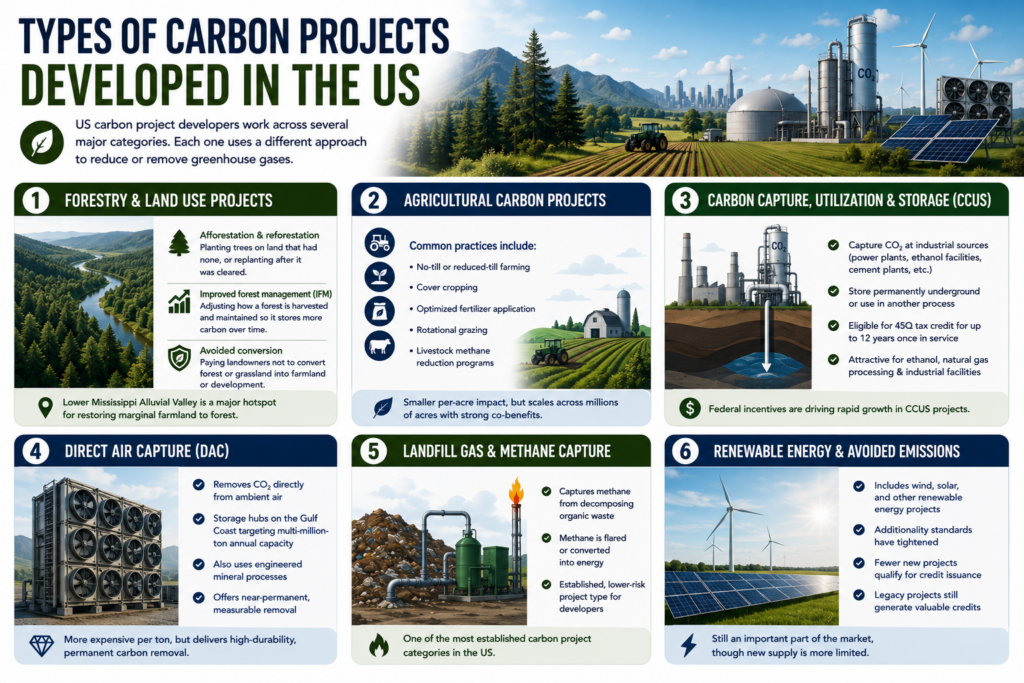
US carbon project developers work across several major categories. Each one uses a different approach to reduce or remove greenhouse gases.
1. Forestry and Land Use Projects
These projects protect, restore, or better manage forests and land.
- Afforestation and reforestation: Planting trees on land that had none, or replanting after it was cleared.
- Improved forest management (IFM): Adjusting how a forest is harvested and maintained so it stores more carbon over time.
- Avoided conversion: Paying landowners not to convert forest or grassland into farmland or development.
The Lower Mississippi Alluvial Valley is a well-known hotspot for this kind of work. Developers there convert marginal farmland back into functioning forest ecosystems, paying landowners upfront and over time for enrolling their acreage.
2. Agricultural Carbon Projects
Agricultural developers work directly with farmers to change practices that affect soil carbon and emissions.
Common practices include:
- No-till or reduced-till farming
- Cover cropping
- Optimized fertilizer application
- Rotational grazing
- Livestock methane reduction programs
These projects tend to have smaller per-acre carbon impact than forestry projects. But they scale well across the millions of acres of US farmland, and they often deliver strong co-benefits like improved soil health and water retention.
3. Carbon Capture, Utilization, and Storage (CCUS)
This category covers industrial-scale projects that capture CO2 directly at the source, such as a power plant, ethanol facility, or cement plant, and store it permanently underground or use it in another process.
Under federal law, developers can claim the 45Q tax credit for projects that begin construction within a set window, for up to twelve years once the project is placed in service. This has made ethanol plants, natural gas processing facilities, and industrial manufacturers attractive targets for CCUS project developers.
4. Direct Air Capture (DAC)
DAC technology pulls CO2 straight out of the ambient atmosphere rather than from a concentrated industrial source.
Companies developing DAC and storage hubs in places like the Gulf Coast of Louisiana are targeting multi-million-ton annual capture capacity as these facilities scale up. Other developers use engineered mineral processes, such as heating limestone to release and then reabsorb CO2, with credits sold to corporate buyers seeking high-durability removal credits.
DAC remains more expensive per ton than forestry or agricultural credits, but it offers something those methods cannot guarantee: near-permanent, easily measurable removal.
5. Landfill Gas and Methane Capture
Landfills release methane as organic waste decomposes. Developers install systems that capture this methane and either flare it or convert it into usable energy.
This category has been part of the US carbon market for decades and remains one of the more established, lower-risk project types for new developers to enter.
6. Renewable Energy and Avoided Emissions
Older-generation carbon credits included renewable energy projects like wind and solar. Additionality standards have tightened significantly here, since renewables are now cost-competitive on their own in most of the US. As a result, fewer new US renewable energy projects qualify for fresh carbon credit issuance today, though legacy projects still hold value in some portfolios.
How Carbon Project Development Actually Works: Step by Step
Every serious carbon project follows a similar lifecycle, regardless of type. Here is how it plays out in practice.
Step 1: Feasibility and Site Selection
The developer identifies a site or activity with real potential to reduce emissions. They check land ownership, legal access, baseline emissions data, and whether the activity is genuinely additional (meaning it would not have happened anyway without carbon revenue).
Step 2: Choosing a Methodology and Standard
The developer picks a carbon standard, such as Verra’s Verified Carbon Standard, the American Carbon Registry, the Climate Action Reserve, or Gold Standard. Each standard publishes specific methodologies for different project types, and the project must follow one closely.
Step 3: Project Design Document (PDD)
The developer writes a detailed document describing the project, its baseline scenario, its expected emissions reductions, and its monitoring plan. This document goes through a validation process before the project is officially registered.
Step 4: Validation
An accredited third-party auditor reviews the PDD to confirm the project design meets the chosen standard’s rules. This is separate from the people actually running the project, which protects the integrity of the process.
Step 5: Implementation
The developer builds or begins operating the project. This might mean planting trees, installing capture equipment, changing farming practices, or building a methane capture system.
Step 6: Monitoring
The developer tracks real-world data over time: tree growth, soil samples, gas flow measurements, satellite imagery, or farmer practice records, depending on project type.
Step 7: Verification
A separate independent auditor checks the monitored data against what was promised in the PDD. If the numbers hold up, the registry issues credits based on verified performance, not just projections.
Step 8: Issuance and Sale
Once verified, credits are issued into a registry account. From there, developers sell them directly to buyers, through brokers, or on carbon exchanges.
Step 9: Retirement
When a buyer uses a credit to offset emissions, the registry marks it as retired. That credit is now permanently removed from circulation and can never be resold or reused.
This cycle can take anywhere from several months to several years from initial site selection to first credit issuance, depending on project type and standard.
Top Standards and Registries US Developers Work With
| Registry | Focus Areas | Notable For |
|---|---|---|
| Verra (VCS) | Forestry, renewable energy, methane, industrial | Largest global registry by volume |
| American Carbon Registry (ACR) | Forestry, agriculture, livestock, industrial gas | Strong US agricultural and forestry methodologies |
| Climate Action Reserve (CAR) | Forestry, landfill gas, ozone-depleting substances, US compliance offsets | Deep ties to California’s Cap-and-Trade program |
| Gold Standard | Renewable energy, community-based projects, cookstoves | Strong co-benefit and sustainable development focus |
| California Air Resources Board (CARB) | Compliance offsets for the state’s Cap-and-Trade program | Government-run, legally binding market |
Most experienced developers work with more than one registry, choosing whichever fits a specific project type and buyer preference best.
Leading Carbon Project Developers Operating in the US
The US developer landscape includes large established players, specialized regional firms, and newer technology-driven entrants. Here is a look at some of the notable names shaping the market.
Large diversified developers run project portfolios spanning multiple categories, often across renewable energy, industrial gas capture, and offset generation. They typically bring decades of experience, strong balance sheets, and the ability to manage projects across dozens of states.
Reforestation and afforestation specialists focus heavily on converting marginal or unproductive farmland back into forest. They tend to operate landowner-friendly models, paying enrollees upfront and over time as trees mature and sequester carbon.
Agricultural carbon program operators partner directly with row-crop and livestock farmers, often working through cooperatives or aggregators to reach enough acreage to make a project financially viable.
CCUS and DAC developers are typically backed by significant capital, given the infrastructure costs involved. Many operate near industrial corridors on the Gulf Coast, in the Midwest ethanol belt, or in regions with strong underground geology suited to permanent storage.
Boutique and regional developers focus on specific niches, such as blue carbon in coastal wetlands, biochar production from agricultural residue, or dairy methane digesters.
A well-run developer typically shows a few common traits:
- A track record of credits actually issued, not just projects announced
- Transparent methodology use and public registry listings
- Third-party validation and verification through accredited bodies
- Clear landowner or client terms, without buried fine print
- A realistic timeline from project design to first credit issuance
Federal Policy Shaping US Carbon Project Development
Federal policy has a direct and growing influence on which projects get built and where.
The 45Q Tax Credit
The credit value of $85 per metric ton for point-source captured carbon and $180 per metric ton for direct air capture was maintained through the current period, with inflation adjustments kicking in for projects beginning construction afterward. A key recent change created parity between permanent storage and utilization for secondary products or enhanced oil recovery, meaning oil and gas operators using captured CO2 for enhanced oil recovery now see a stronger return on that investment.
Credit transferability was preserved, which allows developers with relatively low tax liabilities to sell their earned credits directly to a third party with greater tax liabilities in exchange for cash. This transferability feature has become a major financing tool for CCUS developers, since it lets smaller operators monetize credits without needing a large tax bill of their own.
Restrictions were also added limiting which foreign-linked entities can claim or receive transferred 45Q credits going forward.
Reference: click here
Reporting and Verification Rules
Federal regulators recently released interim guidance establishing a safe harbor for developers to verify carbon sequestration volumes through independent engineer or geologist certification, addressing a potential gap in the standard federal reporting system. This guidance applies specifically where carbon oxide is placed in secure geological storage rather than used for enhanced oil recovery.
This kind of regulatory clarity matters more than it might sound. Developers and investors view clear, government-backed verification standards as essential for unlocking project financing, since many CCUS projects require enormous upfront capital and multi-year development timelines.
State-Level Programs
California’s Cap-and-Trade Program and the Regional Greenhouse Gas Initiative both create compliance markets that run alongside the voluntary market. Compliance offsets must meet strict, government-approved protocols, and developers working in this space need to follow California Air Resources Board rules closely if they want their credits accepted for compliance purposes.
Voluntary Market vs Compliance Market: What US Developers Need to Know
| Feature | Voluntary Carbon Market | Compliance Carbon Market |
|---|---|---|
| Who buys credits | Companies and individuals offsetting voluntarily | Regulated entities required by law to hold allowances or offsets |
| Who sets the rules | Independent standards like Verra, ACR, CAR, Gold Standard | Government bodies like CARB or state regulators |
| Price stability | More variable, driven by buyer demand and credit quality | More stable, tied to regulatory supply and demand |
| Project flexibility | Wide range of project types accepted | Narrower list of approved protocols |
| Best fit for developers | Smaller or newer developers testing new project types | Developers with resources to meet strict compliance protocols |
Many established developers operate in both markets at once, using voluntary credits to test new methodologies before pursuing compliance-grade projects.
Regional Hotspots for Carbon Project Development
Certain regions of the country have become natural hubs for specific project types, thanks to geology, land use patterns, and existing industrial infrastructure.
The Gulf Coast (Texas and Louisiana). Deep saline geology and a dense concentration of refineries, chemical plants, and hydrogen facilities make this region the leading destination for CCUS and direct air capture projects. Pipeline infrastructure already built for oil and gas makes transporting captured CO2 more practical here than almost anywhere else in the country.
The Lower Mississippi Alluvial Valley. Spanning parts of Arkansas, Louisiana, and Mississippi, this region has become a center for reforestation and afforestation projects, since large amounts of marginal farmland here are well suited to converting back into native bottomland hardwood forest.
The Midwest Corn Belt. Iowa, Nebraska, Illinois, and neighboring states host a growing number of agricultural carbon programs tied to row-crop farming, along with ethanol plants that have become early adopters of carbon capture equipment to qualify for federal tax credits.
California. As the state with its own compliance Cap-and-Trade market, California drives demand for forestry offsets, methane capture, and ozone-depleting substance destruction projects that meet Air Resources Board protocols.
The Rocky Mountain region. Colorado and Wyoming have seen a rise in CCUS projects tied to ethanol production and industrial facilities, supported by favorable underground storage geology.
Developers do not need to operate nationally to succeed. Many of the most respected names in the industry built their reputation by mastering one region and one project type before expanding elsewhere.
How to Become a Carbon Project Developer
For businesses or entrepreneurs interested in entering the field rather than just hosting a project, here is a realistic starting path.
- Pick a project type that matches your expertise. Someone with a forestry or agronomy background is better positioned for land-based projects. Someone with an engineering or industrial background may be better suited to CCUS or methane capture.
- Study the methodologies closely. Every registry publishes detailed, publicly available methodology documents. Read several from your chosen project type before designing anything.
- Build relationships with landowners or facility operators early. Access to eligible sites is often the hardest part of getting started, and long-term relationships built on trust tend to outperform cold outreach.
- Line up financing before you commit to a project. Carbon credit revenue arrives only after verification, which can take a year or more. You need a funding plan that covers costs before that first check arrives.
- Work with experienced validators and verifiers from day one. Choosing an accredited, reputable third party helps you avoid costly redesigns later in the process.
- Start smaller than you think you need to. A well-executed pilot project builds the track record you need to attract landowners, financiers, and buyers for larger projects down the road.
Common Challenges US Carbon Project Developers Face
Building a carbon project sounds straightforward on paper. In practice, developers deal with a long list of obstacles.
Upfront capital requirements. Most projects need significant funding before any credit revenue arrives. Forestry projects can take years before trees generate meaningful sequestration. CCUS projects can require hundreds of millions of dollars in infrastructure.
Additionality proof. Developers must show a project would not have happened without carbon credit revenue. Regulators and buyers have gotten far stricter about this over recent years, especially for renewable energy and avoided deforestation claims.
Permanence risk. Forestry and agricultural carbon can be reversed by wildfire, disease, drought, or a landowner simply changing their mind. Developers often maintain buffer pools, which are reserve credits held back to cover potential losses.
Long verification timelines. Getting a project validated and verified by independent auditors takes time, sometimes many months, which slows down cash flow for smaller developers.
Changing regulations. Federal tax policy, EPA reporting rules, and state program rules can shift, sometimes mid-project. Developers who build flexibility into their financing structures tend to handle this better than those who do not.
Buyer skepticism. After several high-profile controversies over credit quality in the broader voluntary market, corporate buyers now demand more transparency, tighter methodologies, and stronger third-party verification before they commit to a purchase.
How to Work With a Carbon Project Developer
If you are a landowner, farmer, or business owner considering carbon credits, here is a practical path forward.
- Assess your eligibility. Look at your land type, current practices, or industrial process and compare it against common project categories: forestry, agriculture, methane capture, or industrial carbon capture.
- Research developers active in your project type. Not every developer works in every category. A CCUS specialist will not help you enroll marginal farmland into a reforestation program.
- Ask about contract terms. Understand payment timing, contract length, and what happens if you want to exit early. Some agricultural and forestry contracts run for decades.
- Confirm which registry and methodology they use. This affects credit quality, buyer demand, and how long it takes to see revenue.
- Check their track record. Ask how many credits they have actually issued, not just how many projects they have signed up.
- Understand your share of revenue. Landowners and farmers typically receive a portion of credit sale proceeds, not the full sale price, since the developer covers project design, verification, and marketing costs.
- Get everything in writing. Payment schedules, monitoring obligations, and exit terms should all be clearly documented before you sign anything.
What Buyers Should Know About US Project Developers
If you are a company looking to purchase carbon credits, the developer behind a project matters just as much as the credit itself.
- Check the registry listing directly. Do not rely solely on marketing materials. Registries like Verra, ACR, and CAR publish public project documentation you can review yourself.
- Look at verification history. A project verified multiple times over several years carries more credibility than a brand-new, unverified pipeline project.
- Understand the project type’s risk profile. Forestry credits carry permanence risk. DAC credits carry higher cost but lower reversal risk. Match your risk tolerance to your climate goals.
- Ask about co-benefits. Many US projects deliver benefits beyond carbon, such as improved water quality, wildlife habitat, or rural economic development. These can strengthen your sustainability reporting.
- Diversify across project types and developers. Relying on a single project or developer concentrates risk. A balanced portfolio spreads exposure across forestry, agriculture, and engineered removal.
The Future of Carbon Project Development in the US
A few trends are shaping where US carbon project developers head next.
Engineered removals are gaining ground. Buyers increasingly want durable, measurable removal credits, not just avoidance credits. This favors DAC, biochar, and enhanced mineralization developers, even though these methods cost more per ton.
Agricultural carbon is scaling up. As measurement, reporting, and verification technology improves, especially through satellite monitoring and remote sensing, agricultural projects are becoming easier and cheaper to verify at scale.
Federal tax policy remains a major lever. Programs like 45Q continue to shape where and how quickly CCUS and DAC projects get built. Developers who stay close to policy changes tend to move faster than competitors caught off guard by new rules.
Quality standards keep tightening. Registries and independent rating agencies are pushing for stronger additionality tests, tighter permanence safeguards, and clearer co-benefit reporting. Developers who invest early in high-integrity practices will likely hold a competitive advantage as buyer scrutiny grows.
Consolidation is likely. As the market matures, expect some smaller developers to merge with or get acquired by larger, better-capitalized players who can absorb the cost of rigorous verification and long project timelines.
Frequently Asked Questions
What does a carbon project developer actually do?
A carbon project developer designs, finances, builds, and manages projects that reduce or remove greenhouse gases, then guides those projects through registration, verification, and credit issuance with a recognized carbon standard.
How do carbon project developers make money?
Developers earn revenue primarily by selling issued carbon credits to buyers. They typically share a portion of that revenue with landowners or partners involved in hosting the project, while covering their own costs for project design, monitoring, and verification.
What is the difference between a carbon project developer and a carbon credit broker?
A developer builds and manages the actual project that generates credits. A broker connects buyers and sellers of already-issued credits without necessarily being involved in the underlying project itself.
Which US carbon standard is best for a new project?
It depends on project type. Verra suits a wide range of global project types. The American Carbon Registry and Climate Action Reserve have strong US-specific agricultural and forestry methodologies. California compliance projects must follow California Air Resources Board protocols.
Is carbon capture and storage eligible for tax credits in the US?
Yes. The federal Section 45Q tax credit rewards qualifying carbon capture and storage projects, with the credit value maintained at $85 per metric ton for point-source capture and $180 per metric ton for direct air capture through the current period.
How long does it take to develop a carbon project?
Timelines vary widely by project type. Landfill gas and methane capture projects can move relatively quickly. Forestry projects often take years to reach meaningful credit issuance. CCUS and DAC facilities can take several years just to reach construction, given their scale and financing needs.
Can a small landowner work with a carbon project developer?
Yes, particularly for forestry and agricultural projects. Many developers run landowner-friendly models designed specifically for smaller parcels, sometimes aggregating multiple landowners into a single larger project to make verification and administration more cost-effective.
What happens if a forestry carbon project is destroyed by wildfire?
Most registries require developers to contribute credits to a buffer pool, a shared reserve of credits set aside specifically to cover losses from wildfire, disease, or other unexpected reversals. This protects the overall integrity of the credits already sold to buyers.
Final Thoughts
Carbon project developers are the backbone of the US carbon market. They take an idea, whether that is a reforested valley, a farm with new soil practices, or an industrial facility capturing its own emissions, and turn it into a verified, tradable climate asset.
The best US carbon project developers combine technical rigor with genuine transparency. They pick real methodologies, work with credible registries, and stand behind their numbers through repeated independent verification.
Whether you are a landowner exploring your options, a business planning a purchase, or simply someone trying to understand how carbon markets function, understanding the role of carbon developers America depends on gives you a clearer picture of where climate action actually gets built. Not in press releases, but in the fields, forests, and facilities where these projects come to life.
If you want to keep learning about carbon markets, ESG strategy, and sustainability trends, explore more resources on Carbon Market Network.