Carbon Market Network


Forests cover about 31% of the Earth’s land surface. They quietly absorb billions of tonnes of carbon dioxide every year. But when they are cut down, burned, or degraded, they release all that stored carbon back into the atmosphere.
That is where forestry carbon credits come in.
If you have ever wondered what forestry carbon credits are, how they work, who buys them, and how you can even earn them, you are in the right place. This guide breaks everything down from scratch, in plain and simple language.
Whether you are a landowner, a corporate sustainability manager, a student, or just a curious reader, this article will give you everything you need to understand the world of forestry carbon credits in 2026.
What Are Forestry Carbon Credits?
A forestry carbon credit is a tradeable certificate that represents one metric tonne of carbon dioxide (CO2) either removed from the atmosphere or prevented from being released into it, through a forest-related activity.
Think of it like this: a company emits 1,000 tonnes of CO2 from its operations. It cannot eliminate all of that right away. So it buys 1,000 forestry carbon credits from a project that has either planted trees, protected a forest, or improved how a forest is managed.
Each credit proves that 1 tonne of CO2 was dealt with somewhere on Earth, through a certified and verified forest action.
Forestry carbon credits fall under the broader category of nature-based solutions (NBS) in the carbon market. They are one of the most popular types of carbon offsets in the world.
Key fact: Forestry and land-use projects accounted for 37% of all voluntary carbon credit retirements in 2025, making them the single largest category in corporate offsetting strategies.
Carbon Market Insider Newsletter
Weekly insights on carbon markets, climate policy, carbon credits, and sustainability.
Why Forests Matter for Carbon
Before going deeper, it helps to understand why forests are so central to climate action.
Trees absorb CO2 through photosynthesis. They store that carbon in their wood, leaves, roots, and surrounding soil. A healthy, mature forest acts as a massive carbon warehouse.
When that forest is destroyed, all that stored carbon gets released. Tropical deforestation alone releases around 4 to 5 billion tonnes of CO2 every year, roughly the same as all emissions from the European Union.
Protecting, restoring, and better managing forests is one of the fastest and most affordable ways to fight climate change.
That is precisely why forest carbon credits exist. They create a financial mechanism to reward the people and organizations that protect and restore forests.
The Global Forestry Carbon Market in 2026
The forestry carbon market is growing at a rapid pace.
The global carbon credit market for agriculture, forestry, and land use was valued at $7.51 billion in 2025. It is projected to reach $9.67 billion in 2026, growing at a CAGR of 28.8%. By 2030, analysts expect it to hit $26.35 billion.
This growth is driven by several forces:
- Rising corporate net-zero commitments. Major companies are setting science-based targets and need high-quality offsets to compensate for hard-to-abate emissions.
- Demand for high-quality removal credits. Buyers are no longer satisfied with cheap, low-integrity credits. They want verified, durable removals.
- Better MRV technology. Satellite imagery, AI-powered monitoring, and digital measurement tools are making forest carbon projects more credible and transparent.
- Policy tailwinds. Governments around the world are introducing regulations, carbon trading schemes, and net-zero mandates that increase demand for carbon credits.
- The Symbiosis Coalition. In 2025, major technology companies pledged to contract up to 20 million tonnes of high-quality nature-based carbon removal credits by 2030. This signals growing institutional demand.
How Forestry Carbon Credits Work: Step by Step
Here is a simple walkthrough of how a forestry carbon credit is born, certified, and used.
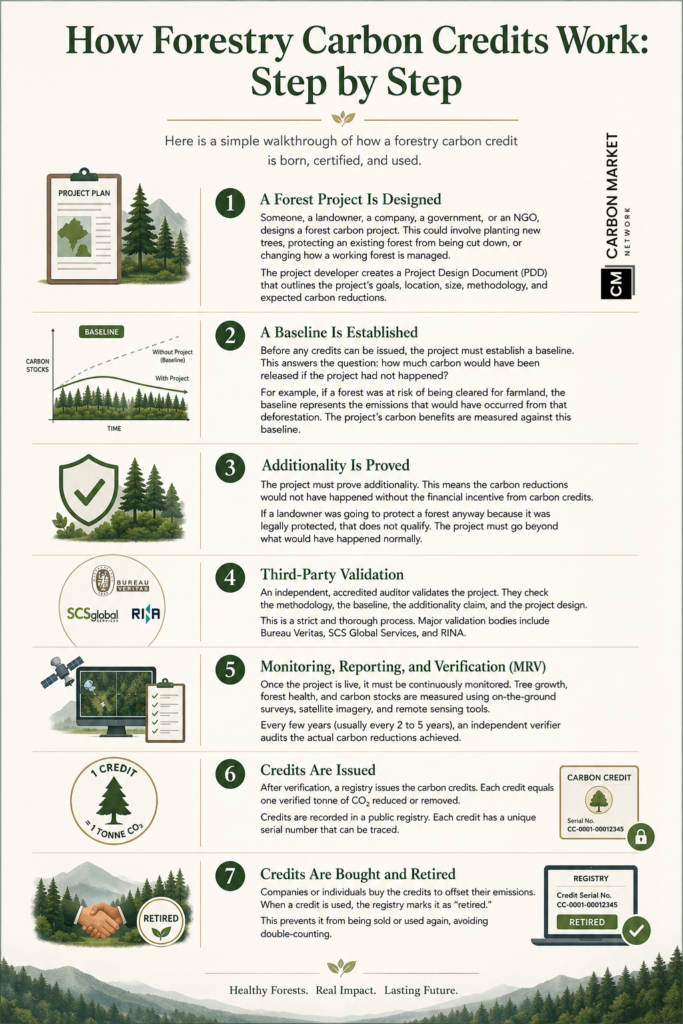
Step 1: A Forest Project Is Designed
Someone, a landowner, a company, a government, or an NGO, designs a forest carbon project. This could involve planting new trees, protecting an existing forest from being cut down, or changing how a working forest is managed.
The project developer creates a Project Design Document (PDD) that outlines the project’s goals, location, size, methodology, and expected carbon reductions.
Step 2: A Baseline Is Established
Before any credits can be issued, the project must establish a baseline. This answers the question: how much carbon would have been released if the project had not happened?
For example, if a forest was at risk of being cleared for farmland, the baseline represents the emissions that would have occurred from that deforestation. The project’s carbon benefits are measured against this baseline.
Step 3: Additionality Is Proved
The project must prove additionality. This means the carbon reductions would not have happened without the financial incentive from carbon credits.
If a landowner was going to protect a forest anyway because it was legally protected, that does not qualify. The project must go beyond what would have happened normally.
Step 4: Third-Party Validation
An independent, accredited auditor validates the project. They check the methodology, the baseline, the additionality claim, and the project design.
This is a strict and thorough process. Major validation bodies include Bureau Veritas, SCS Global Services, and RINA.
Step 5: Monitoring, Reporting, and Verification (MRV)
Once the project is live, it must be continuously monitored. Tree growth, forest health, and carbon stocks are measured using on-the-ground surveys, satellite imagery, and remote sensing tools.
Every few years (usually every 2 to 5 years), an independent verifier audits the actual carbon reductions achieved.
Step 6: Credits Are Issued
After verification, a registry issues the carbon credits. Each credit equals one verified tonne of CO2 reduced or removed.
Credits are recorded in a public registry. Each credit has a unique serial number that can be traced.
Step 7: Credits Are Bought and Retired
Companies or individuals buy the credits to offset their emissions. When a credit is used, the registry marks it as “retired.” This prevents it from being sold or used again, avoiding double-counting.
Types of Forestry Carbon Credit Projects
Not all forest carbon projects are the same. There are three main types, each with a different approach.
1. REDD+ (Reducing Emissions from Deforestation and Forest Degradation)
REDD+ is the most well-known type of forest carbon project. It focuses on preventing deforestation and forest degradation, primarily in tropical regions.
The acronym stands for:
- R = Reducing
- E = Emissions from
- D = Deforestation and forest
- D+ = Degradation, plus conservation, sustainable forest management, and enhancement of forest carbon stocks
REDD+ projects work by providing financial incentives to local communities and landowners to keep their forests standing instead of converting them to farmland, logging operations, or development.
Real-world example: A REDD+ project in the Amazon rainforest pays local communities to protect their land from cattle ranchers and soy farmers. The avoided deforestation generates carbon credits that companies buy to offset their emissions.
Key stats (2025):
- REDD+ accounted for 25% of all carbon credit retirements in 2025.
- REDD+ project prices averaged around $2.70 per tonne in 2024, though high-quality verified projects command significantly more.
Challenges with REDD+:
- Leakage: Deforestation sometimes shifts to a neighboring area just outside the project boundary.
- Permanence: A fire or political change could destroy a protected forest years later.
- Baseline accuracy: Some projects have historically overcredited by setting inflated baselines. Verra is developing a new standardized baseline approach to fix this.
Despite these challenges, REDD+ remains the backbone of forest carbon markets, and integrity improvements are ongoing.
2. ARR (Afforestation, Reforestation, and Revegetation)
ARR projects create new forests or restore degraded land by planting trees where there were none (afforestation) or replanting forests that were previously cleared (reforestation).
These are removal credits, meaning they actively pull CO2 out of the atmosphere as trees grow.
ARR is distinct from REDD+ in a critical way: ARR adds new carbon to the system, while REDD+ avoids releasing existing carbon.
Key stats:
- ARR projects had an average credit price of $24 per tonne in 2025.
- ACR’s ARR of Degraded Lands methodology has been approved under the ICVCM’s Core Carbon Principles (CCP).
- Many corporate buyers are shifting toward ARR credits because they qualify as removals under frameworks like SBTi and CSRD.
Benefits of ARR projects:
- Restore biodiversity and ecosystem services
- Improve soil health and water retention
- Create jobs in rural communities
- Deliver durable long-term carbon storage
Challenges:
- Trees take decades to mature, so carbon benefits accumulate slowly.
- Planted monocultures can be less resilient to pests, disease, and climate shocks compared to native forests.
3. IFM (Improved Forest Management)
IFM projects enhance carbon storage in existing managed forests by changing how those forests are harvested and maintained.
Unlike REDD+ (which stops deforestation) or ARR (which plants new trees), IFM keeps working forests working, but with better practices that lock up more carbon over time.
Common IFM techniques include:
- Extended rotation periods: Letting trees grow longer before harvesting, so they store more carbon.
- Selective harvesting: Cutting only specific trees rather than clear-cutting, which preserves older, higher-carbon trees.
- Reducing forest degradation: Fire prevention, controlling invasive species, and protecting from illegal logging.
- Converting harvested land to conservation status.
Key stats:
- In 2024, IFM transaction volumes surged by 242% year-on-year, as buyers moved away from controversial REDD+ projects.
- By 2025, IFM accounted for nearly 30% of all nature-based credits issued.
- Average IFM credit price: around $16 per tonne, though US-based IFM projects command $29 to $34 per tonne.
Why IFM is surging: Corporate buyers in Europe prefer IFM because it sits between short-lived nature-based options and expensive engineered removals. It also provides a mix of avoided emissions and removals, making it versatile for different corporate reporting frameworks.
4. Agroforestry
Agroforestry projects integrate trees into agricultural landscapes. This improves soil fertility, water retention, and crop yields while generating carbon credits.
These projects are especially impactful in Latin America and Africa, where they support smallholder farmers and promote sustainable land use.
5. Mangrove and Blue Carbon Projects
Mangrove forests and coastal wetlands store enormous amounts of carbon in their soil, often far more per hectare than tropical rainforests.
Blue carbon projects protect or restore these coastal ecosystems. The first blue carbon project ever registered under Verra’s VCS program, led by Conservation International, conserves over 7,500 hectares of coastal mangrove forest and holds a BeZero Carbon AAA rating.
Key Concepts in Forestry Carbon Credits
Understanding a few technical terms will help you evaluate any forest carbon project.
Additionality
The project must prove it delivers climate benefits that would not have happened anyway. This is non-negotiable for all major certification bodies.
Permanence
Carbon stored in forests must remain stored. If a fire destroys a forest 20 years later, the carbon is re-released. Projects address this through:
- Buffer pools: A percentage of credits is set aside in a reserve pool to compensate for future losses.
- Insurance policies against natural disaster.
Leakage
When a project stops deforestation in one place but pushes it elsewhere, that is leakage. Good projects account for and reduce leakage in their methodology.
Co-benefits
The best forest carbon projects deliver more than just carbon. Co-benefits include:
- Biodiversity protection
- Clean water for local communities
- Livelihoods and jobs for indigenous peoples
- Soil health improvements
- Sustainable timber production
Certification Standards for Forestry Carbon Credits
Not all forest carbon credits are equal. A certification standard sets the rules for how a project is designed, monitored, and verified.
As of 2026, the leading certification standards for forestry carbon credits are:
Verra Verified Carbon Standard (VCS)
The largest voluntary carbon credit program in the world. By 2025, Verra had certified over 2,000 projects in more than 80 countries, issuing over 1 billion Verified Carbon Units (VCUs).
VCS is the dominant standard for REDD+ projects and also certifies ARR and IFM projects. Verra is developing a new standardized baseline approach for REDD+ to address concerns about historical overcrediting.
Gold Standard
Originally developed for energy projects, Gold Standard also certifies forestry projects, especially those with strong co-benefits for local communities and sustainable development.
American Carbon Registry (ACR)
ACR focuses on North American forestry projects. Its ARR of Degraded Lands methodology is now CCP-approved under the ICVCM.
Climate Action Reserve (CAR)
CAR offers standardized North American forestry protocols, including reforestation provisions in its US Forest Protocol.
ART TREES (Architecture for REDD+ Transactions)
ART’s TREES standard allows countries and eligible subnational jurisdictions to generate verified emission reduction credits. In December 2022, Guyana became the first country to receive TREES credits. In April 2024, ICVCM approved ART as a CCP-eligible carbon crediting programme.
The ICVCM Core Carbon Principles (CCP): The New Quality Bar
In 2023 and 2024, the Integrity Council for the Voluntary Carbon Market (ICVCM) introduced its Core Carbon Principles (CCP), a new set of quality criteria that define what makes a carbon credit genuinely high integrity.
As of 2026, credits from programs like VCS, ACR, CAR, and Gold Standard that meet specific approved methodologies can carry the CCP label. This gives buyers a baseline integrity signal when purchasing forestry credits.
The ICVCM rejected all legacy renewable energy methodologies from CCP approval, raising the bar significantly for what counts as a credible credit in the market.
Independent Quality Ratings: The New Layer of Scrutiny
Registry certification alone (Verra VCS, Gold Standard) is no longer enough for buyers who need to defend their purchases under CSRD or SBTi scrutiny.
Three independent rating agencies now provide project-level quality scores that go beyond registry labels:
- BeZero Carbon: Rates credits on an eight-point scale from AAA to D, based on the likelihood that a credit represents a real tonne of CO2.
- Sylvera: Provides carbon credit ratings using satellite data, field measurements, and AI analysis.
- Calyx Global: Offers project-level assessments and risk scoring.
Price impact: In 2025, high-rated credits (A to AAA) averaged $14.80 per tonne, while low-quality credits (CCC to B) saw just $3.50 per tonne. High-rated credits traded at more than 300% above lower-rated ones.
Forestry Carbon Credit Prices in 2026
Forest carbon credit prices vary widely based on:
- Project type: ARR, IFM, REDD+, or blue carbon
- Certification standard: Verra, Gold Standard, ACR, etc.
- Geography: Tropical, temperate, or boreal forests
- Co-benefits: Social, biodiversity, and water-related co-benefits command premiums
- Quality rating: BeZero, Sylvera, or Calyx scores
- Vintage: When the credit was issued
Here is a broad price guide for 2026:
| Project Type | Typical Price Range |
|---|---|
| REDD+ (standard) | $2 to $10 per tonne |
| REDD+ (high-quality, AAA-rated) | $10 to $30 per tonne |
| ARR (afforestation/reforestation) | $15 to $35 per tonne |
| IFM (US-based) | $20 to $40 per tonne |
| Blue carbon (mangroves) | $20 to $80 per tonne |
| Peatland restoration | €89+ per tonne |
Important note: The widely cited “$6.34 average” from the Ecosystem Marketplace 2025 report is misleading for active buyers. That figure is dragged down by legacy and pre-2020 avoidance credits. Corporate buyers paying for ICVCM-screened, Verra or Gold Standard certified credits typically pay $25 to $80 per tonne in a blended portfolio.
Who Buys Forestry Carbon Credits?
Corporations
The biggest buyers are companies with net-zero commitments. Tech firms, airlines, banks, consumer goods companies, and energy companies all purchase forestry credits to offset emissions they cannot yet eliminate.
Major buyers have included Microsoft, Salesforce, and companies in the Symbiosis Coalition, which pledged to buy up to 20 million tonnes of high-quality nature-based removal credits by 2030.
Governments
Some national governments use forestry carbon credits as part of their Nationally Determined Contributions (NDCs) under the Paris Agreement, particularly through Article 6 bilateral deals.
Airlines
Under CORSIA (Carbon Offsetting and Reduction Scheme for International Aviation), airlines use eligible carbon credits, including forestry credits, to offset their international flight emissions.
Small Businesses and Individuals
Voluntary buyers can purchase forestry credits to offset personal or business carbon footprints. Many platforms allow retail purchases.
Who Sells Forestry Carbon Credits?
Landowners
Private landowners with forests can enroll their land in a carbon project and earn credits based on the carbon stored or avoided.
Indigenous Communities
Many REDD+ and IFM projects are run in partnership with indigenous communities who hold rights over forest land. They receive revenue from carbon credit sales.
Governments
Tropical forest nations like Brazil, Guyana, Indonesia, and the Democratic Republic of Congo have sold or plan to sell forestry carbon credits from national-level programs.
Project Developers
Specialized companies design and manage carbon projects on behalf of landowners or governments. They handle certification, monitoring, and credit sales.
How to Start a Forestry Carbon Credit Project
If you own forested land or degraded land suitable for reforestation, here is a general roadmap to generate forestry carbon credits.
Step 1: Identify Your Project Type
Decide whether you are planting new trees (ARR), protecting existing forests (REDD+), or improving forest management (IFM). Your choice depends on your land type, location, and goals.
Step 2: Choose a Certification Standard
Select a standard like Verra VCS, Gold Standard, or ACR. Your choice will affect the credibility and marketability of your credits. Verra VCS is the most widely used globally, with over 1,800 certified projects active as of 2026.
Step 3: Conduct a Feasibility Study
Assess your land’s carbon sequestration potential, land tenure, baseline emissions, and additionality. A good feasibility study includes:
- Satellite mapping of the project area
- Soil carbon analysis
- Community consultation
- Legal review of land ownership
This step saves time and significantly reduces rejection risk during third-party validation.
Step 4: Prepare a Project Design Document (PDD)
The PDD outlines your project’s objectives, methodology, expected emissions reductions, monitoring plan, and risk management approach. It must follow the chosen certification standard’s format.
Step 5: Get Third-Party Validation
An accredited third-party auditor reviews and validates your PDD. This confirms that the project meets all required standards before it goes live.
Step 6: Register the Project
After validation, register your project with the chosen certification body. This step is required before credits can be issued.
Step 7: Implement and Monitor
Plant the trees or implement your conservation activities. Monitor carbon stocks regularly using satellite imagery, field measurements, and reporting tools.
Step 8: Get Verified and Receive Credits
Every few years, an independent verifier audits your project. After successful verification, credits are issued to your account in the registry.
Step 9: Sell Your Credits
You can sell credits through:
- Carbon exchanges (Xpansiv, ACX)
- Direct sales to corporate buyers
- Brokers and aggregators
- Carbon project platforms
Forestry Carbon Credits in India
India has significant potential for forestry carbon credit generation, and the market is developing rapidly.
India’s Forest Cover
India has over 80 million hectares of forests and tree cover. States like Madhya Pradesh, Uttarakhand, and Odisha are seeing an increase in forest carbon projects.
India’s Carbon Credit Trading Scheme (CCTS)
India’s Energy Conservation (Amendment) Act empowers the government to implement a domestic carbon credit trading scheme. The Voluntary Market (Offset Mechanism) for non-obligated sectors like farming and forestry is already being operationalized as of early 2026. The compliance market is expected to launch by late 2026.
Green Credits Programme
The Indian government introduced a Green Credits Programme to reward positive environmental actions, including forestry-related activities. This is separate from, but complementary to, the carbon credit market.
Opportunity for Landowners
Indian forestry projects can sell credits in international voluntary markets like Gold Standard and Verra. Verified credits from Indian projects trade between $5 to $25 per tonne in 2026.
A typical forestry project on 50 acres in India might generate 5,000 to 10,000 credits over 10 years, earning between Rs 25 lakhs to Rs 1 crore depending on market prices.
For small-scale project developers: Large forestry initiatives in India require Rs 2 to 5 crores in initial investment, while smaller initiatives can start lower depending on land size and project scope. Returns typically come after 2 to 3 years.
Challenges and Criticisms of Forestry Carbon Credits
Forest carbon credits are powerful, but they are not perfect. Here are the main challenges.
Permanence Risk
A fire, drought, pest outbreak, or political change can destroy a protected forest. When this happens, the stored carbon is re-released. Buffer pools and insurance mechanisms help, but they do not eliminate this risk entirely.
Leakage
When a project stops deforestation in one area but pushes it somewhere else, the net climate benefit is reduced or eliminated. Well-designed projects try to account for leakage in their methodology, but it remains a challenge.
Overcrediting
Some REDD+ projects have been criticized for issuing too many credits based on inflated baseline assumptions. If a project claims it protected a forest from deforestation that was never actually going to happen, the credits it issues represent no real climate benefit. Verra and other registries are working to fix this through new baseline methodologies.
Quality Variability
Not all forestry credits deliver equal climate benefits. A cheap, low-rated credit may represent questionable climate action. Buyers are increasingly using independent rating agencies like BeZero Carbon and Sylvera to screen their purchases.
Social Safeguards
Some forest carbon projects have displaced indigenous communities or violated local land rights. The best projects include robust social safeguards and meaningful community participation.
Forestry Carbon Credits vs. Other Types of Carbon Credits
| Feature | Forestry Credits | Renewable Energy Credits | Tech-Based Removals (DAC, Biochar) |
|---|---|---|---|
| Primary benefit | Removal or avoidance | Avoidance | Removal |
| Durability | Medium to high | Low | Very high |
| Co-benefits | Very high | Low | Low to medium |
| Price range | $2 to $80/tonne | $1 to $5/tonne | $100 to $1,000+/tonne |
| Scalability | High | High | Currently limited |
| Controversy | Some (REDD+ baseline issues) | Yes (additionality questioned) | Low |
Nature-based solutions like forestry credits dominate 46% of demand in the voluntary carbon market. Renewable energy credits are falling out of favor: their market share, once above 25%, is expected to fall to just 2% over the next decade as ICVCM standards tighten.
Best Practices for Buying Forestry Carbon Credits
If you are a company looking to buy forestry carbon credits responsibly in 2026, here is what you should do.
1. Prioritize Quality Over Price
Cheap credits are often a liability. Don’t chase the lowest price. High-integrity credits protect your brand and hold up to audit.
2. Check the Certification Standard
Only buy credits from CCP-approved programs and methodologies where possible. VCS, Gold Standard, ACR, and ART TREES are currently the leading standards.
3. Look for Independent Ratings
Check BeZero Carbon, Sylvera, or Calyx Global ratings before buying. A project with an A or AAA rating provides much stronger climate integrity.
4. Consider Co-benefits
The best forest carbon projects deliver biodiversity protection, community livelihoods, clean water, and more. These co-benefits add value and reduce reputational risk.
5. Diversify Your Portfolio
Spread purchases across project types (ARR, IFM, REDD+), geographies, and vintages to reduce risk.
6. Use Credits to Supplement, Not Replace, Decarbonization
Carbon credits should be used to offset residual, hard-to-abate emissions, not as an excuse to delay reducing your own carbon footprint.
The Future of Forestry Carbon Credits
The forestry carbon credit market is maturing fast. Here is what to watch in the years ahead.
Digital MRV Technology
Satellite imagery, AI-powered forest monitoring, and blockchain-based registries are making forest carbon verification faster, cheaper, and more accurate. Projects that invest in better data command premium prices.
Article 6 and International Carbon Markets
The finalization of Article 6.4 rules at COP29 in 2024 opened new pathways for countries to trade carbon credits internationally. This creates new demand for forestry credits from tropical nations with large forest estates.
Nature-Based Carbon Removal
Corporate buyers increasingly need “removal” credits, not just avoided emissions, to meet SBTi and CSRD requirements. ARR and IFM projects that can be classified as removals are gaining market share.
Jurisdictional REDD+
Instead of project-level REDD+, the market is moving toward whole-country or state-level programs. Brazil’s Amazon Fund and Guyana’s ART TREES program are examples. Jurisdictional credits reduce leakage risk and scale up impact.
Community and Indigenous-Led Projects
Buyers increasingly prefer projects with strong community ownership. Projects where 80 to 90% of revenues go directly to indigenous communities command trust and premium pricing.
Real-World Examples of Forestry Carbon Credit Projects
Guyana National REDD+ Program
Guyana became the first country to receive ART TREES credits in December 2022. The country protects over 18 million hectares of rainforest and has sold large volumes of credits to companies like Hess Corporation.
Washington Olympic Peninsula (USA) – IFM
A 676,000-credit contract running through 2035 supports the management of 68,000 acres as climate-smart forest. The wider project is expected to deliver over 1 million tonnes of additional removals over the next decade while nearly doubling timber stocks. The project also supports salmon habitat restoration and tribal collaboration.
Mikoko Pamoja (Kenya) – Blue Carbon
One of Africa’s most established community forestry programs, Mikoko Pamoja is a mangrove conservation project in coastal Kenya. Revenues from carbon credits directly fund community development projects like schools and clean water.
Conservation International, Belize – Blue Carbon
The first blue carbon project ever registered under Verra’s VCS program, it conserves and manages over 7,500 hectares of coastal mangrove forest. It holds a BeZero Carbon AAA rating and returns 92% of carbon revenues directly to local communities. Co-benefits include coastal protection, habitat for manatees and otters, and sustainable livelihoods for 12,000 people.
FAQ: Forestry Carbon Credits
What is a forestry carbon credit?
A forestry carbon credit is a certificate representing one metric tonne of carbon dioxide either removed from the atmosphere or prevented from being released, through a certified forest-related activity such as tree planting, forest protection, or improved forest management.
How much is one forestry carbon credit worth?
Prices vary widely. In 2026, forestry carbon credits range from $2 to $80 per tonne depending on project type, quality rating, certification standard, and co-benefits. High-rated credits trade significantly above low-rated ones.
What is the difference between REDD+ and ARR?
REDD+ prevents deforestation and protects existing forests. ARR (Afforestation, Reforestation, and Revegetation) plants new trees or restores degraded land. REDD+ produces avoided emission credits; ARR produces removal credits.
Are forestry carbon credits reliable?
They can be, when they come from well-designed, independently verified projects with strong baselines, additionality, and permanence safeguards. Low-quality credits have faced criticism. Using independent quality ratings from BeZero, Sylvera, or Calyx helps buyers identify reliable credits.
Can landowners in India earn forestry carbon credits?
Yes. Indian landowners can generate forestry carbon credits through international standards like Verra VCS and Gold Standard. India’s domestic Carbon Credit Trading Scheme is also developing a voluntary market for forestry projects.
How long does it take to get forestry carbon credits?
From project design to first credit issuance, the process typically takes 2 to 3 years. Ongoing monitoring and verification happen every 2 to 5 years after that.
What is additionality in forest carbon projects?
Additionality means the carbon reductions would not have happened without the financial incentive from selling carbon credits. It is a strict, non-negotiable requirement for all major certification bodies.
What is the biggest risk of investing in forestry carbon credits?
Permanence risk is one of the biggest challenges: a fire, storm, drought, or policy change could destroy a forest and release stored carbon years after credits were issued. Buffer pools and insurance mechanisms help manage this risk.
How do I buy forestry carbon credits?
You can buy verified forestry carbon credits through carbon exchanges like Xpansiv, through carbon brokers and aggregators, or directly from project developers. Always check the certification standard and independent quality rating before buying.
What is IFM in carbon credits?
IFM stands for Improved Forest Management. It involves enhancing carbon storage in existing managed forests by extending harvest rotations, practicing selective logging, and reducing forest degradation. IFM is one of the fastest-growing categories of nature-based carbon credits in 2025 and 2026.
Conclusion
Forestry carbon credits are one of the most important tools we have in the fight against climate change. They turn forest protection and restoration into a financially viable activity for landowners, communities, and governments.
From REDD+ projects protecting tropical rainforests to IFM programs transforming how working forests are managed, to ARR initiatives restoring degraded land, forestry carbon credits cover a wide spectrum of activities, all united by a common goal: keeping more carbon out of the atmosphere.
The market is growing fast, quality standards are rising, and technology is making forest carbon monitoring more accurate than ever before.
Whether you are a corporate buyer looking to offset your residual emissions, a landowner exploring ways to monetize your forest, or someone who simply wants to understand how carbon markets work, forestry carbon credits deserve your attention.
The forests are already doing the work. Carbon credits are how we make sure they get paid for it.
This article was last updated in May 2026. For the latest pricing data, certification standards, and project developments, always consult current reports from Ecosystem Marketplace, Verra, ICVCM, and Sylvera.