Carbon Market Network


Imagine a power plant that burns wood chips or crop waste to make electricity, and instead of releasing carbon dioxide into the sky, it captures that CO2 and buries it deep underground forever. That is BECCS in a nutshell, and it is quickly becoming one of the most talked about tools in the global fight against climate change.
If you have come across the term BECCS while reading about carbon removal, net zero targets, or carbon credits, you are not alone. This technology sits at the crossroads of energy production and climate solutions, and it is generating both excitement and controversy in equal measure.
This guide breaks down BECCS explained in plain language. You will learn what it is, how it actually works, where it is being used around the world, what it costs, why critics push back against it, and how it fits into the broader carbon market.
By the end, you will understand BECCS well enough to follow any news story, research paper, or carbon credit listing that mentions it.
What Is BECCS?
BECCS stands for Bioenergy with Carbon Capture and Storage.
It is a process that combines two separate ideas into one system:
- Bioenergy: producing heat, electricity, or fuel by burning or converting biomass such as wood, crop residues, or organic waste.
- Carbon Capture and Storage (CCS): trapping the carbon dioxide produced during that process and storing it permanently, usually deep underground in geological formations.
When you put these two steps together, you get a system that can actually pull more carbon out of the atmosphere than it puts in. This is why BECCS is often labeled a “negative emissions technology.”
Here is the simple logic behind it:
- Plants absorb CO2 from the atmosphere as they grow.
- That biomass gets burned or processed to create energy.
- The CO2 released during that process gets captured before it escapes into the air.
- The captured CO2 gets injected into secure underground storage sites.
The net result is that carbon comes out of the atmosphere and stays locked away, while useful energy gets produced along the way.
Carbon Market Insider Newsletter
Weekly insights on carbon markets, climate policy, carbon credits, and sustainability.
Why BECCS Matters for Climate Goals
Most climate strategies focus on cutting emissions. BECCS does something different. It actively removes carbon that is already in the atmosphere.
Climate scientists increasingly agree that cutting emissions alone will not be enough to meet global temperature targets. The world also needs to actively remove carbon dioxide that has already built up in the atmosphere.
This is where carbon dioxide removal (CDR) technologies come in, and BECCS is currently one of the most mature and scalable options on the table.
How Does BECCS Work? A Step by Step Breakdown
Understanding the mechanics of BECCS makes the whole concept much easier to grasp. Here is how a typical BECCS project operates from start to finish.
Step 1: Growing and Harvesting Biomass
The process starts with biomass. This can include:
- Fast growing energy crops like switchgrass or miscanthus
- Forestry residues such as wood chips and sawdust
- Agricultural waste like straw, husks, and bagasse
- Municipal solid waste with organic content
As these plants grow, they absorb carbon dioxide from the air through photosynthesis. This step is what gives BECCS its carbon removal potential, since the biomass is essentially a temporary carbon sponge.
Step 2: Converting Biomass Into Energy
The harvested biomass then gets converted into usable energy. This conversion can happen in a few different ways:
- Combustion: burning biomass directly to generate heat and electricity, similar to a traditional power plant
- Gasification: converting biomass into a syngas that can be used for power or chemical production
- Fermentation: breaking down biomass, often sugar or starch crops, to produce bioethanol
- Anaerobic digestion: breaking down organic waste to produce biogas
Each pathway produces energy, but each also releases carbon dioxide as a byproduct.
Step 3: Capturing the Carbon Dioxide
This is the step that makes BECCS different from ordinary bioenergy.
Instead of letting the CO2 escape through a chimney or exhaust stack, the plant uses carbon capture technology to separate CO2 from the other gases produced during combustion or conversion.
Common capture methods include:
- Post-combustion capture, which removes CO2 from flue gas after burning
- Pre-combustion capture, which removes carbon before fuel is fully combusted
- Oxy-fuel combustion, which burns biomass in pure oxygen to produce a purer, easier to capture CO2 stream
Fermentation based BECCS, such as at ethanol plants, has an advantage here. The fermentation process naturally produces a fairly pure stream of CO2, which makes capture simpler and cheaper compared to combustion based plants.
Step 4: Transporting the Captured CO2
Once captured, the CO2 needs to travel from the plant to a storage site. This usually happens through:
- Dedicated CO2 pipelines
- Rail or truck transport for smaller volumes
- Ships, for offshore storage locations
Transport infrastructure is one of the biggest practical challenges for scaling BECCS, since pipelines and storage hubs take years to plan, permit, and build.
Step 5: Storing the CO2 Permanently
The final step locks the carbon away for good. CO2 typically gets injected into:
- Depleted oil and gas reservoirs
- Deep saline aquifers
- Basalt rock formations, where CO2 can mineralize over time
Storage sites are chosen based on geology that can hold pressurized CO2 safely for centuries without leaking back into the atmosphere.
A Simple Visual Summary
| Stage | What Happens | Climate Effect |
|---|---|---|
| Biomass Growth | Plants absorb CO2 from the air | Carbon capture in nature |
| Energy Conversion | Biomass burned, fermented, or gasified | Energy produced, CO2 released |
| Carbon Capture | CO2 separated from other gases | CO2 prevented from escaping |
| Transport | CO2 moved via pipeline, truck, or ship | Enables centralized storage |
| Storage | CO2 injected underground | Carbon locked away long term |
Why BECCS Is Considered a Negative Emissions Technology
Ordinary fossil fuel power plants add new carbon to the atmosphere that had been locked underground for millions of years.
Biomass works differently. The carbon in biomass came from the atmosphere recently, through photosynthesis. So burning biomass alone is often considered close to carbon neutral, since it just returns recently absorbed carbon.
Add carbon capture and storage to that same process, and something powerful happens. The plant absorbs carbon during growth, then locks that same carbon away permanently instead of releasing it again. The atmosphere ends up with less carbon than before the cycle started.
This is the core reason climate researchers classify BECCS as a genuine negative emissions solution, not just a low emissions one.
Learn more about carbon credit: https://carboncreditcourse.com/
Real World BECCS Examples Around the Globe
BECCS is not just a theoretical concept. Real projects are operating, under construction, or in advanced planning stages across several countries.
Industrial Ethanol Plants Using Fermentation Based Capture
Bioethanol facilities in the United States have become early leaders in commercial scale BECCS. These plants use fermentation to produce ethanol, and the resulting CO2 stream is relatively pure and cheap to capture compared to combustion flue gas.
Captured CO2 from several such facilities gets piped to nearby storage sites and injected deep underground, making ethanol production one of the most cost effective entry points for BECCS today.
District Heating and Power Plants in Northern Europe
Several Northern European utilities operate combined heat and power plants that burn wood chips and other biomass to supply electricity and district heating to entire cities. These utilities are now retrofitting plants with carbon capture units aimed at removing hundreds of thousands of tonnes of biogenic CO2 every year.
One notable operator has already begun selling verified carbon removal credits generated from its biomass plant, becoming one of the largest suppliers of BECCS based carbon removal credits in the voluntary carbon market.
Waste to Energy and Straw Fired Power Stations
Some projects focus on waste to energy facilities and straw fired power stations, capturing biogenic CO2 from burning wood chips, straw, and organic waste. These projects are often supported through government backed subsidy tenders that reward developers based on the guaranteed price per tonne of CO2 removed, helping de-risk early investment in the technology.
A Cautionary Example
Not every large scale BECCS ambition has gone smoothly. One of the world’s biggest biomass power generators, long positioned as a flagship candidate for BECCS, has repeatedly delayed its carbon capture retrofit plans due to cost overruns, permitting delays, and shifting government support.
This example is frequently cited by critics as proof that BECCS is progressing much more slowly than early climate models assumed, and it is an important reminder that not every announced project reaches full operation on schedule.
Emerging Projects in Other Regions
Interest in BECCS is also growing outside its traditional strongholds. Waste to energy operators in the United Kingdom have submitted planning applications for new BECCS facilities, and engineering firms in South America have begun partnering on carbon capture feasibility studies tied to biomass and biofuel production. Meanwhile, corporate buyers, including major technology companies, continue signing multi year purchase agreements for future BECCS carbon removal credits, signaling long term confidence even as individual projects face delays.
BECCS and the Carbon Credit Market
For anyone following carbon markets, BECCS deserves special attention because it has become one of the most actively traded categories of carbon removal credits.
Why Buyers Like BECCS Credits
Corporate buyers looking to meet net zero commitments often prefer BECCS credits for a few reasons:
- Durability: Carbon stored underground can remain locked away for hundreds to thousands of years, unlike some nature based credits that carry reversal risk from fires or land use change.
- Measurability: Because BECCS involves industrial processes, the CO2 captured and stored can be measured, reported, and verified with high precision.
- Scale: A single BECCS facility can remove hundreds of thousands of tonnes of CO2 per year, far more than most nature based projects of similar cost.
How BECCS Credits Get Verified
Carbon removal credits generated by BECCS projects typically go through a verification process that includes:
- Independent monitoring of biomass sourcing to confirm sustainability
- Metering of CO2 captured at the facility
- Verification of permanent geological storage, often using monitoring wells and seismic surveys
- Issuance of carbon removal credits through a recognized carbon credit registry
Because of this rigor, BECCS credits often sell at a premium compared to many other carbon credit categories, reflecting buyer confidence in their durability and traceability.
BECCS Credit Pricing Trends
Carbon removal credits from BECCS projects tend to be priced higher than typical avoidance based carbon credits, since they represent actual removal of atmospheric carbon rather than simply preventing future emissions. Buyers looking for durable, verifiable removal are often willing to pay a premium, which explains why BECCS has topped the charts for durable carbon removal credit volume sold in recent years.
Benefits of BECCS
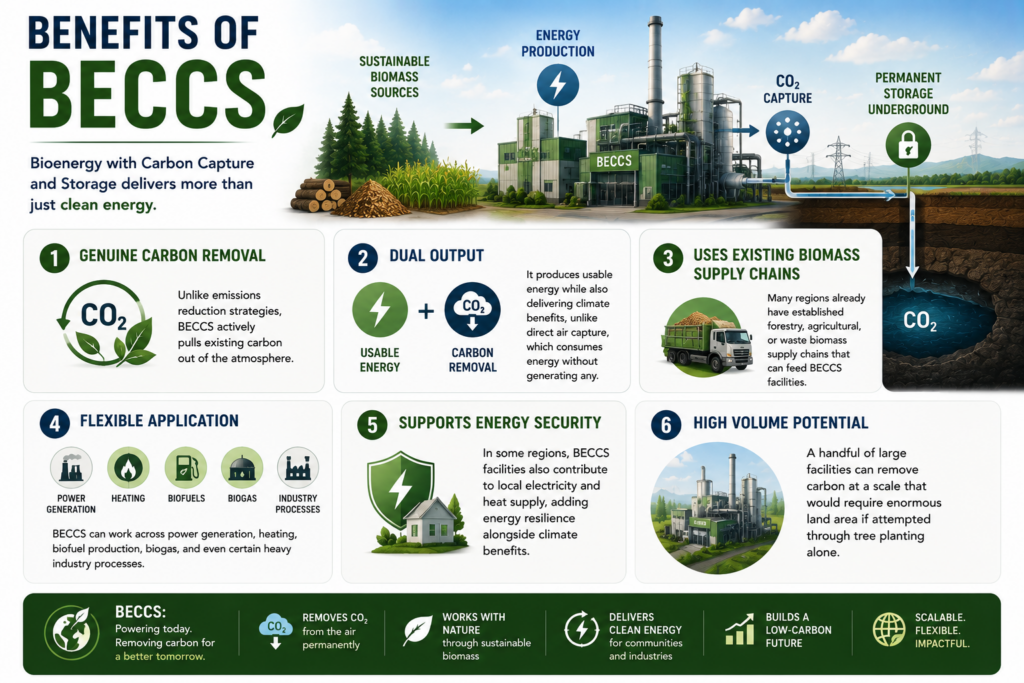
BECCS brings several advantages that explain why it keeps attracting attention from policymakers, investors, and corporations alike.
- Genuine carbon removal: Unlike emissions reduction strategies, BECCS actively pulls existing carbon out of the atmosphere.
- Dual output: It produces usable energy while also delivering climate benefits, unlike direct air capture, which consumes energy without generating any.
- Uses existing biomass supply chains: Many regions already have established forestry, agricultural, or waste biomass supply chains that can feed BECCS facilities.
- Flexible application: BECCS can work across power generation, heating, biofuel production, biogas, and even certain heavy industry processes.
- Supports energy security: In some regions, BECCS facilities also contribute to local electricity and heat supply, adding energy resilience alongside climate benefits.
- High volume potential: A handful of large facilities can remove carbon at a scale that would require enormous land area if attempted through tree planting alone.
Challenges and Criticisms of BECCS
BECCS is not without serious concerns, and it is important to understand both sides of the debate.
High Costs
Carbon capture equipment, transport pipelines, and storage infrastructure require massive upfront investment. Many BECCS projects depend heavily on government subsidies or premium carbon credit prices to remain financially viable.
Land Use and Biodiversity Pressure
Growing biomass at the scale needed for meaningful climate impact could require enormous amounts of agricultural or forest land. Critics warn that large scale BECCS deployment could compete with food production or put pressure on natural ecosystems if not carefully managed.
Questions Around Sustainable Sourcing
Not all biomass is created equal from a climate perspective. If forests are harvested faster than they can regrow, or if long distance transport of biomass adds significant emissions, the net climate benefit of a BECCS project can shrink considerably.
This is why sustainable sourcing certification and lifecycle emissions accounting matter enormously for any BECCS project claiming genuine carbon removal.
Slow Real World Deployment
Despite years of policy support and academic modeling, only a small number of BECCS facilities are fully operational today. Several flagship projects have faced delays, cost overruns, or outright cancellation, leading some researchers to argue that BECCS is not scaling anywhere near the pace assumed in many climate pathways.
Risk of Overreliance
Some climate scientists worry that heavy reliance on future BECCS deployment in emissions models could create a false sense of security, potentially reducing pressure to cut emissions today in favor of promised future removals that may not materialize on schedule.
BECCS vs Other Carbon Removal Methods
BECCS is just one tool among several carbon dioxide removal approaches. Here is how it stacks up against common alternatives.
| Method | How It Works | Permanence | Typical Cost | Scale Potential |
|---|---|---|---|---|
| BECCS | Biomass energy plus carbon capture and storage | Very high, centuries or more | Moderate to high | High |
| Direct Air Capture (DAC) | Machines pull CO2 directly from ambient air | Very high, centuries or more | Very high | Moderate, growing |
| Afforestation and Reforestation | Planting trees to absorb CO2 | Lower, risk of fire or logging | Low | Moderate |
| Soil Carbon Sequestration | Farming practices that store carbon in soil | Moderate, reversible with poor practices | Low | Moderate |
| Enhanced Weathering | Spreading crushed rock to absorb CO2 chemically | High | Moderate | Emerging |
| Biochar | Converting biomass into stable charcoal for soil | High | Low to moderate | Moderate |
BECCS sits in an interesting middle ground. It offers permanence closer to direct air capture, but often at a lower cost, while also producing usable energy as a byproduct, something none of the other methods on this list can claim.
The Role of Policy and Government Support
BECCS growth depends heavily on supportive government policy, since the technology often cannot compete on cost alone against conventional bioenergy or fossil generation.
Common policy tools that support BECCS include:
- Carbon capture subsidy tenders, where governments guarantee a fixed price per tonne of CO2 removed over a long term contract
- Tax credits for carbon capture and storage, which reduce the effective capital cost for developers
- Inclusion in national net zero strategies, which signals long term policy commitment to investors
- Public funding for pilot projects, aimed at proving out new capture technologies and storage sites
Countries that have moved fastest on BECCS deployment tend to share a few traits: existing carbon capture infrastructure, strong biomass supply chains, supportive subsidy mechanisms, and suitable geology for underground CO2 storage.
Common Applications of BECCS Across Industries
BECCS is not limited to one type of facility. Its flexibility is part of what makes it attractive to climate planners.
Power and Heat Generation
Biomass fired power stations and combined heat and power plants represent some of the largest scale BECCS opportunities, since they already burn large volumes of biomass and can be retrofitted with capture units.
Biofuel and Ethanol Production
Fermentation based biofuel plants offer some of the cheapest carbon capture opportunities available today, thanks to the naturally pure CO2 stream produced during fermentation.
Biogas and Anaerobic Digestion
Facilities that convert organic waste into biogas can also capture and store the resulting CO2, turning waste management infrastructure into a carbon removal tool.
Heavy Industry
Some cement and chemical facilities are exploring partial biomass substitution combined with carbon capture, aiming to reduce process emissions while adding a removal component to their operations.
What Does the Future Hold for BECCS?
Looking ahead, several trends are likely to shape how BECCS develops.
- Growing carbon removal demand: As more companies commit to net zero targets, demand for durable, verifiable carbon removal credits is expected to keep rising, supporting continued investment in BECCS.
- Falling capture costs: As carbon capture technology matures and scales, per tonne capture costs are expected to gradually decline, improving BECCS project economics.
- Stricter sustainability standards: Expect tighter scrutiny on biomass sourcing, lifecycle emissions accounting, and land use impact, as regulators and buyers push for higher integrity claims.
- More diverse project types: Beyond traditional power plants, expect growth in fermentation based and waste to energy BECCS projects, since these often offer lower cost entry points.
- Continued policy dependence: Government subsidy tenders and tax incentives will likely remain essential to unlocking new BECCS investment for the foreseeable future.
Practical Takeaways on BECCS
If you are trying to make sense of BECCS for investment, corporate sustainability planning, or general climate literacy, keep these points in mind:
- BECCS combines bioenergy production with permanent carbon storage, making it one of the few technologies that produces energy while also removing atmospheric carbon.
- Fermentation based BECCS, such as ethanol production, tends to offer the lowest cost entry point due to purer CO2 streams.
- Sustainable biomass sourcing is essential. Without it, the climate benefits of any BECCS project can shrink or disappear entirely.
- BECCS carbon removal credits often command a premium in carbon markets due to their durability and measurability.
- Real world deployment has been slower than early projections suggested, so treat aggressive rollout timelines with healthy skepticism.
- BECCS works best as part of a broader climate strategy, not as a replacement for cutting emissions at the source.
Frequently Asked Questions About BECCS
What does BECCS stand for?
BECCS stands for Bioenergy with Carbon Capture and Storage. It describes a process that produces energy from biomass while capturing and permanently storing the resulting carbon dioxide.
Is BECCS the same as carbon capture and storage (CCS)?
No. CCS captures carbon dioxide from any industrial or energy source, including fossil fuels. BECCS specifically pairs carbon capture with bioenergy production, which is what allows it to achieve net negative emissions rather than simply reducing emissions.
Does BECCS actually remove carbon dioxide from the atmosphere?
Yes, when done correctly with sustainably sourced biomass. Since the biomass absorbed CO2 from the atmosphere during growth, capturing and permanently storing the carbon released during energy conversion results in a net removal of atmospheric carbon.
What are the main challenges facing BECCS?
The biggest challenges include high upfront costs, land use pressure from large scale biomass cultivation, questions around sustainable biomass sourcing, and slower than expected real world project deployment.
How is captured CO2 stored underground?
Captured CO2 typically gets injected into depleted oil and gas reservoirs, deep saline aquifers, or basalt rock formations, where geological conditions keep it securely trapped for centuries or longer.
Why are BECCS carbon credits considered high quality?
BECCS credits are considered high quality because the carbon removal can be precisely measured, verified through independent monitoring, and stored with very high permanence compared to many nature based alternatives.
Can BECCS work at a small scale, or does it require massive facilities?
While the largest BECCS projects involve big power plants, smaller scale applications exist too, particularly in fermentation based biofuel production and biogas facilities, which can be more modest in size while still delivering meaningful carbon removal.
Is BECCS considered a proven technology?
The individual components, bioenergy production and carbon capture and storage, are both well established. What remains less proven is large scale, fully integrated deployment across many facility types, which is still in relatively early commercial stages.
Final Thoughts
BECCS represents one of the most promising, and most debated, tools available for tackling the climate crisis. It offers something rare: a way to generate usable energy while actively pulling carbon out of the atmosphere and locking it away for good.
At the same time, real world experience shows that BECCS is neither cheap nor easy to scale, and its success depends heavily on sustainable biomass sourcing, supportive policy, and honest accounting of its climate benefits.
As carbon markets mature and demand for durable removal credits continues to grow, BECCS will likely remain a central topic in climate finance and carbon credit discussions for years to come. Understanding how it works, where it succeeds, and where it falls short puts you in a strong position to evaluate any BECCS related project, credit, or policy debate you come across.
Whether you are a climate professional, an investor, or simply someone curious about how the world plans to tackle rising carbon dioxide levels, BECCS explained clearly gives you a solid foundation for everything else you will read about carbon removal in the future.
For more updates, guides, and resources on carbon markets, explore Carbon Market Network.