Carbon Market Network


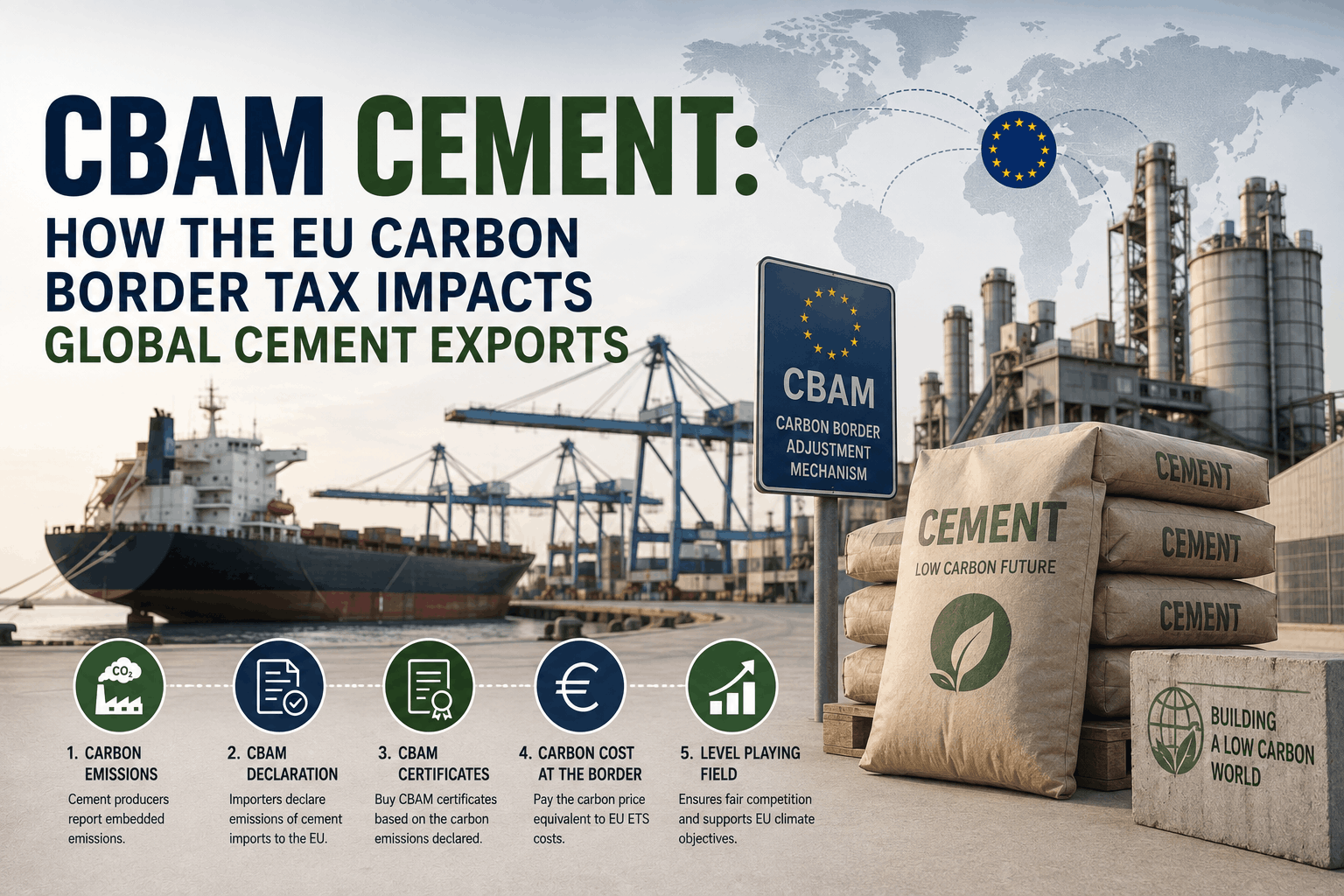
If you export cement to Europe, or if you buy cement from outside the EU, your costs just changed.
The Carbon Border Adjustment Mechanism, widely known as CBAM, moved from a reporting exercise into a real financial obligation at the start of this year. Cement was one of the first sectors it targeted, and for good reason. Cement is one of the most carbon-intensive industries on the planet, contributing roughly 8% of global CO₂ emissions every year. That number alone tells you why regulators put it at the top of the list.
But here is the thing. CBAM is not just a compliance headache for legal and sustainability teams. It is reshaping trade flows, rewarding low-carbon producers, and forcing the entire global cement supply chain to think differently about carbon.
Whether you work at a cement plant in Turkey, run procurement for a European construction company, or are simply trying to understand what all the fuss is about, this article breaks it all down. Simply. Clearly. Without the jargon overload.
What Is CBAM and Why Does It Matter for Cement?
CBAM stands for Carbon Border Adjustment Mechanism. It is a regulation introduced by the European Union as part of its “Fit for 55” climate package.
The basic idea is straightforward. Inside the EU, manufacturers pay for their carbon emissions through the EU Emissions Trading System (EU ETS). Every tonne of CO₂ they emit has a price tag attached to it.
Outside the EU, many countries do not have comparable carbon pricing. So a cement producer in, say, Vietnam or Egypt can emit carbon freely, produce cement cheaply, and sell it to European buyers at lower prices than EU producers can match.
That creates an unfair playing field. It also encourages a phenomenon called carbon leakage, where production shifts to places with weaker climate rules, essentially exporting emissions rather than reducing them.
CBAM fixes this by applying an equivalent carbon price to imported goods. If you make cement outside the EU and sell it inside the EU, you now face the same carbon cost that a European cement maker would pay.
This is not a tariff in the traditional sense. It is a carbon cost equaliser.
Carbon Market Insider Newsletter
Weekly insights on carbon markets, climate policy, carbon credits, and sustainability.
Why Cement Is in CBAM’s First Wave
CBAM currently covers six product groups. Those six are:
- Cement (including clinker)
- Iron and steel
- Aluminium
- Fertilisers
- Electricity
- Hydrogen
Cement made this list because of two qualities that regulators specifically look for: high carbon intensity and significant trade exposure.
Cement production is energy-heavy and chemically unavoidable in its emissions. When you heat limestone to make clinker (the core ingredient in cement), it releases CO₂ as part of the chemical reaction itself. No amount of energy efficiency can eliminate that. It is called a process emission, and it accounts for roughly 60% of cement’s total carbon footprint.
The remaining 40% comes from burning fossil fuels in the kiln.
So cement enters every conversation about industrial decarbonisation as one of the hardest-to-abate sectors. That is exactly why CBAM applies to it from day one.
CBAM Timeline: From Reporting to Real Money
Understanding where we are in the CBAM journey matters a great deal if you are making business decisions right now.
The Transitional Phase (October 2023 to December 2025)
During this period, EU importers of cement had to report the embedded emissions in their imports every quarter. There was no financial obligation, no certificates to buy, and no verification required.
It was essentially a data collection and learning period. Importers had to engage their cement suppliers, gather emissions data, and figure out how the new reporting system worked.
Many importers discovered during this phase that they had almost no visibility into their suppliers’ actual carbon footprint.
The Definitive Phase (From January 2026 Onwards)
The transitional period ended on 31 December 2025. The definitive phase kicked in on 1 January 2026.
This is where things get financially real.
From 2026 onwards, EU importers of cement must:
- Hold authorised CBAM declarant status
- Track and declare the embedded emissions in all cement imports
- Purchase CBAM certificates to cover those emissions
- Have their emissions data verified by an accredited third party
- Surrender certificates by 30 September 2027 for all 2026 imports
The certificate purchase window opens in February 2027. So while the financial obligation applies to imports made from 1 January 2026, the actual payment happens in 2027. But the data collection and verification have to happen now.
Phase-Out of Free Allowances
At the same time CBAM phases in, EU cement producers are watching their free ETS allowances phase out. The phase-out runs from 2026 to 2034:
| Year | Free Allocation Factor |
|---|---|
| 2026 | 97.5% |
| 2027 | 95.0% |
| 2028 | ~86% |
| 2029 | ~72% |
| 2030 | ~51.5% |
| 2034 | 0% (Full CBAM) |
By 2034, CBAM covers 100% of embedded emissions and free allowances are gone entirely. The transition is gradual, but the direction is completely clear.
CBAM Certificate Pricing: What Does It Actually Cost?
CBAM certificates are priced to mirror the EU ETS carbon price. You do not set the price. The European Commission calculates it quarterly based on average EU ETS auction prices.
Here is where things stand right now:
- Q1 2026 CBAM certificate price: €75.36 per tonne of CO₂
- Q2 2026 CBAM certificate price: €75.28 per tonne of CO₂
These prices are published officially by the European Commission and apply to all CBAM-covered goods, including cement.
Now let us put that number into context for a cement importer.
Portland cement typically carries an embedded emissions factor of around 0.83 tonnes of CO₂ per tonne of cement. Clinker sits higher, at approximately 0.85 to 0.87 tonnes of CO₂ per tonne.
So if you import 10,000 tonnes of Portland cement into the EU, you are looking at roughly 8,300 tonnes of embedded CO₂. At €75.28 per tonne, that works out to a CBAM certificate cost of approximately €624,800 for that single shipment.
That is not a line item you can ignore.
How Are Embedded Emissions Calculated for Cement?
This is where the technical detail really matters, because the number of certificates you need depends entirely on the emissions calculation.
For cement, embedded emissions include both direct and indirect emissions.
Direct Emissions
These come from the production process itself:
- Process emissions from calcination: When limestone (calcium carbonate) is heated, it converts to calcium oxide and releases CO₂. This is chemical and unavoidable.
- Combustion emissions: CO₂ released from burning fuels in the kiln.
Indirect Emissions
For cement specifically, CBAM also includes indirect emissions from electricity used during production. This is different from the approach used for some other sectors like steel, which only counts direct emissions.
This matters enormously for producers in countries with carbon-intensive electricity grids, because their indirect emissions are counted and billed.
The Calculation Formula
The formula for specific embedded emissions in cement is:
Specific Embedded Emissions = Total CO₂ from Cement Production ÷ Total Cement Production Volume
Or put simply:
Embedded Emissions (tCO₂/t cement) = (Calcination CO₂ + Fuel Combustion CO₂ + Electricity CO₂) ÷ tonnes of cement produced
Clinker-to-Cement Ratio: The Key Variable
The single most important factor that drives a cement plant’s CBAM cost is its clinker factor: the ratio of clinker to the final cement product.
Pure Portland cement can have a clinker factor above 90%. Blended cements using fly ash, blast furnace slag, or calcined clay can have clinker factors as low as 50% or even lower.
Here is why this matters:
| Cement Type | Approx. Clinker Factor | Approx. Embedded Emissions |
|---|---|---|
| Clinker | 100% | ~0.85-0.87 tCO₂/t |
| Portland cement (OPC) | ~90-95% | ~0.83 tCO₂/t |
| Blended cement (50-70% clinker) | 50-70% | ~0.40-0.65 tCO₂/t |
A cement plant that reduces its clinker factor from 90% to 60% does not just help the climate. It directly cuts the number of CBAM certificates its EU buyer has to purchase.
What Is a CBAM Declarant and Who Needs to Register?
Under CBAM, only authorised CBAM declarants can legally import cement into the EU from the definitive phase onwards.
The application window to become an authorised declarant opened in March 2025. If an importer missed the registration deadline, they are now classified as an unauthorised importer and face much steeper penalty rates.
Penalties under CBAM work like this:
- Standard penalty for missing certificates: €100 per tonne of CO₂ per missing certificate
- Penalty for unauthorised importers: €300 to €500 per tonne of CO₂
These penalties are on top of the obligation to still surrender the missing certificates. So non-compliance gets expensive very fast.
Default Values vs. Actual Emissions: A Critical Distinction
Here is one of the most important financial decisions a cement exporter faces under CBAM.
If an exporter does not provide their actual, verified embedded emissions data to the EU importer, the importer has to use the Commission’s default values.
These default values are deliberately conservative. They are set at the 90th percentile of EU production emissions, which typically represents the dirtiest end of the spectrum. In practice, they are often two to three times higher than what a modern, well-run cement plant actually emits.
What does this mean in practice?
A Turkish cement plant with actual clinker emissions of 0.88 tCO₂/t could be assessed at the default value of 1.551 tCO₂/t if they do not provide verified data. That is a 76% inflation of their real footprint, directly translating into 76% more certificates their EU buyer must purchase.
The default value mark-up is also increasing over time:
| Year | Mark-up Above Benchmark on Default Values |
|---|---|
| 2026 | 10% |
| 2027 | 20% |
| 2028+ | 30% |
This creates a powerful commercial incentive for cement producers everywhere to invest in measurement, monitoring, and third-party verification of their actual emissions.
Who Gets a De Minimis Exemption?
The CBAM Omnibus Regulation (Regulation EU 2025/2083), which entered into force in 2025, introduced a de minimis threshold.
Importers who bring in 50 tonnes or less of cement per year are exempt from CBAM obligations.
This sounds like it would exempt a huge number of importers. And it does. About 90% of importers by number fall below this threshold.
But here is the catch: those small importers represent only about 1% of total embedded emissions in cement imports. The 10% of importers who exceed the threshold are responsible for 99% of the embedded emissions.
So the de minimis rule simplifies compliance for small businesses without meaningfully undermining the environmental goal of CBAM.
How CBAM Is Reshaping Global Cement Trade Flows
This is where CBAM gets really interesting from a trade perspective.
The EU is a significant importer of cement and clinker. Traditional suppliers to the European market have included Turkey, Egypt, Vietnam, China, and several countries in North Africa and the Western Balkans.
CBAM is shaking up those trade relationships in profound ways.
Turkey: The Biggest Supplier Under Pressure
Turkey has historically been one of the largest cement exporters to the EU. But Turkey faces a particular challenge under CBAM.
When the European Commission published default values for cement, it did not provide a specific default for Turkey. This means Turkish exporters are classified under the “other countries” category, which carries a default value of 1.551 tCO₂ per tonne of clinker.
The Turkish Cement Manufacturers’ Association (TurkCimento) has pointed out that the actual average emissions from Turkish clinker plants during the transition period were only around 0.88 tCO₂ per tonne. The default value nearly doubles that.
The result is predictable. Turkish cement is becoming less competitive in the EU at current price levels, because the CBAM cost assessed on default values eliminates Turkey’s traditional price advantage.
Egypt and North Africa: Facing Trade Diversion
Egypt and other North African producers are experiencing something similar. CBAM costs based on default values push up the total landed cost of their cement in European markets.
The response from many of these producers is not necessarily to decarbonise immediately. Instead, they are redirecting export volumes toward markets that do not apply a carbon price: West Africa, the Middle East, parts of South America.
This trade diversion is real and already happening. Markets like West Africa are seeing rising volumes from Pakistan and Vietnam, which have positioned themselves as low-cost suppliers to markets where CBAM does not apply.
Vietnam and Pakistan: Lower Default Costs, Competitive Advantage
Vietnam and Pakistan produce cement at relatively low carbon intensity (partly due to more modern kiln technology and favourable fuel mixes), and their fob prices are extremely competitive, often in the mid-to-high $30s per tonne.
For EU buyers, buying lower-carbon cement from Vietnam can mean significantly fewer CBAM certificates are needed compared to buying from a higher-intensity supplier using default values. The CBAM-adjusted economics are shifting buying decisions.
The Trade Flow Outlook
The consensus from trade analysts is that CBAM will:
- Reduce EU imports from high-carbon, high-cost suppliers who rely on default values
- Reward exporters who invest in emissions measurement and can demonstrate lower actual intensities
- Divert some volumes from traditional EU-facing suppliers toward non-EU markets
- Incentivise decarbonisation in exporting countries that want to maintain EU market access
The EU is not closing its borders to cement imports. But it is making carbon intensity a competitive factor that is as important as price.
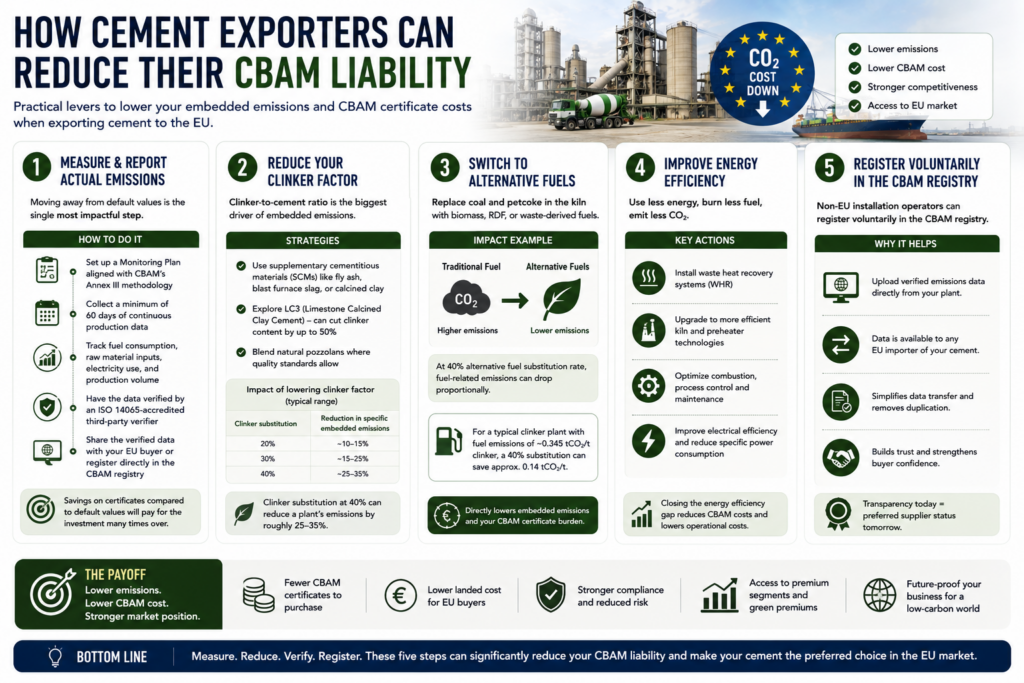
How Cement Exporters Can Reduce Their CBAM Liability
If you export cement to the EU, or if you are advising someone who does, here are the practical levers available to reduce CBAM costs.
1. Measure and Report Actual Emissions
The single most impactful step is to move away from default values by establishing robust monitoring and providing verified actual emissions data.
The process for doing this:
- Set up a Monitoring Plan aligned with CBAM’s Annex III methodology
- Collect a minimum of 60 days of continuous production data
- Track fuel consumption, raw material inputs, electricity use, and production volume
- Have the data verified by an ISO 14065-accredited third-party verifier
- Share the verified data with your EU buyer or register directly in the CBAM registry
This is not a small undertaking. But for any plant shipping meaningful volumes to the EU, the savings on certificates compared to default values will pay for the investment many times over.
2. Reduce Your Clinker Factor
As discussed earlier, the clinker-to-cement ratio is the biggest driver of embedded emissions. Strategies here include:
- Using supplementary cementitious materials (SCMs) like fly ash, blast furnace slag, or calcined clay
- Exploring LC3 (Limestone Calcined Clay Cement), which can cut clinker content by up to 50%
- Blending natural pozzolans where quality standards allow
Clinker substitution at 40% can reduce a plant’s specific embedded emissions by roughly 25-35%, depending on the baseline.
3. Switch to Alternative Fuels
Replacing coal and petcoke in the kiln with biomass, refuse-derived fuel, or waste-derived fuels reduces combustion emissions.
At a 40% alternative fuel substitution rate, fuel-related emissions can drop proportionally. For a typical clinker plant with fuel emissions of around 0.345 tCO₂/t clinker, a 40% substitution can save approximately 0.14 tCO₂/t.
That directly lowers the embedded emissions figure and the CBAM certificate burden.
4. Improve Energy Efficiency
Installing waste heat recovery systems, upgrading to more efficient kiln technologies, and optimising combustion reduces total fuel consumption and therefore combustion-related CO₂.
Modern cement plants in Europe routinely achieve energy efficiencies that older plants in exporting countries have not yet reached. Closing that gap is both a CBAM strategy and a straight operational cost reduction.
5. Register Voluntarily in the CBAM Registry
The CBAM regulation allows non-EU installation operators to register voluntarily in the CBAM registry. This lets a cement plant in an exporting country upload its verified emissions data directly, making it available to any EU importer purchasing that plant’s cement.
This simplifies the data transfer process and removes a friction point in the EU buyer-supplier relationship.
What EU Cement Buyers Need to Do Right Now
If you are an EU-based importer of cement, your compliance checklist looks like this:
Step 1: Confirm Authorised Declarant Status If you did not apply before March 31, 2026, you cannot legally import CBAM goods. Check your status immediately.
Step 2: Map Your Cement Supply Chain Identify all cement and clinker suppliers, their country of origin, and the CN codes of every product you import. The relevant CN codes for cement are 2523 10, 2523 21, 2523 29, and 2523 30.
Step 3: Collect Actual Emissions Data from Suppliers Contact each supplier and request their embedded emissions data in the format required by the CBAM regulation. Suppliers who cannot provide this leave you exposed to default values.
Step 4: Calculate Your Annual Certificate Obligation Sum up the embedded emissions across all cement imports for the year. Multiply by the applicable quarterly CBAM certificate price. This is your liability.
Step 5: Budget for Certificate Purchases Certificate purchases open in February 2027 for 2026 imports. Plan your cash flow accordingly.
Step 6: Maintain Quarterly Coverage Checks From 2027 onwards, you must ensure you hold certificates covering at least 50% of cumulative embedded emissions at each quarterly check point. Missing this triggers penalties.
Step 7: Submit Your Annual Declaration and Surrender Certificates The first annual CBAM declaration and certificate surrender is due on 30 September 2027 for all 2026 imports.
The Decarbonisation Imperative: What CBAM Really Wants
CBAM is not primarily a revenue-raising tool. Its goal is to drive decarbonisation in global industry.
And it is working. Evidence from the cement sector already shows:
- European cement producers are accelerating low-carbon innovation, with companies like Hoffmann Green Cement Technologies and Titan Cement investing in alternative binder chemistries
- Major global players including LafargeHolcim, Heidelberg Materials, and CEMEX have made net-zero commitments with specific product lines already achieving dramatically lower carbon intensities
- The green cement market is projected to reach $74.4 billion globally in the coming years, driven partly by regulatory pressure from mechanisms like CBAM
The Four Decarbonisation Pathways
For cement producers anywhere in the world, the route to a lower CBAM liability runs through one or more of these four pathways:
| Pathway | Emission Reduction Potential | Key Constraint |
|---|---|---|
| Clinker substitution (SCMs) | 20-40% | SCM availability and quality standards |
| Alternative fuels | Up to 27% (combustion) | Supply chains and regulatory acceptance |
| Energy efficiency | 5-15% | Capital cost, diminishing returns in modern plants |
| Carbon Capture (CCUS) | Up to 90%+ | High capital cost, limited commercial scale today |
No single pathway achieves full decarbonisation on its own. Most serious cement producers are pursuing a combination of the first three now, while preparing for CCUS as costs fall and the technology matures.
The Omnibus Simplification: What Changed in 2025
In October 2025, the EU adopted the CBAM Omnibus Regulation (EU 2025/2083) (reference) as part of a broader effort to reduce administrative burden. The key changes relevant to cement importers are:
- De minimis threshold introduced: 50 tonnes per importer per year for cement, iron and steel, aluminium, and fertilisers
- Annual declaration deadline shifted: From 31 May to 30 September of the following year
- Certificate purchase window changed: Sales now open in February 2027, not January 2026 as originally planned
- Quarterly holding requirement: Importers must hold certificates covering at least 50% of cumulative embedded emissions at each quarter (reduced from the originally planned 80%)
- Certificate price calculation: Quarterly average for 2026 compliance year, switching to weekly averages from 2027
These changes make compliance more manageable, particularly for smaller importers. But they do not change the fundamental obligation for major cement traders.
CBAM vs. Carbon Pricing in Exporting Countries: The Article 9 Deduction
One feature of CBAM that often gets overlooked is the Article 9 deduction.
If a cement producer in an exporting country has already paid a carbon price on their production emissions under a domestic carbon pricing mechanism, that cost can be deducted from the CBAM certificate obligation.
This means exporters in countries with functioning carbon markets (such as those with a cap-and-trade system or a carbon tax) gain a competitive advantage. Their EU buyers need fewer CBAM certificates.
It also creates an incentive for exporting countries to develop their own domestic carbon pricing, which aligns with the EU’s broader climate diplomacy goals.
Countries currently developing or expanding carbon markets (including several in Southeast Asia, Latin America, and the MENA region) are partly motivated by the prospect of CBAM deductions maintaining their export competitiveness to Europe.
CBAM and the EU ETS: How They Work Together
CBAM and the EU ETS are designed to work as a system.
EU cement producers pay for their emissions through the EU ETS. They receive some free allowances, but those free allocations are phasing out alongside CBAM’s phase-in. The two timelines mirror each other deliberately.
The logic is that as EU producers lose their free allowances, they face increasing carbon costs. CBAM ensures that imported cement faces equivalent costs. Neither EU producers nor non-EU producers get a structural advantage.
From the perspective of a European construction company buying cement, this means:
- EU-produced cement and imported cement will converge in carbon cost by 2034
- Choosing the lower-carbon option becomes the financially smarter choice regardless of origin
- Procurement decisions will increasingly incorporate embedded carbon data
CBAM and Scope Expansion: What Is Coming Next?
CBAM in its current form covers six sectors. But the EU has signalled clearly that it intends to expand.
From 1 January 2028, CBAM is expected to expand to cover 180 downstream products, including steel and aluminium-intensive processed goods. This could pull in products like prefabricated concrete elements and other construction materials that contain CBAM-covered inputs.
The Commission is also reviewing whether to include additional sectors such as chemicals, polymers, and glass in subsequent phases.
For the cement industry, the practical implication is that CBAM exposure is a long-term feature of doing business with Europe. It is not a short-term compliance exercise.
The Carbon Competitiveness Opportunity
Here is the perspective shift that forward-thinking cement companies are making.
CBAM is not just a cost. For low-carbon producers, it is a competitive advantage.
A cement plant that invests in:
- Lower clinker factors
- Alternative fuels
- Verified monitoring systems
…can offer EU buyers a product with a lower CBAM liability than competitors who do not invest in these areas.
Lower embedded carbon means fewer certificates. Fewer certificates mean lower total landed cost. Lower total landed cost wins contracts.
Early movers in decarbonisation will price this advantage into their commercial relationships. They will also be better positioned when carbon pricing spreads beyond the EU, which it increasingly is: the UK has its own CBAM, Australia is actively considering one, and Canada and several Asian economies are developing comparable border carbon policies.
Getting ahead of CBAM now is not just about EU market access. It is about building a carbon-resilient business model for a world where carbon pricing is becoming the norm.
Quick Summary: CBAM Cement at a Glance
| Topic | Key Facts |
|---|---|
| What is covered | Cement (clinker, Portland cement) under CN codes 2523 10, 21, 29, 30 |
| Emission types covered | Direct (calcination + combustion) + indirect (electricity) |
| Typical embedded emissions | ~0.83 tCO₂/t Portland cement; ~0.85-0.87 tCO₂/t clinker |
| Current certificate price | €75.28/tCO₂ (Q2 2026) |
| De minimis threshold | 50 tonnes per importer per year |
| First surrender deadline | 30 September 2027 (for 2026 imports) |
| Standard penalty rate | €100/tCO₂ per missing certificate |
| Full CBAM implementation | 2034 (when free ETS allocations reach zero) |
| Default value penalty | Up to 10-30% mark-up above benchmark values |
| Deduction available | For carbon prices already paid in country of origin (Article 9) |
Frequently Asked Questions (FAQ)
What is CBAM in simple terms for the cement industry?
CBAM is the EU’s carbon border tax on imported goods. For cement, it means that any cement or clinker sold into the EU must carry a carbon price equivalent to what EU cement producers pay under the EU Emissions Trading System. EU buyers purchase digital certificates to cover the embedded CO₂ emissions in the cement they import.
Which cement products fall under CBAM?
CBAM covers clinker, Portland cement, aluminous cement, and slag cements, as listed under Combined Nomenclature codes 2523 10, 2523 21, 2523 29, and 2523 30.
Does CBAM cover both direct and indirect emissions for cement?
Yes. Cement is one of a small number of sectors where CBAM covers both direct emissions (from calcination and fuel combustion) and indirect emissions (from electricity used in production). This makes cement’s CBAM obligation broader than it is for sectors like steel, which only count direct emissions.
How much does CBAM cost for cement imports?
The cost depends on the embedded emissions of the specific cement and the current certificate price. At Q2 2026 prices of €75.28/tCO₂, importing one tonne of standard Portland cement (0.83 tCO₂/t) would carry a gross CBAM cost of around €62.50 per tonne, before any adjustment for carbon already paid in the exporting country or the current free allocation factor.
Can a cement exporter reduce CBAM costs for their EU buyers?
Yes, substantially. By measuring and verifying actual embedded emissions (rather than using default values), reducing the clinker factor, switching to alternative fuels, and improving energy efficiency, exporters can significantly lower the embedded emissions figure, which directly reduces the number of certificates their EU buyers need to purchase.
What happens if a cement importer does not comply with CBAM?
Unauthorised importers (those who import without being registered as an authorised CBAM declarant) face penalties of three to five times the standard rate, which is €300 to €500 per tonne of CO₂. Standard non-compliance for registered declarants carries a penalty of €100 per tonne, on top of still being required to surrender the missing certificates.
Does CBAM apply to cement from all countries?
Yes. CBAM applies to cement imports regardless of the country of origin, with one key exception: countries that have a carbon pricing system that the EU formally recognises as equivalent may be partially or fully exempt. Currently, no major cement-exporting country outside the EU has achieved this status, although the situation may evolve as more countries develop domestic carbon markets.
When do CBAM certificates need to be purchased?
CBAM certificate sales open in February 2027. Importers will purchase certificates at that point to cover all 2026 imports. The first annual declaration and surrender deadline is 30 September 2027. From 2027 onwards, there is also a quarterly check requiring importers to hold certificates covering at least 50% of cumulative embedded emissions at each quarter end.
Is CBAM the same as the EU ETS?
No. The EU ETS is a cap-and-trade system that applies to installations inside the EU. CBAM applies to imports of covered goods from outside the EU. They work together: EU producers pay through the ETS; importers pay through CBAM certificates. The certificate price under CBAM is linked to the EU ETS price.
What is a de minimis exemption under CBAM?
Importers who bring in 50 tonnes or less of cement per year (in total) are exempt from CBAM obligations. This is called the de minimis threshold. It was introduced by the Omnibus Regulation to reduce administrative burden on very small importers, who represent the vast majority of importers by number but only a tiny fraction of embedded emissions.
Published on CarbonMarketNetwork.com | Your trusted resource for carbon markets education