Carbon Market Network


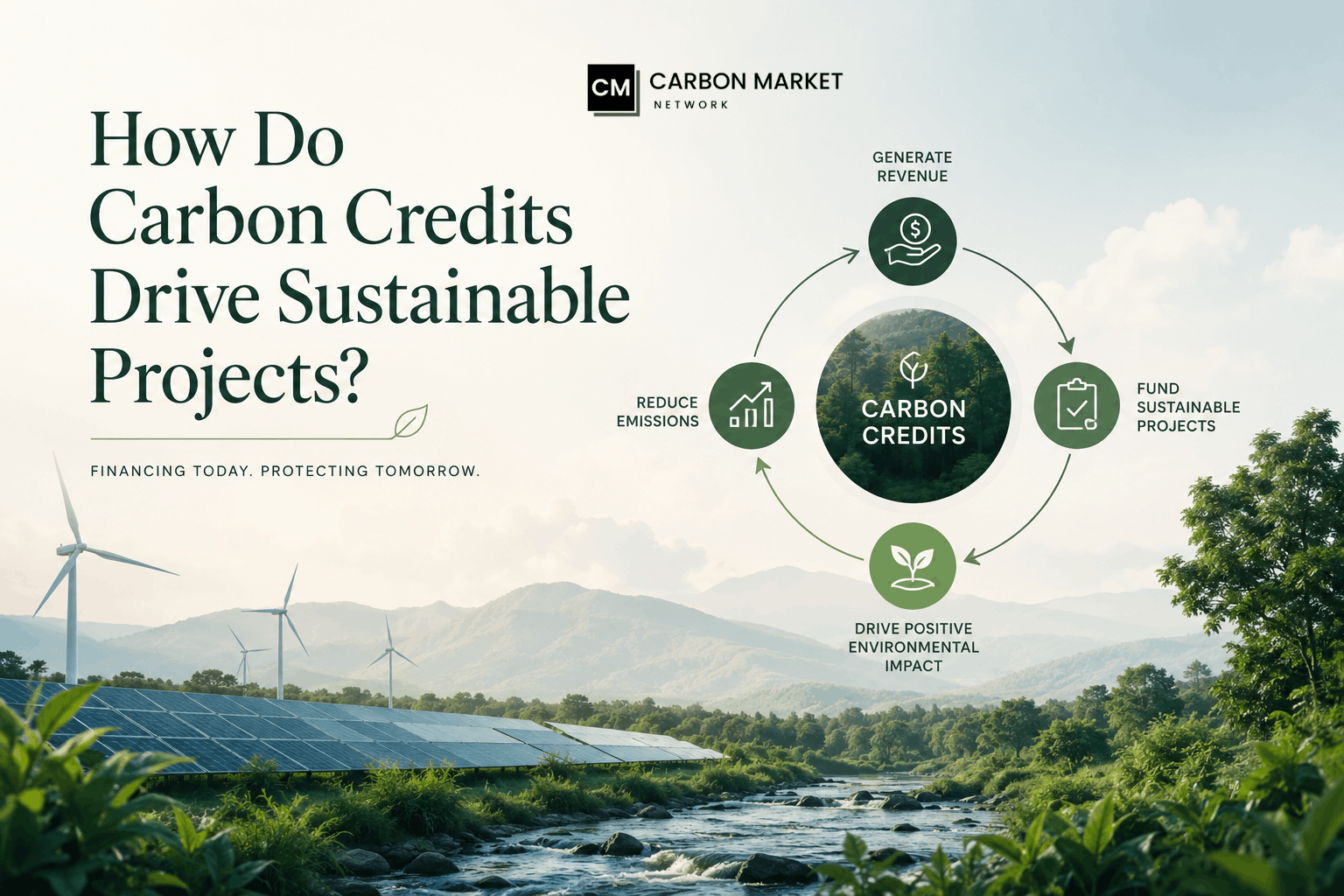
Every year, millions of tonnes of carbon dioxide pour into the atmosphere. Forests are cleared. Factories run. Planes take off. And the planet keeps getting warmer.
But here is the thing: some of the most powerful tools we have to fight climate change are not government mandates or expensive technologies. They are financial instruments called carbon credits, and they are quietly funding some of the most important sustainability projects on the planet.
If you have ever wondered how a company in Germany can help plant trees in Kenya, or how a solar farm in India gets funded by a corporation in the United States, the answer almost always involves carbon credits.
This article explains how carbon credits drive sustainable projects, how the whole system works, what kinds of projects it supports, and why it matters for the future of our planet.
What Are Carbon Credits? A Quick Recap
Before we dive into how carbon credits drive sustainable projects, let us quickly understand what a carbon credit actually is.
A carbon credit is a tradable certificate that represents the reduction or removal of one metric tonne of carbon dioxide (CO2) or its equivalent in other greenhouse gases from the atmosphere.
Think of it like a permission slip, but in reverse. Instead of giving someone the right to pollute, a carbon credit gives someone the right to say: “We have prevented or removed one tonne of CO2 from entering the atmosphere.”
These credits are generated by verified projects that either:
- Reduce emissions (like switching to cleaner fuel)
- Avoid emissions (like protecting a forest from being cut down)
- Remove emissions (like planting new trees or using direct air capture technology)
Once a project generates these credits, companies, governments, or individuals can purchase them to offset their own emissions.
This creates a direct financial link between a company’s climate goals and the sustainable projects happening on the ground.
Carbon Market Insider Newsletter
Weekly insights on carbon markets, climate policy, carbon credits, and sustainability.
Why Carbon Credits Matter for Sustainable Projects
Here is the core idea: sustainable projects need money to exist.
A reforestation project in the Amazon does not fund itself. A clean cooking stove initiative in rural Africa needs capital to manufacture and distribute stoves. A solar microgrid in a remote Indian village requires upfront investment.
These projects deliver enormous environmental and social value. But they often happen in places where traditional investment dollars do not flow easily.
Carbon credits change that equation.
When a company buys carbon credits from these projects, that money goes directly to the project developers, the communities involved, and the ongoing operations of the project.
This is not charity. It is a market mechanism that creates economic value out of environmental impact.
The result? Projects that would never have existed on their own now have a sustainable funding stream.
According to the United Nations Development Programme (UNDP), carbon pricing now covers 28 percent of global emissions and generated over $100 billion in revenue in 2024. That is a significant pool of capital flowing into sustainability every year.
How the Carbon Credit Funding Cycle Works
Understanding how money flows from a buyer to a sustainable project helps explain why this system is so powerful.
Here is how the cycle works, step by step:
Step 1: A Project Developer Identifies an Opportunity
A project developer (this could be a government, an NGO, a private company, or a local community) identifies a project that can reduce or remove greenhouse gas emissions.
Examples include:
- Protecting a forest from deforestation
- Installing solar panels in off-grid communities
- Building biogas systems from agricultural waste
- Restoring degraded wetlands
Step 2: The Project Gets Designed and Validated
The developer creates a detailed project plan. This plan explains:
- What emissions the project will reduce or remove
- How it will be measured (this is called the methodology)
- What would have happened without the project (the baseline scenario)
- The social and environmental benefits it will deliver
A third-party auditor then validates the plan to confirm it meets the standards of a recognized certification body like Verra or the Gold Standard.
Step 3: The Project Gets Registered and Monitored
Once validated, the project is officially registered in a public registry. The project then starts operating and collects ongoing data on its actual emission reductions.
This data collection process is called Monitoring, Reporting, and Verification (MRV).
MRV ensures that every carbon credit issued truly reflects a real reduction or removal of emissions. It is the process used to monitor and quantify how much CO2 equivalent is reduced or removed from the atmosphere by a project, transparently report those findings, and have them independently verified to validate the issuance of credits.
Step 4: Credits Are Verified and Issued
Once the monitoring period is complete, another independent auditor verifies the data. If everything checks out, the certification body issues carbon credits equal to the verified emission reductions.
Under Verra’s Verified Carbon Standard, after verification is completed and approved by Verra, the project developer can request the issuance of credits. These credits are then listed on a public registry for full transparency.
Step 5: Companies Buy the Credits
Corporations looking to meet their sustainability targets, offset their unavoidable emissions, or fulfill regulatory requirements purchase these credits.
The revenue from these sales goes back to the project developer, who uses it to:
- Continue running the project
- Expand its impact
- Pay workers and communities
- Fund new sustainability initiatives
Step 6: Credits Are Retired
Once a company uses a credit to offset its emissions, the credit is permanently retired, meaning it cannot be sold or used again. This prevents double-counting and ensures the offset is real.
This six-step cycle is what makes carbon credits such a powerful driver of sustainable projects.
The Types of Sustainable Projects Funded by Carbon Credits
Carbon credits support an incredible variety of projects. Let us walk through the main categories.
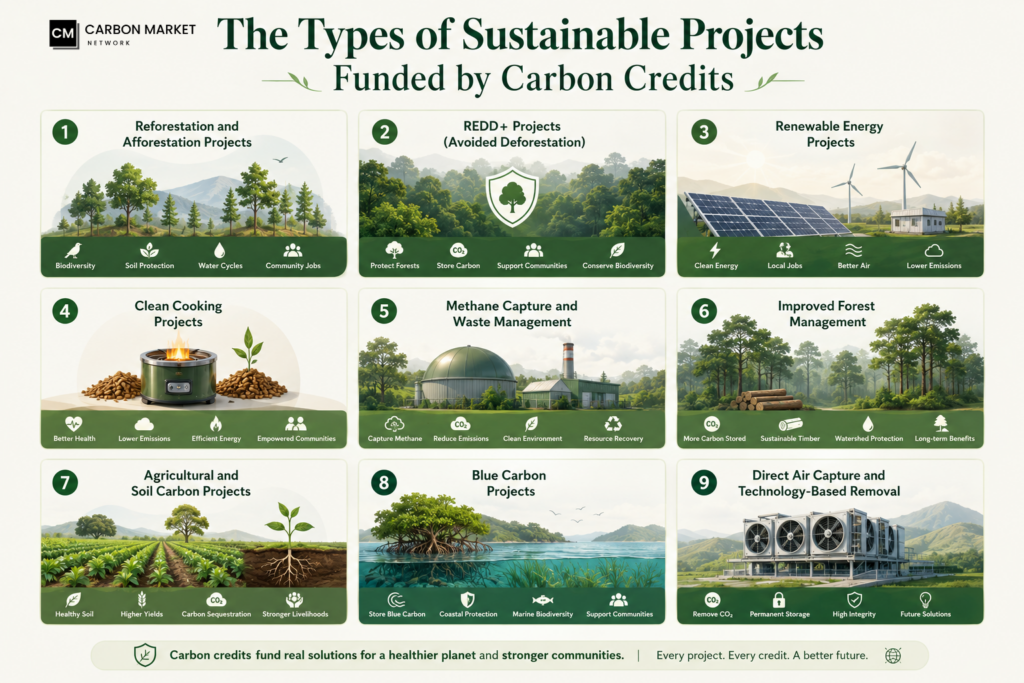
1. Reforestation and Afforestation Projects
These are among the most well-known types of carbon credit projects.
Reforestation means restoring forests on land that was previously deforested. Afforestation means planting trees on land that has not been forested before.
Both types of projects absorb CO2 from the atmosphere as trees grow. Afforestation and reforestation projects typically sequester 5 to 15 tonnes of CO2 per hectare annually, with credits averaging around $24 per tonne in 2025.
But these projects do far more than absorb carbon. They also:
- Restore biodiversity by providing habitat for wildlife
- Prevent soil erosion
- Improve local water cycles
- Create jobs for communities in forestry and conservation
A well-known example is the EcoMakala project in the Democratic Republic of Congo. It focuses on native species reforestation in a region that is both a biodiversity hotspot and a high-risk area for deforestation. The project creates local employment, builds community capacity, and protects endangered wildlife, all while generating verified carbon credits.
2. REDD+ Projects (Avoided Deforestation)
REDD+ stands for Reducing Emissions from Deforestation and Forest Degradation.
These projects protect existing forests from being cut down. Forests already store enormous amounts of carbon. When they are cleared, all of that stored carbon gets released into the atmosphere.
REDD+ projects prevent that from happening. They pay communities and governments to protect standing forests instead of clearing them.
Forestry and land-use projects (which include REDD+) accounted for 37% of all voluntary carbon credit retirements in 2025, making them the largest single category in corporate offsetting strategies.
REDD+ projects also protect biodiversity and support the rights of indigenous communities who depend on forests for their livelihoods.
3. Renewable Energy Projects
Carbon credits have played a major role in funding renewable energy in developing countries.
Solar farms, wind energy projects, small hydropower systems, and biomass energy installations all qualify for carbon credits when they replace energy that would otherwise come from fossil fuels.
These projects:
- Provide clean electricity to underserved communities
- Create local jobs in installation and maintenance
- Reduce indoor and outdoor air pollution
- Accelerate the shift away from coal and diesel
The International Renewable Energy Agency (IRENA) reported that renewable energy jobs reached 13.7 million globally in 2024, with strong growth expected in developing countries, much of it supported by carbon finance.
A notable example is a solar project in the Comoros Islands, which became the first project to receive carbon credits under Verra’s digital MRV pilot, allowing credits to be issued monthly rather than waiting years. This gives the project faster access to funding and improves transparency for credit buyers.
4. Clean Cooking Projects
This is one of the most impactful yet underappreciated categories of carbon credit projects.
Nearly 2.6 billion people still cook on open fires or traditional biomass stoves. These stoves produce massive amounts of black carbon, methane, and CO2. They also cause serious indoor air pollution, which kills millions of people each year.
Clean cookstove projects distribute improved stoves that burn fuel far more efficiently, dramatically cutting emissions and health risks.
One standout project replaces charcoal stoves with gasification cookstoves that burn renewable biomass pellets. This project cuts respiratory diseases by 60% in participating households, while generating verified carbon credits that fund its continued operation.
5. Methane Capture and Waste Management
Landfills and agricultural waste produce large quantities of methane, a greenhouse gas far more potent than CO2 in the short term.
Carbon credit projects in this space capture that methane and either flare it (destroying it before it enters the atmosphere) or use it as a fuel source.
This category received a major boost in late 2025 when the UN’s Article 6.4 Supervisory Body approved its first official methodology under the Paris Agreement Crediting Mechanism, specifically for waste sector projects involving flaring or using landfill gas. This opens up a significant new funding channel for waste management sustainability projects globally.
6. Improved Forest Management
Beyond planting new trees, there is also a category focused on managing existing forests better.
These projects use selective logging, extended harvest rotations, and sustainable forest management practices to increase the amount of carbon stored in forests over time.
They are particularly valued because the credits are often available immediately (unlike new forests which take years to grow), and they come with strong co-benefits including watershed protection and sustainable timber production.
7. Agricultural and Soil Carbon Projects
Agriculture is both a major source of emissions and a potential carbon sink.
Regenerative agriculture practices like cover cropping, reduced tillage, and agroforestry can pull carbon out of the atmosphere and store it in soil.
Agroforestry projects (which integrate trees into agricultural landscapes) are especially impactful in regions like Latin America and Africa. They support smallholder farmers, improve soil fertility, retain water, and increase crop yields.
These projects often combine both carbon avoidance and carbon removal, making them versatile and high-impact.
8. Blue Carbon Projects
Blue carbon refers to the carbon stored in coastal and marine ecosystems like mangroves, seagrasses, and salt marshes.
These ecosystems store carbon at a rate far higher than terrestrial forests. Protecting them prevents massive carbon releases while also:
- Protecting coastlines from storm surges and flooding
- Providing nursery habitats for fish and marine species
- Supporting coastal fishing communities
Blue carbon projects are growing in importance, especially as sea-level rise threatens coastal ecosystems worldwide.
9. Direct Air Capture and Technology-Based Removal
At the cutting edge of carbon removal are technology-based solutions like Direct Air Capture (DAC). These are machines that literally pull CO2 out of the atmosphere and store it permanently underground.
These projects generate removal credits, which are increasingly valued by companies that want permanent, verifiable carbon removal.
Technology credits currently command premium prices ranging from $100 to $1,000 per tonne, because of their permanence and measurability. While expensive today, costs are expected to fall significantly as the technology scales up.
How Carbon Credits Deliver Co-Benefits Beyond Carbon
One of the most important but often overlooked aspects of carbon credit projects is what they deliver beyond carbon.
These projects create what experts call co-benefits, which are additional environmental, social, and economic impacts that go far beyond the tonnes of CO2 they remove or avoid.
The United Nations has identified 17 Sustainable Development Goals (SDGs) – https://sdgs.un.org/goals that the world needs to achieve by 2030. High-quality carbon credit projects often contribute directly to multiple SDGs at once.
Here is how different project types align with the SDGs:
| Project Type | SDGs Supported |
|---|---|
| Reforestation | Life on Land (SDG 15), Climate Action (SDG 13), Decent Work (SDG 8) |
| Clean Cookstoves | Good Health (SDG 3), Clean Energy (SDG 7), Gender Equality (SDG 5) |
| Renewable Energy | Affordable Clean Energy (SDG 7), Industry and Innovation (SDG 9) |
| Wetland Restoration | Life Below Water (SDG 14), Clean Water (SDG 6) |
| Agroforestry | Zero Hunger (SDG 2), Responsible Consumption (SDG 12) |
| Waste Management | Sustainable Cities (SDG 11), Industry and Innovation (SDG 9) |
The Gold Standard certification was specifically designed to ensure that carbon projects deliver strong social and environmental co-benefits alongside carbon reduction. Projects certified by Gold Standard must demonstrate tangible contributions to the SDGs.
Research consistently shows that nature-based solutions generating high-integrity carbon credits also deliver direct SDG co-benefits including clean water, job creation, biodiversity conservation, and education.
The financing gap for the SDGs is estimated at over $4 trillion annually. Carbon markets have emerged as a key mechanism to channel capital toward high-impact environmental and social projects, helping to close that gap.
This is why many companies are increasingly choosing carbon credits not just for the carbon benefit, but for the broader positive impact on communities and ecosystems.
The Role of Verification Standards in Driving Project Quality
Not all carbon credits are created equal. The quality of a carbon credit depends entirely on the rigor of the project behind it.
This is where certification bodies play a crucial role.
Verra (Verified Carbon Standard)
Verra is the world’s largest carbon credit certification body, covering the largest share of the voluntary carbon market.
Its Verified Carbon Standard (VCS) program provides a rigorous framework for quantifying, monitoring, and verifying project emissions reductions. Credits issued under the VCS are called Verified Carbon Units (VCUs).
Verra supports a wide range of project types (from REDD+ and reforestation to renewable energy and agricultural soil carbon) with an extensive library of approved methodologies.
In early 2026, Verra approved its first carbon credits under a digital MRV pilot, enabling monthly or bi-monthly credit issuances for eligible projects. This is a major step forward in making carbon finance faster and more transparent.
Gold Standard
Created in 2003 by WWF and other NGOs, Gold Standard was specifically designed to ensure that carbon projects deliver strong social and environmental impacts alongside carbon reduction.
Gold Standard requires projects to demonstrate tangible contributions to the SDGs and strong stakeholder engagement. Its credits are known for being highly traceable and transparent, often commanding a premium price because of the additional rigor involved.
Core Carbon Principles (CCPs)
In 2024, the Integrity Council for the Voluntary Carbon Market (ICVCM) launched its Core Carbon Principles (CCPs), a new benchmark for identifying the highest-quality carbon credits in the market.
Credits that receive the CCP label meet the most rigorous international standards for environmental integrity, transparency, and additionality. This label helps buyers quickly identify trustworthy credits and is becoming a widely adopted market standard.
The MRV Process: The Backbone of Credibility
Whether a project is certified under Verra, Gold Standard, or any other recognized body, the MRV process is what makes the whole system credible.
MRV stands for:
- Measurement: Collecting quantitative data on emissions reductions or removals
- Reporting: Compiling that data into transparent, standardized reports
- Verification: Having an independent third-party auditor confirm the accuracy of the reported data
Without robust MRV, carbon credits would just be paper claims. With it, they become reliable financial instruments backed by real-world impact.
The good news is that MRV is becoming faster, cheaper, and more reliable. Verra’s digital MRV pilot (launched in 2026) is a landmark development that lets some projects receive credits monthly, with data verified digitally instead of through slow, expensive paper-based audits.
How Carbon Credits Fund Sustainable Projects in India
India deserves a special mention because it is one of the most active participants in the global carbon credit ecosystem.
India hosts a large number of carbon credit projects spanning renewable energy, energy efficiency, forest conservation, and waste management.
The country has also been actively developing its own domestic carbon market. India’s Carbon Credit Trading Scheme (CCTS) and the Indian Carbon Market (ICM) framework (overseen by the Bureau of Energy Efficiency, or BEE) aim to create a structured domestic market where companies can trade carbon credits to meet their compliance obligations.
Some key carbon credit project categories active in India include:
Renewable energy: Solar and wind projects in states like Rajasthan, Tamil Nadu, and Gujarat have generated millions of credits for the voluntary market.
Energy efficiency: Projects under India’s Perform, Achieve, and Trade (PAT) scheme help energy-intensive industries cut their specific energy consumption and earn tradable energy savings certificates.
Reforestation and agroforestry: Projects in India’s forests and farmlands are generating credits that fund tree planting, soil restoration, and community livelihoods.
Clean cooking: Improved cookstove initiatives across rural India cut household emissions while reducing indoor air pollution.
As India’s domestic carbon market matures and the global voluntary carbon market grows, India is positioned to be one of the largest generators and users of carbon credits in the world.
How Companies Use Carbon Credits to Drive Sustainable Projects
Let us look at this from the buyer’s perspective. How exactly do companies use carbon credits to drive sustainable projects?
Step 1: Measure Their Carbon Footprint
Companies start by calculating their total greenhouse gas emissions across their operations, supply chain, and products. This is called a carbon footprint assessment.
Step 2: Reduce Emissions Where Possible
A credible sustainability strategy always focuses on direct emission reductions first, through energy efficiency, switching to renewables, reducing travel, or redesigning products.
Carbon credits are meant to address the residual emissions that cannot yet be eliminated.
Step 3: Identify High-Quality Carbon Credits
Companies then look for carbon credit projects that align with their values and sustainability goals.
Some prefer reforestation projects that support biodiversity. Others prefer clean energy projects that deliver energy access to underserved communities. Some choose technology-based removal for its permanence.
Key criteria for choosing a quality credit include:
- Additionality: Would the project have happened without carbon finance? If yes, the credit has no real value.
- Permanence: Is the carbon stored durably and protected against reversal?
- Measurability: Can the emission reduction be accurately quantified?
- Co-benefits: Does it deliver SDG-aligned social and environmental benefits?
- Verification: Is it certified by a recognized body like Verra or Gold Standard?
Step 4: Purchase and Retire Credits
Companies purchase the required credits and retire them against their emissions. This is formally recorded in a public registry so that anyone can verify the claim.
Step 5: Report and Communicate
Companies report their offset actions in their annual sustainability reports and public communications, often with reference to the specific projects funded.
This transparency builds stakeholder trust and drives accountability.
The Growing Market: Why Carbon Credits Are Scaling Sustainable Projects
The scale of carbon credit funding for sustainable projects is growing rapidly.
The global voluntary carbon market was valued at approximately $1.4 billion in 2024. While it remained relatively flat during that year, it is showing strong signs of recovery and growth heading into 2025 and 2026.
Here is what the numbers look like:
- Over 300 million carbon credits were retired in 2024, up from 250 million in 2023
- More than 2,700 companies set science-based climate targets in 2024, a 65% increase from 2023, and many of these companies will need carbon credits to meet their 2030 goals
- Carbon pricing now covers 28% of global emissions, generating over $100 billion in revenue in 2024
- The voluntary carbon market is projected to reach between $7 billion and $35 billion by 2030, and could climb to $250 billion by 2050
This growth means more money flowing into sustainable projects around the world. It means more forests protected, more solar panels installed, more clean cookstoves distributed, and more communities supported.
COP30 and Article 6: The Framework Driving the Next Wave of Sustainable Projects
One of the most significant developments shaping carbon markets in 2025 and beyond was COP30, held in Belem, Brazil, in November 2025. This conference marked the tenth anniversary of the Paris Agreement and delivered meaningful progress for carbon markets.
What COP30 Delivered for Carbon Markets
COP30 produced a package of decisions known as the “mutirao” (collective effort) that moved carbon markets forward on several fronts:
The Clean Development Mechanism (CDM) is shutting down. The CDM (the Kyoto Protocol-era carbon crediting system that issued nearly 2.5 billion credits since 2001) will cease operations by end of 2026. Its remaining funds are being transferred to support the new Paris Agreement Crediting Mechanism.
Article 6.4 received a green light. COP30 confirmed that the Paris Agreement Crediting Mechanism (PACM) should continue its implementation path. Essential standards on baselines and additionality were adopted, building the governance foundation for the mechanism to issue its first credits.
Forest finance got a boost. COP30 committed $1.8 billion to support indigenous peoples and Afrodescendants’ land tenure rights from 2026 to 2030. The Tropical Forest Forever Facility was established, with 20% of its funds guaranteed for indigenous groups. Honduras and Suriname also signed Letters of Intent to develop sovereign rainforest credits under Article 6.2.
A Coalition to Grow Carbon Markets was launched. Co-chaired by Kenya, Singapore, and the UK, with members including France, Panama, Indonesia, Peru, and Brazil, this government-led initiative is focused on building global confidence in voluntary carbon markets.
Article 6 of the Paris Agreement: What It Means for Sustainable Projects
Article 6 establishes an international framework for countries to cooperate through carbon markets. It allows countries to trade verified emission reductions and use them toward their national climate targets (called Nationally Determined Contributions, or NDCs).
Article 6.4 (also known as the Paris Agreement Crediting Mechanism, or PACM) is the new international crediting system replacing the old CDM. It aims to:
- Stop double-counting of emission reductions between countries
- Ensure credits come from real, measurable emission cuts
- Promote sustainable development in host countries
- Direct climate finance toward developing nations
The first PACM methodologies are expected to cover grid-connected renewable energy and clean cookstoves, directly funding two of the most impactful categories of sustainable projects.
With first credits expected by the end of 2026, PACM is positioned to unlock billions of dollars in new financing for sustainable projects in developing countries.
Challenges and How the Market Is Addressing Them
It would not be fair to write about carbon credits driving sustainable projects without acknowledging the challenges in the system.
The Additionality Problem
One of the most common criticisms of carbon credits is the additionality issue. A credit only has value if the project would not have happened without carbon finance. If a renewable energy project would have been built anyway because it was already economically viable, then the carbon credit represents no additional benefit.
This is why certification bodies like Verra and Gold Standard have strict additionality tests, and why the ICVCM’s Core Carbon Principles raise the bar even further.
Impermanence
Forest-based carbon credits face the risk of reversal. A forest that was protecting carbon could be destroyed by fire, disease, or policy changes.
Standards address this by requiring projects to maintain buffer pools of extra credits that can be used to compensate for any reversal events.
Credit Quality Concerns
A 2024 study found that a significant number of older offset credits lacked verifiable emission savings. This damaged trust in parts of the market.
The market is responding strongly. Stronger standards, more rigorous verification, digital MRV, and the ICVCM’s CCP label are all helping buyers identify high-integrity credits and avoid low-quality ones.
Greenwashing Risk
Some companies use carbon credits to claim they are carbon neutral while not actually reducing their own emissions. This is called greenwashing.
Voluntary frameworks like the Voluntary Carbon Markets Integrity Initiative (VCMI) are working to define what constitutes a credible use of carbon credits. The VCMI emphasizes that carbon credits should supplement, not replace, direct emission reduction efforts.
Looking Forward
Despite these challenges, the direction of travel is clear. The market is rapidly maturing. Standards are tightening. Verification is becoming more digital and transparent. Article 6 of the Paris Agreement is now being actively implemented. And the policy environment is providing stronger governance than at any point in the history of carbon markets.
Real-World Examples of Carbon Credits Driving Sustainable Projects
Example 1: The Amazon Conservation (Brazil)
In early 2025, a fund called Race to Belem launched with plans to issue $1.5 billion in new carbon credits to finance the conservation of Brazil’s Amazon forests. This is one of the largest carbon-credit-backed conservation efforts ever attempted, directly linking corporate climate spending to forest protection at a massive scale.
Example 2: Community Forestry in Africa
One of Africa’s most established community forestry programs uses REDD+ credits to protect forests while providing sustainable livelihoods for thousands of people. The project distributes benefits directly to local communities, who in turn become active stewards of the forest.
Example 3: Sovereign Rainforest Credits (Honduras and Suriname)
At COP30 in Belem, both Honduras and Suriname signed Letters of Intent with Deutsche Bank and the Coalition for Rainforest Nations to develop sovereign rainforest credits under Article 6.2. These government-to-government carbon market deals represent a new model for directing large-scale finance into forest protection.
Example 4: Solar Microgrid in Comoros
Aera Group’s solar project in the Comoros Islands became the first in the world to receive carbon credits under Verra’s digital MRV pilot. By enabling monthly credit issuances, the project gets faster access to climate finance, and buyers get more frequent, transparent data on its performance.
Example 5: Gasification Cookstoves Across Africa
A carbon credit project distributes gasification cookstoves that replace traditional charcoal stoves in communities across Africa. The result: a 60% reduction in respiratory diseases in participating households, significant cuts in household emissions, and reduced deforestation pressure on local forests.
Example 6: India’s PAT Scheme and Industrial Decarbonization
Under India’s Perform, Achieve, and Trade (PAT) scheme, energy-intensive industries earn tradable certificates by cutting their specific energy consumption. These certificates function like carbon credits and are driving major energy efficiency improvements across steel, cement, aluminium, and textile sectors.
How You Can Support Sustainable Projects Through Carbon Credits
Carbon credits are not just for large corporations. Individuals, small businesses, and organizations of all sizes can participate.
Here is how you can get involved:
For individuals:
- Calculate your personal carbon footprint using an online calculator
- Purchase high-quality voluntary carbon credits from verified platforms
- Look for credits certified by Gold Standard or Verra with strong co-benefit documentation
- Choose projects that align with your values, such as forests, clean energy, or community development
For small businesses:
- Start with a carbon footprint assessment for your operations
- Set a science-based emission reduction target
- Offset residual emissions with verified, high-quality credits
- Communicate your actions transparently to customers and stakeholders
For large organizations:
- Align your carbon credit strategy with the VCMI’s guidance on credible use of credits
- Prioritize credits with CCP labels from the ICVCM
- Consider long-term offtake agreements with project developers to ensure a reliable supply of high-quality credits
- Publish detailed offset disclosures in your sustainability reports
Key Terms to Know in the Carbon Credit World
Here is a quick glossary to help you navigate this space:
Carbon Credit: A certificate representing the reduction or removal of one metric tonne of CO2 equivalent.
VCM (Voluntary Carbon Market): The market where companies and individuals voluntarily buy and sell carbon credits.
Compliance Market: A regulated market where governments require companies to hold carbon credits or allowances to cover their emissions.
Additionality: The principle that an emission reduction would not have happened without the existence of the carbon project.
MRV (Measurement, Reporting, and Verification): The process of tracking and confirming emission reductions.
Retirement: The permanent cancellation of a carbon credit after it has been used for offsetting.
Co-benefits: Social, environmental, and economic benefits delivered by a carbon credit project beyond the carbon reduction itself.
VCU (Verified Carbon Unit): A carbon credit issued under Verra’s Verified Carbon Standard.
CCP (Core Carbon Principle): A quality label from the ICVCM identifying high-integrity carbon credits.
REDD+: Reducing Emissions from Deforestation and Forest Degradation, a framework for avoided deforestation credits.
Article 6: The section of the Paris Agreement that governs international cooperation through carbon markets.
PACM (Paris Agreement Crediting Mechanism): The new international crediting mechanism under Article 6.4, replacing the old Clean Development Mechanism.
NDC (Nationally Determined Contribution): A country’s official climate target and plan under the Paris Agreement.
Conclusion: Carbon Credits as a Bridge to a Sustainable Future
So, how do carbon credits drive sustainable projects?
They do it by turning the act of protecting nature and cutting emissions into an economically viable activity. They connect corporations that want to offset their footprint with communities and ecosystems that desperately need investment.
They fund solar panels in remote villages, protect ancient forests from chainsaws, put clean stoves in the hands of families breathing toxic smoke, and restore degraded wetlands that protect coastlines.
Carbon credits are not a perfect solution. They are not a substitute for cutting emissions at the source. But when used correctly, with rigorous verification, strong co-benefits, and transparent reporting, they are one of the most powerful financial tools we have to accelerate the transition to a sustainable world.
The market is growing. The standards are improving. The policy frameworks are getting stronger.
COP30 in Belem confirmed that countries and corporations are more committed to Article 6 and international carbon cooperation than ever before. And the projects getting funded are delivering real, measurable change for the climate, for communities, and for biodiversity.
Understanding how carbon credits drive sustainable projects is the first step toward using this tool effectively.
Whether you are a business, a policymaker, an investor, or simply a curious individual, the carbon credit market offers a clear and growing pathway to meaningful climate action.
Frequently Asked Questions (FAQ)
Q1. How exactly do carbon credits fund sustainable projects?
When a company buys carbon credits from a verified project, the payment goes directly to the project developer. That revenue funds the project’s operations, pays workers, supports local communities, and enables the project to continue or expand. This creates a direct financial link between corporate climate spending and on-the-ground sustainability.
Q2. What types of projects generate carbon credits?
Many types of projects can generate carbon credits, including reforestation and afforestation, avoided deforestation (REDD+), renewable energy (solar, wind, hydro), clean cooking stoves, methane capture from landfills, improved forest management, regenerative agriculture, blue carbon (mangroves, wetlands), and technology-based carbon removal like direct air capture.
Q3. Are carbon credits actually effective at reducing emissions?
High-quality carbon credits from rigorously verified projects do reduce or remove real emissions. The key is quality. Credits certified under recognized standards like Verra or Gold Standard, with robust MRV and strong additionality, represent genuine climate impact. Low-quality credits without these checks can be ineffective. The market is improving significantly with new standards like the ICVCM’s Core Carbon Principles.
Q4. What is the difference between voluntary and compliance carbon credits?
Voluntary carbon credits are purchased by companies or individuals voluntarily, to meet self-imposed climate goals. Compliance carbon credits are required by law in regulated markets, such as the EU Emissions Trading System. Both types fund sustainable projects, but they operate under different rules and governance structures.
Q5. Can individuals buy carbon credits to support sustainable projects?
Yes. Individuals can calculate their personal carbon footprint and purchase verified carbon credits from reputable platforms. Look for credits certified by Gold Standard or Verra, and choose projects with documented co-benefits for communities and biodiversity.
Q6. What is additionality and why does it matter?
Additionality means that the emission reduction achieved by a project would not have happened without the existence of the carbon credit market. If a project would have been built or protected anyway, the credit does not represent a genuine additional benefit for the climate. This is why certification standards test for additionality before issuing credits.
Q7. What is Article 6 of the Paris Agreement and how does it affect carbon credit projects?
Article 6 of the Paris Agreement establishes the framework for countries to cooperate through carbon markets. Article 6.4 specifically creates the Paris Agreement Crediting Mechanism (PACM), a new international crediting system replacing the old Clean Development Mechanism (CDM) from the Kyoto Protocol. With the CDM shutting down by end of 2026, PACM is set to become the primary international mechanism for generating verified credits used by both companies and governments to meet their climate targets. First credits under PACM are expected by end of 2026.
Q8. How do I know if a carbon credit is high quality?
Look for credits that are:
- Certified by Verra, Gold Standard, or another recognized body
- Labeled with ICVCM’s Core Carbon Principles (CCP) mark
- Backed by transparent MRV data
- Additional (they would not have happened without carbon finance)
- Delivering documented co-benefits for communities and ecosystems
- Listed on a public registry with full project documentation
Q9. What is the carbon credit market expected to be worth in the future?
The voluntary carbon market was valued at around $1.4 billion in 2024. It is projected to grow to between $7 billion and $35 billion by 2030, and potentially $250 billion by 2050, driven by growing corporate climate commitments, stronger standards, and new policy frameworks under the Paris Agreement.
Q10. What are co-benefits in carbon credit projects?
Co-benefits are the additional positive impacts that carbon projects deliver beyond reducing or removing greenhouse gas emissions. These include job creation, biodiversity conservation, improved public health, access to clean water and energy, support for indigenous communities, food security, and coastal protection. High-quality projects often align with multiple UN Sustainable Development Goals simultaneously.
Q11. What happened at COP30 for carbon markets?
COP30, held in Belem, Brazil in November 2025, delivered several important outcomes for carbon markets. It confirmed the shutdown of the old Clean Development Mechanism by end of 2026, operationalized the Paris Agreement Crediting Mechanism (PACM) by adopting standards on baselines and additionality, launched the Coalition to Grow Carbon Markets (co-chaired by Kenya, Singapore, and the UK), and committed $1.8 billion to indigenous land tenure rights tied to forest protection. These developments collectively strengthen the governance and financing of sustainable projects through carbon credits.
Q12. What is the difference between carbon avoidance and carbon removal credits?
Carbon avoidance credits are generated by projects that prevent emissions from entering the atmosphere in the first place, such as protecting a forest from being cleared or distributing clean cookstoves. Carbon removal credits come from projects that actively extract existing CO2 from the atmosphere, such as planting trees or using direct air capture technology. Both types fund sustainable projects, but removal credits are generally considered more permanent and are increasingly preferred by companies with science-based net-zero targets.