Carbon Market Network


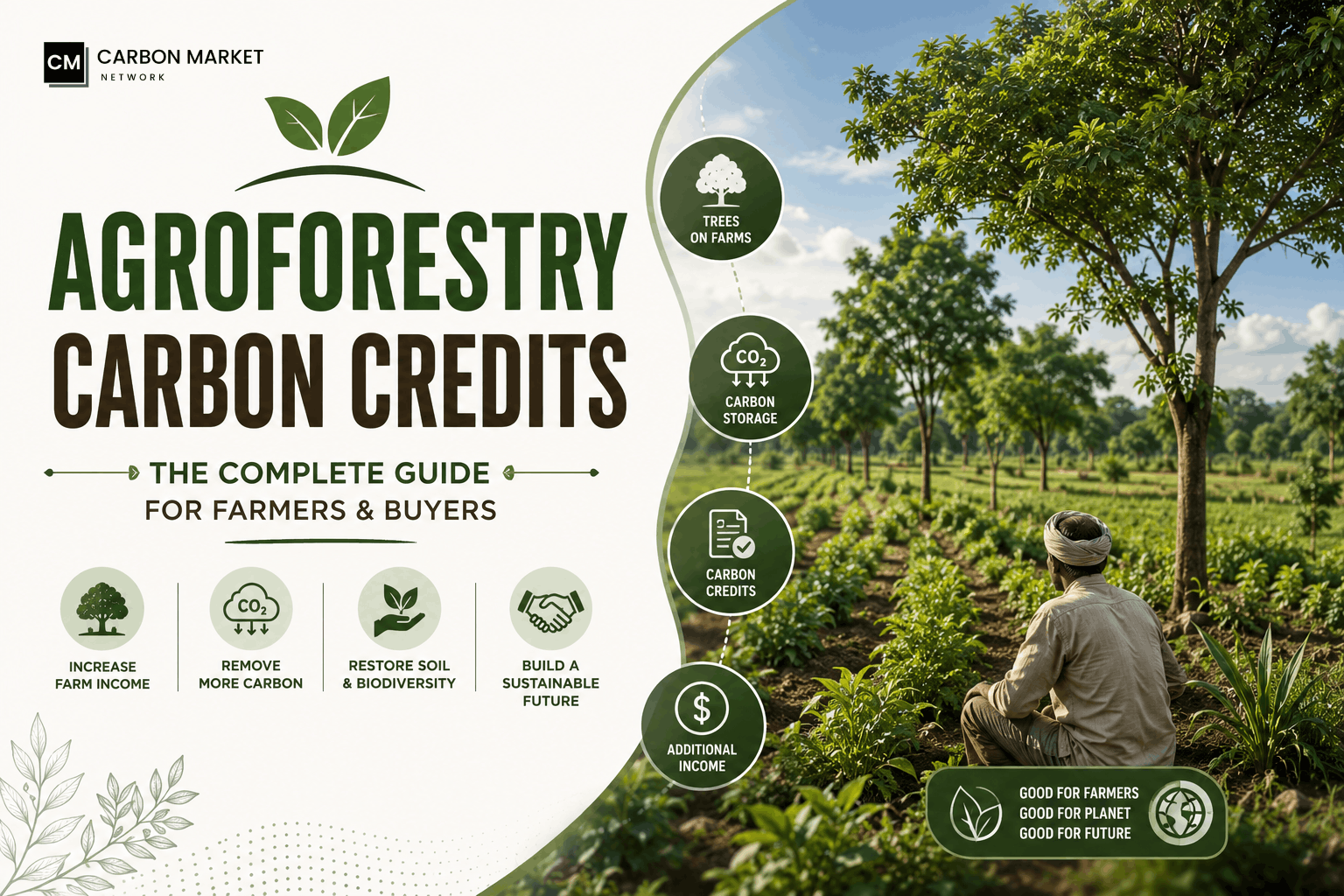
Trees and crops growing together on the same piece of land can now generate real income through carbon credits. That is the simple promise behind agroforestry carbon credits, and it is changing how farmers, landowners, and companies think about climate action.
If you have ever wondered how planting trees alongside crops or livestock can turn into a tradable financial asset, you are in the right place.
This guide breaks down everything you need to know about agroforestry carbon credits. It covers how they work, how they are measured, who can earn them, what they are worth, and how to get started, whether you are a smallholder farmer, a large landowner, or a company looking to buy high-quality credits.
Let’s dig in.
What Are Agroforestry Carbon Credits?
Agroforestry carbon credits are tradable units that represent carbon dioxide removed from the atmosphere or stored in the soil and biomass of an agroforestry system.
Agroforestry itself simply means growing trees, shrubs, or perennial plants together with crops or livestock on the same land. Think of coffee grown under shade trees, mango orchards mixed with vegetable rows, or cattle grazing under scattered trees.
When farmers adopt these practices, the trees and soil absorb and store carbon that would otherwise stay in the atmosphere as carbon dioxide. Independent certification bodies measure this stored carbon and issue one carbon credit for every tonne of CO2 equivalent captured or avoided.
Companies and individuals then buy these credits to offset their own emissions or to meet sustainability targets. The farmer or landowner earns revenue for the carbon their trees and soil have captured.
Carbon Market Insider Newsletter
Weekly insights on carbon markets, climate policy, carbon credits, and sustainability.
Why Agroforestry Matters for Climate Action
Agroforestry sits at a unique intersection of food production and carbon removal. Unlike a pure forestry project, it does not require taking farmland out of production.
Farmers keep growing food while trees quietly build carbon stocks in their trunks, roots, leaf litter, and the surrounding soil. This dual benefit makes agroforestry one of the more practical nature-based climate solutions available today.
Global climate bodies increasingly recognize agroforestry as a key tool for both emissions reduction and rural income generation, especially in regions where smallholder farming dominates the landscape.
How Do Agroforestry Carbon Credits Work?
Understanding the mechanics helps you see why this market is growing so quickly. Here is the basic process, step by step.
Step 1: A Farmer or Project Developer Designs the Project
A landowner, farmer cooperative, or project developer identifies land suitable for agroforestry. They design a planting and management plan that fits local conditions, such as tree species, spacing, and crop combinations.
Step 2: The Project Is Registered Under a Carbon Standard
The project gets registered with a recognized carbon credit standard. The most common ones for agroforestry include:
- Verra’s Verified Carbon Standard (VCS)
- Gold Standard
- Plan Vivo
Each standard has its own methodology, which is essentially a rulebook for how carbon storage should be measured, verified, and reported.
Step 3: Baseline Carbon Levels Are Measured
Before any trees go in the ground, project developers measure the existing carbon stock on the land. This baseline shows how much carbon the land holds without the agroforestry intervention.
Step 4: Trees and Perennial Crops Are Planted
Farmers plant the agreed tree and crop combinations. This might include fruit trees, nitrogen-fixing species, timber trees, or a mix designed for both income and carbon storage.
Step 5: Monitoring, Reporting, and Verification (MRV)
As trees grow, the project tracks carbon accumulation using field measurements, remote sensing, satellite imagery, and increasingly, AI-powered monitoring tools. This process is known as MRV, short for Monitoring, Reporting, and Verification.
An independent third-party auditor checks the data to confirm the numbers are accurate and not overstated.
Step 6: Credits Are Issued
Once verified, the standard issues carbon credits based on the tonnes of CO2 equivalent captured beyond the baseline. Each credit typically represents one tonne of CO2e.
Step 7: Credits Are Sold on the Voluntary Carbon Market
Companies, governments, or individuals purchase these credits to support climate targets. Revenue flows back to the project, and a share reaches the farmers who did the actual planting and land management work.
Types of Agroforestry Systems That Qualify for Carbon Credits
Not every tree-and-crop combination looks the same. Carbon credit programs generally recognize several distinct agroforestry models.
| Agroforestry System | Description | Common Examples |
|---|---|---|
| Alley cropping | Rows of trees planted between rows of crops | Maize between nitrogen-fixing tree rows |
| Silvopasture | Trees combined with grazing land for livestock | Cattle grazing under scattered shade trees |
| Homegardens | Multiple tree and plant species around a household | Fruit, timber, and vegetable mix near homes |
| Shaded perennial systems | Cash crops grown under a tree canopy | Shade-grown coffee or cacao |
| Boundary and scattered planting | Trees planted along field edges or windbreaks | Windbreak trees around farmland |
| Multi-strata agroforestry | Layered planting with trees of different heights | Tropical fruit and timber combinations |
Each system stores carbon differently, so project developers choose species and layouts based on local climate, soil, and farmer priorities.
Carbon Credit Standards and Methodologies for Agroforestry
Getting certified is not a one-size-fits-all process. Different standards use different methodologies, and choosing the right one matters.
Verra (Verified Carbon Standard)
Verra is the largest voluntary carbon standard globally. It offers several methodologies relevant to agroforestry, including frameworks for improved agricultural land management and afforestation, reforestation, and revegetation activities.
Verra (https://verra.org/) credits are widely traded and, when paired with recognized quality labels, are considered a strong signal of credibility for corporate buyers.
Gold Standard
Gold Standard places heavy emphasis on sustainable development co-benefits alongside carbon removal. Agroforestry projects certified here often highlight improvements in biodiversity, water quality, and community livelihoods, not just tonnes of CO2.
Plan Vivo
Plan Vivo was built specifically with smallholder farmers and community-based land use in mind. It is a popular choice for agroforestry and reforestation projects run by rural communities rather than large corporations.
Quality Labels to Look For
Buyers increasingly check for additional quality assurance layers on top of standard certification, such as ratings from independent carbon credit rating agencies and approval under the Core Carbon Principles framework maintained by the Integrity Council for the Voluntary Carbon Market. These labels help separate high-integrity credits from weaker ones.
How Carbon Is Measured in Agroforestry Projects
Accurate measurement is the backbone of any credible carbon credit. Agroforestry carbon accounting typically covers multiple carbon pools.
Key carbon pools measured include:
- Above-ground biomass – carbon stored in tree trunks, branches, and leaves
- Below-ground biomass – carbon stored in root systems
- Soil organic carbon – carbon stored in the soil itself, often the largest and slowest-changing pool
- Litter and deadwood – decomposing plant material on the ground
- Harvested wood products – carbon retained in wood removed from the system, where applicable
Project developers combine several measurement tools to track these pools accurately:
- Field sampling, where technicians physically measure tree diameter, height, and soil samples
- Remote sensing and satellite imagery, which tracks canopy cover and vegetation growth over large areas
- Allometric equations, mathematical formulas that estimate biomass from simple tree measurements
- AI-assisted monitoring tools, which are increasingly used to reduce measurement costs and improve accuracy over time
This combination of ground data and technology keeps monitoring costs manageable while maintaining scientific rigor.
Why Permanence and Additionality Matter
Two concepts sit at the heart of every credible agroforestry carbon project. Understanding them helps explain why some credits are trusted more than others.
Additionality
Additionality means the carbon storage would not have happened without the carbon finance. If a farmer was already planning to plant the same trees anyway, the project may fail this test.
Carbon standards require project developers to demonstrate that the revenue from credits is what made the agroforestry investment possible.
Permanence
Permanence refers to how long the stored carbon stays out of the atmosphere. Trees can be cut down, burned in wildfires, or lost to disease, which releases stored carbon back into the air.
To manage this risk, most standards require projects to:
- Commit to long-term monitoring periods, often twenty years or more
- Contribute a portion of issued credits into a buffer pool, a shared reserve of credits held back to cover losses from fire, disease, or other reversals
- Report any significant loss of tree cover so credits can be adjusted accordingly
A well-designed buffer pool system protects buyers from paying for carbon that later disappears, which strengthens trust in the entire market.
Who Can Earn Agroforestry Carbon Credits?
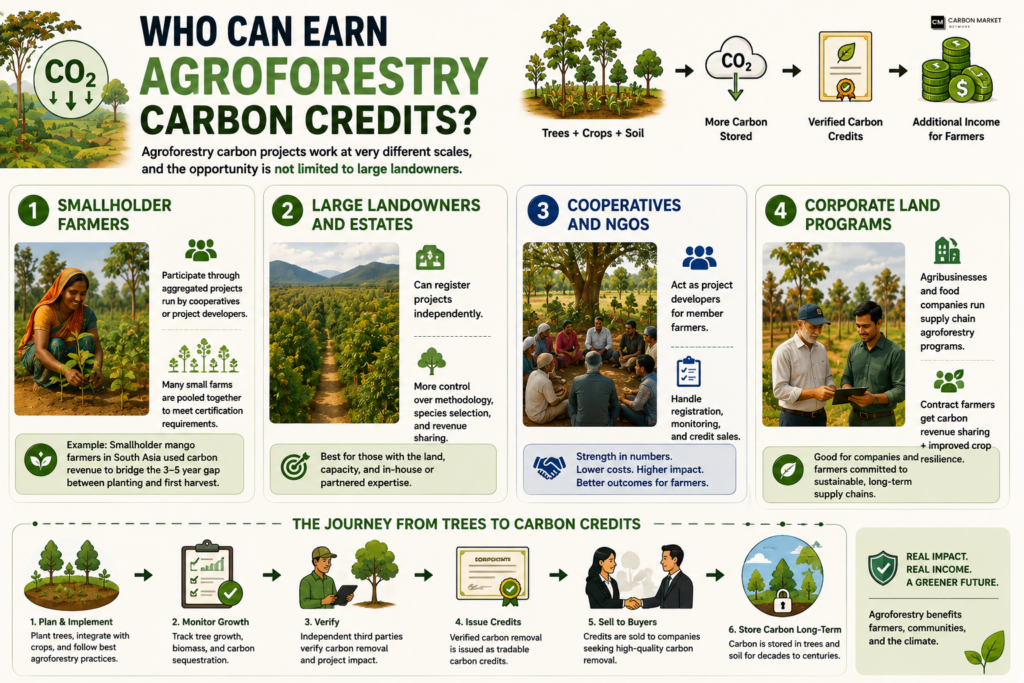
Agroforestry carbon projects work at very different scales, and the opportunity is not limited to large landowners.
Smallholder Farmers
Smallholder farmers, often working just a few acres, can participate through aggregated projects run by cooperatives or project developers. Individual farms are too small to certify alone, but pooling many farms together creates a project large enough to justify certification costs.
A recent example involved smallholder mango farmers in South Asia who joined a high-density agroforestry project. Carbon revenue helped bridge the multi-year gap between planting and their first fruit harvest, a period that traditionally discouraged farmers from investing in tree crops at all.
Large Landowners and Estates
Bigger landholders can register projects independently, giving them more control over methodology choice, species selection, and revenue sharing.
Cooperatives and NGOs
Farmer cooperatives and non-profit organizations frequently act as project developers, handling registration, monitoring, and credit sales on behalf of member farmers.
Corporate Land Programs
Some agribusinesses and food companies are now running their own supply chain agroforestry programs, encouraging contract farmers to adopt tree-based systems in exchange for carbon revenue sharing plus improved crop resilience.
Benefits of Agroforestry Carbon Credits
The appeal of agroforestry carbon credits goes far beyond the carbon itself.
For farmers and landowners:
- Additional income stream alongside regular crop or livestock sales
- Improved soil fertility and water retention from tree cover
- Greater resilience to drought, heat, and erratic rainfall
- Diversified income if one crop or market underperforms
- Access to technical support and better farming practices through project developers
For the environment:
- Increased biodiversity from mixed planting systems
- Reduced soil erosion and improved water cycling
- Habitat creation for pollinators and wildlife
- Long-term carbon storage in both biomass and soil
For carbon credit buyers:
- Access to nature-based credits with strong co-benefits
- Support for smallholder livelihoods, which appeals to ESG and sustainability reporting goals
- Diversification away from purely industrial removal credits
Challenges Facing Agroforestry Carbon Projects
No system is without its difficulties, and agroforestry carbon credits face a few real challenges worth understanding.
High Transaction Costs for Smallholders
Measuring, verifying, and monitoring carbon on thousands of small farms costs money. Aggregation models help, but transaction costs still eat into farmer revenue if not managed carefully.
Measurement Uncertainty
Soil carbon in particular can be difficult and expensive to measure precisely. Some methodologies use conservative estimates to account for this uncertainty, which can reduce the number of credits issued.
Permanence Risk
Trees face real risks from fire, pests, disease, and land-use change. A single bad wildfire season can wipe out years of carbon storage, which is exactly why buffer pools exist.
Price Volatility
Voluntary carbon market prices fluctuate based on demand, credit quality, and broader market sentiment. Agroforestry project revenue can vary year to year as a result.
Verification Delays
The path from planting trees to issuing credits can take several years, since carbon accumulation happens gradually and verification cycles take time to complete.
How Much Are Agroforestry Carbon Credits Worth?
Pricing in the voluntary carbon market varies widely depending on credit quality, co-benefits, certification standard, and buyer demand.
Factors that influence agroforestry credit prices:
- The certification standard used and whether it carries a recognized quality label
- The strength of co-benefits, such as biodiversity or community impact
- Project location and scale
- Independent ratings from carbon credit rating agencies
- Buyer type, since some corporate buyers pay a premium for verified, high-integrity nature-based credits
Rather than quoting a fixed number, it is more useful to understand that nature-based credits with strong co-benefits and recognized quality labels tend to command higher prices than generic, unverified offsets. Farmers and project developers should always check current market listings on established registries before setting expectations.
Step-by-Step: How to Start an Agroforestry Carbon Project
If you are a farmer, landowner, or organization considering this path, here is a practical roadmap.
- Assess your land. Determine whether your soil, climate, and existing land use support a viable agroforestry system.
- Choose the right tree and crop combination. Match species to local conditions and your income goals, balancing timber, fruit, and soil-improving trees.
- Select a carbon standard. Compare Verra, Gold Standard, and Plan Vivo based on your project scale and location.
- Partner with a project developer. Especially for smallholders, working with an experienced developer or aggregator dramatically simplifies registration and monitoring.
- Establish your baseline. Get existing carbon stocks measured before major planting begins.
- Plant and manage the system. Follow the agreed management plan closely, since deviations can affect verification outcomes.
- Support ongoing monitoring. Cooperate with field visits, data collection, and remote sensing checks.
- Get verified and receive credits. Once an independent auditor confirms your carbon storage, credits get issued to the project.
- Sell credits and receive revenue share. Credits move to buyers through the registry, and revenue flows back to participating farmers.
Real-World Examples of Agroforestry Carbon Projects
Real projects help illustrate how this all comes together on the ground.
Smallholder mango-based agroforestry in South Asia: A project combined high-density mango planting with carbon finance to help farmers manage the years-long wait before their first harvest. Carbon revenue supported hundreds of demonstration farms and channeled meaningful income directly to participating households.
Shade-grown coffee and cacao systems: Across several tropical regions, coffee and cacao farmers have integrated native shade trees into their plantations, earning carbon credits while also improving crop quality and reducing dependence on chemical inputs.
Large-scale restoration combined with agroforestry elements: Some major landscape restoration projects blend afforestation with agroforestry zones, allowing local communities to continue farming portions of restored land while still contributing to overall carbon removal targets.
These examples share a common thread: carbon finance makes tree-based farming systems financially viable years before the trees themselves generate their own income.
The Future of Agroforestry Carbon Credits
Several trends are shaping where this market goes next.
Stronger regulation and quality standards. Governments and international bodies are tightening rules around credit quality, additionality, and permanence, pushing the market toward higher integrity overall.
Better, cheaper monitoring technology. Advances in satellite imagery, remote sensing, and AI-based measurement are lowering the cost of verifying smallholder projects, which should open the door to more farmers participating.
Growing corporate demand for nature-based credits with co-benefits. Companies are increasingly seeking credits that combine carbon removal with measurable social and biodiversity benefits, a natural fit for agroforestry.
Expansion beyond traditional regions. While agroforestry carbon projects have concentrated in certain tropical and subtropical regions, the model is expanding into new geographies as methodologies mature and aggregation platforms improve.
Integration with compliance markets. As government-backed carbon certification frameworks develop alongside voluntary standards, agroforestry methodologies are increasingly being considered for inclusion, which could unlock new sources of demand.
Key Takeaways
- Agroforestry carbon credits reward farmers for growing trees alongside crops or livestock, turning carbon storage into income.
- Credits get issued after rigorous measurement, monitoring, and independent verification under standards like Verra, Gold Standard, or Plan Vivo.
- Additionality and permanence are the two pillars that determine whether a project is credible.
- Smallholder farmers typically participate through aggregated projects run by cooperatives or developers.
- Buyers should prioritize credits with strong co-benefits and recognized quality labels.
- The market is evolving quickly, with better monitoring technology and tightening quality standards shaping its future.
Frequently Asked Questions
What exactly is an agroforestry carbon credit?
It is a certified unit representing one tonne of CO2 equivalent captured or stored through tree-and-crop farming systems, verified by an independent carbon standard.
Can a small farmer earn carbon credits from agroforestry?
Yes, though usually through an aggregated project run by a cooperative, NGO, or project developer, since individual small farms are too small to certify on their own.
How long does it take to earn agroforestry carbon credits?
It varies by project, but farmers typically wait several years after planting before the first credits are verified and issued, since carbon needs time to accumulate and monitoring cycles take time to complete.
Which carbon standard is best for agroforestry projects?
There is no single best option. Verra suits large-scale projects seeking wide market recognition, Gold Standard emphasizes sustainable development co-benefits, and Plan Vivo focuses specifically on community and smallholder land use.
Do agroforestry carbon credits affect food production?
Not necessarily. Most agroforestry systems are designed to integrate trees alongside continued crop or livestock production rather than replacing it entirely.
What happens if the trees die or are cut down?
Standards address this risk through buffer pools, shared reserves of credits held back specifically to cover losses from fire, disease, or other reversals, protecting the integrity of already-sold credits.
Are agroforestry carbon credits a reliable long-term income source?
They can be a valuable supplementary income stream, but prices and demand fluctuate. Most experts recommend treating carbon revenue as one part of a diversified farm income strategy rather than the sole source of income.
Agroforestry carbon credits sit at a rare intersection where climate action, farmer income, and food security all move in the same direction. As monitoring technology improves and quality standards tighten, this market is only set to grow more robust and more accessible to farmers of every size.
Whether you are exploring how to start a project on your own land or looking to buy high-integrity credits for your sustainability goals, understanding the fundamentals covered here gives you a solid foundation to move forward with confidence.
For more insights on carbon markets, environmental finance, and sustainability mechanisms, explore the resources at Carbon Market Network.