Carbon Market Network



Picture this. A company buys carbon credits from a forest restoration project on the other side of the world.
Two years later, a wildfire rips through that exact forest. Most of the stored carbon goes straight back into the atmosphere.
Does the company’s purchase suddenly become worthless?
In a well-run carbon market, the answer is no. A mechanism called a buffer pool exists for exactly this reason.
This guide gets buffer pools explained in plain, practical language. You will learn what they are, how they actually work, how much projects contribute, and why they have become one of the most debated topics in carbon markets today.
By the end, you will be able to evaluate any carbon credit with far more confidence.
What Is a Buffer Pool in Carbon Markets?
A buffer pool is a shared reserve of carbon credits that a registry holds back from sale.
Instead of issuing every credit a project earns, the registry sets aside a percentage into a central, locked account.
Nobody can buy, sell, or trade these set-aside credits. They simply sit in reserve, waiting.
If a project later loses some of its stored carbon (through fire, disease, illegal logging, or another unplanned event), the registry cancels credits from this shared reserve to cover the loss.
This keeps the original buyers protected. Their purchased credits stay valid even though the underlying carbon disappeared.
The industry uses several different names for this same idea:
- Non-permanence buffer
- Pooled buffer account
- Risk buffer or buffer reserve
- Carbon credit insurance pool (informally, though true insurance works a bit differently, more on that later)
Whichever name you come across, the core function stays identical. A buffer pool acts as a built-in safety net for carbon credits.
Carbon Market Insider Newsletter
Weekly insights on carbon markets, climate policy, carbon credits, and sustainability.
Why Carbon Markets Need Buffer Pools in the First Place
The Permanence Problem with Nature-Based Carbon
Carbon dioxide stays in the atmosphere for centuries once released. Some of it lingers for over a thousand years.
A forest, by contrast, can lose its stored carbon in a single afternoon.
This mismatch creates what the industry calls the permanence problem. A carbon credit promises one ton of CO2 kept out of the atmosphere long term.
But biological carbon storage in trees, soil, and wetlands is far less stable than the fossil emissions it offsets.
Buffer pools exist to close that gap. They give forestry, soil carbon, and wetland restoration projects a credible way to make a long-term promise while operating inside an unpredictable natural system.
This is also why buffer pools matter most for nature-based projects specifically. Engineered carbon removal methods, like direct air capture paired with geological storage, and most straightforward emission reduction projects rarely need one.
What Actually Triggers a Reversal
When stored carbon escapes back into the atmosphere, the carbon market calls this event a reversal.
Reversals fall into two broad categories.
Natural and uncontrollable reversals typically include:
- Wildfires
- Drought-driven tree die-off
- Pest outbreaks and disease, such as bark beetle infestations or sudden oak death
- Storms, floods, and landslides
- Geological events
Human-caused or avoidable reversals typically include:
- Illegal logging
- Poor forest management practices
- Land conversion for farming or development
- Project bankruptcy or abandonment
This distinction matters enormously. Buffer pools generally cover only the first category, unavoidable natural losses.
When a developer mismanages a project and causes a reversal, they usually have to replace the lost credits themselves, not draw from the shared buffer pool.
How Buffer Pools Work: A Step by Step Breakdown
Here is the core mechanism, broken into simple steps.
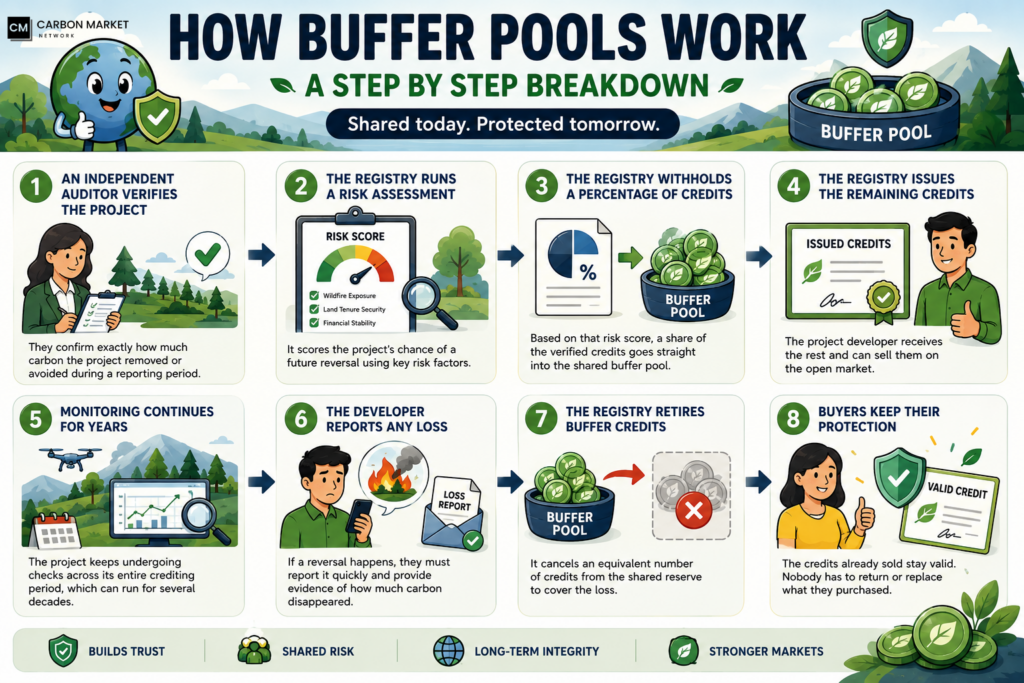
- An independent auditor verifies the project. They confirm exactly how much carbon the project removed or avoided during a reporting period.
- The registry runs a risk assessment. It scores the project’s chance of a future reversal using factors like wildfire exposure, land tenure security, and financial stability.
- The registry withholds a percentage of credits. Based on that risk score, a share of the verified credits goes straight into the shared buffer pool.
- The registry issues the remaining credits. The project developer receives the rest and can sell them on the open market.
- Monitoring continues for years. The project keeps undergoing checks across its entire crediting period, which can run for several decades.
- The developer reports any loss. If a reversal happens, they must report it quickly and provide evidence of how much carbon disappeared.
- The registry retires buffer credits. It cancels an equivalent number of credits from the shared reserve to cover the loss.
- Buyers keep their protection. The credits already sold stay valid. Nobody has to return or replace what they purchased.
Here is a simplified example to make this concrete.
A forestry project removes 1,000 tons of CO2 in one year. Its non-permanence risk score comes back at 15 percent.
That means 150 credits go into the buffer pool, and the project receives 850 credits to sell.
A storm later destroys carbon equal to 60 tons. The registry retires 60 credits from the buffer pool to cover it.
The 850 credits already sold to buyers stay completely intact.
How Much Do Projects Actually Contribute to the Buffer Pool?
Contribution rates are not arbitrary. Registries calculate them using a structured risk assessment, often called a non-permanence risk tool.
These tools generally score risk across three broad categories.
| Risk Category | What It Measures | Common Examples |
|---|---|---|
| Internal risk | How well the project itself is run | Financial viability, management experience, project longevity |
| External risk | Risk coming from outside the project boundary | Land tenure security, community relationships, political stability |
| Natural risk | Risk from the surrounding environment | Wildfire, pests, disease, drought, storms, and climate change impacts |
Each factor earns a score, and the registry adds them together into one overall risk rating. That rating becomes the percentage of credits the project must contribute to the buffer pool.
Lower risk projects contribute less. Higher risk projects contribute significantly more.
This design creates a built-in incentive. Developers who invest in fire breaks, secure land documentation, and strong community agreements can lower their risk score over time and keep a bigger share of their own credits.
Buffer Pools Across the Major Carbon Registries
Registries do not all handle buffer pools the same way. Here is how the major ones compare.
Verra and the VCS Program
Verra runs the largest voluntary carbon registry in the world through its Verified Carbon Standard (VCS) Program.
For agriculture, forestry, and other land use projects, commonly called AFOLU, Verra uses a tool called the AFOLU Non-Permanence Risk Tool, or NPRT.
Verra sets a minimum buffer contribution of roughly 10 percent, with the figure climbing for riskier projects based on the NPRT score.
Verra’s buffer pool is fully fungible. Credits contributed to cover one risk category, like wildfire, can cover losses from a completely different category, like disease, if needed.
Gold Standard
Gold Standard takes a simpler, flat-rate approach for land use and forestry projects.
It requires a fixed 20 percent contribution to a pooled compliance buffer, regardless of an individual project’s risk profile.
One feature stands out here. Gold Standard keeps its buffer credits locked up even after a project’s crediting period ends, adding a layer of long-term protection few other registries match.
American Carbon Registry and Climate Action Reserve
The American Carbon Registry (ACR) applies its own risk-based, non-permanence assessment, broadly similar in spirit to Verra’s tool.
ACR also offers an interesting flexibility. A developer can sometimes contribute buffer credits sourced from a different project they own, rather than only from the project generating the credits in question.
Climate Action Reserve (CAR) (website: https://climateactionreserve.org/) operates a buffer pool too, though independent market research has found that CAR projects disclose far less detail about their underlying risk assessments compared to other registries.
California’s Compliance Offset Program
California’s cap-and-trade program runs its own version, called the Forest Buffer Account, managed by the California Air Resources Board.
This sits inside a compliance market rather than a voluntary one, but the mechanics work almost identically.
Under the current forest protocol, projects contribute between roughly 8.7 and 19.2 percent of credited carbon, broken down by risk category.
| Risk Category | Contribution Range |
|---|---|
| Wildfire risk | 2 to 4 percent |
| Disease and insect risk | Fixed at 3 percent |
| Other catastrophic risk (wind, ice, flood) | Fixed at 3 percent |
| Financial and management risk | 1 to 9 percent |
Registry Comparison at a Glance
| Registry | Buffer Approach | Typical Contribution |
|---|---|---|
| Verra (VCS) | Risk based (NPRT) | Minimum around 10 percent, higher for riskier projects |
| Gold Standard | Fixed rate | 20 percent flat |
| American Carbon Registry | Risk based | Varies by project, flexible sourcing allowed |
| Climate Action Reserve | Risk based | Varies by project, limited public disclosure |
| California Compliance Program | Risk based, category specific | Roughly 8.7 to 19.2 percent |
A Real-World Example: What Happens When a Project Actually Burns
Wildfire is not a hypothetical risk for forest carbon projects. It is one of the single biggest threats to permanence, and it has already tested buffer pools under real conditions.
Researchers studying California’s forest offset program found something striking. Within less than a decade of the program running, two back-to-back severe wildfire seasons alone caused enough carbon loss to wipe out nearly all the credits the entire program had set aside for wildfire risk across its full 100-year commitment.
In other words, fire alone consumed roughly a century’s worth of planned protection in just a couple of unusually bad years.
This single case captures the core challenge with buffer pools better than any abstract explanation could. The mechanism performs exactly as designed when losses arrive at the pace the model expected. It struggles badly when reality moves faster than the model predicted.
Are Buffer Pools Actually Big Enough? The Growing Debate
This is where buffer pools get genuinely controversial, and both sides deserve a fair hearing.
The Wildfire Wake-Up Call
The wildfire finding above was not an isolated result. Independent researchers have repeatedly found that real-world losses outpaced the assumptions built into forest carbon risk models.
One peer-reviewed actuarial analysis concluded that a single disease event, separate from wildfire entirely, such as sudden oak death, could on its own consume the credits set aside to cover disease and insect risk for the next hundred years.
The researchers behind this work described California’s buffer pool as severely undercapitalized relative to the actual risks forests face.
Climate Change Is Rewriting the Risk Math
Registries originally built buffer pool contribution percentages using historical disturbance data. Climate change is now actively changing the frequency and severity of the very disturbances those percentages were designed around.
A separate peer-reviewed study compared buffer pool assumptions against validated forest biomass models. It found that current contribution levels do not match real disturbance trajectories, especially for older, more carbon-dense forests.
Newer research goes further still. One recent peer-reviewed analysis estimated that climate change could more than triple the long-term probability of wildfire-driven reversals across many forest regions, with smaller but still meaningful increases for drought and insect related losses.
Researchers keep reaching the same conclusion. Buffer pool sizing methods built on historical averages need fundamental updates to stay credible as the climate keeps shifting.
The Transparency Problem
A separate issue compounds the risk math problem. Not every registry, and not every project, discloses its buffer-related data clearly.
Independent market analysis has found that only a small fraction of large nature-based projects publicly disclose the non-permanence risk assessment behind their buffer contribution.
This makes it genuinely hard for buyers to judge how well protected their specific credits actually are, even when the underlying mechanism works fine in theory.
How Buffer Pools Are Evolving: Welcome to Buffer Pools 2.0
The encouraging news is that the market is actively responding to these criticisms. Buffer pools today already look noticeably different from how they looked just a few years ago.
Insurance Enters the Picture
A new wave of specialized carbon insurance providers has entered the market specifically to strengthen, or in some cases replace, traditional buffer pools.
Some carbon standards have already signed partnerships adding dedicated insurance coverage on top of an existing buffer pool, designed to step in if the buffer runs unusually low after a bad loss year.
Other insurers now underwrite individual projects directly, covering reversal and invalidation risk much like a property insurer covers fire damage on a building.
One specialist carbon insurance provider has started calling this combined approach Buffer Pools 2.0: a pooled credit reserve working alongside a regulated insurance backstop, rather than the reserve standing entirely on its own.
Newer carbon programs are building this hybrid approach in from day one, offering project developers a choice between contributing to a shared buffer pool or purchasing dedicated project insurance instead.
Even international aviation’s offsetting scheme has weighed in on this debate, with major registries pointing to buffer pools and insurance as two complementary ways to manage reversal risk for the credits airlines use.
Verra’s Newest Standard Rebuilds the Buffer Pool from the Ground Up
Verra recently rolled out its biggest overhaul of non-permanence rules in over a decade, widely referred to as version 5 of the VCS Program.
The update brings several major changes to how its buffer pool functions:
- Climate-adjusted risk scoring. A new climate impact factor pushes natural risk scores higher for projects facing climate-amplified hazards, like worsening wildfire seasons.
- Stricter eligibility. The registry can now reject projects facing too high a probability of catastrophic natural loss outright, rather than simply assigning them a bigger buffer contribution.
- Segregated pools. Buffer credits tied to carbon removals, like tree growth, now sit separate from credits tied to emission reductions, giving each pool a clearer purpose.
- A longer minimum commitment. Carbon sink projects must now commit to a longer minimum project lifespan, reportedly around 40 years, before they qualify at all.
- A fully digital risk tool. Developers now complete the non-permanence risk assessment through an online platform instead of a manual process, which should cut calculation errors.
- An insurance pilot pathway. For the first time, developers can use insurance, surety bonds, or a dedicated reserve fund as an alternative to the standard pooled buffer, with credits issued this way carrying a distinct label so buyers know exactly which protection backs their purchase.
That last point matters a great deal. It marks the first time a major registry has formally let project-level insurance substitute for the shared buffer pool, rather than just supplementing it.
Some projects with consistently strong risk scores can also reclaim a portion of their contributed buffer credits gradually over time under the new rules, rather than leaving every withheld credit locked away permanently. That gives developers an ongoing incentive to keep improving their project’s resilience long after it first launches.
Buffer Pools vs Carbon Credit Insurance: What’s the Difference?
People often use “buffer pool” and “insurance” interchangeably, but the two work quite differently.
| Feature | Buffer Pool | Carbon Credit Insurance |
|---|---|---|
| What it is | A shared reserve of carbon credits | A regulated financial contract |
| Who provides it | The carbon registry itself | A licensed insurance company |
| How it pays out | Cancels reserve credits to cover a loss | Pays a cash settlement or replacement credits |
| Regulation | Set by the registry’s own internal rules | Subject to insurance industry regulation |
| Cost to the project | A percentage of credits, withheld upfront | A premium, paid in cash |
| Flexibility | Fixed by the registry’s standard | Can be customized to the specific project |
Buyers increasingly see these two tools as complementary layers rather than competing alternatives. Many practitioners now treat them as parts of the same overall risk management strategy.
Pros and Cons of Buffer Pools
| Pros | Cons |
|---|---|
| Protects buyers automatically with no extra cost or claims process | Ties up a meaningful share of project revenue for decades |
| Spreads risk across an entire portfolio of projects | Can fail if losses arrive faster than the model assumed |
| Built directly into the registry’s existing infrastructure | Calculation methods are not always transparent |
| Requires no paperwork from buyers when a loss occurs | Generally does not cover avoidable, human-caused losses |
| Encourages developers to improve project resilience over time | Historically slow to adapt to rising climate change risk |
Practical Takeaways
If You Buy Carbon Credits
- Check whether the project discloses its non-permanence risk score and buffer contribution rate before you buy.
- Favor projects under registries that have recently updated their risk tools to reflect climate change impacts.
- Treat a buffer pool as risk reduction, not a guarantee. It lowers risk; it does not erase it.
- Ask whether the credits also carry insurance backing on top of the standard buffer pool.
If You Develop Carbon Projects
- Invest early in fire management plans, clear land tenure documentation, and strong community agreements. These directly lower your risk score and your buffer contribution.
- Keep detailed, consistent monitoring records, since strong data supports a lower risk rating at your next verification.
- Explore whether your registry now offers an insurance-based alternative to the standard buffer contribution, since this can free up more credits for sale.
- Treat your buffer contribution as a long-term investment in project credibility, not a cost to minimize at all costs.
If You’re Just Learning About Carbon Markets
- Remember that buffer pools solve only one piece of a much larger permanence puzzle, alongside additionality, leakage, and accurate baseline setting.
- A high buffer contribution is not automatically a bad sign. It often means the registry correctly flagged a genuinely higher-risk project.
- Pay close attention to which registry stands behind a credit, since buffer pool rules vary significantly between them, as this guide has shown.
Conclusion: Why Buffer Pools Matter More Than Ever
Buffer pools solve a genuinely hard problem. They let inherently unpredictable natural systems, like forests and wetlands, back a financial promise that needs to hold for decades.
For most of carbon market history, buffer pools quietly did their job in the background. Climate change has now pushed them into the spotlight.
Wildfires, droughts, and pest outbreaks keep arriving faster and harder than the historical data that originally shaped buffer pool sizing. That reality has forced registries to rebuild their risk models, tighten eligibility rules, and bring in outside insurance to share the load.
Understanding how buffer pools work, how much projects contribute, and where the real weak points sit puts you in a far stronger position. Whether you buy credits, develop projects, or simply want to understand how carbon markets manage risk, buffer pools deserve real attention.
That is buffer pools explained from every practical angle: simple enough for a first read, detailed enough to guide a real decision.
Frequently Asked Questions About Buffer Pools
What is a buffer pool in carbon credits?
A buffer pool is a shared reserve of carbon credits that a registry holds back from sale to cover unexpected carbon losses from any project in its program. It protects buyers if a reversal occurs at a project they purchased credits from.
How much do carbon projects contribute to a buffer pool?
Contribution rates vary by registry and individual project risk. They commonly start around 10 percent for lower risk projects and run well above 20 percent for higher risk ones, based on a structured risk assessment.
What happens when a buffer pool runs out of credits?
A fully depleted buffer pool can no longer absorb new losses on its own. This pushes registries to tighten future contribution requirements, update their risk models, or bring in supplemental protection like insurance.
Can buffer pool credits be bought or sold?
No. A buffer pool locks its credits away completely. Nobody can trade, sell, or use them. They exist purely as a reserve that the registry can cancel if a covered loss occurs.
Do all carbon credits have a buffer pool behind them?
No. Buffer pools mainly apply to nature-based projects, like forestry, agriculture, and wetland restoration, where reversal risk runs high. Engineered removal methods and most standard emission reduction projects typically do not need one.
What is the difference between a buffer pool and carbon credit insurance?
A buffer pool is a credit reserve managed directly by the registry. Carbon credit insurance is a separate, regulated financial product from an insurance company. Many projects now use both together for stronger protection.
Which carbon registries use buffer pools?
The major registries using buffer pools include Verra, Gold Standard, the American Carbon Registry, and Climate Action Reserve, along with compliance programs like California’s cap-and-trade system.
How long do buffer pool credits stay locked up?
This depends entirely on the registry. Some registries gradually release buffer credits if a project consistently performs well, while others, like Gold Standard, keep buffer credits locked even after a project’s official crediting period ends.
For more insights on carbon markets, environmental finance, and sustainability mechanisms, explore the resources at Carbon Market Network.