Carbon Market Network


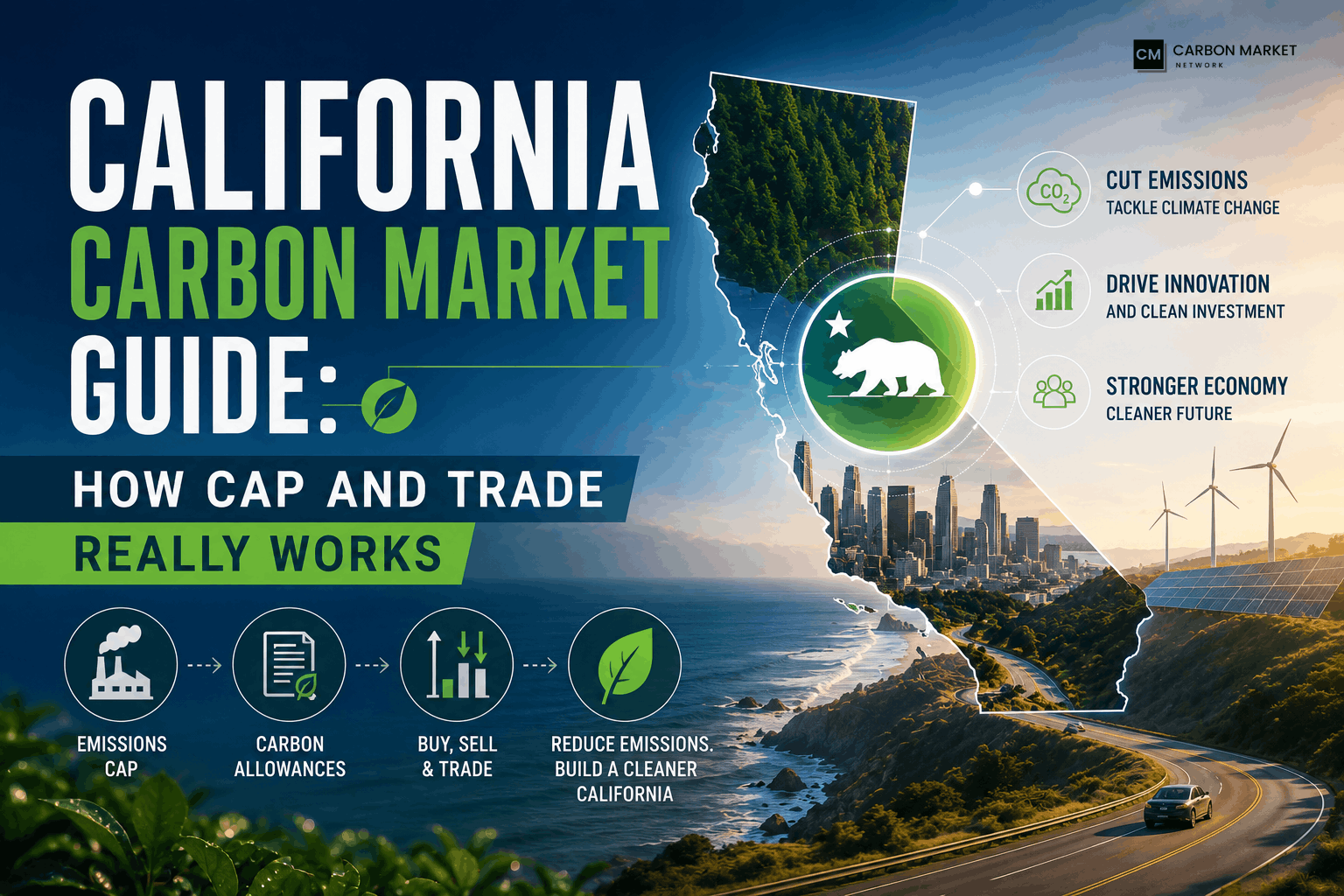
Every time you fill up your gas tank or open a utility bill in California, a carbon price is quietly baked into that number.
Most people never notice it. But behind the scenes, the California carbon market is one of the most powerful climate tools in the world, and it touches nearly every corner of the state’s economy.
If you have ever wondered how California puts a price on pollution, what California cap and trade actually means, or how California carbon credits work, this guide breaks it all down in plain language.
No jargon. No fluff. Just a clear, practical explanation of one of the largest carbon markets on the planet.
By the end, you will understand how the program works, who it affects, how prices move, and what it means for the future of climate policy in the United States.
What Is the California Carbon Market?
The California carbon market is a state-run system that puts a price on greenhouse gas emissions.
It works on a simple idea. If polluting costs money, companies have a financial reason to pollute less.
The state calls this system “cap and invest” today, though most people still know it by its original name, cap and trade.
Here is the basic logic behind it.
- The state sets a hard limit, or cap, on total emissions from major polluters.
- That cap shrinks a little every year.
- Companies covered by the program must hold enough allowances to match their actual emissions.
- Companies can buy, sell, or trade these allowances with each other.
This turns pollution into a limited resource with a real price tag. Businesses that cut emissions can sell their extra allowances. Businesses that pollute more have to pay for the privilege.
It sounds simple, but it is actually one of the most sophisticated environmental policy tools ever built at the state level.
Carbon Market Insider Newsletter
Weekly insights on carbon markets, climate policy, carbon credits, and sustainability.
A Quick History of California’s Carbon Market
Understanding where this program came from helps explain why it works the way it does today.
The origin story
California created the legal foundation for this market through a law often referred to by its bill number, which authorized the California Air Resources Board, known as CARB, to build a market based system for cutting statewide emissions.
CARB launched the actual trading program a few years later, making California the first state in the country to run an economy wide cap and trade system.
Linking with Quebec
Not long after launch, California linked its market with Quebec, Canada. This created a joint carbon market where allowances from both regions can be used for compliance in either jurisdiction.
This linkage matters because it pools liquidity, meaning more buyers and sellers, which generally makes the market more stable.
A later extension
A follow up law extended the program’s legal authority into the next decade and added new guardrails, including a price ceiling and a two tier cost containment reserve to prevent extreme price spikes.
The recent extension through 2045
The most significant update happened when California lawmakers passed new legislation extending the program all the way through 2045 and formally renaming it “Cap-and-Invest.”
This extension matters enormously. Before this law passed, the program’s legal authority was set to expire, creating uncertainty for every business, investor, and project developer relying on the market.
Now the program has a clear runway that stretches for two decades, giving companies and investors far more confidence to plan long term strategies around carbon costs.
How California Cap and Trade Actually Works
Let’s break the mechanics down step by step, because this is where most beginners get confused.
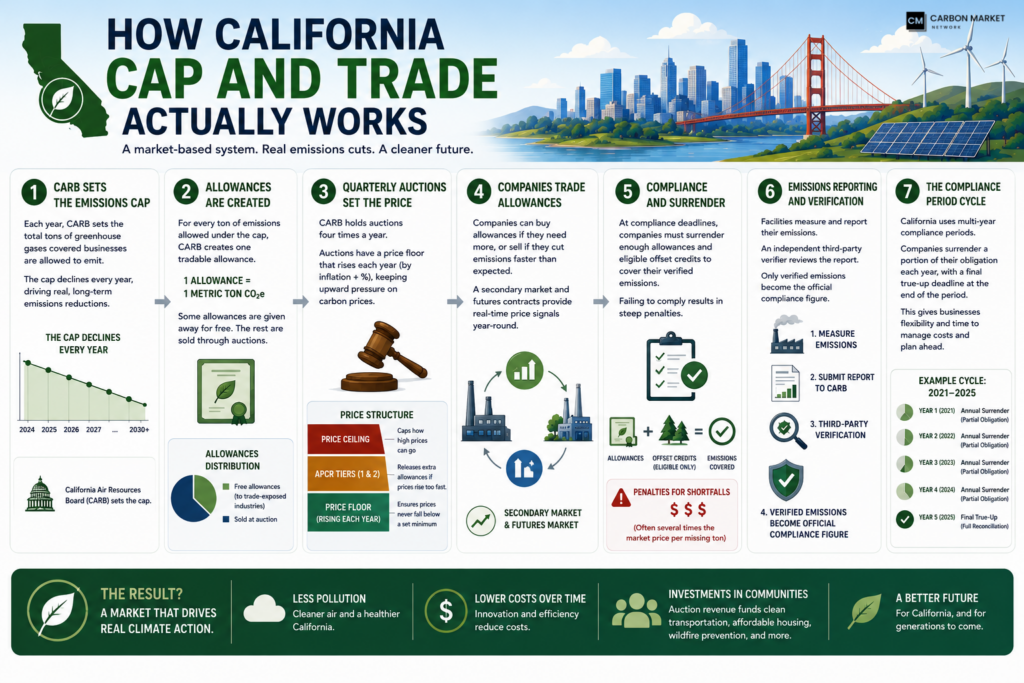
Step 1: CARB Sets the Emissions Cap
Each year, CARB decides exactly how many tons of greenhouse gases covered businesses are allowed to emit in total.
This total is called the cap, and it declines steadily every year. A shrinking cap is what actually drives long term emissions reductions, not just the existence of a market.
Step 2: Allowances Are Created
For every ton of emissions allowed under the cap, CARB creates one tradable allowance.
One allowance equals the right to emit one metric ton of carbon dioxide equivalent.
Some allowances are given away for free to industries at risk of relocating to states or countries with looser climate rules. The rest are sold through public auctions.
Step 3: Quarterly Auctions Set the Price
CARB holds auctions four times a year where companies bid for allowances.
These auctions include a price floor, meaning allowances can never sell below a set minimum. This floor rises every year by a set percentage plus inflation, which keeps steady upward pressure on carbon prices over time.
There is also a price ceiling, which caps how high prices can climb in extreme situations. Between the floor and ceiling sit two intermediate price tiers, known as the Allowance Price Containment Reserve, which release extra allowances if prices climb too fast.
Step 4: Companies Trade Allowances
Once companies own allowances, they do not have to just sit on them.
They can buy more if they need extra room to emit, or sell their surplus if they cut emissions faster than expected.
This secondary market, combined with futures contracts traded on commodity exchanges, gives the whole system real time price signals throughout the year.
Step 5: Compliance and Surrender
At set compliance deadlines, covered companies must turn in, or surrender, enough allowances and offset credits to cover their actual verified emissions.
If a company comes up short, it faces steep penalties, often several times the market price per missing ton.
Step 6: Emissions Reporting and Verification
Before any company can surrender allowances, it first has to prove exactly how much it actually emitted.
Covered facilities track their emissions throughout the year and submit detailed reports to CARB, typically covering fuel combustion, industrial processes, and any other regulated emissions sources on site.
An independent third party verifier then reviews these reports for accuracy. This verification step matters because the entire market depends on trustworthy numbers. If reported emissions were inflated or understated, the whole trading system would lose credibility fast.
Only after a report passes verification does it become the official emissions figure used to calculate that company’s compliance obligation for the year.
Step 7: The Compliance Period Cycle
California does not require companies to fully true up their accounts every single year. Instead, the program runs on multi year compliance periods.
Within each compliance period, companies must surrender a portion of their obligation annually, but they get a final true up deadline at the end of the full period to reconcile any remaining shortfall.
This structure gives businesses breathing room. A company having a rough year with higher than expected emissions can plan ahead and buy allowances over time, rather than scrambling to cover everything at once.
A Simple Real World Example
Imagine a mid sized cement manufacturer operating in California.
- The facility emits roughly 500,000 metric tons of carbon dioxide equivalent in a given year.
- CARB allocates a portion of free allowances to the facility because cement production is considered at risk of leakage, meaning production could otherwise shift to a state or country with looser rules.
- The remaining allowances the facility needs get purchased at quarterly auctions or through the secondary market.
- At year end, the facility’s emissions get verified by an independent auditor.
- The company then surrenders enough allowances, and a small percentage of eligible offset credits, to match its verified emissions total.
This example shows how the market translates an abstract policy goal, cutting emissions, into a concrete, auditable business process that finance and operations teams can actually plan around.
Who Is Covered Under the Program
Not every business in California answers to this system. The program specifically targets large emitters.
Covered entities generally include:
- Electric power plants and importers of electricity into the state
- Large industrial facilities, such as cement plants, refineries, and manufacturing sites
- Fuel distributors, including suppliers of gasoline and diesel
The threshold for coverage is typically facilities emitting more than 25,000 metric tons of carbon dioxide equivalent per year.
Together, covered sectors represent a large majority of the state’s total climate pollution, which is why this program has such an outsized impact despite touching a relatively small number of individual companies.
Understanding California Carbon Credits
People often mix up two very different things: allowances and offset credits. Understanding the difference matters if you want to actually understand California carbon credits.
Allowances
An allowance is issued directly by CARB and represents permission to emit one ton of greenhouse gas within the capped system.
Offset credits
An offset credit comes from a project outside the capped sectors that reduces or removes emissions elsewhere, such as a forestry project, a methane capture project, or a rice cultivation project that lowers methane output.
Companies can use a limited number of offset credits to meet part of their compliance obligation instead of surrendering allowances.
Under the current rules, offset usage is capped at 6 percent of a company’s total compliance obligation, and at least half of the offsets used must come from projects that deliver direct environmental benefits inside California.
A newer and important rule change places offsets “under the cap.” This means that whenever a company uses an offset credit for compliance, CARB removes an equivalent number of allowances from the following year’s allowance budget.
In simple terms, offsets no longer add extra room to the overall emissions total. They now count against the same shrinking pool of allowed pollution, which closes a loophole that critics had raised for years.
Types of Offset Projects
Common offset project categories include:
| Offset Project Type | What It Does |
|---|---|
| Forestry and reforestation | Captures carbon in growing trees and soil |
| Livestock methane capture | Reduces methane released from manure management |
| Ozone depleting substance destruction | Destroys refrigerants and industrial gases with high warming potential |
| Rice cultivation practices | Lowers methane emissions from flooded rice fields |
| Mine methane capture | Captures methane released during coal mining |
CARB is also required to update all of these offset protocols to reflect the best available science and to launch a task force focused on expanding nature based solutions, such as wetland restoration and soil carbon projects.
California Carbon Market Prices: What Drives Them
If you have looked into buying, trading, or simply following this market, you have probably noticed something interesting. Prices do not move in a straight line.
Several forces push and pull on the price of a California carbon allowance.
The price floor
Every auction has a minimum reserve price that rises annually by 5 percent plus inflation. This floor sets a hard bottom under the market.
The price ceiling
At the very top, a price ceiling limits extreme spikes. Between the floor and ceiling, two intermediate reserve tiers can release extra allowances if prices rise too quickly, smoothing out sudden shocks.
Supply and demand from the cap
As the annual cap shrinks, the available supply of allowances shrinks with it, which naturally pushes prices upward over the long run, assuming demand stays steady or grows.
Economic activity
When the economy slows down, industrial output and fuel consumption drop, which reduces demand for allowances and can push prices toward the floor.
Policy uncertainty
Prices often soften when investors are unsure about future rule changes, and they tend to firm up once regulators provide clarity. This happened noticeably around the recent rulemaking process tied to the program’s extension through 2045, where prices hovered near the floor for an extended stretch while the market waited for final regulatory details.
Regulatory changes on other fronts
Because transportation fuel suppliers make up a large share of allowance demand, anything that changes fuel consumption, such as vehicle efficiency standards or electric vehicle adoption rates, can meaningfully shift demand in the carbon market.
A Simple Way to Think About Pricing
Picture the carbon price as a barometer for two competing forces. On one side sits a steadily shrinking supply of allowances. On the other sits real world demand from companies that still need to burn fuel, run factories, and generate power.
When the market believes the cap will tighten faster than industries can adapt, prices rise. When the market believes there is more room to breathe, either through slower targets or economic softness, prices settle closer to the floor.
Cap and Invest: The Renamed and Extended Program
You may have started noticing the term “Cap-and-Invest” replacing “cap and trade” in recent news coverage. This is not a different program. It is the same market, rebranded and extended.
The rebrand reflects a shift in emphasis toward how auction revenue gets reinvested into communities, clean transportation, housing, and clean energy projects rather than simply describing the trading mechanism itself.
Key elements of the extended program include:
- Extension through 2045, aligning the program’s legal authority with the state’s broader net zero emissions target for that same year.
- A new offsets framework, placing offset usage under the overall emissions cap rather than on top of it.
- A dedicated climate fund structure, directing auction revenue toward clean transportation, housing, wildfire resilience, clean energy, and affordability programs.
- Ongoing cost protections for ratepayers, including free allowances for utilities specifically intended to shield household energy bills from sudden cost increases.
- A gradual shift of free allowances from natural gas utilities toward electric utilities, designed to support the state’s broader electrification goals.
This extension removed what many market participants had been calling the “2030 cliff,” a looming deadline where the program’s legal authority would have simply expired without new legislative action.
Where the Money Goes: The Greenhouse Gas Reduction Fund
Every dollar raised through allowance auctions, aside from fines and penalties, flows into a dedicated account called the Greenhouse Gas Reduction Fund.
This fund does not just sit there. State law directs it toward specific categories of investment, including:
- Clean transportation programs, including transit and rail projects
- Affordable housing located near public transit
- Clean and efficient energy upgrades for homes and businesses
- Wildfire prevention and forest resilience projects
- Agricultural programs that reduce emissions from farms
- Direct consumer relief, including the California Climate Credit that shows up as a line item reduction on many residential utility bills
This is the “invest” half of the renamed Cap-and-Invest program, and it is a major reason lawmakers chose that new name. The program is not just about restricting pollution. It actively recycles the money raised back into projects that lower emissions and support affordability.
How the California Carbon Market Affects Everyday People
You do not need to work in a factory or trade allowances to feel the effects of this program.
At the gas pump
Fuel suppliers are covered entities, so a portion of the carbon price gets built into the wholesale cost of gasoline and diesel, which can show up as a modest increase at the pump.
On your utility bill
Electric and gas utilities receive free allowances specifically to protect ratepayers, and many households see a twice yearly California Climate Credit that offsets part of their energy costs.
In local air quality
Because covered facilities include large industrial polluters, communities near these facilities can benefit from reduced local pollution alongside the broader climate benefit, although critics argue the program should do more to guarantee local air quality improvements in overburdened neighborhoods.
In state infrastructure
Auction revenue funds public transit, high speed rail development, affordable housing, and wildfire resilience work across the state, meaning residents benefit indirectly even if they never think about carbon markets at all.
California Cap and Trade vs Other Carbon Markets
California is not the only place running a market like this, and comparing it to others helps put the program in context.
| Feature | California Cap-and-Invest | European Union ETS | Regional Greenhouse Gas Initiative (RGGI) |
|---|---|---|---|
| Sectors covered | Power, industry, fuel suppliers | Power, industry, aviation | Power sector only |
| Geographic scope | California, linked with Quebec | 27 European Union member states plus partners | Eleven northeastern and mid Atlantic US states |
| Price floor | Yes, rises annually | No hard floor, market based reforms instead | Yes, rises annually |
| Price ceiling | Yes, with two intermediate reserve tiers | Market stability reserve mechanism | Cost containment reserve |
| Offset credits allowed | Yes, capped and now placed under the cap | Very limited | Not currently a major feature |
| Program authority | Extended through 2045 | Ongoing, tightened over time | State by state authorization |
California’s program stands out for covering a broader slice of the economy than RGGI, which only targets power plants, while sharing some structural similarities with the EU system, particularly around price stability tools.
How Different Industries Experience the Market
The California carbon market does not treat every sector the same way. Free allowance allocation, leakage risk, and compliance strategy all look different depending on the industry.
Electric Utilities
Electric utilities receive a significant share of free allowances specifically to protect residential ratepayers.
Utilities are required to sell, or consign, these free allowances into the auction on behalf of customers, and the proceeds get returned to households through the twice yearly California Climate Credit.
This structure lets utilities comply with the program without directly passing the full carbon cost onto customer bills.
Oil Refineries and Fuel Suppliers
Refineries and fuel suppliers face some of the largest compliance obligations in the entire program because transportation fuels represent a massive share of statewide emissions.
Because fuel suppliers must cover the tailpipe emissions associated with the fuel they sell, this sector tends to purchase the largest volume of allowances at each quarterly auction.
Some refineries have also announced plans to reduce or exit California production altogether, which illustrates how carbon costs interact with broader business decisions about where to operate, especially when combined with other state fuel regulations.
Cement, Steel, and Heavy Manufacturing
These industries typically receive free allowances tied to a leakage risk designation, since moving production out of state would not reduce global emissions, it would simply relocate them elsewhere.
Manufacturers in this category often focus compliance strategy on efficiency upgrades and fuel switching, since these changes directly reduce their exposure to rising allowance costs over time.
Agriculture and Forestry
While farms are generally not covered entities themselves, agriculture plays a major role on the offset side of the market.
Livestock methane capture projects and rice cultivation practice changes are two of the most common ways agricultural operations generate California carbon credits that covered companies can purchase for compliance.
Common Criticisms and Debates
No policy this large avoids controversy, and it helps to understand both sides of the conversation.
Concerns about local pollution
Because the program allows trading and offsets, critics argue that some facilities located in already burdened communities could theoretically maintain higher local emissions while buying allowances rather than reducing pollution directly at the source.
Concerns about offset quality
Offset credits have faced scrutiny over the years regarding additionality, meaning whether a project would have happened anyway without carbon credit funding, and permanence, meaning whether the carbon reduction actually lasts. This is part of why lawmakers pushed CARB to update offset protocols and study the program’s offset framework in depth.
Concerns about affordability
Because carbon costs eventually reach consumers through fuel and energy prices, affordability advocates have pushed hard for the program to include stronger consumer protections, which is part of why recent reforms expanded direct financial relief programs.
Concerns about price volatility
Because prices depend heavily on economic activity and regulatory clarity, businesses sometimes criticize the market for periods of price stagnation near the floor, arguing it signals weaker than expected demand for allowances relative to what regulators originally projected.
Support for the program’s track record
Supporters point to the program’s long operating history, its role in generating billions of dollars for clean energy and transportation investment, and its position as proof that a large, diverse economy can reduce emissions while continuing to grow.
Practical Takeaways for Businesses
If your company operates in a covered sector, or if you are simply trying to understand how this market might affect your industry, keep these practical points in mind.
- Track the annual cap adjustments. The declining cap directly affects how many allowances exist each year, which shapes long term price expectations.
- Watch auction results every quarter. Settlement prices, whether they land near the floor or push higher, offer a clear read on market sentiment.
- Understand your offset limits. If your compliance strategy relies on offset credits, remember the 6 percent cap and the requirement that half must deliver direct benefits inside California.
- Plan for rising floor prices. Because the reserve price increases every year by a fixed formula, long term cost planning should assume steadily rising minimum allowance prices.
- Stay alert to rulemaking updates. CARB continues to issue regulatory updates tied to the program’s extension, and these updates can shift allowance budgets, offset rules, and free allocation formulas.
Practical Takeaways for Everyday Consumers
You do not need to trade allowances to benefit from understanding this system.
- Check your utility bill twice a year for the California Climate Credit, which directly reflects auction revenue being returned to households.
- Understand that a portion of fuel prices reflects the carbon market, which helps explain some of the price differences between California and other states.
- Recognize that public transit, affordable housing, and wildfire resilience projects in your community may be partially funded through this program.
The Future of the California Carbon Market
With legal authority now extended through 2045, the program has entered a new, more stable era.
Expect the following themes to shape the market over the coming years.
A tighter long term cap
As California pushes toward its net zero target, expect continued conversations about accelerating the pace at which the annual cap shrinks, since a faster decline is the main lever for meeting stricter long term goals.
Deeper offset reform
CARB must study offset effectiveness, update every existing offset protocol to reflect current science, and expand opportunities for high quality, in-state offset projects, particularly nature based solutions like wetland restoration and improved forest management.
Possible new state linkages
California and Quebec have been in ongoing discussions with Washington State about linking Washington’s cap and invest program to the joint market, which would create an even larger, more liquid, three jurisdiction carbon market across North America.
Continued focus on affordability
Expect ongoing regulatory attention on keeping household energy costs manageable, including continued free allowance protections for utilities and dedicated climate credit payments for residents.
Growing investor interest
As the market matures with a clear regulatory runway through 2045, expect continued interest from institutional investors and funds that view California carbon allowances as a long term climate linked asset class.
Frequently Asked Questions
What is the California carbon market in simple terms?
It is a state program that limits total greenhouse gas emissions from major polluters and lets them buy, sell, and trade a limited number of pollution permits called allowances.
What is the difference between California cap and trade and Cap-and-Invest?
They refer to the same underlying program. Lawmakers renamed cap and trade to Cap-and-Invest as part of the recent extension through 2045, emphasizing how auction revenue gets reinvested into clean energy, transportation, and affordability programs.
How do California carbon credits work?
Offset credits come from projects outside the capped sectors, such as forestry or methane capture projects, that reduce or remove emissions. Companies can use a limited number of these credits, currently capped at 6 percent of their compliance obligation, to help meet their obligations instead of surrendering allowances.
Who has to participate in the California carbon market?
Large emitters covered by the program include power plants, major industrial facilities, and fuel suppliers, generally those emitting above 25,000 metric tons of carbon dioxide equivalent per year.
Does the California carbon market affect gas prices?
Yes, to a degree. Fuel suppliers are covered entities, and a portion of the carbon price gets reflected in wholesale fuel costs, which can show up as a modest increase at the pump.
Is California linked with any other carbon markets?
Yes. California has been linked with Quebec, Canada for many years, forming a joint market. Discussions are also underway about linking with Washington State’s program.
How long will the California carbon market run?
The program’s legal authority now extends through 2045, aligned with the state’s target of reaching net zero greenhouse gas emissions by that year.
What is the price floor and ceiling for California carbon allowances?
The market includes an auction reserve price, or floor, that rises annually by 5 percent plus inflation, along with a price ceiling and two intermediate cost containment tiers designed to prevent extreme price swings in either direction.
Final Thoughts
The California carbon market is far more than a niche policy experiment. It is a full scale economic system that touches gas prices, utility bills, industrial strategy, and billions of dollars in public investment every single year.
Understanding how California cap and trade works, how California carbon credits fit into the compliance picture, and how pricing mechanisms keep the whole system balanced gives you a real edge, whether you run a business, invest in climate assets, or simply want to understand the policy shaping your state.
With its authority now extended through 2045, tighter offset rules, and continued reinvestment through the Greenhouse Gas Reduction Fund, the California carbon market is positioned to remain one of the most influential climate policy tools in the country for decades to come.
If you want to keep learning about carbon markets, ESG strategy, and sustainability trends, explore more resources on Carbon Market Network.