Carbon Market Network


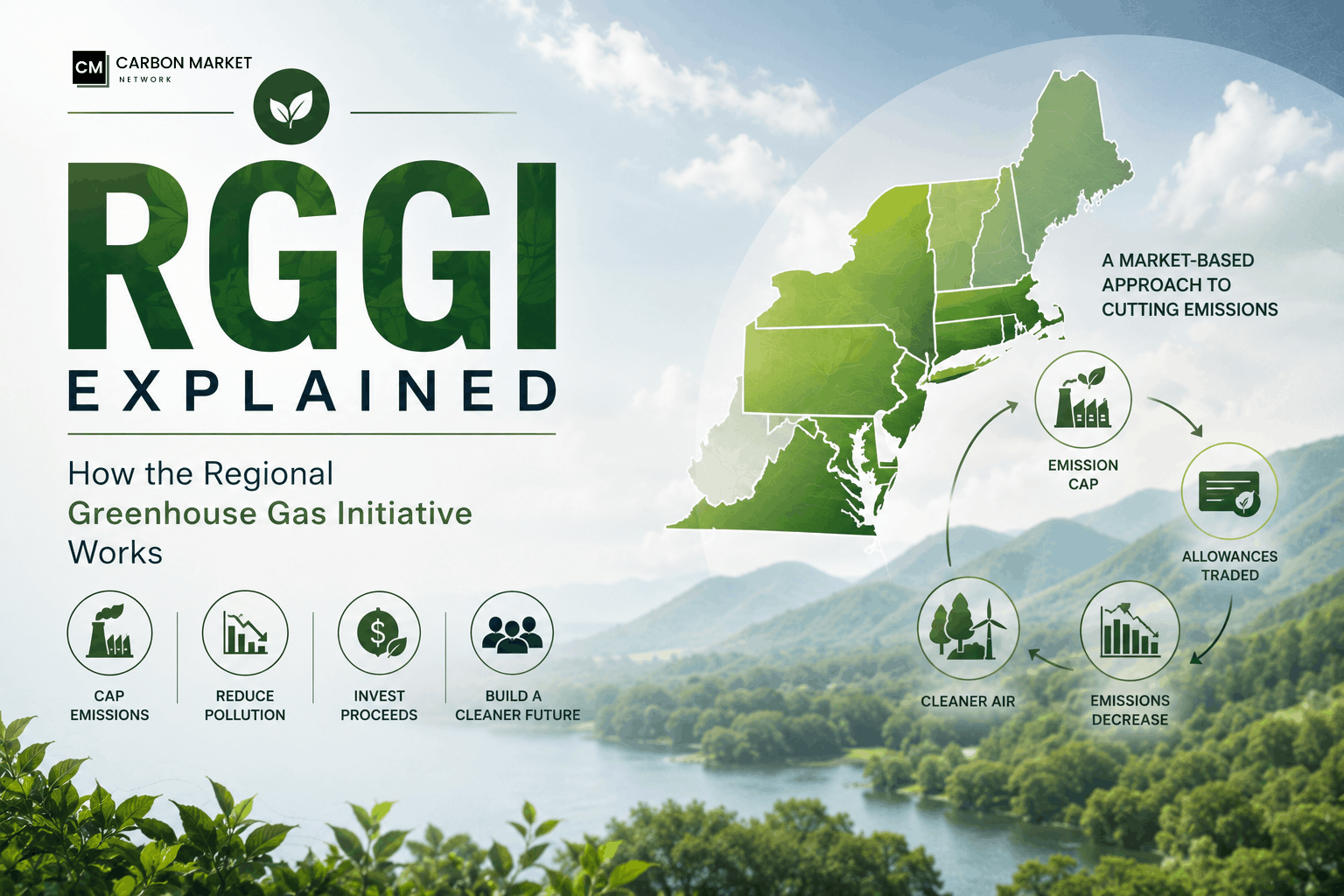
If you have ever seen the term RGGI in a news article about power plants, electricity bills, or state climate policy, you are not alone in wondering what it actually means.
RGGI stands for the Regional Greenhouse Gas Initiative, and it is one of the most talked about carbon markets in the United States.
It affects how power companies operate, how much you might pay for electricity, and how much carbon pollution enters the air you breathe.
This guide breaks down RGGI in plain English. No jargon overload, no confusing legal language, just a clear explanation of how it works and why it matters.
By the end, you will understand the mechanics of RGGI, which states participate, how the money gets used, and what critics and supporters say about it.
Let’s get started.
What Is RGGI?
RGGI (website), pronounced “Reggie,” is a cooperative effort among a group of Northeastern and Mid-Atlantic states in the US.
Its goal is simple: cap carbon dioxide emissions from power plants and let the market figure out the cheapest way to cut pollution.
It was the first mandatory, market-based program of its kind in the country, and it predates many of the carbon trading systems that other regions later built.
At its core, RGGI is a “cap-and-invest” program. That means two things happen at once.
- A hard limit, or cap, is placed on the total carbon dioxide that power plants in member states can emit.
- The money raised from selling pollution permits gets reinvested into clean energy, energy efficiency, and consumer programs.
This structure makes RGGI different from a simple carbon tax. Instead of just charging companies for pollution, it creates a real market where emission allowances can be bought, sold, and traded.
Carbon Market Insider Newsletter
Weekly insights on carbon markets, climate policy, carbon credits, and sustainability.
A Quick Look at How RGGI Started
RGGI began as an agreement among a handful of Northeastern governors who wanted to tackle power sector emissions without waiting for federal action.
The idea was straightforward. Group together several states with connected electricity grids, set one shared cap, and let power companies trade allowances across state lines.
This approach gave flexibility to businesses while still guaranteeing an overall drop in emissions across the region.
Since its first compliance period, RGGI has gone through multiple “program reviews,” which are periodic check-ins where member states tighten the rules, lower the cap, and adjust market features based on real-world results.
Today, RGGI operates in multi-year phases called control periods, and it continues to evolve through updated Model Rules that guide how each state writes its own regulations.
How Does RGGI Work?
Understanding RGGI gets much easier once you break it into its core building blocks. Here is the simple version.
The Emissions Cap
Every year, RGGI sets a regional cap, which is the maximum amount of carbon dioxide that covered power plants across all member states can legally emit.
This cap shrinks over time. Each year, the total number of allowances issued goes down, which forces the region’s power sector to become cleaner year after year.
Think of the cap like a slowly closing door. Power plants have to find ways to fit through it, whether that means switching fuels, improving efficiency, or investing in renewable energy.
Allowances and Auctions
For every ton of carbon dioxide a power plant emits, it must hold one “allowance.” An allowance is essentially a permission slip to emit one short ton of CO2.
States distribute the vast majority of these allowances through regional auctions, which happen four times a year.
Here is how a typical auction works:
- RGGI, Inc. announces the number of allowances available for that quarter.
- Power companies and other market participants submit sealed bids stating how much they are willing to pay per allowance.
- The auction clears at a single price, meaning every winning bidder pays the same amount per allowance, based on the lowest winning bid.
- Proceeds from the auction go to the state where the allowances originated.
- Companies can then use those allowances for compliance or trade them on the secondary market.
Because allowances are tradable, a business that finds cheap ways to cut emissions can sell its extra allowances to a company that needs more. This is what makes it a genuine market rather than a fixed fee.
Compliance Periods
Power plants do not need to true up their emissions every single day. Instead, RGGI groups years together into control periods, usually spanning three years.
At the end of each control period, every covered power plant must hold enough allowances to match its total emissions during that stretch.
This gives companies breathing room to plan ahead, bank extra allowances when prices are low, and manage compliance costs strategically.
Cost Containment and Emissions Containment Reserves
RGGI includes two safety valves designed to keep the market stable.
- Cost Containment Reserve (CCR): If auction prices climb above a set trigger price, RGGI releases a fixed pool of extra allowances into the market. This prevents prices from spiraling out of control during periods of high demand.
- Emissions Containment Reserve (ECR): If prices fall too low, meaning the market has more allowances than it needs, states can withhold a portion of allowances from auction. This keeps the program meaningful even when demand is soft.
These mechanisms act like guardrails, smoothing out extreme price swings in either direction while still letting supply and demand set the actual price.
Which States Are Part of RGGI?
RGGI membership has shifted over time as states join, leave, and in some cases rejoin after political and legal battles. Here is the current picture.
Current Member States
| State | Region |
|---|---|
| Connecticut | Northeast |
| Delaware | Mid-Atlantic |
| Maine | Northeast |
| Maryland | Mid-Atlantic |
| Massachusetts | Northeast |
| New Hampshire | Northeast |
| New Jersey | Mid-Atlantic |
| New York | Northeast |
| Rhode Island | Northeast |
| Vermont | Northeast |
| Virginia | Mid-Atlantic / South |
That brings the current total to eleven active member states, spanning a large chunk of the eastern power grid.
States That Left or Never Fully Joined
Two states illustrate just how politically contested RGGI can be.
Virginia joined RGGI a few years ago, becoming the first Southern state to take part in a regional carbon market. A change in state leadership later led to an executive push to pull Virginia out through a regulatory vote rather than a new law.
Courts eventually ruled that withdrawal unlawful, since only the state legislature has the authority to remove Virginia from a program that state law requires. After a lengthy legal fight and a change in governorship, Virginia formally rejoined RGGI.
Pennsylvania tells a different story. A past governor attempted to bring the state into RGGI through executive rulemaking rather than a vote in the legislature.
That move triggered years of litigation, with courts ultimately ruling that joining RGGI amounted to an illegal tax that only lawmakers could approve. Pennsylvania never completed a single auction as an active participant, and state lawmakers eventually repealed the regulation entirely as part of a budget deal, closing the door on participation for now.
These two examples highlight an important truth about RGGI. Because it functions like a tax or fee on emissions in the eyes of many courts, most states need full legislative approval, not just an executive order, to join or leave permanently.
Who Has to Follow RGGI Rules?
RGGI does not apply to every business or every source of pollution. It specifically targets the power sector.
The program covers fossil fuel fired power plants with a generating capacity of 25 megawatts or larger.
This includes:
- Coal fired power plants
- Natural gas power plants
- Oil fired power plants
- Certain combined heat and power facilities that sell electricity to the grid
Smaller plants, residential energy use, industrial facilities outside the power sector, and transportation emissions fall outside RGGI’s scope. Some other states have separate programs, like transportation-focused initiatives, that work alongside RGGI but operate independently.
This narrow focus is intentional. Power generation is one of the largest and most measurable sources of carbon dioxide, which makes it a practical starting point for a regional carbon market.
Where Does RGGI Auction Money Go?
This is one of the most important parts of RGGI, and one that often gets overlooked. Unlike a straightforward tax that disappears into a general fund, RGGI proceeds are almost always earmarked for specific programs.
Each participating state designs its own investment plan, but common categories include:
- Energy efficiency programs, which typically receive the largest share of funding. This includes home weatherization, appliance rebates, and building upgrades.
- Renewable energy development, supporting solar, wind, and other clean generation projects.
- Beneficial electrification, such as incentives for heat pumps and electric vehicle infrastructure.
- Direct bill assistance, which helps lower-income households manage energy costs.
- Greenhouse gas abatement and climate adaptation projects, including flood resilience and community climate planning.
States have collectively raised billions of dollars since the program began, and several states report meaningful energy bill savings tied directly to efficiency programs funded through RGGI proceeds.
Individual states also publish detailed dashboards showing exactly how auction revenue gets spent, which adds a layer of public accountability that a pure tax rarely offers.
RGGI Auction Prices: What They Actually Mean
Auction prices are the clearest signal of how tight or loose the carbon market feels at any given moment.
For years after the program launched, allowance prices sat below five dollars per ton. That changed significantly once states began tightening the cap through successive program reviews.
Here is a simplified look at how pricing behavior has shifted over the life of the program.
| Period | General Price Trend | Why |
|---|---|---|
| Early years | Under $5 per ton | Cap was set loosely relative to actual emissions |
| Mid program | Rising gradually | Tighter caps introduced through program reviews |
| Recent auctions | Around $20 to $35+ per ton | Shrinking cap, new state entries, and market uncertainty |
Several factors push prices up or down at any given auction:
- A shrinking cap naturally makes each remaining allowance more valuable.
- New states joining can add uncertainty, since the market has to absorb a new supply and demand balance.
- Fuel prices for natural gas and other inputs affect how much power plants actually emit.
- Weather and electricity demand, since hotter summers or colder winters change how much fossil generation gets used.
- Policy announcements, including news about states joining, leaving, or rewriting the Model Rule.
It is worth noting that allowances also trade on secondary markets outside of the quarterly auctions, through commodity exchanges. These secondary prices sometimes move ahead of the official auction results, especially when investors anticipate policy changes.
Real World Impact: Has RGGI Actually Cut Emissions?
This is the question everyone eventually asks. Does RGGI actually work, or is it just an added cost with no real environmental payoff?
The data leans strongly toward yes, with some nuance.
Power sector carbon dioxide emissions across RGGI member states have fallen by roughly half since the program’s early years, a decline that has consistently outpaced the national average for the broader US power sector.
This drop reflects a mix of factors, including the RGGI cap itself, a broader national shift away from coal, and falling costs for natural gas and renewables. RGGI supporters argue the program accelerated and locked in that transition, while critics argue market forces would have delivered similar results anyway.
One especially telling data point comes from Virginia’s back and forth membership. During the years Virginia actively participated in RGGI, its power sector emissions measurably declined. During the period it was pulled out, emissions in the state rose again. That real-world natural experiment gives useful evidence about the program’s direct effect, separate from broader national energy trends.
Beyond emissions, states also report tangible consumer benefits tied to RGGI-funded programs, including energy bill savings from efficiency upgrades and expanded access to weatherization services for lower income households.
RGGI Compared to Other Carbon Markets
RGGI is not the only carbon pricing program in the US or the world. Comparing it to others helps put its design choices in context.
| Program | Region | Sectors Covered | Style |
|---|---|---|---|
| RGGI | Northeast and Mid-Atlantic US | Power plants only | Cap-and-invest |
| California Cap-and-Trade | California | Power, industry, fuels | Broader economy-wide cap-and-trade |
| Western Climate Initiative | California and Quebec (linked market) | Power, industry, fuels | Linked cap-and-trade |
| EU Emissions Trading System | European Union | Power, industry, aviation | Cap-and-trade with free allocation in some sectors |
RGGI stands out for being narrowly focused on the power sector, which makes it simpler to administer but also limits how much total emissions reduction it alone can achieve.
Broader programs like California’s system or the EU system cover more industries, which can drive larger overall emissions cuts but also involve more complex rules and more political friction.
Arguments For and Against RGGI
Because RGGI touches electricity prices and state budgets, it remains a genuinely contested policy topic. A balanced explainer should present both sides fairly.
Arguments supporters make:
- The program has coincided with a significant, measurable drop in regional power sector emissions.
- Auction revenue funds visible, popular programs like home weatherization and bill assistance, rather than disappearing into general budgets.
- The market-based design lets businesses choose their own lowest-cost path to compliance, rather than dictating a single technology.
- Multiple independent program reviews have found little evidence of unfair market manipulation or collusion in the auctions.
- States retain flexibility to invest proceeds according to local priorities.
Arguments critics make:
- Higher allowance costs can get passed through to electricity ratepayers, raising bills for households and businesses.
- Regulatory uncertainty, especially during lawsuits over a state’s participation, can discourage new power plant investment and construction.
- Some critics argue courts have correctly identified RGGI’s design as functioning like a tax, meaning it should always require full legislative approval rather than executive action.
- Critics in some states argue that a state acting alone or in a small regional bloc has a limited effect on a genuinely global problem like climate change.
- Debate continues over how “surplus” allowances should be counted and whether the market is truly scarce enough to keep driving further reductions.
Reasonable people disagree on how to weigh these tradeoffs, and the ongoing political fights in states like Pennsylvania and Virginia show just how much this debate can shift with elections and court rulings.
What’s Next for RGGI?
RGGI is not a static program. Member states periodically renegotiate and update the Model Rule, which is the template each state uses to write its own regulations.
Recent program review discussions have focused on several themes:
- A steeper declining cap to keep pushing emissions down over the next multi-year phase of the program.
- Phasing out offset provisions, tightening the rules around how flexibility mechanisms can be used for compliance.
- Stronger market stability tools, refining how the CCR and ECR trigger prices adjust over time.
- Expanding or contracting membership, as individual states weigh the political and economic tradeoffs of joining, staying, or leaving.
Given the pattern of the last several years, expect continued back-and-forth as governors and legislatures change hands. RGGI’s structure gives states meaningful independence, which means membership can realistically shift again depending on future elections and court decisions.
How RGGI Affects Everyday Americans
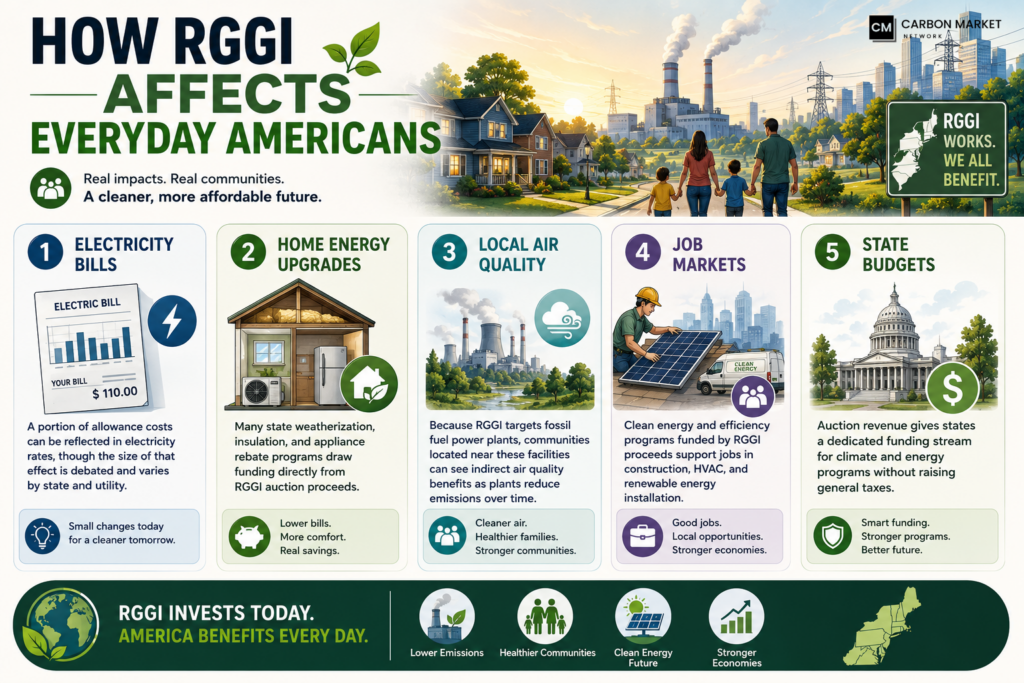
You do not need to work in the energy industry to feel the effects of RGGI. Here is how it can show up in daily life if you live in a member state.
- Electricity bills: A portion of allowance costs can be reflected in electricity rates, though the size of that effect is debated and varies by state and utility.
- Home energy upgrades: Many state weatherization, insulation, and appliance rebate programs draw funding directly from RGGI auction proceeds.
- Local air quality: Because RGGI targets fossil fuel power plants, communities located near these facilities can see indirect air quality benefits as plants reduce emissions over time.
- Job markets: Clean energy and efficiency programs funded by RGGI proceeds support jobs in construction, HVAC, and renewable energy installation.
- State budgets: Auction revenue gives states a dedicated funding stream for climate and energy programs without raising general taxes.
Actionable Takeaways
If you want to understand or even engage with RGGI as a resident, business owner, or policy watcher, keep these points in mind.
- RGGI covers power plants only, so it will not directly affect emissions from cars, factories, or home heating fuel choices unless your state layers on separate programs.
- Auction results are public. Anyone can check quarterly clearing prices and see exactly how much revenue their state earned.
- State investment plans are also public documents, so residents can see precisely how RGGI money gets spent in their area.
- Membership can change with elections, so following state-level races and legislative sessions is the best way to track where RGGI is headed next in any given state.
- Businesses operating power generation facilities near the 25 megawatt threshold should track program review updates closely, since rule changes can affect compliance costs.
Frequently Asked Questions
What does RGGI stand for?
RGGI stands for the Regional Greenhouse Gas Initiative, a cooperative cap-and-invest program among Northeastern and Mid-Atlantic states aimed at cutting carbon dioxide emissions from power plants.
Which states are currently in RGGI?
The current member states include Connecticut, Delaware, Maine, Maryland, Massachusetts, New Hampshire, New Jersey, New York, Rhode Island, Vermont, and Virginia.
Is Pennsylvania part of RGGI?
No. Pennsylvania attempted to join through executive rulemaking, faced years of litigation, and ultimately repealed its RGGI regulation, meaning it is not currently an active member.
Does RGGI raise electricity prices?
It can contribute modestly to electricity costs since power plants may factor allowance prices into their operating costs, though the actual impact on consumer bills varies by state, utility, and broader energy market conditions.
How often does RGGI hold auctions?
RGGI holds allowance auctions four times a year, once each quarter.
What happens to the money from RGGI auctions?
Each state decides how to spend its share of auction proceeds, typically directing funds toward energy efficiency programs, renewable energy projects, electrification incentives, and direct bill assistance for lower income households.
Is RGGI a carbon tax?
Not exactly. RGGI is a cap-and-trade or cap-and-invest program, meaning it sets a hard limit on emissions and lets the market determine allowance prices, rather than fixing a specific tax rate on each ton of carbon.
How does a company comply with RGGI?
Power plants covered under RGGI must hold one allowance for every ton of carbon dioxide they emit and must true up their total holdings against total emissions at the end of each multi-year control period.
Can RGGI allowances be traded?
Yes. Allowances can be bought and sold both at quarterly auctions and on secondary markets, giving companies flexibility in how and when they manage compliance costs.
Has RGGI actually reduced pollution?
Power sector emissions across RGGI member states have dropped substantially since the program began, outperforming the broader national trend, though the exact share of credit attributable to RGGI alone versus other market trends remains debated.
Final Thoughts
RGGI represents one of the most closely watched experiments in American climate policy. It shows what happens when a group of states decide to act together on carbon emissions, using market forces instead of rigid mandates.
The program has clearly coincided with major reductions in power sector pollution across its member states, alongside billions of dollars reinvested into energy efficiency and clean energy programs that benefit everyday households.
At the same time, RGGI remains politically contested, with real debates over cost, fairness, and whether regional action alone is enough to meaningfully address climate change.
Whether you view RGGI as a model worth expanding or a cautionary tale about regulatory overreach, understanding how it actually works is the first step to forming an informed opinion.
As more states weigh joining, leaving, or renegotiating their participation, RGGI will likely remain one of the most important case studies in how carbon markets function in the real world.
If you found this guide helpful, explore more deep dives into carbon markets, compliance programs, and climate policy on Carbon Market Network.