Carbon Market Network


You want to do the right thing for the planet. So you buy carbon credits. But what if those credits are doing nothing? What if you’re paying for a forest that was never under threat, a project that would have happened anyway, or a claim that looks good on paper but achieves zero climate benefit?
This is the reality of greenwashing in carbon markets, and it is far more common than most buyers realize.
Greenwashing in carbon credits is not just a PR problem. It delays real climate action, wastes money, and exposes buyers to serious legal and reputational risks. The good news is that you can avoid it if you know what to look for.
This guide walks you through everything you need to know: what greenwashing looks like in carbon markets, why it happens, how to spot it, and most importantly, how to buy carbon credits that actually work.
What Is Greenwashing in Carbon Credits?
Greenwashing happens when a company makes environmental claims that are misleading, exaggerated, or simply untrue.
In the carbon credit world, greenwashing occurs when a credit does not represent a real, additional, and permanent reduction or removal of greenhouse gases. The company claims a climate benefit that does not actually exist.
This can happen in two directions:
At the buyer level: A company buys cheap or low-quality credits to claim “carbon neutrality” without actually reducing its own emissions.
At the project level: A carbon project overstates its climate impact, issues more credits than the actual emissions reduced, or credits reductions that would have happened anyway.
Both forms are a problem. And both are disturbingly widespread.
Research by the Max Planck Institute found that 84% of carbon credits on the voluntary market carry high integrity risks. A separate analysis found that more than 68% of large DAX40 companies that purchased carbon credits ended up supporting projects with no real climate impact.
These are not fringe cases. They reflect a systemic challenge in a market that is growing faster than its quality controls.
Carbon Market Insider Newsletter
Weekly insights on carbon markets, climate policy, carbon credits, and sustainability.
Why Does Greenwashing in Carbon Markets Happen?
Understanding the root causes helps you protect yourself as a buyer.
Low barriers to entry. Anyone can sell carbon credits. Not all sellers operate under rigorous standards. Brokers sometimes prioritize volume and margins over credit quality.
Complexity. Carbon markets involve complex methodologies, scientific assumptions, and baseline projections. It is genuinely difficult for non-experts to evaluate quality.
Demand for cheap credits. Buyers often want the lowest price. Sellers respond by sourcing the cheapest credits, which are often the weakest.
Vague language. Claims like “carbon neutral” or “climate positive” have historically had no legal definition. This made it easy to make them without evidence.
Lack of transparency. Many projects do not publish enough data for buyers to independently verify claims.
The result is a market where, without careful due diligence, even well-intentioned buyers can end up with credits that do nothing for the climate.
The Most Common Types of Carbon Credit Greenwashing
Before you learn how to avoid greenwashing when buying carbon credits, you need to recognize what it actually looks like.
Buying Credits Instead of Reducing Emissions
This is the most widespread form of greenwashing in carbon markets.
A company continues to emit at the same rate, buys some credits, and then claims to be “carbon neutral.” No internal reductions happen. No operational changes are made.
The carbon market exists to support residual emissions that are genuinely hard to eliminate. It is not a license to keep polluting without consequence.
Several airlines, oil companies, and consumer goods brands have faced regulatory action and public backlash for using carbon credits as a substitute for real emissions reductions.
Non-Additional Credits
Additionality means that the emissions reductions funded by the carbon credit would not have happened without the carbon finance.
A project fails the additionality test if:
- The project would have been built or protected anyway for economic or regulatory reasons
- Government policy or subsidies already fund the activity
- The project was already underway before carbon finance was sought
Some renewable energy projects, particularly older wind and solar installations in regions where renewables were already economically viable, have been criticized for failing this test. The project would have happened with or without the credit revenue.
Over-Credited Projects
Some projects generate far more credits than the actual emissions they reduce or avoid.
This often happens in forest protection projects (known as REDD+) where the “baseline” scenario (how much forest would have been lost without the project) is exaggerated. By overstating the threat, developers can issue more credits than are justified.
Investigations have found that some forest protection projects issued credits for trees that were never at risk of being cut down.
Impermanent Carbon Storage
Some projects store carbon that can be released back into the atmosphere if conditions change.
Forest projects are particularly vulnerable. A wildfire, pest outbreak, illegal logging, or change in land ownership can release all the carbon stored over decades in just a few weeks.
If a carbon credit claims to store carbon permanently but the storage is not guaranteed over the long term, the climate benefit is questionable.
Double Counting
Double counting happens when the same carbon reduction is claimed by more than one party.
A company buys a credit. The host country also counts the same reduction toward its national climate target. Two claims are made for one tonne of CO2. One of them is not real.
This is a growing issue as more countries implement national carbon accounting under the Paris Agreement.
Vague and Misleading Claims
Some companies buy credits and then use sweeping language like “carbon neutral,” “net zero,” or “climate positive” without clarifying what the claim means, what the scope is, or how the credits were chosen.
A product labeled “carbon neutral” might only account for shipping emissions, not manufacturing. A company calling itself “net zero” might be offsetting only a fraction of its actual footprint.
Key Quality Standards Every Buyer Should Know
The first practical step to avoid greenwashing when buying carbon credits is understanding the certification landscape.
Verra (Verified Carbon Standard)
Verra operates the Verified Carbon Standard (VCS), the world’s most widely used greenhouse gas crediting program. It issues credits called Verified Carbon Units (VCUs), each representing one metric tonne of CO2 equivalent reduced or removed.
Every VCS project must be independently validated before credits are issued and verified at regular intervals afterward. All project data is publicly accessible on the Verra registry.
Verra has more than 2,000 registered projects across forestry, energy, agriculture, and industrial sectors.
What to watch for with Verra: The legacy VCS portfolio includes some older renewable energy projects with additionality concerns and cookstove projects that have been criticized for over-crediting. Focus on newer methodologies like VM0047 for reforestation and VM0048 for jurisdictional REDD+, which carry stronger integrity.
Gold Standard
Founded with support from the World Wildlife Fund, Gold Standard places a strong emphasis on co-benefits: social, environmental, and community impacts beyond just carbon.
Projects under Gold Standard must demonstrate alignment with the UN’s Sustainable Development Goals and undergo verification by accredited third parties. Gold Standard is particularly strong for community-based projects in developing countries.
It is a smaller registry than Verra but carries high credibility, especially for buyers who care about social impact alongside climate impact.
ICVCM Core Carbon Principles (CCPs)
The Integrity Council for the Voluntary Carbon Market (ICVCM) has established what is arguably the most important global quality benchmark in the carbon market: the Core Carbon Principles.
The CCPs cover ten fundamental requirements for a high-quality carbon credit:
| CCP Category | What It Requires |
|---|---|
| Effective governance | Transparent, accountable program management |
| Tracking | Unique registry system to prevent double counting |
| Transparency | Public disclosure of project information |
| Robust independent validation and verification | Third-party audits at key project stages |
| Additionality | Emissions reductions beyond what would happen anyway |
| Permanence | Long-term storage of carbon |
| Robust quantification | Conservative and accurate measurement |
| No double counting | Credit used by only one entity |
| Sustainable development | No social or environmental harm |
| Net atmospheric benefit | Overall positive impact on the climate |
Projects and methodologies that earn the CCP label have passed a rigorous eligibility assessment. Data shows that CCP-labelled projects consistently achieve higher independent quality ratings than non-CCP projects. In the latest data, 76% of CCP projects were rated BBB or above by independent analysts, compared to just 13% of non-CCP projects.
As a buyer, look for credits from CCP-Approved methodologies. This is currently the strongest signal of quality available in the voluntary carbon market.
Other Recognized Standards
| Standard | Focus Area | Key Strength |
|---|---|---|
| American Carbon Registry (ACR) | North American land use and forestry | Strong scientific methodology |
| Climate Action Reserve (CAR) | North American offset projects | Transparent protocols |
| Gold Standard for SDGs | Community and development projects | Strong social co-benefits |
| ART TREES | Jurisdictional REDD+ (country-scale) | National-level accounting integrity |
| Puro.earth | Carbon removal credits | Engineered and biomass-based removals |
The Five Core Principles of a High-Quality Carbon Credit
When you evaluate any carbon credit, these are the five non-negotiable criteria:
1. Additionality
The emissions reductions must be directly caused by the carbon finance.
The project would not have happened, or would not have been economically viable, without the revenue from selling credits.
How to check: Look at the project design document. Does it demonstrate why the project needs carbon finance? Does it pass the regulatory surplus test (the activity is not required by law)?
2. Permanence
The carbon storage must be long-lasting and protected.
A forest carbon project needs buffer pools (a reserve of credits set aside to cover unexpected losses like fires or disease). A project that relies on reversible biological storage with no protection mechanism carries high permanence risk.
How to check: Look for buffer pool disclosures and risk management plans. Projects registered under Verra have a pooled buffer account that absorbs permanence reversals.
3. Real and Measurable Impact
The emissions reductions must be based on actual measurements, not forecasts or projections.
Credits issued ex ante (before reductions occur, based on models) carry more risk than ex post credits (issued after the reductions are verified). Baseline assumptions must be conservative and transparent.
How to check: Ask whether the monitoring, reporting, and verification (MRV) system is robust. How frequently is the project verified? Who conducts the verification?
4. No Double Counting
The credit must be retired on behalf of one buyer and one buyer only.
How to check: Search the project’s serial number on the relevant registry (Verra, Gold Standard, ACR). Confirm the credit has a unique serial number and that retirement records are publicly accessible.
5. Independent Third-Party Verification
The project’s claims must be audited and confirmed by an accredited, independent verification body.
How to check: Look for the name of the Validation and Verification Body (VVB) in the project documents. Is the VVB accredited by the relevant standard? Is there a recent (not outdated) verification report available?
How to Avoid Greenwashing When Buying Carbon Credits: A Step-by-Step Guide
Here is a practical process you can follow.
Step 1: Reduce First, Then Offset
This is the most important rule in responsible carbon credit buying.
Carbon credits are not a replacement for reducing your own emissions. They are a complement to genuine decarbonization.
Before buying any credits, commit to a science-based emissions reduction plan across your Scope 1, 2, and 3 emissions. The Science Based Targets initiative (SBTi) provides a recognized framework for setting credible reduction targets.
Only after you have prioritized genuine reductions should you turn to credits to address residual emissions that cannot yet be eliminated.
The “reduce first, offset second” principle is not just best practice. It is increasingly a legal requirement. The EU’s Empowering Consumers for the Green Transition Directive, which came into force in September 2026, prohibits offset-based product claims like “carbon neutral” that are not grounded in actual lifecycle reductions.
Step 2: Choose Credits from Recognized Standards
Only buy credits certified by standards with public registries, robust verification requirements, and transparent methodologies.
Start with:
- Verra VCS (focus on CCP-Approved methodologies)
- Gold Standard
- American Carbon Registry
- Climate Action Reserve
Cross-check whether the specific methodology or project category you are buying from has received ICVCM CCP-Approval. This adds an important layer of quality assurance.
Step 3: Check the Project Registry Directly
Every legitimate carbon credit has a unique serial number and a publicly accessible project record.
To verify a Verra credit:
- Go to the Verra Registry at registry.verra.org
- Search by project name, project ID, or serial number
- Review the Project Description Document
- Check the most recent Monitoring Report and Verification Report
- Confirm the credit has been issued and, after purchase, is listed as “retired” in your name
Do the same with Gold Standard’s Impact Registry or whichever registry applies to your credits.
Never buy credits from a seller who cannot or will not provide a project ID and registry link.
Step 4: Evaluate Additionality and Baseline Assumptions
Open the Project Design Document and look specifically at the additionality argument.
Ask yourself:
- Why would this project not have happened without carbon finance?
- Is the baseline (what would have happened without the project) conservative and plausible?
- Has the project been independently validated on its additionality claim?
- Is the project in a region or sector where this type of activity is increasingly common or already economically viable?
For forestry projects, additional scrutiny is warranted. Some forest protection projects have used overstated deforestation threat scenarios to justify high credit volumes. Look for independent satellite monitoring data or third-party assessments that validate the baseline.
Step 5: Check Permanence and Buffer Pools
For any nature-based project (forest, wetland, soil carbon), understand how permanence is protected.
Key questions:
- Does the project contribute to a buffer pool?
- What is the project’s permanence rating?
- What happens if a wildfire or other reversal event occurs?
- Is the carbon storage legally protected (e.g., through a conservation easement or government land tenure)?
Engineered removal projects (biochar, direct air capture, enhanced weathering) generally offer longer permanence than biological storage. If your climate strategy requires durable, long-term removals, these categories may carry lower reversal risk.
Step 6: Avoid Common Red Flags
| Red Flag | What It Signals |
|---|---|
| Price is extremely low (under $3-5 per tonne) | Likely low-quality or non-additional credits |
| No project ID or registry link offered | Lack of transparency; unverifiable claims |
| “Carbon neutral” claim made without details | Likely greenwashing; ask for specific accounting |
| Credits from unrecognized or unregistered sources | No independent verification in place |
| Old verification reports (more than 2-3 years) | Project data may no longer reflect current conditions |
| No information on what happens in case of reversals | Permanence not adequately addressed |
| Seller cannot explain the methodology | Sign of insufficient due diligence on their end |
| Credits used to avoid internal reductions entirely | Misuse of offsets; not credible climate action |
Step 7: Use Independent Ratings and Quality Tools
Several independent organizations rate carbon credits without financial ties to project developers. These ratings add a critical layer of objectivity.
Sylvera provides independent carbon ratings that assess project quality, additionality risk, and permanence. Their data can help you quickly screen a portfolio of credits.
BeZero Carbon offers credit-level ratings with a scale similar to credit agency ratings. Data shows that higher-rated credits command significant price premiums in the market, which reflects real quality differences.
Senken’s Integrity Index is another tool that assesses projects against sustainability and integrity criteria.
These platforms are increasingly being used by institutional buyers, banks, and corporations to justify their carbon credit procurement decisions to auditors and regulators.
Step 8: Match Your Claims to Your Actions
Once you have purchased verified, high-quality credits, be careful about how you communicate their role.
What you can say:
- “We finance high-integrity carbon removal projects to address our residual emissions.”
- “We support X tonnes of verified emissions reductions annually, outside our direct value chain.”
- “We are working to reduce our emissions in line with science-based targets and supplement those efforts with verified carbon credits.”
What you should not say (without specific evidence and qualification):
- “Carbon neutral”
- “Net zero” (unless you have a validated, comprehensive strategy)
- “Climate positive”
- “Zero emissions”
These labels are now under intense legal scrutiny globally. Under the EU’s Empowering Consumers for the Green Transition Directive, making product-level “carbon neutral” claims based solely on carbon offsetting became a prohibited practice from September 2026.
Nature-Based vs. Technology-Based Carbon Credits: What to Know
Not all carbon credits carry the same risk profile. The type of project matters.
| Project Type | Examples | Strengths | Key Risks |
|---|---|---|---|
| Avoided deforestation (REDD+) | Forest protection in tropical regions | Large volumes, biodiversity co-benefits | Additionality and permanence risks; baseline inflation |
| Afforestation and reforestation | Planting trees on degraded land | Measurable, co-benefits for biodiversity | Long timelines; fire, drought, pest risks |
| Improved forest management | Reducing logging intensity | Protects existing forest carbon | Requires strong MRV and legal tenure |
| Soil carbon (agriculture) | Regenerative farming practices | Broad application across global farmland | Difficult to measure; impermanence |
| Cookstoves | Replacing open-fire cooking with efficient stoves | Social co-benefits, community health | Additionality and over-crediting concerns |
| Methane capture | Landfill gas, livestock methane reduction | High global warming potential impact | Must demonstrate additionality |
| Biochar | Applying charcoal-like material to soil | Long-term carbon storage (hundreds of years) | Scaling is still limited |
| Direct Air Capture (DAC) | Machine-based CO2 removal from atmosphere | Permanent, measurable, verifiable | High cost; limited current scale |
| Enhanced weathering | Spreading rock minerals to accelerate carbon drawdown | High permanence potential | MRV is still developing |
For buyers focused on avoiding greenwashing, technology-based removals like biochar and direct air capture offer the most measurable and permanent carbon storage, though at higher prices. Nature-based credits can be high quality when rigorously verified, but require more careful due diligence.
A portfolio approach combining both categories is often the most credible strategy.
The Role of Transparency in Avoiding Greenwashing
Transparency is not just a nice-to-have. It is the foundation of credible carbon credit use.
Every legitimate carbon project should publish:
- A detailed Project Design Document describing the methodology, location, and expected impact
- Baseline assumptions and how they were calculated
- Annual or periodic monitoring reports with actual measurement data
- Independent verification reports from accredited third parties
- Registry records showing credit issuance, transfer, and retirement
If a seller cannot point you to all of these documents, treat it as a serious warning sign.
Transparency also extends to your own communications. Buyers who are transparent about what they are offsetting, how they chose their credits, and what their broader decarbonization strategy looks like are far less vulnerable to greenwashing allegations than those who make sweeping claims without supporting evidence.
The Regulatory Landscape: What Buyers Need to Know
The rules around carbon credits and environmental claims are tightening globally. Buyers who ignore this do so at significant legal and financial risk.
European Union: The EU’s Empowering Consumers for the Green Transition Directive took effect in September 2026. It bans generic environmental claims like “carbon neutral” when these are based on offsetting rather than actual lifecycle reductions. Companies can still communicate their investment in carbon projects, but they cannot translate that investment into a blanket neutrality claim on their products.
EU Corporate Sustainability Reporting Directive (CSRD): Large companies subject to CSRD must report their climate strategies with specific, auditable data. Carbon credit use must be clearly disclosed, distinguished from actual emission reductions, and tied to a credible long-term reduction plan.
Germany: German courts have already been enforcing greenwashing rules ahead of EU-wide implementation. More than 90 successful court cases targeted misleading environmental claims, with particular focus on “climate neutral” advertising that relied on carbon offsets without adequate disclosure.
United States: The Federal Trade Commission’s Green Guides provide guidance on environmental marketing claims. The FTC has signaled increasing scrutiny of carbon offset-based claims.
Australia: The Australian Competition and Consumer Commission (ACCC) has actively pursued greenwashing enforcement across industries, including companies making carbon-related claims.
Global direction: Regulators worldwide are converging on the same principle: offsetting and reducing emissions are fundamentally different. Claims must reflect this distinction accurately.
How to Evaluate a Carbon Credit Seller or Broker
Your seller is as important as your credit. Here is what a trustworthy carbon credit seller looks like:
They are transparent about project details. They proactively share project documentation, registry links, and verification reports.
They explain methodology limitations. No carbon project is perfect. A credible seller explains the risks alongside the benefits.
They do not pressure you into cheap credits. A seller who pushes volume and low price without discussing quality is not acting in your climate interest.
They support your “reduce first” approach. Responsible sellers encourage buyers to reduce emissions first and use credits only for residual emissions.
They provide retirement documentation. After purchase, a credible seller provides a retirement certificate from the relevant registry with your organization’s name and the specific serial numbers of retired credits.
They stay up to date on standards. The ICVCM CCP framework, evolving Verra methodologies, and regulatory changes are moving fast. A good seller tracks these developments and adjusts their portfolio accordingly.
Building a Credible Carbon Credit Strategy
Buying individual credits without a broader strategy is not enough. Here is what a credible approach looks like.
Set science-based reduction targets. Work with the SBTi or an equivalent framework to establish near-term and long-term reduction targets for your Scope 1, 2, and 3 emissions.
Measure your actual footprint. You cannot offset what you have not measured. Conduct a comprehensive GHG inventory using GHG Protocol methodology and have it independently verified.
Prioritize internal reductions. Invest in energy efficiency, renewable energy, supply chain improvements, and operational changes before reaching for credits.
Use credits only for residual emissions. These are emissions you genuinely cannot yet eliminate given current technology and economics.
Buy high-quality credits. Apply the due diligence process described in this guide. Focus on CCP-Approved credits from recognized standards.
Diversify your portfolio. Do not rely on a single project type or geography. Spread risk across project categories and vintages.
Document everything. Keep records of every credit purchased: project ID, registry link, serial numbers, retirement certificates, and the methodology used.
Communicate with precision. Match your claims to your actual data. Avoid sweeping labels. Use specific, evidence-backed language.
Review and update annually. Carbon market standards evolve. Review your portfolio each year against current quality benchmarks.
Real-World Examples of Carbon Credit Greenwashing
Understanding what has gone wrong in the past helps you avoid the same mistakes.
Airlines and “carbon neutral” flights: Several major airlines have faced backlash and regulatory scrutiny for advertising flights as “carbon neutral” based on the purchase of avoidance credits, particularly older renewable energy credits with weak additionality. German courts ruled against Lufthansa over similar advertising. Regulators found that consumers had no way to verify the claims being made.
REDD+ baseline inflation: Investigations into some of the largest REDD+ projects found that the baseline deforestation rate used to issue credits was significantly overstated. The forests were not at the level of risk portrayed, meaning credits were issued for reductions that were not additional. These investigations led to a major reassessment of how forest protection credits are issued and verified.
Cookstove over-crediting: Some cookstove projects, particularly earlier-generation programs, were found to issue significantly more credits than the actual fuel savings achieved. Usage surveys found that stoves were not used as consistently as the models assumed. This highlighted the need for robust monitoring of actual behavioral outcomes.
Consumer goods “carbon neutral” products: Several consumer brands in Europe have faced legal action for labeling products as “carbon neutral” without adequate evidence. Some used cheap, unverified credits. Others failed to disclose that the claim covered only a portion of the product’s lifecycle emissions.
These cases share a common thread: a gap between what was claimed and what was real. Rigorous due diligence at the credit level, combined with accurate communication, prevents buyers from ending up in the same position.
A Quick Due Diligence Checklist for Carbon Credit Buyers
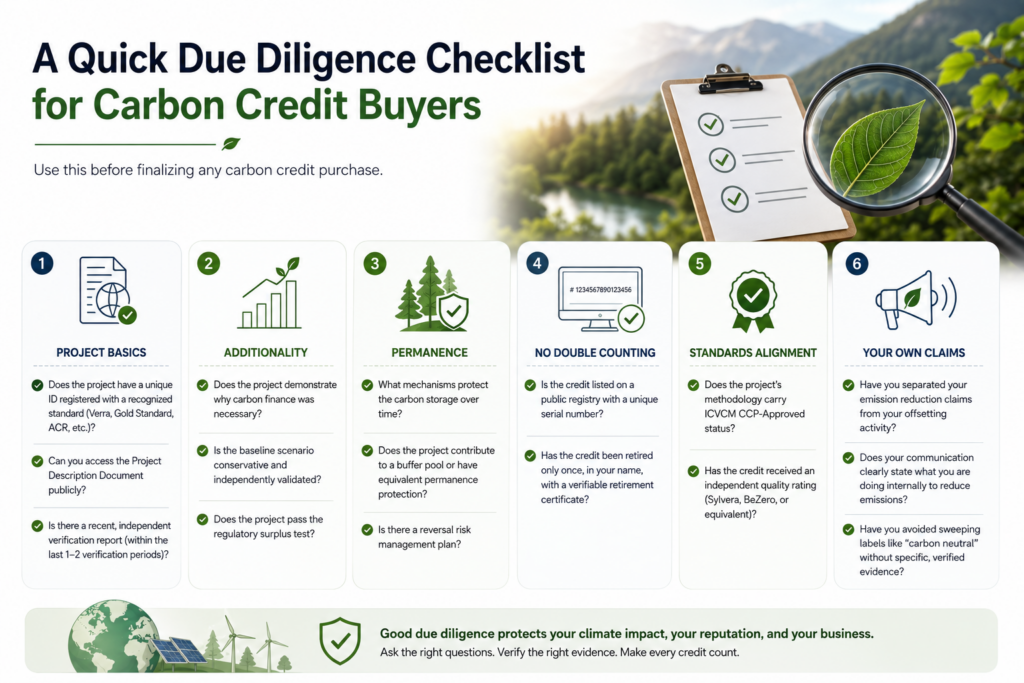
Use this before finalizing any carbon credit purchase.
Project basics:
- Does the project have a unique ID registered with a recognized standard (Verra, Gold Standard, ACR, etc.)?
- Can you access the Project Description Document publicly?
- Is there a recent, independent verification report (within the last 1-2 verification periods)?
Additionality:
- Does the project demonstrate why carbon finance was necessary?
- Is the baseline scenario conservative and independently validated?
- Does the project pass the regulatory surplus test?
Permanence:
- What mechanisms protect the carbon storage over time?
- Does the project contribute to a buffer pool or have equivalent permanence protection?
- Is there a reversal risk management plan?
No double counting:
- Is the credit listed on a public registry with a unique serial number?
- Has the credit been retired only once, in your name, with a verifiable retirement certificate?
Standards alignment:
- Does the project’s methodology carry ICVCM CCP-Approved status?
- Has the credit received an independent quality rating (Sylvera, BeZero, or equivalent)?
Your own claims:
- Have you separated your emission reduction claims from your offsetting activity?
- Does your communication clearly state what you are doing internally to reduce emissions?
- Have you avoided sweeping labels like “carbon neutral” without specific, verified evidence?
FAQ: How to Avoid Greenwashing When Buying Carbon Credits
What is the most common form of greenwashing in carbon markets?
The most common form is buying cheap or low-quality credits to claim “carbon neutrality” while doing little or nothing to reduce actual emissions. This substitutes offsetting for genuine decarbonization and is increasingly targeted by regulators.
How do I know if a carbon credit is legitimate?
A legitimate credit will have a unique serial number, be registered on a public registry (like Verra or Gold Standard), have a recent independent verification report, and be issued under a methodology that meets recognized quality standards. The ICVCM CCP label is currently the strongest global quality signal.
What does “additionality” mean, and why does it matter?
Additionality means the emissions reductions funded by the credit would not have happened without the carbon finance. Without additionality, you are paying for something that would have occurred anyway, which means no real climate benefit is achieved.
Are all certified carbon credits safe to buy?
Not all certifications are equal. A credit certified under a recognized standard like Verra VCS or Gold Standard is more trustworthy than one with no certification. But even within recognized standards, credit quality varies significantly by project type and vintage. Always look for CCP-Approved methodologies and independent ratings.
Can I make “carbon neutral” claims if I buy carbon credits?
This depends on your jurisdiction and the specific nature of your claim. In the EU, product-level “carbon neutral” claims based on offsetting are now prohibited under the Empowering Consumers for the Green Transition Directive (applicable from September 2026). In most markets, you can communicate your investment in carbon projects, but you should not make neutrality claims without verified lifecycle data and a credible internal reduction strategy.
What is the difference between avoidance credits and removal credits?
Avoidance credits represent emissions that were prevented from entering the atmosphere (e.g., protecting a forest that would otherwise be cut down). Removal credits represent carbon that has been actively removed from the atmosphere (e.g., through reforestation or direct air capture). Removal credits are generally considered more durable and increasingly preferred for high-integrity strategies.
How should I respond to a supplier offering very cheap carbon credits?
Treat it as a red flag. While price is not the only quality indicator, credits priced well below market rates often reflect weak additionality, poor verification, or outdated vintages. The voluntary carbon market increasingly rewards high-quality credits with price premiums. Cheap credits usually carry higher reputational, regulatory, and climate integrity risks.
What is double counting and how do I avoid it?
Double counting occurs when the same emission reduction is claimed by more than one party. To avoid it, always verify that credits are retired on your behalf with a unique serial number on a public registry, and confirm that the project developer has addressed potential overlap with host country national carbon accounting.
What resources can I use to independently rate carbon credits?
Sylvera, BeZero Carbon, and Senken’s Integrity Index are three independent rating services that assess carbon credit quality without financial ties to project developers. Their ratings can serve as a useful screening tool before purchase.
Conclusion
Avoiding greenwashing when buying carbon credits is not complicated. But it does require discipline, curiosity, and a willingness to ask hard questions.
The carbon market has real power to finance climate solutions. Forest protection, renewable energy transitions, carbon removal technologies, and community-level clean energy projects all benefit from well-directed carbon finance. But that power depends entirely on credit quality.
Every buyer who demands high-quality credits, asks for registry proof, insists on independent verification, and resists the temptation to make sweeping climate claims raises the bar for the whole market. Every buyer who cuts corners does the opposite.
The path to avoiding greenwashing when buying carbon credits comes down to four core habits: reduce first and offset second, buy only from recognized and independently verified sources, check the registry yourself, and match your claims to your actual data.
The climate crisis needs real solutions, not impressive-sounding labels. Make sure your carbon credits are part of the solution.
This article is published by Carbon Market Network, your global resource for carbon markets education and insight. Visit carbonmarketnetwork.com for more guides, tools, and resources on navigating the voluntary carbon market.