Carbon Market Network


You have an idea for a carbon reduction project in India. Maybe you want to install solar panels, plant mangroves, capture landfill gas, or produce green hydrogen. You have heard that you can earn carbon credits for it. But now you are asking the most important question: how do you actually get your project certified?
This guide answers that question in full. It walks you through every step of the carbon credit project certification process in India, covering both the government’s new Indian Carbon Market framework and international voluntary standards.
Whether you are a first-time project developer, a sustainability professional, or a business exploring this space, you will find everything you need right here.
India’s carbon market is no longer a future plan. It is live, operational, and growing fast. Getting your project certified correctly gives you access to a $50 billion opportunity that is only going to get bigger.
What Is Carbon Credit Project Certification and Why Does It Matter?
Before diving into the process, let us get clear on what certification actually means.
Carbon credit project certification is the official process by which a third party verifies that your project genuinely reduces, removes, or avoids greenhouse gas (GHG) emissions. Once verified, your project earns carbon credits. Each carbon credit represents one metric tonne of CO2 equivalent (tCO2e) reduced or removed from the atmosphere.
Certification matters for three key reasons:
- It makes your credits tradable. Without certification, no buyer will trust or pay for your credits.
- It prevents greenwashing. Certification proves your project delivers real, measurable climate benefits.
- It protects your investment. A certified project commands higher prices and attracts serious buyers.
In India, certified carbon credits are called Carbon Credit Certificates (CCCs) under the government’s Carbon Credit Trading Scheme (CCTS). On international voluntary markets, they are called Verified Carbon Units (VCUs) under Verra or Gold Standard Certified Emission Reductions (GS-CERs) under the Gold Standard.
Carbon Market Insider Newsletter
Weekly insights on carbon markets, climate policy, carbon credits, and sustainability.
Understanding India’s Carbon Market Framework in 2026
To understand certification in India, you first need to understand how the Indian Carbon Market (ICM) is structured. This is the big picture.
The Carbon Credit Trading Scheme (CCTS)
The Government of India launched the Carbon Credit Trading Scheme (CCTS) under the Energy Conservation (Amendment) Act 2022. The Ministry of Power notified the scheme in June 2023, with the offset mechanism framework added in December 2023.
The CCTS has two components that are directly relevant to project developers:
1. The Compliance Mechanism
This is for large industries in energy-intensive sectors. These entities receive legally binding GHG emission intensity targets. If they beat their targets, they earn CCCs. If they fall short, they must buy CCCs to comply.
As of 2025–2026, compliance obligations cover approximately 490 entities across seven sectors: aluminium, cement, chlor-alkali, pulp and paper, petroleum refining, petrochemicals, and textiles. The first compliance period runs from FY 2025–26, with FY 2023–24 as the baseline year.
2. The Offset Mechanism
This is the pathway for everyone else. Any entity that is not covered by the compliance mechanism can develop and register a carbon reduction project under the Offset Mechanism. If your project is approved, you earn CCCs that can be sold to compliance entities or other buyers.
This is the primary certification pathway for most project developers reading this guide.
Key Institutions You Need to Know
Understanding who does what in the Indian Carbon Market saves you a lot of confusion later.
| Institution | Role |
|---|---|
| Bureau of Energy Efficiency (BEE) | Administrator of the CCTS. Issues CCCs, approves methodologies, accredits verification agencies. |
| National Steering Committee for Indian Carbon Market (NSCICM) | Oversight body that recommends policy and approves project registrations. |
| Grid Controller of India Limited (GCIL) | Operates the ICM Registry where all CCCs are issued and tracked. |
| Central Electricity Regulatory Commission (CERC) | Regulates CCC trading on power exchanges and prevents fraud. |
| Accredited Carbon Verification Agency (ACVA) | BEE-accredited third-party agencies that validate and verify projects. |
| Indian Carbon Market (ICM) Portal | The central digital platform launched in March 2026 at the Prakriti 2026 conference. All registration and transactions happen here. |
The ICM Portal: Your Starting Point
In March 2026, Power Minister Manohar Lal Khattar officially launched the Indian Carbon Market Portal at the Prakriti 2026 International Conference on Carbon Markets in New Delhi. This portal is the single digital backbone of the entire Indian Carbon Market. It handles everything from entity registration to project submission to CCC issuance. Every project developer must work through this portal.
Two Certification Pathways for Indian Project Developers
You have two main routes to certify your carbon credit project in India:
Pathway 1: The CCTS Offset Mechanism (Indian Government Framework)
This is the domestic certification route administered by BEE. It issues CCCs that are tradable on India’s power exchanges. It is designed specifically for the Indian market and aligns with India’s national climate commitments.
Pathway 2: International Voluntary Standards (Verra, Gold Standard, etc.)
These are globally recognised standards. Projects certified under Verra or Gold Standard earn credits that can be sold to international buyers. Many Indian project developers use these standards because the buyer pool is larger and the price premiums can be significant.
You do not have to choose just one. Some developers pursue both, though you must be careful to avoid double-counting. If you register under CCTS and also use international standards, you need to ensure corresponding adjustments under Article 6 of the Paris Agreement.
Let us walk through each pathway in detail.
Pathway 1: Certifying Your Project Under India’s CCTS Offset Mechanism
This is a step-by-step breakdown of what you need to do to get your project certified under BEE’s Offset Mechanism.
Step 1: Check If Your Project Is Eligible
The first thing to do is confirm that your project qualifies under BEE‘s approved methodologies and sector framework.
Project start date requirement: Your project must have a start date no earlier than January 1, 2025. Projects that began before this date are not eligible under the CCTS Offset Mechanism.
Exclusivity requirement: Your project must not be double-counted under any other carbon market (except the Green Credit Programme, which has a specific arrangement).
Additionality requirement: Your project must go beyond business-as-usual. In other words, the emission reductions would not happen without the carbon finance. A project that would be economically viable without carbon credits may not meet this requirement.
Approved Sectors Under Phase 1:
Phase 1 of the Offset Mechanism covers six broad sectors:
- Energy (renewable energy, green hydrogen, energy efficiency)
- Industry (industrial processes and energy use)
- Agriculture (sustainable farming practices)
- Waste Handling and Disposal (landfill gas capture, biochar, biogas)
- Forestry (afforestation, reforestation, mangrove restoration)
- Transport (low-emission transport solutions)
Phase 2 will later expand to fugitive emissions, construction, solvent use, and carbon capture and utilisation (CCUS).
Approved Methodologies (as of May 2026):
BEE has approved nine methodologies so far. As of the Prakriti 2026 conference, over 40 entities have registered or submitted projects. The approved methodologies include:
- Renewable energy (including hydro and pumped storage)
- Renewable energy with storage
- Green hydrogen production via electrolysis
- Green hydrogen production via biomass
- Industrial energy efficiency
- Landfill methane recovery
- Mangrove afforestation and reforestation
- Offshore wind
- Compressed biogas
BEE has also approved 12 general-purpose tools and 5 forestry-specific tools to support methodology application.
If your project type is not covered by an existing methodology, you can apply to develop a new one, but this is a complex and expensive process. It is generally recommended for established organisations with significant technical capacity.
Step 2: Register as a Non-Obligated Entity on the ICM Portal
Before you can submit a project, you need to register yourself as a participant in the Indian Carbon Market.
BEE officially opened non-obligated entity registrations on June 6, 2025. Here is what you need to do:
- Go to the Indian Carbon Market Portal (icm.gov.in or the BEE-linked portal).
- Complete the entity registration form as a non-obligated entity.
- Submit your details and pay the registration fees as prescribed by CERC.
- Receive your Certificate of Registration from the ICM Registry (GCIL). This certificate is mandatory before you can trade or receive CCCs.
This is a one-time step. Once registered, you can submit multiple projects under the same entity account.
Step 3: Prepare Your Project Design Document (PDD)
The Project Design Document is the most critical document in the entire certification process. Think of it as your project’s full business plan for the carbon market.
Your PDD must cover all of the following:
Project Description
- What your project does, where it is located, and who is involved.
- The technology or intervention you are implementing.
Applicable Methodology
- Which BEE-approved methodology your project follows.
- Justification for why this methodology applies to your project.
Project Boundary
- The physical and organisational scope of your project.
- Which emission sources and sinks are included and excluded.
Baseline Scenario
- What would happen to emissions if your project did not exist.
- The reference point against which your reductions are measured.
Additionality Demonstration
- Evidence that your project is additional. This typically involves financial, regulatory, or common practice arguments.
Estimated Emission Reductions
- A calculation of how many tonnes of CO2e your project will reduce per year.
- This must follow the formulas and tools prescribed in your chosen methodology.
Monitoring Plan
- How you will track and measure your emission reductions over time.
- What data you will collect, at what frequency, and who is responsible.
Crediting Period
- How long your project will generate carbon credits.
- Crediting periods may be fixed or renewable. Renewable periods require reassessment at the end of each term.
Alignment with Sustainable Development Goals (SDGs)
- The Offset Mechanism requires you to identify which SDGs your project contributes to.
Stakeholder Consultation Summary
- Evidence that you have consulted local communities and relevant stakeholders before submitting.
Writing a high-quality PDD takes significant expertise. Most project developers work with experienced carbon project consultants at this stage. A poorly written PDD is the most common reason projects face delays or rejection.
Step 4: Engage an Accredited Carbon Verification Agency (ACVA) for Validation
Once your PDD is ready, you need to hire a BEE-accredited ACVA to conduct validation.
Validation is a forward-looking assessment. The ACVA reviews your PDD before your project starts generating credits. They check whether:
- Your methodology is correctly applied.
- Your baseline scenario is realistic.
- Your additionality claim is credible.
- Your monitoring plan is technically sound.
- Your project complies with all applicable BEE rules and national regulations.
How to find an ACVA:
BEE publishes an official list of accredited verification agencies on its website (beeindia.gov.in). The list is regularly updated. Look for agencies empanelled under CCTS for both compliance and offset mechanisms. BEE has been progressively expanding this list since late 2025, with Round 2 notifications issued in early 2026.
Important: You cannot use the same ACVA for both validation and the subsequent verification of your project. Different ACVAs must perform these two roles to maintain independence.
What happens during validation:
The ACVA will:
- Conduct a desk review of your PDD and supporting documents.
- Visit your project site (usually required for most project types).
- Interview your project team and review your monitoring systems.
- Issue a Validation Report confirming whether your project meets all requirements.
If the ACVA finds issues, they will raise Corrective Action Requests (CARs) or Clarification Requests (CLs). You need to address these before the validation can be completed.
Step 5: Submit Your Project to BEE for Registration
After successful validation, you submit your project to BEE for official registration. This submission goes through the ICM Portal and includes:
- Your completed PDD.
- The ACVA’s Validation Report.
- All supporting documents (site photos, legal agreements, financial models, etc.).
- Any applicable regulatory approvals or clearances.
BEE’s review process:
A Technical Committee under BEE reviews project submissions on a monthly basis. The review process includes:
- Completeness check: BEE verifies that all required documents are present. This takes up to 10 working days.
- Technical review: Experts assess the project’s methodology application, baseline, and monitoring plan. This takes 30 days or more.
- Clarifications: The Technical Committee may ask for additional information. You must respond within the specified timeframe.
- NSCICM recommendation: The National Steering Committee reviews the Technical Committee’s findings and recommends approval or rejection.
- Registration: Approved projects are officially listed as “ICM Offset Projects” on the ICM Portal.
Once registered, your project is live and you can begin implementing and monitoring your emission reduction activities.
Step 6: Implement Your Project and Monitor Emissions
With your project registered, the real work begins. You must now implement the project activities exactly as described in your PDD and follow your monitoring plan rigorously.
Your monitoring obligations include:
- Collecting all required data at the specified frequency (monthly, quarterly, or annually depending on the methodology).
- Maintaining detailed records that can be audited at any time.
- Reporting any significant deviations from your PDD to BEE.
- Keeping records of all equipment, measurements, and calculations used.
Good monitoring practices:
- Use calibrated measurement equipment. Uncalibrated meters are a common source of verification failures.
- Keep digital records with timestamps and backup copies.
- Train your site team on the monitoring requirements.
- Do not wait until verification time to compile your data. Keep it updated continuously.
The crediting period for your project typically runs for a fixed number of years. BEE and the methodology you have chosen determine the exact length. Renewable crediting periods require fresh validation before renewal.
Step 7: Undergo Verification by a Separate ACVA
At the end of each monitoring period (usually annually), you need to hire a different ACVA (not the one that validated your project) to conduct verification.
Verification is a backward-looking process. The ACVA reviews your actual monitoring data to confirm that the emission reductions you are claiming are real, accurately measured, and consistent with your approved PDD.
The verification process:
- The ACVA reviews all your monitoring data, calculations, and records.
- They conduct a site visit to physically verify your project activities.
- They check for any deviations from your approved monitoring plan.
- They issue a Verification Report with the number of tonnes of CO2e verified.
If the verification is successful, the ACVA submits a CCC issuance request to BEE through the ICM Portal.
Step 8: Receive Your Carbon Credit Certificates (CCCs)
After verification, BEE conducts a final review:
- Completeness check: 10 working days.
- Technical and expert review: 30+ days.
- NSCICM recommendation for issuance.
- CCC issuance: BEE credits the CCCs to your project owner account on the ICM Registry.
Each CCC represents 1 tonne of CO2e verified reduced or removed. Once issued, your CCCs are:
- Active: Available for trading.
- Retired: Permanently removed from circulation when used for offsetting (cannot be reused).
- Cancelled: Removed for other administrative reasons.
Step 9: Trade Your Carbon Credit Certificates
Once you have CCCs in your account, you can sell them. Trading currently takes place on India’s power exchanges under CERC supervision. Over-the-counter trading is not permitted initially; all transactions go through the official exchange platform.
As of mid-2026, full CCC trading operations are expected to officially commence, with the first batch of credits from FY 2025–26 flowing through the market by October 2026.
Current price ranges (May 2026):
- Voluntary market: Approximately INR 200 to INR 400 per tonne (USD 2 to USD 5).
- Compliance market (from 2026): Expected to rise to INR 800 to INR 1,200 per tonne (USD 10 to USD 15).
- High-quality nature-based projects: INR 1,200 to INR 2,000 per tonne (USD 15 to USD 25).
Pathway 2: Certifying Your Project Under International Voluntary Standards
Many Indian project developers also pursue certification under international standards like Verra (the Verified Carbon Standard, or VCS) and the Gold Standard. This gives access to global buyers and can fetch premium prices.
Verra (Verified Carbon Standard)
Verra is the world’s most widely used carbon credit standard. It issues Verified Carbon Units (VCUs). Each VCU equals 1 tonne of CO2e.
Key features of Verra:
- Largest global registry with thousands of registered projects.
- Covers a wide range of project types including forestry (REDD+), renewable energy, methane capture, and more.
- VCUs can be sold globally to corporate buyers looking to offset emissions.
- Credits command a premium, with high-quality credits trading at USD 24 per tonne and above in late 2025.
- Faster certification if you use an existing approved methodology.
Verra certification steps:
- Select your methodology from Verra’s library of approved VCS methodologies.
- Develop a Project Description (PD) document outlining your project design, baseline, additionality, and monitoring plan.
- Engage a VCS-accredited auditor (called a Validation/Verification Body or VVB) for validation.
- Submit to Verra for review and listing on the Verra Registry.
- Implement and monitor your project per your approved monitoring plan.
- Undergo periodic verification (typically every 1 to 5 years).
- Receive VCUs issued to your Verra Registry account.
- Sell your VCUs on the open market through brokers, marketplaces, or direct sales.
Tip: Choosing an existing methodology is significantly faster and less expensive than developing a new one. New methodology development can cost more than USD 100,000 and take 12 to 18 months.
Gold Standard
Gold Standard was launched in 2003 by WWF and other NGOs. It certifies projects that not only reduce emissions but also generate strong sustainable development co-benefits.
Key features of Gold Standard:
- Known for high-integrity, SDG-linked certification.
- Particularly popular with projects in renewable energy, clean cookstoves, water purification, and similar areas.
- SDG premium can add USD 2 to USD 3 per tonne above standard credits.
- More stringent social and environmental safeguards than most other standards.
- Slower process than Verra but commands a price premium.
Gold Standard certification steps:
- Check eligibility against Gold Standard’s eligible project types.
- Stakeholder consultation is mandatory and must be documented.
- Develop your Project Design Document in line with Gold Standard templates.
- Submit for listing on the Gold Standard Impact Registry.
- Third-party validation by a Gold Standard accredited auditor.
- Monitoring and verification at defined intervals.
- Gold Standard Certified Emission Reductions (GS-CERs) or Gold Standard Voluntary Emission Reductions (GS-VERs) are issued.
Comparing the Main Certification Pathways
| Feature | CCTS Offset Mechanism | Verra (VCS) | Gold Standard |
|---|---|---|---|
| Issuing body | BEE (Government of India) | Verra (non-profit) | Gold Standard Foundation |
| Credit type | Carbon Credit Certificate (CCC) | Verified Carbon Unit (VCU) | GS-CER / GS-VER |
| Market | Indian power exchanges | Global voluntary market | Global voluntary market |
| SDG focus | Moderate | Optional | High (mandatory) |
| Price range (INR) | INR 800–1,200 (compliance) | INR 1,500–2,500+ | INR 1,800–3,000+ |
| Timeline | 6–18 months | 6–24 months | 12–30 months |
| Best for | Selling to Indian compliance buyers | Large-scale projects, global buyers | SDG-focused projects, premium buyers |
Common Project Types That Can Be Certified in India
A wide range of project types can qualify for carbon credit certification in India. Here are some of the most common and viable options:
Renewable Energy Projects
Solar, wind, small hydro, and biomass power projects can earn carbon credits by displacing fossil fuel-based electricity. India has approved methodologies for standard renewable energy as well as renewable energy with storage.
Important note: As renewable energy becomes mainstream in India, additionality for standard solar and wind projects has become harder to demonstrate under international standards. Projects in remote areas or with storage components tend to have stronger additionality arguments.
Green Hydrogen Production
India has approved methodologies for green hydrogen produced via electrolysis and via biomass. This is an emerging and high-value area, especially given India’s National Green Hydrogen Mission.
Landfill Gas Capture and Utilisation
Municipal solid waste landfills produce methane, a potent greenhouse gas. Projects that capture this methane and use it for energy generation or flaring earn strong carbon credits. Methane has approximately 28 times the warming potential of CO2, making each tonne of methane captured worth 28 carbon credits.
Biogas and Compressed Biogas (CBG)
Waste-to-energy projects using agricultural residues, cattle dung, or municipal waste to produce biogas or compressed biogas are eligible under both CCTS and international standards.
Mangrove Afforestation and Reforestation
India’s coastal mangrove restoration projects are among the most impactful nature-based solutions available. BEE has an approved methodology specifically for mangrove afforestation and reforestation. These projects also generate strong co-benefits for coastal communities.
Industrial Energy Efficiency
Manufacturing plants that significantly improve energy efficiency beyond standard practice can earn credits for the emissions they avoid. BEE’s industrial energy efficiency methodology covers this area.
Forestry and Land Use
Tree planting, forest conservation, and soil carbon sequestration projects are among the highest-demand project types globally, especially from corporate buyers pursuing net-zero goals.
Biochar
Converting agricultural waste into biochar and applying it to soil sequesters carbon and improves soil health. This is a growing area under India’s Offset Mechanism waste sector.
What Is Additionality and Why It Is the Most Important Concept in Certification
If you remember one thing from this guide, let it be this: your project must be additional.
Additionality means your project reduces emissions that would not have been reduced in a business-as-usual scenario. If your project would happen anyway, even without carbon finance, it is not additional and it will not be certified.
There are three main ways to demonstrate additionality:
1. Financial additionality
Your project is not financially viable without carbon revenue. You show this by demonstrating that the internal rate of return (IRR) or net present value (NPV) is too low without carbon credits to justify investment.
2. Regulatory additionality
Your project goes beyond what is legally required. If your local regulations already mandate what your project does, it is not additional.
3. Common practice additionality
Your project type is not common practice in your region or sector. If everyone is already doing what you propose, your project is not additional.
Additionality testing is rigorous and often the biggest challenge for new project developers. Get expert help with this analysis early in your project development process.
Understanding MRV: The Backbone of Certification
MRV stands for Monitoring, Reporting, and Verification. It is the system that proves your emission reductions are real.
- Monitoring means tracking your emission reductions using approved measurement methods.
- Reporting means compiling your data into official forms and submitting them on time.
- Verification means having an independent ACVA confirm your data is accurate.
Under the CCTS, obligated entities are required to submit their MRV plans by June 2025, and verified reports (in the prescribed forms A, B, C, D and E2) must be submitted by June 2026 for the FY 2025–26 compliance year.
For offset projects, your MRV plan is a core part of your PDD. BEE and your chosen ACVA will scrutinise it carefully.
Key MRV tips for project developers:
- Use calibrated, certified measurement equipment.
- Keep data logs updated in real time, not retrospectively.
- Align your data collection systems with your methodology’s requirements from day one.
- Build your MRV system before your project starts, not after.
How Long Does the Certification Process Take?
This is one of the most common questions from new project developers. The honest answer is: it varies significantly.
Typical timelines:
| Stage | Estimated Duration |
|---|---|
| Project design and PDD preparation | 2–6 months |
| ACVA engagement and validation | 2–4 months |
| BEE review and registration | 2–4 months |
| First monitoring period | 12 months (typical) |
| Verification | 1–3 months |
| CCC issuance | 1–2 months |
| Total (first credit issuance) | 12–24+ months |
For international standards like Verra, the timeline is similar, ranging from 12 to 24 months for first credit issuance depending on methodology choice and project complexity.
Factors that speed up the process:
- Using an existing, well-tested methodology.
- Having a clean, complete PDD on first submission.
- Working with an experienced consultant from the beginning.
- Maintaining a well-documented monitoring system.
Factors that slow down the process:
- Developing a new methodology.
- Incomplete documentation at submission.
- Multiple rounds of corrective action requests from the ACVA.
- Delays in site visits or regulatory clearances.
Costs Involved in Carbon Credit Project Certification
Getting certified is not free. Here is a realistic breakdown of the costs you should budget for:
PDD Development
Hiring a carbon project consultant to write your PDD typically costs between USD 5,000 and USD 30,000 depending on project complexity and the consultant’s experience. Larger or more complex projects can cost more.
ACVA Validation Fees
Validation by an accredited agency typically costs between USD 3,000 and USD 10,000. Site visits, travel costs, and technical complexity all affect the price.
Registry and Administrative Fees
BEE charges registration fees for ICM projects. For international standards, Verra charges pipeline and registration fees based on project size. Gold Standard has its own fee structure.
Verification Fees
Annual or periodic verification by a separate ACVA costs a similar amount to validation, typically USD 3,000 to USD 10,000 per verification cycle.
Ongoing Monitoring Costs
Installing monitoring equipment, maintaining data systems, and staff time for data collection add to your annual operating costs.
Total first-year cost estimate: USD 15,000 to USD 60,000 for a small-to-mid-size project. Larger projects may cost significantly more.
A note on returns: At INR 800 to INR 1,200 per tonne for compliance market CCCs, a project generating 10,000 tonnes per year earns INR 80 lakh to INR 1.2 crore annually. The economics often justify the upfront investment, especially for larger projects.
Choosing the Right Pathway: CCTS vs International Standards
Here is how to think about which certification route is right for your project:
Choose CCTS Offset Mechanism if:
- Your primary buyers are Indian compliance entities.
- Your project is in a CCTS-approved sector with a matching BEE methodology.
- You want to be part of India’s official carbon market infrastructure.
- Your project started on or after January 1, 2025.
Choose Verra (VCS) if:
- You want to sell to global corporate buyers.
- Your project type has an established Verra methodology.
- You want faster certification and a large established buyer network.
- You are comfortable working in USD-denominated markets.
Choose Gold Standard if:
- Your project has strong sustainable development co-benefits.
- You want to command a price premium for SDG-linked credits.
- Your buyers prioritise social impact alongside emission reductions.
Consider both if:
- Your project is large enough to justify dual registration costs.
- You want to access both Indian compliance buyers and international voluntary buyers.
Remember to ensure corresponding adjustments under Article 6 of the Paris Agreement to avoid double-counting when pursuing both domestic and international registration.
Key Challenges to Watch Out For
The certification process is rewarding, but it comes with real challenges. Here are the ones you need to prepare for:
Documentation Complexity
The PDD is a detailed technical document. Errors, gaps, or inconsistencies lead to corrective action requests that can delay your project by months. Invest in good documentation from day one.
Additionality Risk
If your project cannot convincingly demonstrate additionality, it will not be certified. Do the additionality analysis early before committing to project development costs.
Methodology Gaps
Not all project types have approved BEE methodologies yet. Phase 2 sectors under CCTS are still pending. If your project type falls into an unapproved area, you will need to wait or use an international standard.
ACVA Availability
India’s list of accredited verification agencies is still growing. In some sectors and regions, finding a qualified and available ACVA may take time. Plan your ACVA engagement early.
Double Counting Risk
If you plan to use both domestic and international certification, you must ensure your credits are not counted twice. India is currently in discussions with Japan, Singapore, Sweden, and South Korea for Article 6 bilateral agreements. This is an evolving area and you need expert guidance.
Regulatory Delays
India’s carbon market framework is still maturing. Some aspects, such as floor and forbearance prices for CCCs and the penalty structure, are still being finalised. Stay updated with BEE notifications.
Practical Tips to Get Your Project Certified Faster
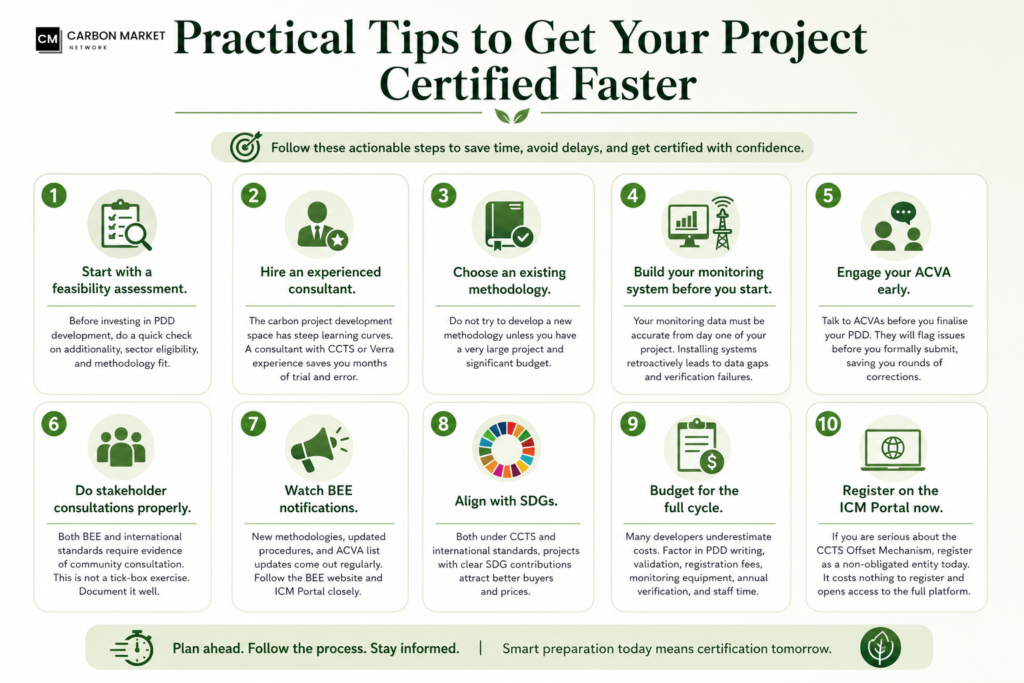
Here are actionable steps to improve your chances and reduce your timeline:
- Start with a feasibility assessment. Before investing in PDD development, do a quick check on additionality, sector eligibility, and methodology fit.
- Hire an experienced consultant. The carbon project development space has steep learning curves. A consultant with CCTS or Verra experience saves you months of trial and error.
- Choose an existing methodology. Do not try to develop a new methodology unless you have a very large project and significant budget.
- Build your monitoring system before you start. Your monitoring data must be accurate from day one of your project. Installing systems retroactively leads to data gaps and verification failures.
- Engage your ACVA early. Talk to ACVAs before you finalise your PDD. They will flag issues before you formally submit, saving you rounds of corrections.
- Do stakeholder consultations properly. Both BEE and international standards require evidence of community consultation. This is not a tick-box exercise. Document it well.
- Watch BEE notifications. New methodologies, updated procedures, and ACVA list updates come out regularly. Follow the BEE website and ICM Portal closely.
- Align with SDGs. Both under CCTS and international standards, projects with clear SDG contributions attract better buyers and prices.
- Budget for the full cycle. Many developers underestimate costs. Factor in PDD writing, validation, registration fees, monitoring equipment, annual verification, and staff time.
- Register on the ICM Portal now. If you are serious about the CCTS Offset Mechanism, register as a non-obligated entity today. It costs nothing to register and opens access to the full platform.
Real-World Examples of Carbon Projects in India
To make this concrete, here are examples of project types that Indian developers are actively working on in 2025–2026:
Solar energy with storage in Rajasthan: A renewable energy developer combines a solar plant with battery storage to qualify under BEE’s renewable energy with storage methodology. The storage component strengthens the additionality argument compared to a standalone solar project.
Mangrove restoration in the Sundarbans: An NGO plants mangroves along the West Bengal coast. The project earns credits under the BEE mangrove afforestation methodology and also qualifies for Gold Standard certification for its biodiversity and community livelihood co-benefits.
Compressed biogas plant in Punjab: A startup converts paddy straw (a major agricultural waste and burning issue in Punjab) into compressed biogas. The project earns CCCs under BEE’s compressed biogas methodology and also reduces the open burning of crop residue.
Landfill gas capture in Maharashtra: A municipal authority develops a project to capture methane from a large urban landfill. The gas is used to generate electricity, earning strong credits under the landfill methane recovery methodology.
Green hydrogen electrolysis in Gujarat: An industrial company installs a green hydrogen electrolyser powered by renewable energy, earning credits under BEE’s green hydrogen via electrolysis methodology.
The Future of Carbon Credit Certification in India
India’s carbon market is at a major turning point in 2026. Here is what is on the horizon:
- Full trading operations on India’s power exchanges are expected by mid-to-late 2026, with CCC trading from the FY 2025–26 compliance period flowing into the market by October 2026.
- More methodologies are being developed by BEE. The target is eventually 50 to 100 approved methodologies across sectors. New areas like carbon capture and storage, green construction, and fugitive emissions will be added in Phase 2.
- Article 6 linkages with Japan, Singapore, Sweden, and South Korea are under active negotiation. Once finalised, Indian CCCs may be usable for international compliance, significantly expanding the buyer pool.
- Price discovery will become clearer as the compliance market matures. Analysts project compliance market prices rising from current estimates of INR 800 to INR 1,200 per tonne toward higher levels as demand from obligated entities increases.
- MSME and farmer participation is a specific goal of the Indian Carbon Market framework. The government has stated its intent to make the Offset Mechanism accessible to small businesses and agricultural communities.
- Digital infrastructure will continue improving. The ICM Portal launched in March 2026 will add more features including Article 6 modules and real-time project tracking.
Summary: Your Carbon Credit Certification Checklist for India
Here is a quick reference checklist covering the key steps:
Preparation:
- Confirm your project type falls under an approved BEE methodology or international standard.
- Verify your project start date is on or after January 1, 2025 (for CCTS Offset Mechanism).
- Conduct an additionality assessment.
- Identify your target buyer market (India compliance, international voluntary, or both).
Registration:
- Register as a non-obligated entity on the ICM Portal (icm.gov.in).
- Receive your Certificate of Registration from GCIL.
Project Design:
- Hire a qualified carbon project consultant.
- Develop your Project Design Document (PDD).
- Build your monitoring system.
- Conduct and document stakeholder consultations.
Validation:
- Engage a BEE-accredited ACVA for validation.
- Address all corrective action requests.
- Receive your Validation Report.
Registration and Implementation:
- Submit your PDD and Validation Report to BEE via the ICM Portal.
- Receive BEE registration and Technical Committee approval.
- Begin project implementation and monitoring.
Verification and Issuance:
- Engage a different ACVA for verification at the end of each monitoring period.
- Receive your Verification Report.
- Wait for BEE review and NSCICM recommendation.
- Receive your CCCs in your ICM Registry account.
Trading:
- List your CCCs for sale on India’s power exchange platform.
- Ensure compliance with CERC trading rules.
Frequently Asked Questions (FAQ)
Q1: Can I certify my existing project that started before 2025 under the CCTS Offset Mechanism?
No. The CCTS Offset Mechanism requires your project to have a start date of January 1, 2025 or later. If your project started before this date, you should explore international standards like Verra or Gold Standard, which have different retroactive eligibility rules.
Q2: Can Indian projects get certified under both CCTS and Verra at the same time?
In principle, yes, but you must be very careful about double counting. Under Article 6 of the Paris Agreement, credits used for international purposes require corresponding adjustments from the Indian government. You should get expert legal and technical guidance before pursuing dual certification.
Q3: What is the difference between validation and verification?
Validation happens before your project starts generating credits. It checks whether your project design meets certification requirements. Verification happens after a monitoring period. It checks whether your actual emission reductions match what you planned. They must be performed by different ACVAs.
Q4: How do I find a BEE-accredited ACVA?
Visit the BEE website (beeindia.gov.in) and look for the published list of Accredited Carbon Verification Agencies empanelled under CCTS. This list is regularly updated.
Q5: What happens if my project fails verification?
If verification finds that your reductions are lower than claimed, you will receive fewer CCCs than expected. If there are serious discrepancies or if your monitoring data is found to be fraudulent, your project registration can be cancelled. This is why rigorous monitoring from day one is critical.
Q6: How much can I earn from a certified carbon credit project in India?
It depends on your project’s emission reductions and the market price. In the Indian compliance market, CCCs are expected to trade at INR 800 to INR 1,200 per tonne from 2026 onward. A project reducing 10,000 tonnes per year earns approximately INR 80 lakh to INR 1.2 crore annually at current estimates.
Q7: Is carbon credit project certification only for large companies?
No. The CCTS Offset Mechanism is explicitly designed to also support MSMEs, startups, NGOs, and even farmers. The government has stated its commitment to making the mechanism accessible to smaller actors. That said, smaller projects may find it harder to justify the upfront certification costs without aggregating multiple sites or activities.
Q8: What sectors will be covered in Phase 2 of the CCTS Offset Mechanism?
Phase 2 will expand to fugitive emissions, construction, solvent use, and carbon capture, utilisation, and storage (CCUS). The timeline for Phase 2 methodologies has not yet been officially announced.
Q9: What is the crediting period for a project under the CCTS Offset Mechanism?
Crediting periods may be fixed or renewable depending on the methodology. Renewable crediting periods require fresh validation to be extended. The BEE-approved methodology for your project type will specify the standard crediting period.
Q10: Do I need government approvals or environmental clearances before certifying my project?
Yes, in many cases. Your project must comply with all applicable regulations, including environmental clearance requirements under Indian environmental law. Your PDD must demonstrate regulatory compliance. The ACVA will check this during validation.
Conclusion
Getting your carbon credit project certified in India is now more possible than ever before. The Indian Carbon Market has moved from blueprint to reality. The ICM Portal is live, BEE has published detailed procedures, ACVAs are accredited and operating, and the first compliance period is already underway.
The process involves clear, defined steps: confirming your project’s eligibility, registering on the ICM Portal, preparing a strong Project Design Document, getting validated by a BEE-accredited ACVA, registering with BEE, monitoring your project, undergoing verification, and finally receiving your Carbon Credit Certificates.
Yes, the process takes time and requires investment. But the financial returns, the contribution to India’s climate goals, and the growing demand from compliance entities and global corporate buyers make it a genuinely worthwhile opportunity.
India is building one of the world’s largest carbon markets. The time to get your project in is now, not after the market matures and competition intensifies.
Start with the basics: check your project’s eligibility, register on the ICM Portal, and talk to a carbon project consultant. Every certified project brings India one step closer to its 2070 net-zero goal, and it brings you one step closer to earning real returns from real climate action.