Carbon Market Network


Imagine a giant vacuum cleaner that pulls carbon dioxide straight out of the sky and locks it away for thousands of years. That is not science fiction anymore.
It is called engineered carbon removal, and it is one of the fastest growing fields in the entire climate industry.
If you have ever wondered how companies plan to hit “net zero” when they cannot cut every single emission, engineered carbon removals are usually part of the answer.
This guide breaks down everything you need to know about engineered carbon removals in plain, simple language. No jargon overload. No fluff. Just a clear, practical look at how these technologies work, why they matter, and what to watch for.
By the end, you will understand the major methods, the real costs, the leading companies, and how engineered removals fit into the bigger carbon market picture.
What Are Engineered Carbon Removals?
Engineered carbon removals are technology-based methods that pull carbon dioxide out of the atmosphere and store it safely, usually for centuries or longer.
Unlike planting a tree, which relies on nature to absorb carbon slowly, engineered removal uses machines, chemistry, or industrial processes to speed things up.
The core idea is simple. Take carbon dioxide that is already floating in the air, capture it, and lock it away somewhere it cannot escape back into the atmosphere.
This is different from carbon capture at a factory smokestack. Engineered carbon removal deals with carbon dioxide that is already spread out in the open air, not carbon leaving a pipe.
That distinction matters a lot, and it is one of the most common points of confusion in the carbon market.
Carbon Market Insider Newsletter
Weekly insights on carbon markets, climate policy, carbon credits, and sustainability.
Engineered Removal vs Nature-Based Removal
People often lump all carbon removal into one bucket, but there are two very different families.
Nature-based removal uses living systems like forests, soils, wetlands, and oceans to absorb carbon dioxide naturally.
Engineered removal uses human-built systems like machines, chemical reactions, and industrial processes to capture and store carbon.
Here is a simple side-by-side comparison.
| Feature | Nature-Based Removal | Engineered Removal |
|---|---|---|
| Method | Trees, soil, wetlands | Machines, chemistry, industrial processes |
| Speed | Slow, takes years to decades | Often faster once operational |
| Storage duration | Decades to about a century | Hundreds to thousands of years |
| Land and water needs | Often high | Varies, generally lower for direct air capture |
| Cost per tonne today | Usually lower | Usually higher |
| Reversal risk | Higher, fires and disease can undo gains | Lower, especially with geological storage |
| Co-benefits | Biodiversity, soil health, community impact | Fewer direct ecological co-benefits |
Neither approach is automatically better. Most credible climate strategies use a blend of both, and this guide focuses specifically on the engineered side.
Why Engineered Carbon Removals Matter Right Now
Cutting emissions is the top priority for fighting climate change. Nothing replaces that.
But even in the most optimistic scenarios, some emissions will remain hard to eliminate completely. Think heavy industry, aviation, and certain agricultural processes.
Climate scientists increasingly agree that the world needs both deep emissions cuts and some level of carbon removal to keep warming in check.
Major assessments from leading climate science bodies have confirmed that nearly every credible pathway to limiting warming includes some amount of carbon dioxide removal alongside aggressive emissions reductions.
The disagreement is not whether removal is needed. It is about how much, when, and which combination of technologies makes the most sense.
That is why engineered carbon removal has moved from a niche research topic to a serious, fast-growing industry with real projects, real funding, and real corporate buyers.
Who Is Actually Buying Engineered Removal Credits
Large technology companies have become the biggest buyers of durable removal credits.
Major cloud computing companies, payment platforms, and shipping firms have signed multi-year agreements to purchase engineered removal credits well before projects even finish construction.
These early purchase agreements are called offtake deals, and they work like a pre-order. The buyer commits money now, which helps developers raise capital to build their facilities.
This buyer demand is what is pushing the entire engineered removal sector from small pilot projects toward genuine industrial scale.
The Main Types of Engineered Carbon Removal
There are several distinct engineered removal pathways, and each one uses a different method to capture and store carbon. Let us go through them one at a time.
1. Direct Air Capture (DAC)
Direct air capture, often shortened to DAC, is the most talked-about engineered removal technology.
It works by pulling ambient air through large machines using powerful fans. The air passes over a special material, either a liquid solvent or a solid sorbent, that chemically binds to carbon dioxide molecules.
Once the material is saturated with carbon dioxide, it gets heated or treated to release a pure, concentrated stream of carbon dioxide. That gas is then compressed and sent underground for permanent storage, or used in industrial products.
How direct air capture works, step by step:
- Giant fans pull large volumes of outside air into a contactor unit.
- The air passes over a chemical material that binds to carbon dioxide.
- The captured carbon dioxide is separated from the material using heat or a vacuum.
- The pure carbon dioxide stream is compressed.
- The compressed gas is injected deep underground into stable rock formations, where it mineralizes over time, or it gets used to make products like concrete or synthetic fuel.
There are two dominant DAC approaches worth understanding.
Liquid solvent systems pass air through large contactors where it meets an alkaline solution, typically a potassium-based liquid, which absorbs the carbon dioxide.
Solid sorbent systems pull air through contactors packed with solid materials that adsorb carbon dioxide and then release it when heated or exposed to a vacuum.
DAC has one major advantage over almost every other method: it has a very small physical land footprint compared to biological approaches, and it can theoretically scale without running into land constraints.
The tradeoff is energy. Pulling carbon dioxide out of open air, where it makes up only a tiny fraction of the atmosphere, takes a huge amount of energy compared to capturing it from a concentrated industrial source.
This is often called the dilution problem. The lower the concentration of carbon dioxide in the air, the more air you need to move to capture a meaningful amount, and the more energy that requires.
Because of this, the climate benefit of a DAC facility depends heavily on what kind of electricity powers it. A DAC plant running on renewable or very low-carbon power delivers a much stronger net climate benefit than one running on fossil-fuel electricity.
Several DAC developers currently operate or are building large facilities across North America, Iceland, the Middle East, and beyond, with plants ranging from tens of thousands to several hundred thousand tonnes of annual capacity, and some announced projects targeting well beyond that scale in the years ahead.
2. Bioenergy with Carbon Capture and Storage (BECCS)
BECCS combines two ideas: growing biomass that absorbs carbon dioxide as it grows, and capturing the carbon dioxide released when that biomass is burned or processed for energy.
Here is the basic loop.
- Crops or biomass grow and absorb carbon dioxide from the atmosphere through photosynthesis.
- The biomass is burned or processed to generate energy, such as electricity or biofuel.
- The carbon dioxide released during that process is captured rather than released into the air.
- The captured carbon dioxide is transported and stored underground in geological formations.
Because the plants originally pulled carbon dioxide out of the air, and that carbon dioxide is then captured and stored instead of released, the net effect can be carbon removal, not just carbon neutrality.
BECCS currently tends to cost less per tonne than direct air capture and can even generate usable energy as a byproduct. However, it requires large amounts of land and water to grow the biomass feedstock, which raises questions about competition with food production and natural ecosystems.
The most rigorous climate modeling generally treats DAC and BECCS as complements rather than competitors, since each one solves a different part of the puzzle.
3. Enhanced Rock Weathering (ERW)
Enhanced rock weathering speeds up a natural chemical process that normally takes place over geological timescales.
Certain rocks, especially silicate minerals like basalt, naturally react with carbon dioxide and rainwater to form stable bicarbonates over very long periods.
Enhanced rock weathering accelerates this by grinding these minerals into a fine powder and spreading them across farmland or other land surfaces, dramatically increasing the surface area available for the reaction.
Basic steps involved in enhanced rock weathering:
- Silicate rock, often basalt, is mined and crushed into a fine powder.
- The powder is spread across agricultural fields or suitable land.
- Rainwater and natural weathering reactions convert atmospheric carbon dioxide into stable bicarbonate ions.
- These bicarbonates eventually wash into groundwater and rivers, and much of it ultimately reaches the ocean, where the carbon stays locked away for a very long time.
Enhanced rock weathering also offers agricultural co-benefits. The rock powder can improve soil pH and nutrient availability, which some farmers find useful alongside the carbon removal benefit.
In terms of permanence, enhanced rock weathering sits close to direct air capture and BECCS, offering storage that lasts far longer than typical biological carbon storage in forests or soil organic matter.
4. Biochar
Biochar is one of the fastest-scaling engineered removal pathways today, largely because it is relatively simple to produce and deploy compared to some other technologies.
Biochar is created through pyrolysis, a process where biomass such as agricultural residue, wood waste, or crop leftovers is heated in a low-oxygen environment.
This process transforms the biomass into a stable, carbon-rich material that resists decomposition far longer than raw organic matter would in normal conditions.
How biochar carbon removal works:
- Waste biomass, such as crop residue or wood chips, is collected.
- The biomass is heated in a low-oxygen chamber through pyrolysis.
- The heating converts the material into biochar, a stable, carbon-dense solid.
- The biochar is applied to soil, used in construction materials, or otherwise kept out of decomposition pathways.
- Because biochar resists breaking down, the carbon inside it stays locked away for decades to centuries rather than being released back into the atmosphere quickly, the way untreated biomass would if it simply decomposed.
Biochar has become the dominant source of verified durable carbon removal credits delivered into carbon registries, largely because it is cheaper and faster to scale than some of the more capital-intensive engineered methods.
It also delivers strong co-benefits. When applied to soil, biochar can improve water retention, support microbial activity, and reduce the need for certain fertilizers.
That said, biochar’s permanence, while much longer than untreated biomass, is generally considered century-scale rather than the multi-thousand-year permanence of geological storage used in DAC and BECCS.
5. Ocean-Based and Mineralization Approaches
A newer and smaller category of engineered removal focuses on the ocean and mineral reactions.
Ocean alkalinity enhancement adds alkaline substances to seawater, which increases the ocean’s natural capacity to absorb and store carbon dioxide as stable compounds.
Direct ocean capture pulls carbon dioxide directly out of seawater, similar in concept to direct air capture but working with water instead of air, since ocean water actually holds a much higher concentration of dissolved carbon dioxide than the atmosphere.
Mineralization involves reacting carbon dioxide with certain minerals to form solid carbonate rock, permanently locking the carbon into a stable mineral form.
These approaches remain earlier stage compared to DAC, BECCS, ERW, and biochar, but they are attracting growing research interest and pilot funding because oceans and minerals offer enormous long-term storage potential.
Comparing All the Major Engineered Removal Methods
Here is a side-by-side look at how the main engineered pathways stack up against each other.
| Method | How it works | Typical permanence | Relative cost today | Land or water need |
|---|---|---|---|---|
| Direct Air Capture (DAC) | Chemically captures carbon dioxide from open air | Thousands of years | Highest | Low land, high energy |
| BECCS | Captures carbon dioxide from burning biomass for energy | Thousands of years | High, generally below DAC | High land and water |
| Enhanced Rock Weathering | Crushed silicate rock reacts with carbon dioxide | Around a thousand years or more | High | Moderate, uses farmland |
| Biochar | Stable carbon material made through pyrolysis | Decades to centuries | Moderate, lowest among durable methods | Low, uses waste biomass |
| Ocean and mineralization | Reacts carbon dioxide with seawater or minerals | Very long, geological in some cases | Variable, still early stage | Low land, ocean-based |
A well-built carbon removal portfolio often blends several of these approaches rather than relying on just one, since each method has different strengths around cost, speed, permanence, and co-benefits.
How Permanent Is Engineered Carbon Removal, Really?
Permanence is one of the most important concepts in the entire carbon removal conversation, and it is worth understanding clearly.
When carbon dioxide is stored underground in stable geological formations, as with DAC and BECCS, the storage duration is generally measured in thousands of years or longer, because the carbon dioxide reacts with surrounding rock to form solid minerals over time.
Enhanced rock weathering offers similarly long storage, since the bicarbonates it creates are chemically stable for very long periods.
Biochar sits in the middle. It resists decomposition far better than raw biomass, but it can still slowly break down over decades to centuries depending on soil conditions, temperature, and how it is used.
This is why buyers and carbon registries increasingly separate carbon credits by durability category. A credit representing thousand-year storage is treated very differently from one representing century-scale storage, and both are treated differently again from short-term nature-based storage.
Understanding this hierarchy helps explain why prices vary so much between different removal methods, which we will cover next.
What Does Engineered Carbon Removal Actually Cost?
Cost is probably the single biggest barrier standing between engineered carbon removal and truly massive scale.
Here is a general sense of where pricing tends to land across different methods, though prices vary by project, region, quality certification, and contract length.
| Removal Method | Approximate Price Range per Tonne of CO2 |
|---|---|
| Biochar | Generally the lowest among durable methods, often in the low hundreds |
| Enhanced Rock Weathering | Moderate to high, often above biochar |
| BECCS | High, often in the mid to upper hundreds |
| Direct Air Capture | Currently the highest, often several hundred dollars and above |
Nature-based avoidance credits, like forest protection, typically trade far below any engineered removal method, sometimes in the single digits per tonne. But those credits represent avoided emissions rather than actual removal, and they generally carry a much higher risk of reversal.
Several structural forces are pushing costs down over time for engineered methods.
- Larger facilities benefit from economies of scale.
- Manufacturing improvements are lowering equipment costs.
- Co-locating facilities near cheap, low-carbon power reduces operating costs.
- Growing buyer demand is encouraging long-term offtake agreements that help finance construction.
- Government incentives and tax credits in several countries are lowering the effective cost for developers.
Most credible market forecasts expect blended carbon removal portfolio prices to decline over time as facilities scale up, though engineered methods like DAC and ERW are expected to remain more expensive than biochar and nature-based options for the foreseeable future.
Real-World Examples of Engineered Carbon Removal in Action
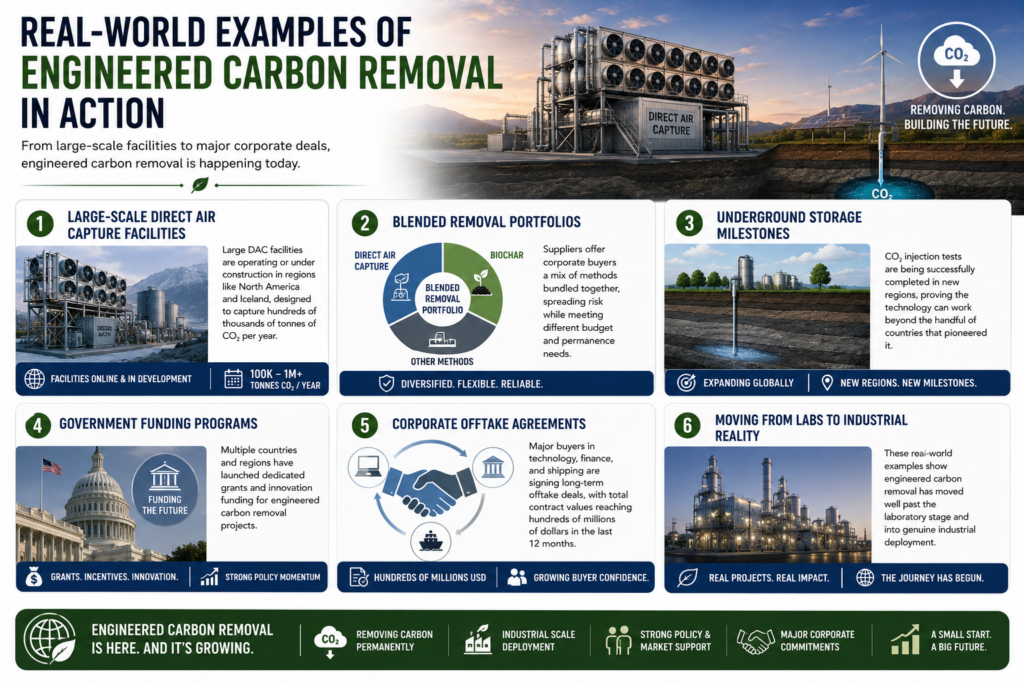
Engineered carbon removal is not just a theory anymore. Multiple companies around the world are actively building and operating facilities today.
Large-scale direct air capture facilities are now operating or under construction in regions like North America and Iceland, with some designed to capture hundreds of thousands of tonnes of carbon dioxide per year once fully operational.
Blended removal portfolios are increasingly common, where a single supplier offers corporate buyers a mix of direct air capture, biochar, and other methods bundled together, spreading risk while meeting different budget and permanence needs.
Underground storage milestones continue to be reached in new regions, including early-stage carbon dioxide injection tests that demonstrate the technology can work beyond the handful of countries that pioneered it.
Government funding programs in multiple countries and regions have opened dedicated grant and innovation funding specifically for engineered carbon removal projects, signaling growing policy support for the sector.
Corporate offtake agreements from major buyers in technology, finance, and shipping continue to grow, with total contract values reaching hundreds of millions of dollars across a rolling twelve-month period in the sector.
These real examples show that engineered carbon removal has moved well past the laboratory stage and into genuine industrial deployment, even though the overall scale still remains small compared to global emissions.
Benefits of Engineered Carbon Removal
Engineered carbon removal brings several distinct advantages to the broader climate response.
- Long-lasting storage. Many engineered methods lock carbon away for centuries to thousands of years, reducing the risk of reversal compared to some nature-based approaches.
- Measurable and verifiable. Engineered processes are generally easier to measure precisely, since they involve controlled industrial systems rather than complex, variable natural ecosystems.
- Lower land footprint. Methods like direct air capture require far less land than large-scale reforestation projects aiming for equivalent removal volumes.
- Scalability potential. Engineered systems can theoretically be replicated and expanded through manufacturing, similar to how solar panel costs fell as production scaled.
- Complements emissions cuts. Engineered removal can address hard-to-eliminate emissions from sectors like aviation, shipping, and heavy industry that cannot be fully decarbonized with current technology.
- Job creation and local economic activity. New facilities create construction jobs, ongoing operational roles, and demand for supporting infrastructure like clean power and pipelines.
Challenges and Criticisms of Engineered Carbon Removal
No honest guide would skip the real challenges facing this industry, and there are several worth understanding.
High Costs Remain a Major Barrier
Engineered removal, especially direct air capture, remains significantly more expensive per tonne than many other climate solutions. This limits how much can be purchased today, even with strong buyer interest.
Energy Intensity
Because engineered removal often requires significant energy input, especially for direct air capture, the climate benefit depends heavily on using clean power. Powering these facilities with fossil fuel electricity can seriously undercut their net benefit.
Risk of Distracting from Emissions Cuts
Some critics worry that heavy investment in engineered removal could give companies or governments an excuse to delay cutting emissions at the source, treating removal as a shortcut rather than a complement.
Most climate experts agree that removal should come after aggressive emissions reductions, addressing only the emissions that genuinely cannot be eliminated, rather than replacing the harder work of cutting pollution in the first place.
Ownership and Trust Questions
Some large removal facilities are owned or operated by companies with ties to the fossil fuel industry. Critics ask whether removal projects tied to oil and gas operations genuinely deliver net climate benefit, particularly when captured carbon dioxide is sometimes used to extract more oil from depleted wells rather than purely stored away.
This has become a real point of debate within the carbon market, and it is worth understanding as a buyer or observer.
Slower Than Hoped Scale-Up
Several flagship facilities have faced delays reaching their designed capacity, missing early production targets during their first years of operation. Scaling industrial hardware to reliably operate at massive volume has proven harder than early projections suggested.
Land, Water, and Feedstock Constraints
BECCS in particular faces real limits around how much biomass can be sustainably grown without competing with food production or natural ecosystems.
Engineered Carbon Removal and Carbon Markets
Engineered removal credits are increasingly traded and certified within both voluntary and compliance carbon markets.
Voluntary carbon markets allow companies to purchase removal credits to support climate commitments even without a legal requirement to do so. Many corporate net-zero pledges rely partly on voluntary removal purchases.
Compliance markets, tied to government regulation, are beginning to incorporate removal credits in select regions, though this integration remains an evolving area of policy.
Certification frameworks matter enormously here. Registries and standards bodies have been developing and refining specific methodologies for engineered removal pathways, covering everything from measurement protocols to storage verification requirements.
Regulatory frameworks in multiple regions are now building formal certification systems specifically for carbon removal, distinct from traditional emissions-avoidance credit frameworks, reflecting the recognition that removal deserves its own dedicated rules.
For buyers, this evolving standards landscape means due diligence matters more than ever. Look for credits certified under recognized methodologies, verified by independent third parties, and backed by transparent monitoring, reporting, and verification data.
How Companies Should Approach Buying Engineered Removal Credits
If your organization is considering engineered removal credits as part of a climate strategy, a few practical principles help.
- Cut emissions first. Treat removal as a tool for genuinely unavoidable residual emissions, not a substitute for reducing your footprint.
- Diversify across methods. Blending biochar, enhanced rock weathering, and direct air capture balances cost, permanence, and delivery timelines.
- Check the certification. Confirm credits are verified under a recognized, credible methodology with transparent monitoring data.
- Understand delivery timelines. Many engineered removal projects sell credits years before physical delivery. Know whether you are buying already-delivered tonnes or future contracted tonnes.
- Consider co-benefits. Some methods, like biochar and enhanced rock weathering, offer additional agricultural or soil health benefits worth factoring into your decision.
- Watch the energy source. For direct air capture in particular, ask what powers the facility, since this materially affects the net climate benefit.
The Future of Engineered Carbon Removal
Engineered carbon removal is still a young industry relative to its long-term ambitions, but the trajectory points toward continued growth.
Expect to see larger facilities, falling costs as manufacturing scales, growing government support through grants and tax incentives, and expanding corporate demand as more companies formalize long-term climate commitments.
New methods, particularly around ocean-based removal and advanced mineralization, are likely to mature further and could open additional low-cost, high-volume removal pathways over time.
At the same time, expect continued scrutiny around permanence claims, energy sourcing, and the relationship between removal projects and fossil fuel operations. This scrutiny is healthy and will likely push the industry toward higher standards and better transparency.
Engineered carbon removal will not single-handedly solve climate change. But as part of a broader strategy that prioritizes emissions cuts first, it offers a genuinely useful tool for addressing the emissions that are hardest to eliminate.
Learn more about carbon credits: https://carboncreditcourse.com/
Conclusion
Engineered carbon removals represent one of the most important and fastest-growing tools in the fight against climate change.
From direct air capture machines pulling carbon dioxide straight out of the sky, to biochar locking carbon into stable soil-friendly material, to enhanced rock weathering harnessing simple chemistry at scale, these technologies offer real, measurable, and increasingly durable ways to pull carbon out of the atmosphere.
They are not a replacement for cutting emissions. They are a complement, designed to handle the stubborn, hard-to-eliminate emissions that remain even in the most ambitious climate strategies.
As costs fall, technology matures, and certification standards strengthen, engineered carbon removals will likely play an even larger role in global climate strategy in the years ahead.
Whether you are a business evaluating your first removal purchase or simply someone trying to understand where climate technology is headed, engineered carbon removal is a space worth watching closely.
Frequently Asked Questions
What is the difference between carbon capture and engineered carbon removal?
Carbon capture usually refers to capturing carbon dioxide at the source, such as a factory smokestack, before it reaches the atmosphere. Engineered carbon removal captures carbon dioxide that is already spread out in the open air or ocean, actually reducing the existing concentration in the atmosphere.
Is engineered carbon removal proven to work?
Yes, the core chemistry and engineering behind methods like direct air capture, biochar, and enhanced rock weathering are well established and operating at commercial and pilot scale today. The main challenges are cost and scaling up to meet global climate needs, not whether the underlying science works.
Which engineered removal method is the cheapest?
Biochar is generally the most affordable durable engineered removal method available today, largely because it uses relatively simple pyrolysis technology and waste biomass feedstock.
How long does engineered carbon removal store carbon?
It depends on the method. Direct air capture with geological storage, BECCS, and enhanced rock weathering typically store carbon for hundreds to thousands of years. Biochar generally offers storage lasting decades to centuries.
Can engineered carbon removal replace cutting emissions?
No. Nearly every credible climate strategy treats engineered removal as a complement to deep emissions cuts, not a replacement. The priority remains reducing emissions at the source first, then using removal for genuinely unavoidable residual emissions.
Why is direct air capture so expensive?
Direct air capture is energy-intensive because carbon dioxide makes up only a small fraction of the atmosphere, meaning huge volumes of air must be processed to capture meaningful amounts. This energy requirement, combined with the cost of building specialized equipment, keeps prices high compared to other removal methods.
Are engineered carbon removal credits worth buying?
For companies serious about climate commitments, engineered removal credits can be a valuable part of a diversified portfolio, especially when certified under credible methodologies and verified through transparent monitoring. Buyers should prioritize emissions reductions first and treat removal credits as one part of a broader strategy.
What industries benefit most from engineered carbon removal?
Industries with hard-to-eliminate emissions, such as aviation, shipping, cement, and steel, are among the biggest potential beneficiaries, since engineered removal offers a way to address emissions that current technology cannot fully eliminate at the source.
For more updates, guides, and resources on carbon markets, explore Carbon Market Network.