Carbon Market Network



The carbon credit market is no longer just a niche environmental concept. It is a trillion-dollar global marketplace where some of the biggest companies on the planet are spending billions to offset their emissions.
Whether you are new to carbon markets or already familiar with the basics, understanding who the top carbon credit buyers are gives you powerful insight into where the market is heading and why it matters.
This article breaks it all down, simply and clearly.
What Is a Carbon Credit Buyer?
A carbon credit buyer is any company, government, or organization that purchases carbon credits to compensate for greenhouse gas emissions they cannot yet eliminate.
Each carbon credit represents one metric tonne of carbon dioxide (or equivalent greenhouse gas) that has been reduced, avoided, or removed from the atmosphere.
Buyers fall into two broad categories:
- Compliance buyers who must purchase credits under government regulations
- Voluntary buyers who choose to buy credits as part of their sustainability or net-zero commitments
Both types of buyers play a huge role in driving demand across the global carbon market.
Carbon Market Insider Newsletter
Weekly insights on carbon markets, climate policy, carbon credits, and sustainability.
Why Do Companies Buy Carbon Credits?
Before we look at the top carbon credit buyers, it helps to understand why they buy in the first place.
1. To meet legal obligations
In regulated markets like the European Union Emissions Trading System (EU ETS), companies that emit above their permitted cap must buy additional allowances or credits. This is non-negotiable.
2. To achieve net-zero or carbon-neutral targets
Many corporations have publicly pledged to reach net zero by a certain date. Carbon credits help them offset the emissions they cannot yet cut through technology or operations alone.
3. To meet customer and investor expectations
Consumers, investors, and rating agencies increasingly expect companies to show credible climate action. Buying high-quality carbon credits signals that commitment.
4. To comply with industry-specific schemes
Industries like aviation face their own carbon offsetting programs. Airlines under CORSIA (the Carbon Offsetting and Reduction Scheme for International Aviation) must buy certified credits to cover international flight emissions above baseline levels.
5. To get ahead of future regulations
Smart companies buy credits now to avoid higher costs later as carbon prices rise and regulations tighten globally.
The Two Types of Carbon Credit Markets
Understanding the market structure helps you see why different buyers behave differently.
| Market Type | Who Uses It | How It Works |
|---|---|---|
| Compliance Market | Regulated industries under government schemes like EU ETS, CORSIA | Companies must buy allowances or credits to stay within legal emission caps |
| Voluntary Carbon Market (VCM) | Any company choosing to offset beyond legal requirements | Companies buy verified credits from projects like reforestation, renewable energy, or direct air capture |
The voluntary carbon market is where most of the well-known corporate buyers operate, though some buyers operate in both markets simultaneously.
Top Carbon Credit Buyers: The Companies Leading the Market
Let us look at the biggest and most active carbon credit buyers in the world right now.
1. Shell
Shell is consistently one of the largest buyers of carbon credits in the voluntary carbon market.
The energy giant retired approximately 14.5 million carbon credits in a single recent year, making it the top single retirer by volume. In the following year, Shell remained the largest retirer at around 9.75 million tonnes, primarily using nature-based credits.
What does Shell buy?
Shell’s purchases lean heavily toward nature-based solutions, particularly REDD+ forestry projects that protect forests from deforestation. A large share of its credits come from forestry and land-use initiatives. The company also retires renewable energy credits.
Why does Shell buy so many?
Shell uses carbon credits to market products like “carbon-neutral LNG” to customers. It also uses credits to address its Scope 1 and Scope 2 operational emissions as part of its broader climate strategy.
Key insight: Shell pays a lower average price per credit compared to buyers focused on high-integrity removals. This reflects its preference for nature-based avoidance projects over more expensive engineered removals.
2. Microsoft
Microsoft is the world’s largest buyer of carbon removal credits and one of the most closely watched players in the entire carbon market.
The company has pledged to become carbon negative by 2030 and to remove all of its historical carbon emissions by 2050.
Scale of purchases:
Microsoft contracted around 5 million tonnes of carbon removal in one year, then grew that to roughly 20 million tonnes the next year, and then more than doubled that again to 45 million tonnes in a single fiscal year. Those figures come from agreements signed with 21 different companies across a wide range of removal technologies.
Nearly all of Microsoft’s purchased credits are forward contracts, meaning the actual delivery of credits is scheduled for between 2030 and 2050.
Recent developments:
In a significant market development, Microsoft reportedly paused future carbon removal purchases in early 2026. The company later confirmed its carbon removal program had not ended, and it subsequently signed a new agreement with Denmark-based biogas producer BioCirc for 650,000 tonnes of removals over seven years.
Through mid-2026, Microsoft had purchased 8.55 million tonnes of carbon removal credits, down roughly 80% from the same period the prior year, driven partly by its massive AI infrastructure buildout and rising emissions. Despite the pullback, Microsoft still accounts for close to half of all carbon removal transactions globally.
What does Microsoft buy?
Microsoft deliberately targets carbon removal, not just avoidance. Its portfolio includes:
- Bioenergy with carbon capture and storage (BECCS)
- Direct air capture (DAC)
- Forestry-based removals
- Biochar
- Enhanced rock weathering
- Soil carbon projects
This focus on high-durability, high-integrity removal credits sets Microsoft apart from volume-focused buyers like Shell.
Average price paid: Microsoft pays significantly more per credit than Shell because removal credits are far more expensive to produce. Engineered solutions like DAC can cost hundreds of dollars per tonne.
3. Google (Alphabet)
Google has committed to running on 100% carbon-free energy by 2030 and to achieving net-zero emissions across all operations and value chains by the same date.
Google is one of the most active buyers of carbon credits in the tech sector and a key participant in the Frontier initiative, a coalition of companies including Stripe, Shopify, McKinsey, and others that collectively commits to purchasing high-quality carbon removal.
What does Google buy?
Google focuses on a mix of nature-based and engineered carbon removal. Through Frontier, the coalition has committed over $1 billion toward permanent carbon removal across technologies like direct air capture, enhanced weathering, and biochar.
Google also buys standard voluntary credits to address emissions it cannot immediately reduce.
Key insight: Google is notable for its emphasis on quality over quantity. The company actively works with scientific advisors to evaluate credit integrity before purchasing.
4. Amazon
Amazon has signed the Climate Pledge, committing to net-zero carbon by 2040, a decade ahead of the Paris Agreement timeline.
Amazon is one of the most active corporate buyers of carbon credits across both nature-based and removal categories. The company has secured long-term offtake agreements to lock in future credit supplies, a strategy increasingly popular as competition for high-quality credits grows.
Amazon’s approach:
Amazon has opened access to parts of its carbon credit portfolio, allowing hundreds of partner companies to use its vetted credits. This move reflects both Amazon’s scale and its intent to drive broader corporate climate action through its supply chain.
Amazon’s purchases span reforestation projects, soil carbon, and engineered removal technologies.
5. JPMorgan Chase
JPMorgan Chase is among the most active buyers of carbon credits in the financial sector.
As one of the world’s largest banks, JPMorgan has made climate commitments that include net-zero financed emissions by 2050. The company uses carbon credits to offset residual emissions while scaling up its broader sustainability programs.
JPMorgan consistently appears in data from AlliedOffsets as one of the top corporate buyers in the voluntary carbon market.
Why this matters:
When major financial institutions buy carbon credits, it signals to the entire market that carbon offsets are becoming mainstream financial assets, not just niche environmental products.
6. Airlines: A Sector-Wide Wave of Buying
Aviation is one of the biggest growth areas for carbon credit demand, driven by the global CORSIA scheme.
What is CORSIA?
CORSIA (Carbon Offsetting and Reduction Scheme for International Aviation) is the ICAO-backed program requiring airlines to offset international flight emissions above 2019 baseline levels. Phase 1 runs from 2024 to 2026, with Phase 2 running from 2027 to 2035.
The scale of demand:
IATA estimated that total Phase 1 demand could reach 170 to 236 million CORSIA-eligible credits. Airlines face a cumulative carbon compliance bill that could reach up to $127 billion between now and 2035 under tight supply scenarios.
Which airlines are buying?
| Airline | Status |
|---|---|
| Emirates | One of the highest estimated CORSIA exposure globally |
| Qatar Airways | Significant Phase 1 compliance exposure |
| United Airlines | Among the top compliance buyers |
| British Airways | Active buyer under CORSIA obligations |
| Lufthansa Group | Signed direct agreements with removal credit developers |
| Korean Air | Significant exposure due to long-haul network |
| Cathay Pacific | Active CORSIA compliance buyer |
| Singapore Airlines | Active compliance and voluntary buyer |
Lufthansa Group has taken a proactive step by partnering directly with Canadian removal developer Deep Sky for high-quality carbon removal credits, bypassing traditional broker channels.
Delta Airlines was historically the largest all-time buyer of carbon credits but stepped back from voluntary purchases. Its return or sustained absence will be closely watched by the market.
7. Oil and Gas Companies Beyond Shell
Shell is the biggest, but it is not the only energy company buying carbon credits in significant volumes.
Other major buyers from the energy sector include:
- Eni (Italy): Used around 6 million credits in a recent year as part of its net-zero strategy
- Engie: Around 2.1 million credits retired in the same period
- Woodside Energy: Approximately 1.4 million credits
- ExxonMobil: Active in both forward contracts and over-the-counter (OTC) credit deals
- Equinor: Expanding commitments in the voluntary carbon market
- BP: Active buyer and also a project developer through subsidiaries
The energy sector and financial sector are tied as the largest cohort of buyers by number of companies, with the energy sector leading by volume of credits retired.
8. Meta (Facebook)
Meta has committed to net-zero emissions across its value chain by 2030.
As part of the Frontier coalition alongside Google and Stripe, Meta has made financial commitments to purchase permanent carbon removal credits. This focus on durable, long-lasting removals reflects a shift in the tech sector away from cheap avoidance credits toward higher-quality solutions.
Meta is also an active buyer of renewable energy credits and has invested in nature-based carbon projects.
9. Stripe
Stripe is smaller than Microsoft or Google in terms of raw credit volume, but the company has outsized influence on the carbon removal market.
Stripe co-founded the Frontier initiative, which has committed over $1.8 billion toward permanent carbon removal purchases. This consortium model, where multiple companies pool commitments, has become a template for how businesses can drive market development at scale.
Stripe purchases across multiple removal pathways including direct air capture, enhanced weathering, and biomass-based removal.
10. Apple
Apple has committed to being fully carbon neutral across its entire supply chain and product life cycle by 2030.
Apple buys carbon credits as part of a broader strategy that includes massive investments in renewable energy and supplier decarbonization. The company focuses on nature-based credits that also deliver biodiversity and community benefits.
Apple also runs its own Restore Fund, a $200 million initiative that channels investment into forest conservation and restoration projects to generate high-quality carbon credits.
Sector Breakdown: Who Buys the Most Carbon Credits?
Looking at the carbon credit market by industry helps identify where demand is concentrated.
| Sector | Buying Profile | Key Drivers |
|---|---|---|
| Energy (Oil and Gas) | Highest volume buyers by retirement | Offsetting product emissions, net-zero pledges, carbon-neutral product marketing |
| Technology | Largest buyers of carbon removal | Net-zero commitments, AI emissions pressure, data center energy use |
| Aviation | Compliance-driven growth sector | CORSIA mandatory offsetting requirements |
| Financial Services | Growing voluntary buyers | ESG investor pressure, Scope 3 financed emissions |
| Consumer Goods | Voluntary buyers for brand sustainability | Customer expectations, carbon-neutral product claims |
| Manufacturing | Mix of compliance and voluntary | EU ETS obligations, supply chain pressure |
| Automotive | Regulatory credit buyers and sellers | Emissions fleet standards, compliance markets |
What Types of Carbon Credits Do Top Buyers Prefer?
The type of credit a buyer chooses reveals a lot about their climate strategy.
Nature-based credits (lower cost, higher volume)
These come from projects like:
- Avoided deforestation (REDD+)
- Reforestation and afforestation
- Soil carbon and regenerative agriculture
- Blue carbon (mangroves, wetlands)
Shell, energy companies, and airlines tend to use these because they are cheaper and available in larger volumes.
Engineered removal credits (higher cost, higher durability)
These come from:
- Direct air capture (DAC)
- Bioenergy with carbon capture and storage (BECCS)
- Enhanced rock weathering
- Biochar
- Ocean-based removals
Microsoft, Google, Stripe, and other tech-forward buyers favor these because they offer permanent, verifiable carbon storage.
| Credit Type | Approx. Price Range | Key Buyers |
|---|---|---|
| REDD+ Forestry | $3 to $15 per tonne | Shell, airlines, energy companies |
| Renewable Energy | $1 to $5 per tonne | Various sectors |
| Reforestation | $5 to $20 per tonne | Consumer brands, tech |
| Biochar | $50 to $200 per tonne | Microsoft, Stripe, Frontier buyers |
| Direct Air Capture | $200 to $600+ per tonne | Microsoft, Google, Shopify |
| BECCS | $100 to $350 per tonne | Microsoft, Lufthansa |
How Do Top Carbon Credit Buyers Choose What to Buy?
The best buyers do not just pick any credit off the market. They follow a rigorous process.
Step 1: Define the purpose
Are credits bridging a gap while internal reductions ramp up? Or are they addressing hard-to-abate residual emissions? The purpose shapes the type of credit needed.
Step 2: Align with a verified standard
Top buyers only accept credits verified under trusted standards like:
- Verra (VCS)
- Gold Standard
- American Carbon Registry (ACR)
- Climate Action Reserve (CAR)
- Puro.earth (for engineered removals)
Step 3: Check for independent ratings
Leading buyers increasingly consult independent rating agencies like BeZero Carbon, Sylvera, Calyx Global, and Renoster to assess credit quality before purchasing.
Step 4: Consider co-benefits
High-quality buyers look beyond just the carbon number. They ask whether a project also protects biodiversity, supports local communities, or advances water access.
Step 5: Secure supply through offtake agreements
Many top buyers, especially Microsoft, Google, and Amazon, use long-term forward contracts called offtake agreements to lock in future supply before credits are even generated. This helps developers finance new projects and ensures buyers have access to high-quality credits as the market tightens.
The Rise of Carbon Credit Buying Coalitions
One of the most important trends in the carbon credit buyer landscape is the rise of coalitions.
Frontier
Frontier is an advance market commitment (AMC) co-founded by Stripe, Alphabet (Google), McKinsey, Shopify, and Meta. It has committed over $1.8 billion to purchase permanent carbon removal at scale. The goal is to send a demand signal strong enough to bring down the cost of emerging removal technologies.
First Movers Coalition
The First Movers Coalition, launched in partnership with the World Economic Forum, brings together companies like Apple, Amazon, Boeing, and others who commit to buying enough low-carbon products and technologies to help drive down costs. Carbon removal is a key component.
SBTI-Aligned Buyers
Companies aligned with the Science Based Targets initiative (SBTi) follow strict guidance on how to use carbon credits responsibly. These buyers use credits only for residual emissions after reducing as much as possible, which raises the overall quality of market demand.
These coalitions matter because they do not just buy credits. They actively shape what kinds of credits get developed, which pushes the entire market toward higher integrity.
What Makes a “High-Quality” Carbon Credit Buyer?
Not all buyers approach the market with the same level of rigor. The best buyers share several characteristics.
They reduce first, offset second
Top-quality buyers treat carbon credits as a complement to deep internal emission reductions, not a substitute. They invest heavily in energy efficiency, renewable energy, and supply chain decarbonization before turning to offsets.
They are transparent about what they buy
Leading buyers publish detailed reports about which projects they support, what credits they retire, and why. Microsoft, Apple, and Stripe are examples of companies with strong public disclosure practices.
They avoid cheap, low-integrity credits
Buyers who rely primarily on very cheap avoidance credits from contested project methodologies face greenwashing risk. The shift toward removal credits and independently rated projects reflects growing awareness of this issue.
They think long-term
Rather than buying spot credits year to year, leading buyers sign multi-year offtake agreements. This gives project developers revenue certainty and helps scale new technologies.
Emerging Trends Among Carbon Credit Buyers
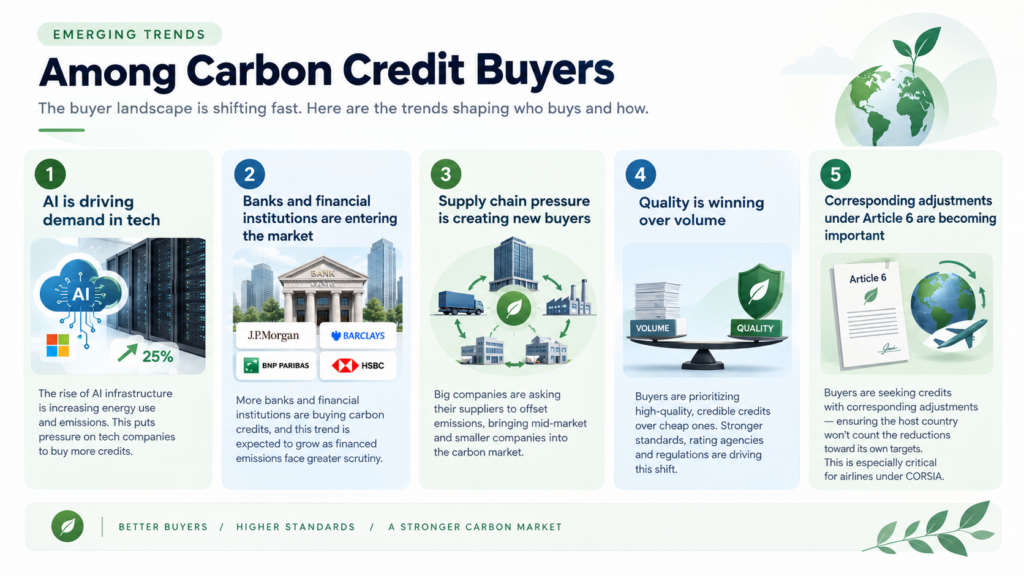
The buyer landscape is shifting fast. Here are the trends shaping who buys and how.
AI is driving demand in tech
The rapid expansion of AI infrastructure has increased energy consumption and emissions at major tech companies. Microsoft’s emissions rose 25% in a single fiscal year, driven largely by data center expansion tied to AI. This creates pressure on companies to buy more credits even as they invest in clean energy.
Banks and financial institutions are entering the market
Beyond JPMorgan, banks like Barclays, BNP Paribas, HSBC, and others are increasing their voluntary carbon credit purchases. As financed emissions face greater scrutiny, financial sector buying is expected to grow significantly.
Supply chain pressure is creating new buyers
Large corporations are now pushing their suppliers to offset emissions as well. This is creating a ripple effect where mid-market and smaller companies enter the carbon market for the first time to meet customer requirements.
Quality is winning over volume
Buyers are shifting from asking “how many credits can I get cheaply?” to “what is the quality and integrity of these credits?” Independent rating agencies, improved verification standards, and regulatory scrutiny are all driving this shift.
Corresponding adjustments under Article 6 are becoming important
As the Paris Agreement’s Article 6 framework matures, buyers are increasingly seeking credits that come with corresponding adjustments. This means the host country of the carbon project has formally agreed not to count those emission reductions toward its own national targets, preventing double counting. This is especially important for airlines under CORSIA.
How to Identify Credible Carbon Credit Buyers
If you are researching companies for investment, partnership, or procurement purposes, here are signals that a buyer takes carbon markets seriously.
| Signal | What It Means |
|---|---|
| SBTi-aligned targets | Company follows science-based guidance on using offsets only for residual emissions |
| Credits verified by Verra, Gold Standard, or equivalent | Credible third-party oversight of the project |
| Independent credit ratings from BeZero or Sylvera | Buyer is assessing quality, not just price |
| Long-term offtake agreements | Strategic commitment rather than opportunistic purchasing |
| Public retirement disclosures | Transparency about what was bought and why |
| Focus on removals alongside avoidance | Forward-looking approach to climate |
| Net-zero aligned with Race to Zero or similar initiative | Buying embedded in a broader credible strategy |
Frequently Asked Questions
Who is the biggest carbon credit buyer in the world?
By volume of credits retired in a single year, Shell has consistently held the top position, retiring tens of millions of credits focused primarily on nature-based projects. By value and focus on carbon removal, Microsoft has been the dominant buyer, having contracted over 45 million tonnes of removal credits in a single fiscal year, though it has significantly reduced its pace of new purchases more recently.
Why do tech companies buy so many carbon credits?
Technology companies like Microsoft, Google, and Amazon operate large data centers that consume enormous amounts of electricity. As their AI and cloud businesses grow, so do their energy needs and associated emissions. Carbon credits help offset what they cannot yet eliminate through renewable energy alone.
Do airlines have to buy carbon credits?
Airlines operating international flights between participating countries under CORSIA must purchase CORSIA-eligible credits to offset emissions above their 2019 baseline. This is a mandatory compliance requirement, not voluntary. Phase 1 covers the period from 2024 to 2026, and Phase 2 expands the obligation from 2027 onward.
How much do companies pay for carbon credits?
Prices vary enormously depending on the credit type and quality. Nature-based avoidance credits like REDD+ can trade as low as $3 to $15 per tonne. Biochar credits typically range from $50 to $200 per tonne. Direct air capture credits can cost $200 to over $600 per tonne. The average price across the voluntary market is much lower because most credit volume comes from cheaper project types.
What is the difference between buying and retiring carbon credits?
Buying a carbon credit means you own it. Retiring (or canceling) a credit means you have permanently taken it off the market and used it to offset your emissions. Only retired credits count toward a company’s stated emissions reduction claims. Tracking retirements is how analysts measure real market activity.
Can small companies buy carbon credits too?
Absolutely. Carbon credits are not just for large corporations. Small and medium businesses can buy credits through platforms like CNaught, Patch, South Pole, ClimatePartner, and others. Many platforms allow purchases starting from a few tonnes, making carbon credits accessible to businesses of all sizes.
What is an offtake agreement in the carbon market?
An offtake agreement is a forward contract where a buyer commits to purchasing a set volume of carbon credits from a project that has not yet generated them. This gives project developers upfront financial certainty to build and scale their projects. Major buyers like Microsoft, Amazon, and Google use offtake agreements extensively to secure future supply of high-quality removal credits.
What are the risks of buying carbon credits?
The main risks include buying low-integrity credits that do not represent real emission reductions, greenwashing accusations if credits are used as a substitute for real reductions rather than a complement, regulatory risk as standards evolve, and project failure risk where a purchased project does not deliver promised reductions. Using independent rating agencies and choosing credits from reputable standards significantly reduces these risks.
Conclusion
The list of top carbon credit buyers reads like a who’s who of the global economy. Shell, Microsoft, Google, Amazon, JPMorgan, major airlines, and dozens of other leading companies are all actively purchasing carbon credits as a core part of their climate strategies.
What is especially interesting is that buyer behavior is evolving fast. The market is moving away from cheap, bulk purchases toward high-quality, high-integrity credits that deliver verifiable, permanent results. Buyers who get ahead of this shift are not just managing regulatory risk. They are shaping what the future carbon market looks like.
Whether you are a business exploring carbon credits for the first time, an investor tracking climate finance trends, or a sustainability professional building a procurement strategy, understanding the top carbon credit buyers gives you a clearer picture of where demand is growing and where the market is heading.
The carbon credit market is maturing. The buyers driving that maturity are worth watching closely.
For more in-depth guides on carbon markets, carbon credits, and sustainability strategies, explore the resources at Carbon Market Network.