Carbon Market Network


The carbon market is no longer just for big corporations and governments. Today, anyone from a small business owner in Mumbai to a sustainability manager in Berlin can access a carbon credit marketplace and start buying or selling verified credits with a few clicks.
But with dozens of platforms now competing for your attention, choosing the right one feels overwhelming.
This guide cuts through the noise. You will learn what a carbon credit marketplace actually is, how these platforms differ, which ones are leading the global market right now, and exactly how to make your first purchase with confidence.
What Is a Carbon Credit Marketplace?
A carbon credit marketplace is a platform where buyers and sellers trade carbon credits.
Each carbon credit represents the reduction or removal of one metric tonne of carbon dioxide equivalent (CO2e) from the atmosphere. When a project avoids, reduces, or removes emissions, it earns credits. Companies and individuals then buy those credits to offset their own emissions.
Marketplaces sit in the middle of this transaction. They verify projects, list credits, match buyers with sellers, process payments, and issue retirement certificates that prove a credit has been permanently used.
Think of it like a stock exchange, but instead of shares, you are trading certified climate action.
Why Carbon Credit Marketplaces Matter
Without a marketplace, buying and selling carbon credits is messy, slow, and expensive.
Before digital marketplaces emerged, buyers had to contact project developers individually, negotiate terms over email, and navigate registries manually. Transaction fees from brokers could reach 20 to 30 percent of the credit value.
Today, modern carbon credit marketplaces have changed everything. They bring price transparency, standardized contracts, instant settlement, and access to thousands of verified projects in one place.
Carbon Market Insider Newsletter
Weekly insights on carbon markets, climate policy, carbon credits, and sustainability.
Two Types of Carbon Markets You Need to Know
Before exploring specific platforms, you need to understand the two main types of carbon markets. Each serves a different audience and operates under different rules.
Compliance Carbon Markets
Compliance markets are government-mandated. Companies in regulated industries must participate or face penalties.
The most well-known example is the European Union Emissions Trading System (EU ETS), the world’s largest carbon market. Under this system, regulators set a cap on total emissions, allocate allowances to companies, and require them to surrender allowances equal to their actual emissions every year. Companies that emit less can sell surplus allowances. Those that emit more must buy additional ones.
Other major compliance markets include California’s Cap-and-Trade Program, China’s National Emissions Trading Scheme (which covers over 5 billion tonnes of CO2 from more than 2,200 power plants), and India’s Carbon Credit Trading Scheme, which is expanding to cover nine industrial sectors.
Compliance carbon prices are typically higher and more stable because regulatory demand is non-negotiable.
Voluntary Carbon Markets
Voluntary carbon markets (VCMs) are open to everyone. There is no government mandate forcing companies to participate.
Companies join voluntary markets because they want to meet net-zero targets, strengthen sustainability credentials, respond to investor pressure, or simply fund climate projects they believe in.
The VCM gives buyers access to a wide range of project types including forest conservation, renewable energy, clean cookstoves, soil carbon, and cutting-edge technologies like direct air capture and biochar.
| Feature | Compliance Markets | Voluntary Markets |
|---|---|---|
| Participation | Mandatory for regulated industries | Open to all |
| Governed by | Governments and regulators | Independent standards bodies |
| Credit types | Allowances (e.g., EUAs, CCAs) | Offsets verified by standards like Verra, Gold Standard |
| Typical price range | $35 to $98 per tonne | $8 to $400+ per tonne (varies by type) |
| Main buyers | Heavy industry, power companies | Corporations, SMEs, individuals |
| Price stability | Generally more stable | More volatile |
| Geographic scope | Regional | Global |
Most of the platforms covered in this guide operate in or bridge both markets, though the majority focus primarily on voluntary carbon credits.
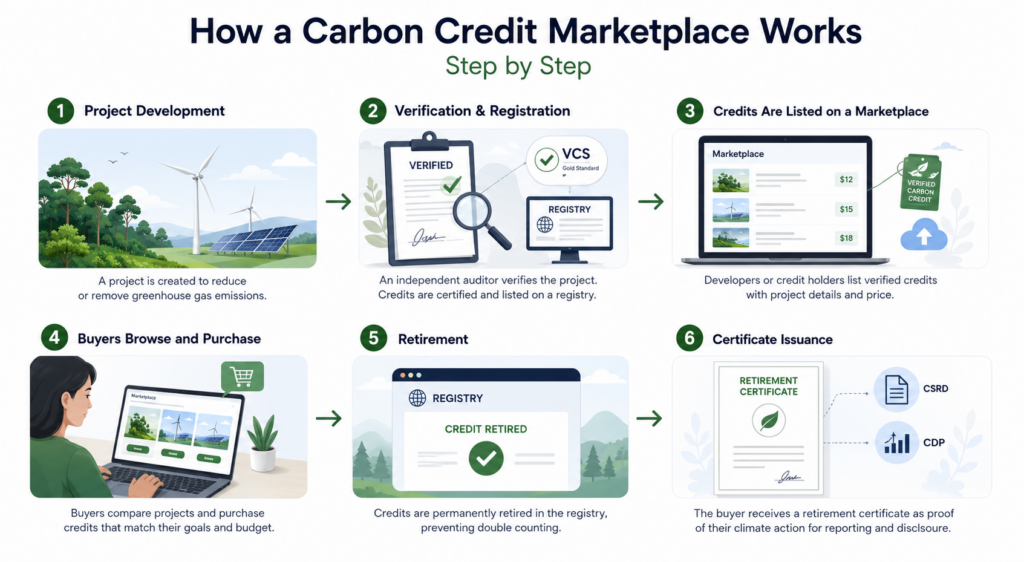
How a Carbon Credit Marketplace Works: Step by Step
Understanding the mechanics helps you use any marketplace more effectively.
Step 1: Project Development A landowner, renewable energy company, or conservation group creates a project that reduces or removes greenhouse gas emissions. This could be protecting a rainforest, building wind turbines, or manufacturing biochar.
Step 2: Verification and Registration An independent auditor verifies that the project genuinely reduces emissions. A recognized carbon standard like Verra’s Verified Carbon Standard (VCS) or the Gold Standard then certifies the credits and lists them on a registry.
Step 3: Credits Are Listed on a Marketplace Project developers or credit holders list their verified credits on a marketplace. Each listing includes the project type, location, vintage year, verification standard, and price.
Step 4: Buyers Browse and Purchase Corporate buyers, sustainability teams, or individual consumers browse the marketplace, compare projects, and purchase credits that match their goals and budget.
Step 5: Retirement Once a buyer uses a credit to offset emissions, the credit is permanently retired from the registry. This prevents double counting and ensures each tonne is only used once.
Step 6: Certificate Issuance The buyer receives a retirement certificate as auditable proof of their climate action. This document can be included in sustainability reports and disclosed under frameworks like the CSRD or CDP.
What Makes a Good Carbon Credit Marketplace?
Not all platforms are created equal. Here is what separates a trustworthy marketplace from a low-quality one.
Project Quality Standards The best marketplaces only list projects verified by credible standards. Look for Verra (VCS), Gold Standard, Climate Action Reserve (CAR), American Carbon Registry (ACR), or Puro.earth for engineered removals. Since the Integrity Council for the Voluntary Carbon Market (ICVCM) introduced its Core Carbon Principles (CCPs), many top platforms now label or filter for CCP-eligible credits.
Independent Ratings The market has shifted toward a financial-markets approach where buyers want third-party quality ratings, not just registry certification. Independent rating agencies like BeZero Carbon, Sylvera, Calyx Global, and MSCI Carbon score projects on a scale similar to bond ratings. Leading marketplaces now display these ratings directly on their trading screens.
Price Transparency Reputable platforms show live or recently settled prices. Hidden fees and opaque pricing are red flags.
Liquidity A marketplace with deep liquidity means more buyers and sellers, tighter spreads, and easier execution. Thin liquidity makes it harder to buy or sell at a fair price.
Settlement Efficiency Top platforms settle trades quickly, sometimes on the same day. Slow settlement adds cost and operational risk.
Registry Coverage The best platforms connect to multiple registries so buyers can access a wide range of project types from a single account.
Top Carbon Credit Marketplaces in the World
Here is a detailed look at the leading platforms shaping the global carbon credit market.
1. Xpansiv (CBL Exchange)
Best for: Institutional traders, corporate buyers, and anyone who wants exchange-grade liquidity in voluntary carbon credits.
Xpansiv is the infrastructure backbone of the voluntary carbon market. Its CBL exchange is the world’s most active spot marketplace for environmental commodities, including carbon credits and renewable energy certificates.
Since launching the first standardized voluntary carbon market contract in 2020, Xpansiv has facilitated transactions involving more than 330 million carbon credits and environmental certificates. The platform offers a central limit order book with full depth-of-book transparency, instant trade matching, and same-day (T+0) settlement.
One of CBL’s most important innovations is the Global Emissions Offset (GEO) standardized spot contract. This was the first VCM bellwether contract, giving the market a benchmark price for the first time. CBL also offers CCP-labeled GEO contracts for buyers who want ICVCM-approved credits specifically.
Sylvera carbon credit ratings now appear directly on CBL’s trading screen, making it easier for buyers to assess project quality before executing a trade.
Xpansiv also connects to 15+ registries including Verra, Gold Standard, ACR, CAR, and its own C-Capsule registry for high-permanence carbon dioxide removal. Its Evolution Markets brokerage arm handles complex structured transactions, forward contracts, and OTC trades.
For airlines specifically, the ACE platform (powered by CBL) provides access to CORSIA-eligible credits for international aviation compliance.
Key highlights:
- World’s most active voluntary carbon spot exchange
- 330 million+ credits facilitated since inception
- T+0 settlement via integrated registry network
- Sylvera ratings integrated on trading screen
- Standardized GEO and CCP-GEO benchmark contracts
- Connects to 15+ registries globally
2. AirCarbon Exchange (ACX)
Best for: Global buyers seeking a fully digital, regulated exchange with transparent pricing and simplified market entry.
AirCarbon Exchange (ACX) was launched in Singapore in 2019 and has grown into a leading global digital exchange for carbon credits and other environmental assets. The platform now serves more than 190 members from over 30 countries, including corporations, traders, financial institutions, and project developers.
ACX has transacted over 21 million tonnes of CO2 equivalent (MtCO2e) since launch. The exchange has won the Environmental Finance Voluntary Carbon Market Rankings award for Best Carbon Exchange, reflecting its strong reputation for technology and market structure.
A major milestone came when ACX launched the world’s first fully regulated carbon exchange and clearing house in the Abu Dhabi Global Market (ADGM), adding a regulatory framework that gives institutional buyers additional confidence.
One of ACX’s most useful features for new market participants is that members do not need to open separate registry accounts to access carbon credits. The platform handles trading, custody, and portfolio management in a single, streamlined experience.
ACX has also expanded internationally through partnerships with the Athens Stock Exchange (Greece) and the Johannesburg Stock Exchange (South Africa), broadening global market access through CBL’s infrastructure.
Key highlights:
- 190+ members across 30+ countries
- 21+ MtCO2e total transacted volume
- World’s first regulated carbon exchange and clearing house (ADGM)
- No separate registry account needed
- Covers CORSIA compliance credits and voluntary carbon credits
- Winner of Best Carbon Exchange at Environmental Finance VCM Rankings
3. Intercontinental Exchange (ICE)
Best for: Compliance market participants, financial institutions, and large corporates managing carbon price risk.
The Intercontinental Exchange (ICE) is one of the world’s largest financial exchanges and a dominant force in both compliance and voluntary carbon markets. ICE offers futures, options, and spot products across the EU ETS, the California Cap-and-Trade Program, the UK ETS, RGGI, and voluntary carbon markets.
ICE’s North American environmental markets reached record activity, with 6.2 million contracts traded in a single year, including 4.2 million California Carbon Allowance contracts. This depth makes ICE the preferred venue for companies and financial institutions managing large carbon exposures or hedging price risk.
For companies with compliance obligations, ICE provides the liquidity and reliability they need to manage carbon costs effectively. For sophisticated voluntary buyers, ICE also lists products tied to the voluntary carbon market.
ICE is not typically the starting point for small businesses or individuals, but for treasury teams, commodity traders, and institutional buyers, it remains essential.
Key highlights:
- World’s largest carbon futures and options exchange
- Covers EU ETS, California Cap-and-Trade, UK ETS, RGGI
- 6.2 million contracts traded annually in North American environmental markets
- Preferred by financial institutions for carbon price risk management
- Deep liquidity and reliable price discovery
4. Carbonmark
Best for: Companies, sustainability teams, and individuals who want a transparent, blockchain-enabled self-service marketplace.
Carbonmark is a public marketplace built on blockchain infrastructure, operated by KlimaDAO. It offers access to 150+ verified carbon projects across 20+ countries, spanning a wide range of project types from forest conservation to engineered removals.
One of Carbonmark’s most accessible features is its fractional purchasing. Buyers can start with as little as 0.001 tonnes (1 kilogram), which is perfect for individuals offsetting a single flight or small businesses testing the market. Payment is straightforward via credit card or bank transfer.
Every retirement on Carbonmark is recorded on a publicly verifiable blockchain, creating an immutable and auditable trail. Buyers receive instant retirement confirmation, and the entire process takes minutes from browsing to certificate.
Carbonmark also provides an API for businesses that want to automate carbon credit procurement and retirement at scale. Projects are listed from registries including Verra, the International Carbon Registry (ICR), and others.
Key highlights:
- 150+ verified projects in 20+ countries
- Fractional purchasing from 0.001 tonnes
- Blockchain-enabled retirement with public audit trail
- Instant settlement and certificate issuance
- API available for automated, large-scale procurement
- Credit card and bank transfer supported
5. Patch
Best for: Enterprise buyers who want software-driven procurement, data transparency, and access to the widest selection of high-integrity projects.
Patch is not a traditional marketplace. It is better described as enterprise carbon procurement software with an embedded marketplace of over 25,000 projects, including 100% of projects from ICROA-endorsed standards.
What sets Patch apart is its data layer. The platform aggregates project data from Verra, Gold Standard, ACR, CAR, Puro.earth, Isometric, and others, giving buyers unparalleled visibility into available supply. Corporate buyers can filter by project type, standard, vintage, registry, geography, BeZero rating, and Sylvera tier.
According to Patch’s own market research, 79% of corporate buyers now require a BeZero BBB or higher rating on credits they purchase, and 83% require a Sylvera Tier 2 or higher. Patch’s platform is designed to make this kind of quality-filtered procurement straightforward.
Patch also offers API integration so companies can embed carbon procurement directly into their own products and workflows.
Key highlights:
- 25,000+ projects including all ICROA-endorsed credits
- Enterprise procurement software with deep data layer
- Integrates BeZero and Sylvera ratings for quality filtering
- API-first for workflow automation
- Covers avoidance, reduction, and removal credit types
- Supports forward offtake and long-term supply agreements
6. ClimateTrade
Best for: Companies that want a broker-free, blockchain-backed self-service marketplace with over 200 projects and API integration for carbon-neutral products.
ClimateTrade is a Spain-based marketplace that has built a strong reputation for transparency, ease of use, and a diverse project catalogue. The platform lists over 200 certified projects globally, ranging from reforestation and renewable energy to ocean plastic removal and direct carbon removal.
Every transaction on ClimateTrade is recorded on the blockchain, giving buyers verifiable, tamper-proof proof of their offset. The platform generates customizable impact certificates for each purchase, which companies can use directly in sustainability reports and RFP responses.
What makes ClimateTrade particularly useful for product companies is its API and SaaS offering. Businesses can integrate ClimateTrade’s technology directly into their own websites, apps, or point-of-sale systems, allowing them to offer carbon-neutral products or services to end consumers.
ClimateTrade offers three plans: Basic, Business, and Enterprise, making it accessible to a wide range of company sizes.
Key highlights:
- 200+ certified projects across multiple categories
- Blockchain-verified transactions with customizable certificates
- No broker required, direct digital purchasing
- API and SaaS integration for carbon-neutral products
- Available in Basic, Business, and Enterprise plans
- Strong focus on UN Sustainable Development Goal co-benefits
7. South Pole
Best for: Large corporations that want a full-service partner combining project development, credit procurement, and net-zero strategy advisory.
South Pole is one of the largest and most established carbon project developers and brokers in the world. While not a traditional exchange or self-service marketplace, South Pole operates a marketplace-like platform that connects buyers to its extensive portfolio of projects.
Where South Pole differs from pure technology marketplaces is its advisory depth. The company works with large corporations to design and implement comprehensive net-zero strategies, not just sell credits. Its team helps buyers align purchases with frameworks like SBTi, CSRD, and the Oxford Principles, ensuring credits fit within a credible wider strategy.
South Pole develops projects across forest conservation, renewable energy, clean cookstoves, soil carbon, and more, in dozens of countries. Its global footprint and project development expertise make it a go-to partner for buyers who need both quality assurance and strategic support.
Key highlights:
- One of the largest carbon project developers globally
- Full-service net-zero strategy advisory
- Projects verified by Verra, Gold Standard, and other leading standards
- Alignment with SBTi, CSRD, CDP, and Oxford Principles
- Suitable for large volumes and long-term supply agreements
- Publishes annual Carbon Market Buyer’s Guide
8. KlimaDAO and Toucan Protocol
Best for: Web3-native buyers and sellers who want blockchain-based trading of tokenized carbon credits.
Toucan Protocol and KlimaDAO represent the decentralized finance (DeFi) side of carbon markets. Toucan built the infrastructure to tokenize carbon credits from traditional registries like Verra, bringing them onto the blockchain as digital tokens. Toucan has tokenized nearly 22 million Verra credits since its launch.
KlimaDAO uses these tokenized credits to operate decentralized carbon pools and its Carbonmark marketplace. The protocol’s retirement aggregator allows buyers to purchase and retire credits using a range of digital payment assets, with every retirement recorded immutably onchain.
KlimaDAO is also pioneering blockchain-based carbon trading in Japan, in collaboration with Mizuho Financial Group and others, using Japan’s J-Credit system as the foundation for a blockchain transaction demonstration.
It is important to note that while blockchain adds transparency and settlement efficiency, the underlying climate integrity of credits depends on the original registry and project documentation. Buyers should apply the same quality standards here as on any other platform.
Key highlights:
- Toucan Protocol has tokenized 22 million+ Verra credits
- Onchain retirement creates immutable, public proof
- KlimaDAO operates Carbonmark marketplace and retirement aggregator
- Partnering with Mizuho in Japan for J-Credit blockchain transactions
- Supports payment in a range of digital assets
Worth Checking Out
Carbon Compared
Carbon Compared is a free platform for comparing carbon credit projects side by side. Buyers can filter and compare projects by price per tonne, independent ratings from BeZero Carbon, MSCI and Calyx Global, number of co-benefits, removal vs avoidance, and project and developer location. Crucially, buyers can connect directly with project developers to request quotes, without going through a broker.
Carbon Credit Marketplace Comparison Table
| Marketplace | Best For | Credit Types | Settlement | Price Range |
|---|---|---|---|---|
| Xpansiv (CBL) | Institutional/corporate spot trading | VCUs, GEOs, RECs | T+0 | Market price |
| AirCarbon Exchange (ACX) | Global digital exchange, CORSIA | Voluntary + CORSIA | Near real-time | Market price |
| ICE | Compliance market hedging | EUAs, CCAs, voluntary futures | Exchange standard | $35 to $98+ |
| Carbonmark | SMEs, individuals, blockchain buyers | VCS, ICR, Puro.earth | Instant | $8 to $400+ |
| Patch | Enterprise procurement software | 25,000+ projects, all types | Flexible | Varies |
| ClimateTrade | Product companies, SMEs | 200+ certified projects | Instant | Varies |
| South Pole | Large corporates, advisory-led | VCS, Gold Standard | Contract-based | Premium |
| KlimaDAO / Toucan | Web3 buyers | Tokenized carbon credits | Blockchain instant | Market price |
How to Choose the Right Carbon Credit Marketplace
The right marketplace depends on your goals, budget, and level of experience.
If you are an individual or small business: Start with Carbonmark or ClimateTrade. Both allow you to browse projects, understand what you are buying, and make a purchase without needing a trading account or broker. Carbonmark lets you start with as little as one kilogram of CO2.
If you are a mid-sized or large company: Patch gives you the deepest project database and enterprise-grade procurement tools. South Pole is ideal if you also need advisory support to build a broader net-zero strategy.
If you are an institutional buyer or financial trader: Xpansiv CBL and ICE are built for you. Both offer exchange-grade liquidity, standardized contracts, and sophisticated order types.
If you need CORSIA compliance for aviation: ACX’s ACE platform and Xpansiv’s ACE solution (powered by CBL) specialize in CORSIA-eligible credits.
If you are Web3-native: KlimaDAO’s Carbonmark and Toucan Protocol provide blockchain-based trading and retirement infrastructure.
Questions to Ask Before Choosing a Marketplace
- Does the platform list projects verified by recognized standards like Verra, Gold Standard, ACR, or Puro.earth?
- Does it display independent ratings from BeZero, Sylvera, or Calyx Global?
- Are pricing and fees transparent?
- Can I filter by project type, vintage, geography, and registry?
- Does it provide auditable retirement certificates for sustainability reporting?
- Does it integrate with frameworks I need to comply with, such as CSRD, CDP, or SBTi?
Understanding Carbon Credit Quality in Today’s Market
Buying from a marketplace does not automatically mean buying a high-quality credit. Credit quality has become the defining issue of the modern carbon market.
A 2024 study by the Max Planck Institute found that a large portion of issued credits did not represent genuine emissions reductions. This finding pushed the market toward stricter quality standards and independent verification.
Today, the ICVCM’s Core Carbon Principles represent the most widely accepted quality benchmark for the voluntary market. Credits that meet these principles are labeled as CCP-eligible and carry a premium. Buyers building CSRD-compliant or SBTi-aligned portfolios typically focus exclusively on CCP-eligible, recently-vintaged, third-party-rated credits.
In practice, this means:
- Prefer newer vintages. Older credits, especially pre-2020 renewable energy credits, carry higher additionality risk.
- Check independent ratings. Credits rated BeZero BBB or higher, or Sylvera Tier 2 or higher, reflect the quality standard most serious corporate buyers now require.
- Distinguish between avoidance and removal. Avoidance credits prevent future emissions. Removal credits take CO2 out of the atmosphere. Both have a role, but removal credits are increasingly preferred for high-integrity claims, especially as net-zero deadlines approach.
- Watch for co-benefits. Projects with verified social or biodiversity benefits, such as Gold Standard projects with SDG certifications, often carry a premium but deliver additional value for stakeholder communications.
Carbon Credit Price Ranges by Type
| Credit Type | Typical Price Range |
|---|---|
| Lower-rated nature-based avoidance | €8 to €15 per tonne |
| High-quality nature-based (REDD+, IFM) | €15 to €50 per tonne |
| Soil carbon and regenerative agriculture | €22 to €60 per tonne |
| Biochar and enhanced rock weathering | €80 to €300 per tonne |
| Direct air capture (DAC) | €400+ per tonne |
| EU ETS compliance allowances | ~€84 per tonne (current) |
The Carbon Credit Marketplace Landscape: What’s Changing
The market is evolving quickly. Here are the key trends shaping carbon credit marketplaces right now.
The flight to quality is accelerating. Corporate buyers are moving away from cheap, low-rated credits toward high-integrity, recently-vintaged projects. In one recent measurement period, credits rated A or higher by MSCI Carbon accounted for 36% of total retirement value despite representing a smaller share of volume.
Independent ratings are becoming standard. BeZero, Sylvera, Calyx Global, and MSCI Carbon have moved from niche tools to core procurement infrastructure. Leading marketplaces now integrate these ratings directly into their trading screens.
The Paris Agreement is reshaping supply. Article 6 of the Paris Agreement governs the international trade of carbon credits across borders. As Article 6 rules become operational, some credits will carry additional government authorization, creating a new premium tier in the market. Gold Standard and Verra have already joined with Singapore to publish a joint Article 6.2 Crediting Protocol.
Blockchain is improving transparency. Platforms like Carbonmark, ClimateTrade, and KlimaDAO are using blockchain to create immutable retirement records, reducing concerns about double counting and improving auditability.
Engineered removals are growing. As net-zero deadlines approach, demand for high-permanence carbon removal via biochar, enhanced rock weathering, direct air capture, and ocean-based methods is rising sharply. Over 80% of high-durability carbon removal capacity needs additional offtake commitments to become reality.
Demand is rising despite a supply correction. In a recent annual measurement, corporate climate commitments surged 227% while carbon credit retirements fell 7%. This widening gap between ambition and action suggests significant unmet demand that will likely drive market growth and price increases in the near future.
How to Buy Carbon Credits on a Marketplace: A Step-by-Step Guide
Here is a practical walkthrough using a typical retail marketplace like Carbonmark or ClimateTrade.
Step 1: Estimate Your Emissions Before buying, calculate how much CO2 you want to offset. Many marketplaces have built-in calculators. For a business, this typically means using annual emission data from your operations, travel, and supply chain. For individuals, online carbon footprint calculators cover flights, household energy use, and transport.
Step 2: Create an Account Register on the marketplace of your choice. For retail platforms, this takes a few minutes. Institutional platforms like Xpansiv CBL require a more detailed onboarding and account qualification process.
Step 3: Browse Projects Use the search and filter tools to find projects that match your priorities. Filter by standard (Verra, Gold Standard, Puro.earth), project type (forests, renewables, removal), geography, vintage, and price. Check independent ratings where available.
Step 4: Review Project Details Click on a project to read its full documentation. Look for the monitoring and verification report, the registry listing, the vintage, and any available quality ratings. A transparent marketplace will link directly to the registry record.
Step 5: Select Your Volume Enter the number of tonnes you want to purchase. Most platforms allow fractional purchases for smaller buyers.
Step 6: Purchase and Retire Complete the payment. On most retail platforms, payment via credit card or bank transfer is instant. The credits are retired from the registry immediately or shortly after, removing them permanently from circulation.
Step 7: Download Your Certificate Save your retirement certificate. This document records the project name, standard, vintage, volume, retirement date, and beneficiary details. Use it in your sustainability report, CDP disclosure, or CSRD filing.
Frequently Asked Questions About Carbon Credit Marketplaces
What is the difference between a carbon credit marketplace and a carbon registry?
A registry like Verra or Gold Standard is where carbon credits are issued, tracked, and retired. It is essentially the record-keeping system. A marketplace is where those credits are bought and sold. Some registries operate their own marketplaces, but most marketplaces connect to multiple registries.
Can individuals buy carbon credits on a marketplace?
Yes. Platforms like Carbonmark and ClimateTrade are accessible to individuals. Carbonmark allows purchases starting from 1 kilogram (0.001 tonnes), making it practical for offsetting a single flight or a small personal carbon footprint.
How do I know if a carbon credit is high quality?
Look for three things: verification by a recognized standard (Verra, Gold Standard, ACR, Puro.earth), a CCP label from the ICVCM, and an independent rating from BeZero, Sylvera, or Calyx Global. A credit that meets all three criteria gives you high confidence in its integrity.
What is credit retirement and why does it matter?
Retirement is the permanent removal of a credit from the market after it has been used to offset emissions. Once retired, a credit cannot be resold or used again. This is what prevents double counting. Always ensure you receive a retirement certificate that includes the registry retirement ID.
Are carbon credits regulated?
Compliance credits (like EU ETS allowances) are heavily regulated by governments. Voluntary carbon credits operate under private standards and are not mandatory, though frameworks like the ICVCM’s Core Carbon Principles, CSRD disclosure requirements, and the SBTi’s guidance are increasingly shaping quality expectations across the voluntary market.
What is the cheapest carbon credit marketplace to use?
Price depends on the credit type, not just the marketplace. Lower-rated nature-based credits can trade under €10 per tonne, while engineered removal credits cost €400 or more. Retail platforms like Carbonmark and ClimateTrade charge no broker markup. Exchange platforms like Xpansiv CBL charge standard exchange fees. South Pole and advisory-led providers charge a premium for the strategic support they provide.
What is a CCP label and should I look for it?
CCP stands for Core Carbon Principles, a quality framework developed by the Integrity Council for the Voluntary Carbon Market (ICVCM). Credits that earn a CCP label have been assessed against a rigorous set of criteria covering environmental integrity, additionality, and reporting standards. CCP-labeled credits are increasingly the minimum standard for corporate buyers making public-facing climate claims.
Can I buy and sell carbon credits on the same platform?
Yes, on exchange-based platforms like Xpansiv CBL and ACX, you can both buy and sell. Retail marketplaces like Carbonmark and ClimateTrade are primarily designed for buyers. Project developers looking to sell credits at scale typically work with brokers, exchanges, or advisory firms like South Pole.
Final Thoughts: Choosing the Right Carbon Credit Marketplace
The carbon credit marketplace landscape has matured dramatically. What was once an opaque, broker-dominated market is now a transparent, technology-driven ecosystem with platforms for every type of buyer.
The most important lesson is this: the marketplace you use matters less than the quality of the credits you buy.
Whichever platform you choose, prioritize projects verified by recognized standards, filter for independent ratings from BeZero, Sylvera, or Calyx Global, focus on recent vintages, and always insist on a proper retirement certificate for your records.
For individual buyers and small businesses, Carbonmark and ClimateTrade offer the easiest entry points. For enterprise buyers, Patch and South Pole provide depth, data, and strategic support. For institutional and professional traders, Xpansiv CBL and ICE are the global benchmarks.
The voluntary carbon market is growing fast. Companies that understand how to navigate carbon credit marketplaces effectively, and that move early to secure high-quality supply, will be in the strongest position as corporate climate commitments move from aspiration to legal obligation.
Now you have everything you need to take that first step.
If you want to keep learning about carbon markets, ESG strategy, and sustainability trends, explore more resources on Carbon Market Network.