Carbon Market Network


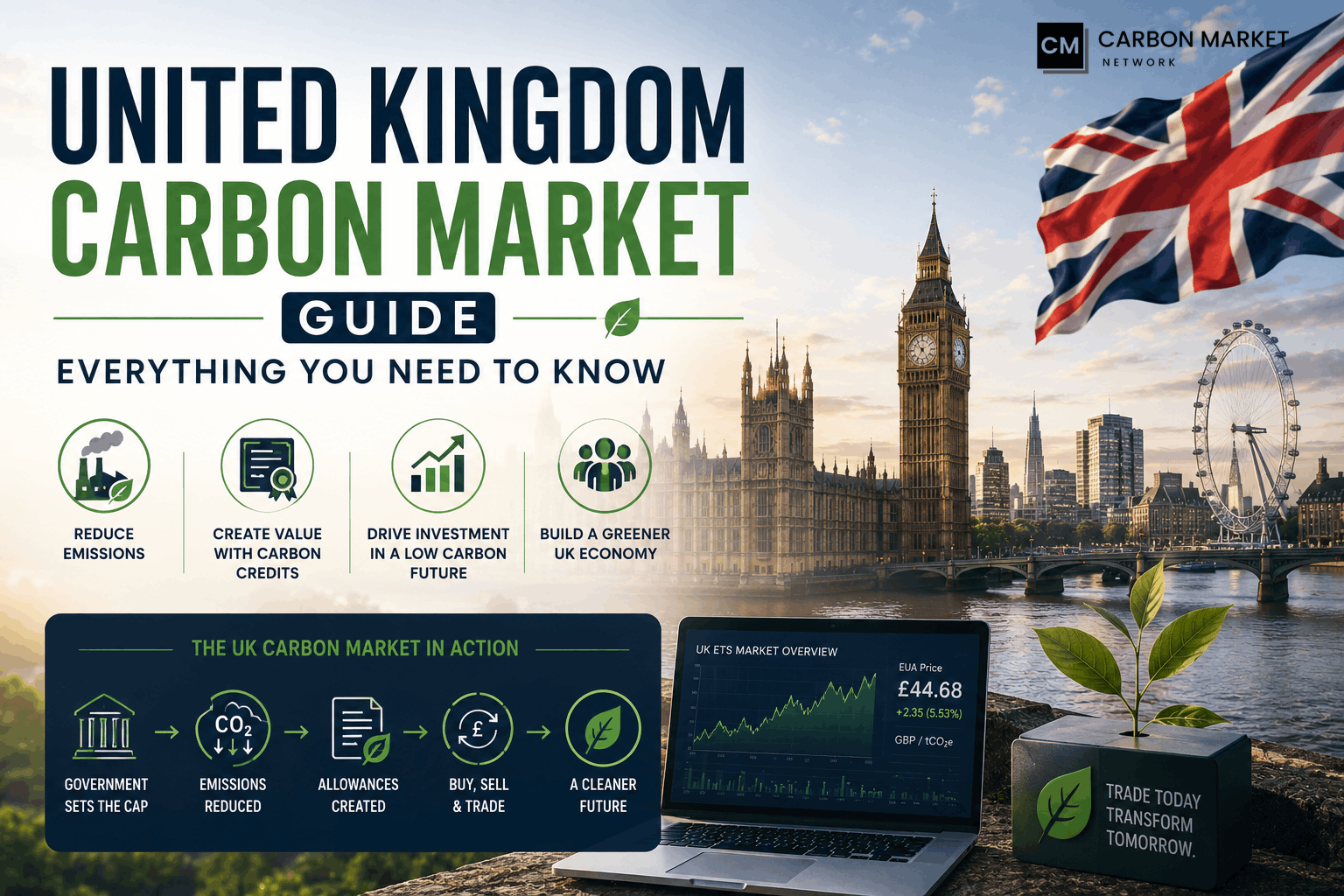
If you search for “carbon market UK” today, you will find a maze of scheme names, price tables, and policy jargon. This United Kingdom carbon market guide cuts through that noise.
Whether you run a factory, manage a portfolio, or simply want to understand how Britain prices carbon, this guide gives you the full picture in plain English.
The United Kingdom carbon market is one of the most closely watched trading systems in the world. It shapes energy bills, industrial investment, and the country’s path to net zero.
By the end of this guide, you will understand how the UK ETS works, what drives carbon prices, who needs to comply, and how the voluntary carbon market fits alongside it.
Let’s get started.
What Is the United Kingdom Carbon Market?
The United Kingdom carbon market is the system Britain uses to put a price on greenhouse gas emissions.
It works on a simple idea. Companies that pollute must pay for that pollution. Companies that cut emissions can sell their spare allowances for profit.
The UK carbon market has two main parts:
- The UK Emissions Trading Scheme (UK ETS): a mandatory cap-and-trade system for heavy industry, power generation, and aviation.
- The UK voluntary carbon market: a space where businesses buy carbon credits voluntarily to support climate goals beyond legal requirements.
Together, these systems push the UK toward its legally binding target of reaching net zero emissions.
Carbon Market Insider Newsletter
Weekly insights on carbon markets, climate policy, carbon credits, and sustainability.
A Quick History of the UK Carbon Market
Understanding where the UK carbon market came from helps explain how it works today.
Before Brexit, UK installations traded under the EU Emissions Trading System (EU ETS) (website). After leaving the European Union, Britain needed its own scheme.
The government launched the UK Emissions Trading Scheme to replace EU ETS participation for domestic installations. This gave the UK full control over its own carbon price, cap, and rules.
Since launch, the scheme has expanded steadily. New sectors, tighter caps, and new mechanisms like the Carbon Border Adjustment Mechanism have all been added or announced.
The direction is clear. The UK carbon market is becoming stricter, broader, and more closely tied to global carbon pricing systems.
How the UK ETS Works
The UK ETS is the backbone of the United Kingdom carbon market. Here is how the mechanics work.
The Cap
The government sets a cap on total emissions allowed across all participating installations.
This cap shrinks every year. A smaller cap means fewer allowances, which pushes companies to cut emissions or pay more for permits.
The Allowances
Each UK Allowance (UKA) represents the right to emit one tonne of carbon dioxide equivalent.
Companies must hold enough allowances to cover their verified emissions. If they emit more than they hold allowances for, they face penalties.
Auctions and Free Allocation
Allowances enter the market in two ways:
- Auctions: Most allowances are sold through regular government auctions.
- Free allocation: Industries at high risk of “carbon leakage” (moving production abroad to avoid carbon costs) receive some allowances for free.
Free allocation is gradually shrinking as the Carbon Border Adjustment Mechanism takes over the job of protecting UK industry from unfair overseas competition.
The Secondary Market
Once allowances are issued, they can be traded freely on the secondary market, mainly through ICE Futures Europe.
This is where the real “market” in carbon market comes alive. Prices move based on supply, demand, energy costs, and weather patterns.
Compliance and Penalties
Every year, companies must:
- Monitor and report their emissions.
- Get emissions data independently verified.
- Surrender enough allowances to cover verified emissions by the annual deadline.
Failing to surrender enough allowances brings a heavy financial penalty per tonne of shortfall, in addition to still needing to make up the difference.
Who Needs to Comply With the UK ETS?
The UK ETS applies to specific sectors. Here is a simple breakdown.
| Sector | Included Activities | Status |
|---|---|---|
| Power generation | Electricity and heat production above emissions thresholds | Fully covered |
| Energy-intensive industry | Steel, cement, glass, lime, paper, chemicals, aluminium | Fully covered |
| Aviation | Domestic flights and flights to the European Economic Area | Fully covered |
| Offshore oil and gas | Emissions from offshore platforms | Fully covered |
| Maritime | Domestic voyages and emissions at UK ports | Being phased in |
| Energy from waste | Waste incineration above set thresholds | Voluntary monitoring phase, moving toward full inclusion |
| Greenhouse gas removals | Direct air capture and similar technologies | Planned for future inclusion |
Installations below a certain emissions threshold can apply for simplified treatment, such as the Ultra-Small Emitter or Small Emitter opt-out schemes, which reduce the compliance burden for very low emitters.
UK Carbon Prices: What Drives Them?
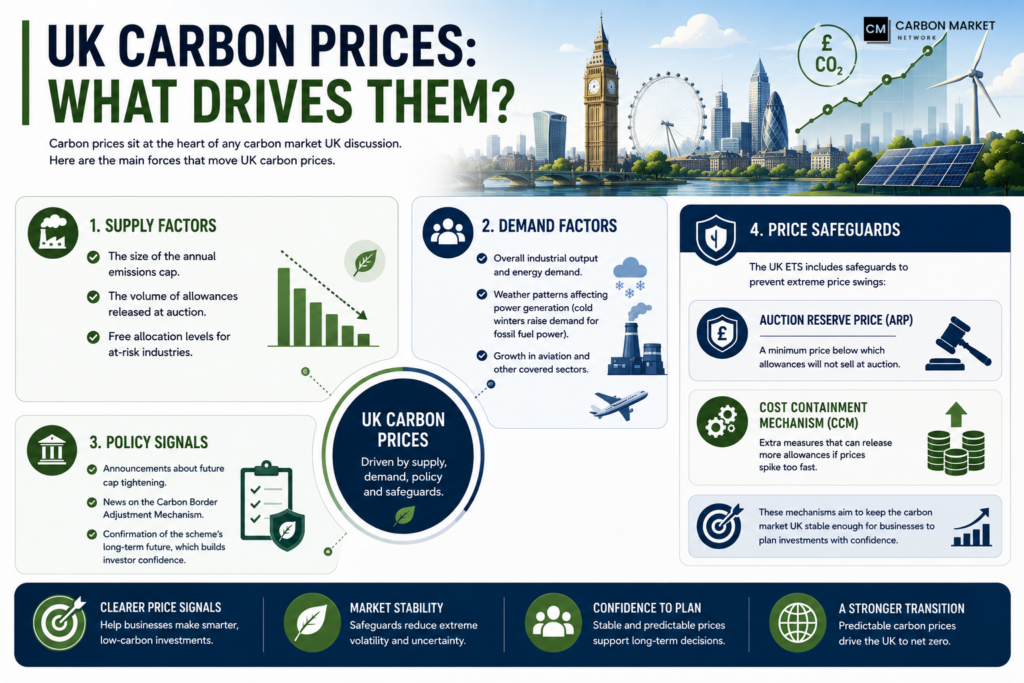
Carbon prices sit at the heart of any carbon market UK discussion. Here are the main forces that move UK carbon prices.
Supply Factors
- The size of the annual emissions cap.
- The volume of allowances released at auction.
- Free allocation levels for at-risk industries.
Demand Factors
- Overall industrial output and energy demand.
- Weather patterns affecting power generation (cold winters raise demand for fossil fuel power).
- Growth in aviation and other covered sectors.
Policy Signals
- Announcements about future cap tightening.
- News on the Carbon Border Adjustment Mechanism.
- Confirmation of the scheme’s long-term future, which builds investor confidence.
Price Safeguards
The UK ETS includes safeguards to prevent extreme price swings:
- Auction Reserve Price (ARP): a minimum price below which allowances will not sell at auction.
- Cost Containment Mechanism (CCM): extra measures that can release more allowances if prices spike too fast.
These mechanisms aim to keep the carbon market UK stable enough for businesses to plan investments with confidence.
UK ETS vs EU ETS: What Is the Difference?
Many people confuse the UK ETS with the EU ETS. Here is a clear comparison.
| Feature | UK ETS | EU ETS |
|---|---|---|
| Coverage | UK-based installations only | European Union member states |
| Governance | UK ETS Authority | European Commission and member states |
| Price history | Historically traded at a discount to EU ETS | Generally higher and more liquid |
| Linkage | Currently independent, discussions about closer alignment ongoing | Independent system, larger market size |
| Sector scope | Power, industry, aviation, expanding to maritime and waste | Power, industry, aviation, maritime, and a separate buildings and transport scheme |
Northern Ireland power generators remain linked to the EU ETS because of the integrated electricity market with Ireland. This is one of the more unusual features of the UK carbon market.
The Carbon Border Adjustment Mechanism (CBAM)
The UK is introducing its own Carbon Border Adjustment Mechanism to sit alongside the UK ETS.
Here is why it matters.
Without a border mechanism, UK producers pay a carbon price while foreign competitors may not. This can push companies to move production overseas, a problem known as carbon leakage.
The UK CBAM solves this by applying a carbon price to certain imported goods, including:
- Aluminium
- Cement
- Fertilisers
- Hydrogen
- Iron and steel
This creates a level playing field. Domestic and imported goods face a comparable carbon cost, protecting UK industry while still supporting emissions reduction goals.
As the CBAM rolls out, free allocation for these sectors under the UK ETS will gradually reduce, since the CBAM takes over the job of protecting competitiveness.
Expansion of the UK Carbon Market
The United Kingdom carbon market is not standing still. Several sectors are being added or considered.
Maritime Sector
Domestic shipping voyages and emissions at UK ports are being brought into the scheme. This mirrors similar moves already made in the EU ETS for maritime transport.
Energy from Waste
Waste incineration plants are moving through a voluntary monitoring phase first. This lets operators get familiar with reporting requirements before facing financial obligations.
Greenhouse Gas Removals
Technologies like direct air capture and bioenergy with carbon capture and storage are expected to join the scheme. This would let engineered carbon removal generate tradeable value within the compliance market.
Long-Term Commitment
The authorities have confirmed a second phase of the scheme extending well into the future. This long-term signal matters because industries like power generation and heavy manufacturing plan investments decades in advance.
A confirmed long runway for the UK ETS gives businesses confidence to invest in low-carbon technology today.
The UK Voluntary Carbon Market
Alongside the mandatory UK ETS, a separate voluntary carbon market UK ecosystem is growing fast.
What Is the Voluntary Carbon Market?
Companies that are not legally required to buy carbon allowances can still purchase carbon credits voluntarily. These credits typically fund projects like:
- Forest protection and reforestation
- Renewable energy in developing countries
- Methane capture from landfills or agriculture
- Direct air capture and other removal technologies
The UK’s Ambition
The UK government has expressed a clear ambition to become a global hub for voluntary carbon markets. This includes:
- Supporting high-integrity standards for carbon credits.
- Encouraging London’s financial sector to develop carbon trading expertise.
- Building trust in the market through better transparency and verification.
Why It Matters for Businesses
Even companies outside the UK ETS can benefit from engaging with the voluntary carbon market. Reasons include:
- Meeting corporate net zero commitments.
- Responding to customer and investor pressure on climate action.
- Building experience with carbon markets before future regulation expands.
Step-by-Step: How a Company Complies With the UK ETS
If your business falls under UK ETS rules, here is the general compliance journey.
- Determine if you are covered. Check your sector and emissions thresholds against the scope of the scheme.
- Apply for a permit. Installations need a greenhouse gas emissions permit before operating under the scheme.
- Monitor emissions. Use approved methods to track your greenhouse gas output throughout the year.
- Get emissions verified. An independent verifier checks your reported data for accuracy.
- Report annually. Submit your verified emissions report to the regulator by the required deadline.
- Surrender allowances. Hand over enough UKAs to cover your verified emissions.
- Manage your allowance position. Buy allowances at auction or on the secondary market if you are short, or sell surplus allowances if you have extra.
Missing steps 5 or 6 can trigger financial penalties, so most companies build in buffer allowances well ahead of deadlines.
Practical Tips for Businesses Engaging With the UK Carbon Market
Here are actionable takeaways for anyone dealing with the UK carbon market, whether directly regulated or exploring voluntary participation.
- Track policy announcements closely. Free allocation rules, cap changes, and new sector inclusions can shift costs quickly.
- Hedge price risk. Forward contracts help lock in allowance costs and avoid surprises from price spikes.
- Invest early in efficiency. Cutting emissions reduces your allowance needs permanently, unlike buying allowances which is a recurring cost.
- Watch the CBAM rollout. If you import covered materials, factor future border carbon costs into supply chain decisions.
- Consider voluntary credits carefully. Choose credits from reputable standards with strong verification to avoid reputational risk.
- Build internal carbon literacy. Train finance and operations teams to understand carbon costs, since they increasingly affect budgeting and strategy.
Common Challenges in the UK Carbon Market
No market is without friction. Some of the ongoing debates in the United Kingdom carbon market include:
- Price gap with the EU ETS. UK carbon prices have often traded below EU levels, raising concerns about lost government revenue and weaker investment signals for clean energy.
- Balancing competitiveness and ambition. Regulators must protect UK industry from carbon leakage while still driving genuine emissions cuts.
- Complexity of expansion. Adding new sectors like maritime and waste requires new monitoring systems and stakeholder coordination.
- Market confidence. Businesses need certainty that rules will not change abruptly, which is why long-term commitments like Phase II matter so much.
The Future of the United Kingdom Carbon Market
Looking ahead, several trends will shape the carbon market UK landscape:
- Tighter caps as the scheme aligns more closely with binding carbon budgets.
- Broader sector coverage, especially maritime, waste, and greenhouse gas removals.
- A functioning CBAM that reshapes import costs for carbon-intensive goods.
- Growing voluntary market activity, positioning London as a serious global centre for carbon trading and finance.
- Possible closer alignment with other carbon markets, which could support price stability and reduce administrative complexity for businesses trading across borders.
The direction of travel is consistent. The United Kingdom carbon market is maturing into a long-term, structurally important part of the UK economy.
Conclusion
The United Kingdom carbon market has grown from a post-Brexit necessity into a serious policy tool with global relevance.
Through the UK ETS, the government caps emissions from power, industry, and aviation, while pushing that cap lower every year.
Through the emerging Carbon Border Adjustment Mechanism, the UK protects domestic industry while extending carbon pricing to imported goods.
Through the growing voluntary carbon market, the UK is positioning itself as a trusted global hub for high-integrity carbon credits.
For businesses, understanding this landscape is no longer optional. Carbon costs increasingly touch energy bills, supply chains, and long-term investment decisions across almost every sector.
Whether you are directly regulated under the UK ETS or simply exploring the voluntary carbon market, staying informed on the United Kingdom carbon market gives you a real strategic advantage.
Frequently Asked Questions
What is the UK ETS in simple terms?
The UK ETS is a cap-and-trade system that limits how much carbon dioxide certain UK industries can emit, forcing companies to buy allowances for their emissions.
Is the UK carbon market linked to the EU ETS?
No, the UK ETS currently operates independently from the EU ETS, although both systems share similar design features and discussions about closer alignment continue.
Who has to comply with the UK ETS?
Power generators, energy-intensive industries like steel and cement, aviation operators, offshore oil and gas platforms, and increasingly maritime and waste sectors must comply.
How is the UK carbon price determined?
UK carbon prices are set by supply and demand at government auctions and on the secondary market, influenced by the emissions cap, free allocation levels, and energy demand.
What happens if a company does not surrender enough allowances?
The company faces a significant financial penalty per tonne of shortfall and must still surrender the outstanding allowances afterward.
What is the Carbon Border Adjustment Mechanism?
It is a UK policy that applies a carbon price to certain imported goods, ensuring imports face costs comparable to those paid by UK producers under the UK ETS.
Can small businesses ignore the UK carbon market?
Small businesses below emissions thresholds are usually outside the mandatory UK ETS, but many still engage voluntarily to support sustainability goals and prepare for future regulation.
Is the voluntary carbon market regulated in the UK?
The voluntary carbon market is less formally regulated than the UK ETS, though the UK government is actively working to strengthen integrity and transparency standards in this space.
If you want to keep learning about carbon markets, ESG strategy, and sustainability trends, explore more resources on Carbon Market Network.