Carbon Market Network


If you run a business in energy, manufacturing, aviation, or shipping, you have probably heard the term “UK ETS” thrown around in board meetings or compliance emails. But what does it actually mean for your bottom line?
The UK Emissions Trading Scheme, commonly shortened to UK ETS, is the country’s main tool for putting a price on carbon. It forces heavy polluters to pay for the greenhouse gases they release, and it rewards companies that cut emissions faster than required.
This guide breaks down everything you need to know about the UK emissions trading scheme. We will cover how it works, who it applies to, how pricing is set, what is changing, and what practical steps businesses should take right now.
Whether you are a compliance officer, an investor, a student of climate policy, or simply curious about how carbon markets shape the UK economy, this article gives you a clear and accurate picture.
What Is the UK ETS?
The UK ETS is a cap-and-trade carbon market that covers energy-intensive industries, power generation, aviation, and increasingly, maritime transport.
It replaced the UK’s participation in the EU Emissions Trading System after the country left the European Union. The government designed it to keep the same environmental ambition while giving the UK full control over its own carbon pricing policy.
Under the scheme, the government sets a hard limit, called a cap, on the total amount of carbon dioxide and other greenhouse gases that covered installations can emit. This cap shrinks over time, forcing overall emissions down.
Companies covered by the scheme receive or buy allowances. Each allowance permits the holder to emit one tonne of carbon dioxide equivalent. At the end of each compliance year, businesses must surrender enough allowances to match their verified emissions.
If a company emits less than its allowance holding, it can sell the surplus. If it emits more, it must buy additional allowances on the market. This buy-and-sell mechanism is what makes it a “trading” scheme rather than a simple tax.
Carbon Market Insider Newsletter
Weekly insights on carbon markets, climate policy, carbon credits, and sustainability.
Why Does the UK Have Its Own Carbon Market?
Before Brexit, UK installations were part of the EU ETS, the world’s first major carbon market. Once the UK left the EU, it needed its own domestic system to maintain a legal carbon price for industry and power generation.
The government designed the UK ETS to be at least as ambitious as the EU system it replaced. In several respects, the UK scheme has moved faster, tightening its cap and expanding its sector coverage more aggressively than its European counterpart.
There is also an important geopolitical angle. The UK and the EU have been working toward linking their two emissions trading systems. A link would let allowances from each system count toward compliance in the other, reduce administrative friction for cross-border trade, and support mutual exemptions under carbon border rules. Formal negotiations toward this link are ongoing, though a final agreement has not yet been finalised.
How the UK ETS Works: The Core Mechanics
Understanding the mechanics of the UK ETS makes the rest of this guide much easier to follow. Here is the step-by-step logic.
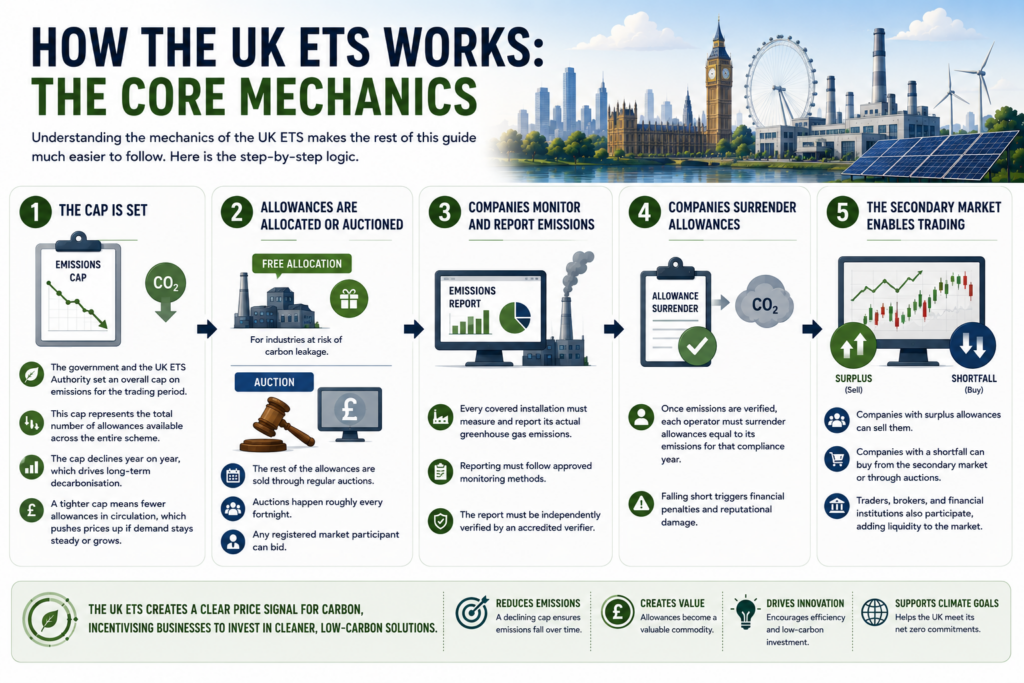
Step 1: The Cap Is Set
The government and the UK ETS Authority set an overall cap on emissions for the trading period. This cap represents the total number of allowances available across the entire scheme.
The cap declines year on year, which is what drives long-term decarbonisation. A tighter cap means fewer allowances in circulation, which naturally pushes prices up if demand for allowances stays steady or grows.
Step 2: Allowances Are Allocated or Auctioned
Some allowances are given to industries for free, particularly those at high risk of “carbon leakage,” meaning companies that might otherwise relocate production to countries with weaker climate rules.
The rest of the allowances are sold through regular auctions. Auctions happen roughly every fortnight, and any registered market participant can bid.
Step 3: Companies Monitor and Report Emissions
Every covered installation must measure and report its actual greenhouse gas emissions using approved monitoring methods. This reporting has to be independently verified by an accredited verifier.
Step 4: Companies Surrender Allowances
Once emissions are verified, each operator must surrender allowances equal to its emissions for that compliance year. Falling short triggers financial penalties and reputational damage.
Step 5: The Secondary Market Enables Trading
Companies with surplus allowances can sell them. Companies with a shortfall can buy from the secondary market or through auctions. Traders, brokers, and financial institutions also participate, adding liquidity to the market.
Who Does the UK ETS Cover?
The scheme currently applies to a wide range of sectors, and its scope keeps growing. Here is a simplified breakdown.
| Sector | Coverage Detail |
|---|---|
| Power generation | Installations with a rated thermal input above 20 megawatts |
| Heavy industry | Steel, cement, chemicals, refining, and similar energy-intensive manufacturing |
| Aviation | Domestic UK flights and flights between the UK and the European Economic Area |
| Domestic maritime | Vessels of 5,000 gross tonnage and above operating on domestic routes |
| Waste incineration and energy from waste | Currently in a voluntary monitoring phase ahead of full inclusion |
| Engineered greenhouse gas removals | Planned integration for UK-based removal technologies |
A few notable exclusions and quirks are worth flagging.
- Northern Ireland power generators remain under the EU ETS because of the region’s integrated electricity market with the Republic of Ireland.
- Ultra-small emitters can apply for simplified treatment, reducing their administrative burden.
- Hospital and small emitter exemptions exist for installations below certain emission thresholds.
Understanding UK ETS Allowances (UKAs)
The tradable unit in the scheme is called a UK Allowance, or UKA. One UKA equals the right to emit one tonne of carbon dioxide equivalent.
UKAs are created and distributed through two main channels.
- Free allocation, given to eligible industrial sectors based on historical activity and product-specific benchmarks.
- Auctions, run on a fortnightly basis through ICE Futures Europe, with the Department for Energy Security and Net Zero (website) acting as the appointed auctioneer.
Businesses that need extra allowances beyond their free allocation can buy them at auction or trade on the secondary market. Financial firms and brokers also participate purely for trading purposes, which adds depth and liquidity to the market.
UK ETS Price: What Drives It and Where It Stands
Carbon prices under the UK ETS move based on supply and demand, just like any other traded commodity. Several factors push prices up or down.
Factors that tend to push prices higher:
- A tightening cap that reduces the total number of allowances
- Strong industrial activity and higher fuel combustion
- Colder weather increasing power sector emissions
- Expansion of the scheme to new sectors, increasing demand for allowances
Factors that tend to push prices lower:
- Economic slowdown reducing industrial output
- Faster-than-expected decarbonisation, such as renewable energy growth
- Higher free allocation levels reducing net demand
- Market interventions designed to release additional allowances
The Auction Reserve Price
The scheme includes a minimum bid price at auctions, known as the Auction Reserve Price, or ARP. This floor price ensures allowances never sell for an unreasonably low amount, protecting the long-term integrity of the carbon signal.
The ARP is periodically reviewed and adjusted to keep pace with inflation, which preserves its real value over time rather than letting it erode.
The Cost Containment Mechanism
To prevent extreme price spikes from destabilising the market, the scheme has a built-in safety valve called the Cost Containment Mechanism, or CCM.
The CCM can be triggered when allowance prices rise sharply and stay elevated for a sustained period, typically measured against average prices over the preceding years. When triggered, the authority can intervene through several tools.
| Intervention Tool | What It Does |
|---|---|
| Redistributing auction volumes | Moves allowances between auctions within the current year |
| Bringing forward future supply | Pulls allowances from future years into the present |
| Drawing from the Market Stability Mechanism | Releases reserved allowances into the market |
| Auctioning New Entrants’ Reserve allowances | Sells a portion of allowances set aside for new market entrants |
| Auctioning unallocated industry cap allowances | Releases allowances that were not claimed through free allocation |
Following a public consultation, the authority chose to keep the existing design of the CCM largely unchanged, signalling confidence that the current safety valve works as intended.
UK ETS vs EU ETS: Key Differences
Many businesses operating across borders want to know how the UK scheme compares with its European counterpart. Here is a side-by-side comparison.
| Feature | UK ETS | EU ETS |
|---|---|---|
| Geographic scope | United Kingdom (excluding Northern Ireland power generation) | European Union member states |
| Sector coverage | Power, industry, aviation, domestic maritime, expanding to waste and removals | Power, industry, aviation, maritime (including international voyages) |
| Linking status | Working toward a formal link with the EU | Working toward a formal link with the UK |
| Carbon border mechanism | UK version planned to align timing with EU’s system | Already implemented for select imported goods |
| Governance | UK ETS Authority, jointly run by UK government departments and devolved administrations | European Commission and member state regulators |
A future link between the two systems would be significant. It would allow allowances to be mutually recognised, enable cross-system trading, and support mutual recognition under each side’s carbon border adjustment mechanism. This would reduce compliance costs for companies trading across the UK-EU border and create a more unified carbon price signal across the region.
What Is Changing: Scope Expansion and Scheme Evolution
The UK ETS is not static. The government has confirmed several major expansions and reforms that businesses need to track closely.
Maritime Emissions Are Now Included
Domestic maritime transport has entered the scheme, covering vessels of 5,000 gross tonnage and above operating on UK domestic routes. This mirrors the threshold used by the EU ETS for comparability, though the UK implemented this measure with a longer lead time than the EU.
Operators of qualifying vessels must install monitoring systems, train relevant personnel, and budget for allowance purchases tied to their verified emissions.
Waste Incineration Is Entering a Transition Phase
The waste and energy-from-waste sector is moving through a voluntary monitoring, reporting, and verification phase before full inclusion under the cap. During this phase, operators must measure and report emissions without yet facing financial liability for allowance surrender.
Full compliance obligations, including mandatory allowance surrender, will follow once the transition phase concludes. This includes non-hazardous waste incineration above a defined throughput threshold and hazardous waste incineration above a separate capacity threshold.
Greenhouse Gas Removals Are Being Integrated
The authority has confirmed plans to integrate UK-based engineered carbon removal technologies into the scheme, subject to further legislation and consultation. This would allow verified removal credits, such as those from direct air capture or similar engineered methods, to interact with the compliance market.
This is a notable structural shift. Historically, the scheme has only dealt with emission reductions and avoidance. Bringing removals into the fold recognises that some hard-to-abate sectors will need to rely on actual carbon removal rather than reduction alone.
A Second Trading Phase Has Been Confirmed
The authority has confirmed the scheme will run into a second major phase covering the next decade, following the conclusion of the current trading period. This long-term extension matters enormously for investment decisions.
Heavy industry, power generation, and carbon capture projects typically require long asset lifespans and large upfront capital. Confirming that carbon pricing will remain a permanent feature of the UK’s regulatory landscape gives investors the confidence to commit capital to low-carbon infrastructure, hydrogen production, and carbon capture and storage projects.
A UK Carbon Border Adjustment Mechanism Is Coming
The UK is developing its own carbon border adjustment mechanism, broadly similar in purpose to the EU’s version. The goal is to prevent carbon leakage by applying a carbon cost to certain imported goods that would otherwise avoid the domestic carbon price faced by UK producers.
This mechanism is expected to work alongside free allocation, and over time, free allocation may be reduced as border adjustment measures take on more of the carbon leakage protection role.
How UK ETS Compliance Works: A Practical Walkthrough
If your business is newly covered by the scheme, or you are trying to understand what compliance actually involves, here is a practical step-by-step overview.
- Determine if your installation is covered. Check activity thresholds for combustion, industrial processes, aviation, or maritime operations.
- Register with the UK ETS Registry. This is the official system for holding, transferring, and surrendering allowances.
- Set up a monitoring plan. This plan must be approved by the relevant regulator and describes how you will measure emissions.
- Monitor emissions continuously through the compliance year. Use approved methodologies for fuel combustion, process emissions, or fuel consumption data depending on your sector.
- Get your emissions report verified. An accredited independent verifier must check your data before you submit it.
- Submit your verified emissions report to the regulator by the required deadline.
- Surrender allowances equal to your verified emissions for that year.
- Manage your allowance position throughout the year by buying or selling based on your expected shortfall or surplus.
Missing deadlines or under-surrendering allowances leads to financial penalties, and persistent non-compliance can result in further enforcement action from the regulator.
Free Allocation: How It Protects Competitiveness
Free allocation exists to protect industries that compete internationally against producers who do not face an equivalent carbon price. Without this protection, UK manufacturers could lose business to overseas competitors and simply shift emissions elsewhere, a problem known as carbon leakage.
Free allowances are calculated using product-specific benchmarks, based on the emissions performance of the most efficient installations in each sector. This rewards efficient operators and penalises those still relying on older, more polluting processes.
Over time, and especially as a UK carbon border adjustment mechanism matures, free allocation levels for some sectors may be reduced, since border measures would take over part of the competitiveness protection role.
How Businesses Can Buy and Trade UK Allowances
Companies access the primary and secondary markets for UKAs in a few main ways.
- Auctions, held roughly every fortnight through ICE Futures Europe, open to registered market participants.
- Secondary market trading, where allowances change hands directly between businesses, brokers, and financial institutions.
- Over-the-counter deals, arranged privately, often through brokers who specialise in carbon markets.
To participate in auctions directly, businesses generally need to register with ICE Futures Europe and open an account within the UK ETS Registry to hold and transfer allowances.
Smaller businesses that only need to cover occasional shortfalls often rely on brokers rather than bidding at auction themselves, since brokers can handle smaller trade sizes more efficiently.
Impact of the UK ETS on Businesses
The financial impact varies significantly by sector, but a few themes hold true across the board.
For heavy emitters:
- Rising compliance costs as the cap tightens and free allocation potentially reduces
- Strong financial incentive to invest in energy efficiency and lower-carbon technology
- Growing exposure to carbon price volatility, making hedging strategies increasingly important
For lower emitters and service-based sectors:
- Indirect exposure through higher electricity prices, since power generators pass through some of their carbon costs
- Opportunities in supplying low-carbon products, services, and technologies to covered industries
For investors and financial institutions:
- New opportunities in carbon trading, carbon-linked financial products, and advisory services
- Growing importance of carbon price forecasting in investment decision-making for energy and industrial assets
Impact of the UK ETS on Household Energy Bills
Because power generators are covered by the scheme, some of their carbon costs flow through into wholesale electricity prices, and ultimately into household bills.
That said, carbon pricing is just one factor among many driving energy bills. Wholesale gas prices, network investment costs, supplier operating costs, and broader global energy market conditions typically have a much larger influence on what households pay than the carbon price alone.
It is also worth noting that a tighter carbon price pushes the power sector further toward renewables and low-carbon generation, which over the long run tends to reduce the UK’s exposure to volatile fossil fuel markets.
Criticisms and Challenges Facing the UK ETS
No carbon market is without critics, and the UK ETS faces several recurring debates.
- Price volatility concerns. Some businesses argue that carbon price swings make long-term investment planning difficult, even with the Cost Containment Mechanism in place.
- Carbon leakage risk. Industry groups continue to push for stronger protections until a robust carbon border adjustment mechanism is fully operational.
- Complexity for smaller operators. Monitoring, reporting, and verification requirements can be a significant administrative burden for smaller covered installations.
- Divergence from the EU system. Until a formal link is agreed, differences between UK and EU carbon prices can create competitive distortions for cross-border businesses.
- Pace of scope expansion. Some sectors facing new inclusion, such as waste incineration, argue for longer transition periods to adapt operationally and financially.
The Future of the UK ETS
Looking ahead, several trends are likely to define the next stage of the scheme’s development.
- A tighter cap trajectory, continuing to reduce the total allowances available and pushing long-term carbon prices upward.
- Full inclusion of currently transitional sectors, such as waste incineration moving from voluntary monitoring to mandatory compliance.
- Integration of engineered carbon removals, creating new revenue opportunities for removal technology providers.
- A functioning UK carbon border adjustment mechanism, changing how free allocation and import competitiveness protections interact.
- Progress toward linking with the EU ETS, potentially creating one of the most significant carbon market integrations outside North America.
- Confirmed extension into a second long-term trading phase, giving businesses a clearer multi-decade investment horizon for low-carbon infrastructure.
Together, these changes point toward a scheme that is maturing from a post-Brexit replacement system into a permanent, expanding pillar of UK climate and industrial policy.
Practical Takeaways for Businesses
If your organisation is covered by the UK ETS, or expects to be soon, here are actionable steps worth taking now.
- Audit your emissions exposure. Confirm whether your activities meet inclusion thresholds, including any upcoming sector expansions relevant to your industry.
- Build a carbon price forecasting capability. Understand how cap tightening and scope expansion could affect your future compliance costs.
- Review your free allocation position. Track benchmark updates and consider efficiency investments that improve your allocation relative to peers.
- Develop a hedging strategy. Consider how auction participation, secondary market trades, and forward contracts can manage price risk.
- Prepare early for new sector inclusion. If you operate in maritime, waste, or removals, start monitoring systems well ahead of mandatory compliance deadlines.
- Watch the UK-EU linking negotiations closely. A future link could materially change cross-border compliance strategy and pricing dynamics.
- Invest in decarbonisation technology. Long-term scheme confirmation makes low-carbon capital investment a safer long-term bet than in the scheme’s earlier years.
Frequently Asked Questions
What does UK ETS stand for?
UK ETS stands for the UK Emissions Trading Scheme, the country’s cap-and-trade carbon market covering major polluting sectors.
Who has to comply with the UK ETS?
Power generators, heavy industry, aviation operators, and domestic maritime operators above defined emission and size thresholds must comply, along with sectors moving through transition phases such as waste incineration.
How is the UK ETS different from a carbon tax?
A carbon tax sets a fixed price per tonne of emissions. The UK ETS instead sets a fixed limit on total emissions and lets the market determine price through allowance trading, based on supply and demand.
Is the UK ETS linked to the EU ETS?
Not yet. The UK and EU are working toward a formal link that would allow mutual recognition of allowances and cross-system trading, but this has not been finalised.
What happens if a company does not surrender enough allowances?
The company faces financial penalties and is still required to make up the shortfall in allowances, alongside potential reputational and regulatory consequences.
Does the UK ETS affect household energy bills?
It has some indirect effect through electricity generation costs, but wholesale gas prices, network costs, and global energy market conditions typically play a much larger role in household bills.
Can individuals trade UK ETS allowances?
The market is designed primarily for compliance entities, financial institutions, and brokers. Individual retail trading is not the typical route, though interested investors can gain indirect exposure through carbon-focused financial products.
Will the UK ETS cover more sectors in the future?
Yes. Maritime transport has already joined, waste incineration is moving through a transition phase, and engineered carbon removals are planned for future integration.
Conclusion
The UK Emissions Trading Scheme has grown from a post-Brexit necessity into one of the most important tools shaping the UK’s path to a low-carbon economy. By putting a real financial cost on carbon emissions, the UK ETS pushes power generators, heavy industry, aviation, and now maritime operators to cut emissions faster while rewarding those who innovate.
Understanding how the UK ETS works, from cap setting and allowance allocation to auctions and compliance, is essential for any business operating in a covered sector. With scope expansion, a confirmed long-term second phase, and progress toward linking with the EU ETS, the scheme is only becoming more central to UK industrial strategy.
For businesses, staying ahead of UK ETS obligations is no longer optional. It is a core part of long-term financial planning, competitiveness, and climate responsibility in the modern UK economy.
If you want to keep learning about carbon markets, ESG strategy, and sustainability trends, explore more resources on Carbon Market Network.