Carbon Market Network


If you have ever wondered how the UK puts a price on carbon, you have landed in the right place.
The UK Emissions Trading Scheme, better known as the UK ETS, is the country’s main carbon pricing tool. It forces the biggest polluters to pay for the greenhouse gases they release.
This guide breaks down exactly how UK ETS works, in plain English. No jargon overload, no confusing policy speak.
Whether you run a business that falls under the scheme, invest in carbon markets, or simply want to understand UK climate policy, this article covers everything you need.
By the end, you will understand the cap, the trade, the auctions, the penalties, and where the scheme is headed next.
Let’s get started.
What Is the UK ETS?
The UK ETS stands for the United Kingdom Emissions Trading Scheme. It is a carbon pricing system built on the classic cap and trade model.
Here is the simple version. The government sets a limit, or cap, on the total amount of carbon dioxide and other greenhouse gases that certain industries can emit.
Companies covered by the scheme receive or buy allowances. Each allowance permits the holder to emit one tonne of carbon dioxide equivalent.
At the end of every compliance year, each company must hand back enough allowances to match its actual emissions. If a company pollutes more than it has allowances for, it faces steep penalties.
If a company pollutes less than its allowance total, it can sell the spare allowances to other companies. This is where the “trade” part of cap and trade comes in.
The scheme replaced the UK’s participation in the EU Emissions Trading System (website) after the UK left the European Union. It launched in the power, industry, and aviation sectors, and has been expanding ever since.
Carbon Market Insider Newsletter
Weekly insights on carbon markets, climate policy, carbon credits, and sustainability.
Why Does the UK Need Its Own ETS?
Before its departure from the EU, the UK operated as part of the EU ETS, the world’s first major carbon market.
Once the UK left the EU single market, it needed its own domestic mechanism to keep pricing carbon for heavy industry, power generation, and aviation.
The UK ETS was designed to mirror many EU ETS principles while giving the UK government full control over its own cap, price floor, and sector coverage.
This independence lets the UK set climate ambition in line with its own legal net zero target, rather than following EU-wide decisions.
A Brief History of the UK ETS
The UK spent close to two decades pricing carbon as part of the EU Emissions Trading System, one of the world’s largest and longest running carbon markets.
Once the UK left the EU single market, continuing inside the EU scheme was no longer straightforward. Policymakers needed a domestic replacement that could launch quickly and keep the country’s heavy industry and power sector under a carbon price.
The result was a standalone UK scheme, built using much of the same architecture as its EU predecessor but tailored to UK specific policy goals and legal commitments.
Since launch, the scheme has steadily grown more ambitious. Free allocation has been trimmed back, new sectors have joined the coverage list, and the cap trajectory has been tightened to keep pace with the UK’s climate targets.
This evolution is not accidental. Cap and trade schemes are designed to be reviewed and adjusted regularly, so that the mechanism keeps matching the latest scientific and economic understanding of what net zero actually requires.
How the Scheme Fits Into the Wider UK Climate Framework
The UK ETS does not operate as a stand-alone policy. It sits within a much broader legal architecture built around the country’s climate change legislation.
Carbon budgets set out in law define the maximum emissions allowed across the whole economy over successive periods. The UK ETS cap for covered sectors is deliberately calibrated to stay consistent with these wider carbon budgets.
This means the scheme is not just an isolated trading mechanism. It is one lever, arguably the most powerful market-based lever, inside a coordinated national strategy that also includes regulation, subsidies for clean technology, and direct government investment in low-carbon infrastructure.
How Does UK ETS Work? The Core Mechanics Explained
Understanding how UK ETS works comes down to four building blocks: the cap, the allowances, the trading, and the compliance cycle.
Let’s walk through each one step by step.
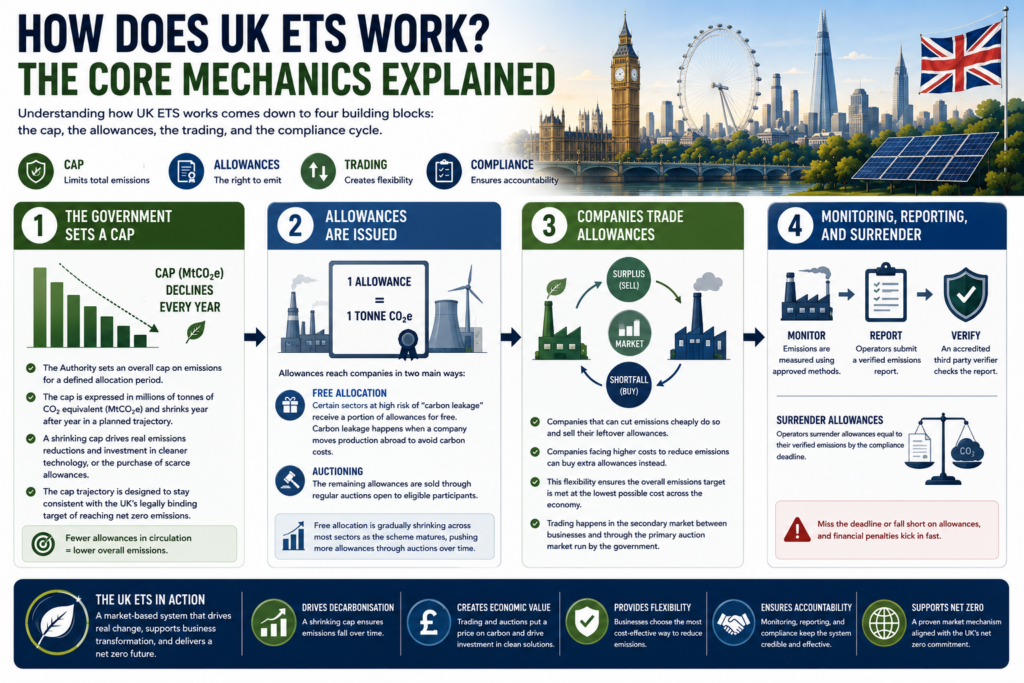
Step 1: The Government Sets a Cap
The Authority responsible for running the scheme sets an overall cap on emissions for a defined allocation period.
This cap is expressed in millions of tonnes of carbon dioxide equivalent (MtCO2e). It shrinks year after year in a planned trajectory.
A shrinking cap is the entire point of the system. Fewer allowances in circulation means covered industries must gradually cut real emissions, invest in cleaner technology, or buy increasingly scarce allowances.
The cap trajectory is designed to stay consistent with the UK’s legally binding target of reaching net zero greenhouse gas emissions.
Step 2: Allowances Are Issued
Once the cap is set, it gets converted into individual allowances. One allowance equals the right to emit one tonne of CO2 equivalent.
Allowances reach companies in two main ways:
- Free allocation: Certain sectors at high risk of “carbon leakage” receive a portion of allowances for free. Carbon leakage happens when a company moves production abroad to avoid carbon costs, which does nothing to help the planet and simply shifts emissions elsewhere.
- Auctioning: The remaining allowances get sold through regular auctions open to eligible participants.
Free allocation is gradually shrinking across most sectors as the scheme matures, pushing more allowances through the auction route over time.
Step 3: Companies Trade Allowances
This is the “trade” half of cap and trade, and it is what makes the scheme flexible rather than a blunt, one-size-fits-all rule.
Companies that can cut emissions cheaply are encouraged to do so and sell their leftover allowances. Companies that face higher costs to reduce emissions can buy extra allowances instead.
This flexibility means the overall emissions target gets hit at the lowest possible cost across the whole economy, rather than forcing every single company to cut emissions at the same pace regardless of cost.
Trading happens both through a secondary market between businesses and through the primary auction market run on behalf of the government.
Step 4: Monitoring, Reporting, and Surrender
Every covered installation or operator must monitor its emissions using approved methods throughout the scheme year.
At the end of the compliance year, operators submit a verified emissions report, checked by an accredited third party verifier.
Each operator then must surrender allowances equal to its verified emissions by the compliance deadline. This is the moment where the cap becomes real and enforceable.
Miss the deadline or fall short on allowances, and financial penalties kick in fast.
Who Is Covered by the UK ETS?
The scheme applies to organisations that meet specific thresholds across a defined set of sectors. Coverage has expanded gradually since launch and continues to grow.
Here is a snapshot of the sectors currently in scope or being phased in.
| Sector | What It Covers | Status |
|---|---|---|
| Power generation | Electricity generators above capacity thresholds | Fully covered since launch |
| Energy intensive industry | Steel, cement, glass, chemicals, refining, and similar heavy industry | Fully covered since launch |
| Aviation | UK domestic flights and flights to the European Economic Area and Switzerland | Fully covered, free allocation being phased out |
| Domestic maritime | Larger vessels travelling between UK ports | Being phased in |
| Waste and energy from waste | Incineration and waste-to-energy facilities | Being phased in, monitoring first |
| Greenhouse gas removals | Engineered carbon removal technologies | Under active development |
Roughly a thousand industrial and power installations sit inside the scheme, alongside several hundred aircraft operators.
Small and Hospital Emitters Get Some Relief
Not every eligible installation has to fully participate. The scheme recognises that very small emitters and hospitals face disproportionate administrative burden relative to their climate impact.
Two special categories exist:
- Hospital and Small Emitters (HSE): Facilities below a certain emissions threshold, including hospitals meeting specific heat supply criteria, can apply for simplified obligations.
- Ultra Small Emitters (USE): Very low emitting organisations can be excused from full trading and permit requirements, though they must still monitor emissions and notify the regulator if thresholds are exceeded.
These carve-outs keep the scheme proportionate, focusing compliance effort where emissions actually matter most.
The UK ETS Auction Process, Step by Step
Auctions form the beating heart of the primary allowance market. Here is how the process typically unfolds.
- Auction calendar published: The exchange running the auctions on behalf of the government publishes a schedule well in advance, so participants can plan ahead.
- Eligible bidders register: Companies covered by the scheme, along with approved market participants such as investment firms, register to take part.
- Bidding window opens: Auctions run on a set day and time, with a defined bidding window.
- Clearing price determined: All winning bids pay the same clearing price, which is the lowest price at which all available allowances get sold.
- Auction Reserve Price applied: If demand is too weak, a minimum reserve price stops allowances from selling for next to nothing, protecting the integrity of the carbon price signal.
- Allowances delivered: Successful bidders receive allowances directly into their registry accounts shortly after the auction closes.
Auctions happen on a regular biweekly schedule, giving the market predictable, frequent opportunities to buy allowances rather than relying only on scarce free allocation.
What Is the Auction Reserve Price?
The Auction Reserve Price, often shortened to ARP, sets a floor beneath which allowances cannot be sold at auction.
It exists to prevent a collapse in carbon prices during periods of weak demand, which would blunt the incentive for companies to cut emissions.
The ARP is reviewed periodically and adjusted in line with inflation, keeping the price floor meaningful over time rather than eroding in real terms.
The Role of the Registry
Every allowance under the UK ETS exists as a digital entry in an official registry, similar in concept to a bank account but for carbon rather than money.
Each participant, whether a covered installation, an aircraft operator, or a financial market participant, needs a registry account before it can hold, buy, sell, or surrender allowances.
The registry performs several critical functions.
- Ownership tracking: It records exactly who holds each allowance at any given moment, preventing double counting or disputes over ownership.
- Transaction settlement: When allowances change hands, whether through auction or secondary trading, the registry updates instantly to reflect the new owner.
- Surrender processing: At compliance time, operators formally surrender allowances through their registry account, which permanently retires those allowances from further use.
- Security and fraud prevention: Strict identity verification and account security requirements protect the integrity of the market, given the real financial value tied to each allowance.
Without a functioning registry, none of the trading flexibility that makes cap and trade work would be possible. It is the quiet infrastructure layer that keeps the entire market honest and enforceable.
What Is the Cost Containment Mechanism?
Carbon markets can swing in the other direction too, with prices spiking sharply due to sudden demand or supply shocks.
To guard against runaway prices, the scheme includes a Cost Containment Mechanism (CCM). If average allowance prices stay above a defined trigger level for a sustained period, the Authority can intervene.
Intervention options typically include releasing additional allowances into the market or bringing forward future auction volumes.
Think of the CCM as a relief valve. It does not remove the cap altogether, but it stops short-term volatility from causing chaotic price spikes that could damage business confidence in the scheme.
UK ETS Price: What Determines It?
Unlike a carbon tax, the UK ETS does not set a fixed price on carbon. Instead, the price emerges from supply and demand in the market.
Several factors push the price up or down:
- Cap tightness: A shrinking cap generally supports higher prices over time, since fewer allowances chase the same or growing demand.
- Industrial activity: Higher output from covered sectors increases demand for allowances.
- Fuel prices: Gas and electricity prices influence which power sources get used, affecting emissions and allowance demand.
- Policy announcements: News about free allocation changes, new sectors joining, or linkage with other carbon markets can move sentiment quickly.
- Weather and seasonal demand: Cold winters or hot summers affect power generation patterns and therefore emissions.
Because the price floats, it acts as a genuine market signal rather than an administratively fixed number, which is one of the defining features that separates cap and trade schemes from a straightforward carbon tax.
UK ETS vs Carbon Tax: What Is the Difference?
People often confuse cap and trade schemes with carbon taxes, but the two work quite differently.
| Feature | UK ETS (Cap and Trade) | Carbon Tax |
|---|---|---|
| Emissions outcome | Fixed by the cap, guaranteed | Uncertain, depends on behaviour |
| Price outcome | Variable, set by the market | Fixed by government |
| Flexibility | High, allowances can be traded | Low, tax rate applies uniformly |
| Administrative complexity | Higher, requires registries and auctions | Lower, collected like other taxes |
| Investment certainty | Price can fluctuate | Price is predictable |
Cap and trade guarantees the environmental outcome because the total number of allowances is fixed. A carbon tax guarantees price certainty but leaves the emissions outcome open to guesswork.
The UK deliberately chose the cap and trade route to lock in a specific, science aligned emissions trajectory rather than hope a fixed tax rate produces the right result.
How the UK ETS Links to Global Carbon Markets
The UK ETS does not operate in total isolation. Policymakers have actively explored connections with other carbon markets, most notably the EU ETS.
A link between the UK and EU systems would let allowances flow between both markets, effectively merging liquidity and price discovery across a much larger carbon market.
Discussions between UK and EU officials have progressed toward formal linkage, which would be one of the most significant developments in European carbon markets in years.
The UK is also examining how its aviation coverage should interact with the international aviation offsetting scheme run through the International Civil Aviation Organization, ensuring airlines are not double regulated for the same flights.
The UK Carbon Border Adjustment Mechanism (CBAM)
A carbon price only works fairly if it applies evenly. Without safeguards, companies could simply import carbon-intensive goods from countries with no carbon price, undermining UK industry and achieving nothing for the climate.
To address this, the UK is introducing its own Carbon Border Adjustment Mechanism. This places an equivalent carbon cost on certain imported goods from carbon-intensive sectors, levelling the playing field between domestic and imported products.
The rollout of the CBAM is being carefully timed alongside changes to free allocation rules, so that domestic industry protection from carbon leakage shifts smoothly from free allowances toward border adjustment.
What Happens If a Company Does Not Comply?
The UK ETS carries real teeth. Non-compliance is not a paperwork slap on the wrist.
Common consequences include:
- Civil penalties: Fixed financial penalties per tonne of unaccounted emissions, often set well above the prevailing market price to remove any incentive to simply skip compliance.
- Public disclosure: Non-compliant operators can be named, creating reputational risk alongside financial risk.
- Continued liability: Outstanding allowances remain owed even after a penalty is paid. Companies cannot simply pay a fine and walk away from their obligation.
- Operational restrictions: In serious or repeated cases, regulators can restrict or suspend an operator’s permit to run their installation.
These penalties exist to make compliance always the cheaper, safer option compared with under-reporting or ignoring obligations altogether.
Practical Steps for Businesses Covered by the UK ETS
If your organisation falls under the scheme, here is a practical action checklist.
- Confirm your obligation: Check installation thresholds and activity types against current scheme guidance to see if you are in scope.
- Set up a monitoring plan: Establish an approved methodology for tracking emissions data throughout the year.
- Appoint a verifier: Engage an accredited third party verifier ahead of your reporting deadline, since verifier capacity can get tight close to deadlines.
- Open a registry account: Register with the appropriate national registry to hold, buy, and surrender allowances.
- Plan your allowance strategy: Decide whether to rely on free allocation, participate in auctions, buy on the secondary market, or use a mix of all three.
- Track the auction calendar: Build your allowance purchasing around the published auction schedule rather than scrambling near your deadline.
- Monitor price trends: Keep an eye on market pricing so you are not caught out by sudden cost increases before a compliance deadline.
- Prepare for sector-specific changes: If you operate in aviation, maritime, or waste, track upcoming scope changes closely since obligations are actively evolving in these sectors.
Getting ahead of these steps avoids last-minute compliance scrambles and keeps carbon costs predictable inside your wider financial planning.
Real World Example: How a Manufacturer Might Experience UK ETS
Picture a mid-sized steel manufacturer covered by the scheme.
At the start of the year, the manufacturer receives a portion of free allowances based on historic benchmarks for the sector, reflecting its exposure to international competition.
Throughout the year, the manufacturer monitors its emissions using an approved methodology, tracking fuel use and production output.
Midway through the year, an unplanned equipment upgrade actually reduces emissions intensity, meaning the manufacturer ends up with slightly more allowances than it needs.
Rather than let the spare allowances sit unused, the manufacturer sells them on the secondary market to another company facing a shortfall, generating extra revenue that partly offsets the cost of the equipment upgrade.
At year end, the manufacturer’s independently verified emissions report confirms compliance, and the correct number of allowances is surrendered before the deadline.
This example shows exactly why cap and trade rewards efficiency. Cutting emissions is not just good for the planet, it can directly improve a company’s bottom line.
The Future of the UK ETS
The scheme continues to evolve at a fast pace. Expect ongoing developments across several fronts.
- Expanding sector coverage: Maritime and waste sectors are being phased in, following the earlier addition of aviation.
- Free allocation phase-out: Sectors covered by the new Carbon Border Adjustment Mechanism will see free allowances gradually reduced over roughly a decade.
- Greenhouse gas removals: Work is underway to bring engineered carbon removal activities into the scheme, recognising negative emissions alongside traditional emission reductions.
- Potential EU linkage: A formal link with the EU ETS remains under active negotiation, which would meaningfully deepen liquidity and align pricing across a much larger carbon market.
- Sustainable aviation fuel treatment: Ongoing consultations aim to clarify how emissions savings from sustainable aviation fuel should be recognised within the scheme.
For businesses and investors, staying current with these changes is essential. The direction of travel is consistently toward broader coverage, tighter caps, and reduced reliance on free allowances.
Why the UK ETS Matters for the Wider Economy
Carbon pricing through cap and trade does more than just regulate a handful of industrial sites. It shapes investment decisions across the entire economy.
A credible, rising carbon price nudges capital toward cleaner technology, renewable power, energy efficiency, and low-carbon industrial processes.
It also creates a genuine market for carbon reduction projects and removal technologies, since anyone able to generate verified emissions reductions or removals has a growing pool of buyers who need allowances or credits to meet their obligations.
For the United Kingdom specifically, the scheme forms a central pillar supporting the country’s legally binding net zero commitment, translating a long-term climate target into a working, enforceable, market-based mechanism today.
Key Takeaways
- The UK ETS is a cap and trade scheme that limits total emissions from covered sectors and lets companies trade allowances.
- The cap shrinks over time, forcing real emissions reductions in line with the UK’s net zero target.
- Allowances reach the market through free allocation and regular auctions, with free allocation shrinking over time.
- An Auction Reserve Price and a Cost Containment Mechanism keep prices from crashing or spiking uncontrollably.
- Coverage is expanding beyond power, industry, and aviation into maritime, waste, and carbon removals.
- Non-compliance carries serious financial and operational penalties, making genuine compliance the sensible business choice.
- Potential linkage with the EU ETS and the new UK carbon border mechanism will shape the scheme’s next chapter.
Frequently Asked Questions About the UK ETS
What does UK ETS stand for?
UK ETS stands for the United Kingdom Emissions Trading Scheme, the country’s cap and trade system for pricing carbon emissions from major industrial and energy sectors.
How is the UK ETS different from the EU ETS?
The UK ETS only applies within the United Kingdom, while the EU ETS covers the European Economic Area. Both systems share a similar cap and trade design, and discussions are ongoing about formally linking the two markets.
Who has to comply with the UK ETS?
Large power stations, energy intensive industrial installations, and aircraft operators flying UK and certain international routes must comply. Domestic maritime operators and waste facilities are being phased in over time.
How are UK ETS allowance prices set?
Prices are determined by supply and demand in the market through auctions and secondary trading, not fixed by the government. An Auction Reserve Price provides a floor, while a Cost Containment Mechanism can moderate extreme price spikes.
Can small businesses be exempt from the UK ETS?
Yes. Very small emitters and certain hospitals can qualify for simplified treatment under the Hospital and Small Emitter or Ultra Small Emitter categories, though they still need to monitor emissions.
What happens if a company does not surrender enough allowances?
The company faces a civil penalty, remains liable to make up the shortfall, and may face reputational and operational consequences from the regulator.
Will the UK ETS link with the EU ETS?
Formal linkage discussions between UK and EU authorities are ongoing. A link would let allowances be used interchangeably across both markets, increasing liquidity and aligning carbon prices more closely.
Is the UK ETS the same as a carbon tax?
No. A carbon tax fixes the price and lets emissions vary, while the UK ETS fixes total emissions through a cap and lets the price float based on market trading.
Do individuals or households need to worry about the UK ETS?
No. The scheme applies directly only to large installations and operators in covered sectors, not to individual households or consumers, though carbon costs can indirectly influence energy prices over time.
How often do UK ETS allowance auctions take place?
Auctions run on a regular biweekly schedule, giving the market frequent, predictable opportunities to buy allowances rather than relying solely on free allocation or waiting for infrequent sales.
Digging Deeper Into Sector Coverage
Understanding why certain sectors are covered, and how they differ in treatment, helps explain some of the scheme’s more nuanced rules.
Power generation was included from day one because electricity production is heavily concentrated in a relatively small number of large, easily monitored facilities, making it an efficient starting point for carbon pricing.
Energy intensive industry covers sectors like steel, cement, glass, and chemicals. These industries face genuine international competition, which is exactly why free allocation exists here in the first place, cushioning exposure to competitors operating in countries without an equivalent carbon price.
Aviation occupies a unique position. Flights are highly visible, emissions are relatively easy to measure per flight, and the sector has faced growing pressure to decarbonise given the technical difficulty of finding low-carbon alternatives to jet fuel at scale. Free allocation for aviation has been phased out faster than in other sectors, reflecting research suggesting limited carbon leakage risk in this sector.
Domestic maritime brings shipping between UK ports into scope, covering larger vessels above a set gross tonnage threshold. Ships are required to develop monitoring plans and use accredited verifiers, mirroring the approach used for industrial installations.
Waste and energy from waste is one of the newest sectors under consideration, starting with a monitoring-only phase before facilities take on full trading obligations. This phased approach gives operators time to build the necessary data systems before financial obligations kick in.
Each sector’s treatment reflects a careful balancing act between environmental ambition, economic competitiveness, and practical measurement challenges. No two sectors are treated identically, and that is very much by design.
Understanding how UK ETS works puts you ahead of most people trying to make sense of climate policy and carbon markets. The scheme sits at the heart of how the United Kingdom prices carbon, drives industrial decarbonisation, and works toward its net zero future.
As coverage expands and the cap continues to tighten, UK cap and trade will only grow more relevant to businesses, investors, and anyone following the UK’s climate strategy closely.
Keep this guide bookmarked as a reference, and revisit it whenever new UK ETS developments make headlines.
If you want to keep learning about carbon markets, ESG strategy, and sustainability trends, explore more resources on Carbon Market Network.
Great content! Keep up the good work!